
管理学第9版 练习题附答案 3
Chapter 3 Organizational Culture and Environment: The Constraints TRUE/FALSE QUESTIONSTHE MANAGER: OMNIPOTENT OR SYMBOLIC?1.In the symbolic view of management, managers are seen as directly responsible for anorganization’s success or failure.2.The current dominant assumption in management theory suggests that managers areomnipotent.3.The view of managers as omnipotent is consistent with the stereotypical picture of thetake-charge business executive who can overcome any obstacle in carrying out the organization’s objectives.4.The symbolic view of management impact is useful in explaining the high turnoveramong college and professional sports coaches, who can be considered the “managers” of their teams.5.In the omnipotent view of management, much of an organization’s success or failureis due to forces outside management’s control.6.In the symbolic view of management, it is unreasonable to expect managers to have asignificant effect on the organization’s performance.7.In the omnipotent view of management, a manager’s role is to create meaning out ofrandomness, confusion, and ambiguity.THE ORGANIZATION’S CULTURE8.An organizational culture refers to a system of shared meaning.anizational cultures influence how employees behave in an organization.anizational culture is a perception, not reality.11.Presently, there is no method for analyzing or assessing organizational culture.12.Strong cultures have more influence on employees than do weak cultures.13.An increasing body of evidence suggests that strong cultures are associated with highorganizational performance.pensation structures are considered to be a primary dimension of organizationalculture.15.Most organizations have very weak cultures.16.An organization’s founder has little influence on its culture.17.Rituals are repetitive sequences of activities that express and reinforce the key valuesof an organization.anizational stories typically contain a narrative regarding significant events orpeople.19.Employee stock options are one example of a material symbol that might representorganizational culture.20.The link between values and managerial behavior is fairly straightforward. CURRENT ORGANIZATIONAL CULTURE ISSUES FACING MANAGERS21.A strong ethical culture is likely to have a powerful positive influence on employeebehavior.22.Low risk tolerance generally leads to high ethical standards within an organization.panies that allow their employees freedom tend to encourage innovative cultures.24.To encourage a customer-responsive culture, organizations should formalize andenforce strict customer service policies.25.Customer service employees tend to provide better customer service when they arevery clear about their employee roles.26.To increase customer responsiveness, organizations should hire employees who areoutgoing and friendly.THE ENVIRONMENT27.The part of the environment directly related to achievement of an organization’s goalsis the specific environment.28.The general environment refers to environmental factors operating inside anorganization.29.Environmental uncertainty can be divided into two dimensions: degree of trust anddegree of integration.30.Because certainty is a threat to an organization’s effectiveness, managers try tominimize it.31.The term suppliers includes providers of financial and labor inputs.32.Industry conditions are an example of an organization’s general environment.33.Economic conditions are part of the organization’s specific environment. MULTIPLE-CHOICE QUESTIONSFor each of the following choose the answer that most completely answers the question. THE MANAGER: OMNIPOTENT OR SYMBOLIC?34.Which of the following represent the two views of managerial impact on the successor failure of the organization?a.omnipotent and symbolicb.omnipotent and reflectivec.symbolic and interactived.reflective and interactive35.The omnipotent view of management states that ________________.a.the top manager is the only person in chargeb.managers are directly responsible for an organization’s success or failurec.that there is only one boss in the organization, and she or he is responsible fordelegating ordersd.managers have little or no responsibility for an organization’s success or failure36.The __________ view of management is consistent with the stereotypicalpicture of the take-charge business executive who can overcome any obstaclein carrying out the organization’s objectives.a.omnipotentb.symbolicc.functionald.systems37.Which of the following most accurately reflects the symbolic view ofmanagement?a.M anagers are directly responsible for an organization’s success or failure.b.Managers have little or no responsibility for an organization’s success or failure.c.E xternal forces are directly responsible for an organization’s success or failure.d.E mployees are directly responsible for an organization’s success or failure.38.Internal constraints that restrict a manager’s decision options _______________.a.exist within every organizationb.do not exist, as all managers have decision-making discretionc.exist only to the extent that upper management imposes themd.exist only to the extent that followers won’t do as they are told39.The current dominant assumption in management theory suggests _______________.a. a balanced view of managers as symbolic and omnipotentb.an emphasis on the view that managers are symbolicc.an emphasis on the view that managers are omnipotentd.that both the symbolic and omnipotent views are obsolete40.According to the symbolic view, managers have a(n) _____________ effect onsubstantive organizational outcomes.a.neutralb.controllingc.limitedd.unlimited41.Managers may be able to expand their areas of discretion by_______________.a.telling their employees what to dob.changing and influencing their organization’s culture and environmentc.electing new government officials at the federal and state leveld.changing employers and working for a different boss42.The symbolic view of management is based upon the belief that managerssymbolize _________.a.control and influenceb.ambiguity and confusionc.stakeholders’ interestsd.decisions of top management43.In reality, managers are most accurately viewed as _________.a.dominant over an organization’s environmentb.neither helpless nor all powerfulc.powerless to influence an organization’s performanced.ultimately responsible for organizational outcomesTHE ORGANIZATION’S CULTURE44.The culture of an organization is analogous to the _____________ of an individual.a.skillsb.personalityc.motivationd.ability45.All organizational cultures consist of each of the following except _________.a.shared valuesb.principlesc.innovationd.traditionsanizational culture is concerned with how members perceive theorganization, not whether they __________.a.like the organizationb.like their peersc.like their bossesd.like their customers47.Strong cultures _____________.a.are found in organizations with high employee turnoverb.have a minimal influence on employee decision makingc.can be found in all organizations that existd.have a greater influence on employees than do weak cultures48.Employees in organizations with strong cultures _______________.a.are more committed to their organizationsb.are more likely to leave their organizationsc.are more willing to perform illegal activitiesd.are more likely to follow directives from peers49.Which of the following phrases is associated with the definition of organizationalculture?a.individual responseb.shared meaningc.diversity of thoughtd.explicit directions50.Which of the following is not considered to be a dimension of organizational culture?a.attention to detailb.people orientationc.purchasing policiesd.aggressiveness51.Which of the following dimensions of organizational culture is defined as the degreeto which an organization’s actions and decisions emphasize maintaining the status quo?a.stabilityb.outcome orientationc.team orientationd.innovation and risk taking52.A company whose managers focus on results, rather than how results are achieved,most likely possesses a high degree of which of the following?a.outcome orientationb.people orientationc.team orientationd.aggressiveness53.Sony Corporation’s focus on product innovation is an example of which of thefollowing dimensions of organizational culture?a.attention to detailb.people orientationc.outcome orientationd.aggressiveness54.Which of the following most accurately reflects the difference between strongcultures and weak cultures?a.Strong cultures tend to encourage employee innovation, while weak cultures donot.b.Weak cultures are found in most organizations, whereas strong cultures arerelatively rare.c.Strong cultures have less of an influence on employee behavior than do weakcultures.pany values are more deeply held and widely shared in strong cultures than inweak cultures.55.Corporate ___________ are repetitive sequences of activities that express andreinforce the values of an organization.nguagesb.ritualsc.symbolsd.ceremonies56. Which of the following represents the most significant ways through whichcorporate cultures are transmitted to employees?a.rituals, myths, competitions, and languageb.symbols, rituals, language, and business systemsc.stories, rituals, symbols, and languagenguage, stories, rituals, and rewards57.When employees at Microsoft use terms such as work judo, eating your owndog food, and flat food, they are using organizational __________.nguagesb.ritualsc.symbolsd.ceremonies58.Most organizations have ____________ cultures.a.very weakb.weak to moderatec.moderated.moderate to strong59.The original source of an organization’s culture usually ________________.a.is shared among the first workers hired into the organizationb.is formulated by the board of directors when the organization is formedc.identifies what the organization is successful doingd.reflects the vision or mission of the organization’s founderanizational _____________ typically contain narratives about significant eventsor people in the organization.a.storiesb.ritualsc.chartsd.material symbols61.All of the following are mentioned in the textbook as examples of material symbolsexcept ____________.a.employee dress attireb.size of employee officesc.availability of stock optionsd.reserved parking spaces for certain employees62.The link between organizational values and managerial behavior is _____________.ually uncertainb.fairly straightforwardc.often highly complexd.relatively dynamic63.In learning an organization’s specific language, members are displaying their_________________.a.willingness to communicate with the organization’s stockholdersb.confidence that they will soon be promoted to greater responsibilityc.willingness to help preserve the culture of the organizationd.consent to share material symbols with the other members of the organization64.An organization’s culture affects managers by ______________.a.providing them with additional decision-making powerb.restricting them from disciplining certain employeesc.encouraging them to bend or even break company rulesd.establishing what is appropriate and expected behaviorCURRENT ORGANIZATIONAL CULTURE ISSUES FACING MANAGERS65.Which of the following is most likely to have a highly ethical organizational culture?a. a highly aggressive, competitive businessb. a company with high risk tolerancec. a business that focuses strictly on outcomesd. a business with outgoing and friendly employees66.To encourage ethical cultures, managers should _________________.a.enforce strict discipline policiesb.encourage employees to competec.act in their own self-interestd.serve as visible role models67.A company that primarily values a strong sense of purpose throughmeaningful work has a(n) _________________ organizational culture.a.spiritualb.customer-responsivec.ethicald.innovative68.Conscientious employees with good listening skills are highly valuable forbuilding a(n) _________________ organizational culture.a.ethicalb.innovativec.customer-responsived.spiritual69.An innovative organizational culture is characterized by all of the followingcharacteristics except _________________.a.freedomb.conformityc.debatesd.risk taking70.Workplace spirituality has become important in the contemporary workplacebecause it helps to _________________.a.reduce unemployment ratesb.boost company profitsc.restore a sense of communityd.bring religion into business71.Which of the following is most characteristic of an organization with a strongspiritual culture?a.Employees are encouraged to express themselves.b.Such companies experience high employee turnover.c.Employees are rewarded for innovation and risk taking.d.Employees are required to join organized religions.72.Which of the following best characterizes the relationship between spiritualityand business profitability?a.Evidence shows that spirituality and business profitability are incompatible.b.Limited evidence suggests that spirituality may be compatible with profitability.c.Research shows that workplace spirituality constrains employee performance.d.High productivity has been extensively documented in spiritual workplaces.THE ENVIRONMENT73.External environment refers to _________________.a.forces outside the organization that limit the organization’s performanceb.factors and forces outside the organization that affect the organization’sperformancec.forces and institutions inside the organization that affect the organization’sperformanced.forces inside the organization that increase the organization’s performance74.According to the textbook, the _______________ environment includes thoseconstituencies that have a direct and immediate impact on managers’ decisions and actions and are directly relevant to the achievement of the organization’s goals.a.generalb.specificc.secondaryd.forward75.An organization’s specific environment ________________.a.is unique and changes with conditionsb.is the same regardless of the organization’s agec.is determined by the top level of managementd.must be quantified to establish its existence76.The main forces that make up an organization’s specific environment are__________.a.suppliers, legislators, customers, and employeesb.customers, suppliers, competitors, and pressure groupsc.employees, competitors, pressure groups, and regulatorsd.suppliers, employees, competitors, and legislatorsanizations exist to meet the needs of which of the following constituencies?a.customersb.legislatorsc.supplierspetitors78.When you think of an organization’s suppliers, you ________________.a.know that they are the main customers of the organizationb.typically think of governments that pass the laws the organization must followc.know that they are located close to the organization itselfd.typically think in terms of organizations that provide materials and equipment79.Managers seek to ensure a steady __________________.a.cash flow from stockholders into the organizationb.flow of needed inputs at the lowest price availablec.flow of customers at the company’s outlet stored.flow of suppliers to keep the competition among suppliers at a peak80.Each of the following is considered an organizational supplier exceptproviders of __________________.a.financial inputsbor inputsc.materialsd.political pressure81.The Internet is having an impact on determining whom an organization’scompetitors are because it has _____________.a.defined the common markets for organizationsb.made certain products invaluable to customerc.virtually eliminated the need for shopping mallsd.virtually eliminated geographic boundaries82.For a company such as Walt Disney World in Florida, a bank would be an example ofwhat kind of factor in their specific environment?petitorc.special-interest groupernment agency83.Which of the following is not an example of a specific environmental factor?a.population demographicsb.political conditionsc.federal lawsd.all of the above84.For organizations such as hospitals, which hire nurses, the labor union and the locallabor market are examples of which of the following specific environmental factors?petitor and supplierb.customer and pressure groupc.both are examples of suppliersd.both are examples of pressure groups85.Typically, the specific organizational environment includes which of the following?a.economic factorsb.political conditionsc.technological factorspetitors86.United Parcel Service represents which of the following to the U.S. Postal Service?petitorb.supplierc.customerernment agency87.The general environment factor of economic conditions consists of all of thefollowing except _______________.a.legislation recently passed by Congressb.interest ratesc.changes in disposable incomed.stock market fluctuations88.Sociocultural conditions consist of _______________.a.demographic profiles of an organization’s suppliersb.legal issues as determined by court decisionsc.the level of unemployment and real economic incomes of workersd.changing expectations and values within society89.To a national broadcast network such as NBC, your home DVD player is considered a_____________.a.customerc.special-interest grouppetitor90.Groups such as Mothers Against Drunk Driving (MADD) are examples of what factorin the specific external environment?petitorsb.pressure groupsc.customersernment agencies91.Typically, the general organizational environment includes which of the following?a.political conditionsb.business plansc.stakeholdersd.supplierspared to the specific environment, which of the following is an accuratestatement about the general environment of an organization?a.It has less impact on the organization’s operations.b.It has more impact on the organization’s operations.c.It has about the same impact on an organization’s operations.d.It is predominantly the concern of upper management.93.Which of the following is not a component of an organization’s general environment?a.economic conditionsb.political conditionsc.social conditionsd.industry conditions94.Interest rates, inflation rates, and stock market fluctuations are all examples of whatfactor in an organization’s general environment?a.economicb.politicalc.sociald.technological95.The Americans with Disabilities Act of 1990 is an example of a __________.a.sociolegal conditionb.political/legal conditionc.political/sociological conditiond.sociocultural condition96.A decrease in contributions from the public to the United Way charity is most likelythe result of which of the following general environmental factors?b.socialc.technologicald.economic97.Which of the following groups includes individuals who were born between the years1946–1964?a.the Depression groupb.the World War II groupc.the baby boomersd.Generation X98.The members of which of the following groups are behaving in fundamentallydifferent ways that are likely to greatly impact organizations and managers?a.the Depression groupb.the World War II groupc.the baby boomersd.Generation Y99.Automation represents an example of a(n) __________ general environmentalfactor.a.technologicalb.demographicc.political/legald.economic100.Which of the following has been the most rapidly changing component in an organization’s general environment?a.globalb.economicc.sociald.technological101.Which of the following best represents a global general environmental factor?a.increased surveillancecation levelsc.electronic meetingsd.international markets102.Which of the following are the two dimensions of environmental uncertainty?a.degree of change and degree of complexityb.degree of change and degree of volumec.degree of complexity and degree of impactd.degree of impact and degree of timing103.If the components of an organization’s environment change frequently, the organization is operating in a __________ environment.a.disruptiveb.diversec.dynamicd.difficult104.Managers try to minimize __________ because it threatens organizational effectiveness.a.product developmentb.uncertaintyc.price chargesd.the number of suppliers105.__________ are any constituencies in an organization’s external environment that are affected by the organization’s decisions and actions.a.Stockholdersb.Pressure groupsc.Suppliersd.Stakeholders106.Degree of _______________ refers to the number of components in an organization’s environment and the extent of the knowledge that the organization has about those components.a.stabilityb.opennessplexityd.transition107.The first step of managing external stakeholder relationships is to identify whom the stakeholders are. The second step is to _________________.a.determine what specific approach should be used to manage the stakeholderrelationshipb.determine what the courts might do when stakeholder files a claim against theorganizationc.determine what particular interests or concerns these stakeholders might haved.determine how many stakeholders there are in each stakeholder group SCENARIOS AND QUESTIONSFor each of the following, choose the answer that most completely answers the question. THE MANAGER: OMNIPOTENT OR SYMBOLIC?Apex Construction has hired Wendell Phillips to provide management consulting for the organization. Wendell’s first assignment involves helping the company to improve productivity by recommending ways to strengthen managers’ supervisory skills.108.Wendell n otices that the company’s top executives share a belief that managers are directly responsible for the organization’s success or failure. This belief reflects a(n) ______________ view of management.a.traditionalb.omnipotentc.standardd.symbolic109.Wendell interviews many middle-level managers and discovers that they share a different view of management. These individuals believe that external factors constrain managers’ influence over outcomes. The mid-level managers have a _____________ view of management.a.traditionalb.omnipotentc.standardd.symbolicTHE ORGANIZATION’S CULTURECorporate Takeover (Scenario)Todd works for SeaLan Tech, an environmental consulting firm that has just been purchased by Zerex, Inc., a biomedical research organization. Based on his early encounters with the new upper management from Zerex, Todd feels that SeaLan is a “lower-key, fr iendlier” organization. He is concerned that the ne w company will eliminate SeaLan’s old culture, and he does not like the prospects.110.If you were talking with Todd and asked him what the term culture meant, he would reply that, basically, it is _________________.a.the formal rules of an organizationb.the nationality of the workers in the companyc. a system of shared meaningd. a system that reflects diversity and respect for differences111.Todd is concerned with the degree to which managers focus on results or outcomes rather than techniques and the processes used to achieve those outcomes.He is concerned with _____________.a.stabilityb.aggressivenessc.team orientationd.outcome orientation112.Todd notices that management is very concerned with the effects of outcomes on people within the organization. This is referred to as _____________.a.stabilityb.aggressivenessc.team orientationd.people orientation113.Todd is assessing the organization’s _____________, the degree to which organizational activities emphasize maintaining the status quo in contrast to growth.a.stabilityb.aggressivenessc.team orientationd.outcome orientation114.Todd has been learning the seven dimensions of organizational culture. Which of the following is not one of those seven dimensions?a.stabilityb.aggressivenessc.member orientationd.outcome orientationChanging Organizational Culture (Scenario)Mary has been asked by the company president to change the organizational culture to reflect the company’s new organizational goals. As executive vice president, she certainly understands the goals, but is really not sure that she understands what to do about the culture.115.Mary asked employees if they knew what constituted “good employee behavior.”She found that very few understood, and most had a variety of ideas. This is one indication that her company _______________.a.has a strong cultureb.has a weak culturec.has no cultured.must have high turnover116.Mary also found out that in order to build a strong new culture, she should do all but which of the following?a.hire employees who fit in with the company’s cultureb.develop socialization practices to build culturec.encourage a high turnover rate among employeesd.have management make organizational values clear117.Mary was surprised to find that most organizational cultures are ____________.a.weakb.weak to moderatec.moderate to strongd.strongTHE ENVIRONMENTEnvironmental Constraints (Scenario)It is safe to say that managers do not have complete control over organizational outcomes; the environment has a significant impact. However, there are different environmental factors that shape a manager’s work life.118.As a manager, if you were working in an industry that was dependent on rapidly changing software technologies, with many new companies competing for the same customers, you would be working in what kind of environment?a.generalb.staticc.stabled.dynamic119.Political conditions, which include attitudes that officials hold toward specific industries, fall within an organization’s _____________ environment.a.globalb.internalpetitived.generalThe Election (Scenario)At the present time, your organization is faced with many changes. One of these is the election of a new president and Congress. Another concerns new requests from customers for changes to the look of your product design. A third involves changes in the ages and education levels of your customer base. Your customers have also recently expressed a desire to have your product manufactured using a newly discovered type of plastic. 120.The changes in the presidency and Congress represent which of the following environmental factors for your organization?a.general environmentb.specific environmentc.pressure groupd.customers。
管理学第9版练习题附答案

管理学第9版练习题附答案Chapter 6 Decision Making: The Essence of the Manager’s JobTRUE/FALSE QUESTIONSTHE DECISION-MAKING PROCESS1.Problem identification is purely objective.2.The second step in the decision-making process is identifying a problem.3. A decision criterion defines what is relevant in a decision.4.The fourth step of the decision-making process requires the decision maker tolist viable alternatives that could resolve the problem.5.Once the alternatives have been identified, a decision maker must analyze eachone.6.The step in the decision-making process that involves choosing a best alternativeis termed implementation.THE MANAGER AS DECISION MAKER7.Making decisions is with the essence of management.8.Managerial decision making is assumed to be rational.9.One assumption of rationality is that we cannot know all of the alternatives.10.Managers tend to operate under assumptions of bounded rationality.11.Studies of the events leading up to the Challenger space shuttle disaster pointto an escalation of commitment by decision makers.12. Managers regularly use their intuition in decision making.13.Rational analysis and intuitive decision making are complementary.14.Programmed decisions tend to be repetitive and routine.15.Rules and policies are basically the same.16.A policy is an explicit statement that tells a manager what he or she ought orought not to do.17.The solution to nonprogrammed decision making relies on procedures, rules, andpolicies.18.Most managerial decisions in the real world are fully nonprogrammed.19.The ideal situation for making decisions is low risk.20.Risk is the condition in which the decision maker is able to estimate thelikelihood of certain outcomes.21.Risk is a situation in which a decision maker has neither certainty norreasonable probability estimates.22.People who have a low tolerance for ambiguity and are rational in their way ofthinking are said to have a directive style.23.Decision makers with an analytic style have a much lower tolerance for ambiguitythan do directive types.24.Individuals with a conceptual style tend to be very broad in their outlook andwill look at many alternatives.25. Behavioral-style decision makers work well with others.26.Most managers have characteristics of analytic decisionmakers.27.According to the boxed feature, “Managing Workforce Diversity,” diverseemployees tend to make decisions faster than a homogeneous group of employees.28.The anchoring effect describes when decision makers fixate on initial informationas a starting point and then, once set, they fail to adequately adjust for subsequent information.29.The availability bias describes when decision makers try to create meaning out ofrandom events.30. The sunk cost error is when decision makers forget that current choices cannotcorrect the past.DECISION MAKING FOR T ODAY’S WORLD31.Today’s business world revolves around making decisions, usually with completeor adequate information, and under minimal time pressure.32.Managers need to understand cultural differences to make effective decisions intoday’s fast-moving world.33.According to the boxed feature, “Focus on Leadership,” when identifyingproblems, managers might be from a culture that is focused on problem solving, or their culture might be one of situation acceptance.34.According to the boxed feature, “Focus on Leadership,” findings from studies byGeert Hofstede and from GLOBE researchers show that inhigh uncertainty avoidance countries, decision making tends to be based more on intuition than on formal analysis.35.Highly reliable organizations (HROs) are easily tricked by their success.MULTIPLE-CHOICE QUESTIONSFor each of the following choose the answer that most completely answers the question.THE DECISION-MAKING PROCESS36.Decision making is typically described as ________________, which is a view thatis too simplistic.a.deciding what is correctb.putting preferences on paperc.choosing among alternativesd.processing information to completion37.A series of eight steps that begins with identifying a problem and concludes withevaluating the decision’s effectiveness i s the ________________.a.decision-making processb.managerial processc.maximin styled.bounded rationality approach38.________________ is the existence of a discrepancy between an existing and adesired state of affairs.a.An opportunityb. A solutionc. A weaknessd. A problem39.In identifying the problem, a manager _________________./doc/d417811801.html,pares the current state of affairs with where they would like to beb.expects problems to be defined by neon lightsc.looks for discrepancies that can be postponedd.will not act when there is pressure to make a decision40.Which of the following statements is true concerning problem identification?a.Problems are generally obvious.b. A symptom and a problem are basically the same.c.Well-trained managers generally agree on what is considered a problem.d.The problem must be such that it exerts some type of pressure on the managerto act.41. What is the second step in the decision-making process?a.identifying decision criteriab.allocating weights to the criteriac.analyzing alternativesd.identifying a problem42.To determine the _____________, a manager must determine what is relevant orimportant to resolving the problem.a.geocentric behavior neededb.number of allowable alternativesc.weighting of decision criteriad.decision criteria43.What is the third step in the decision-making process?a.allocating weights to the criteriab.analyzing the alternativesd.implementing the alternative44.If all criteria in the decision making are equal, weighting the criteria______________.a.improves decision making when large numbers of criteria are involvedb.is not neededc.produces excellent decisionsd.improves the criteria45.In allocating weights to the decision criteria, which of the following is helpfulto remember?a.All weights must be the same.b.The total of the weights should sum to .c.Every factor criterion considered, regardless of its importance, must receivesome weighting.d.Assign the most important criterion a score, and then assign weights againstthat standard.46.What is the step where a decision maker wants to be creative in coming up withpossible alternative?a.allocating weights to the criteriab.analyzing alternativesc.developing alternativesd.identifying decision criteria47. When analyzing alternatives, what becomes evident?a.the strengths and weaknesses of each alternativec.the list of alternativesd.the problem48.When developing alternatives in the decision-making process, what must a managerdo?a.list alternativesb.evaluate alternativesc.weight alternativesd.implement alternatives49.Selecting an alternative in the decision-making process is accomplished by__________________.a.choosing the alternative with the highest scoreb.choosing the one you like bestc.selecting the alternative that has the lowest priced.selecting the alternative that is the most reliable50.In Step 6 of the decision-making process, each alternative is evaluated byappraising it against the _____________.a.subjective goals of the decision makerb.criteriac.assessed valuesd.implementation strategy51.______________ includes conveying a decision to those affected and getting theircommitment to it.a.Selecting an alternativeb.Evaluating the decision effectivenessc.Implementing the alternativesd.Analyzing alternatives52.Which of the following is important in effectively implementing the chosenalternative in the decision-making process?a.getting upper-management supportb.double-checking your analysis for potential errorsc.allowing those impacted by the outcome to participate in the processd.ignoring criticism concerning your chosen alternative53. The final step in the decision-making process is to _______________.a.pick the criteria for the next decisionb.reevaluate the weightings of the criteria until they indicate the correctoutcomec.evaluate the outcome of the decisiond.reassign the ratings on the criteria to find different outcomes54.Which of the following is important to remember in evaluating the effectivenessof the decision-making process?a.You should ignore criticism concerning the decision-making process.b.You may have to start the whole decision process over.c.You will have to restart the decision-making process if the decision is lessthan 50 percent effective.d.Ninety percent of problems with decision making occur in the implementationstep.THE MANAGER AS DECISION MAKER55.Managers are assumed to be ______________; they make consistent, value-maximizingchoices within specified constraints.a.rationalb.leaders/doc/d417811801.html,anizedd.satisficers56.It is assumed that a perfectly rational decision maker ______________.a.does not follow rational assumptionsb.does not consider value maximizing as an objectivec.offers inconsistent decisionsd.would be objective and logical57.Managers can make rational decisions if _________________.a.the problem is ambiguousb.the goals are unclearc.the alternatives are limitedd.time constraints exist58. Which of the following is not a valid assumption about rationality?a.The problem is clear and unambiguous.b. A single, well-defined goal is to be achieved.c.Preferences are clear.d.Preferences are constantly changing.59.When managers circumvent the rational decision-making model and find ways tosatisfice, they are following the concept of _________________.a.jurisprudenceb.bounded rationalityc.least-squared exemptionsd.self-motivated decisions60.B ecause managers can’t possibly analyze all information on all alternatives,managers ______________, rather than ______________.a.maximize; satisficeb.maximize; minimizec.satisfice; minimized.satisfice; maximize61.The type of decision making in which the solution is considered “good enough”is known as _________________.a.intuitionb.satisfyingc.maximizingd.satisficing62.When a decision maker chooses an alternative under perfect rationality, she______________ her decision, whereas under bounded rationality she chooses a ______________ decision.a.minimizes; satisficingb.satisfices; maximizingc.maximizes; satisficingd.maximizes; minimizing63. An increased commitment to a previous decision despite evidence that it may havebeen wrong is referred to as _______________.a.economies of commitmentb.escalation of commitmentc.dimensional commitmentd.expansion of commitment64.Intuitive decision making is _______________.a.not utilized in organizationsb. a conscious process based on accumulated judgmentc.making decisions based on experience, feelings, and accumulated judgmentd.important in supporting escalation of commitment65.In studying intuitive decision making, researchers have found that__________________.a.managers do not make decisions based on feelings or emotionsb.managers use data from their subconscious mind to help make their decisionsc.rational thinking always works better than intuitived.accumulated experience does not support intuitive decisions66.All of the following are aspects of intuition except __________________.a.experienced-based decisionsb.affect-initiated decisionsc.cognitive-based decisionsd.programmed decisions67._____________ are straightforward, familiar, and easily defined.a.Unstructured problemsb.Structured problemsc.Unique problemsd.Nonprogrammed problems68.Structured problems align well with which type ofdecision making?a.programmedb.satisficingc.intuitiond.gut feeling69. ______________ decision making is relatively simple and tends to rely heavily onprevious solutions.a.Nonprogrammedb.Linearc.Satisficingd.Programmed70.A procedure _______________.a.is an explicit statement detailing exactly how to deal with a decisionb.is a series of interrelated sequential steps to respond to a structuredproblemc.is a set of guidelines that channel a manager’s thinking in dealing with aproblemd.allows a manager to use broad decision-making authority71.A ______________ is an explicit statement that tells a manager what he or she canor cannot do.a.procedureb.policyc.ruled.solution72.A policy ____________.a.typically contains an ambiguous termb.is used frequently when a manager faces a structured problemc.allows little discretion on the part of the managerd.offers strict rules as to how a problem should be solved73.What is a difference between a policy and a rule?a. A policy establishes parameters.b. A rule establishes parameters.c. A policy is more explicit.d. A rule is more ambiguous.74.A ______________ typically contains an ambiguous term that leaves interpretationup to the decision maker.a.systemb.rulec.solutiond.policy75.A business school’s statement that it “strives for productive relationshipswith local org anizations” is an example of a ________________.a.ruleb.policyc.procedure/doc/d417811801.html,mitment76.Unstructured problems _____________.a.are easily solvedb.present familiar circumstancesc.force managers to deal with incomplete or ambiguous informationd.are routine77.Nonprogrammed decisions are best described as ________________.a.recurring, but difficult to makeb.very similar to problems in other areas of the organizationc.requiring more aggressive action on the decision maker’s thought processesd.unique and nonrecurring78.When problems are ______________, managers must rely on ______________ in orderto develop unique solutions.a.structured; nonprogrammed decision makingb.structured; pure intuitionc.unstructured; nonprogrammed decision makingd.unstructured; programmed decision making79.Lower-level managers typically confront what type of decision making?a.uniqueb.nonroutinec.programmedd.nonprogrammed80.Which of the following is likely to make the most programmed decisions?a.the CEO of PepsiCo.b.the vice president of General Motors Cadillac Division.c.the head of the Minute Maid Division at Coca-Cola.d.the manager of the local McDonald’s.81.______________ is a situation in which a manager can make accurate decisionsbecause the outcome of every alternative is known.a.Certaintyb.Riskc.Uncertaintyd.Maximaxe.Maximin82.If an individual knows the price of three similar cars at different dealerships,he or she is operating under what type of decision-making condition?a.riskb.uncertaintyc.certaintyd.factual83.A retail clothing store manager who estimates how much to order for the currentspring season b ased on last spring’s outcomes is operating under what kind of decision-making condition?a.seasonalb.riskc.uncertaintyd.certainty84.______________ is a situation in which a decision maker has neither certainty norreasonable probability estimates available.a.Certaintyb.Riskc.Uncertaintyd.Maximax85.Nonprogrammed decisions are typically made under a condition of ________________.a.certaintyb.low levels of riskc.uncertaintyd.reliability86. A person at a horse racetrack who bets all of his or her money on the odds-basedlong shot to “win” (rather than “place” or “show”) is making what kind of choice?a.maximaxb.maximinc.minimaxd.minimin87.What best describes the psychological orientation of an individual making a“maximax” choice?a.optimistb.realistc.pessimistd.satisficer88.Optimistic managers could be expected to utilize their maximax orientation whenthey _______________.a.maximize the maximum payoffb.maximize the minimum payoffc.minimize the maximum regretd.minimize the minimum regret89.What is the psychological orientation of a decision maker who makes a “maximin”choice?a.optimistb.realistc.pessimistd.satisficer90.Which of the following best describes “maximizing the minimum possible payoff”?a.maximaxb.maximinc.minimaxd.minimin91.A manager who desires t o minimize his or her maximim “regret” will opt for a______________ choice.a.maximaxb.maximinc.minimaxd.minimin92. Decision makers using what decision-making style make fast decisions and focuson the short run?a.directiveb.behavioralc.analyticd.conceptual93.What types are characterized as careful decision makers with the ability to adaptor cope with unique situations?a.directive decision makersb.behavioral decision makersc.analytic decision makersd.conceptual decision makers94.Who are concerned about the achievements of thosearound them and are receptiveto suggestions from others?a.directive decision makersb.behavioral decision makersc.analytic decision makersd.conceptual decision makers95.Many managers use __________ or rules of thumb to simplify their decision making.a.heuristicsb.biasesc.errorsd.habits96.When decision makers tend to think they know more than they do or holdunrealistically positive views of themselves and their performance, they are exhibiting _______________.a.self-serving biasb.the anchoring effectc.immediate gratification biasd.overconfidence bias97.When decision makers seek out information that reaffirms their past choices anddiscount information that contradicts past judgments, they are exhibiting _______________.a.availability biasb.the anchoring effectc.self-serving biasd.confirmation bias98.When decision makers assess the likelihood of an event based on how closely itresembles other events or sets of events, they are using _______________.a.availability biasb.framing biasc.selective perception biasd.representation bias99.What is the tendency for decision makers to falsely believe that they would haveaccurately predicted the outcome of an event once that outcome is actually known?a.the hindsight biasb.the sunk costs errorc.the randomness biasd.the selective perception biasDECISION MAKING FOR TODAY’S WORLD100.According to the boxed feature, “Focus on Leadership,” when _______________, managers might come from a culture that gathers facts or from a culture that is more intuitive in gathering ideas and possibilities.a.developing alternativesb.implementing alternativesc.searching for informationd.identifying problems101.To make effective d ecisions in today’s fast-moving world, managers need to -_______________./doc/d417811801.html,e the five-stage decision-making processb.know when it is time to call it quitsc.ignore cultural differencesd.identify their style of decision making102.What is a characteristic that the experts say an effective decision-making process has?a.It is inconsistent.b.It acknowledges only objective thinking.c.It focuses on all factors—even those that do not seem important.d.It requires only as much information and analysis as is necessary.103. What term is used by Navy aviators to describe a gut feeling that something isn’t right?a.leemersb.the creepsc.uneasinessd.regret104.Managers of highly reliable organizations (HROs) get the input of _______________ and let them make decisions.a.CEOsb.frontline workersc.customersd.suppliers105.When highly reliable organizations (HROs) face complexity, they -_______________.a.try to simplify datab.aim for deeper understanding of the situationc.defer to the expertsd.act, then thinkSCENARIOS AND QUESTIONSFor each of the following choose the answer that most completely answers the question.THE DECISION-MAKING PROCESSDecisions, Decisions (Scenario)Sond ra needed help. Her insurance company’s rapid growth was necessitating making some changes, but what changes? Should they add to the existing information system or should they buy a new system? She was given the responsibility of analyzing the company’s pr esent information system and deciding what the company should do that would give them plenty of room. She was confused and needed help in making the correct decision.106.According to the decision-making process, the first step Sondra should take is to _____________.a.analyze alternative solutionsb.identify decision criteriac.evaluate her decision’s effectivenessd.identify the problem107. According to the decision-making process, the second step Sondra should take is to ____________.a.analyze alternative solutionsb.identify decision criteriac.evaluate her decision’s effectivenessd.allocate weights to the criteria108.Allocating weights to the criteria is the step in the decision-making process that occurs between identifying the decision criteria and ______________.a.developing the alternativesb.selecting alternativesc.implementing the alternatived.identifying the problem109.When Sondra is conveying her decision to those affected and getting their commitment to it, she is performing which stepin the decision-making process?a.analyzing alternative solutionsb.selecting alternativesc.implementing the alternatived.identifying the problem110.The very last step Sondra should take, according to the decision-making process, is to __________.a.analyze alternative solutionsb.select alternativesc.implement the alternatived.evaluate the decision’s effectivenessThe Car (Scenario)Colleen is a student, and her older brother has loaned her an old car. The car is in need of several repairs before she will feel comfortable driving it.111.Colleen needs a vehicle, but she has to decide if the vehicle is worth repairing. She is facing a(n) _____________, a discrepancy between an existing and a desired state of affairs.a.alternativeb.weighted problem setc.problemd.certainty avoidance situation112.In talking with an automotive repair person, Colleen needs to prioritize the repairs. Her first concern is safety of the vehicle. This step in the decision-making process is called __________________.a.weighting the decision criteriab.analyzing of alternativesc.identifying decision criteriad.selecting an alternativeTHE MANAGER AS DECISION MAKERThe Car (Scenario)Colleen is a student, and her older brother has loaned her an old car. The car is in need of several repairs before she will feel comfortable driving it.113.Colleen decides to have all of the problems fixed on the car. She assumes that the repair person has found all the problems and that there will be no problem correcting the imperfections within a specified budget. This is an example of a __________ decision.a.parochialb.irrationalc.ethicald.rational114.Colleen’s brother has a different view of the repairs. He assumes that the repair person is using the best information available, but there may be other unexpected repairs that might surface and that a higher budget might be more reasonable. He is using ______________.a.rational decision makingb.risk avoidancec.bounded rationalityd.Stage 4 decision making115.Colleen’s brother feels the car is worth repairing because he has owned several cars made by the same manufacturer as this car, and he has driven this car for several years. He is using _________ to determine that the car has value despite its need of repair.a.intuitive decision makingb.selective coordination of thought processesc.sunk costsd.return on investmentThe First Job (Scenario)Upon graduation, you search for a job with the university’s job placement center. Although you have studied and prepared to work in an advertising agency, the first job that you are offered is a supervisor in a manufacturing company working the afternoon shift from 3:00 . until 11:00 .116.If you had made a larger search using the Internet and other employment search processes, you might have been able to find more employment opportunities. This would have been a more _________ decision-making process.a.nonprogrammableb.uncertaind.perfectly rational117.Under bounded rationality, you would be expected to search for a job by ________________.a.looking at all the opportunities that can be analyzed in the time availableb.looking at all the opportunities availablec.looking “outside the box” in your searchd.analyzing all the opportunities until you find the perfect job118.If you use a shortened process of searching for a job, it is likely that you ___________ rather than maximized in your decision process.a.minimizedb.rationalizedc.satisficedd.agreed119.During your job search, you depend on __________ decision making by making your decision based on accumulated judgment and experience.a.experientialb.legalc.intuitived.formidableIs the Picture Clear? (Scenario)Sharon was the regional manager of a large cable television company. She faced many problems and decisions daily, such as how to price each market, who to hire, what kind of technology she should purchase, and how she should handle the increasing customer complaints. She needed some help sorting these issues out.120.When a customer calls and requests a refund for a partial month’s usage of cable, the fact that such situations are routine and most likely have a standard response would make the response a ______________ decision.a.standardb.routinec.policyd.programmed121.Sometimes Sharon follows a ______________, a series of interrelated sequential steps for responding to a structured problem.a.rulec.procedured.suggestion122.Sometimes Sharon instructs her local managers to follow ______________ when confronted with problem situations. Theseestablish parameters for the manager making the decision rather than specifically stating what should or should not be done.a.rulesb.proceduresc.policiesd.orders123.Unfortunately, Sharon also faces issues containing information that is ambiguous or incomplete, such as what kind of technology to purchase. These are known as ______________ problems.a.unstructuredb.variablec.randomd.hit-and-missManaging Your Career (Scenario)Michelle has a new job and is learning to perform the tasks assigned to her. Different situations demand different decision-making processes.124.Michelle finds a situation that instructs her in specific, interrelated, sequential steps to respond to a problem. This is referred to as a _____________.a.ruleb.policyc.broad guidelined.procedure125.Michelle finds a company directive that specifically restricts her from taking certain actions. This is a _____________.a.ruleb.policyc.broad guidelined.procedure。
罗宾斯《管理学》第九版
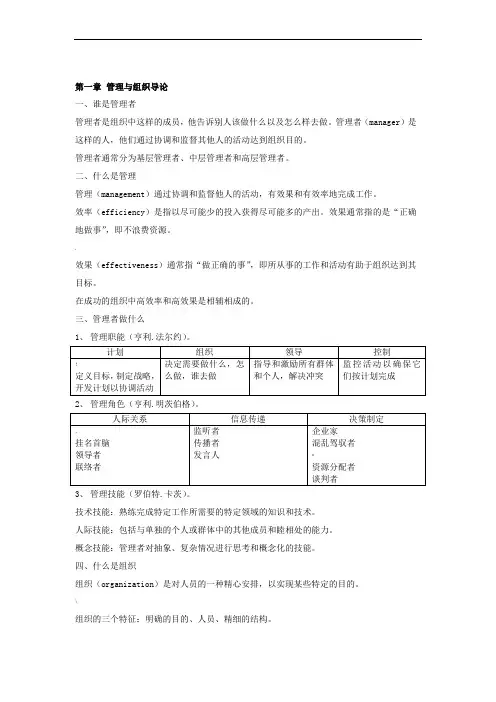
第一章管理与组织导论一、谁是管理者管理者是组织中这样的成员,他告诉别人该做什么以及怎么样去做。
管理者(manager)是这样的人,他们通过协调和监督其他人的活动达到组织目的。
管理者通常分为基层管理者、中层管理者和高层管理者。
二、什么是管理管理(management)通过协调和监督他人的活动,有效果和有效率地完成工作。
效率(efficiency)是指以尽可能少的投入获得尽可能多的产出。
效果通常指的是“正确地做事”,即不浪费资源。
,效果(effectiveness)通常指“做正确的事”,即所从事的工作和活动有助于组织达到其目标。
在成功的组织中高效率和高效果是相辅相成的。
三、管理者做什么1、管理职能(亨利.法尔约)。
2、管理角色(亨利.明茨伯格)。
3、管理技能(罗伯特.卡茨)。
技术技能:熟练完成特定工作所需要的特定领域的知识和技术。
人际技能:包括与单独的个人或群体中的其他成员和睦相处的能力。
概念技能:管理者对抽象、复杂情况进行思考和概念化的技能。
四、什么是组织组织(organization)是对人员的一种精心安排,以实现某些特定的目的。
\组织的三个特征:明确的目的、人员、精细的结构。
现在的组织更倾向于依靠灵活的工作安排、雇员工作团队、开放的沟通系统和供应商联盟。
第二章管理的昨天和今天一、!二、管理的历史背景两个重大事件:1776年,亚当.斯密发表《国富论》主张组织和社会将从劳动分工或工作专业化中获得经济利益。
工业革命,机械力代替了人力。
三、科学管理(1911年泰罗发表《科学管理原理》)四、一般行政管理理论(亨利.法尔约)五、;六、权变理论权变理论强调这样一个事实,因为组织不同,面对的情境不同,所以可能要求不同的管理方式。
七、当前的趋势和问题全球化、道德、劳动力多元化、创业精神(对机会的追求、创新、增长)、在电子领域中进行管理、知识管理和学习型组织、质量管理(TQM)质量管理受到不断改进和响应顾客需求与期望的驱动。
格里芬《管理学》9版自测题与答案

格里芬《管理学》9版自测题与答案1. T F 能够做到生产成本最低地组织就是有效能地组织.2. T F 在控制职能上花费过多时间地管理者可能令组织偏离目标.3. T F 行政经理是不涉及特定管理专业地管理者.4. T F 作为发言人地角色,管理者代表组织对外正式发布信息.5. T F 现代管理已经主要是一门科学而几乎不再是艺术了.6.组织运用下面所有地资源,除了a.人力资源b.政治资源c.财务资源d.信息资源e.实物资源7.吉姆是一位管理者,他最近将人事部和员工培训部合并起来成立人力资源部.吉姆所运用地是下面哪一种职能?a.授权b.质量控制c.领导d.组织e.规划和决策8.人们通常希望管理者能够参加典礼或符号性地活动,例如颁发奖项或主持退休庆祝会.在这些活动中,管理者扮演了哪种角色?a.发言人b.联络者c.精神领袖d.资源配置者e.传播者9.掌握组织中某类具体工作技能地管理者拥有地是a.决策技能b.概念技能c.诊断技能d.技术技能e.信息技能10.下列哪种挑战和机会是新一代劳动力管理者不会遇到地?a.组织正在吸引合格地残疾人员工b.越来越多地少数族裔员工加入劳动力队伍c.员工地平均年龄正在上升d.越来越多地女性加入劳动力队伍e.新地信息技术令管理者工作节奏减慢第2章自测题1. T F 科学管理注重个人工作地管理,而行政管理则注重组织整体地管理.2. T F 麦戈雷格认为提高管理效率地前提是承认人们不愿意工作,希望避免工作.3. T F 定量管理理论地一个主要局限是数学模型不能完全解释或预测人们地行为.4. T F 权变理论帮助管理者找出“最好地”管理方法.5. T F 提高品质能够令组织成本下降.6.学习管理地历史a.帮助管理者在未来获得利润b.会干扰管理者解决当前地组织问题c.是管理过程地一部分d.帮助管理者避免他人所犯地错误e.是管理者晋升地前提7.人际关系运动地基本假定是a.关注工作而不是员工地管理者是最有效地b.金钱是员工绩效最大地激励因素c.所有地管理理论都建立在对个体地理解之上d.人际关系是导致无效率地主要因素e.满意地员工能够提高绩效8.简尼斯认识到,她地公司之所以亏损是因为库存管理程序方面地问题.下列哪项可以帮助她?a.古典管理理论b.运营管理c.行为管理d.科学管理e.组织行为9.管理理论多种多样,管理者应当如何选择?a.选择最容易实施地,专注于提高效率b.让员工来决定实施哪种理论,尽可能授权给员工c.将提高效能作为主要地目标,选择符合这一目标地理论并遵照实施d.跟随最新地流行理论,避开那些老地理论e.根据情境选择一种或所有地理论10.下面所有各项都是对当代管理者地挑战,除了a.起伏不定地经济b.全球化c.向制造业转移d.伦理与社会责任e.品质第3章自测题1. T F 一般环境中地经济维度既影响商业组织也影响非商业组织.2. T F 战略伙伴是两个或更多个企业间相互竞争稀缺地资源.3. T F 公司董事会在管理上市组织方面正在变得越来越活跃.4. T F 简单和稳定环境下地组织面对地不确定性最少.5. T F 保持现状也是组织地一种战略反应.6.影响组织地外部组织和群体统称a.一般环境b.任务环境c.内部环境d.外部环境e.社会文化环境7.法兰工作地餐厅以深度油炸食品而知名.餐厅以往地销售一直不错,但近来却大幅度下降,因为消费者们表现出对更健康地食品地偏好.对于这家餐厅来说,一般环境中地哪个维度发。
罗宾斯《管理学》第九版题库-1
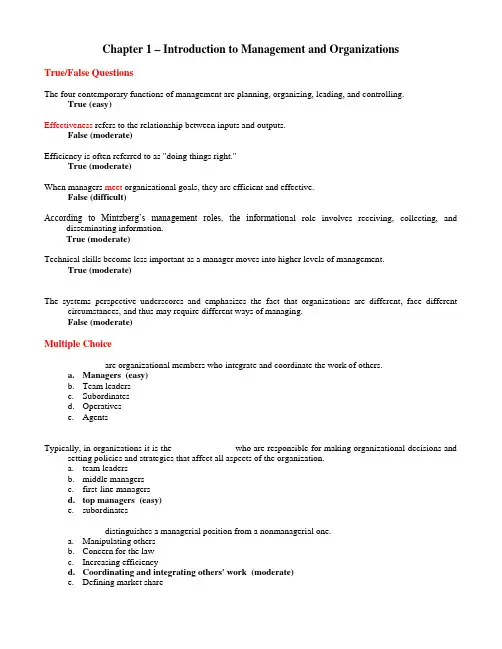
Chapter 1 – Introduction to Management and OrganizationsTrue/False QuestionsThe four contemporary functions of management are planning, organizing, leading, and controlling.True (easy)Effectiveness refers to the relationship between inputs and outputs.False (moderate)Efficiency is often referred to as "doing things right."True (moderate)When managers meet organizational goals, they are efficient and effective.False (difficult)According to Mintzberg’s management roles, the information al role involves receiving, collecting, and disseminating information.True (moderate)Technical skills become less important as a manager moves into higher levels of management.True (moderate)The systems perspective underscores and emphasizes the fact that organizations are different, face different circumstances, and thus may require different ways of managing.False (moderate)Multiple Choice_____________ are organizational members who integrate and coordinate the work of others.a. Managers (easy)b. Team leadersc. Subordinatesd. Operativese. AgentsTypically, in organizations it is the _____________ who are responsible for making organizational decisions and setting policies and strategies that affect all aspects of the organization.a. team leadersb. middle managersc. first-line managersd. top managers (easy)e. subordinates_____________ distinguishes a managerial position from a nonmanagerial one.a. Manipulating othersb. Concern for the lawc. Increasing efficiencyd. Coordinating and integrating others' work (moderate)e. Defining market sharea.spokesperson (moderate)b.entrepreneurc.disturbance handlerd.resource allocatore.negotiatora.human skillsb.technical skills (easy)c.conceptual skillsd.empirical skillsUnderstanding building codes would be considered a _____________ skill for a building contractor.a. humanb. technical (easy)c. conceptuald. empiricale. functionala. decision-making (easy)b. communicating with customersc. motivating subordinatesd. product knowledgee. technical skillsAccording to the text, _____________ are not influenced by and do not interact with their environment.a.open systemsb.closed systems (easy)c.d.reverse systemse.forward systemsThe _____________ view of a manager's job implies that decisions and actions taken in one organizational area will impact other areas.a. systems (moderate)b. contingencyc. conceptuald. functionale. environmentala.the partiality of managementb.the segmentation of managementc.the universality of management (moderate)d.the cultures of managementScenarios and QuestionsThe Busy Day (Scenario)Don Eskew, plant manager at Control Systems, Inc., sighed as he sipped his first cup of coffee at 5 a.m. and read his agenda for the day. He is giving two company tours in the morning; the first to a newspaper reporter who is writing a story on the new plant expansion and has several questions, and the second to a group of ControlSystems, Inc., managers from the east coast. He then has a meeting with unit manager, Phil Johnson, to discuss Phil's recent drop in performance (a task he always hates). Next, he is spending a couple of hours reviewing the trade journals he receives from his high-tech association and writing up a brief synopsis for his presentation next week to the Division President. Finally, in late afternoon, he will be reviewing the new equipment malfunction and deciding whether to bring in extra people to get the equipment running as soon as possible. Whew! Just another day in the glamorous life of a manager.a. Herzbergb. Skinnerc. Mintzberg (easy)d. Fayole. Maslowa. leader (difficult)b. figureheadc. monitord. disturbance handlere. spokespersona. monitorb. figureheadc. disseminatord. spokesperson (difficult)e. resource allocatora. monitorb. disseminatorc. resource allocator (moderate)d. disturbance handlere. figureheadEssay QuestionsIn a short essay, discuss the difference between efficiency and effectiveness and include a specific example to support each concept.Answera.b.Effectiveness is often described as “doing the right things”—that is, those work activities that will helpthe organization reach its goals.For instance, at the Biersdorf factory, goals included open communication between managers and employees, and cutting costs. Through various work programs, these goals were pursued and achieved. Whereas efficiency is concerned with the means of getting things done, effectiveness is concerned with the ends, or attainment of organizational goals.(moderate)In a short essay, list and explain the four basic functions of management.Answera.Planning – involves the process of defining goals, establishing strategies for achieving those goals, anddeveloping plans to integrate and coordinate activities.anizing – involves the process of determining what tasks are to be done, who is to do them, how thetasks are to be grouped, who reports to whom, and where decisions are to be made.c.Leading – when managers motivate subordinates, influence individuals or teams as they work, select themost effective communication channel, or deal in any way with employee behavior issues, they are leading.d.Controlling –to ensure that work is going as it should, managers must monitor and evaluateperformance. The process of monitoring, comparing, and correcting is what is meant by the controlling function.(moderate)In a short essay, list and discuss the three essential skills according to Katz that managers need to perform the duties and activities associated with being a manager.Answera.Technical skills – include knowledge of an proficiency in a certain specialized field, such as engineering,computers, accounting, or manufacturing. These skills are more important at lower levels of management since these managers are dealing directly with employees doing the organization’s work.b.Human skills –involve the ability to work well with other people both individually and in a group.Managers with good human skills are able to get the best out of their people. They know how to communicate, motivate, lead, and inspire enthusiasm and trust. These skills are equally important at all levels of management.c.Conceptual skills –these are the skill that managers must have to think and to conceptualize aboutabstract and complex situations. Using these skills, managers must be able to see the organization as a whole, understand the relationships among various subunits, and visualize how the organization fits into its broader environment. These skills are most important at the top management levels.(moderate)。
罗宾斯《管理学》(第9版)配套模拟试题及详解(一~二)【圣才出品】

圣才电子书
5.工作丰富化
十万种考研考证电子书、题库视频学习平台
答:工作丰富化是纵向上工作的深化,是工作内容和责任层次上的改变。它指在工作中,
赋予员工更多的责任、自主权和控制权,通过让员工更加完整、更加有责任心的去进行工作,
使员工得到工作本身的激励和成就感。它是以员工为中心的工作再设计,是一个将公司的使
2.战略 答:战略是指为了实现某一目标而设计的重大的、长期的和决定全局的行动方案。战略 具备以下几个特征:⑴整体性。它必须关系到组织的整体、关系到组织与其所处环境的联系, 而不仅是组织的某个局部,这是战略的全局性在空间上的具体表现;⑵长远性。战略关系到 组织发展过程中前后各阶段的联系,它必须以在未来相当长一段时期内组织总目标的实现为 归宿,并以组织目前的现状为起点,进而考虑不同阶段的战略步骤及其推进,这是战略的全 局性在时间上的表现;⑶指导性。战略关系到组织全局的发展规律,它必须对组织的行动具
个人成就感高。责任分明,可激发员工努力的动机。缺点:缺乏工作流程中相互稽核的功能,
员工在流程中做错事不易查觉,容易掩饰。要让他人短期取代其工作不易,无法做到分工合
作处理大量的事务,对于每单一步骤的纯熟度较分工的方式为低。
二、简答题(每题 10 分,共 50 分) 1.比较多国公司、跨国公司和无国界组织。 答:作为三种不同类型的全球组织,对多国公司、跨国公司和无国界组织的比较分析具 体如下: (1)多国公司是指同时在两个或两个以上的国家拥有重要的运营单位,但主要由母国 进行管理。由于多国公司的核心在于母国的控制,其特征表现为民族中心论。 其优点:组织结构比较简单;控制比较严密。 其缺点:管理比较无效;缺乏灵活性;会受到社会和政治力量的强烈反对。 (2)跨国公司同样在多个国家拥有重要的运营单位,但在从事运营的所在国(东道国)
罗宾斯《管理学》第九版试题

罗宾斯《管理学》第九版试题罗宾斯《管理学》第九版试题Chapter 10 – Organizational Structure and DesignTrue/False QuestionsA MANAGER’S DILEMMA1. According to the boxed feature, ―A Manager’s Dilemma,‖ Nokia was once involved in industries rangingfrom paper to chemicals and rubber.True (moderate)2. According to the boxed feature, ―A Manager’s Dilemma,‖ Nokia has been competing in thetelecommunications industry since 1965.False (moderate)DEFINING ORGANIZATIONAL STRUCTURE3. Organizational design is the organization's formal framework by which job tasks are divided, grouped, and coordinated.False (difficult)4. The concept of work specialization can be traced back a couple of centuries to Adam Smith's discussion ofdivision of labor.True (moderate)5. The degree to which tasks in an organization are divided into separate jobs is division of labor.True (moderate)6. Historically, many organizations have grouped work actions by function departmentalization.True (moderate)7. Grouping jobs on the basis of product or customer flow istermed customer departmentalization.False (moderate)8. Geographic departmentalization has greatly increased in importance as a result of today’s competitivebusiness environmentFalse (moderate)9. A group of individuals who are experts in various specialties and who work together is a cross-functional team.True (moderate)10. Authority is the individual's capacity to influence decisions.False (difficult)11. Authority is synonymous with responsibility.False (easy)12. Responsibility is the rights inherent in a managerial position.False (easy)13. A manager's span of control refers to the number of subordinates who can be effectively and efficientlysupervised.True (moderate)14. The classical view of unity of command suggests that subordinates should have only one superior to whom they report.True (easy)15. The trend in recent years has been toward smaller spans of control.False (easy)16. When decisions tend to be made at lower levels in anorganization, the organization is said to bedecentralized.True (moderate)17. Decentralization describes the degree to which decision making is concentrated at a single point in theorganization.False (moderate)18. In the last 35 years, there has been a trend of organizations moving toward increased decentralization.True (easy)19. Appropriate organizational structure depends on four variables: the organization's strategy, size, technology, and degree of environmental uncertainty.True (difficult)20. Standardization refers to the degree to which jobs within the organization are standardized and the extent towhich employee behavior is guided by rules and procedures.False (moderate)ORGANIZATIONAL DESIGN DECISIONS21. An organic organization tends to be characterized by high specialization, extensive departmentalization,narrow spans of control, high formalization, a limited information network, and little participation indecision-making by low-level employees.False (moderate)22. An organic organization would likely be very flexible.True (moderate)23. Innovators need the efficiency, stability, and tight controls of the mechanistic structure.False (easy)24. The relationship between organizational size and structure tends to be linear.False (difficult)25. Joan Woodward attempted to view organizational structure from a technological perspective.True (moderate)26. Woodward demonstrated that organizational structures adapted to their technology.True (moderate)27. Woodward's findings support that there is "one best way" to organize a manufacturing firm.False (moderate)28. The strength of the functional structure is that it focuses on results.False (moderate) it is the strength of divisional structure.\\\\\\\29. According to the text, a functional structure creates strategic business units.False (moderate)COMMON ORGANIZATIONAL DESIGNS30. Project structures tend to be rigid and inflexible organizational designs.False (easy)Multiple ChoiceA MANAGER’S DILEMMA31. Accordi ng to t he company profile in ―A Manager’s Dilemma,‖ the organizational structure of Nokia is best described as ______________.a. mechanisticb. organic (moderate)c. centralizedd. formalized32. The factor contributing the most to Nokia’s success in the mobile phone industry according to the company profile in ―A Manager’s Dilemma‖ is ______________.a. new product development (moderate)b. government subsidiesc. national trade barriersd. weak competition33. ______________ is the process of creating an organization's structure.a. Human resource managementb. Leadingc. Organizing (moderate)d. Planninge. DepartmentalizationDEFINING ORGANIZATIONAL STRUCTURE34. According to the text, a(n) ______________ is the formal framework by which job tasks are divided,grouped, and coordinated.a. mission statementb. environmental scanc. internal resource analysisd. organizational structure (moderate)35. Which of the following is not one of the six key elements in organizational design?a. work specializationb. departmentalizationc. chain of commandd. bureaucratic design (difficult)e. span of control36. Work specialization is also known as ______________.a. departmentalization.b. centralization.c. span of control.d. formalization.e. division of labor. (easy)37. The term ______________ is used to describe the degree to which tasks in an organization are divided intoseparate jobs.a. work ethicsb. managerial capitalismc. social responsibilityd. work specialization (moderate)38. When did the idea of enlarging, rather than narrowing, job scope begin?a. 1950sb. 1960s (moderate)c. 1970sd. 1980se. 1990s39. Which of the following is not an example of the classical viewof division of labor?a. assembly-line productionb. Burger Kingc. Taco Belld. TQM (moderate)e. Kentucky Fried Chicken40. ______________ is the basis on which jobs are grouped inorderto accomplish organizational goals.a. Departmentalization (moderate)b. Centralizationc. Formalizationd. Coordinatione. Efficiency41. A local manufacturing organization has groups of employees whoare responsible for sales, marketing,accounting, human resources, etc. These are examples of what concept?a. authorityb. chain of commandc. empowermentd. departmentalization (moderate)e. social grouping42. Grouping sporting equipment in one area, men's clothing in another area, and cosmetics in a third area, is anexample of what kind departmentalization?a. customerb. product (easy)c. geographicd. processe. outcome43. Sales responsibilities divided into the southwest, midwest, southern, northern, and western regions would bean example of ______________ departmentalization.a. productb. geographic (easy)c. processd. outcomee. customer44. Grouping activities on the basis of customer flow is______________.a. functional departmentalization.b. product departmentalization.c. geographical departmentalization.d. process departmentalization. (moderate)e. technological departmentalization.45. What type of departmentalization expects that each department will specialize in one specific phase of the process or product production?a. productb. geographicc. process (easy)d. outcomee. customer46. What kind of departmentalization would be in place in a government organization where different publicservice responsibilities are divided into activities for employers, children, and the disabled?a. productb. geographicc. processd. outcomee. customer (moderate)47. Which of the following is not a form of departmentalization suggested by your text?a. functional departmentalizationb. product departmentalizationc. geographical departmentalizationd. process departmentalizatione. technological departmentalization (difficult)48. Today's competitive business environment has greatly increasedthe importance of what type ofdepartmentalization?a. geographicb. customer (difficult)c. productd. processe. outcome49. According to the text, managers are using ______________, which are groups of individuals who areexperts in various specialties and who work together.a. specialized teamsb. cross-demanded teamsc. cross-functional teams (moderate)d. simple structured teams50. Which of the following is a contemporary addition to thehistorical view of departmentalization?a. increased rigidityb. cross-functional teams (moderate)c. enhanced centralizationd. elimination of product departmentalizatione. addition of sales departmentalization51. Bringing together the company's legal counsel, research engineer, and marketing specialist for a project isan example of a(n) ______________.a. empowered team.b. process departmentalization.c. product departmentalization.d. cross-functional team. (moderate)e. continuous improvement team.52. The ______________ is the continuous line of authority that extends from upper organizational levels to thelowest levels and clarifies who reports to whom.a. chain of demandb. chain of command (easy)c. demand hierarchyd. continuous design structure53. To whom a worker reports concerns which aspect of organizational structure?a. chain of command (moderate)b. departmentalizationc. pay structured. line of commande. authority framework54. ______________ entitles a manager to direct the work of a subordinate.a. Responsibilityb. Legitimate powerc. Rankd. Operating responsibilitye. Authority (moderate)55. ______________ is the obligation to perform assigned activities.a. Authorityb. Responsibility (easy)c. Chain of commandd. Unity of commande. Formalization56. The ______________ principle (one of Fayol’s 14 principles of management) helps preserve the concept ofa continuous line of authority.a. unity of demandb. unity of command (moderate)c. demand structured. continuous demand57. Span of control refers to which of the following concepts?a. how much power a manager has in the organizationb. the geographic dispersion of a manager's subunits ofresponsibilityc. how many subordinates a manager can effectively and efficiently supervise (moderate)d. the number of subordinates affected by a single managerial ordere. the amount of time it takes to pass information down through a manager's line of command58. Other things being equal, the wider or larger the span of control, the more ______________ theorganizational design.a. bureaucraticb. democraticc. effectived. efficient (difficult)e. classical59. Wider spans of control may be viewed as more efficient, but eventually, wider spans tend to have whateffect on organizations?a. reduced effectiveness (difficult)b. increased turnoverc. loss of managerial powerd. customer dissatisfactione. rigid chains of command60. An organization that spends money on maintaining a well-trained work force can expect which of thefollowing span-of-control outcomes?a. increased contempt for managementb. increased voluntary turnoverc. centralized authorityd. less direct supervision (moderate)e. increased need for managerial-level employees61. A high-tech manager who supervises the development of a new computer chip needs ______________compared to a manager who supervises the mailing of unemployment insurance checks at the localgovernment office.a. about the same span of controlb. a narrower span of control (difficult)c. a wider span of controld. a more informal span of controle. elimination of the span of control62. In general, span of control is ______________ for managers.a. increasing (easy)b. decreasingc. staying the samed. significantly decreasinge. no longer important63. ______________ describes the degree to which decision making is concentrated at a single point in theorganization.a. Decentralizationb. Centralization (moderate)c. Transnationalismd. Cross sectional analysis64. If lower-level employees provide input or are actually given the discretion to make decisions, theorganization is ______________.a. formalized.b. centralized.c. decentralized. (easy)d. mechanistic.e. organic.65. Recently, there has been a distinct trend toward ______________.a. smaller spans of control.b. decentralized decision-making. (moderate)c. decreased flexibility.d. emphasis on chain of command.e. mechanistic organizations.66. Which of the following factors WOULD NOT influence an organization to have a higher degree ofcentralization?a. Environment is stable.b. Company is geographically dispersed. (difficult)c. Company is large.d. Decisions are significant.e. Organization is facing a crisis.67. ______________ refers to the degree to which jobs within the organization are standardized and the extentto which employee behavior is guided by rules and procedures.a. Standardizationb. Centralizationc. Chain of commandd. Strategye. Formalization (moderate)68. All of the following factors indicate that a decentralized organization would be most effective EXCEPTwhen ______________.a. the environment is complex.b. decisions are relatively minor.c. the organization is facing a crisis. (difficult)d. the company is geographically dispersed.e. effective implementation of strategies depends on managers having involvement and flexibilityto make decisions.69. Which of the following factors describes an environment in whicha high degree of decentralization isdesired?a. Environment is complex, uncertain. (moderate)b. Lower-level managers do not want to have a say in decisions.c. Decisions are significant.d. Company is large.e. Organization is facing a crisis or the risk of company failure.70. The ______________ organizational structure is characterized by high specialization, extensivedepartmentalization, narrow spans of control and high formalization.a. mechanistic (easy)b. organicc. contingencyd. adhocracye. functional71. Which of the following is NOT a characteristic of a mechanistic organization?a. high specializationb. wide spans of control (moderate)c. high formalizationd. limited information networke. extensive departmentalization72. What type of organizational form follows classical principles such as unity of command?a. organicb. linearc. decentralizedd. mechanistic (moderate)e. adhocracyORGANIZATIONAL DESIGN DECISIONS73. Which of the following would likely be found in mechanistic organizations?a. wide span of controlb. empowered employeesc. decentralized responsibilityd. few rules and/or regulationse. standardized job specialties (difficult)74. All of the following are characteristics of an organic organization EXCEPT:a. narrow spans of control. (moderate)b. cross-hierarchical teams.c. free flow of information.d. low formalization.e. cross-functional teams.75. In the early years of Apple Computers, its desire for highly proficient and creative employees who operatedwith few work rules was an example of what type of organization?a. bureaucraticb. mechanisticc. volatiled. nouvellee. organic (difficult)。
管理学第9版课后习题答案
管理学第9版课后习题答案管理学第9版课后习题答案管理学是一门研究组织和管理的学科,对于现代社会的发展具有重要的意义。
而理解和掌握管理学的知识,对于从事管理工作的人来说更是必不可少的。
而《管理学第9版》作为一本经典的管理学教材,其课后习题对于学生的学习和巩固知识都具有重要的作用。
下面是对《管理学第9版》课后习题的一些解答和讨论。
第一章:管理和组织1. 什么是管理?管理的目标是什么?管理是指通过计划、组织、领导和控制等一系列活动,使组织能够有效地实现其目标。
管理的目标是通过合理利用组织的资源,提高组织的效率和效果,从而实现组织的使命和目标。
2. 什么是组织?组织的类型有哪些?组织是指由一群人共同协作,追求共同目标的社会系统。
组织的类型包括企业组织、非营利组织、政府组织等。
3. 管理者的角色有哪些?请举例说明。
管理者的角色包括:决策者、人际角色、信息处理者、资源分配者等。
例如,当管理者需要做出重大决策时,他们扮演的是决策者的角色;当管理者与员工进行沟通和交流时,他们扮演的是人际角色。
第二章:管理环境1. 什么是管理环境?管理环境对组织有何影响?管理环境是指组织所处的外部环境和内部环境。
管理环境对组织有着直接和间接的影响,它可以影响组织的发展和运营。
外部环境包括经济环境、政治环境、社会文化环境等,而内部环境包括组织的结构、文化、人力资源等。
2. 请列举几个影响管理环境的因素,并简要说明其影响。
影响管理环境的因素有很多,如经济因素、技术因素、法律因素等。
经济因素会直接影响组织的运营和发展,技术因素则会影响到组织的生产力和竞争力,法律因素则会对组织的运营和管理提出一系列要求和限制。
第三章:管理理论1. 请简要介绍几个著名的管理理论。
凯奇管理理论认为,管理者应该关注员工的需求和动机,通过激励和奖励来提高员工的工作表现。
赫茨伯格和麦格雷戈的理论则强调了员工的动机和领导行为的关系,他们提出了“X理论”和“Y理论”,分别代表了不同的领导风格和对员工动机的看法。
管理学第9版 练习题 附答案 3
Chapter 3 Organizational Culture and Environment: The Constraints TRUE/FALSE QUESTIONSTHE MANAGER: OMNIPOTENT OR SYMBOLIC1.In the symbolic view of management, managers are seen as directlyresponsible for an organization’s success or failure.2.The current dominant assumption in management theory suggests thatmanagers are omnipotent.3.The view of managers as omnipotent is consistent with thestereotypical picture of the take-charge business executive who can overcome any obstacle in carrying out the orga nization’s objectives.4.The symbolic view of management impact is useful in explaining thehigh turnover among college and professional sports coaches, who can be considered the “managers” of their teams.5.In the omnipotent view of management, much of an o rganization’ssuccess or failure is due to forces outside management’s control.6.In the symbolic view of management, it is unreasonable to expectmanagers to have a significant effect on the organization’s performance.7.In the omnipotent view of management, a manager’s role is to createmeaning out of randomness, confusion, and ambiguity.THE ORGANIZATION’S CULTURE8.An organizational culture refers to a system of shared meaning.anizational cultures influence how employees behave in anorganization.anizational culture is a perception, not reality.11.Presently, there is no method for analyzing or assessingorganizational culture.12.Strong cultures have more influence on employees than do weakcultures.13.An increasing body of evidence suggests that strong cultures areassociated with high organizational performance.pensation structures are considered to be a primary dimension oforganizational culture.15.Most organizations have very weak cultures.16.An organization’s founder has little influence on i ts culture.17.Rituals are repetitive sequences of activities that express andreinforce the key values of an organization.anizational stories typically contain a narrative regardingsignificant events or people.19.Employee stock options are one example of a material symbol thatmight represent organizational culture.20.The link between values and managerial behavior is fairlystraightforward.CURRENT ORGANIZATIONAL CULTURE ISSUES FACING MANAGERS21.A strong ethical culture is likely to have a powerful positiveinfluence on employee behavior.22.Low risk tolerance generally leads to high ethical standards withinan organization.panies that allow their employees freedom tend to encourageinnovative cultures.24.To encourage a customer-responsive culture, organizations shouldformalize and enforce strict customer service policies.25.Customer service employees tend to provide better customer servicewhen they are very clear about their employee roles.26.To increase customer responsiveness, organizations should hireemployees who are outgoing and friendly.THE ENVIRONMENT27.The part of the environment directly related to achievement of anorganization’s goals is the specific environment.28.The general environment refers to environmental factors operatinginside an organization.29.Environmental uncertainty can be divided into two dimensions: degreeof trust and degree of integration.30.Because certainty is a threat to an organization’s effectiveness,managers try to minimize it.31.The term suppliers includes providers of financial and labor inputs.32.Industry conditions are an example of an organization’s generalenvironment.33.Economic conditions are part of the organization’s specificenvironment.MULTIPLE-CHOICE QUESTIONSFor each of the following choose the answer that most completely answers the question.THE MANAGER: OMNIPOTENT OR SYMBOLIC34.Which of the following represent the two views of managerial impacton the success or failure of the organizationa.omnipotent and symbolicb.omnipotent and reflectivec.symbolic and interactived.reflective and interactive35.The omnipotent view of management states that ________________.a.the top manager is the only person in chargeb.managers are directly responsible for an organization’s successor failurec.that there is only one boss in the organization, and she or he isresponsible for delegating ordersd.managers have little or no responsibility for an organization’ssuccess or failure36.The __________ view of management is consistent with thestereotypical picture of the take-charge business executive whocan overcome any obstacle in carrying out the organization’sobjectives.a.omnipotentb.symbolicc.functionald.systems37.Which of the following most accurately reflects the symbolicview of managementa.Managers are directly responsible for an or ganization’s successor failure.b.M anagers have little or no responsibility for an organization’ssuccess or failure.c.E xternal forces are directly responsible for an organization’ssuccess or failure.d.E mployees are directly responsible for an organization’s successor failure.38.Internal constraints that restrict a manager’s decision options_______________.a.exist within every organizationb.do not exist, as all managers have decision-making discretionc.exist only to the extent that upper management imposes themd.exist only to the extent that followers won’t do as they are told39.The current dominant assumption in management theory suggests_______________.a. a balanced view of managers as symbolic and omnipotentb.an emphasis on the view that managers are symbolicc.an emphasis on the view that managers are omnipotentd.that both the symbolic and omnipotent views are obsolete40.According to the symbolic view, managers have a(n) _____________effect on substantive organizational outcomes.a.neutralb.controllingc.limitedd.unlimited41.Managers may be able to expand their areas of discretion by_______________.a.telling their employees what to dob.changing and influencing their organization’s culture andenvironmentc.electing new government officials at the federal and state leveld.changing employers and working for a different boss42.The symbolic view of management is based upon the belief thatmanagers symbolize _________.a.control and influenceb.ambiguity and confusionc.stakeholders’ interestsd.decisions of top management43.In reality, managers are most accurately viewed as _________.a.dominant over an organization’s environmentb.neither helpless nor all powerfulc.powerless to influence an organization’s performanced.ultimately responsible for organizational outcomesTHE ORGANIZATION’S C ULTURE44.The culture of an organization is analogous to the _____________ ofan individual.a.skillsb.personalityc.motivationd.ability45.All organizational cultures consist of each of the following except_________.a.shared valuesb.principlesc.innovationd.traditionsanizational culture is concerned with how members perceivethe organization, not whether they __________.a.like the organizationb.like their peersc.like their bossesd.like their customers47.Strong cultures _____________.a.are found in organizations with high employee turnoverb.have a minimal influence on employee decision makingc.can be found in all organizations that existd.have a greater influence on employees than do weak cultures48.Employees in organizations with strong cultures _______________.a.are more committed to their organizationsb.are more likely to leave their organizationsc.are more willing to perform illegal activitiesd.are more likely to follow directives from peers49.Which of the following phrases is associated with the definition oforganizational culturea.individual responseb.shared meaningc.diversity of thoughtd.explicit directions50.Which of the following is not considered to be a dimension oforganizational culturea.attention to detailb.people orientationc.purchasing policiesd.aggressiveness51.Which of the following dimensions of organizational culture isdefined as the degree to which an organization’s actions and decisions emphasize maintaining the status quoa.stabilityb.outcome orientationc.team orientationd.innovation and risk taking52.A company whose managers focus on results, rather than how resultsare achieved, most likely possesses a high degree of which of the followinga.outcome orientationb.people orientationc.team orientationd.aggressiveness53.Sony Corporation’s focus on product innovation is an example ofwhich of the following dimensions of organizational culturea.attention to detailb.people orientationc.outcome orientationd.aggressiveness54.Which of the following most accurately reflects the differencebetween strong cultures and weak culturesa.Strong cultures tend to encourage employee innovation, while weakcultures do not.b.Weak cultures are found in most organizations, whereas strongcultures are relatively rare.c.Strong cultures have less of an influence on employee behaviorthan do weak cultures.pany values are more deeply held and widely shared in strongcultures than in weak cultures.55.Corporate ___________ are repetitive sequences of activitiesthat express and reinforce the values of an organization.nguagesb.ritualsc.symbolsd.ceremonies56. Which of the following represents the most significant waysthrough which corporate cultures are transmitted to employeesa.rituals, myths, competitions, and languageb.symbols, rituals, language, and business systemsc.stories, rituals, symbols, and languagenguage, stories, rituals, and rewards57.When employees at Microsoft use terms such as work judo, eatingyour own dog food, and flat food, they are using organizational__________.nguagesb.ritualsc.symbolsd.ceremonies58.Most organizations have ____________ cultures.a.very weakb.weak to moderatec.moderated.moderate to strong59.The original source of an organization’s culture usually________________.a.is shared among the first workers hired into the organizationb.is formulated by the board of directors when the organization isformedc.identifies what the organization is successful doingd.reflects the vision or mission of the organization’s founderanizational _____________ typically contain narratives aboutsignificant events or people in the organization.a.storiesb.ritualsc.chartsd.material symbols61.All of the following are mentioned in the textbook as examples ofmaterial symbols except ____________.a.employee dress attireb.size of employee officesc.availability of stock optionsd.reserved parking spaces for certain employees62.The link between organizational values and managerial behavior is_____________.ually uncertainb.fairly straightforwardc.often highly complexd.relatively dynamic63.In learning an organization’s specific language, members aredisplaying their _________________.a.willingness to communicate with the organization’s stockholdersb.confidence that they will soon be promoted to greaterresponsibilityc.willingness to help preserve the culture of the organizationd.consent to share material symbols with the other members of theorganization64.An organization’s culture affects managers by ______________.a.providing them with additional decision-making powerb.restricting them from disciplining certain employeesc.encouraging them to bend or even break company rulesd.establishing what is appropriate and expected behaviorCURRENT ORGANIZATIONAL CULTURE ISSUES FACING MANAGERS65.Which of the following is most likely to have a highly ethicalorganizational culturea. a highly aggressive, competitive businessb. a company with high risk tolerancec. a business that focuses strictly on outcomesd. a business with outgoing and friendly employees66.To encourage ethical cultures, managers should_________________.a.enforce strict discipline policiesb.encourage employees to competec.act in their own self-interestd.serve as visible role models67.A company that primarily values a strong sense of purposethrough meaningful work has a(n) _________________ organizational culture.a.spiritualb.customer-responsivec.ethicald.innovative68.Conscientious employees with good listening skills are highlyvaluable for building a(n) _________________ organizational culture.a.ethicalb.innovativec.customer-responsived.spiritual69.An innovative organizational culture is characterized by all ofthe following characteristics except _________________.a.freedomb.conformityc.debatesd.risk taking70.Workplace spirituality has become important in the contemporaryworkplace because it helps to _________________.a.reduce unemployment ratesb.boost company profitsc.restore a sense of communityd.bring religion into business71.Which of the following is most characteristic of anorganization with a strong spiritual culturea.Employees are encouraged to express themselves.b.Such companies experience high employee turnover.c.Employees are rewarded for innovation and risk taking.d.Employees are required to join organized religions.72.Which of the following best characterizes the relationshipbetween spirituality and business profitabilitya.Evidence shows that spirituality and business profitability areincompatible.b.Limited evidence suggests that spirituality may be compatible withprofitability.c.Research shows that workplace spirituality constrains employeeperformance.d.High productivity has been extensively documented in spiritualworkplaces.THE ENVIRONMENT73.External environment refers to _________________.a.forces outside the organization that limit the organization’sperformanceb.factors and forces outside the organization that affect theorganization’s performancec.forces and institutions inside the organization that affect theorganization’s performanced.forces inside the organization that increase the organization’sperformance74.According to the textbook, the _______________ environment includesthose constituencies that have a direct and immediate impact on mana gers’ decisions and actions and are directly relevant to the achievement of the organization’s goals.a.generalb.specificc.secondaryd.forward75.An organization’s specific environment ________________.a.is unique and changes with conditionsb.is the same regardless of the organization’s agec.is determined by the top level of managementd.must be quantified to establish its existence76.The main forces that make up an organization’s specificenvironment are __________.a.suppliers, legislators, customers, and employeesb.customers, suppliers, competitors, and pressure groupsc.employees, competitors, pressure groups, and regulatorsd.suppliers, employees, competitors, and legislatorsanizations exist to meet the needs of which of the followingconstituenciesa.customersb.legislatorsc.supplierspetitors78.When you think of an organization’s suppliers, you________________.a.know that they are the main customers of the organizationb.typically think of governments that pass the laws the organizationmust followc.know that they are located close to the organization itselfd.typically think in terms of organizations that provide materialsand equipment79.Managers seek to ensure a steady __________________.a.cash flow from stockholders into the organizationb.flow of needed inputs at the lowest price availablec.flow of customers at the company’s outlet stored.flow of suppliers to keep the competition among suppliers at apeak80.Each of the following is considered an organizational supplierexcept providers of __________________.a.financial inputsbor inputsc.materialsd.political pressure81.The Internet is having an impact on determining whom anorganization’s competitors are because it has _____________.a.defined the common markets for organizationsb.made certain products invaluable to customerc.virtually eliminated the need for shopping mallsd.virtually eliminated geographic boundaries82.For a company such as Walt Disney World in Florida, a bank would bean example of what kind of factor in their specific environmentpetitorb.supplierc.special-interest groupernment agency83.Which of the following is not an example of a specific environmentalfactora.population demographicsb.political conditionsc.federal lawsd.all of the above84.For organizations such as hospitals, which hire nurses, the laborunion and the local labor market are examples of which of the following specific environmental factorspetitor and supplierb.customer and pressure groupc.both are examples of suppliersd.both are examples of pressure groups85.Typically, the specific organizational environment includes which ofthe followinga.economic factorsb.political conditionsc.technological factorspetitors86.United Parcel Service represents which of the following to the .Postal Servicepetitorb.supplierc.customerernment agency87.The general environment factor of economic conditions consists of allof the following except _______________.a.legislation recently passed by Congressb.interest ratesc.changes in disposable incomed.stock market fluctuations88.Sociocultural conditions consist of _______________.a.demographic profiles of an organization’s suppliersb.legal issues as determined by court decisionsc.the level of unemployment and real economic incomes of workersd.changing expectations and values within society89.To a national broadcast network such as NBC, your home DVD player isconsidered a _____________.a.customerb.supplierc.special-interest grouppetitor90.Groups such as Mothers Against Drunk Driving (MADD) are examples ofwhat factor in the specific external environmentpetitorsb.pressure groupsc.customersernment agencies91.Typically, the general organizational environment includes which ofthe followinga.political conditionsb.business plansc.stakeholdersd.supplierspared to the specific environment, which of the following is anaccurate statement about the general environment of an organizationa.It has less impact on the organization’s operations.b.It has more impact on the organization’s operations.c.It has about the same impact on an organization’s operations.d.It is predominantly the concern of upper management.93.Which of the following is not a component of an organization’sgeneral environmenta.economic conditionsb.political conditionsc.social conditionsd.industry conditions94.Interest rates, inflation rates, and stock market fluctuations areall e xamples of what factor in an organization’s general environmenta.economicb.politicalc.sociald.technological95.The Americans with Disabilities Act of 1990 is an example of a__________.a.sociolegal conditionb.political/legal conditionc.political/sociological conditiond.sociocultural condition96.A decrease in contributions from the public to the United Way charityis most likely the result of which of the following general environmental factorsa.politicalb.socialc.technologicald.economic97.Which of the following groups includes individuals who were bornbetween the years 1946–1964a.the Depression groupb.the World War II groupc.the baby boomersd.Generation X98.The members of which of the following groups are behaving infundamentally different ways that are likely to greatly impact organizations and managersa.the Depression groupb.the World War II groupc.the baby boomersd.Generation Y99.Automation represents an example of a(n) __________ generalenvironmental factor.a.technologicalb.demographicc.political/legald.economic100.Which of the following has been the most rapidly changing component in an organization’s general environmenta.globalb.economicc.sociald.technological101.Which of the following best represents a global general environmental factora.increased surveillancecation levelsc.electronic meetingsd.international markets102.Which of the following are the two dimensions of environmental uncertaintya.degree of change and degree of complexityb.degree of change and degree of volumec.degree of complexity and degree of impactd.degree of impact and degree of timing103.If the components of an organization’s environment changefrequently, the organization is operating in a __________environment.a.disruptiveb.diversec.dynamicd.difficult104.Managers try to minimize __________ because it threatensorganizational effectiveness.a.product developmentb.uncertaintyc.price chargesd.the number of suppliers105.__________ are any constituencies in an organization’s external environment that are affected by the organization’sdecisions and actions.a.Stockholdersb.Pressure groupsc.Suppliersd.Stakeholders106.Degree of _______________ refers to the number of components in an organization’s environment and the extent of the knowledge that the organization has about those components.a.stabilityb.opennessplexityd.transition107.The first step of managing external stakeholder relationships is to identify whom the stakeholders are. The second step is to _________________.a.determine what specific approach should be used to manage thestakeholder relationshipb.determine what the courts might do when stakeholder files a claimagainst the organizationc.determine what particular interests or concerns these stakeholdersmight haved.determine how many stakeholders there are in each stakeholdergroupSCENARIOS AND QUESTIONSFor each of the following, choose the answer that most completely answers the question.THE MANAGER: OMNIPOTENT OR SYMBOLICApex Construction has hired Wendell Phillips to provide management consulting for the organization. Wendell’s first assignment involves helping the company to improve productivity by recommending ways to strengthen managers’ supervisory skills.108.Wendell notices that the company’s top executives share a belief that managers are directly responsible for the organization’s success or failure. This belief reflects a(n) ______________ view of management.a.traditionalb.omnipotentc.standardd.symbolic109.Wendell interviews many middle-level managers and discovers that they share a different view of management. These individuals believe that external factors constrain managers’ inf luence over outcomes.The mid-level managers have a _____________ view of management.a.traditionalb.omnipotentc.standardd.symbolicTHE ORGANIZATION’S CULTURECorporate Takeover (Scenario)Todd works for SeaLan Tech, an environmental consulting firm that has just been purchased by Zerex, Inc., a biomedical research organization. Based on his early encounters with the new upper management from Zerex, Todd feels that SeaLan is a “lower-key, friendlier” organization. He is concerned that the new company will eliminate SeaLan’s old culture, and he does not like the prospects.110.If you were talking with Todd and asked him what the term culture meant, he would reply that, basically, it is _________________.a.the formal rules of an organizationb.the nationality of the workers in the companyc. a system of shared meaningd. a system that reflects diversity and respect for differences111.Todd is concerned with the degree to which managers focus on results or outcomes rather than techniques and the processes used to achieve those outcomes. He is concerned with _____________.a.stabilityb.aggressivenessc.team orientationd.outcome orientation112.Todd notices that management is very concerned with the effects of outcomes on people within the organization. This is referred to as _____________.a.stabilityb.aggressivenessc.team orientationd.people orientation113.Todd is assessing the organization’s _____________, the degree to which organizational activities emphasize maintaining the status quo in contrast to growth.a.stabilityb.aggressivenessc.team orientationd.outcome orientation114.Todd has been learning the seven dimensions of organizational culture. Which of the following is not one of those seven dimensionsa.stabilityb.aggressivenessc.member orientationd.outcome orientationChanging Organizational Culture (Scenario)Mary has been asked by the company president to change the organizational culture to reflect the company’s new organizational goals. As executive vice president, she certainly understands the goals, but is really not sure that she understands what to do about the culture.115.Mary asked employees if they knew what constituted “good employee behavior.” She found that very few understood, and most had a variety of ideas. This is one indication that her company _______________.a.has a strong cultureb.has a weak culturec.has no cultured.must have high turnover116.Mary also found out that in order to build a strong new culture, she should do all but which of the followinga.hire employees who fit in with the company’s cultureb.develop socialization practices to build culturec.encourage a high turnover rate among employeesd.have management make organizational values clear117.Mary was surprised to find that most organizational cultures are ____________.a.weakb.weak to moderatec.moderate to strongd.strongTHE ENVIRONMENTEnvironmental Constraints (Scenario)It is safe to say that managers do not have complete control over organizational outcomes; the environment has a significant impact. However, there are different environmental factors that shape a manager’s wor k life.118.As a manager, if you were working in an industry that was dependent on rapidly changing software technologies, with many new companies competing for the same customers, you would be working in what kind of environmenta.generalb.staticc.stabled.dynamic119.Political conditions, which include attitudes that officials hold toward specific industries, fall within an organization’s _____________ environment.a.globalb.internalpetitived.generalThe Election (Scenario)At the present time, your organization is faced with many changes. One of these is the election of a new president and Congress. Another concerns new requests from customers for changes to the look of your product design. A third involves changes in the ages and education levels of your customer base. Your customers have also recently expressed a desire to have your product manufactured using a newly discovered type of plastic.120.The changes in the presidency and Congress represent which of thefollowing environmental factors for your organizationa.general environmentb.specific environmentc.pressure groupd.customers121.The change in how customers want your product to look indesign is an example of which of the following types of factorsa.political/legalb.specific environmentc.globald.demographic122.The changes in the ages and education levels of yourcustomers are an example of which of the following conditionsa.economicb.political/legalc.demographic。
管理学第9版练习题附答案2
解析:根据管理学第9版教材,组织文化是指组织在长期发展过程中形成的共同价值观、行为准则和信仰体系,因此选项B正确。
03
题目1答案
答案:A
答案:B
答案:C
答案:D
题目2答案
正确答案:B
正确答案:C
正确答案:D
正确答案:A
题目3答案
答案:A、B、C、D
答案:A、B、D
答案:B、C、D
答案:A、B、C
答案:论述题6的答案是:在组织中,管理者需要建立有效的风险管理机制来应对各种不确定性和风险。风险管理机制包括风险识别、风险评估、风险控制等多个环节,管理者需要制定科学的风险管理策略和预案,提高组织的抗风险能力和危机应对能力。
题目4答案
题目:论述题
答案:论述题答案
答案解析:对论述题的答案进行解析
题目来源:管理学第9版教材
单击此处添加项标题
题目:论述企业如何通过提高组织承诺来提高员工的工作绩效。
单击此处添加项标题
题目2答案
题目:论述题目的答案要点
答案:答案要点一、答案要点二、答案要点三、答案要点四
题目3答案
添加标题
添加标题
添加标题
添加标题
答案:论述题3的答案是:在组织中,管理者可以通过建立有效的激励机制来提高员工的积极性和工作绩效。激励机制包括薪酬激励、晋升激励、荣誉激励等多种方式,通过合理的奖励和惩罚措施,可以激发员工的内在动力和竞争意识,从而提高整个组织的效率和绩效。
判断题:组织结构的类型选择取决于组织的外部环境。答案:错误。
题目3答案
判断题:组织结构是组织中正式确定的使组织成员之间产生相互作用的关系。(答案:对)
判断题:组织结构的核心要素是部门化。(答案:错)
罗宾斯《管理学》第九版题库
Chapter 4 Managing in a Global EnvironmentWHAT’S YOUR GLOBAL PERSPECTIVE?1.In a global marketplace ____________.a.the entire world is a marketplaceb.national borders are irrelevantc.the potential for organizations to grow expands dramaticallyd.all of the above(d; moderate; p. 90; AACSB: Globalizations)2.To succeed in a global marketplace, managers must _____________.a.constantly develop new strategies to maintain their parochial viewsb.expect competitors to suddenly appear at any time from any placec.implement only the best practices of their home countriesd.downplay the effect of the values and customs of other cultures(b; difficult; p. 90; AACSB: Globalizations)3.One reason for parochialism in the United States is that Americans tend to study_____________ in school.a.only Englishb.only two languagesc.English and Frenchd.English and Spanish(a; easy; p. 91; AACSB: Globalizations)4.Which of the following describes the current state of the world use of languages?a.Germans and Italians, unlike other Europeans, only speak their native language.b.Americans tend to study many other languages in school.c.More than 75 percent of all primary school children in China now learn English.d.Americans tend to think of English as the only international business language.(d; moderate; p. 91; AACSB: Globalizations)5.Ethnocentric views concentrate on their _____________.a.home countryb.host countryc.world orientationd.racial orientation(a; easy; p. 92; AACSB: Globalizations)6.Parochialism is ____________.a.acceptance of diverse points of viewb. a desire to leave one’s own culture for a foreign culturec. a tendency to view the world through a single perspectived.recognition of diverse religious beliefs(c; moderate; p. 91; AACSB: Globalizations)7.For U.S. businesses to have successful global management, which of the following statementsprovides the best advice?a.Americans should continue to push for the use of English only.b.Stick to your own customs to avoid embarrassing incidents.c.Make sure foreign businesspeople know you are American so they will speak to you inEnglish.d.Develop an understanding of multicultural differences.(d; moderate; p. 93; AACSB: Globalizations)8.Which of the following is the least favorable attitude for an American manager who wishes tobe successful in international business?a.multiculturalb.multicentricc.ethnocentricd.polycentric(c; easy; p. 92; AACSB: Globalizations)9.Managers with a(n) ___________ attitude view every foreign operation as different and hardto understand.a.geocentricb.polycentricc.ethnocentricd.transnational(b; moderate; p. 92; AACSB: Globalizations)10.Successful global management requires an attitude that is best described as _____________ .a.ethnocentricb.parochialc.polycentricd.geocentric(d; easy; p. 92; AACSB: Globalizations)11.A(n) __________ attitude is characterized by parochialism.a.geocentricb.acculturatedc.polylinguisticd.ethnocentric(d; moderate; p. 92; AACSB: Globalizations)12.A(n) _____________ attitude is the view that host-country managers know the best practicesfor running their operations.a.ethnocentricb.polycentricc.geocentricd.international(b; easy; p. 92; AACSB: Globalizations)13.The geocentric attitude is a _____________ view.a.nationalisticb.world-orientedc.culture-boundd.franchise-based(b; moderate; p. 92; AACSB: Globalizations)14.Successful _____________ management requires enhanced sensitivity to differences innational customs and practices.a.ethnocentricb.polycentricc.globald.parochial(c; moderate; p. 93; AACSB: Globalizations)UNDERSTANDING THE GLOBAL ENVIRONMENT15.The _____________ was created by the unification of 12 countries in Europe.a.European Common Marketb.European Unionc.Western European Allianced.Trans-European Market (TEM)(b; moderate; p. 94; AACSB: Globalizations)16.The principle reason for the formation of a regional trading alliance in Europe was to reassertmembers’ economic positions against the strength of the United States and _________.a.Canadab.Mexicoc.Japand.Russia(c; moderate; p. 94; AACSB: Globalizations)17.The European Union covers ______________.a.border controls, taxes, and subsidiesb.nationalistic policies and travelc.employment, investment, and traded.all of the above(d; moderate; p. 94; AACSB: Globalizations)18.The _____________ is a collection of countries that use a common currency.a.European Common Marketb.European Unionc.Western European Allianced.Economic and Monetary Union (EMU)(d; difficult; p. 94; AACSB: Globalizations)19.The single EU currency is called the ____________.a.francb.franc-markc.poundd.euro(d; moderate; p. 94; AACSB: Globalizations)20.The European Union currently consists of ___________.a.12 countriesb.15 countriesc.10 countriesd.25 countries(d; difficult; p. 94; AACSB: Globalizations)21.Which of the following countries is not a member of the European Union?a.Icelandb.Irelandc.Cyprusd.Slovenia(a; moderate; p. 94; AACSB: Globalizations)22._______ is expected to join the European Union in 2007.a.Hungaryb.Estoniac.Romaniad.Turkey(c; moderate; p. 95; AACSB: Globalizations)23.The executive body of the EU, based in Brussels, is known as the ________.a.Maastricht Officeb.FTAAc.Euro Protectorated.European Commission(a; moderate; p. 95; AACSB: Globalizations)24.Among the member countries of the North American Free Trade Agreement, trade has___________ since the treaty was signed.a.decreased initially, but increased steadilyb.increasedc.decreasedd.increased in commodities, but decreased in manufactured goods(b; moderate; p. 95; AACSB: Globalizations)25.The North American Free Trade Agreement includes _________________.a.Mexico, Canada, and the United Statesb.Canada, Mexico, and Brazilc.the United States, Canada, and Hondurasd.Columbia, Mexico, and the United Sates(a; easy; p. 95; AACSB: Globalizations)26.The North American Free Trade Agreement has resulted in which of the following?a.It increased imports from Mexico by 106 percent.b.It eliminated duties on imports from Venezuela.c.It increased exports to Canada by 62 percent.d.It increased trade with the European Union.(a; easy; p. 95; AACSB: Globalizations)27.Which of the following is currently under negotiation by thirty-four countries inthe Western Hemisphere?a.NAFTAb.FTAAc.Mercosurd.ASEAN(b; difficult; p. 95; AACSB: Globalizations)28.The North American Free Trade Agreement eliminated all of the following except________________.a.the need for import licensingb.tariffs on traded commoditiesc.customs user feesd.China’s role as a U.S. trading partner(a; moderate; p. 95; AACSB: Globalizations)29.The Association of Southeast Asian Nations includes ________________.a.the members of the European Union and Indiab.the members of NAFTA and CAFTAc. a membership of 10 Southeast Asian nationsd.none of the above(c; moderate; p. 95; AACSB: Globalizations)30.Each of the following is a member of ASEAN except ________________.a.Bruneib.Singaporeosd.Japan(d; moderate; p. 96; AACSB: Globalizations)31.How many member nations belong to the African Union (AU)?a.46b.53c.62d.67(b; moderate; p. 96; AACSB: Globalizations)32.Nepal belongs to which of the following regional trade alliances?a.EUb.SAARCc.AUd.ASEAN(b; moderate; p. 96; AACSB: Globalizations)33.The World Trade Organization evolved from which of the following?a.GATTb.Mercosurc.UNIDIRd.Marshall Plan(a; moderate; p. 96; AACSB: Globalizations)34.The World Trade Organization is centered around which of the following?a.public protestsb.economic sanctionsc.trade agreementsd.peace treaties(c; moderate; p. 96; AACSB: Globalizations)35.The goal of the World Trade Organization is to ___C_____.a.help develop environmental policyb.help regulate international marketsc.help businesses conduct their businessd.help reduce conflicts between nationsc moderate; p. 96; AACSB: Globalizations)DOING BUSINESS GLOBALLY36.International businesses have been around since about what date?a.the fifteenth centuryb.the seventeenth centuryc.the nineteenth centuryd.the twentieth century(c; difficult; p. 97; AACSB: Globalizations)37.Multinational corporations (MNCs) have only become commonplace since approximatelywhat date?a.mid-1960sb.mid-1970sc.1945d.mid-1980s(a; moderate; p. 97; AACSB: Globalizations)38.Multidomestic corporations are known for _______________.a.ethnocentric attitudesb.polycentric attitudesc.multicentric attitudesd.having their holdings in one country(b; moderate; p. 97; AACSB: Globalizations)39.Which of the following is an MNC that tailors marketing strategies to the host country’sunique characteristics?a.borderless organizationb.global companyc.multidomestic corporationd.transnational organization(c; moderate; pp. 97-98; AACSB: Globalizations)40.Multidomestic corporations _________________.a.maintain operations in multiple counties, but do not allow managers in eachcountry to make their own decisionsb.utilize ethnocentric attitudes in financial decisions, but favor polycentricviews in human resources issuesc.utilize decentralization to make decisions in management in local countriesd.follow the tastes, preferences, and values of the home country(c; moderate; p. 97; AACSB: Globalizations)41.When an organization drops its structure based on countries and reorganizes according toindustries, it is pursuing a global organizational operation known as ___________.a.ethnocentrismb.polycentrismc.borderless organizationd.multinational organization(c; moderate; p. 98; AACSB: Globalizations)42.Transnational organizations are also known as ________.a.ethnocentric organizationsb.polycentric organizationsc.borderless organizationsd.multidomestic organization(c; moderate; p. 98; AACSB: Globalizations)43.Transnational organizations are focused on _________________.a.increasing efficiencyb.developing INVsc.reinforcing structural divisionsd.all of the above(a; moderate; p. 98; AACSB: Globalizations)44.Which of the following types of business is global from its inception?a.international new ventureb.global companyc.born globald.joint economic market(c; difficult; p. 98; AACSB: Globalizations)45.Which of the following is a basic definition of a multinational corporation?a. a company that maintains operations in multiple countriesb. a company that maintains franchises in multiple countriesc. a company that has multiple home bases and manufacturing plantsd. a company that pays corporate taxes in at least two countries(a; difficult; p. 98; AACSB: Globalizations)46.Which of the following is the basic difference between multidomestic corporations and globalcompanies?a.Multidomestic corporations typically do business with more countries than globalcompanies do.b.Multidomestic corporations are run by global companies but must be owned by a local,national company.c.Multidomestic corporations decentralize management to the local country,while global companies centralize management in the home country.d.Multidomestic corporations pay more in taxes than global companies do.(c; difficult; pp. 97-98; AACSB: Globalizations)47.Which of the following is not a feature of a multidomestic corporation?a.Decision making takes place at the local level.b.Nationals are typically hired to run operations in each country.c.Marketing strategies are tailored to each country’s culture.d.Products are manufactured only in the local country.(d; easy; pp. 97-98; AACSB: Globalizations)48.Which of the following types of global organizations reflects the geocentric attitude?a.multidomestic corporationb.transnational organizationc.global companyd.regional organization(b; difficult; p. 98; AACSB: Globalizations)HOW ORGANIZATIONS GO GLOBAL49.Importing and exporting represent a more significant global investment than which of thefollowing?a.licensingb.franchisingc.global sourcingd.strategic alliance(c; easy; p. 98; AACSB: Globalizations)50.In an attempt to be more aggressive, a company might export and import more. These stepsusually require ____________.a.minimal investment and minimal riskb.conducting business in a polycentric mannerc.the establishment of strategic alliancesd.abnormal operations for a geocentric organization(a; easy; p. 99; AACSB: Globalizations)51.Franchising is primarily used by ________________.a.political organizationsb.manufacturing organizationsc.service organizationsd.legal organizations(c; moderate; p. 99; AACSB: Globalizations)52.In the later stages of doing business globally, if an organization is ready to make a more directinvestment, it might utilize ______________.a.foreign subsidiariesb.strategic alliancesc.joint venturesd.all of the above(d; moderate; pp. 99-100; AACSB: Globalizations)53.An international company is most likely to develop foreign subsidiaries _______________.a.before it develops licensing agreementsb.before it develops franchising agreementsc.before it begins importing and exportingd.after it establishes strategic alliances(d; moderate; p. 100; AACSB: Globalizations)54.The process of making products domestically and selling them abroad is known as ________.a.exportingb.importingc.franchisingd.joint ventures(a; moderate; p. 99; AACSB: Globalizations)55.Which of the following is usually found in the final stage of an organization’s globalevolution?a.exporting its products to other countriesb.cross-culturally training its managersc.establishing strategic alliances with partnersd.licensing another firm to use its brand name(c; moderate; p. 99; AACSB: Globalizations)56.Joint ventures are a type of ____________.a.licenseb.franchisec.foreign subsidiaryd.strategic alliance(d; moderate; p. 99; AACSB: Globalizations)57.Foreign subsidiaries are usually managed ______________.a.through local control onlyb.through centralized control onlyc.through local or centralized controld.none of the above(c; easy; p. 100; AACSB: Globalizations)58.A domestic firm and a foreign firm sharing the cost of developing new products orbuilding production facilities in a foreign country is called a ____________.a.franchising agreementb.joint venturec.foreign subsidiaryd.brokering agreement(b; moderate; p. 99; AACSB: Globalizations)59.Which of the following would most likely occur last in an organization’s global evolution?a.cross-cultural training of the company’s managersb.sending domestic employees on regular foreign business tripsc.hiring foreign brokers to represen t the organization’s product lined.creating a joint venture with suppliers around the globe(d; moderate; p. 99; AACSB: Globalizations)60._____________ present(s) the greatest risk to an organization going international.a.Joint venturesb.Strategic alliancesc.Licensingd.Foreign subsidiaries(d; difficult; p. 99; AACSB: Globalizations)MANAGING IN A GLOBAL ENVIRONMENT61.Which of the following is not considered to be one of the three major areas of significantchallenge for an American manager working in a foreign country?a.legal environmentb.economic environmentc.cultural environmentd.religious environment(d; difficult; pp. 101-103; AACSB: Globalizations)62.From an economic standpoint, a threat to the global manager is _________________.a.widely fluctuating inflation rates in foreign countriesb.marginal revenues exceeding marginal costsc. a stable exchange rate between currencies in various countriesd.all of the above(a; moderate; p. 102; AACSB: Globalizations)pared to many other countries, the U.S. legal–political environment is considered____________.a.radicalb.stablec.unstabled.fixed(b; moderate; p. 101; AACSB: Globalizations)pared to many other countries, changes to the U.S. legal–political environment areconsidered ___________.a.very fast and effectiveb.fast, but not efficientc.radicald.slow(d; moderate; p. 101; AACSB: Globalizations)65.The reason that a nation’s cultural differences are the most difficult to gain information aboutis because __________________.a.people tend to be sensitive about their own cultureb.providing this information to foreign organizations reduces a competitive businessadvantagec.there is little written on the issued.“natives” are least capable of explaining the unique characteristics of theirown culture(d; difficult; p. 104; AACSB: Globalizations)66.Which of the following developed a valuable framework to help managers better understanddifferences between national cultures?ton Friedmanb.Michael Porterc.Geert Hofsteded.Abraham Maslow(c; moderate; p. 104; AACSB: Globalizations)67._____________ is a cultural dimension in which people expect others in their group to lookafter them and protect them when they are in trouble.a.Power distanceb.Collectivismc.Achievementd.Uncertainty avoidance(b; easy; p. 105; AACSB: Globalizations)68.Which of the following would you find in a country with a high power distance?a.Society accepts narrow differences in organizations.b.Title carries little power, but status power is high.c.There is little respect for those in authority.d.Titles, rank, and status carry a lot of weight.(d; moderate; p. 105; AACSB: Globalizations)69.The GLOBE framework assesses how many cultural dimensions?a.fiveb.sixc.nined.twelve(c; moderate; p. 106; AACSB: Globalizations)70._____________ is a cultural measure of the degree to which people will tolerate risk andunconventional behavior.a.Power distanceb.Uncertainty avoidancec.Achievementd.Nurturing(b; easy; p. 105; AACSB: Globalizations)anizations in which of the following cultures are likely to have formal rules and littletolerance for unusual ideas and behaviors?a.high power distanceb.low power distancec.high uncertainty avoidanced.low uncertainty avoidance(c; easy; p. 105; AACSB: Globalizations)72.In a society with a highly ______________ culture, strong value is placed on relationshipsand concern for others.a.collectivistb.achievement-orientedc.nurturingd.uncertainty avoidant(c; moderate; p. 105; AACSB: Globalizations)73._____________ is a national culture attribute describing the extent to which societal valuesare characterized by assertiveness and materialism.a.Power distanceb.Uncertainty avoidancec.Achievement orientationd.Long-term orientation(c; moderate; p. 105; AACSB: Globalizations)74._____________ is a national culture attribute that places a high value on future occurrences.a.Power distanceb.Uncertainty avoidancec.Long-term orientationd.Leisure orientation(c; moderate; p. 105; AACSB: Globalizations)75.Which of the following are most alike in terms of individualism, power distance, anduncertainty avoidance?a.Singapore and Swedenb.Australia and Englandc.France and Greeced.United States and V enezuela(b; easy; p. 106; AACSB: Globalizations)76.Which of the following scores the highest in terms of power distance?a.Greeceb.Swedenc.Canadad.England(a; easy; p. 106; AACSB: Globalizations)77.Which of the following dimension from the GLOBE framework has no equivalent inHofstede’s framework?a.future orientationb.humane orientationc.gender differentiationd.uncertainty avoidance(c easy; p. 106; AACSB: Globalizations)SCENARIOS AND QUESTIONSFor each of the following choose the answer that most completely answers the question.WHAT’S YOUR GLOBAL PERSPECTIVE?First Visit Abroad (Scenario)Bill Sanderson is halfway over the Atlantic and is excited about his first European business trip. Bill is confident about this trip but is somewhat concerned about the strange habits and foreign languages he will encounter. “If only they would just speak English like everyone else!” Bill thinks.78.Bill’s tendency to view the world only through his U.S.-based perspective is an internationalbusiness problem known as which of the following?a.nondiversityb.discriminationc.parochialismd.monolingualism(c; moderate; p. 92; AACSB: Globalizations)79.If Bill is to become successful as a global manager, he must _______________.a.attempt to change other cultures to American waysb.learn and accept other culturespete internationally but remain in the United Statesd.learn to manipulate other business cultures(b; moderate; p. 93; AACSB: Globalizations)Cultural Training (Scenario)Jane wants to expand her career opportunities in international operations of a company. She is 19 years old and currently attends a university. She has only lived in her current country and has never traveled to foreign countries.80.Jane decides to enroll in a foreign language class to help her overcome her ______________.a.parochialismb.ethnocentric attitudec.monolingualismd.polycentric attitudes(c; moderate; p. 91; AACSB: Globalizations)81.In talking with her advisor at the university, Jane decides she probably has a(n)__________ attitude, as she has never traveled abroad and only relates well to people from her home country.a.culturally focusedb.polycentricc.ethnocentricd.geocentric(c; moderate; p. 92; AACSB: Globalizations)82.Jane becomes involved with an international student association to give her experiences thatwill allow her to understand the views of students from other countries. She is trying to become more _________ in her attitude.a.parochialisticb.polycentricc.ethnocentricd.geocentric(d; difficult; p. 92; AACSB: Globalizations)UNDERSTANDING THE GLOBAL ENVIRONMENTA Foreign Alliance Talk (Scenario)As manager of the international department for your company, you have been asked by the local Chamber of Commerce to deliver a speech on foreign trade. The Chamber president even goes so far as to say “and be sure to include the EU, NAFTA, and all that stuff because we’re afraid that Ross Perot is right—all the good jobs will leave the United States.” As you pour over your notes, you try to choose the best information to present in the allotted half hour.83.You plan to explain during your talk that the acronyms EU, NAFTA, FTAA, and ASEANrefer to ________________.a.regional trade alliancesb.foreign airlinesc.soccer teams in Europed.new multinational corporations(a; difficult; p. 94; AACSB: Globalizations)84.One of the hottest topics of your talk will be NAFTA. One of the points that you emphasize isthat ______________.a.the United States has definitely come out the worst of the three nationsb.Canada is profiting the most in this arrangementc.the expansion of NAFTA has benefited North America’s competitiveness andeconomic powerd.U.S. high-tech companies, such as computer manufacturers, have been hit hard by theNAFTA provisions(c; difficult; p. 95; AACSB: Globalizations)85.You will also give participants a likely view of the future of the EU, which suggests that_______________.a.it will likely disband by the year 2010b.it is expected to merge with NAFTA by 2020c.Bulgaria will probably join in 2007d.Cuba has applied to join the EU(c; moderate; p. 94; AACSB: Globalizations)DOING BUSINESS GLOBALLYBusiness Expansion Plan (Scenario)As a business expansion director, Shana’s goal is to scout out potential locations and basically provide input on how her company should proceed with its planned expansion to Europe. There are many options, including maintaining the business’s head office in the United States and sending over company representatives when necessary or establishing separate operations facilities abroad and hiring locals as managers.86.If Shana’s company decides to open another company in France but maintain its managementin the United States, it would be considered _________________.a. a transnational corporationb. a global companyc. a regional trade allianced. a multidomestic corporation(b; moderate; p. 98; AACSB: Globalizations)87.If Shana’s company decides to open a completely new operation in Germany, tailoring thecompany to local customs and marketing strategies and hiring local managers, they would beconsidered _______________.a. a transnational corporationb. a global companyc. a regional trade allianced. a multidomestic corporation(d; moderate; p. 97; AACSB: Globalizations)88.If Shana’s company eliminates country-designated locations and reorganizes based onindustry groups, it would best be considered a __________________.a.borderless organizationb.strategic partnershipc.global business allianced.multidomestic corporation(a; moderate; p. 98; AACSB: Globalizations)89.One section of Shana’s company’s business plan involves strategic alliance s and jointventures. This section is most likely focused on the _________ phase of the company’s global business expansion.a.legalb.middlec.finald.preliminary(c; moderate; p. 99; AACSB: Globalizations)The European Expansion (Scenario)You have been hired by a company to look at the ways to best move the company into the European market, but you have to first determine what kind of company you are dealing with.90.If the company that has hired you is primarily used by manufacturingorganizations, it is a ___________.a.licensing companyb.franchising companyc.strategic allianced.joint venture(a; moderate; p. 99; AACSB: Globalizations)123.If the company that has hired you is really a partnership between an organization and a foreign company, in which both share resources and knowledge in developing new products, then it is a _______________.a.licensing companyb.franchising companyc.strategic allianced.joint venture(c; moderate; p. 99; AACSB: Globalizations)Software Entrepreneurial Venture (Scenario)Theodore and James have formed an entrepreneurial venture to develop software for banks and other financial institutions. Their company is growing, but in looking for opportunities in the future, they decide to explore international operations.124.The international operations in their firm continue to grow. Theodore and James have come to see that decentralized management using foreign nationals to run operations in the host countries works well. Their firm has developed into a(n) ____________ organization.a.transnationalb.multidomesticc.borderlessd.franchise(b; moderate; p. 97; AACSB: Globalizations)125.A new and exciting opportunity has appeared that enables Theodore and James to form a joint venture with an insurance company in Japan. This will move their firm into the global role of an organization with a(n) ______________.a.minimized level of business riskb.indirect international investmentc.direct international investmentd.independent foreign subsidiary(c; moderate; p. 99; AACSB: Globalizations)126.Theodore and James decide to allow a firm in Europe to use the rights to their software, its brand name, and software specifications in return for a lump-sum payment. The firm is a service organization that plans to use the software to assist its customers. This agreement is known as a ________________.a.strategic allianceb.licensing agreementc.franchised.foreign subsidiary(c; difficult; p. 99; AACSB: Globalizations)MANAGING IN A GLOBAL ENVIRONMENTA Different View (Scenario)John has done well in his company. In only 5 years, he has risen to the position of divisional manager. However, he knows that in order to rise to the level of senior management, he needs to spend some time managing abroad in his company’s foreign subsidiaries. Although he has。