
新外研版七年级英语上册 Module 9 模块知识点归纳
Module 9 People and places
We're enjoying the school trip a lot. 必背单词
1.postcard(n.)明信片→postcards(pl.)
2.lie(v.)躺;平躺→lying(现在分词)→lies(第三人称单数形式) 3.sun(n.)太阳→sunny(adj.)晴朗的
4.wait(v.)等待,等候→waiting(现在分词)
5.walk(v.)行走;步行→walks(第三人称单数形式)
6.sale(n.)卖;出售→sell(v.)卖
7.enjoy(v.)享受……的乐趣;喜爱→enjoys(第三人称单数形式)→enjoyment(n.)乐趣
8.call(v.)(给……)打电话
9.line(n.)行,排,列
10.take(v.)拿,取;花费(时间)
11.trip(n.)旅行
12.anyway(adv.)尽管如此,无论如何
必背短语
13.take photos 拍照
14.wait for等待,等候
15.a few 一些;几个
16.on sale正在出售
17.go back回去
必背句子
18.I'm standing on the Great Wall of China and talking to you.
我正站在中国的长城上和你说话。
19.What about the others?其余的人呢?
20.Daming is having lunch and lying in the sun.
大明正躺在阳光下吃午饭。
21.We're enjoying the school trip a lot.
我们非常喜欢这次学校旅行。
They're waiting for buses or trains. 必背单词
1.drive(v.)驾驶;驾车→driver(n.)司机
2.leave(v.)离开→leaves(第三人称单数形式)
3.place(n.)地点→places(pl.)
4.thing(n.)事情;东西→things(pl.)
5.star(n.)明星;星;星状物→stars(pl.)
6.most(adj.)大部分(的);大多数(的)
7.still(adv.)仍然;依旧
必背短语
8.get off下(飞机、火车、公共汽车等)
9.hot dog热狗(一种中间夹香肠的三明治)
10.at this moment此时此刻
11.have a drink喝一点
12.in different places在不同的地方
必背句子
13.In Moscow, it's eight o'clock in the evening, so people aren't having afternoon tea.
在莫斯科,是晚上8点钟,因此人们没有在喝下午茶。
14.They are having dinner at home or in restaurants.
他们正在家里或餐馆吃晚饭。
15.Some people are seeing friends, calling home or shopping.
一些人在看望朋友,给家里打电话或购物。
Language in use
必背单词
1.run(v.)跑,奔跑→running(现在分词)→runner(n.)赛跑者2.study(v.)学习;研究→studies(第三人称单数形式)
必背短语
1.the Forbidden City紫禁城
2.enjoy the sun 享受阳光
3.look at maps 看地图
必背句子
1.We are having a great time.
我们正玩得非常高兴。
2.In the US,from New York to Hawaii, there are several time zones.
在美国,从纽约到夏威夷有几个时区。
Module+9+Unit+2课件+2023-2024学年外研版英语七年级上册
leave+地点,表示“离开某地”;leave for +地点,表示“动身去某 地”;leave…for…表示“离开……去……”。如:
(2)Does Jenny leave Shanghai? 珍妮离开上海了吗?
(3)We are leaving for 我们正动身去伦敦。
London.
(4)Miss Li doesn’t leave Guangzhou for Beijing. 李小姐没离开广州去北京。
( C )(1)People in the UK_______ work at the moment. A.leave B.leaves C.are leaving D.is leaving
2.In London, it’s five o’clock in the afternoon and people are leaving work and are going home.在伦敦,现在是下午5点钟,人们正在下班回 家。 ◆leave work “下班”。leave可作及物动词和不及物动词,表示“离开(某 人或某物)”;还可意为“递送,留给,投递”。常用结构:leave sth.(for sb.) 或leave (sb.)sth.。如: Mr Smith leaves work at 6 o’clock every day.史密斯先生每天6点钟下班。 He leaves me a few books.他留给我几本书。
London
5:00 pm
WWhhaattatriemteheispite?ople doing?
They are having afternoon tea.
They are leaving work and waiting for buses or trains.
外研版七年级上册Module9People and places单元知识梳理(含答案)
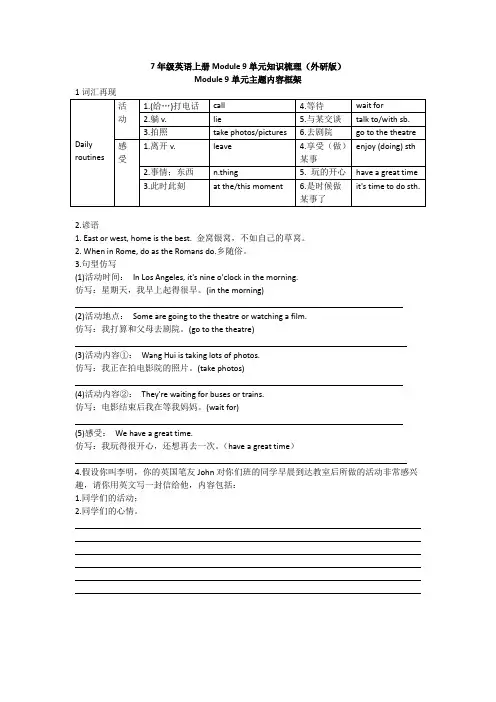
7年级英语上册Module 9单元知识梳理(外研版)Module 9单元主题内容框架2.谚语1. East or west, home is the best. 金窝银窝,不如自己的草窝。
2. When in Rome, do as the Romans do.乡随俗。
3.句型仿写(1)活动时间:In Los Angeles, it's nine o'clock in the morning.仿写:星期天,我早上起得很早。
(in the morning)(2)活动地点:Some are going to the theatre or watching a film.仿写:我打算和父母去剧院。
(go to the theatre)(3)活动内容①:Wang Hui is taking lots of photos.仿写:我正在拍电影院的照片。
(take photos)(4)活动内容②:They're waiting for buses or trains.仿写:电影结束后我在等我妈妈。
(wait for)(5)感受:We have a great time.仿写:我玩得很开心,还想再去一次。
(have a great time)4.假设你叫李明,你的英国笔友John对你们班的同学早晨到达教室后所做的活动非常感兴趣,请你用英文写一封信给他,内容包括:1.同学们的活动;2.同学们的心情。
答案:1.On Sunday, I get up early in the morning.2.I'm going to go to the theatre with my parents.3.I'm taking photos of the cinema.4.I wait for my mother after the movie ends.5.I have a great/good time and want to go there again.作文:Dear John,My classmates are all in the classroomº. We are very busy. [Lingling is cleaning theblackboard. Lucy is talking to Anna. They look happy. Some students are sweeping the floor.The floor becomes clean because of them. Some are doing their homework. What about me?I'm writing this letter to you!We have lots of8 things to do but we are happy.Yours,Li Ming。
外研版七年级英语上册Module 9 知识汇总

Module9知识梳理【重点短语】1.stand in line 排队2.take a photo of... 给......照相3.wait for a bus 等公共汽车4.walk on the Great Wall 在长城上走walk to school/work 走着去学校/上班walk home 走着回家5.talk with sb on the phone 在电话里和......说话6.right now =at the moment =now 现在7.be with sb 和......在一起8.be on sale 在出售9.lie in the sun 躺在阳光下10.send sth to sb by email 通过电子邮件发送某东西给某人11.enjoy the trip a lot 非常喜欢这次旅游12.it’s time to do sth 该做......的时间了it’stime for sth 该......的时间了13.go/be on a trip to +地点参加到......的旅游14.get off / on 下/上(车,船......)15.leave work 下班16.drive to school/work 开车去学校/上班drive home 开车回家17.have afternoon tea 喝下午茶18.have a drink 喝酒,喝饮料19.go to the theater 去剧院看戏20.watch a film=see a film 看电影21.go home from work 下班回家22.start lessons 开始上课23.see friends=visit friends 拜访某人,看望某人24.call home 给家人打电话25.a few+可数复数一些......26.enjoy doing sth 喜欢做.......27.go back to... 回......28.hi from... 来自......的问候29.thank sb for sth 因某事谢谢某人thank sbfor doing sth 因做某事谢谢某人30.enjoy the sun 享受阳光31.look at the homes of ...... 观赏......的房屋32.a movie star 电影明星33.a postcard from sb 来自于......的明信片34.call sb 给......打电话35.visit the Forbidden City 参观故宫36.look at maps 看地图37.have a good time =have fun =enjoy oneself 玩的高兴,过的愉快38.play/do taijiquan 打太极拳39.play/do yangge 扭秧歌40.run for a bus.=run for buses 向公共汽车跑去,去赶公共汽车【重点句子】1.We’re enjoying the school trip a lot.我们非常喜欢学校的这次旅游。
外研版英语七年级上册Module9 U2解析
Choose the best answer. 1. In London, it’s five o’clock and
people are _____. A. leaving home B. having lunch C. going home 2. It’s eight o’clock, people are washing
Read and fil
What are they doing?
London
five o’clock going home
Moscow
eight o’clock having dinner
Beijing
one o’clock sleeping
Los Angeles nine o’clock working
4. People are ____ in Beijing when people are having lunch in New York.
A. having dinner B. sleeping C. watching television
Complete the passage with the correct form of the words from the box.
New words and expressions
drive v. 驾驶;驾车 get off 下(飞机、火车、公共汽车等) hot dog 热狗(一种三明治)
leave v. 离开 restaurant n. 饭店;餐馆
moment n. (某事发生的) 时刻, 时候 place n. 地点 thing n. 事情; 东西 most adj. 大部分(的); 大多数 (的) still adv. 仍然, 依旧 star n. 明星;星;星状物
外研版英语七年级上册Module 9知识点归纳
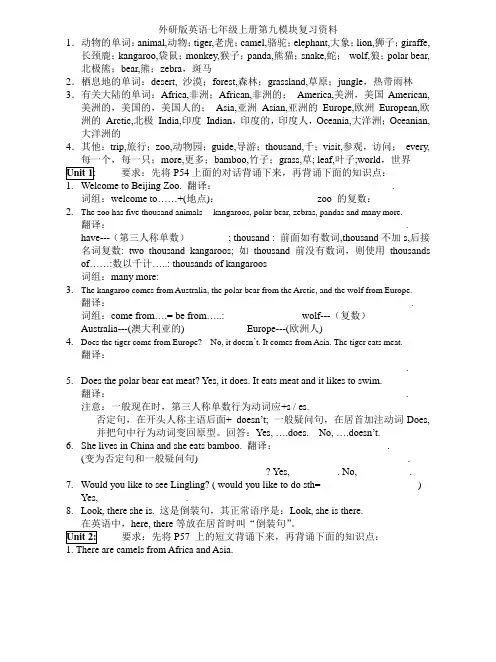
外研版英语七年级上册第九模块复习资料1.动物的单词:animal,动物;tiger,老虎;camel,骆驼;elephant,大象;lion,狮子;giraffe,长颈鹿;kangaroo,袋鼠;monkey,猴子;panda,熊猫;snake,蛇;wolf,狼;polar bear,北极熊;bear,熊;zebra,斑马2.栖息地的单词:desert, 沙漠;forest,森林;grassland,草原;jungle,热带雨林3.有关大陆的单词:Africa,非洲;African,非洲的;America,美洲,美国American,美洲的,美国的,美国人的;Asia,亚洲Asian,亚洲的Europe,欧洲European,欧洲的Arctic,北极India,印度Indian,印度的,印度人,Oceania,大洋洲;Oceanian,大洋洲的4.其他:trip,旅行;zoo,动物园;guide,导游;thousand,千;visit,参观,访问;every,more,更多;bamboo,竹子;grass,草; leaf,叶子;world,世界要求:先将P54上面的对话背诵下来,再背诵下面的知识点:翻译:___________________________________.词组:welcome to……+(地点):___________________ zoo 的复数:_______ 2.The zoo has five thousand animals--- kangaroos, polar bear, zebras, pandas and many more.翻译:___________________________________________________________.have---(第三人称单数)________; thousand : 前面如有数词,thousand不加s,后接名词复数: two thousand kangaroos; 如thousand前没有数词,则使用thousands of……:数以千计…..: thousands of kangaroos词组:many more: _________3.The kangaroo comes from Australia, the polar bear from the Arctic, and the wolf from Europe.翻译:____________________________________________________________.词组:come from….= be from…..:_______________ wolf---(复数)_________ Australia---(澳大利亚的)____________ Europe---(欧洲人)_____________4.Does the tiger come from Europe? No, it doesn’t. It comes from Asia. The tiger eats meat.翻译:___________________________________________________________________________________________________________________________.5.Does the polar bear eat meat? Yes, it does. It eats meat and it likes to swim.翻译:___________________________________________________________.注意:一般现在时,第三人称单数行为动词应+s / es.否定句,在开头人称主语后面+ doesn’t; 一般疑问句,在居首加注动词Does, 并把句中行为动词变回原型。
七年级英语上册 Module9单元知识、同步演练、单元评估 外研版
Student’s book------------ Module 9 A trip to the zoo【单元知识概要】【内容综述】本模块话题是“动物”。
介绍了世界各地的动物以及其栖息地、习性等,同时也唤起学生热爱动物、保护动物的意识。
要求能够使用一般现在时第三人称单数做主语的疑问句及其回答,并能够介绍并写出自己喜欢的动物。
1.运用联系,归纳,推测等技能。
如本模块出现的动物名称可归纳为一类:tiger, camel,elephant, lion, ……;世界各大洲可归为一类:Africa, African, America, American, Asia, …..;动物的居住地又可归为一类:desert, forest, grass, grassland, jungle;等等。
2.同时注意联系方法的运用,如世界各大洲的书写方法就可找出规律:即一般情况下在名词后字母n构成形容词。
注意发现合成词的合成规律举一反三地学习和记忆单词Unit 1. Does the tiger eat meat?【预习导航学案】(走进去,眼前一道美丽的风景) 【轻松起航】 一.读出这些单词:ea----idea, real, theatre, really /i eer--- beer, deer, pioneer ear--- ear, fear, hear, near. year, nearly, nearby are- care, dare, prepare, careful / e ear —bear, pear, wear eir/ere---- their, there, where air/aire----air, chair, hair , airport, repair 二.翻译并熟记这些单词: tiger _______ camel ________ elephant________ lion______ giraffe ______ kangaroo _______ monkey________ panda_____ snake _______ wolf _________ polar_________ bear______ zebra_______ Africa __________ African________ America_____ American ______ Asia__________ Asian______ Europe _____ European _________ Arctic _______trip_________ zoo _____ guide ___________ thousand ________visit _______every ________animal _________ more ________【激活思维】 1.观察下列单词,你发现了什么? Africa, African, America, American, Asia, Asian, Europe, European, Australia, Australian 2.你喜欢动物吗?你最喜欢的动物是什么呢?你对它了解多少呢?你能用英语把它的一些相关知识用英语表达出来吗?请查阅资料,把它写下在下面.【预习导航学案】(走进去,眼前一道美丽的风景)【轻松起航】一.完成表格:二.汉译英6.一头非洲象7.在沙漠里8.在亚洲 9.在森林里10.在草地上 11.南美洲12.在热带雨林里 13.一只欧洲狼【激活思维】1.你知道沙漠(desert),森林(forest),草地(grassland),热带雨林(jungle)都分布在世界的哪些地区吗?读课本,写在下面.① The desert is in______________② The forest is in______________.③ The grassland is in___________.④ The jungle is in______________.2.这一单元我们学习了一些和介词in连用的短语,把它们总结一下,写在下面.China,【方法链接】例1. There _____ ( be ) a box and some bookson the desk.答案 is点拨因为离a box最近是单数,所以用is.例2 . He ______ lunch at school every day.A. doesn’tB. doesn’t haveC. doesn’t hasD. hasn’t答案 B点拨见注解二.例3 ______ they _______ Chinese food?A. Are; likeB. Do; likeC. Are; likingD. Do; liking答案 B点拨见注解二.例4 ( ) There is ____ “a”and _____”n”in the word “fan”.A. an, anB. an, aC. a, anD. a, a答案 A点拨 a, n的音标分别是/ei/, /en/,第一个音标分别是/ei/,/e/,是元音,所以要用冠词an.例5 ( ) Lily is ________ American schoolgirl.A. aB. theC. anD. /答案 C点拨这里考查的是的冠词的用法,America的第一个音标是//,所以要用an,另外America是个Unit 3 Language in use【预习导航学案】(走进去,眼前一道美丽的风景)【轻松起航】翻译句子:1. 有来自非洲和亚洲的骆驼。
外研版英语七年级上册Module9 单元必考知识点
Module9 单元必考知识点1. 【课本原句】We’re enjoying the school trip a lot.【解析】(1) enjoy作动词,其后接名词(词组),表示“享受……的快乐”。
Enjoy 之后也可以接反身代词,与have a good time / have fun同义,表示“玩得开心;过得愉快”。
如:We often enjoy ourselves on Sunday. = We often have a good / nice / great / wonderful time on Sundays. 周日我们经常过得很愉快。
(2) a lot用来修饰动词,表示“很;非常”。
如:Thanks a lot. 非常感谢!2. 【课本原句】Wang Hui is taking lots of photos.【解析】(1)take photos与take pictures同义,都表示“照相”,该短语后接of 短语时,表示给某人照相。
如:Let me take photos / pictures of you. 我来给你照几张照片吧。
(2)lots of用来修饰可数名词复数或不可数名词,表示“许多,大量”,与a lot of 有相同用法。
They have lots of books to read. 他们有很多书要读。
3.【课本原句】They’re waiting for buses and funning for trains.【解析】wait是不及物动词,不能直接跟宾语,接宾语时,后面需用for引出。
for后接表示人或车辆等名词。
如:Someone is waiting for you outside the school gate. 学校门口有人在等你。
4.【课本原句】They’re on sale at the shop.【解析】sale作名词,意为“卖;出售”,on sale表示“出售;上市;打折销售”,for sale表示“供出售,待售”。
外研版七年级上册英语Module 9知识点
Module 9 unit 1知识点1.lie 不及物动词,“躺,卧,平放”,过去式lay过去分词lain动词,“说谎‘过去式lied过去分词liedLie 现在分词lyingLie 名词,“谎言,谎话‘短语:tell a lie 撒谎2.in the sun 在阳光下under the sun 世界上,天底下3.take photos=take pictures拍照take photos of …..给。
拍照4.take常考的考点有:1)it takes/took sb +时间+to do sth 做某事话费某人多长时间It took me two hours to do my homework2)sb takes+交通工具+to+某地方“某人乘坐….去某地”He often takes the bus to school3)take sb to +地点带某人去某地My mother often takes me to the museum on Sundays.5.wait 不及物动词,等待,等待某人某物,后面必须接介词forwait for sb /sth 等待某人某物wait in line 排队等候6.on a school trip在进行学校旅行on表示“正在进行“关于trip的短语有:the trip to ……去。
的旅行on the trip在郊游,在旅行go on a trip去旅行7.the others别的人/物,其他的人/物,表示一定范围内除去一部分以后其余的全部,相当于the other+名词复数,在前面加the 表示特指8.辨析other the other others another1)other形容词,“别的,其他的“,做代词用时前面可加the ,any,some等或用做复数形式。
2)the other“另一个人,另一个东西“,指两个中另外的一个,常用于one……the other“一个….另一个….“3)others其他的人或物,做代词用,常用于some……others一些….lingyixie4)another形容词,“另外的,别的“,只可修饰单数可数名词,做代词,意为“另一个,再一个“指两者以上中的另一个9.right now =at the moment 此刻,用于一般现在时right now =at once =right away立刻马上10.on sale 出售,sale不可数名词,意为“出售,销售“11.辨析on sale 与for saleon sale 表示出售,表示现有供应的,在卖的for sale待售,表示准备出售12.by email 通过电子邮件,by 介词,表示方法或手段,“由,靠,通过“13.enjoy喜欢,享受,后接名词、代词、或v-ing形式,不接动词不定式(to do )enjoy oneself=have fun =have a good time 过得愉快14.。
最新外研版七年级英语上册各单元知识点汇总(全册)
最新外研版七年级英语上册各单元知识点汇总(全册)MODULE 1一、同义句1.My name's Daming. = I'm Daming.2.I'm from England. = I come from England.3.Are you a new student.?= Are you new?4.Nice to meet you. = Nice to see you. =Glade to meet you. = Glade to see you.5.What's your name. = May I have your name ?6.Welcome to +地点二、用法集萃—What's your name.—How old are you?—My name is ....— Where do you come from?—I come from...—I'm twelve years old.—I’m 12.—Where are you from?—What class are you in?—I'm from...—I'm in Class One, Grade One.—What about ...?—What about doing ...?=How about doing ...?With 和 andJim and Lily go to the bank.(and 表并列)Jim with Lily goes to the bank.(with 是介词,和...一起,动词的形式 要与 with 前面的主语一致)三 语法专项。
Be 动词用法口诀我用 am 你用 are,is 跟着他,她,它. 单数名词用 is ,复数名词全用 are. 变疑问,往前提,句末问号莫丢弃。
变否定,更容易,be 后 not 莫忘记。
否定疑问任你变,句首大写莫迟疑。
外研版七年级上册英语Module 9 知识点精讲(含答案)
外研版七年级上册英语Module 9 People and places Unit1 We’re enjoying the school trip a lot.1.call(1)call 意为“( .... )打电话", 后面可以直接跟打电话的对象,即call sb.(2)call 意为“称呼;把.......叫作"的意思。
(3)called 意为“被叫作...”【例题解析】用所给词的适当形式填空(1)Please (call) me this afternoon.(2)They (call) the panda Lingling.(3)I know a girl (call) lingling.答案:call call called2.lie in the sun 躺在太阳底下lie 躺现在分词形式是: lying【例题解析】用所给词的适当形式填空My cat likes (lie) in the sun.答案:lying3.stand in line 站成一排【例题解析】用所给词的适当形式填空They are (stand) in line.答案:standing4.take photos 照相【例题解析】用所给词的适当形式填空They are (take) (photo) of the beautiful flowers. 答案:taking photos5.wait for... 等待......【例题解析】补全句子我正在等我的妈妈。
I (wait) for my mother.答案:am waiting6.We're on a school trip.我们正在进行一次学校郊游。
on a school trip 意为“进行一次学校郊游”。
7. What about the others? 其他人呢?the others 意为“别的人/物,其他的人/物”,其后不能跟名词,表示一定范围内除去部分以后其余的全部。