
外研版高中英语选修八Book 8 Module2 The Renaissance
李林中学高三年级英语导学案学科English 主备人审查人授课时间课题课型New Lesson教学目标知识与技能1. To master the useful words and expressions in the passage;2.To get the main idea of each paragraph;3.To get the students to know the background of theRenaissance and the achievements during this time and therepresentatives in many fields.过程与方法1.By appreciating the pictures, the students can get interestedin this lesson;2.Knowing the whole passage through skimming and scanning. 情感态度与价值观Arouse the students’interest in learning The Renaissance andhave the spirit of being a useful man to the society.教学重点1.To improve the reading skills;2.To master the useful words and expressions in the passage.教学难点How to develop the ability of reading教学方法Reading ,listening,explanation and pair-work 教学用具Regular aids信息技术与学科整合的目的1. To obtain the English knowledge better;2. To develop the students’ ability of getting knowledge and originality;3. To learn to read with strategies教学模式激趣定向——自学探究——交流互动——归纳提升教学过程教学内容创设情境激趣定向Leading-in;Purpose:To arouse Ss’ interest in The Renaissance1 .disturb vt. 干扰,妨碍disturbing adj. 令人烦恼的,令人不安的disturbed adj.心神不安的be disturbed to do 心神不安地去做disturb the peace 扰乱治安Do not disturb请勿打扰2. work n.(1) 著作,作品(可数)He is making a study of William Faulkner's works. 他在研究威廉·福克纳的作品。
(2)工厂(可数)A chemical works has been built recently.These chemical works were built 20 years ago.(3) 工作;劳动;作业;事[U]It takes a lot of work to dig a deep well. 挖一口深井很费事。
A work of art 一件艺术品out of work 失业work wonders/miracles 创造奇迹Work on 从事,进行work out 算出,理解,弄懂3. effect n. 结果,影响(c,u)effective adj. 有效的,实际上的effectively adv. have (an ) effect on sb/sth 对。
有影响have a great/rpofound/bad/no/ effect on take effect 见效,生效,起作用come into effect 开始实施,生效put/bring sth. into effect 使。
开始起作用be of no effect 无效Unfortunately, their efforts had no effect.不幸的是,他们的努力毫无作用。
The British Government announed that a ban on fox hunting would be brought into effect.英国政府宣布猎杀狐狸的禁令即将生效。
affect =have an effect/influence on Smoking affects health.【巩固运用】⑴The aspirins soon________________.服下的阿司匹林药片很快见效了。
⑵Some ancient laws are still__________.有些古时的法律现在仍然有效。
(3) The two systems are , ________________, identical.这两种制度实际上一模一样。
(4) This __________________________both mother and son.这对母子俩的将来影响很大。
(5) He_______________________________.到他完成了几项重要的改革。
4.motivate vt. 给与动机, 刺激, 提高...的学习欲望, 促动motivation n.动机,诱因motive n. 动机,目的motive n. 动机,目的motivate sb. to do 促使某人做have a motive for doing sth 有做。
的动机Examinations do not motivate a student to seek more knowledge考试不能促使学生去追求更多的知识。
Motivated by a strong desire, he donated a great deal of money to help the poor people.5. depend on 依赖,依靠取决于由。
而定depend on/rely on sb. to do 指望。
做depend on sb for sthIt all depends/ That depends 看情况而定Depend on it. 请相信,请放心He is a man to be depended on. 他是一个可以信赖的人。
Whether you can succeed depends on your efforts. 你是否能成功取决于你的努力。
【巩固运用】(1) We can depend on ______________________. 我们可以相信他会准时到来。
(2) All living things depend on the sun____________________.万物生长靠太阳。
(3) Children ____________________food and clothing.小孩依赖他们的父母供给衣食。
(4) But ____________________ the specific circumstances. 不过,那要看具体情况而定。
6. reckon v. 计算,总计,评估, 认为(多跟复合结构)(1) I reckon this will be a hot summer. 我估计这将是一个炎热的夏天。
(2) They reckon the book as one of his best works. 他们认为这本书是他的优秀作品之一。
(3) The news won't worry her, I reckon. 我看这消息不会使她不安。
reckon sb. (to be/as)…认为某人是…reckon in包括进去reckon on/upon 指望,依靠reckon without 没考虑到,不算7. appeal appeal to sb. 向某人呼吁appeal for 呼吁(希望得到什么)appeal to sb. to do sth. 希望某人怎样做, 呼吁某人做sth. appeal to sb. 某事投合(兴趣或心意)appeal to sb. 诉诸,求助于appealing adj. 引人同情的;招人喜欢的make an appeal to sb.向某人提出呼吁引起某人兴趣(1) He was appealing for funds to build a new school. 他在恳求拨款修建一所新学校。
(2) I appeal to you to get rid of your bad habits. 我希望你们改掉你们的坏习惯。
(3) The government is appealing to everyone to save water.政府呼吁人人节约用水。
(4)The Great Wall appeals to people from different countries.长城吸引了不同国家的人们。
Translation:(1) Harry Potter appeals to people of all ages.(2) If you don’t obey me I shall appeal to force.(3) She appealed to the high court against her sentence.8. suspect v. 怀疑,猜想n. 嫌疑犯,可疑分子adj. 可疑的,靠不住的Suspect sb of (doing) sth 怀疑某人做suspect sb to be 猜想某人是under suspicion 涉嫌(1)I suspect him of giving false information. 我怀疑他提供了假信息。
(2)The police have taken the suepect to the police station. 警察把嫌疑犯带到了警察局。
(3)We suspect him to be a pickpocket. 我们怀疑他是个扒手。
(4)What made you suspect her of having taken the money?凭什么怀疑钱是她偷的?9. seek seek(sought; sought) v.寻求,寻找,搜索,征求(1)You should seek advice from your lawyer on this matter. 这件事情你应该请教你的律师。
外研版高中英语选修8Module2TheRenaissanceGrammarandUsag教案
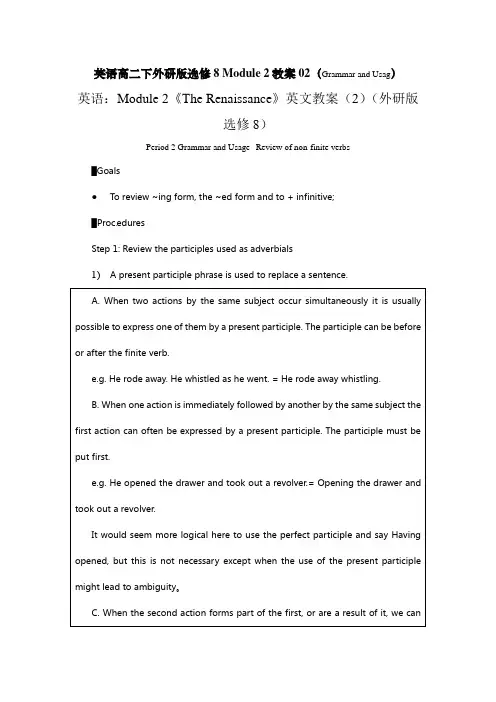
英语高二下外研版选修8 Module 2教案02(Grammar and Usag)英语:Module 2《The Renaissance》英文教案(2)(外研版选修8)Period 2 Grammar and Usage--Review of non-finite verbs▇Goals●To review ~ing form, the ~ed form and to + infinitive;▇Proc eduresStep 1: Review the participles used as adverbials1) A present participle phrase is used to replace a sentence.A. When two actions by the same subject occur simultaneously it is usually possible to express one of them by a present participle. The participle can be before or after the finite verb.e.g. He rode away. He whistled as he went. = He rode away whistling.B. When one action is immediately followed by another by the same subject the first action can often be expressed by a present participle. The participle must be put first.e.g. He opened the drawer and took out a revolver.= Opening the drawer and took out a revolver.It would seem more logical here to use the perfect participle and say Having opened, but this is not necessary except when the use of the present participle might lead to ambiguity。
外研版选修8Module2TheRenaissanceGrammar课件
now looks very confident. →Analyse :in the sentencse there is _a__(a/no) verb(谓语) ,so we fill in the blank with a
contribute to
pay attention to
get down to
2.动名词的语态和否定情势
主动语态: do+ing 被动语态:being done 否定情势:not doing
1. He escaped b_e_in_g_c_a_u_ghtthis time. 2. I can’t standb_e_in_g_t_re_a_t_edlike that. 3. I thank you very much for
lead to
spend /waste time or money in doing
devote…to… have some difficulty/trouble in doing
prefer…to… have a hard time in doing sth.
add to
there is no sense in doing
4. Attributive(定)
5.after an object(宾) plement(补) 6.at the start /end of a sentence
and usually followed a comma 6.Adverbial状
1.Subject:to do /doing
Learning Chinese becomes increasingly popular in the whole world . 4.对我们而言学习非谓语很重要。
外研版选修八Module2TheRenaissance课件
7.circulate v. 8.confidential adj. 9.courtyard n. 10.crossing n. 11.crossroads n. 12.dash v. 13.ferry n.
返回
_流__传__;__传__播_ _秘__密__的__,__机__密__的__ _庭__院__,__院__子_ 十__字__路__口__;__交__叉__口__ 十__字__路__口__ _猛__冲__ _渡__船__
打扰的;不安的;心理失常的→ disturb v.打扰;扰乱;打 5.basically adv.基本上,本质上,大致说来→ basic adj.基本
的 n.基本,要素→ base n.基础 v.以……为基 6.skilled adj.有技巧的,熟练的→ skill n.技能,技巧→_s_k_il_lf_u_l
adj.灵巧的
返回
7.gifted adj.有天赋的;有才华的→ gift n.天赋;天才; 礼物
8.suspect n.(犯罪)嫌疑人;可疑分子 v.怀疑→_su_s_p_i_c_io_u_s_ adj.可疑的
返回
[语境活用]
1.The disturbing news made people present at the meeting
37. lead to 38. leave for 39. leave sth.behind 40. on behalf of 41. take up 42. up to
返回
导致,通向,通往 出发去某地 把……抛在后面 代表…… 从事,开始做(某项工作) 到(某个数量)
返回
二、刷清单
——热身自盘点(再过基本应用关)
外研版选修八Module2TheRenaissanceGrammar

until hundreds of years later. 3. During the Renaissance, philosophers
began __a_s_k_in_g__ questions like “What is a person?” or “Why am I here?”
writes back.
a. The story he told us is very interesting. b. What you said is really inspiring. c. It was amazing to see so many rare
animals and plants in the zoo. d. He was shocked at the news of her death. e. You seem frightened. f. His aim was to cheer me up.
b. Mother warns us not to play in the street. c. I saw the naughty boy beating the dog. d. The captain got the soldiers moving
towards the destination after a short rest. e. Speak louder so that you can make
d. Some of the people invited to the party can’t come.
e. I have a very important meeting to attend.
外研版高中英语选修8 Module2教案The Renaissance
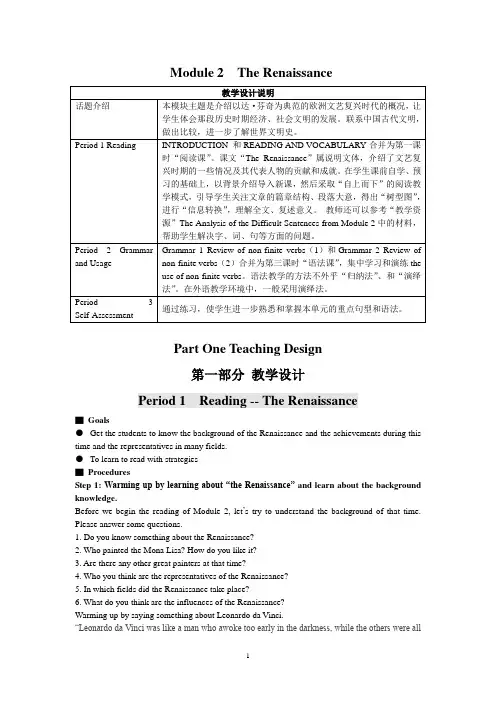
Module 2 The RenaissancePart One Teaching Design第一部分教学设计Period 1 Reading -- The Renaissance▇Goals●Get the students to know the background of the Renaissance and the achievements during this time and the representatives in many fields.●To learn to read with strategies▇ProceduresStep 1: Warming up by learning about “the Renaissance” and learn about the background knowledge.Before we begin the reading of Module 2, let’s try to understand the background of that time. Please answer some questions.1. Do you know something about the Renaissance?2. Who painted the Mona Lisa? How do you like it?3. Are there any other great painters at that time?4. Who you think are the representatives of the Renaissance?5. In which fields did the Renaissance take place?6. What do you think are the influences of the Renaissance?Warming up by saying something about Leonardo da Vinci.“Leonardo da Vinci was like a man who awoke too early in the darkness, while the others were allstill asleep”----Sigmund FreudLeonardo da Vinci is a man well beyond his time. Leonardo da Vinci was a renaissance painter, architect, engineer, mathematician and philosopher, a genius the world has never seen again so far. Step 2: Before you readPlease introduce the words for this module, paying attention to the pronunciation of the words, the relationship between their pronunciation and spelling.Practice for words study:Have a spelling quiz. Read every sentence and fill the blanks with proper forms of the words in this module.1)The ____ is the study and design of buildings.2)The ____ is the study of the meaning of life.3)If you give somebody a job, it means you ______ him or her.4)Madam Curie did a great _____ to the mankind.5)_____ means something difficult to understand or explain.6) A large church is called a ______.7)What’s your ______ of the painting.?8)What the teachers did was to _____ the students to study even harder.9)He is really a genius. His painting shows ______ talent.Step 3: While you read2. A diagram of The Renaissance3. Complete the article with one word in each blankThe Renaissance is French word meaning _1_. This word was used to describe a period in European history which began with the _2__ of the first Europeans in America. It was as if Europe was __3__ up after the long sleep of the Middle Ages. From Italy, the idea of the Renaissance rapidly __4__ to France, Germany, England and the rest of Europe. _5_ made people get richer. It became easier for artists to find people who could _6_ to buy their works or employ them.During that time, people developed a type of philosophy. For the first time, humans _7__ ofGod was put in the center of the Universe. The renaissance was also a time of _____ invention. Leonardo was also a skilled inventor. He had many detailed drawings of machines, such as airplanes, parachutes, submarines and tanks. He was really an extraordinary genius with so many4. Answer the reading comprehension questions according to the text1. Which of the following groups about the description of the Renaissance is TRUE?a. The Renaissance means 14th to 16th century Italy, and the development in art and architecture, music and literature.b. The Renaissance is no more than the Mona Lisac. From France, the idea of the Renaissance rapidly spread northwards to Italy, Germany, England, and the rest of Europe.d. The Renaissance was a time of scientific invention.e. The Mona Lisa expresses the spirit of the renaissance.A. a b cB. a d eC. b c eD. a c d2. Why do we say the Mona Lisa is a mysterious masterpiece?A. Because people want to know who Mona Lisa was and what she was doing.B. Because people want to know where Mona Lisa was from and why she was smiling.C. Because people want to know how old Mona Lisa was and who she was .D. Because people want to know who Mona Lisa was and why she was smiling.3. Trade with other parts of the world did NOT mean that ______.A. it was difficult for Leonardo to be employed by the rich.B. Europe was getting richer.C. people had money to spend on the arts.D. it because easier for artists to find people who could afford to buy their works or employ them.4. The new frontiers in the arts opened by the Renaissance artists include the following EXCEPT _______.A. painters discovered how to use perspective and the effects of lightB. composers put different voices together and created polyphonyC. the artists first put people rather than religion at the center of the universe.D. architects preferred designing buildings with more light which contrasted with the heaviness of the Gothic cathedrals of the Middle Ages.5. Which of the following sentences is WRONG about Leonardo?A. Leonardo painted the Mona Lisa in the year 1503-1506B. Leonardo was only a famous painter in the world.C. In short, Leonardo was an extraordinary genius.Step 4: After you read1. Copy all the useful expressions into your Expression Book and make your own sentences withStep 5: Closing down by learning about the RenaissanceRenaissance is a French word that means “Rebirth.” After around a millenium of Dark Midieval Age at about 1450, European scholars became more interested in studying the world around them. They nurtured the aesthetics of men as shown in their arts which became more true to life. They began to explore new lands and new territories to crossbreed cultures and economies. They started to rely on senses and reasons to study how the world operates. They speculated their meaning of existence in view of not only God but also of themselves. They posed more emphasis on the well-being on earthly lives and developed such a belief as Humanism. The brand-new era was eventually called “the Renaissance.”Period 2 Grammar and Usage—Review of non-finite verbs ▇Goals●To review ~ing form, the ~ed form and to + infinitive;▇ProceduresStep 1: Review the participles used as adverbials2)The perfect participle (active) ---having done分词在句中作状语,可以表示各种不同的语义内容。
外研版高中英语选修八Book 8 Module2 The Renaissance 2
Period 1 WORDS AND INSTRUCTION1. disturb vt.干扰,妨碍disturbing adj. 令人烦恼的,令人不安的disturbed adj.心神不安的be disturbed to do 心神不安地去做disturb the peace 扰乱治安Do not disturb请勿打扰①The noise in the street disturbed my study.街上噪音干扰我念书。
②Tell me if I\'m disturbing you.请告诉我是否打扰你了?③ A light wind disturbed the smooth surface of the lake.一阵微风使平静的湖面泛起波纹。
④She was disturbed to hear of her mother\'s sudden illness.她获悉母亲得急病后感到心神不安。
2. work n.(1) 著作,作品(可数)He is making a study of William Faulkner's works. 他在研究威廉·福克纳的作品。
(2)工厂(可数)A chemical works has been built recently.These chemical works were built 20 years ago.(3) 工作;劳动;作业;事[U]It takes a lot of work to dig a deep well. 挖一口深井很费事。
A work of art 一件艺术品out of work 失业work wonders/miracles 创造奇迹Work on 从事,进行work out 算出,理解,弄懂3. effect n.结果,影响(c,u)effective adj. 有效的,实际上的effectively adv. have (an ) effect on sb/sth 对。
外研版选修八Module2TheRenaissance-Grammar课件
12
(3)疑问词 + 动词不定式:疑问代词和疑问副词后可加动词不定 式构成不定式短语,在句中可作主语、表语或宾语。
How to prevent them from swimming in this river is a problem. 怎么禁止他们在河里游泳是个问题。 (4)动词不定式的否定式:动词不定式的否定式是由“not + 动词不 定式”构成。 They decided not to go. 他们决定不去了。
一二三
4.Seeing from the hill,the town looks very beautiful. Seeing→Seen 5.To be led by the Party,we have won one victory after another. To be led→Led 6.I regret having not written to you earlier. having not→not having
12
即学即用
语法填空
(1)There are still many problems
(solve) before
we are ready for a long stay onthe Moon.
(2)
(free) ourselves fromthe physicaland mental
tensions,we eachneed deepthought and inner quietness.
12
③We have to prevent the air from being polluted. 我们必须禁止空气被污染。 所作成分:宾语 ④Is there a swimming pool in your school? 你们学校有游泳池吗? 所作成分: 定语 ⑤He stayed at home,cleaning and washing. 他待在家里,又擦又洗。 所作成分: 状语
高二英语外研版选修8:Module 2 全单元教案
Module 2 The RenaissanceI. 教学内容分析本模块以the Renaissance为话题,重点介绍以达芬奇为典范的欧洲文艺复兴时代的概括,让学生对文艺复兴时期的经济、社会及文化的发展有初步的了解,尤其是文学艺术的新时代特点,了解其在人类社会发展中的重大作用。
鼓励学生联系中国古代历史的文明,比较两者的异同。
培养学生的历史感和文艺素养。
Introduction部分介绍了达芬奇的名画«蒙娜丽莎»,提供四个人对于«蒙娜丽莎»的评价,使学生学会对文艺书画作品进行描述,发挥想象,提高说的技能。
Reading and Vocabulary (1) 部分通过阅读The Renaissance,让学生了解并体会欧洲文艺复兴时期的社会特点及各方面的发展;学习掌握有关词汇;培养学生略读和查读能力,掌握阅读方法,培养阅读习惯。
Grammar 部分通过复习非谓语动词的三种形式:v--ing, v--ed和to do, 掌握其基本概念,强化训练,巩固语法知识,提高学生的综合运用能力。
Listening and Speaking部分要求学生听懂关于«蒙娜丽莎»的五段采访对话,完成句子,分组讨论,把听说结合,培养学生综合英语思维能力和想象力。
Everyday English部分让学生练习积极词语的使用,充分理解并掌握其在日常生活中的使用。
Reading and Writing (2) 部分通过日记的读写练习,培养学生快速阅读获取有效信息的能力,同时通过强化形象思维和逻辑思维相结合的练习,提高学生根据提纲进行写作的能力。
Vocabulary巩固复习短文中单词的词义和用法,提高运用能力。
Reading Practice部分通过阅读The puzzle of the Mona Lisa,进一步了解关于«蒙娜丽莎»的相关情况,通过较难阅读活动完成深层阅读题目,培养学生获取信息、理解信息和运用信息的能力。
外研版高中英语选修8课件:Module2 The Renaissance
year,many attracted by the mystery of her smile.“It is very
interesting that when you’re not looking at her,she seems to
be smiling,and then you look at her and she stops,” said
家的探索意识与一种新型的哲学携手共进。
[归纳拓展]
motivate v.激发,激励
本
课
motivate sb.to do sth.激励某人做某事
栏 目
motivation n.提供动机;动力;兴趣;干劲
开 关
[语境助记]
(1)She said,“Competitions can motivate a student to seek
目 开
The mystery of her smile.
关
Period One Warmup & Reading
Language Focus
本 1.I find it mysterious,and perhaps even a little disturbing;I
课
栏
don’t know who the subject is,and I find the background
more knowledge.”
她说:“竞争能促使学生去追求更多的知识。”
(2)Jack is an intelligent pupil,but he lacks motivation.
杰克很聪明,但缺乏干劲。
[题组训练] (1)What was your motivation for becoming a doctor (当医生
高中英语外研版高中选修8Module2TheRenaissance-教案
Teaching Plan●Topic: The Review Lesson---and, but & or●Students: Class 8, Senior 3●Teacher: Zhang Lu●Learning duration: 40 minutes●Date: Nov. 25th, 2023●Learning Materials:Venice , Endangered CityThere can be few more beautiful cities in the world than Venice; but as the world’s sea levels rise due to the warming of the atmosphere, there is also a danger that its astonishing architecture and precious works of art may one day end up at the bottom of the Mediterranean.One of the most famous parts of Venic e, visited by millions of tourists, is St Mark’s Square. 150 years ago it used to flood once or twice a year. Now it floods every week. The effect on people’s lives, and on the wonderful Renaissance buildings, is terrible. One Venetian said: “I don’t know anyone who sleeps on the ground floor of their house any more. It’s always too wet and sometimes the water comes in.”The city’s battle with water dates back over 1,500 years. Its wealth has always depended on its position in the middle of the sea, which meant that it was easy for ships to stop there and trade. By the time of the Renaissance in the 15th century, it was one of the world’s richest cities, trading with both the East and the West. But the city’s leaders always depended on skilled engineers to k eep Venice from sinking under the waves. The wonderful architecture is supported by huge sections of trees pushed deep into the earth under the water. Wood is destroyed by a combination of air and water; but under the earth there is no air, so the wood has survived one and a half thousand years.For centuries the Venetians made careful calculations about how to keep the water level from getting too high. But in the 20th century the knowledge was basically forgotten. People did not realize the effect that taking water out of the ground would have on the city. During the 1950s factories took water out of the earth, making it drier; then the weight of the buildings squeezed the earth and the entire city started to sink. By the time the government found out what was happening, Venice had sunk 20 centimeters.That problem has now gone away-but the news about Venice is still very disturbing. Across the world, the height of the sea is going up all the time; and the whole of the northeast of Italy is moving downwards, and taking Venice with it. Unless the government comes up with an answer soon, this Renaissance jewel could be lost for ever.●About StudentsAs the students of senior 1, they are very familiar with the usage of and, but & or in English, which is supposed to be easy for them. However, the students always use them incorrectly when writing compositions and make mistakes when doing exercises. Therefore, it’s necessary for them to review the regulations and make use of what they learned to help them write right sentences.●Learning ObjectivesBy the end of the class, students should be able to✓get the main idea of the passage---Venice, Endangered City✓find out the reason why Venice is in danger and why it should be saved.✓know the different meanings of and, but & or in different sentences.✓master the usage of and, but & or and apply them into doing exercises.✓write sentences by using and, but & or.✓improve their abilities of reading, summarizing and writing.●Teaching Key PointsGuide students to find out the meanings and the usage of and, but & or according to the passages andsentences.●Teaching DifficultiesEnable the students to use this language point correctly.Enable the students to a write short passage about Venice by using and, but & or.●Teaching MethodsTask-based approach; Communicative approach; Cooperative Learning●Teaching AidsMultimedia, chalks and a blackboard●Learning Procedures●Design of the Blackboard WritingThe Review Lesson and, but & orVeniceSea levelsthe warming of the atmosphere● Teaching Flow Chat。