
高中英语必修第三册课件Unit 7 Art Lesson 2 Beijing Opera-北师大版(2019)
ActivLiitsyt8en and imitate. What emotions do the
2 I’m so glad you enjoyed it.s(atisfaction )
3 I was worried because … w( orry
)
4 I loved the dancing and the acrobaticssa. t(isfaction
)
5 The performers were so talenteds!a(tisfaction )
speakers express? Write satisfaction, worry
or regret after the sentences in the Talk
BExuprielsdsinegrE. motions (2)
1 … so colourful and exciting! s( atisfaction )
3. How many roles can be found in Beijing Opera? What are they? There are four roles: sheng, dan, jing, chou.
4. What are some of the special features of Beijing Opera? It has a very unique sound and beautiful costumes.
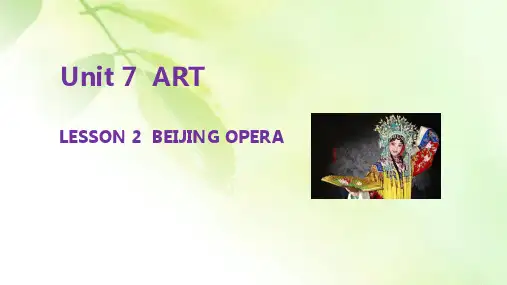
Unit 7 Art Lesson 2 Beijing Opera
Activity 1 Have you ever watched Beijing Opera? Share your experience.
Vo c a b u l a r y Peking=Beijing ancient role lyric instrument unique charm
of opera • Student B: a foreign student, who does not understand opera and
asks questions
●Thank You
Activity 7
Listen to a dialogue about Beijing Opera.
Answer the questions.
1. Who went to see Beijing Opera? Lucy went to see Beijing Opera.
2. How did the person feel about it? She felt that it was an excellent show.
Match.
1. female roles 3. male roles with brightly painted masks
2. common male roles 4. clown roles
a. ___1_____
b. ___4_____
c. ___2_____
d. ___3_____
Activity 2
Activity 4
Understanding Logical
Relationships
● Logical relationships usually refer to the inner relationships between/among things, like between causes and effects.
•
While you are listening, listen for key words like why and because.
•
Take notes of the reasons.
Activity 4
Listen, take notes and answer t h e q u e s t i o n s . 1. Why is Beijing Opera a national treasure of China?
Costumes are in bright colours because in the past, it was often performed on stages that were lit only by oil lamps. The costumes had to have bright and colourful patterns. Otherwise, it would have been difficult to attract the audience’s attention.
Beijing Opera is a national treasure of China because it uses acting, talking, ● 2s.inWghiyngdo, mpeurfsoircm,edrsansicnigngin avnerdy ahicgrhovboaictiecss?. All of those forms are difficult to master.
Listen and tick the aspects that are mentioned on a radio programme.
□√ main roles □ instruments □√ the unique sound □√ costumes
Activity 3
Listen again and answer the questions.
6 But there were quite a few things I didn’t understanrde.g(ret
)
7 I wish I knew more about them.r(egret
)
Activity 9
Pair Work: Act it out.
Act out a dialogue between a Chinese student and a foreign student after watching a local opera. • Student A: a Chinese student who understands the different elements
Activity 6
Introduce Beijing Opera to a group of students from another country.
Activity 7
Is there anything confusing you when you watch Beijing Opera?
● 3P. eWrhfoyramreetrhsescinosgtuwmieths ivnebrryighhitgcholvoourics?es because in the early days, it was usually performed on open-air stages. In order to be heard over the crowds, the music had to be loud and performers had to sing in very high voices.
1. When did Beijing Opera start? It started in the late eighteenth century.
2. What forms of performance are combined together in Beijing Opera? It uses acting, talking, singing, music, dancing and acrobatics.
Activity 5
1. Listen again. What key phrases did Dr. Liu use to give reasons?
Yes. That’s why … This is because … In order to be … Otherwise, …
2. Do you like Beijing Opera?
Unit7ArtLesson3AMusicalGenius课件高中英语北师大版2

1 took charge of 4 jumped about 7 madly turning the pages
2 waving their hats 5 turned him to face 8 jumped to their feet
3 waving his arms wildly 6 backstage atmosphere 9 with a broad smile
轻松的坐着
complete :“圆满结束,彻底完成,竣 工”,后面要接且只能接名词或代词, 通常用来表示完成某个计划、理想、 事业、工程、建筑、书籍及作品等, 强调“完整”,含有从头到尾使其完 全齐备,补充其不足,或不完整之 处,使其成为一个完美的整体; finish:“完成,结束”,普通用词,强 调的是把事情“做完”了,不太在乎 过程及结果。
his arm and turned him to face the audience that the
great man realised his symphony was a success.
跳起来
be buried in: 埋头于、专心于
挽着胳膊
Read and explore
Later, Caroline remembered that Beethoven was not
4 As the final not signalled the end, the audience _______________________, clapping,
cheering, and _____w__a_v_in_g_t_h_e_ir_h_a_t_s_____.
jumped to their feet
Read and explore
Unit 7 Art Lesson 2 Beijing Opera 课件

appreciate... • not have strong
feelings about...
• This is
•
because...
• That is why... •
• The reason
why... is that...
• In my opinion,... •
(4 points) pronunciation(2Heploloin!tEs)veryone, welcome to our school. My name is... I’m very glad that you are
performance (2 points)
interested in Beijing Opera, which is a confidence (2 pnoaitniotsn)al treasure of China...
BceoinjitnegntOpercaovfreormalyl othue. information
(4 points) Does
he/she...
language
in the chart? (2Npooiwntys)ou’ve got ready to do Nhomakorabeathis!
add more information? (2 points) You can begin your introduction like this: fluency(2 points)
• I think...
•
watch Beijing Opera shows introduce it to our foreign friends organise some activities ...
新教材北师大版高中英语必修第三册Unit7 Art 精品教学课件
Unfortunately,Van Gogh's unique⑪ paintings weren't very popular and he only sold one painting in his lifetime.He also thought The Starry Night was a failure⑫.However,the fact remains that The Starry Night is now one of the world's most famous paintings.[2]
Ⅰ.语境填词 figure;exhibition;sight;masterpiece;atmosphere; visual;affect;striking;scream;component 1.We try and provide a very homely _a_tm__o_sp_h_e_r_e_. 2.More than seven million people have been _a_ff_e_c_te_d__ by drought.
[2]that 引导表语从句。 The Scream was painted by Edvard Munch in 1893.What makes it striking⑬ is that it shows a thin figure⑭ with an expression⑮ of fear—the figure's mouth is wide open and letting out a powerful scream ⑯.The figure covers his or her ears and looks directly at the viewer.This figure is set on a bridge above a dark,stormy⑰ sea,and against a burning⑱ orange-red⑲ sky.
高中英语讲义:Unit+7+ART+Section+Ⅲ+Lesson+2

Section ⅢLesson 2Ⅰ.Pre-listening—Translate the following words and phrases.1.female adj.女(性)的2.male adj. 男(性)的3.emotion n. 情感4.master v t. 掌握,精通n. 大师;主人5.refer v i. 提到;谈到6.refer to 提到7.perform v i.& v t. 表演;演出8.pattern n. 图案;花样,样式9.otherwise ad v. 否则;要不然10.absolutely ad v. 确确实实地;绝对11.movement n. 动作;活动12.represent v t. 代表;表现;展现13.complex adj. 复杂的14.aspect n. 方面Ⅱ.While-listening1.Finish Ex.2-Ex.5 on Page 12~13.2.Finish Ex.7-Ex.8 on Page 13.Ⅲ.Post-listening—Translate the following sentences into Chinese.1.It is said that there are four roles Beijing Opera performers can play.据说京剧演员可以扮演四种角色。
2.Otherwise, it would have been difficult to attract the audience’s attention.否则,就很难吸引观众的注意力。
3.I was worried because Beijing Opera is so different from theatre shows in the US.我很担心,因为京剧和美国的戏剧表演太不一样了。
4.It seems like so many aspects of Beijing Opera come from ancient traditions.似乎京剧的很多方面都来自古老的传统。
2019-2020新教材北师大版高中英语必修第三册课件:UNIT 7 ART LESSON 2 BEIJING OPERA
was
ciotmsplex
tune
(simple).
• (3)We have language and use it to express (complexity)ideas.
• ◆单句写作
• (4) The _________ __________ (复杂的关系)
• 词汇五 aspect n. 方面;方位;外貌
• (3)Write down the phone number of that restaurant for future
(refer).
reference
• ◆单句写作
•
(4) Some scientific have come true now.
storrபைடு நூலகம்eefesrsthtois
book
____
endingw.as full of emotion
• ◆单句写作
• (3) 他正试图控制自己的情绪。
• He was attempting to ______ _____ _____ .
• 词汇七 quite a few 相当多;不少(后接可数名词)
• ◆教材原句 • But there were quite a few things I didn’t understand. 但
• (2) You’d better hwuilrl rreygr,et exhibition.
you’ll miss the
• ◆单句写作
would do
• (3) 抓住机会,要不然你会后悔的。
• Seize the chance,otherwise you
it.
• (4) 今天我身体不舒服,否则这事我就会亲自去做了。
Unit7ArtLesson2BeijingOpera(第一课时)教学设计高中英语北师大版
本单元属于“人与社会”主题语境下的“文学、艺术与体育”子主题。
单元主题大观念为“感受艺术魅力,赏析艺术精神,享受艺术人生。
”单元语言大观念为“运用与艺术相关的词汇和表达方式,多角度、多维度地赏析艺术形式,评析艺术精神,表达个人观点并呼吁参与艺术活动。
”本课是第七单元的听说课,话题围绕国粹京剧展开,学生通过了解京剧的基本信息和特色,学会欣赏京剧,多角度感受国粹京剧魅力,增强文化自信。
通过Lesson 1 Masterpieces(西方绘画名作)和本课L esson 2 Beijing Opera(京剧)的学习,在语言小观念1“围绕艺术形式整合性学习相关词汇和表达方式”的辅助下,学生将逐步形成单元主题小观念,即“赏析古今中外的艺术盛宴”。
本课包含两个听力语篇,第一个听力语篇介绍了京剧的主要相关信息,第二个听力语篇围绕观赏京剧后的感受展开,重点关注情感的多样表达方式。
因此,教师分别围绕两个听力语篇进行了两个课时的教学设计。
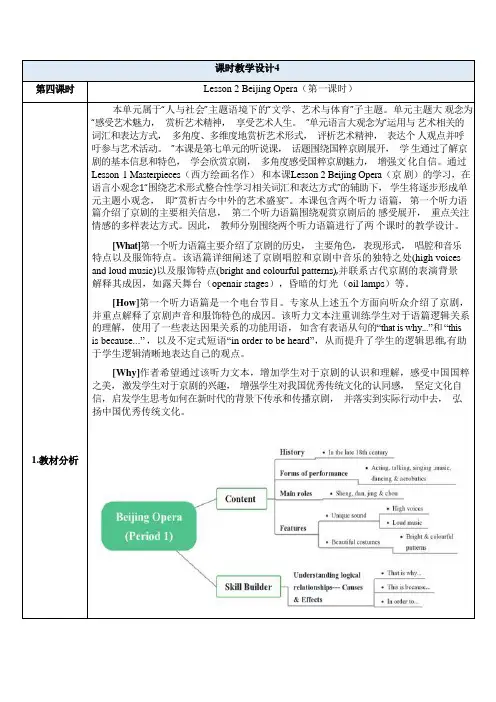
[What]第一个听力语篇主要介绍了京剧的历史,主要角色,表现形式,唱腔和音乐特点以及服饰特点。
该语篇详细阐述了京剧唱腔和京剧中音乐的独特之处(high voices and loud music)以及服饰特点(bright and colourful patterns),并联系古代京剧的表演背景解释其成因,如露天舞台(openair stages),昏暗的灯光(oil lamps)等。
[How]第一个听力语篇是一个电台节目。
专家从上述五个方面向听众介绍了京剧,并重点解释了京剧声音和服饰特色的成因。
该听力文本注重训练学生对于语篇逻辑关系的理解,使用了一些表达因果关系的功能用语,如含有表语从句的“that is why...”和“thisis because...”,以及不定式短语“in order to be heard”,从而提升了学生的逻辑思维,有助于学生逻辑清晰地表达自己的观点。
Unit7ArtLesson2BeijingOpera第1课时教学设计高中英语北师大版
第1课时教学过程
教学目标1 学习活动效果评价预计
时间
获取梳理京剧的基本知识。
Step 1: Activate and share
T shows the four main roles of Beijing Opera and
guide Ss to tell the topic of this lesson: Beijing
Opera.
T creates a situation: Some British high school
students came to our school. They visited the
Beijing Opera club and they wanted to know more
about Beijing Opera from you.
What do you know about Beijing Opera?
学生能够根
据图片说出
本课主题
“Beijing
Opera”
2’
设计意图:
【驱动】激活学生在“京剧”这一主题的背景知识,通过创设真实情境问题,学生认识到自己在内容和语言上的双重不足,激发学生学习兴趣。
Step 2: T shows some pictures and some words that
Ss are unfamiliar with. T guides Ss to match the
words with the pictures.
Ss read after T together.
学生能够读
出生词,并
根据图片猜
出生词含
义,将图片
和单词进行
匹配
3’。
高中英语外北师大版(2019)必修第三册-Unit 7 Art Lesson 2 Beijing O
Unit 7 ArtLesson 2 Beijing Opera【教学目标】Students will be able to1. read and talk about Beijing Opera2. listen for understanding3. recall information previously heard4. express and discuss emotions【教学重难点】1. talking about Beijing Opera2. expressing and discussing emotions【教学过程】1. Talk about Beijing Opera(1) Ask the students if they have watched Beijing Opera and what their experiences were. Write these examples on the board.(2) Discuss the questions as a class. Ensure that all students get a chance to answer the questions.(3) Instruct students to work independently and match the photos with the descriptions.(4) Discuss the answers as a class.2. Listen and tick.(1) Ask a volunteer student to read the four aspects. Explain any unknown terms.(2) Instruct students to tick the aspects that are mentioned as they listen to the radio programme.3. Listen again and answer questions.(1) Explain to students that they will listen to the radio programme once more, and this time to listen for details.(2) Preview the questions with the students.(3) Suggest that students underline or take notes as they listen.(4) Students work independently or in pairs to answer the questions in full sentences.(5) Check answers as a class. If needed, replay the radio programme and point out the different features of Beijing Opera.4. Listen again, take notes, and answer questions.(1) Read aloud the instruction and the Skill Builder. Then read each question. Explain any difficult words.(2) In pairs, students discuss the answers.(3) While the radio programme is playing, students check and complete their answers.(4) Discuss the answers as a class.5. Listen again. List key phrases and talk about whether you like Beijing Opera.(1) In pairs, students listen and take notes of the key phrases used by Dr. Liu to give reasons.(2) Review the answers as a class.(3) Create a class discussion on the students’ opinion of Beijing Opera. Each student needs to provide their opinion and support with logical reasoning.6. Introduce Beijing Opera.(1) Divide students into five groups. Each group discusses one of the topics in relation to Beijing Opera: the four roles, costumes and masks, sound and singing, history and interesting features.(2) Each group selects one person to be the scribe and write down notes for the group.(3) Each student in the group describes the chosen topic. The scribe can mind map this information.(4) Each group writes a few complete sentences about their topic on Beijing Opera using these descriptions.(5) A volunteer from the group reads this passage to the class, role playing that he or she is introducing Beijing Opera to a group of foreign students.(6) The class can ask questions about the topic and members from the group can help to answer the questions.7. Listen and answer.(1) Read the instruction and questions aloud to the students.(2) Play the dialogue.(3) In pairs, students answer the questions in full sentences.(4) If needed, play the dialogue a second time. Give the students time to complete the answers.(5) Discuss the answers as a class.8. Listen, imitate, and talk about emotions.(1) Read aloud the instruction and the Talk Builder box as a class. Explain any unknown terms.(2) Ask students to give a personal example of an emotion, either satisfaction, worry or regret.a. What do these emotions mean?b. Which are positive emotions and which are negative emotions?c. How can your facial features or tone of voice show these emotions?Students can use their dictionaries, if needed.(3) Tell students that they will listen to the dialogue for more detail.(4) As students listen to the dialogue, they need to identify the emotion for each sentence in the brackets.(5) Review the answers as a class.9. Pair Work: Act it out.(1) Explain to students that they will be watching a short local opera. Students need to take notes of the roles, costumes and masks, sound and singing, history and interesting features. Play only some parts of the prepared video, either from TV or from online resources.(2) Divide the class into pairs. Tell students that they will role play a dialogue between a Chinese student and a foreign student.(3) Student A is role playing a Chinese student, who understands the different elements of opera. Student B is role playing a foreign student, who does not understand opera and asks questions.(4) In pairs, students first write down five questions that a foreign student would ask about the opera; then students provide responses in a script format.(5) Students can practise their role play and perform it for the class.。
Unit7+Art+Lesson3+A+Musical+Genius课件高中英语北师大版必修第三册
It is a musical style that originated at the beginning of the 20th century in African American communities in the Southern United States.
Jazz
It’s considered to be serious. It has a value that continues for a long time.
surprised
Audience’s reaction to the performance
The audience did not hesitate to applaud loudly as the
famous composer walked out onto the stage for the first
a. More than 100.
b. More than 200.
c. More than 300.
Read for structure
Read the story again. Then finding the main idea of the passage and each paragraph
P14 2
answers to the quiz.
1. What is Beethoven most famous for?
a. His piano performances.
b. Conducting orchestras.
c. Composing music.
2. Where was Beethoven born?
Para(s). __3_-6___: Performance of Symphony No. 9
新教材北师大版高中英语必修第三册全册精品教学课件(共620页)
Ⅱ.While-listening 1.Finish Ex 2 on Page 6. 2.Finish Ex 4 on Page 7.
Ⅲ.Post-listening—Listen to 7.2 again and fill in the blanks.
(E=Eric
D=Daisy)
E:What are you doing on Saturday afternoon, Daisy? I have tickets for ①_B_e_i_ji_n_g_O__p_e_ra_!
Ⅲ.Talk about what you think about art using the following sayings or proverbs. 1.The love of beauty is an essential part of all healthy human nature.
Ⅱ.文化知识习得
梵·高简介 文森特·威廉·梵·高,出生于荷兰南部布拉邦特,毕业于蒂尔堡大学,荷兰后印象 派画家,是表现主义的先驱,深深影响了二十世纪艺术,尤其是野兽派与德国表现 主义。 梵·高的作品有《星夜》、《向日葵》、《有乌鸦的麦田》等。他的作品现已跻 身于全球广为人知的艺术作品的行列。他在2004年票选最伟大的荷兰人当中,排名 第十位。
5.He showed his unusual talent for piano at the age of 3, when he began to play the piano. 他三岁开始弹钢琴的时候,在钢琴方面显示了非凡的天赋。
6.In addition to improving creativity, learning music will be useful to children throughout their lives. 除了提高小孩的创造力外,学习音乐使小孩终生受益。