
过去时和现在时语法
I am not或 I’m not
No,
you/we/they are not或
aren’t
happy.
he/she/it is not 或 isn’t
结构:系动词Be+主语+其他? 肯定回答:Yes,主语+be. 否定回答:No,主语+be+not.
提示:am not不能写为amn‘t,无缩写形式.
1 2 3 绝大多数动词 以e结尾的动词 +ed +d walk-walked live—lived cry—cried
以辅音字母+y结 变y为ied 尾的动词 以一个元音字母 +一个辅音字母 结尾的短动词
4
双写末 尾的辅 音Байду номын сангаас母 +ed
stop-stopped
提示: 以元音字母+y结尾的动词 按第一条规则,即:+ed, 如: stay —stayed play--played
2.There was some orange juice in the cup. (一般疑问句) _____ Was there _____ any orange juice in the cup?
1.I
was very hungry when I get home. (改为一般疑问句) Were you —— —— very hungry when you get home? 2.Tim was late for work because he missed the bus.(对划线部分提问)
happy
主语+系动词be+not+其他. 特别提示:am not 不能缩写为amn’t.
一般现在时be动词的 一般疑问句及其肯定回答
Am
I happy? Yes,
I
am.
you/we Are /they Is
you/ we/ are. they
he/she /it
he/she/it
is.
一般疑问句的否定回答
3
4 5
改变了辅音
元音和辅音都变化 其他的
Infinitive am/ is are begin become bring build buy can
Past tense was were began became brought built bought could
Infinitive catch come do draw drink eat get fly
Past tense caught came did drew drank ate got flew
写出动词的过去式: 1.go__________ went 3.hear_________ heard could 5.can__________ replied 7.reply__________ 9.run__________ ran 11.happen________ happened 13.tell__________ told 15.look_________ looked searched 17.search________ made 19.make_________ 21.pick_________ picked
Simple past tense of the verb ‘to be’
was 1. I _______ (be) born in 2000. were (be) at home yesterday. 2.We _______
肯定式:主语 + was / were + …
1.She _______ wasn't (not be)at home. 2.The English and Maths papers weren't _______(not be)easy enough for me.
写出下列动词的过去式。
want— wanted talk — talked like — liked worry — worried try — tried stop — stopped
1
2
没有变化
改变了元音
cost-cost
put-put
write-wrote know-knew
make-made spend-spent leave-left teach-taught am/is-was are-were
用法口诀:
“我(I)”用am ,
“你(you)”用are,
“is用于“他(he)”、“她(she)”、“它(it)”,
复数人称we/you/they 都用“are”。单
数名词和不可数名词用is ,复数名词全 用are.
一般现在时be动词在
肯定句中的用法 I am 或 I’m You/We/They are或
Please look at the following sentences.
我今年12岁。 I am twelve years old. 我去年11岁。 I was eleven years old last year.
他现在在家里。 He is at home now.
Please look at the following sentences. 他昨天在家里。 He was at home yesterday. 他们今天在中国。 They are in China today. 他们昨天在中国。 They were in China yesterday.
肯定句:Simon and Sandy are classmates. 否定句:Simon and Sandy aren’t classmates. 疑问句: Are Simon and Sandy classmates?
肯定回答: Yes, they are.
否定回答:No, they aren’t.
1. Paul and I ______ tennis yesterday. He did much better than I. (2011北京) A. play B. will play C. played D. are playing 2.She stayed there for a week.(划线部分
1. A:What ___(be) his name ? B:His name ___(be) Tom. 2. A:___(be)you Mike’s classmate? B:Yes,I ___(be). 3. A:What ___(be) your brother? B:He ___(be) a doctor. 4. A:___( be) they your new classmates? B:No,they___(be not) 5.A:___(be) this your e-dog ? B:No, it __(be not)
一般疑问式: Was / Were + 主语 + …? Yes, 主语 + was / were. No, 主语 + was not (wasn’t) / were not (weren’t).
1. — Where were you last Saturday? — I ____ in the Capital Museum. (2012北京) A. am B. will be C. was D. have been
———
Why
———Tim late for work?
was
She
played ping-pong last Sunday. She didn't stay there for a week.
Did the boy play basketball yesterday afternoon?
Guide One
• 请大家在5分钟 之内相互讨论一下,看看谁能
在最短的时间内总结的又快又准。
• 1. I am a teacher. • 2. You are students.
• 3.Her hair is long.
• 4. I am not a teacher. • 5.Are you good at swimming?
No, he didn’t .
一般过去时的肯定式、否定式和一般疑 问式的构成 肯定式: 主语 + 动词的过去式 + …
He cleaned his room last week.
否定式: 主语 + did + not + 动词原形 + …
He did not / didn’t clean his room last week.
Simple past tense & Simple present tense
Teaching aims
1.Master the different forms of the verb
to be or do.
2.To compare the usage of the Simple Past
Tense and the Simple Present Tense.
2.sit___________ sat turned 4.turn_________ asked 6.ask__________ 8.leave_________ left 10.see__________ saw 12.say__________ said stood 14.stand________ came e________ found 18.find_________ put 20.put__________ 22.take_________ took
布置作业:用be的适当形式填空
动词时态全面解析过去现在将来
动词时态全面解析过去现在将来动词时态全面解析:过去、现在、将来动词时态是语法中一个非常重要的概念,它描述了动作发生的时间。
根据不同的时间点,动词时态可以分为过去时、现在时和将来时。
本文将对这三种时态进行全面解析,并讨论它们在不同语境下的用法和形式。
一、过去时态过去时态用于表达在过去某个特定时间内或过去的某个时间段内发生的动作或状态。
在英语中,过去时态主要有三种形式:一般过去时、过去进行时和过去完成时。
1. 一般过去时一般过去时是过去时态中最常用的形式,表示过去某个时间内发生的动作或状态。
它通常使用动词的过去式形式。
例句1:Yesterday, I went to the park and played basketball with my friends.(昨天,我去了公园并和朋友们打了篮球。
)例句2:He studied English for two hours last night.(昨晚他学了两个小时的英语。
)2. 过去进行时过去进行时描述过去某个时间点或某个时间段内正在进行的动作。
它由“was/w ere + 动词的ing形式”构成。
例句1:She was cooking dinner when I called her.(当我给她打电话时,她正在做晚饭。
)例句2:We were watching a movie at that time.(那个时候我们正在看电影。
)3. 过去完成时过去完成时用来表示过去某个时间或事件之前已经完成的动作。
它由“had + 过去分词”构成。
例句1:By the time I arrived, they had already left.(当我到达时,他们已经离开了。
)例句2:She had finished her homework before dinner.(晚饭之前,她已经完成了她的家庭作业。
)二、现在时态现在时态用于表示目前正在发生的动作或状态,也包括一些客观事实和普遍真理。
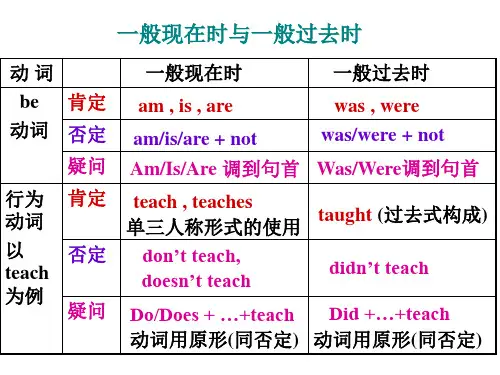
一般现在时与一般过去时用法比较
练习
1. I ___g_e_t_u_p_______ (起床)at six o’clock every day . 2. He often ___g_o_e_s_t_o_s_c_h_o_o_l_____ (上学) by bike . 3. Sometimes they __p_l_a_y____(踢) football after school . 4. He __k_n_o_w__s_ (懂)not only English but also Japanese . 5. I ____l_ik_e__si_n_g_i_n_g________ (喜欢唱歌). 6. She ___l_o_o_k_s_l_ik_e_______ (看起来像)her sister . 7. He _i_s___ always __re_a_d_y__t_o_____(准备) help others . 8. Children __li_k_e_t_o__p_la_y________(喜欢玩) this game. 9. He __li_v_e_s___(住) in the center of the town . 10.The moon ___m_o_v_e_s__ (转)around the earth and the
知识回顾 Knowledge Review
祝您成功!
things worked when he __w_a_s___ (是)a little child .
32. Lei Feng __w_a_s____ always __re_a_d_y__t_o_h_e_l_p__(准备帮助)
the people in trouble .
Hale Waihona Puke 33. I __t_h_o_u_g_h_t__(原来以为) I put my ticket in my pocket . 34. Hi ! Lucy ! I __d_i_d_n_’_t _k_n_o_w__ (不知道) you were here . 35. I _w__a_s_n_’t__ (不在)here last week . 36. _D__id__ you _h_a_v_e__a_g_o_o_d__t_im__e__ (玩得开心)last night ?
英语语法过去时现在时
英语语法过去时现在时The past tense in English is used to talk about actionsor events that have already happened. It is formed byadding "-ed" to regular verbs, while irregular verbs have specific forms. For example, "walked" is the past tense of "walk," but "ate" is the past tense of "eat."The present tense in English is used to talk aboutactions or events that are happening now or regularly. Itis formed by using the base form of the verb, with orwithout the addition of "-s" for third person singular. For example, "I walk to school every day" or "He walks toschool every day."In English, the past tense and present tense are often used together to provide context or describe a sequence of events. For example, "I walked to school yesterday, but today I am taking the bus."中文:英语中的过去时用于谈论已经发生的动作或事件。
动词时态的全面解析准确运用过去现在和将来时

动词时态的全面解析准确运用过去现在和将来时动词时态的全面解析及准确运用过去、现在和将来时动词时态是英语语法中的一个重要部分,它用来表达动作或状态发生的时间。
正确地运用时态可以使句子更加准确、流畅,并能够有效传达我们所要表达的意思。
本文将对动词时态进行全面解析,并指导如何准确运用过去时、现在时和将来时。
1. 过去时(Past Tense)过去时用于描述已经发生过的动作或状态。
一般过去时表示的是过去某个特定时间发生的动作,例如:I watched a movie last night.(昨晚我看了一部电影。
)He lived in London for five years.(他在伦敦生活了五年。
)除了一般过去时外,过去时还有以下几种形式:1.1 过去进行时(Past Continuous Tense)过去进行时表示过去某一时间正在进行的动作,或过去某一时间段内连续发生的动作,例如:I was watching a movie when she called me.(她给我打电话时,我正在看电影。
)They were playing basketball from 4 pm to 6 pm yesterday.(昨天从下午4点到6点,他们一直在打篮球。
)1.2 过去完成时(Past Perfect Tense)过去完成时表示在过去某个时间之前已经发生的动作,例如:She had already finished her homework before he arrived.(他到之前她已经完成了作业。
)They had known each other for ten years before they got married.(他们在结婚前已经认识了十年。
)1.3 过去完成进行时(Past Perfect Continuous Tense)过去完成进行时表示过去某一时间之前一直在进行的动作,例如:I had been waiting for two hours when the bus finally arrived.(公交车最终到达时,我已经等了两个小时了。
英语语法过去式现在时将来时
英语语法过去式现在时将来时
英语语法中的过去式、现在时和将来时是描述动作或状态在不同时间段的表达方式。
1.过去式:表示在过去某个时间发生的动作或状态。
动词
的过去式通常通过在动词后面加上“-ed”形式来表示,如“played”是“play”的过去式。
2.现在时:表示当前正在进行的动作或存在的状态。
动词
的现在时形式通常是在动词原形的基础上进行变化,如“run”
是“run”的现在时形式。
3.将来时:表示在将来某个时间将要发生的动作或状态。
动词的将来时形式通常是在动词原形的基础上加上助动词“will”或“be going to”,如“will run”或“be going to run”都是“run”的将来时形式。
这些时态是英语语法中非常重要的概念,能够帮助我们更准确地表达和理解时间上的动作和状态。
英语语法16种时态总结(经典收藏版)

英语语法16种时态总结(经典收藏版)时态是英语中⼀个重要的语法范畴,它表⼀不同时间发⼀的动作或存在的状态以及动作发⼀或存在的⼀式。
动作发⼀的时间可分为现在、过去、将来和过去将来四种形式,动作发⼀的⼀式可分为⼀般、完成、进⼀和完成进⼀四种形式。
将这时间形式和动作⼀式结合起来,就构成了以下16种时态形式(以do为例):⼀般完成进⼀完成进⼀现在⼀般时现在完成时现在进⼀时现在完成进⼀时现在do have done is doing have been doing过去⼀般时过去完成时过去进⼀时过去完成进⼀时过去did had done was doing had been doing将来⼀般时将来完成时将来进⼀时将来完成进⼀时将来will do will have done will be doing will have been doing过去将来进⼀时过去将来完成进⼀时过去将来⼀般时过去将来完成时过去将来would do would have donewould be doing would have been doing1. ⼀般现在时(do/does; is/am/are)①表⼀现在的情况、状态和特征。
例:He is a student.他是⼀个学⼀。
②表⼀经常性、习惯性动作。
例:He always helps others.他总是帮助别⼀。
③客观事实和普遍真理。
例:The earth moves the sun.地球绕着太阳转。
④表⼀⼀个按规定、计划或安排要发⼀的动作。
(常⼀于列车、客车、飞机或轮船时刻表)例:The next train leaves at 3 o'clock this afternoon.下⼀趟⼀车今天下午3点开车。
⑤主将从现:在时间、条件和让步状语从句中经常⼀⼀般现在表⼀将的来事情。
例:If it rains tomorrow, we will stay at home.如果明天下⼀,我们会待在家⼀。
现在进行时和过去进行时的用法和区别
现在进行时与过去进行时得用法与区别现在进行时态一、现在进行时得构成现在进行时就是由“助动词be+现在分词(doing)”构成。
其中助动词be要根据句子主语得人称与数,分别变化为am, is 或are三种形式。
二、现在进行时得用法1、表示说话时正在进行得动作。
如:We are waiting for you、我们正在等候您。
2、习惯进行:表示长期得或重复性得动作,而说话时动作未必正在进行得时候,用现在进行时态。
如: We are reading English in the morning this week、这个星期得早晨我们在读英语。
She is learning piano under Mr、 Smith、她正在跟着史密斯先生学钢琴。
3、与always, constantly(经常地), forever(永远地)等频度时间状语连用,表示反复发生得动作或持续存在得状态,往往带有说话人得厌烦、气愤、赞许等感情色彩。
也要用现在进行时态。
如: You are always changing your mind、您总就是改变主意。
(生气)She is always thinking of others、她总就是为别人着想。
(赞许)4、e , go , leave, arrive , fly等少数表示位置移动得动词,它们常用现在进行时态来表示将来得动作。
如:He is leaving Shanghai for Guangzhou the day after tomorrow、(她将于后天离开上海去广州。
)三、现在进行时态得常用时间状语1、表示说话人说话时,常用now, Look! Listen !等。
如:Look ! They are playing football、瞧!她们正在踢足球。
2、表示“近阶段”时,常用these days , this week , thiswinter (spring , summer , autumn )等。
4种时态(一般现在时_一般过去时_一般将来时_现在进行时)的时间状语及用法
四种时态的时间状语及用法一般现在时1.用法:1)表示经常性、习惯性的动作或状态2)表示事物或人物的特征、状态3)表示客观事实2.谓语动词:do/does(动词原形\动词第三人称单数形式)3.时间状语:always,usually, often,sometimes,never, at times(偶尔), oncea week,every…(every day,every morning, every year…) on Sundays,,on weekends注意:当主语是第三人称单数时,谓语动词要用第三人称单数形式一般过去时1.用法:1)表示在过去的时间发生的动作或存有的状态2)表示过去经常或反复发生的动作(能够和often,always等表示频率的时间副词连用)2.谓语动词:did(动词过去式)3.时间状语:yesterday, the day before yesterday(前天) ,two days ago, last week,in 2008附:常见动词及其过去式一般将来时1.用法:1)表示将来的时间要发生的动作或存有的状态2)表示打算、计划、决定要做某事2.谓语形式:will/shall+动词原形/be going to +动词原形3.时间状语:next week,this Sunday,next time,tomorrow,the day after tomorrow(后天),现在实行时1.用法:1)表示现在(说话瞬间)正在实行或发生的动作2)表示当前一段时间内的活动或现阶段正在实行的动作2.谓语形式:am/is/are+动词ing形式3.时间状语:now,these days(这几天)附:常见动词及其-ing形式。
时态使用指南正确运用过去现在和将来时
时态使用指南正确运用过去现在和将来时时态使用指南:正确运用过去现在和将来时时态是英语语法中的重要部分,它用于描述动作或事件发生的时间。
正确使用时态可以使句子更加准确和流畅。
本文将为你介绍如何正确运用过去、现在和将来时态。
一、过去时(Past tense)过去时态用于描述已经发生的动作、习惯或状态。
它可以分为简单过去时、过去进行时、过去完成时等形式。
1. 简单过去时(Simple Past)简单过去时用于单个动作或事件,表示发生在过去的特定时间。
通常使用动词的过去式。
例如:She walked to school yesterday. (她昨天走到学校。
)2. 过去进行时(Past Continuous)过去进行时用于过去某个时刻正在进行的动作或事件。
结构为was/were + 动词的ing形式。
例如:They were playing soccer when it started to rain. (当雨下起来时,他们正在踢足球。
)3. 过去完成时(Past Perfect)过去完成时用于描述在过去某个时间之前已经完成的动作或事件。
结构为had + 过去分词。
例如:He had already finished his homework before dinner. (他在晚饭前已经完成了作业。
)二、现在时(Present tense)现在时态用于描述现在正在进行或普遍存在的动作、状态或习惯。
它可以分为简单现在时、现在进行时、现在完成时等形式。
1. 简单现在时(Simple Present)简单现在时用于表达经常性或习惯性的动作或事件,或者描述客观事实。
通常使用动词的原形。
例如:She often reads books in her free time. (她空闲时间经常读书。
)2. 现在进行时(Present Continuous)现在进行时用于描述现在正在进行的动作或事件。
结构为am/is/are + 动词的ing形式。
七年级下册英语语法《一般现在时和一般过去时的区别》知识点
一般现在时和一般过去时的区别对英语动词“时”的理解:在英语中,“时”(TENSE)是有关动词的一个语法范畴,它是表示时间区别的动词形式。
英语动词有两个“时”,即现在时(Present Tense)和过去时(Past Tense)。
一般现在时:现在时是主要表示现在时间的动词形式。
一般现在时(Simple Present)指的是未与进行体或完成体相结合的现在时动词形式。
一般现在时动词的使用规则:一般现在时通常是以动词原形表示的,但在主语为第三人称单数时,动词词尾要加-s或-es。
规则如下:1)当动词是以-s(-ss),sh,ch,x,o结尾时,加-es。
如:kiss-kisses wash-washes teach-teaches box(把……装箱)-boxes go-goes2) 当动词是以“辅音字母+y”结尾时,改y为i再加-es。
如:carry-carries fly-flies try-tries study-studies3)动词be的一般现在时表现形式是:am,is,are,根据人称和数的不同而分别采用。
4)have的第三人称单数形式为has。
5)除上述情况外,其余动词在词尾加-s。
6)-s或-es的读音规则和名词变复数后的读音规则相同。
一般现在时的用法:一般现在“时”属于时的语法范畴,它与现在时间的概念既有联系,又有区别。
一般现在时的各种用法都与现在时间有联系,即使用一般现在时来描述往事,也好像这一往事生动地浮现在讲述者的眼前。
但是,一般现在时与现在时间又有所不同。
在探讨一般现在时的用法时,必须把这一“时”的形式和它所表示的“时间” 内容区别开来。
一般现在时即可用于动作动词,也可用于状态动词,而用于状态动词的居多。
1)表示不受时间限制的客观存在:这一用法多用于状态动词,也可用于动作动词,表示客观真理和科学事实、格言及其他没有时限的客观存在。
如:Twice two is four. 2的的两倍是4。