
英语周报2016-2017学年高二外研版选修八:Module 3 课件 Reading 2 精品
2. Work in pairs and answer the questions about words in the passage.
1) What’s the difference between a king and a ruler?
2) What’s the difference between having a good time and entertaining?
Having a good time means enjoying oneself, while entertaining means making sure other people have a good time.
weekends. 3) Barbecues are a favourite way of
entertaining friends. entertain作__动___词,意为“使欢乐、使有兴 趣”(句1)、“招_待__、__款__待____”(句2、句3)。
4) I have never entertained any ideas
3) What’s the difference between tender and tough? Tender means soft and easy to eat, while tough means hard and difficult to eat.
tender/tough 1. Young leaves of trees are _t_e_n_d_e_r. As
they grow, they get ____to_u. gh 2. The meat which is not cooked
enough is _t_o_u_g_h_ and hard to eat.
4. What’s the difference between simply and casually?
King is a hereditary position; a King can also be a ruler---someone who rules over a country, but a ruler may be elected, and is therefore not always a king.
1. One evening he was entertaining the ruler of small island in the Pacific.
entertain 1) We were all entertained by his humourous
stories. 2) They often entertained their friends on
Edward VII was King of the United Kingdom of Great Britain and Ireland and of the British Dominions and Emperor of India from 22 January 1901 until his death.
2. As soon as the Polynesian guest tasted the asparagus he remarked how delicious it was.
remark 1) Mr. Anderson left the table, remarking
that he had some work to do. 2) The officer remarked on / upon the
2) Most people only eat part of the asparagus.
3) The Polynesian guest enjoyed eating asparagus.
4) The other guests did not talk about what the Polynesian guest did.
about him. 怀有(想法、希望、感觉等)。 [拓展] entertainment n. 招待、款待、娱乐 entertaining adj. 有趣的、娱乐的、使人愉 快的
用entertain的适当形式填空。 1) Every summer they _e_n_t_er_t_a_i_n_s the
s_i_m_p__ly_ because he was not careful enough. 2. It is not a very formal occasion, so you can dress _c_a_su__a_ll_y.
4. What’s the difference between embarrassment and misunderstanding? Embarrassment means feeling bad because you do the wrong thing without realising it when you did it, while a misunderstanding is some kind of problem created by people not knowing what the other one wanted them to do.
have a good time/entertaining 1) He _h_a_d_a__g_o_o_d__ti_m_e_ at the party
yesterday. 2) The differences of _e_n_t_er_t_a_in__in_g_
friends to dinner between the two cultures are amazing.
4) Ellen later regretted her remarks about Bill’s private affairs.
5) Her remarks on the employment question led to a heated discussion.
remark还可作名词,表示“谈论,言 论,评述”(句3至句5),常与介词 about或on搭配。
Simply means without making fuss or show about something; casually is very similar in this context, meaning in a relaxed way.
simply/casually 1. He lost so many marks in the exam
翻译下列句子。
1. My mother remarked how tired I looked. _我__母__亲__说__我__看__上__去__显__得__特__别__累__。_______
2. The similarities between the two have often been remarked on. _人__们__经__常__谈__到__这__两__者__的__相__似__之__处__。_____
3. Jim made a number of rude remarks about the food here.
关_于__这__里__的__食__物__吉__姆_做__了__许__多__无__礼__的__评__论_。
3. The cleaners weren’t very happy, but in the end most people had to agree that the King had been a perfect host, saving his guest and everybody else from the embarrassment which came from a misunderstanding of table manners. 虽然清洁工们很不高兴,但是最后大多数 人却不得不承认国王是一个完美的主人, 他把他的客人和其他的人从因为对餐桌礼 仪的误解而产ห้องสมุดไป่ตู้的窘境中解脱出来。
5) No one had explained the rules of English table manners to the Polynesian guest.
6) It is embarrassing to behave differently from other guests at a party.
embarrassment/misunderstanding 1. He didn’t know the table manners,
so he just followed the host to avoid e_m__b_a_r_r_a_s_sm__e_n_t. 2. _M__is_u_n_d_e_r_s_ta_n__d_in_g_ between people may cause quarrels.
king/ruler 1) A person who rules a certain place is a _r_u_le_r_. A _k_in__g may be a ruler. A _r_u_le_r_ is not necessarily a king. 2) George W. Bush is a _r_u_le_r_, but he is not a _k_i_n_g_.
difference in security measures at the two airports. remark可作动词,表示“说起,谈论,评论” (句1、句2),常见用法如下:remark +从 句(句1);remark _o_n_/_u_p_o_n_ sth.(句2)。
3) What exactly did you mean by that last remark?
外研版高中英语选修8教学课件 Module3 Foreign Food
cold food means 16.________ and you don’t give it to a guest.I alsomliexarned that the
(2)What impressed the writer most at the banquet? A.At first,everyone just tasted a bit of each dish. B.How bad a real Chinese banquet could be. C.The quantity of food served. D.He saw a kid cheerfully chewing a chicken’s head.
To my surprise,more dishes arrived.There was enough tfoee5d.________ a whole armays.pAenctother 6.________ of “food culture” is that the Chinese seem to epaatrat lmost every 7.________ of every anhimorarol—r much to the 8.________ of many westerners.And there are other kinds of foods thatahcacevpet taken longer for me to 9.________ex.Tahmeplienfamous choudoufu is an 10.________.
高二英语选修八课件ModuleSectionⅢ
课件的主题和目标
目标:帮助学生掌握本模块 的知识点和技能,提高英语 水平
主题:高二英语选修八 Module SectionⅢ
内容:包括词汇、语法、阅 读、写作等方面的知识
方法:通过讲解、练习、讨 论等方式进行教学
课件的主要内容
模块SectionⅢ的主题: 文化与交流
主要知识点:文化差异、 跨文化交际、文化适应等
的自信心和自我认知能力。
对教学资源的整合和利用
教材:充分利用 教材中的资源, 如课文、练习等
网络资源:利用 网络资源,如视 频、音频、图片 等,丰富教学内 容
学生资源:利用 学生自身的资源 和经验,如学生 的兴趣爱好、生 活经历等
教师资源:利用 教师的专业知识 和教学经验,提 高教学质量
6
课件的使用建议
口语交流:提供 一些口语话题和 练习,帮助学生 提高口语表达能 力
4
教学方法和手段
教学方法的选择和应用
教学方法的选择:根据教学内容和学生特点选择合适的教学方法
教学方法的应用:在实际教学中运用各种教学方法,如讲授法、讨论法、 实验法等
教学方法的创新:结合现代科技手段,如多媒体教学、网络教学等,提高 教学效果
词汇和语法部分
词汇:介绍本模块涉及的 重点词汇,包括单词、短
语和词组
语法:讲解本模块涉及的 语法知识点,如时态、语
态、句型等
练习:提供与词汇和语法 相关的练习题,帮助学生
巩固所学知识
拓展:介绍一些与本模块 相关的词汇和语法知识,
拓宽学生的知识面
练习和巩固部分
词汇练习:通过 填空、选择、翻 译等方式巩固词 汇
提高教学效果。
探究式教学:鼓励学生自 主探究、解决问题,培养 他们的创新思维和实践能
外研选修八英语module 3 Reading and Vocabulary language points精品课件

外研选修八英语module 3 Reading and Vocabulary language points精品课件
外研选修八英语module 3 Reading and Vocabulary language points精品课件
be obsessed with/by sth 对.....着迷
汤姆迷上彩票了,别的什么也不谈。
TOM is obsessed with lottery and talks about nothing else.
表示对什么着迷的类似的说法还有:
be fascinated by,be crazy about,be hooked on ,be attracted by
Language points
1.Chinese people think a lot about food. _________,I think that they are sometimes obsessed with it.
A.As a result B.However C.In fact D.What's more √
外研选修八英语module 3 Reading and Vocabulary language points精品课件
外研选修八英语module 3 Reading and Vocabulary language points精品课件
The food here goes against the chinese sense of beauty and style at the dinner table.
高中英语外研版选修8课件:Module3SectionⅢ IntegratingSkills
consequence n.后果;结果
(教材 P39)The consequence was that many people were overweight.后果就是许 多人超重了。
(1)in consequence
由于
in consequence of
由于……的原因
(2)of no/little consequence to sb. 对某人来说无关紧要
entertain v.招待;款待某人;请客;使有兴趣;使快乐 (教材 P35)One evening he was entertaining the ruler of a small island in the Pacific. 一天晚上,他正在款待太平洋中一个小岛的统治者。
(1)entertain sb.to sth. entertain sb.with sth. (2)entertaining adj. (3)entertainment n.
【答案】 B
be on close terms with 与……关系密切 (教材 P35)Even if you are on close terms with the host,you should wait to be offered something. 即使你和主人的关系很好,你也应该等着主人提供食物。
remark v.谈到;说起;评论 n.评论;意见;言论 (教材 P35)As soon as the Polynesian guest tasted the asparagus he remarked how delicious it was.那个波利尼西亚客人一尝到芦笋就评论说它是如何的可口。
take/accept the consequences of 承担……的后果
英语周报2016-2017学年高二外研版选修八:Module 3 课件 Writing 精品

Before long all my friends were laughing at my imitation. But none of us had noticed that Mr Jones had come into the class and was standing at the back watching my performance. As soon as I saw him, I blushed bright red and rushed to sit down at my desk. Every one else waited for him to shout at me, but instead he said: “That was a very good piece of acting, John. But I don’t think I walk quite so fast.”
of this month. 3. _In__t_h_e_e_n_d__, we solved that difficult
problem successfully. 4. They finally got the answer _a_t_t_h_e_e_n_d__
of the novel.
பைடு நூலகம்
Write about an embarrassing moment you (or someone you know) had. 1. Describe where you were and when it
Complete the sentences with at the end or in the end.
1. _A_t_t_h_e_e_n_d__ of the party everyone went home.
外研版2016-2017学年外研版英语选修8 16-17版 Module 3 Foreign Food
Module 3Foreign Food饮食是一种文化。
看看西方餐桌上的礼仪吧。
这将更好地帮助你了解中西方饮食文化有什么不同。
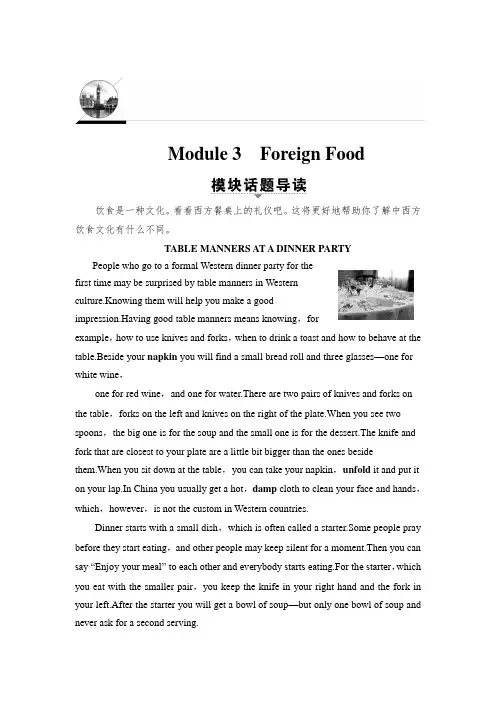
TABLE MANNERS AT A DINNER PARTYPeople who go to a formal Western dinner party for thefirst time may be surprised by table manners in Westernculture.Knowing them will help you make a goodimpression.Having good table manners means knowing,forexample,how to use knives and forks,when to drink a toast and how to behave at the table.Beside your napkin you will find a small bread roll and three glasses—one for white wine,one for red wine,and one for water.There are two pairs of knives and forks on the table,forks on the left and knives on the right of the plate.When you see two spoons,the big one is for the soup and the small one is for the dessert.The knife and fork that are closest to your plate are a little bit bigger than the ones besidethem.When you sit down at the table,you can take your napkin,unfold it and put it on your lap.In China you usually get a hot,damp cloth to clean your face and hands,which,however,is not the custom in Western countries.Dinner starts with a small dish,which is often called a starter.Some people pray before they start eating,and other people may keep silent for a moment.Then you can say “Enjoy your meal” to each other and everybody starts eating.For the starter,which you eat with the smaller pair,you keep the knife in your right hand and the fork in your left.After the starter you will get a bowl of soup—but only one bowl of soup and never ask for a second serving.The next dish is the main course.Many Westerners think the chicken breast with its tender white flesh is the best part of the bird.Some people can use their fingers when eating chicken or other birds,but never touch beef or other meat on bones.It is polite to finish eating everything on your plate,so don't take more food than you need.At table,you should try to speak quietly and smile a lot,but do not laugh all the time.1.napkin n.(吃西餐用的)餐巾2.unfold v. 展开,打开3.damp adj. 潮湿的4.tender adj. 嫩的5.at table 在吃饭;在进餐1.How many knives,forks,glasses,and spoons are there at a formal Western dinner party for each guest?________________________________________________________________ ________________________________________________________________ ________________________________________________________________ 2.When can people use their fingers at a formal Western dinner party?________________________________________________________________ ________________________________________________________________ ________________________________________________________________ 【答案】 1.There are two pairs of knives and forks,three glasses,and two spoons. 2.When eating chicken or other birds.。
外研版高中英语选修第八册 Module 3Revision and Writing上课课件(51张)
与……有共同点have … in common 总之in short 难怪no wonder 注视fix on
欠,把…归功于owe sth. to sth./sb. 由于owing to 结束end up doing/with sth.
理解make out 放火烧set fire to 不用说 needless to say 想做feel like doing sth.
满足…的要求fulfill/meet one’s requirements
要求某人做某事require sb. to do/ require that sb. (should) do
Multiple choice
• In the city people __D___ four tons tomatoes every year.
• 过时的 adj
outdated ________________________________
Hale Waihona Puke Translation• 澳大利亚作为世界上第六大的国家,以优美的风景闻 名,是一些野生动物的乐园,在这里来自不同文化和 社会背景的人都能体验精彩的生活。(一句话翻 可用 非谓语,插入语,从句)
Being famous for fascinating scenery, Australia, as the sixth largest country in the world, is home to the wildlife, where people from different cultural and social backgrounds can experience wonderful life.
Translation
外研英语选修8课件:Module3SectionⅣ
优化方案系列丛书
Module 3 Foreign
二、定语从句
定语从句一般都紧跟在它所修饰的名词后面。 语
法
被定语从句所修饰的名词或代词叫做“先行词”。
专 题
突
引导定语从句的词叫“关系词”。关系词有两个 破
作用:
写
作
1.引导定语从句;
专 题
突
2.代替先行词在其引导的定语从句中充当一定
破
的句子成分。
山东水浒书业有限公司·
写
whose 人、物
定语
which不可省。
作 专
关 系
when
时间
状语
when也可用in/on which 代替
题 突 破
副 where
地点
状语 where可用in which代替
词 why
原因
状语
why可用for which代替
山东水浒书业有限公司·
优化方案系列丛书
写
时不定式可转化为“
请给我找支钢笔写字用。
作 专
介词+关系代词+不
题 突
定式”
破
He met with his English teacher on his
way home.
副词作定语
在回家的路上,他遇上了他的英语老师 。
Are you content with the life here?
山东水浒书业有限公司·w你w对w.y这hfa里bo的ok.生com活满意吗?
山东水浒书业有限公司·
优化方案系列丛书
Module 3 Foreign
规则说明
例句
现在分词作定语
This is a most pressing problem. 这是一个非常紧迫的问题。
英语周报2016-2017学年高二外研版选修八:Module 3 教
附件Ⅰ. 课文注释与疑难解析1. Everything you see I owe to spaghetti.a. you see为定语从句,前面省略了关系代词that,当先行词为something, anything, everything, nothing等不定代词时,引导定语从句只能用that而不用which。
如:I will do everything that I can to help you.我将尽我所能来帮助你。
b. owe ... to ... (常与to连用)归功于;由于;欠,欠债She owes her success to good luck.她把成功归功于幸运。
The young writer owed his success to his teacher’s encouragement.年轻作家把自己的成功归于他老师的鼓励。
He still owes for what he bought last summer.他去年夏天买东西欠的钱还未还呢!2. No wonder my fellow guests had had only a few bites of each dish.难怪和我一块的客人每盘只吃一点菜。
(It’s) no wonder (that) 难怪;并不奇怪;当然。
No wonder he is not hungry; he has been eating sweets all day. 难怪他不饿,他整天在吃糖果。
Peter is always working hard. No wonder that he passed the exam successfully.彼特学习总是很努力,他顺利通过考试并不奇怪。
3. The first six or seven dishes seemed to fill the table, with plates dangerously balanced one on top of another.with plates dangerously balanced one on top of another 被称作介词“with复合结构”。
英语周报2016-2017学年高二外研版选修八:Module 3 教
Module 3 Foreign Food I.模块教学目标Ⅱ. 目标语言Target LanguageIII. 教材分析与教材重组1. 教材分析本模块以Foreign Food为话题,通过与饮食文化相关的材料反映了世界各地饮食文化的差异和丰富多彩,从而激发学生的学习兴趣和了解世界饮食文化的愿望,使他们更加热爱生活,追求生活中美好的事物。
本模块所选内容贴近学生生活,教师可以借助听、说、读、写和讨论等一系列扎实有效的教学活动,充分调动学生的积极性,提高其语言运用能力。
1.1 INTRODUCTION 以几幅食物图片切入话题,然后让学生讨论有关食物的谚语,为后面的阅读做好铺垫。
1.2 READING AND VOCABULARY(1)中包括两篇文章:第一篇文章主要通过一个美国人第一次参加中国宴席和吃臭豆腐的经历以及他对于中餐从吃惊到接受的过程,反映了中餐的特点和东西方饮食文化的差异;第二篇是描述一个中国人第一次在英国吃“西餐”的经历,以及因饮食文化的差异所引发的感受。
从这两篇文章,我们可以看出中西方饮食文化的差异。
两者各有千秋,“中餐”种类丰富,味美可口,而“西餐”似乎很简单,但餐桌礼仪却值得我们借鉴学习。
这两篇文章语言简练,幽默风趣。
与课文相关的练习Activities 1 and 3 要求学生采用快速浏览的方法确定相关的主题,潜移默化中培养学生skimming 这一重要阅读技巧;Activities 4 and 5 要求学生掌握与课文相关的语言知识;Activities 6 and 7 要求学生进一步理解课文并在此基础上进行讨论。
1. 3 GRAMMAR 分两部分。
GRAMMAR(1)旨在通过一系列语法练习,使学生掌握单词、短语和不定式,-ing形式, -ed形式作定语的用法。
GRAMMAR(2)通过多种形式的语法练习,要求学生掌握定语从句中的关系词及非限制性定语从句的用法。
教师可在此基础上做些拓展性和巩固性练习设计。