
2020版新一线高考英语人教版一轮复习教学案:第1部分必修4Unit4Bodylanguage含答案
Unit 4Body language[单词拼写应用]核心单词1.dormitory n.宿舍2.major adj.主要的v.主修3.approach v t.& v i.接近;走近;靠近n.接近;方法;途径4.likely adj.可能的5.hug v i.& v t.拥抱6.function n.作用;功能;职能v i.起作用;运转7.represent v t.代表;象征8.canteen n.食堂9.ease n.安逸;舒适v t.减轻(痛苦、忧虑)10.adult n.成年人[语境运用]用所给词的适当形式填空。
1.At the meeting they discussed three different approaches (approach) to the study of mathematics.2.Linda and I,representing (represent) our class,will take part in the contest to be held this weekend.3.The couple hugged (hug) each other when they heard the exciting news.4.The doctor will give you some medicine to_ease (ease) your pain.5.As adults (adult) ,we should be responsible for our own decisions.6.Li Hua,my best friend,is in Shandong University majoring(major) in English literature.拓展单词1.state v.陈述;说明→statement n.陈述;说明2.greet v i.& v t.迎接;问候→greeting n.问候;招呼3.associate v t.把……联系起来→association n.社团;联系;联想4.curious adj.好奇的→curiously ad v.好奇地→curiosity n.好奇;好奇心5.defend v t.保护;保卫→defence n.防御;保卫6.misunderstand v t.误解;误会→misunderstanding n.误解;误会7.spoken adj.口语的→unspoken adj.(反义词)未说出口的;非口语的8.angry adj.生气的→anger n.怒气;怒火9.true adj.真实的→truly ad v.真实地;真诚地;真正地→truth n.真实;真理[语境运用]用所给词的适当形式填空。
1.If you misunderstand somebody,it's likely to lead to a misunderstanding.(misunderstand)2.The curious boy looked at the box curiously and then he opened it out of curiosity.(curious)3.To tell you the truth,I'm truly grateful for your helping me make my dream come true.(true)4.In time of war,lots of money will be spent on defence and many measures will be taken to defend a country from being attacked.(defend)5.A speaker said that spoken language is quite different from written language in English-speaking countries.(speak)阅读词汇1.flight n.飞行;航班2.cheek n.面颊3.dash v i.猛冲;突进4.crossroads n.十字路口5.facial adj.面部的6.false adj.错误的;假的7.fist n.拳头8.yawn v i.打呵欠9.subjective adj.主观的10.rank n.等级;军衔11.posture n.姿势;体态12.cassette n.磁带拓展联想1.“以-le结尾的形容词去e加y变为副词”集锦①horrible→horribly②possible→possibly③comfortable→comfortably④gentle→gently⑤simple→simply2.“以-e结尾的形容词直接加-ly变为副词”示例①entire→entirely②complete→completely③fortunate→fortunately④wide→widely⑤rude→rudely3.常见“人体部位及器官”名词荟萃①cheek脸颊②forehead 额头③chest 胸④shoulder 肩膀⑤throat 喉咙熟词生义你知道下面句子中黑体词的汉语意思吗?1.(2018·全国卷Ⅰ)Over the years, there have been a number of different techniques to help designers approach this important point.着手处理2.(2015·重庆卷)Riding a horse through the flooded waters of Botswana's Okavango Delta must rank as one of the world's most exciting wildlife journeys.排名;位居[短语多维应用]④on_the_contrarysmile to cheer him up and at that moment the smile will put himforeigners ask you the directionsbody language to make him understand.In_general,body language is as important as精讲5个考纲单词1.represent vt.代表;描绘;声称(1)单句语法填空①Much to his delight,the top student will represent his school to_make(make) a speech at the meeting.②She represents her mother as the kindest mother in the world.(2)[链接写作]——一句多译我非常高兴代表我们学校告诉你们有关这些活动的一些事宜。
①Representing_our_school,I'm glad to tell you something about these activities.(represent)②On_behalf_of_our_school,I'm glad to tell you something about these activities.(behalf)先理解再牢记(1)represent...as/to be...宣称……为……;把……描绘成……(2)represent sb./ on behalf of代表某人(3)represent sth.to sb.向某人说明或传达某事(4)representative n.代表adj.典型的;有代表性的[佳句背诵]Last but not least,I feel it a great honour to represent my class to take part in the speech contest.2.curious adj.好奇的(1)单句语法填空①(2016·北京卷)In high school,I became curious about the computer,and built my first website.②People gathered round,curious to_know (know) what was happening.③They help us understand science subjects better and arouse our curiosity(curious) about scientific discoveries.(2)[链接写作]——句式升级(普通表达)He was curious about Australian cities,so he read the book written by Dr.Johnson.(高级表达)Curious_about_Australian_cities,he read the book written by Dr.Johnson.(形容词短语作状语)先理解再牢记(1)be curious about对……感到好奇be curious to do sth.渴望做某事(2)curiosity n.好奇;好奇心with curiosity 好奇地out of curiosity 出于好奇arouse/satisfy one's curiosity引起/满足某人的好奇心(3)curiously ad v.好奇地3.approach vt.& vi.走近;要求;接近;靠近n.接近;方法;途径(1)单句语法填空①The_best approach to building (build)up your body is to do exercise every day.②Approaching(approach) the city centre,we saw a stone statue of about 10 metres in height.③All the approaches(approach) to the airport were blocked by the police yesterday.(2)[链接写作]——句式升级(普通表达)As the college entrance examination is approaching,some students are getting more and more nervous.(高级表达)With_the_college_entrance_examination_approaching,some students are getting more and more nervous.(with 复合结构)先理解再牢记(1)be approaching临近,靠近with sth.approaching 在……快到的时候(2)(an) approach to 接近;近似;(做某事)的方法/途径at the approach of 在快到……的时候[联想发散]表示“……来临”的表达有:①be approaching②be drawing near③be around the corner4.defencen.[U]保卫,防卫(1)单句语法填空①All the people,men and women,young and old,were fighting against the flood in defence(defend) of their own homes.②It is said that the murderer has employed a famous lawyer to_defend(defend) him.③When a dog attacked me,I picked up a stick to defend myself (I).(2)[链接写作]——完成句子父母常会竭尽全力保护孩子免受伤害,这很自然。
高中英语人教版必修4Unit4教案
高中英语人教版必修4Unit4教案Unit 4: Body LanguageWarming Up and ReadingBy XXXnal Teaching Aims:Knowledge and Skills:1.To increase students' XXX.2.To enable students to discuss body language with ease.Ability Aims:1.XXX.2.XXX.3.XXX' XXX through individual and group work. XXX:1.To XXX interest in learning English.2.XXX diverse customs.XXX:1.Mastery of language points and their n in XXX.2.Development of respect for other cultures.Teaching Difficult Points:1.n of body language with partners XXX.2.XXX.XXX:1.Task-XXX and learning.2.Pair and group work to engage all students in the learning process.different ways.Task 2 Detailed readingRead XXX:1.What is body language?2.What are some examples of body language?3.How do people from different countries XXX?Step 5 Asking-and-answering activityDivide the class into pairs and ask them to discuss the following ns:1.What are some common gestures in your culture?2.How do you express XXX?3.XXX because of body language?Step 6 nToday we have learned about body language and how it varies in different XXX to pay n to your own body language and the body language of others。
新人教版必修42020版高考英语一轮复习Unit4Bodylanguage导学案
Unit 4Body language阅读词汇1.flight n. 飞行;航班2.cheek n. 面颊3.dash vi. 猛冲;突进4.simply adv. 简单地;只5.posture n. 姿势;体态6.crossroads n. 十字路口7.frown vi. 皱眉;蹙额8.misread vt. 读错;误解9.facial adj. 面部的10.fist n. 拳头11.yawn vi. 打呵欠12.respectful adj. 恭敬的13.subjective adj. 主观的14.rank n. 等级;军衔15.cassette n. 磁带16.employee n. 雇员识记词汇1.greet vi.& vt. 迎接;问候2.represent vt. 代表;象征3.dormitory n. 宿舍4.canteen n. 食堂5.curious adj. 好奇的6.curiously adv. 好奇地7.approach vt.& vi. 接近;靠近;走近n. 接近;方法;途径8.defend vt. 保护;保卫9.defence n. 防御;保卫10.major adj. 主要的6.be likely to 很可能……;有希望……7.turn one’s back to 背对8.on the contrary 正相反9.as well as 和……一样好;而且;也10.as if 好像句型整理1.The first person to arrive was Tony Garcia from Colombia,closely followed by Julia Smith from Britain.第一个到达的是从哥伦比亚来的托尼·加西亚,随后紧跟着的是英国的朱莉娅·史密斯。
2.Not all cultures greet each other the same way,nor are they comfortable in the same way with touching or distance between people.各种文化背景下人们互致问候的方式不尽相同,身体接触和相互间距离的程度也并不一样。
2024版高考英语一轮总复习教材复习Unit4教师用书新人教版选择性必修第一册

Unit 4 Body LanguageⅠ.词块记单词1.in our interactions with other people 在我们与别人的互动中2.witness another person nodding 当场看到另一个人点头3.interpret it as a sign of weakness 视为软弱的表现4.favour shaking hands 宁愿选择握手5.bow from the waist 弯身弓腰鞠躬6.break down barriers 打破障碍7.at the trial 在审判中8.make assessments 评价9.reveal the situation and messages 揭露情况和信息10.clarify any misunderstandings or different answers澄清任何误解或不同的答案11.lower one's head 低下头12.occupy much space 占用大量空间13.stare out of the window 凝视窗外14.distinguish from ...区别于……15.experience anxiety 经历焦虑16.be ashamed of 对……感到惭愧17.bother to brush one's hair 懒得梳头18.have serious conflicts with other students 与其他学生发生严重冲突Ⅱ.语境记单词1.You can rely on him to help you solve the problem because he is such a reliable person.(rely)2.Educators are devoted to making research in order to ensure students living in any area can receive good education.(educate)3.The employer decided to employ Tom as her secretary and she hoped he could get on well with her employees.(employ)4.The desks and chairs are adjustable and you can adjust them to the height of the students.The adjustment is not difficult to make.(adjust)5.The storm tends to hit our city, and we will observe the tendency of it closely.(tend)6.His plan was approved, and the approval won him many approving glances.(approve)7.From their appearance, we cannot tell the differences between the twins, but the ways they walk are different.And they also differ in their voices.(differ) 8.How will your father react to the news? I would like to know his reaction.(react) 9.What you did was embarrassing, making the guest so embarrassed and it also embarrassed me.(embarrass)10.There are various goods in the new supermarket, and the prices vary from cents to dollars.The variety of them attracts many customers.(vary)Ⅲ.语境记短语1.He was more than usually depressed by problems at work (有某种影响).2.Getting young people together will help to break down (消除) barriers between them.3.Every time I call on (访问) her, she is always busy writing essays.4.By comparison (相比较) with other European countries, car prices in the UK are very high.5.As a result, people could make inferences (推断) about who was participating in the virtual conversation.6.In autumn and spring, by contrast (相比之下), children usually grow up fast.7.Five people make up the team; in other words (换句话说), the team is made up of five people.8.It is hard to see how people will get through (度过) this winter.9.I don't think anyone is really in favour of (赞成) these changes.10.From ingrained (根深蒂固的) habit he paused to straighten up (整理) the bed.Ⅳ.公式练句型1.(2022·全国甲卷)你使用筷子的方式很重要,可以避免使你的同伴感到不愉快。
2020届一轮复习人教版必修四Unit4 Body languages单元教案(30页word版)
2020届一轮复习人教版必修四Unit 4 Body languages单元教案Period oneTeaching goals 教学目标1. Target Language目标语言a. 重点词汇和短语misunderstand, similar, facial, expression, agreement, yawn, chest, gesture, adult, punishb. 重点句型或交际用语Act out the following meanings, please.Please guess what I mean.Please show the actions, using body language.Now it is your turn to show the action / gesture.Please use either spoken words or body language to express your ideas. Please use both spoken words and body language to express your ideas.2. Ability goals能力目标a. Enable the students to understand what a certain gesture of the body language means in a given situation.b. Enable the students to act out some meanings, requirements, requests or situations given in the target language.c. Enable the students to express with the target language the meanings given in body language.3. Learning ability goals 学能目标a. Help the students learn how to express themselves in body language when needed.b. Help the students understand others when body language is being used. Teaching important points教学重点a. Teach the students how to understand body language used in different countries or cultures as well as in different occasions.b. Teach the students how to use body language in the most appropriate occasions.Teaching difficult points 教学难点a. Enable the students to realize the importance of body language in communication so that little or no misunderstanding may occur.b. Let the students know that there is both positive body language and negative body language.Teaching methods教学方法a. Individual work, pair work and group work.b. Acting out by imitation, mime or with gestures and body movement. Teaching aids教具准备A computer, a projector and some pictures.Teaching procedures & ways教学过程与方式Step I Lead-inThe teacher shows some pictures on screen. These pictures are from the Evening Party Celebrating the coming Lunar New Year of the Rooster of 2005.Ss: Yes, Thousands of Hands Kwan-yin.T: But do you know who she is? Yes, she was the leading dancer of the program. Her name is Tai Lihua(邰丽华). She is called a Fairy of Peach blossom(桃花仙子) by people. You know she is a deaf girl, but she is a wise, diligent, charming and energetic girl. She studied very hard and got two degrees of bachelors in university. She was famous as an artist for her wonderful performance. She is deaf and dumb. But how did she get that great achievement and became a successful person? She loves life very much. We should learn from her spirit. Besides her hard working, body language plays a very important part in her life. We are all healthy people, sometimes we can use body language to express ourselves. So we should pay more attention to learning body languages.Step II IntroductionT: Now let’s do some TPR (Total Physical Response) activities together, Ihope you will enjoy them and have fun as well.Touch your head / face / eyes / nose / mouth / ears / cheeks / forehead / shoulders / stomach / legs / feet / toes ...Shake your head / arm / hand ...Wave your arm / hand ...Open your eyes / arms /mouth ...Close your eyes / mouth ...Twist your wrist / waist.Cross your arms / fingers.Nod your head. Bow your head.Make a face to each other.Bend / cry / shout / scream / smile / laugh ...T: All right. Now let’s do them a little bit difficult. Let’s play a game together. Those who fail to follow the rule of the game will be dropped out. The game is: “Simon says”. For example, if I say “Simon s ays, touch your head”, then you touch your head. If not, you shouldn’t touch your head but remain still. Clear? Ready? Now let’s start.3 or 5 minutes for the game.T: Ok. It’s time to take up the lesson. Please look at the screen. Let’s take a look at the following gestures:Gesture Action MeaningA handshake You are welcome.A clap of hand Come on; be cheerful.A V-shape of the fore-finger and middle finger May you succeed! Or congratulations on your success!A half-closed hand with thumb down I am not in favor of your idea or I’ll have to refuse you.A wrinkling of the brow in thought or displeasure or a scowl She is worried.Tears coming out of his eyes. He is very sad.All smiles on her face She is very happy.Waving their hands They are waving goodbye to people around.A hand stretched out forward with strength He is stopping a tank.People jump with their both hands stretched open in the air. They are cheering for the victory.T: What are the actions of the above gestures? What do they mean?S4: The first gesture is a handshake, which means “You’re welcome”.S5: The second is a handclap, which means “Come on” or “Be cheerful” or something like that.S6: The third one is a V-shaped posture of the first finger and the middle finger, which suggests a wish for the other or others to succeed.S7: The fourth is a half-closed hand with the thumb down. It means theone who gives this gesture is against the other’s idea or simply refuses the request.S8: The fifth is a worried look of a woman. She wrinkles her brows or frowns. It also seems that she scowls. It shows that she is worried or sad. In other words, she is unhappy.S9: The sixth is a man shedding tears. Tears were running down his cheeks. He is very sad for losing his relatives or sad for his failure.S10: The seventh is a smiling face. It is easy to see that she is very happy. S11: The eighth is a gesture of waving hands. They are waving goodbye to people who are around to see them off.S12: The ninth is a hand stretched out forward with great strength. The boy is trying to stop a tank from entering into his homeland.S13: The tenth is hands stretched out upward. They are all very cheerful. They are wild with joy; maybe they have just won a game. So we can see that they are cheering for their victory.T: You have all done a good job. So you see that there are many cases or situations in which body language can convey meanings as well as spoken or written languages. If you want to know more about it, let’s come to Unit 4 Body Language.Step ⅢPracticeT: Look at Page 25.What are these people communicating?Step ⅣTime for FunT: Now let’s play a game in groups of four. One thinks of a situation and asks the others to show some actions using body language. When the one chooses the action that is most likely, it is his or her turn to think of some other situation for the others to show the actions so that the game may go on for a few rounds. Clear?Ss: Yes. That’s funny!T: Try to make the situations as interesting and enjoyable as you can. And show the situation as lively as possible. Besides, make sure that everyone has a turn.Ss: All right.S1: What are you likely to do if it rains?(Actions) S2: reads a book;S3: puts on a raincoat;S4: cleans the house.S1: Ok. I think S3 seems the most likely, so it is his turn.S3: What are you likely to do if the river floods?(Actions) S1: runs away as fast as he can;S2: helps the younger or elder to escape as soon as possible;S4: climbs on to a tree.S3: Ok. I think S2 seems the most likely, so it is her turn.S2: What are you likely to do if the house catches fire?(Actions) S1: fetches some water;S3: tries to put it out with blooms;S4: runs away as quickly as he can.S2: Ok. I think S4 seems the most likely, so it is his turn.S4: What are you likely to do if you meet with a fierce dog? (Actions) S1: remains where he is and bends down, looking at the dog;S3: tries to scare it away with small stones;S4: runs away as quickly as possible.S2: Ok. I think S1 seems the most likely, so we all have done a good job. T: Yes. I couldn’t agree with you. Now, one more group.Step V Role Play (Speaking task on P67)T: Now, there’s still a little time left. Let’s come to Speaking Task on Page 67.Homework1. Team work: Discuss the importance of body language.2. Go over the Reading:1) Communication: No Problem?2) Showing our feeling.T: I think you must have known something about these pictures. Yes, they are from a program of CCTV, the Evening Party Celebrating the Spring Festival of 2005, the coming Lunar New Year of the Rooster. I think that was the best program. Do you remember the name of this program?Period twoTeaching goals 教学目标1. Target language目标语言a. 词汇和短语major, local, represent, curious, Columbia, introduce, approach, touch, cheek, stranger, spoken, express, action, Jordan, nod, general, avoid, comedyb. 重点句子Yesterday, another student and I , representing our university’s student association, went to the Capital International Airport to meet this year’ international students.…I saw several young people enter the waiting area looking around curiously.She stepped back appearing surprised and put up her hands, as if in defence.2. Ability goals能力目标a. Enable the students to realize the importance of body language.What is the purpose of language?What is the purpose of body language?How can you tell if someone is sad even if they do not speak?How can you communicate a feeling to someone who does not speak your language?b. Enable the students to understand the text.Where are the visitors from?How do Mr. Garcia from Columbia and Julia Smith from Britain response when they are introduced to each other?What do Mr. Cook and the Japanese visitor do as they are introduced? How can people express themselves besides their spoken language?Do all cultures greet each other the same way?Do English people and other Europeans act the same when they first meet?Is a handshake very common in Japan?Is a kiss often used in France when people meet?Why are there different kinds of body language?c. Enable the students to retell the text in their own words.3. Learning ability goals 学能目标Help the students learn how to explain the common idea—“different cultures, different body languages” with the targ et language in this unit.Teaching important points 教学重点How does body language differ among people from different cultures? Teaching difficult points 教学难点The understanding of the poorly-written reading text, especially the relationship awkwardly built u p between “you” and the other people in the text, who are met by the awkward arrangement of the compilers of the textbook.Teaching methods 教学方法Skimming method, task-based method, role-play method.Teaching aids 教具准备A recorder, a projector and a computer.Teaching procedures & ways教学过程与方式StepⅠRevisionFree talk about the topic: the Importance of Body Language. While the student on duty gives the presentation, the teacher can simultaneously approve his or her performance by using the body language learned or familiar to the students such as nodding the head, stretching out the hand with thumb up, shrugging the shoulders, etc.Step ⅡPre-readingT: Our text is about a special means of communication—Body Language. Now please look at the screen. And discuss these questions with yourpartner first. And then some of you will be asked to report your work. Are you clear?Ss: Yes, sir/madam.1. What is the purpose of language?2. How can you tell if someone is sad even if they do not speak?3. What would you do if you need the other’s help urgently while you two speak different languages?4. Give an example of how you can communicate a feeling to someone who does not speak your language.After a few minutes.T: Now who’d like to answer the first question? V olun teer! S1: Let me try. The purpose of language, of course, is to be used as a tool of communication. That is, to exchange with others ideas, feelings, information, and so on.T: Perfect! Body language is used anytime and anywhere to convey people’s ideas, f eelings, information, and so on and so forth. Next question?S2: Even if they don’t speak, I can tell if they are sad bylooking at their facial expressions. I’m a good mind-reader. (Smiling)S3: Yes, that is quite easy. Just by watching their frowned brows, their long faces, we know that they are unhappy.T: Very good. We have got two “mind readers” in our class; I’m sure there are more than two! Now who’d like to give the answer to the third question?S4: Let me try, Sir / Madam. I’ll try to use body lang uage to tell the other what I need urgently. I’ll do it by miming, by any proper posture, or gestures, even by drawing pictures.T: You are smart! Now who’d like to do the last one. It is more challenging, right?S5: I’d like to have a try, sir. Last summe r I went on a study tour in the States. When I was on the way toLos Angeles on the flight of the United Airlines, we stopped at Tokyo / Narita Airport in Japan for 3 hours. So I went into the shop at the airport, for I wanted to buy a digital camera. Of course I knew no Japanese, so I spoke to her in Chinese first and then in English. It seemed that she was at a loss when I spoke to her. Then I decided to try it in body language. I just pointed to the camera that I like most-Sony Cyber-shot DSC-P100. The s alesgirl spoke to me in Japanese this time but I couldn’t understand a word of it. So I shook my head and kept pointing at the camera. Finally I reached her understanding and she took out the camera I wanted to buy.I examined it for a little while and asked her the price of it by drawing a big “?” in the air with my forefinger. She took out her calculator and put in the price. The price was reasonable and I decided to take it. I paid for itand the salesgirl bowed to me again and again.T: Wonderful! Thank you for telling us so interesting a true story and giving us so good an example of body language.Step ⅢWhile-reading1. ScanningWhile reading, please try to divide the whole passage into several parts and find out the main idea.Part 1 Para 1Yo u are sent to Capital International Airport to meet this year’s international students.Part 2 (para. 2 and 3 )Examples of learned or cultural “body language”.Part 3. (para. 4 )Different peoples have different body languages.Part 4. (para. 5)Summary of body language.Read the text carefully, then decide if the following statements are true (T) or false (F).•Englishmen often stand close to others or touch strangers as soon as they meet.•Most people around the world now greet each other by kissing . •Japanese will bow to others as greeting.•People from Jordan will move very close to you as you introduce yourself to them.•Some body languages in some countries are good while some cou ntries’ body language are bad.Step IV Post reading1. Is the author of this passage male or female? How do you know ?The author is male. Ahmed Aziz will not shake hands with women, but he shakes hands with the author.2.What were the two mistakes that the author noticed?He noticed that the Colombian man kissed the British woman, but in her culture, a kiss from a stranger is not acceptable. He also noticed that the Japanese man bowed just as the Canadian man started to shake hands, so one man’s nose touched the other man’s hand.3. Who seemed to prefer to keep more physical distance from others? Who seemed to prefer closer physical distance ?The British woman, Julia, and probably the Canadian man, George, seemed to prefer to keep more physical distance from others. The Colombian man, Tony, and the Jordanian man, Ahmed, seemed to prefer closer physical distance .4. Did any students have similar greeting customs? If so, which ones?Yes. Tony from Colombia and Darlene from France had a similargreeting custom-a kiss. George from Canada and Ahmed from Jordan also had a similar greeting custom-a handshake, but Ahmed shakes hands only with men.5. “ When in Rome, do as the Romans do.” What do you think this famous saying means?This saying means that when we are in a certain place, we should follow the customs of the people who live in that place, not our own customs.6. Do you agree with the author’s statement that body language is not good or bad? Why or why not?Students will give their own answers.Step ⅤHomework1. Get ready to retell the text in your own words.Period threeTeaching goals 教学目标1. Target language目标语言a. 词汇和短语unspoken, facial, function, at ease, lose face, turn one’s back to, fist, subjectiveb. 重点句子Body language is one of the most powerful means of communication, often even more powerful than spoken language.2. Ability goals能力目标a. Enable the students to know more about body language.What is the function of body language?What is the similarity of body language?How can you understand the universal facial expression “smile”? Does “a smile” always mean the same thing?What is the difference of body language between various cultures?b. Enable the students to understand better body language.What is the proper attitude towards body language?What would happen if we knew nothing about body language?3. Learning ability goals 学能目标How we can “show our feelings” with the body language learned in this unit or gained in our social life.Teaching important points 教学重点How body language shows the same or different feelings among people from different cultures.Teaching difficult points 教学难点How to tell that the same body language shows different feelings in different cultures.Teaching methods 教学方法Fast readi ng: dealing with the “true” or “false” questions. Discussion: the importance of body language.Teaching aids 教具准备A recorder, a projector and a computer.Teaching procedures & ways教学过程与方式1 Pre-reading1. What is the function of body language?2. How do you find body language in our daily life?3. How can the same body language express different feelings or ideas in different cultures?4. How can different body language express the same feeling or idea in different cultures?2 Fast readingTURE OF FALSE1. Body language is never as powerful as spoken language.2. If you are angry at a person, you might turn your back to him or her.3. You can threaten a person by refusing to speak.4. You should not greet your new boss by giving her or him a hug.5. Body language is the same all over the world.6. Most people can understand each other if they try.Then ask the students to do it one by one and ask them to explain why some of the statements are wrong.3 Further readingT: We have just read a passage ent itled “Showing Our Feelings”, which tells us more about body language. Now let’s read another passage in the Workbook on P66. The title of the reading text is: The Open Hand - A Universal Sign. You will be given 3 minutes to read through the text as quickly as you can, trying to get as much information from the text as possible.Ss: Yes, Sir.T: What information have you got?S1: More about body language, sir. We have learned how people are communicating or getting along with each other besides using spoken language. We are also asked to think about some new situations in which we will communicate in body language.S2: And we have to think about the following questions: It is known that a smile is a sign that people feel friendly and happy. But we have to c onsider: 1. What if we don’t know who the new person is? 2. What if we are not introduced by a friend? 3. What if we are meeting a stranger in an unfamiliar place?S3: And the most important of all is that we have to makesure whether we can trust people we do not know, and we have to show that we are not dangerous.S4: Quite true. We have different ways to show our hands —our open hands, which means that we are not armed and we are friendly.S5: In many cultures today, the Western custom of the handshake is used. Besides this, traditionally, Chinese greet others by covering the left hand with the right hand and bowing; the Japanese cover on hand with the other and bow slightly or quite low, depending on whom they greeted; Hindu people join their hands in front of their faces and bow their heads; Muslims will touch their heart, mouth and forehead to show respect.S6: Now young people in the West give each other the “high five” when they clap each other’s hands in the air.S7: You have taken the words out of my mouth. And I believe that in almost all cultures, to smile and show an open right hand is the most common way to show the goodwill greeting.T: I am more than happy to hear you can get so much information from the passage when you do the reading! Now l et’s act out some of the gestures in the reading material, OK?Some students are asked to act out the body language which appears in the reading text is: The Open Hand - A Universal Sign, such as a handshake, the traditional greetings in China, the Japanese way to greet people, the ways Hindu people and Muslims use to greet people, and theway young people in the West use now.Several minutes later.T: Before we come to the end of this period, let’s take up the last item, doing the arrangement of the information under the passage on Page 67. S8: It can be dangerous to meet people you do not know.S9: Many Asian people do not usually physically touch strangers.S10: If we show an open hand, it means that we are not holding anything dangerous.S11: The right hand is usually used because it is almost the stronger.S12: People shake their hands when meeting to show that they can be trusted.S13: To show respect, people will touch their heart and mouth when greeting someone.Homework1. Read aloud all the reading texts in this unit.2. Get ready to retell the two reading passages learnt in this period.Period fourStructure Study一: V-ing 形式由“do+ing” 构成, 其否定形式是“not doing”, V-ing可以带宾语或状语构成V-ing 短语, 没有人称和数的变化, 但有时态和语态的变化。
2020届一轮复习人教版必修一Unit4学案设计(40页word版)
2020届一轮复习人教版必修一Unit4学案设计话题素材——自然灾害好词1.suffering n. 痛苦;苦难2.harmfuladj. 有害的3.rescue n. &vt. 救援4.frightened adj. 害怕的5.hopelessadj. 没希望的6.be shocked at 对……感到震惊7.attach great importance to... 十分重视……;认为……非常重要8.burst out 突然爆发9.in harmony with 与……和谐10.take_measures/sttif_to_do_sth. 采取措施做某事11.do damage to 对……有害;损害12.get_rid_of 消除;摆脱掉;除掉13.take_on_a_new_look 呈现新面貌14.lead to/contribute to 导致佳句1.United we stand; divided we fall.团结则存;分裂则亡。
2.It_is_really_amazing_that the once-ruined place has now been turnedinto a beautiful town, full_of_life.令人惊奇的是,这个曾经被毁灭的地方已经变成了一个漂亮的城镇,生机勃勃。
3.Obviously,_without the help of the whole society, there would be no new school today.It_is_love_and_concern_that have brought about the great changes.很明显,要是没有全社会的帮助,就不会有今天的新学校,是爱和关心导致了这巨大的改变。
[精美语篇]How to survive in an earthquakeOn April 20, 2013 an earthquake with the magnitude of 7.0 hit Lushan County of Ya'an City, Sichuan Province. The earthquake has caused significant damage. So how to take safety measures during an earthquake has become an important issue. Here are some guidelines to staying safe in earthquakes.Firstly, don't be nervous and keep calm. Try to get into an open area away from trees, buildings, walls, signs, power lines and anything else that might fall on you if outdoors. Secondly, if you are indoors, stay there. Quickly move to a safe location in the room such as under a strong desk, a strong table, or along an interior wall. Cover your head and neck with your arms. The goal is to protect yourself from falling objects and be located near the structural strong points of the room. Avoid taking covernear windows, large mirrors and hanging objects. Thirdly, never go to the stairs and never take the lift to go downstairs. The stairs are a likely part of the building to be damaged. Even if the stairs are not collapsed by the earthquake, they may collapse later when overloaded by fleeing people. Though we can't stop earthquakes, we can reduce the damage that earthquakes bring us if we take right measures.高频单词1.burst (vi.) 爆裂;爆发(n.) 突然破裂;爆发→burst (过去式/过去分词)2.event (n.) 事件;大事3.nation (n.) 国家;民族;国民→national (adj.) 国家的;民族的;全国的→nationality (n.) 国籍4.dirt (n.) 污垢;泥土→dirty (adj.) 肮脏的5.ruin (n.) 废墟;毁灭(vt.) 毁灭;使破产6.suffering (n.) 苦难;痛苦→suffer (v.) 遭受(苦难等)7.extreme (adj.) 极度的→extremely (adv.) 极度地8.injure (vt.) 损害;伤害→injury (n.) 伤害;损害→injured (adj.) 受伤的9.destroy (vt.) 破坏;毁坏;消灭→destruction (n.) 破坏;摧毁10.track (n.) 轨道;足迹;痕迹11.useless (adj.) 无用的;无效的;无益的→useful (反义词) (adj.) 有用的;有益的12.shock (vt. &vi.) (使)震惊;震动(n.) 休克;打击;震惊→shocking (adj.) 令人震惊的→shocked(adj.) 震惊的13.rescue (n. &vt.) 援救;营救14.trap (vt.) 使陷入困境(n.) 陷阱;困境→trapped (过去式/过去分词)15.electricity (n.) 电;电流;电学→electric (adj.) 用电的;带电的→electrical (adj.) 与电有关的;电学的16.disaster (n.) 灾难;灾祸17.bury (vt.) 埋葬;掩埋;隐藏18.shelter (n.) 掩蔽;掩蔽处;避身处19.damage (n. &vt.) 损失;损害20.frighten (vt.) 使惊吓;吓唬→frightened (adj.) 受惊的;受恐吓的→frightening (adj.) 令人恐惧的21.congratulation (n.) 祝贺;(复数)贺词→congratulate (vt.) 祝贺22.judge (n.) 裁判员;法官(vt.&vi.) 断定;判断;判决→_judgement (n.) 判断力;识别力23.express (vt.) 表示;表达(n.) 快车;速递→(n.) expression 表达;表情24.survivor (n.) 幸存者;生还者;残存物→survive (vt. &vi.) 幸存;存活下来→survival (n.) 生存;存活;幸存重点短语1.think_little_of 轻视;认为……没价值2.as_if 仿佛;好像3.dig_out 掘出;发现4.raise_money 集资;筹款;募捐5.right_away 立刻;马上6.at_an_end 结束;终结7.in_ruins 严重受损;破败不堪8.a_(great)_number_of 许多;大量的9.in_the_open_air 在户外10.give_a_speech 做演讲11.cut_across 抄近路穿过;走近路12.be_buried_in 埋头于热点句型1.too... to... “太……而不能……”In the farmyards, the chickens and even the pigs were too_nervous_to_eat (紧张得不吃食).(教材P26)2.looking for... 是现在分词短语作伴随状语Mice ran out of the fields looking_for_places_to_hide (找地方藏身).(教材P26)3.It seems/seemed as if...“看起来好像……”It_seemed_as_if (看起来好像)the world was at an end!(教材P26) 4.leave+宾语+宾语补足语Thousands of families were killed and many children were_left_without_parents (成了孤儿).(教材P26)5.everywhere 用作连词,引导让步状语从句Everywhere_they_looked (人们无论朝哪看)nearly everything was destroyed.(教材P26)6.all...not 表示部分否定All_hope_was_not (并不是所有的希望)lost.(教材P26)巩固训练在空白处填入适当的内容(1 个单词)或括号内单词的正确形式。
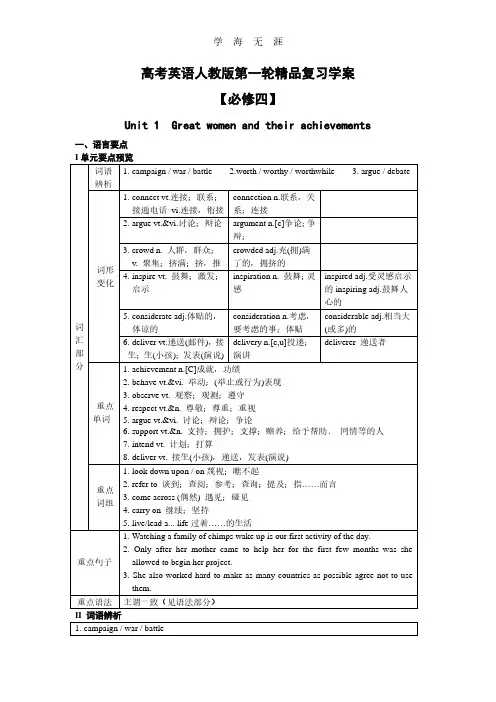
高考英语人教版第一轮精品复习学案必修4(49页).pdf
高考英语人教版第一轮精品复习学案【必修四】Unit 1 Great women and their achievements 一、语言要点IV 重点词汇1. behave vt.&vi. 举动;(举止或行为)表现behavio(u)r n. 行为;举止;习惯[典例]1). Behave yourself; don’ t make a fool of yourself. 注意你的举止, 别闹出笑话来。
2). How is your new car behaving? 你的新车性能如何?[重点用法]behave oneself 使某人自己举止规矩behaviour towards/to... 对……的态度/行为[练习] 根据句子的要求在括号里填入适当的词或翻译。
1). It’ s hard to train children to _______ _______ (举止得体) at the table.2). She is always _______ _______ (举止得体) at school.3). Their _______ (behave) _______ (介词) me shows that they do not like me.2. achievement n.[c]成就,功绩achieve vt. 取得,完成[典例]1). He received the Nobel Prize for his scientific achievements. 他因科学上取得的成就而获得诺贝尔奖。
2). Flying across the Atlantic for the first time was a great achievement. 首次飞越大西洋是一个伟大的功绩。
[重点用法]achieve an aim / goal达到目标achieve success 获得成功[练习] 根据句子的意思在括号里填入适当的词。
2020版新一线高考英语新题型人教版一轮复习教学案第1部分必修4Unit4Bodylanguage含答案
Unit 4Body language[单词拼写应用]核心单词1.dormitory n.宿舍2.major adj.主要的v.主修3.approach v t.& v i.接近;走近;靠近n.接近;方法;途径4.likely adj.可能的5.hug v i.& v t.拥抱6.function n.作用;功能;职能v i.起作用;运转7.represent v t.代表;象征8.canteen n.食堂9.ease n.安逸;舒适v t.减轻(痛苦、忧虑)10.adult n.成年人[语境运用]用所给词的适当形式填空。
1.At the meeting they discussed three different approaches (approach) to the study of mathematics.2.Linda and I,representing (represent) our class,will take part in the contest to be held this weekend.3.The couple hugged (hug) each other when they heard the exciting news.4.The doctor will give you some medicine to ease (ease) your pain.5.As adults (adult) ,we should be responsible for our own decisions.6.Li Hua,my best friend,is in Shandong University majoring(major) in English literature. 拓展单词1.state v.陈述;说明→statement n.陈述;说明2.greet v i.& v t.迎接;问候→greeting n.问候;招呼3.associate v t.把……联系起来→association n.社团;联系;联想4.curious adj.好奇的→curiously ad v.好奇地→curiosity n.好奇;好奇心5.defend v t.保护;保卫→defence n.防御;保卫6.misunderstand v t.误解;误会→misunderstanding n.误解;误会7.spoken adj.口语的→unspoken adj.(反义词)未说出口的;非口语的8.angry adj.生气的→anger n.怒气;怒火9.true adj.真实的→truly ad v.真实地;真诚地;真正地→truth n.真实;真理[语境运用]用所给词的适当形式填空。
2020届一轮复习人教版必修4一轮复习Unit 4 Body language单元学案设计(27页含详细解释)
2018届人教版必修4一轮复习:Unit 4Body language单元学案设计单元话题写作:第一层级——背词汇、学写句,让作文有话可说一、背词汇[常用词汇](1)vocabulary n.词汇(2)phrase n. 短语(3)opportunity n. 机会(4)strategy n. 策略(5)burden n. 负担(6)habit n. 习惯(7)dialogue n. 对话(8)pronunciation n. 发音(9)communication n.沟通(10)conversation n. 会话(11)express v. 表达(12)master v. 掌握(13)recite v. 背诵(14)translate v. 翻译(15)practice v. 练习(16)fluent adj. 流利的(17)practical adj. 实用的(18)keep a diary 记日记[亮点词汇](1)broaden v.扩大(2)obtain v. 获得(3)consolidate v. 巩固(4)benefit v. 使受益(5)exposed adj. 使接触到的(6)complicated adj. 复杂的,难懂的(7)turn to sb.(for help) 求助于某人(8)develop one’s interest 培养兴趣(9)have a good knowledge of 通晓(10)attach importance to 重视……二、学写句(按要求完成句子并背诵)单元课前知识搜索(Ⅰ)单词拼写1.Diana’s greatest ambition was to represent (代表) her country at the Olympics.2.The doctor will give you some medicine to ease (减轻) your pain.3.The library is functioning (起作用) as a temporary hospital to cope with people injured in the earthquake.4.The boy is now an adult (成年人) and ought to be earning his own living.5.The way they interpreted their past was highly subjective (主观的).6.All the flights (航班) were delayed due to bad weather.7.At the meeting they discussed three different approaches (方法) to the study of mathematics.8.Please decide whether the following statements are true or false (错误的).(Ⅱ)用所给词的适当形式填空1.The river is a(n) truly (true) beautiful sight at this time of year.2.—Where is your sister now?—She is in Shandong University, majoring (majority) in English literature.3.There is no doubt that his statement (state) is false.4.They exchanged greetings (greet) and sat down to lunch.5.I’m sorry, but you must have misunderstood (misunderstanding) what I said just now.6.How many representatives (represent) have been sent to the UN conference?(Ⅲ)语境填词(用所给词的适当形式填空)1.All the audience looked at the small box curiously,_because they were curious about the thing in it.To satisfy their curiosity,_the magician — Liu Qian opened the box.(curious)2.In time of war, lots of money will be spent on defence and many measures will be taken to defend a country from being attacked.(defend)(Ⅰ)写出下列短语1.defend_against保卫……以免受2.on_the_contrary 相反地3.at_ease 舒适;快活;自由自在4.turn_one’s_back_to 背对;背弃5.get_close_to 靠近;接近6.be_likely_to 很可能……;有希望……7.in_general 总的来说;通常8.lose_face 丢脸9.as_if 好像10.put_up 举起;升起;搭建;留宿(Ⅱ)选用上述短语填空1.I was hoping Kenny could put me up for a few days.2.I didn’t see his face clearly because he turned_his_back_to me.3.I was surprised to find that the little girl was quite at_ease among strangers as if she had known them for a long time.4.Being afraid of losing_face,_she left the meeting after they found that she had told lies.5.A survey says that men are more likely_to tell lies than women.6.In_general,_the northerners are keen on dumplings while the southerners are fond of rice.7.Mountainclimbing is great fun.You’ll get_close_to nature and take exercise at the same time.8.When the door was opened suddenly, the boy covered his head with his hands, as_if in defence.1.The first person to arrive was Tony Garcia from Colombia,closely followed by Julia Smith from Britain.第一个到达的是从哥伦比亚来的托尼·加西亚,随后紧跟着的是英国的朱莉娅·史密斯。
2024版高考英语一轮总复习教材复习Unit4教师用书新人教版必修第一册
Unit 4 Natural DisastersⅠ.词块记单词1.the rescue workers 救援人员2.damage the buildings 损坏建筑物3.2,400 homes destroyed 2 400所房屋被毁4.no deaths, no injuries 没有人员伤亡5.shelters set up by the government 政府搭建的避难所6.useless pieces of metal 无用的金属块7.bury the dead 掩埋死者8.the tireless efforts of the city's people 全市人民的不懈努力9.the wisdom to stay positive 保持乐观的智慧10.provide the supplies 提供物资11.stay calm 保持冷静12.crash into coastlines 袭击海岸线13.huge waves 巨大的海浪14.strike a match 划火柴15.deliver food and supplies 运送食物和物资Ⅱ.语境记单词1.He was shocked at the shocking news, for I could see his shocked look on his face.(shock)2.You must learn to breathe regularly.Otherwise, you will feel out of breath after such a long run.(breath)3.Mastering some basic skills will greatly increase your chances of survival.Last week, thanks to the swimming skills, he and his friend succeeded in surviving the terrible flood and they were the only two survivors.(survive)4.After he came to power, everyone said he was a powerful leader, but now he feels so powerless that he even can't save his daughter.(power)5.The road has a total length of two miles only, so the workers decide to lengthen it.(long)Ⅲ.语境记短语1.Her life has not come to an end (结束), and she also doesn't know what is waiting for her ahead.2.Although it was Sunday yesterday, Lily got up early as usual (和往常一样).3.Always have your dictionary on hand (在手头) when you study because it is very convenient for you to refer to it.4.We haven't cleaned the house for a few days, because we don't want to sweep away (彻底消除) good luck.5.It was reported that an American couple had dug out (挖出) a lot of gold coins from their own yard.6.The city lay in ruins (成为废墟) after the earthquake.Now, rows of houses are being built.7.Suddenly, a little rabbit jumped out in front of my horse.Seeing this, I was in shock (震惊).Ⅳ.公式练句型1.这个小男孩太小了而不能举起这块沉重的石头。
人教版高三英语一轮复习必修四Unit4Bodylanguage单元学案(34页)
2020届一轮复习人教版必修四Unit 4 Body language 单元学案核心词汇1.Usually in an interview,the interviewee is asked to ____________(陈述,说明)his or her name,age and previous occupation.2.Chinese people often exchange ____________(打招呼)by shaking hands with each other.3.It’s natural that tourists would want to see interesting places that ____________(代表,象征)the city.4. Don’t____________(靠近)that fierce tiger.It’s too dangerous.5.After waiting for a long time,I caught a glimpse of a taxi around the corner and made a____________(猛冲)for it. 6.The brain performs a very important____________(功能)for it controls the body’s nervous system.7.Don’t believe all ads as many of them include f____________information.8.When you travel to a foreign country,culture shock may lead to cultural m____________9.用associate的适当形式填空(1)It has been proved that cigarette smoking is____________with lung cancer.(2)We are working in_______________with a local company to raise money for the homeless.10.用defend的适当形式填空(1)She stepped back appearing surprised and put up her hands,as if in____________.(2)The law allows people to _________ themselves against a charge.1.state2.greetings3.represent4.approach5.dash6.function7.false8.misunderstandings9.(1)associated (2)association 10.(1)defense (2)defend高频短语1._____________ 保卫……以免受2._____________ 很可能……;有希望……3._____________ 总的来说;通常4._____________ 舒适;快活;自由自在5._____________ 丢脸6.________________ 背对;背弃7.________________ 相反地8.________________ 以相同的方式9.________________ 以……为基础10._________________ 小心1.defend...against2.be likely to3.in general4.at ease5.lose face6.turn one’s back to7.on the contrary8.in the same way9.base...on10.watch/look out重点句式1.________________was Tony Garcia from Colombia,closely followed by Julia Smith from Britain.第一个到达的是来自哥伦比亚的托尼·加西亚,紧随其后的是来自英国的朱莉娅·史密斯。