
初三英语上册第一次月考测试题
初三英语上册第一次月考测试题一、听力共二节,计25分第一节共9小题;每小题1分,满分9分听下面9 段对话。
每段对话后面有一个小题,从题后所给的A、B、C 三个选项中选出最佳选项。
1. A. By reading the textbook. B. By listening to songs. C. By studying the grammar.2. A. He can’t speak. B. He is not good at listening. C. His writing is poor.3. A. On Thursday. B. On Tuesday. C. On Friday.4. A. In the shop. B. In an English club. C. In the hospital.5. A. Every day. B. Once a week. C. Often.6. A. He is nervous. B. He is happy. C. He is scared.7. A. We don’t know. B. Yes, he does. C. No, he doesn’t.8. A. Mary. B. Jim. C. Mom.9. A. He wants to go shopping by himself. B. He wants to go shopping with Mom.C. He wants his mom to help him.第二节共16小题,每小题1分,满分16分听下面5 段对话或独白。
每段对话或独白后面有几个小题,从题中所给的A、B、C三个选项中选出最佳选项。
听第10段材料,回答第10、11小题。
10. What’s Sarah’s problem?A. Her listening is poor.B. It is difficult to study grammar.C. She can’t memorize the new words.11. What does Nick think Sarah should do with her problem?A. Join an English clubB. Join a study group.C. Do more reading books about grammar.听第11段材料,回答第12—14小题12. When will the girl go to Yunnan?A. Next week.B. Next month.C. We don’t know.13. What do the people do on that day?A. They all go on the street.B. They give gifts to each other.C. They throw water at each other.14. What does the boy think of the Water Festival?A. excitingB. interestingC. fascinating听第12段材料,回答第15—17小题15. Why don’t Linda’s parents want her to go out with her friends?A. It’s dangerous.B. It’s not good to go shopping.C. They worry that she might fail her tests.16. How does Mary do with her study?A. She works very hard.B. She works hard but fails the tests.C. She doesn’t work hard, so she fails the tests.17. What does Mary think of what she does?A. She is too young to make her own decision.B. She has to agree to her parents’ suggestion.C. She should be allowed to make her own decision.听第13段材料,回答第18-21小题。
18. What are they going to do next week?A. Have an English speech contest.B. Have an English test.C. Have a school trip.19. Who is more confident?A. Tom.B. We don’t know.C. Tina.20. What’s Tom’s problem?A. He is easy to be excited.B. Needs more money.C. He is easy to be nervous.21. When would Tina do her part-time job?A. On weekdays.B. On weekends.C. On school days.听第14段材料,回答第22-25小题。
22. Why was Einstein standing on the bridge?A. He was thinking about a problem.B. He was talking something withhis friends.C. He was waiting for a friend of his.23. When did it begin to rain?A. After he got to the bridge.B. Before he came to the bridge.C. While he was waiting on the bridge.24. How did Einstein know it was raining?A. His friend told him.B. His paper was wet.C. His clothes were wet.25. Which of the followings is true?A. Scientists like thinking in the rainB. Scientists are more careful in their studies than in their life.C. The less the scientists care about their life, the more they can study.二、语言知识运用共二节,计30分第一节单项选择共15小题;每小题1分,满分15分26. —How do you improve your listening skill, Mary?—I often do it _________ tapes and English radios.A. by hearingB. in listening toC. by listening toD. for listening27. ---There’re a few new words in the article? ---What about _________in your dictionary?A. looking it upB. looking up itC. looking them upD. looking up them28. —Why are you so __________, Mei Mei?—Because of the ________news! I failed the test again!A. frustrated, frustratedB. frustrating, frustratingC. frustrating, frustratedD. frustrated, frustrating,29. —What you can do is _______ more English if you want to learn English well.—You mean _______ more English is useful to me?A. practicing, practiceB. to practice, practicingC. practicing, practicingD. to practicing, practice30. —How you’ve changed! You _____very short.—But I am not sure if I am taller than you now.A. are sure to beB. use to beC. areD. used to be31. We will have two family parties this autumn. _____is at Halloween and _________is at Thanksgiving.A. one, otherB. one, the otherC. another, othersD. the others, other32. —I hope you will finish your homework on time, boys and girls! —Sounds bad! So much homework makes us ______. We have to stay up late again, sir.A. excitedB. interestedC. stressed outD. outgoing33. —Zhouye used to spend much time _____ the Internet last month. How about now?—Although he hardly ever surf the Internet, he pays more attention___ his new mobile phone.A. surfing, toB. on, inC. surfing, inD. on, on34. — Have you found the poor dog yet?— Yes. But he was ____ when we found him. The bad weather killed him.A. dyingB. diedC. deadD. die35. — Will we have dinner at the Hope Restaurant?— Maybe. We’ll go there if the show ____ before six o’clock. But I don’t know if there____ any free tables then.A. will end; wereB. will end; will beC. ends; wereD. ends; will be36. The old man asked me______________.A where was the cinemaB where is the cinemaC where the cinema wasD where was the way to37. I didn’t know _________he will come or not.A thatB whetherC weatherD where38.—The more careful you are, ________mistakes you’ll make.A. fewerB. the fewerC. lessD. the less39. _______ along this road and you will find many new buildings on both sides.A WalkB To walkC WalkingD Walks40. Could you please tell me ________?A. how can I get to the parkB. how to learn English wellC. when will the train arriveD. how can I improve my listening ability 第二节完形填空共15小题;每小题1分,满分15分阅读下面短文,从短文后所给的四个选项中,选出可以填入空白处的最佳选项。
新目标人教版九年级上第一次月考英语试题及答案
九年级第一次质量检测英语试卷(共120分,选择题70分,必答题50分)一、单项填空(本大题有10小题,每小题2分,共20分)1.—_________do you study for a test? —By_________to tapes.A. What; listenB. What; listeningC. How; listenD. How;listening2.---Remember this, children. ____careful you are,____mistakes you will make. ---We know,Mr. Li.A. The more;the moreB.The more; the lessC. The more; the fewerD. The less;the less3.Li Na is _____ famous ______ all the tennis fans in China know her.A.too; to B.enough; to C.as; as D.so; that4. We will have two family parties this autumn. One is at Halloween andis at Thanksgiving.A. otherB. the otherC. anotherD. the others5. He was so when he heard the __news that he got the first prize in the contest.A. exciting, excitingB. exciting, excitedC. excited, excitedD. excited, exciting6.You won't pass your exams________ you work harder.A.when B.if C.unless D.after7. is really hard them to climb Mount Huang.A. This, to.B. It, forC. This, forD. It, to8. If you don’t know a word, you must in a dictionary.A. look it upB. look up itC. look over itD. look it out9. Let’s ask Mr. Wang for ________ about the earthquake.A. an information B, informationsC. some informationD. some informations10. —Do you know _____ ? I'm going to see him. —Sorry, I don't know.A. where does Mr. Li liveB. where did Mr. Li liveC. where Mr. Li livesD. where Mr. Li lived二.完形填空(每小题2分,共20分)“How can I learn English well?” “This is a 11 many students may ask. In my opinion, the most effective(有效的) 12 is to learn lessons by heart. If you can recite the text and write it out, you will learn it pretty well. And if you can tell 13 your own words about 14 the lesson says, you are a very successful learner indeed. Your English will be quite perfect.This is a difficult task. However, if you try to learn by heart only part of each lesson, you’ll find it no t so hard 15 you might have thought.Learn this way, and you will 16 fast progress. Of course, writing is also necessary. It helps you a lot on your way to 17 in English studies.It’s equally(同样地) important to feel the language. You should laugh at Englsih jokes and be 18 at bad news. When using English, try to 19 your mother tongue(母语). 20 helping you, your own language gets in your way. So, never try to learn English through putting every word into Chinese.( ) 11. A. question B. puzzle C. problem D. challenge( ) 12. A. time B.place C. road D. way( ) 13 A. by B. with C. of D. in( ) 14. A. which B. how C. what D. when( ) 15. A. as B. like C. so D. than( ) 16. A. make B. do C. learn D. develop( ) 17. A. challenge B.success C. difference D. importance( ) 18. A. happy B. sad C. happily D. sadly( ) 19. A. leave B. remember C. forget D. realize( ) 20. A. Instead of B. Instead C. Besides D. Except for三、阅读理解(每小题2分,共30分)AThe purpose of students who come to school is to study. But studying needs right ways, or we would waste the time or the money.The followings are ways for studying.The best time for reading is morning.Because in the morning, the air is fresh and our minds are clear.For that reason, we can get good results.When we study we must be patient.If we don't understand a text well, we must read it again.We should not read the next until we have learned the first one well.When we are studying, we must put our hearts into the book.We cannot read absent¬mindedly (心不在焉地), or we could get nothing from the book while we are reading.We must always ask “why”.If we can't understand well, write it down and ask our teachers or parents, brothers or friends, in any possible ways.We must know it completely and then our knowledge can be used well.Though there are many ways for studying, however, the above mentioned (提到的) will be helpful if we can keep them in heart.( )21.Morning is the best time for reading because ________.A.we can be more patientB.we can have a good timeC.we can relax ourselvesD.the air is fresh and our minds are clear( )22.When we are studying, ________.A. we must chat with friends on the phoneB.we'd better listen to pop musicC.we should put our hearts into the bookD.we have to eat something( )23.If we don't understand a text well, ________.A.we should read it again till understand itB.we should copy others' answersC.we don't do it any moreD.we should give it up and read the next one( )24.Which of the followings is NOT true?A.The purpose of students who come to school is to study.B.When we are studying,we can't be absent¬minded.C.We don't have to ask “why” when we can't understand well.D.We should know knowledge completely and use it well.( )25.The best title of this passage is ________.A.Don't Waste TimeB.Right Ways of StudyingC.Be PatientD.Learn to Ask “Why”BThree students are talking about the New Year tradition of their own country.A.Christina from SpainOn the last day of the year, the 31st of December, people wait till 12 p.m.Everybody must have 12 grapes to eat at midnight.At each sound of the clock, we must eat a grape.But we can't ever finish eating the grapes on time! Usually when people still have some grapes in their mouths, they look at each other and start to laugh.This tradition started in Spain long ago.One year, when there were a lot of grapes, the king of Spain decided to give grapes to everybody to eat on New Year's Eve.B.Cordon from BritainOn New Year's Day in Britain, people have parties.At 12 o'clock, the music stops, and we listen to the radio.On the radio we hear Big Ben, the famous clock in London.Then everybody sings a song about friendship and kisses their friends.We say “Happy New Year” to each other.It's lucky if a tall man with dark hair is the first person to come to the house in the New Year.So I go and visit as many friends as I can.They all give me a drink.C.Angela from BrazilIn all cities in Brazil, we have a big party on New Year's Eve, especially in Rio de Janeiro.People in this city go to the beaches to watch fireworks (焰火).We put flowers in the sea and think about things we want for ourselves or others.We usually wear white clothes for good luck during the New Year.()26.Which is NOT mentioned (被提到) in the passage?A.Have 12 grapes to eat.B.Give flowers to others.C.Have parties.D.Watch fireworks.()27.Who have parties during the New Year?A.People in Spain.B.People in Britain.C.People in BrazilD.Both B and C.()28.From the paragraph of “Cordon from Britain”,we know that ________.A.Cordon can't drink muchB.people sing a song about good luckC.people hear Big Ben on the radioD.everybody in Britain goes to watch fireworks()29.On New Year's Day, Brazilians usually wear white clothes because ________.A.they think that they look beautiful in whiteB.that reminds them of their happy lifeC.they hope that can bring them good luckD.that's what they have to do during the New Year()30.This article mainly tells us________.A.what people in different countries do on New Year's DayB.when and where people have New Year partiesC.what people in Britain do on New Year's DayD.why people around the world like the New YearCMost dictionaries will tell you a number of things about a language. There are three important things. These three things are spelling, pronunciation and meanings.First, a dictionary will tell you the spelling of a world. If you are not sure about the spelling of a word, you can try to find the correct spelling in a dictionary. Words are listed in alphabetical order—a,b,c and so on. For example, on a dictionary page the word “poor”—p,o,o,r –comes before “poverty”—p,o,v,e,r,t,y—and the word “poverty” comes before “ power”—p,o,w,e,r. The words are always given in an alphabtical order.The second thing, a dictionary will tell you pronunciation. Most give phonetic, or sound, alphabet. The phonetic spelling will tell you how a word is pronounced. There are a few different phonetic alphabets. Many dictionaries use the International Phonetic Alphabet to show pronunciation.The third thing, a dictionary will tell you the meaning of words. You can look up a word and find out what it means. Many words have more than one meaning, and a good dictionary will tell you all of the word’s meaning. For example, in English the common word “get” has over 20 different meanings.31.In the passage, which of the following is among the three important things?A. How to write a word well.B. How to use a word.C. How to make a sentence.D. How to read a word correctly.32.Of the three words: “remove”, “ remote” and “ remount”, _____ in a dictionary.A. “remote” comes first and “remove” comes last.B. “remove” comes first and “ remote” comes last.C. “remote” comes first and “remount” comes last.D, “remove” comes first and “remount” comes last.33.Many words have_______.A. several meaningsB. few meaningsC. one meaningD. no meaning34.A better dictionary can tell you _______.A. more of the word’s pronunciation.B. More of the word’s meaning.C. More of the word’s spelling.D. More of grammar.35.Phonetic alphabets are used to show _______.A. spellingB. handwritingC. meaningsD. pronunciation九年级第一次质量检测英语试卷(笔答卷共50分)一、根据汉语意思写出单词。
初三上英语第一次月考试卷有答案
上学期初三英语第一次月考测试卷一、听力(每小题1分,共20分)Ⅰ.本部分共有10道小题,每小题你将听到一段对话,每段对话听两遍。
在每段对话前,你将有5秒钟时间选择你所认为最合适的备选答案。
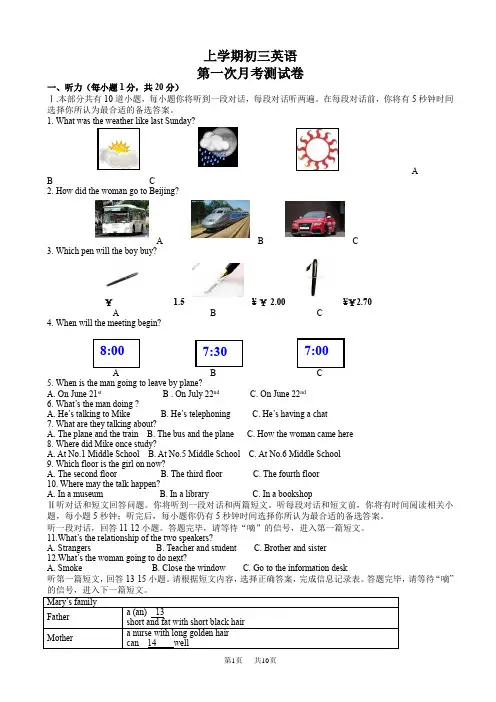
1. What was the weather like last Sunday?AB C2. How did the woman go to Beijing?A B C3. Which pen will the boy buy?¥ 1.5 ¥¥2.00 ¥¥2.70A B C4. When will the meeting begin?B C5. When is the man going to leave by plane?A. On June 21st B . On July 22nd C. On June 22nd6. What’s the man doing ?A. He’s talking to MikeB. He’s telephoningC. He’s having a chat7. What are they talking about?A. The plane and the trainB. The bus and the planeC. How the woman came here8. Where did Mike once study?A. At No.1 Middle SchoolB. At No.5 Middle SchoolC. At No.6 Middle School9. Which floor is the girl on now?A. The second floorB. The third floorC. The fourth floor10. Where may the talk happen?A. In a museumB. In a libraryC. In a bookshopⅡ听对话和短文回答问题。
初三英语上册第一次月考试卷及答案
初三英语上册第一次月考试卷及答案初三英语上册第一次月考试卷及答案就快面对初三第一次月考考试了,别忘面带微笑,有空睡个好觉,不必紧张煎熬。
以下是店铺给你推荐的初三英语上册月考试卷及答案,希望对你有帮助!初三英语上册第一次月考试卷第一部分听力技能(共两节,计25分)第一节听力选择(共15小题,计15分)根据你所听到的对话,选择正确的答案回答问题。
听下面5段对话,每听完一段对话后,做1小题。
1.How does Ms Lee keep fit?A. By runningB. By swimmingC. By skating2.Which festival are they talking about?A. EasterB. ChristmasC. Halloween3. Where is the woman now?A. At the shopping center.B. In the hotel.C. At home.4. Who did Harry probably visit this summer vacation?A. His friends.B. His classmates.C. His relatives.5. How long did Wu Dong stay in Australia?A. For six days.B. For eight days.C. For nine days.听第6段对话,做第6-7小题。
6. Where is Bill learning to draw?A. At the Children Art School.B. At the Teenagers Palace School.C. At the Drawing School.7. How much has Bill paid?A. $100B. $20C. $200听第7段对话,做第8-9小题。
8.Who bought the skirt for Amy?A. Herself.B. Her mother.C. Her sister.9. What does Amy think of the skirt?A. She thinks it’s nice.B. She doesn’t like its color.C. She doesn’t like it at all.听第8段对话,做第10-12小题。
九年级英语上册第一次月考试题试题
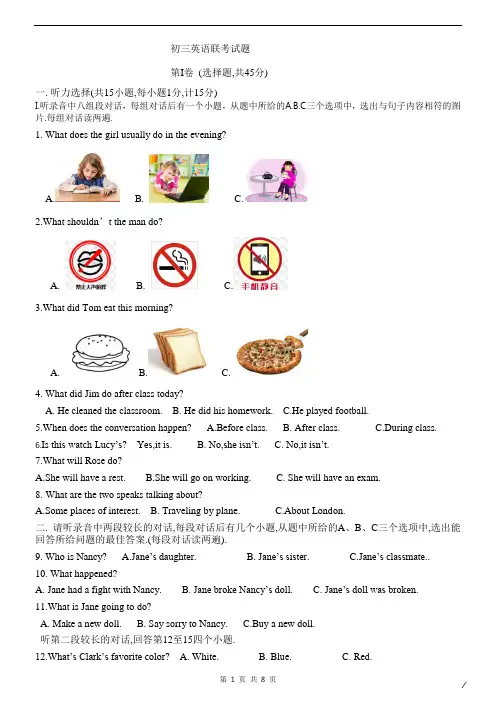
初三英语联考试题第I卷(选择题,共45分)一.听力选择(共15小题,每小题1分,计15分)I.听录音中八组段对话,每组对话后有一个小题,从题中所给的A.B.C三个选项中,选出与句子内容相符的图片.每组对话读两遍.1. What does the girl usually do in the evening?A. B. C.2.What shouldn’t the man do?A. B. C.3.What did Tom eat this morning?A. B. C.4. What did Jim do after class today?A. He cleaned the classroom.B. He did his homework.C.He played football.5.When does the conversation happen? A.Before class. B. After class. C.During class.6.Is this watch Lucy’s?Yes,it is. B. No,she isn’t. C. No,it isn’t.7.What will Rose do?A.She will have a rest.B.She will go on working.C. She will have an exam.8.What are the two speaks talking about?A.Some places of interest.B. Traveling by plane.C.About London.二. 请听录音中两段较长的对话,每段对话后有几个小题,从题中所给的A、B、C三个选项中,选出能回答所给问题的最佳答案.(每段对话读两遍).9. Who is Nancy? A.Jane’s daughter. B. Jane’s sister. C.Jane’s classmate..10. What happened?A. Jane had a fight with Nancy.B. Jane broke Nancy’s doll.C. Jane’s doll was broken.11.What is Jane going to do?A. Make a new doll.B. Say sorry to Nancy.C.Buy a new doll.听第二段较长的对话,回答第12至15四个小题.12.What’s Clark’s favorite color? A. White. B. Blue. C. Red.13.What did Clark do yesterday?A. He played the violin.B.He played the drums.C.He played the guitar.14. How often does Clark play it? A. Three times a week. B. Once a week. C. Every day.15.What does Clark want to be? A singer . B. A scientist . C. A musician.二.阅读理解(共20小题,每题1.5分,计30分)AAI(人工智能)makes our lives easier and better. Let's see the amazing AI.Cool driverless busA bus door opens and you get on. Wait where is thedriver? Here is a new kind of driverless bus calledApolong.It can seat 14 people and doesn't need a driver. Thebus follows traffic rules. It stops every time it sees astop light.A. There is a driver in itB. the door is opened by the passengerC. there are 24 seats in itD. it stops every time it sees a stop light17.Xiaoice CAN’T ____________.A. go out to play with you.B. talk with you if you feel lonely.C.be your friend.D. sing,write poems or tell stories.18.The painting is ________.A. a work painted by Vincent Van Gogh.B. worth about 3,000,000 yuan at an auction.C. studied by three French artists over 15,000 times.D. among the most beautiful paintings in the world.19.Which of the following is TRUE according to the passage?A. Xiaoice is a 17-year-old-girl.B. The AI anchor can only speak English.C. The AI anchor can work 24 hours without mistakes.D. The AI artist is one of the most popular artists in China.20.We can probably see the passage in ________.A. a guidebookB. a noticeC. a novelD. a newspaperBRupert Isaacson was born in Africa, and grew up in London and in the English countryside, where he discovered his love of horses. Because he grew up hearing so many fascinating memories about Africa from his parents, he went there and lived with the people called The Bushmen of the Kalahari Desert.By the year 2000, Rupert was already working as a reporter, writing articles and guidebooks about Africa and India. He met his wife Kristin in India. Today, they live with their son, Rowan, in the US. But Rupert faced the greatest challenge of his life when, at the age of two, Rowan was diagnosed (诊断) with an illness that influenced his ability to communicate with others.Rupert discovered that spending time with horses and riding them was helping Rowan. But unluckily, the Bushmen of the Kalahari do not have horses. So the family set out for Mongolia, where horses have been important for long. Rupert has written about this journey to help his son in his book Horse Boy, and he has produced a documentary of the same name. In the film, people have the chances to see the family travelling in Mongolia, riding horses and meeting healers (治疗师) in order to help Rowan.Because working with horses has helped Rowan, Rupert set up The Horse Boy Foundation on his farm in Texas. It is a school that teaches people how to use horses for healing. Besides writing another book, The Long Ride Home, about travelling with Rowan to Africa, Australia and Arizona in the US, Rupert has also produced the documentary endangerous, with Rowan as host, about dangerous animals that are endangered. Rupert Isaacson has managed to discover the secret of turning one challenge into many achievements.21.Where did Rupert Isaacson discover his love of horses?A.In the English countryside. B.In India.C.In Africa. D.In Mongolia.22.When was Rowan diagnosed with the illness mentioned in the passage?A.In the year 2000. B.At the age of two.C.When he was in Mongolia. D.When he was in London.23.Why did Rupert’s family go to Mongolia? Because_____________________there.A.he worked as a reporter B.there were no horsesC.there were lots of horses D.he wanted to meet his wife24.What is the purpose of The Horse Boy Foundation?A.To produce a documentary. B.To communicate with others.C.To learn how to ride horses. D.To teach people how to use horses for healing.25.How many documentaries has Rupert produced in the passage?A.Two. B.Three. C.Four. D.Five.cOne day, a man saw an old lady sitting inside her car at the side of the road. Though it was dark, he could see she needed help. So he stopped his car and walked towards her. The old lady was worried, even though she noticed the smile on his face. Was he going to hurt her? “I’ll help you start your car, madam. By the way, my name is Bryan Anderson, ” he said.While Anderson was fitting a spare tired(备胎) to her car, the lady began to talk to him. She thanked him much for coming to help.Anderson just smiled as he put his tools away. The lady asked how much she should pay him. He told her that if she really wanted to pay him back, the next time she saw someone who needed help, she could give them the help they needed. He waited until she started her car and drove off.A few miles down the road, the lady saw a small restaurant. She went in and a waitress came over with asweet smile. The old lady noticed the waitress was nearly eight months pregnant(怀孕的), but she never let the pains and aches change her smile when she served her.The lady finished her meal and paid with a hundred-dollar bill. The waitress quickly went to get change, but the old lady was gone when the waitress came back. The waitress wondered where the lady could be. Then she found there was a note on the napkin(餐巾), “You don’t need to give me anything back. Somebody once helped me out the way I’m helping you. If you really want to pay me back, here is what you do—do not let this chain(链子) of love end with you.”Under the napkin were four more $100 bills.26.Why did Anderson tell his name to the old lady?A.Because he wanted to check if the lady knew him.B.Because he hoped that may help relax the lady.C.Because he thought he could be paid back one day.D.Because he wanted to leave his name for doing good things.27.What does the underlined word they refer to (指的是)?A.The old lady and Anderson. B.The people who need help.C.The old lady and the waitress. D.The people who help others.28.Which is the right order of the old lady’s feelings?①Thankful ②Happy ③Worried ④Helpless ⑤Willing and ready to helpA.④③①⑤②B.④①③②⑤C.③②①⑤④D.③①④⑤②29.What can be inferred(推断) from the passage?A.The meal cost the old lady 400 dollars.B.Anderson must be helped by someone before.C.The old lady was able to fit a spare tire herself.D.The waitress will probably help someone later.30.What’s the best title for the passage?A.The Help of Strangers B.The Power of SmileC.The China of Love D.The Bill of KindnessDAre you afraid of going to the dentist(牙医)?If so, you’re not alone.These fears could just be in our heads, however. According to a recent survey by Martin Tickle, a professor at the University of Manchester in the UK, the pain isn’t felt most of the time in dental surgeries(牙科手术). In fact, among the 451 interviewed patients, 75%reported no pain at all during their visits, including situations when they had their teeth pulled out.Could it be the sound of the drill(钻头)then?“I found that the sound of drilling can evoke deep worry in dental patients. Actually they don’t have any pain, ”Hiroyuki Karibe, a scientist at Nippon Dental University in Tokyo, told The Guardian.To find the reason why a drill might bring on a racing heart, Karibe divided the volunteers into low-fear and high-fear groups based on how much they feared a trip to the dentist. Volunteers were played the sound of a drill while their brain activities were watched by a machine.What Karibe found in the low-fear group was increased activity in the areas of the brain relative to auditory processing(听觉处理), which means, for these people, the sound of dental drills is no different from other sounds.In the high-fear group, however, the brain area that was activated(激活)was different. It was the area that carries out a number of duties, including learning, feelings and, most importantly, memory. This means that these volunteers not only heard the sound, but they remembered it——they made connections between the sound of a drill and the worry it produced in the past, causing their worry to return.Understanding how brains reply to the sounds of dentists’ drills could help scientists find ways to make patients more relaxed, according to Karibe, because patients who worry about going to the dentist might keep putting off their visits. But the best way is to keep your teeth healthy.31.How does the writer explain that the pain isn’t felt most of the time in dental surgeries?A.By showing facts with numbers. B.By asking questions one by one.C.By giving examples group by group. D.By comparing results of patients.32.According to the fourth paragraph,what does the word“evoke”mean in Chinese?A.减轻B.引起C.显示D.阻止33.How did the sound of drilling produce different results to the volunteers in the study?A.It produced some worry in the volunteers in the low-fear group.B.For the low-fear group, it activated the brain area dealing with learning, feelings and memory. C.For the high-fear group,it caused more activities in the brain area relative to auditory processing. D.It made people in the high-fear group remember their past uncomfortable memories.34.What is the last paragraph mainly about?A.How the study might be useful.B.Some new ways to treat teeth.C.The proper way to treat dental patients.D.The importance of keeping our teeth healthy.35.What’s the purpose of the passage?A.To show US different areas of fear in brains.B.To introduce US a recent survey by a scientist.C.To help US have less fear of a trip to the dentist.D.To make it clear that the sound of drilling is not terrible.第II卷(非选择题,共55分)三.听力填词(共5小题,每小题1分,计5分)四.单词拼写与运用(共8小题,每小题1分,共8分)1.The boy a_______ Dr.Zhong Nanshan and he wants to be a doctor like him.2.We Chinese eat with c________ while Americans eat with knives and forks.3.Where are we going on vacation?Mr.Wang s_________ going to the West Lake.4.I can’t wait to read the article w________ by the famous writer.5.Without _______(知识), you may have little chance to achieve success.6.The Spring Festival is a holiday for _____(亲戚) and families to get to together.7.I live next to a supermarket. It’s very __________(方便的).8.We are very ______(自豪) that a student from our school has won the first prize.五.语法填空(共10小题,每小题1分,计10分).AAs we all know, Wang Xuan was a very famous computer scientist and inventor in the world. He isfamous 1.the Chinese Language Laser typesetting (激光照排系统),Laser typesetting for Chinese language was a serious problem for scientists all over the world. But Wang Xuan was not afraid to try new technology. Although he2.(fail) many times, he never gave up. He is believed to be the 3.(important) developer in printing Chinese after Bi Sheng. Now, Wang Xuan's amazing invention 4.(use) all over the world.Wang Xuan's story teaches us that a person 5.(follow) him own dream and try his best to make it come true.BCh ina’s first set of AI(人工智能) textbooks ____6___ (come) into the classroom of primary and secondary schools soon in many parts of China. The AI textbooks have already appeared in Shanghai and some experts _____7___(test) some of them. It’s said th at these AI textbooks are popular with local students.It is reported that _____8____( hundred) of schools in China will use the textbooks for primary and secondary school students in 2019.These schools plan___9____(use) them in some of their classes as an experiment.In fact, AI has brought huge benefits(好处) to the education field.Students can not only choose_____10___(they) own ways to study,but also can study at home without going to school.六.完形填空( 共7题,每小题1分,计7分)If you are going to have a baby brother or sister,you’ll want to know some baby facts.It can be a lot of__1__ to have a new baby in the house,but it can be tiring, too.Babies need so much___2__ that your mom and dad will be busy making sure the baby gets the rest, food, clean diapers(尿布) and so on. But this does not mean they love you any less- they just love the baby,too!What can you do at home with the baby? If you are old enough, you may be able to hold or feed the baby. Your mom and dad will __3_ you the right way to care for your brother or sister.You can also help in many _4__ ways,like folding clothes, answering the phone,or getting your mother a cup of tea. That is helpful,especially __5__ she is busy and tired.And if the baby cries, you can try to cheer him or her up. When a new baby _6__ the family,you will surely see some changes.Luckily, many of them are good ones. Before you know it, that little thing will sit up, crawl(爬), run, and __7__ play hide-and-seek(捉迷藏) with you. In other words, this baby just might grow up to be a lifetime friend!七.阅读表达.(共5小题,每小题2分,计10分)Camping is one of the most popular forms of outdoor activities. Now, most people are under too much pressure and like going outdoors to relax. Other activities like hunting and fishing, are often connected with camping trips.It’s also a good idea to spend time camping with your family during a holiday. That will help you create some of the best memories with the family. Here are some things you have to consider while planning your camping trip.The first thing that you need to think about is deciding the camping destination. For most people who like camping, the best place to choose is the spot that they haven’t visited before. As soon as you get to your destination, there will be a lot you will have to do, such as putting up your tent. Of course, food is another necessary factor to be considered. You’d better carry some convenient food like biscuits, nuts and boiled eggs.When all the things are done, fun activities should be planned. It’s a good chance for you to spend time with your family. Lots of open space is perfect when you want to do something as simple as letting your kids ride their bicycles. If your kids are old enough, activities like fishing and horse-riding are also good to choose. These are a few ideas about having fun camping. Once you get ready for it, you don’t need to worry about anything. Go ahead and be a happy camper.1.Why do people go camping according to the passage?(no more than 10 words)______________________________________________________________2.How many suggestions does the writer give us in the passage? (no more than 5 words)______________________________________________________________3.What food had you better carry according to the passage?( no more than 10 words)_______________________________________________________________4.请将文中画线的句子翻译成汉语. ————————————————————————————————5.请给短文拟一个适当的英文题目. ————————————————————————————————八.书面表达(共1小题,共15分)假如你是李磊,你的美国笔友Tom对中国传统文化很感兴趣,请你用英语给他写一封80字左右的电子邮件,介绍中国的传统节日春节(Spring Festival).内容要求: 1. 所给词不计入总数:2.语句通顺,表达准确,内容连贯:3.文中不得出现真实校名、姓名等相关信息.Dear Tom,I’m very glad to tell you something about __________________________________——————————————————————————————————————————————————————————————————————————————————————————————————————————————————————————————————————————————————————————————————————————————————————————————————————————————————————————————————————————————————————————————————————————————————————————————————————————————————————————————————————————————————Yours,Li Lei。
九年级英语第一次月考试卷(含答案)
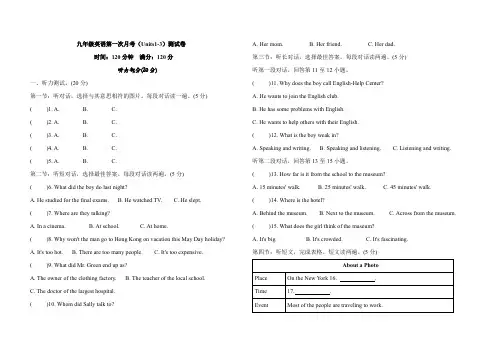
九年级英语第一次月考(Units1-3)测试卷时间:120分钟满分:120分听力部分(20分)一、听力测试。
(20分)第一节:听对话,选择与其意思相符的图片。
每段对话读一遍。
(5分) ( )1. A. B. C.( )2. A. B. C.( )3. A. B. C.( )4. A. B. C.( )5. A. B. C.第二节:听短对话,选择最佳答案。
每段对话读两遍。
(5分)( )6. What did the boy do last night?A. He studied for the final exams.B. He watched TV.C. He slept.( )7. Where are they talking?A. In a cinema.B. At school.C. At home.( )8. Why won't the man go to Hong Kong on vacation this May Day holiday?A. It's too hot.B. There are too many people.C. It's too expensive.( )9. What did Mr. Green end up as?A. The owner of the clothing factory.B. The teacher of the local school.C. The doctor of the largest hospital.( )10. Whom did Sally talk to?A. Her mom. B. Her friend. C. Her dad.第三节:听长对话,选择最佳答案。
每段对话读两遍。
(5分)听第一段对话,回答第11至12小题。
( )11. Why does the boy call English-Help Center?A. He wants to join the English club.B. He has some problems with English.C. He wants to help others with their English.( )12. What is the boy weak in?A. Speaking and writing.B. Speaking and listening.C. Listening and writing.听第二段对话,回答第13至15小题。
初中英语九年级上册第一学期第一次月考试卷

初中英语九年级上册第一学期第一次月考试卷所有选择题一律涂卡,用2B 涂卡笔正确填涂,其余各题一律做在答题纸上!(总分110 分,考试时间90 分钟)一、单项填空(每小题1 分,计15 分)1. To us, a miss is a mile. We can’t afford to make any mistakes.A.as good asB.as well asC.as many asD.as much as2.---Is there anything special in today's newspaper?---Yes. It m any people died in the typhoon yesterday.A. writesB. speaksC. saysD. tells3. He has failed in the maths test and looks sad. Let’s tell him some jokes to .A. pick him upB. give him upC. cheer him upD. wake him up4. The boy looks nice w hite and the red sweater looks good t he girl.A. with, onB. in, onC. on, inD. in, with5. We be too careful when driving a car.A. shouldn'tB. mustn'tC. can'tD. needn't6.---What is your plan for the coming summer holiday?--- I’ll spend as much time as I can some voluntary work.A.to doB. doingC. doD. to doing7. Some people prefer yellow when they hope for .A. moneyB. giftC. successD. health8. ---Hurry up, y ou will miss the school bus.---I know that, Mum. I’ll be ready in a minute.A. butB. andC. soD. or9. When H7N9 bird flu first appeared, people didn't know d octors could cure it.A. ifB. thatC. whatD. why10. Simon is feeling because he didn't pass the exam.A. blueB. redC. yellowD. green11. I'm thirsty and I would rather a cup of coffee a cup of tea.A. to haveB. haveC. havingD. catting12. ---Why do you like going to Kunming for a holiday?---Because the weather there is t oo hot t oo cold.A. either …orB. neither …norC. both …andD. not only …but also13. Wearing red can make e asier for you to take action.A. themB. thatC. itD. us14. The old picture me of the happy time in the village.A.tellsB. remembersC. thinksD. reminds15. I don’tknow .A. where can we buy the ticketsB. how much it costs to fly to HainanC. who is he waiting forD. why was he late for school this morning二、完形填空(每小题1 分,计15 分)I am a 14-year-old middle school student from Shandong. I enjoy travelling and I have been to many places. But Kunyu Mountain was the most unforgettable place I hav1e6 been to.Kunyu Mountain is a place of 17 near my hometown. My dad and I went to18 it in the early summer five years ago. At first I thought the top was s9 that I could never reach it. When I20 ,I always saw the top surrounded by many white clouds.The view was beautifu,1 I was not interestedin looking at it. I 22 very tired because of the23 walk and I had a pain in my legs. However, I saidto 24 that I could not give up climbing because it was my dream to climb to the top.It was cold and the wind was brushing my face strong succeeded in 25 the top without the help of my dad. Seeing the mountainswith large rocks around me, I smiled. I enjoyed my 26 in reaching the top after falling over the stones several times. A dhave fallen in love爱(上) 27 the beauty of nature since then.In our lives, the top is our 28 .The climbing is difficultbut worth(值得)your hard work. Just prepare more so that you can 29 get to the top. Whatever the result is, at least I have tried my best. I believe I can 30 my dream.( )16. A.ever B .never C .always D . already( )17.A.scene B .travel C .interest D . attraction( )18.A.climb B .run C .ride D . rush( )19.A.smooth B .huge C .magic D . high( )20 .A.looked down B .looked up C .looked out D . looked back( )21 .A.and B .but C .or D . so( )22 .A.stayed B .kept C .felt D . turned( )23 .A.three-hour B .three-hours C .three hour’s D . three hours( )24.A.yourself B .herself C .himself D . myself( )25. A.arriving B .getting C. reaching D . going ( )26. A.result B .success C .gift D . luck ( )27. A.for B .by C .with D . to( )28. A.wish B .dream C .idea D . plan ( )29. pletely B .quickly C .finally D . carefully ( )30. A.promise B .understand C .make D . realize三、阅读理解(每小题2 分,计30 分)(A)Music Club Music lessons:(guitar, violin, piano and drums)Time:8:30 a.m. - 9:30 a.m. every SundayPrice:Only $20 each Address:25 Jiefiang RoadTel:420-258-1200National ParkRiding horses ;BoatingTime:11:00a.m.-7:00p.m. everydayPrice: $15,children(ages3-7) $8Address:95 the Fifth AvenueTel:208-683-3400Art Museum200 famous pictures Morethan 300 worksOpening hours:8:00 a.m. - 6:00 p.m. onweekdaysPrice: adults $10,Children$5.50Address:120 Xinjin Street,Thermopolis TownTel: 307-864-299731. When can we visit Art Museum?A. 11:00 am -7:00 pm every day.B. 8:00 am - 6:00 pm on weekdays.[来源:Z。
人教版九年级上册英语月考试卷及答案
人教版九年级上册英语月考试卷及答案初三英语上册月考试题第I卷(选择题共80分)一、听力部分(共30分,每小题1.5分)A.听对话回答问题。
1. What is Tom’s animal sign?2. How will the man go to Beijing?3. Which festival does Jack like best?4. What’s Mike’s favourite hobby?5.What are they talking about?A. Clothes.B. Colours.C. Books.6. When did Mike come back?A. At 6:45B. At 7:15C. At 6:157. How much is the ticket for the students?A. Ten yu an.B. Fifteen yuan.C. Five yuan.8. What does the woman want to drink?A. Black coffee.B. White coffee.C. Tea with milk.9. What does Jim want to be?A. A doctor.B. A teacher.C. A nurse.10. Will Tom go to Amy’s birthday party?A. Yes, he will.B. No, he won’t.C. He is not sure.B.听下面一段对话,回答第11、12两小题。
11. Who made Mr Hu angry this morning?A. Fred and TimB. Jack and FredC. Tim and Jack12. What would they never do again?A. They would never be angry with Mr Hu.B. They would never be noisy in the classroom.C. They would never talk with each other.C.听下面一段对话,回答第13至15题。
人教版九年级英语上册第一次月考试卷(含答案)
人教版九年级上册第一次月考英语I . 听力技巧(共2题,20分)第一节听下面5段对话。
每段对话后有一个小题,从题中所给的A、B、C三个选项中选出最佳选项回答问题。
(共5小题,计5分)1.What are they talking about?A.Some photos.B.Some food.C.Some clothes.2. Who has ever been to America?A.Lucy.B.Gina.C.Dan.3. What does the man want to know?A.What kinds of food Australians eat.B.What TV programs Australians watch.C.What language Australians speak.4. Where did the man use to live?A.In Sydney.B.In Melbourne.C.In New York.5. What will the man have?A.Some noodles.B.Some rice.C. A hamburger and some French fries.第二节听下面6段对话或独白。
每段对话或独白后有2~3个小题,从题中所给的A、B、C三个选项中选出最佳选项回答问题。
(共15小题,计15分)听第六段对话,回答第6至7小题。
6. Why can’t the girl go shopping this afternoon?A.She must cook for her parents.B.She must prepare for the Chinese exam.C.She must prepare for the English exam.7. What day is it today?A.Friday.B.Saturday.C.Sunday.听第七段对话,回答第8至9小题。
人教版九年级上第一次月考英语试题(含答案)
人教版九年级上第一次月考英语试题(含答案)I。
Listening Skills (20 points in three parts)Part 1.Choose the appropriate picture according to what you hear。
You will have 5 seconds to read each n before each n。
After listening。
you will have 5 seconds to answer each n。
(5 ns。
5 points)1.A.2.A.3.A.4.A.5.A.Part XXX and choose the best answer from the three ns A。
B。
and C。
You will have 5 seconds to read each n before each n。
After listening。
you will have 5 seconds to answer each n。
(10 ns。
10 points)6.B。
(Sue)7.A。
(45)8.A。
(In a restaurant)9.B。
(At 7:30)10.C。
(It will be cloudy)11.B。
(Twice an hour)12.A。
(About 5 miles)13.There is no n about this n in the article。
so it cannot be answered.14.There is no n about this n in the article。
so it cannot be answered.15.There is no n about this n in the article。
so it cannot be answered.A.That’XXX25.XXX asked us to ________the XXX.A.hand XXX over26.I’m not used to ________in public.A.XXX27.The ________of the cake is very us.A.XXX28.The company ________a lot of money on research and development.A.XXX29.I’m sure he will come。
九年级上册英语第一次月考试卷【含答案】
九年级上册英语第一次月考试卷【含答案】专业课原理概述部分一、选择题(每题1分,共5分)1. Which word is the opposite of "expensive"?A. cheapB. costlyC. valuableD. price2. Choose the correct form of the verb "be" in the sentence: "He _______ a teacher."A. amB. isC. areD. be3. What is the past tense of "go"?A. goedB. goneC. wentD. go4. Which sentence is correct?A. She don't like apples.B. She doesn't like apples.C. She doesn't likes apples.D. She do not like apples.5. Choose the correct article in the sentence: "The sun _______ in the sky."A. aB. anC. theD. some二、判断题(每题1分,共5分)1. "Run" is the past tense of "running". ( )2. "I am" and "I'm" mean the same thing. ( )3. "He is eating" is in the present continuous tense. ( )4. "She has a book" means she owns the book. ( )5. "They are going to the park" means they will go to the park in the future. ( )三、填空题(每题1分,共5分)1. I _______ (be) a student.2. He _______ (go) to the store yesterday.3. She _______ (have) three brothers.4. We _______ (be) watching TV now.5. They _______ (not go) to the party last night.四、简答题(每题2分,共10分)1. What is the difference between "I'm" and "I am"?2. What is the past tense of "write"?3. What is the opposite of "hot"?4. What is the present continuous tense of "run"?5. What is the past perfect tense of "eat"?五、应用题(每题2分,共10分)1. Translate the sentence "She is reading a book" into Spanish.2. Write a sentence using the word "because".3. Make a question using the word "where".4. Write a sentence using the future tense.5. Write a sentence using the word "everybody".六、分析题(每题5分,共10分)1. Analyze the sentence "He will go to the store tomorrow" and identify the tense and the meaning.2. Expln the difference between "I like him" and "I like his".七、实践操作题(每题5分,共10分)1. Write a short dialogue between two people meeting for the first time.2. Describe a picture of a family having dinner together.八、专业设计题(每题2分,共10分)1. Design a poster for a school event, including the event name, date, time, and location.2. Create a menu for a fictional restaurant, including appetizers, mn courses, desserts, and drinks.3. Draw a floor plan for a bedroom, including a bed, a wardrobe, a desk, anda window.4. Design a logo for a sports team, including the team name and a symbol representing the sport.5. Illustrate a scene from a story you have read, including characters, setting, and an important event.九、概念解释题(每题2分,共10分)1. Expln the concept of a noun.2. Define the term "adjective".3. Describe what an adverb does in a sentence.4. Expln the difference between a verb and an adjective.5. Define the term "preposition".十、思考题(每题2分,共10分)1. How can you use mas to separate items in a list?2. What is the difference between "its" and "it's"?3. How can you form the past tense of a regular verb?4. What is the difference between "affect" and "effect"?5. How can you make a question in English?十一、社会扩展题(每题3分,共15分)1. Write a letter to a pen pal, introducing yourself and asking questions about their life.2. Describe a traditional festival in your country, including the date, activities, and significance.3. Expln the importance of learning a second language.4. Write a short story about a journey, including the starting point, the destination, and the events along the way.5. Describe a famous landmark in your country, including its history, location, and significance.本专业课原理概述部分试卷答案及知识点总结如下:一、选择题答案1. A2. B3. C4. B5. C二、判断题答案1. ×2. √3. √4. √5. √三、填空题答案1. am2. went3. has4. are5. didn't go四、简答题答案1. "I'm" is a contraction of "I am" and is used in informal speech and writing. "I am" is the full form and is used in formal contexts.2. The past tense of "write" is "wrote".3. The opposite of "hot" is "cold".4. The present continuous tense of "run" is "running".5. The past perfect tense of "eat" is "had eaten".五、应用题答案1. Ella está leyendo un libro.2. I will go to the store because I need to buy groceries.3. Where is the nearest restaurant?4. I will study for the test tomorrow.5. Everybody likes to go to the park on a sunny day.六、分析题答案1. The sentence "He will go to the store tomorrow" is in the future tense. It means that he has the intention or plan to go to the store the day after today.2. "I like him" refers to liking the person himself, while "I like his" refers to liking something that belongs to him.七、实践操作题答案1. Person A: Hi, my name is Alex. Nice to meet you.Person B: Hi, Alex. I'm Sarah. Nice to meet you too.2. The family is sitting around a round table. There is a plate of salad, a bowl of soup, and a roasted chicken in the center. The father is cutting the chicken, the mother is pouring water, and the children are chatting happily.本试卷所涵盖的理论基础部分的知识点分类和总结如下:1. Grammar: The test covers various aspects of grammar, including verb tenses, articles, nouns, adjectives, adverbs, prepositions, and sentence structure. It assesses students' understanding of different grammatical rules and their ability to apply them correctly in sentences.2. Vocabulary: The test includes questions that require students to demonstrate their knowledge of vocabulary, such as antonyms, synonyms, and word forms. It evaluates their ability to understand and use words in context.3. Reading prehension: The test includes questions that require students to read and understand short texts, such as sentences, paragraphs, and dialogues. It assesses their ability to extract information, infer meaning, and make connections between different parts of the text.4. Writing: The test includes questions that require students to write short texts, such as letters, stories, and descriptions. It evaluates their ability to organize ideas, use appropriate vocabulary and grammar, and convey meaning clearly and coherently.5. Listening and speaking: Although not directly assessed in this test, the questions related to dialogue and conversation require students to have a good understanding of spoken English and the ability to municate effectively.各题型所考察学生的知识点详解及示例:1. Multiple-choice questions: These questions assess students' understanding of specific grammar rules, vocabulary, and reading prehension. They require students to choose the correct answer from multiple options. Example: "What is the opposite of 'expensive'?" (A. cheap, B. costly, C. valuable, D. price)2. True or false questions: These questions assess students' understanding of grammar rules and reading prehension. They require students to determine whether a statement is true or false based on their knowledge of English. Example: "He don't like apples." (True/False)3. Fill in the blanks: These questions assess students' knowledge of vocabulary and grammar. They require students to fill in the missing words in a sentence based on the context. Example: "I _______ (be) a student."4. Short answer questions: These questions assess students' ability to provide concise and accurate answers to specific questions. They require students to demonstrate their understanding of grammar rules, vocabulary, and reading prehension. Example: "What is the difference between 'I'm' and 'I am'?"5. Application questions: These questions assess students' ability to apply their knowledge of English in practical situations, such as translation, writing sentences, and making questions. Example: "Translate the sentence 'She is reading a book' into Spanish."6. Analysis questions: These questions assess students' ability to analyze and interpret sentences, identifying the tense, meaning, and other grammatical features. Example: "Analyze the sentence 'He will go to the store tomorrow' and identify the tense and the meaning."7. Practical operation questions: These questions assess students' ability to produce spoken or written English in real。