
仁爱版英语八年级上册教材同步详细讲解
仁爱英语八年级上册Unit 1 topic 1Section A语言点讲解1.I saw you play basketball almost every day during the Summer holidays.常见的感官动词有:see, watch, hear, smell, feel 等。
后可接①动词ing形式,表此动作正在发生。
②动词原形,不表此动作正在发生, 表此动作已完成或存在的事实。
①Do you smell something ? (burn) 答案:burning②I often see him basketball after class. ( play ) 答案:play2.There is going to be a basketball game between Class Three and our class this Sunday.There be 句型:表某地有某物. 而have 表示某人有…(1)There is/ are..表现在某地有某物,is/are取决于后面的名词是单数还是复数,单数用is复数用are,如①There is apen and two rulers on the desk.②There are two rulers and a pen…(2) There was/were…表过去某地有某物。
was/were的用法也遵循就近原则。
(3)There will be 或There is/are going to be 表某地将有某事物。
不能说成There will have…(题) a match in our school between Class Three and Class Four next week.3.Would you like to come and cheer us on? ----- Sure, I’d love to.(1)Would you like + 不定式?表建议或邀请。
常用I’d love to 来回答,不同意也常用“I’d love to, but…”来拒绝别人。
如:Would you like to play basketball with me ?--- I’d love to, but I have a lot of homework to do.(2)在肯定句中would like= want 如:I’d like to have a rest. = I want to have a rest.4.I hope our team will win.---- Me , too.(= So do I.)①hope + that从句,that 可省去。
I hope that I can see you soon.②hope to do sth. I hope to see you soon.注意: (1)wish(愿)与hope的用法一样,后既可以接从句也可以接不定式,但不能说hope sb. to do sth. (hope 后不接双宾语, 但wish 可以),如:I hope you to help me (错) I hope that you can help me.(对)(2)hope 后接的从句常用将来时态表可以实现的愿望,而wish 后接的宾语从句常用过去时态表难以实现的愿望,如:①I hope you will come.②I wish I could fly to the moon.5. I prefer rowing.(1)prefer(过去式\过去分词需双写prefe rr ed) 后可直接接动词ing形式或动词不定式, 表更喜欢…,用法同like/ love:①I prefer swimming (更喜欢经常游泳) ②I prefer to swim.(更喜欢这一次去游泳)(2)prefer (doing) A to (doing) B 相当于:like… better than…I prefer swimming to skating. ==I like swimming better than skating.(3) 后接不定式时与rather than 或instead of连用,如:He preferred to die rather than (to) steal. / He preferred to dieinstead of stealing. 他宁死也不去偷窃。
6. -----Do you row much ?你经常划船吗?----- Yes , quite a bit / a lot. 是的,经常。
quite a bit/ a lot 经常/许多,大量.①quite a bit of 后接不可数名词,如:quite a bit of money。
②quite a lot of 后既可接可数名词复数也可以接不可数名词,如:quite a lot of books/ information。
而③quite a few=many 表“相当多”后接可数名词复数,如:quite a few students④quite a little =much表许多,后接不可数名词,如; quite a little money ⑤very few / little 很少很少。
7.Are you going to join the school rowing club?①join 加入(人群,组织)②take part in 参加(活动,比赛)注意:(1)join可与in连用,后接活动,即take part in=join in = be in后都接活动。
如:①He joined in the game ;②He joined in helping the old man.③I’ll be in the relay race. (2) Join sb. in doing sth. 表加入某人的活动。
如:Will you join us in playing basketball ?Section B1.How tall is he, do you know?----- Yes. He is2.26 meters tall.与how构成的疑问词有:How tall(身高)多高; how high(山)多高;how heavy多重;how long 多长;How wide 多宽;how deep 多深;how old 多大…. 对应的回答常用“数词+量词+形容词”,如:1.70 meters tall; 2 kilometers high;3 kilos heavy; 20 years old2.They both play for the Houston Rockets in the NBA.play for 为某个队效力;play against 与某个队比赛;play with 玩某物/与某人玩(比较:play basketball 打篮球;Look, the baby is playing with a basketball 玩弄一个篮球)3. what are you going to be when you grow up ?= what do you want to be …?你长大想干什么?5.David Beckham, a famous soccer star, arrived in Beijing with his team yesterday.表到达的有:①arrive at + (小地名);arrive in +(大地名)②get to③reach6.The fans are very excited.(1)excited 表“感到激动的、兴奋的”,常只作表语,主语常为人。
如:We are excited.类似的有:interested有趣的; tired感到疲劳的; bored感到厌烦的(2)exciting 表“令人激动兴奋的”既可作定语,也可作表语;作表语时,主语常为事物,如:①an interesting book;②The book is interesting.类似的有:interesting令人有趣的; tiring令人感到疲劳的; boring令人感到厌烦的7.It’s too bad that they aren’t going to stay in Beijing for long.主语是斜体that从句部分,前用it 来代替它。
因此这是一个含主语从句的复合句。
It’s too bad that…= It’s a pity that…= It’s a shame that..很遗憾…..8.在英语中有一些表示位置移动的词,如:go,come,leave, arrive, fly 可用现在进行时态表将来。
如:They are flyingto Wuhan tomorrow. (表将飞往武汉而不是正去武汉) They are leaving for Japan.= They will leave for Japan.9.Zhang Yining, one of the world’s best women table tennis players, won two gold medals for China.(1)one of 表…中的一个,后接可数名词的复数,如:one of my friends(2)名词作定语修饰名词时,一般用单数形式,如:two book shops, two shoe shops, 但man,woman,sports修饰可数名词复数时,常用复数形式,如:two men teachers; sports meet(3)win a gold medal赢得一枚金牌; win a prize 赢得奖品; win the first place 赢得第一名10. What a shame != What a pity 多么遗憾!类似的有:What fun ! 多么有趣!11. break the record 打破纪录;keep the record 保持纪录12. Please write back soon.write back 回信Section C1.once a week, 一周一次twice a week一周两次, 三次或三次以上用“数字+times”如:three times a year, four times a day, five times a week,…..2.go + v-ing形式的短语表“去做某事”如:go hiking 去徒步旅行,go shopping去购物,go skating 去滑冰,goskiing 去滑雪;go fishing 去钓鱼。
(最新)仁爱英语八年级上册三单元教材详解
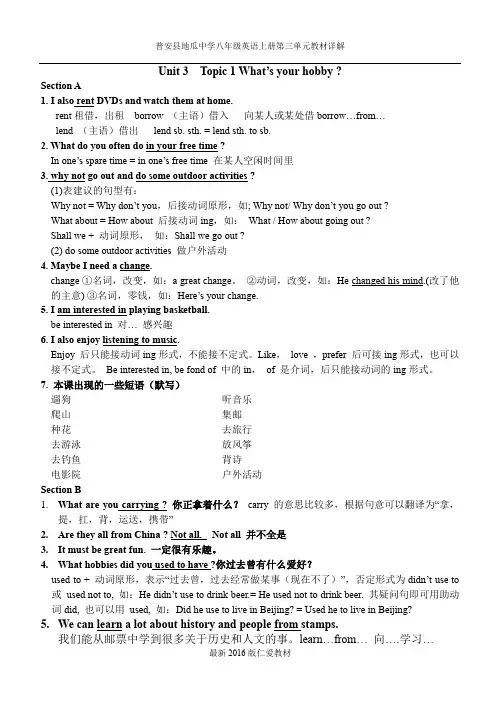
Unit 3Topic 1What’s your hobby ?Section A1.Ialso rent DVDs and watch them at home.rent租借,出租borrow (主语)借入向某人或某处借borrow…from…lend(主语)借出lend sb. sth. = lend sth. to sb.2. What do you often do in your freetime ?In one’s spare time = in one’s free time 在某人空闲时间里3.why not go out and do some outdoor activities ?(1)表建议的句型有:Why not = Why don’t you,后接动词原形,如; Why not/ Why don’t you go out ?What about = How about 后接动词ing,如:What / How about going out ?Shall we + 动词原形,如:Shall we go out ?(2) do some outdoor activities 做户外活动4. Maybe I need a change.change ①名词,改变,如:a great change。
②动词,改变,如:He changed his mind.(改了他的主意) ③名词,零钱,如:Here’s your change.5. I am interested in playing basketball.be interested in 对…感兴趣6. Ialso enjoy listening to music.Enjoy 后只能接动词ing形式,不能接不定式。
Like,love ,prefer 后可接ing形式,也可以接不定式。
Be interested in, be fond of 中的in,of 是介词,后只能接动词的ing形式。
仁爱八年级上册u1t1知识点
仁爱八年级上册u1t1知识点仁爱八年级上册 Unit 1 Topic 1 知识点仁爱八年级上册的第一单元主要涉及关于日常生活、居住环境和社会文化等方面的话题,本文将针对单元第一话题的知识点进行详细介绍。
1.关于家庭和房屋在日常交流中,我们经常使用到与家庭、房屋相关的词汇。
在英语中,一些基本的词汇包括“home”(家)、“house”(房屋)、“room”(房间)、“bedroom”(卧室)、“kitchen”(厨房)、“bathroom”(浴室)等等。
另外,在句子中表达你居住的地方时,你可以使用“I live in…”或“my house is in…”等表述方式。
2. 关于购物在日常生活中,我们不可避免地需要购物。
英语中与购物相关的一些词汇包括“store”(商店)、“mall”(购物中心)、“supermarket”(超市)、“market”(市场)等等。
当你想询问商品的价格时,你可以问“How much does it cost?”或“What's the price?”等。
当你想购买某样商品时,可以说“I'd like to buy…”或“I want to buy…”等表述方式。
3. 关于饮食英语中与饮食相关的一些词汇包括“food”(食物)、“snack”(小吃)、“meal”(饭菜)、“drink”(饮品)等等。
当你在餐厅用餐时,你可以使用“Can I have…”(我能要一份…吗?)、“I'd like…(我想要…)”等表述方式。
若要表达你对食物的喜好或不喜欢程度,你可以使用“like”(喜欢)或“dislike”(不喜欢)等词汇。
4. 关于文化和社交在日常交流中,我们还需要了解与文化和社交相关的词汇。
比如,“friend”(朋友)、“family”(家人)、“hobby”(爱好)、“dance”(舞蹈)等等。
在与陌生人交往时,我们可以使用“How do you do?”或“Nice to meet you”等礼貌的用语。
仁爱版八年级上册英语unit1知识点讲解

仁爱版八年级上册英语unit1知识点讲解Unit 1 Knowledge Points of Ren'ai Version Grade 8 EnglishUnit 1 of the Ren’ai Version Grade 8 English textbook covers a variety of important concepts in the English language. This article will provide a thorough explanation of these knowledge points to help students better understand the material covered in this unit.1. Verb tensesVerbs are an essential part of the English language, and understanding verb tenses is crucial in communicating effectively in English. The unit covers several tenses, including the simple present, present continuous, simple past, and past continuous.- Simple present: used to describe actions that are habitual or regular. Example: Tom reads books every day.- Present continuous: used to describe actions that are happening now or ongoing. Example: I am studying for my English test right now.- Simple past: used to describe actions that were completed in the past. Example: She bought a new phone two days ago.- Past continuous: used to describe actions that were happening in the past at a specific time. Example: We were having dinner at 7 pm last night.2. Preposition usagePrepositions are words that show the relationship between nouns and other words in a sentence. The unit focuses on several prepositions, including at, on, in, to, and with.- At: used to describe a specific time or location. Example: I will meet you at the park at noon.- On: used to describe a specific day or a surface. Example: The party is on Saturday. Put the book on the table.- In: used to describe a general location. Example: The cat is in the house.- To: used to describe a destination. Example: We are going to the beach.- With: used to describe being in someone's company or having something. Example: I am with my friends. She has a new car with leather seats.3. Passive voiceThe unit also covers the passive voice, which is used to describe an action where the subject is being acted upon. Example: The cake was made by John.4. Adjective typesAdjectives are words used to describe a noun or pronoun. The unit covers several types of adjectives, including possessive, demonstrative, interrogative, and articles.- Possessive: used to show ownership or possession. Example: This is my book.- Demonstrative: used to indicate the relative distance from the speaker or listener. Example: This car is mine. That car is his.- Interrogative: used to ask questions about a noun. Example: Whose book is this?- Articles: used to introduce a noun. Example: A dog ran by my house.5. Comparative and superlative forms of adjectivesThe comparative and superlative forms of adjectives are used to compare two or more things. The unit covers the rules for forming these forms of adjectives.- Comparative form: used to compare two things. Example: The cat is faster than the dog.- Superlative form: used to compare three or more things. Example: She is the strongest person in the gym.In conclusion, Unit 1 of the Ren’ai Version Grade 8 English textbook covers essential concepts in the English language, including verb tenses, prepositions, passive voice, adjective types, and comparative and superlative forms. By understanding these knowledge points, students can improve their English communication skills and succeed academically.。
最新仁爱版英语八年级上册教材解说 精华版
1、注重结构的 呈现与功能的运 用
2 、以单元为单位, 每个单元包括section A section B和selfcheck三部分,注重专 项训练。
仁 爱 版
人 教材编写特点 教 版
3、本教材的内容设置 使英语课程的五个总 体目标之间也实现了 相互融合、相互渗透 、相互促进。
3 、设计了大量的 听力素材,注重语 言技能的培养。
认真研读课标 准确把握教材
仁爱版 八年级上册
“三说”课件
一、说课标
二、说教材
三、说建议
总体目标
影响学生学习和 发展的重要因素 得体运用语言 的保证
文化知识 跨文化交际 意识与能力
提高学习效率, 发展自主学习能 力的保证
动机兴趣/自信意志 合作精神/祖国意识 国际视野 情感态度
语音/词汇/ 语法/功能/ 话题 语言知识
Reminding and warning Giving advice
Topic2 I must ask him to give up smoking .
Unit 2 Keeping Hed brush your teeth twice a day . illnesses Making appointments will will Topic2 I‘ll kick you the ball again Making requests and responses
Topic3 理解的 Unit 3 Topic1 Unit 2 基础上 培养 听懂对 Unit 4 学生 Unit 1 Review of Unit 1 话,通 用英 过不同 语做 学习单元 Review of Unit 2 的听力 事情 复习单元 活动, 的能 Review of Unit 3 力 帮助学 Review of Unit 4 生完成 课文及语法注释 词汇表 编写对新材 料的理 体例解,提 帮助学生养成良好的学习习惯,掌握 高其听 科学的学习方法,从而提高学习效率, 及目的 说能力。 成为真正的自主学习者。
仁爱版英语八年级上册Unit1__Topic1重点词汇讲解
Unit1 Topic1重点词汇讲解1.see v. 看见see sb. do sth. 看见某人做某事,强调看到动作的全过程。
see sb. doing sth. 看见某人正在做某事,强调动作正在进展。
类似用法的动词还有feel, hear, watch等。
如:I often see him play soccer on Sunday afternoon. 我经常看见他在星期日下午踢足球。
2.hope v. 希望hope to do sth. 希望做某事。
如:Betty hopes to study Chinese in Peking University. 贝蒂希望在北京大学学中文。
hope+ that 从句,that可以省略。
如:I hope (that) you will come to my party. 我希望你来参加我的晚会。
3.prefer v. 更喜欢相当于like …better。
如:Which sport do you prefer? = Which sport do you like better?1)prefer + 名词/代词,如:I prefer English. 我更喜欢英语。
2)prefer doing sth/to do sth. 如:I prefer watching TV at home.【拓展】prefer…to…比起…更喜欢...。
注意此处的to 为介词,prefer和to后面接名词、代词或动名词。
如:I prefer apples to bananas.He prefer swimming to playing football.4.join v.参加,参加1) join + sb./团体,组织参加某人或某团体。
如:He joined the basketball team last year.他去年加人了篮球队.Would you like to join us for dinner?你要加人我们一起去用餐吗?2)join in + sth. /doing sth. 参与某事或做某事, 如:They always join in the soccer games between classes after school.他下课后总会参加班与班之间的足球赛。
初中英语仁爱版八年级上册知识点梳理

初中英语仁爱版八年级上册知识点梳理八年级(上册)Unit 1 Play SportsTopic 1 Are you going to play basketball?Section A1.We are going to have a basketball game against Class Three.against表示“对着:反对;靠着”2.cheer sb.on为……加油,鼓劲3.win和beat都可表示“赢”,但用法不同。
(1) win(won,won)一般后接比赛,奖品或奖项作宾语,也可作不及物动词,表示“赢”的结果。
(2) beat(beat,beaten)击败、战胜,一般接对手作宾语,还可译为“心脏跳动”或“击打”。
a game a teamwin+事物 a war beat+对手 a nationa prize an apponent(对手)4.prefer宁愿,更喜欢(1)prefer doing sth.to doing sth.跟做某事比较起来更喜欢做某事prefer sb./sth.to sb./sth.跟某人/某物比较起来更喜欢人/某物1.Spen, take, cost 与pay的区别复习指南(p34)2.do exercise=play sports做运动,锻炼3.There be句型的将来时结构为There is/are going to be或There will be。
注意在There be句型中不能出现表示“有”的have和has。
4.the high jump跳高the long jump跳远5.Sure (1)be sure that+从句e.g.I am sure that he is right.(2)sb.be sure to do sth.某人一定会做某事。
强调说话人的语气。
(3)be sure of/about sth./doing sth.“确信”,表示主语对……有把握。
精品推荐:仁爱版八年级上册英语教材同步详解
八年级上册Unit 1 topic 1Section A1.I saw you play basketball almost every day during the Summer holidays.常见的感官动词有:see, watch, hear, smell, feel 等。
后可接①动词ing形式,表此动作正在发生。
②动词原形,不表此动作正在发生, 表此动作已完成或存在的事实。
①Do you smell something ? (burn) 答案:burning②I often see him basketball after class. ( play ) 答案:play2.There is going to be a basketball game between Class Three and our class this Sunday.There be 句型:表某地有某物. 而have 表示某人有…(1)There is/ are..表现在某地有某物,is/are取决于后面的名词是单数还是复数,单数用is 复数用are,如①There is a pen and two rulers on the desk.②There are two rulers and a pen…(2) There was/were…表过去某地有某物。
was/were的用法也遵循就近原则。
(3)There will be 或There is/are going to be 表某地将有某事物。
不能说成There willhave…(题) a match in our school between Class Three and Class Four next week.3.Would you like to come and cheer us on? ----- Sure, I’d love to.(1)Would you like + 不定式?表建议或邀请。
(简化版)仁爱版英语八年级上册教材同步详细讲解
(简化版)仁爱版英语八年级上册教材同步详细讲解1. 单元一:Meeting New Friends本单元主要介绍了如何与新朋友交流和建立友谊的技巧。
- 第一课:Greetings and Introduction这一课主要介绍了问候和自我介绍的基本用语,以及如何用合适的方式与陌生人交流。
- 第二课:Making Friends这一课主要教授了如何主动交友和与他人展开对话的方法。
- 第三课:Meeting People Online该课程旨在向学生介绍如何在网上结识新朋友并保持网络安全。
- 第四课:Inviting Friends to a Party本课程通过模拟邀请朋友参加派对的情景,教会学生如何邀请和回应邀请。
2. 单元二:The World Around Us本单元主要介绍了地理和环境相关的知识。
- 第一课:Weather这一课程向学生介绍了天气相关的词汇以及如何描述天气状况。
- 第二课:Natural Disasters该课程涵盖了地球自然灾害,如地震、火山喷发和飓风等,以及如何保护自己和提前预防。
- 第三课:Wildlife Conservation该课程旨在增强学生对野生动物保护的意识,并了解一些保护动物的方法。
- 第四课:Environmental Issues该课程探讨了当前环境问题,如污染和气候变化,并提倡学生参与环保活动。
3. 单元三:Science and Technology本单元主要介绍了科学和技术领域的知识。
- 第一课:Inventions and Discoveries这一课程介绍了一些重要的发明和发现,并引导学生思考科技对人类生活的影响。
该课程探讨了人与机器之间的交流方式,并介绍了一些常见的科技设备。
- 第三课:The Internet and Social Media该课程向学生介绍了互联网和社交媒体的基本概念,以及如何正确使用和保护个人信息。
- 第四课:Artificial Intelligence本课程以人工智能为主题,向学生介绍了机器研究和智能系统的基本原理。
初中英语仁爱版八年级上册知识点梳理(共计59页)
八年级(上册)Unit 1 Play Sports【考点解析】Topic 1 Are you going to play basketball?Section A1.We are going to have a basketball game against Class Three.against表示“对着:反对;靠着”2.cheer sb.on为……加油,鼓劲3.win和beat都可表示“赢”,但用法不同。
(1) win(won,won)一般后接比赛,奖品或奖项作宾语,也可作不及物动词,表示“赢”的结果。
(2) beat(beat,beaten)击败、战胜,一般接对手作宾语,还可译为“心脏跳动”或“击打”。
a game a teamwin+事物 a war beat+对手 a nationa prize an apponent(对手)4.prefer宁愿,更喜欢(1)prefer doing sth.to doing sth.跟做某事比较起来更喜欢做某事prefer sb./sth.to sb./sth.跟某人/某物比较起来更喜欢人/某物(2)prefer to do sth.(rather)than do sth.跟做某事比较起来更喜欢做某事(3)prefer to do sth.更喜欢做某事5.join/take part in(1)join参加某个政党,团体,组织等,成为其中的一员(2)join sb.(in doing sth.)和某人一起(做某事)(3)join in=take part,in参加某项活动Section B1.play for a team为某队效力be in/on the team在某队打球2.dream作名词,“梦,梦想”。
e.g.my dream job也可作动词dream of/about sth./doing sth.3.“one of the+形容词最高级+名词的复数”意思是“最……之一”。
仁爱版英语八年级[上册]教材同步详细讲解
仁爱英语八年级上册Unit 1 topic 1 Section A 语言点讲解 1. I saw you play basketball almost every day during the Summer holidays. 常见的感官动词有:see, watch, hear, smell, feel 等。
后可接①动词ing 形式,表此动作正在发生。
②动词原形,不表此动作正在发生, 表此动作已完成或存在的事实。
① Do you smell something ? (burn) 答案:burning ② I often see him basketball after class. ( play ) 答案:play 2. There is going to be a basketball game between Class Three and our class this Sunday. There be 句型:表某地有某物. 而have 表示某人有…(1)There is/ are..表现在某地有某物,is/are 取决于后面的名词是单数还是复数,单数用is 复数用are,如①There is a pen and two rulers on the desk.②There are two rulers and a pen …(2) There was/were …表过去某地有某物。
was/were 的用法也遵循就近原则。
(3)There will be 或 There is/are going to be 表某地将有某事物。
不能说成 There will have …(题) a match in our school between Class Three and Class Four next week. 3. Would you like to come and cheer us on? ----- Sure, to come and cheer us on? ----- Sure, I’I’d love to. (1)Would you like + 不定式? 表建议或邀请。