
Unit_1_Topic_3_Section_B仁爱版七年级英语上
Write the sentences, paying attention to the use of capital letters and punctuation.
Example: A: what’s that in English jane ? B: it’s a map
What’s that in English, Jane? It’s a map.
A: Thank you. A: Is that a pen? B: No, _______. it isn’t It is a pencil.
A: Is this an orange? B: No, it isn’t. It’s an apple. A: Is that a desk? B: Yes, it is.
Make up new conversations with the words of 1cand sentences below.
What’s this/that in English? It’s a/an … How do you spell it? / Can you spell it? …
Homework
(1)总结:在学过的名词中,哪些前面加a,
哪些前面加an。
(2)参考1a/2a,自编两则对话。
a book
a map
a和an的区别:
a/an被称作不定冠词,用在单数可数名词前, 表达某一个人或事物中的一个,相当于汉语的 “一、一个” 。a/an用法的区别:
1. a 用在以辅音音素开头的单词前。 例如:a book, a desk 2. an 用在以元音音素开头的单词前。 例如:an egg, an apple
a car
a pencil
a pen
a book
a map
an apple
an orange an eraser
an egg
Let’s say together.
A: What’s this in English?
B: It’s a desk.
A: How do you spell it?
B: D-E-S-K, desk.
A: Excuse me , what’s ____ this in English? B: It’s _____ a pencil. A: How do you spell it? B: P-E-N-C-I-L, ______ pencil . A: Thank you . B: ______ You’re ________. welcome
A: What’s that in English, Jane?
B: It’s a map.
A: Can you spell it, please? B: Yes. M-A-P, map. A: Thanks. B: You’re welcome.
It’s__________. ห้องสมุดไป่ตู้ book
What’s that in English?
A: Excuse me, what’s ____ that in English? B: It’s _____ an apple. A: Can ___ ____ you ____ spell ____? it B: Yes, A-P- P-L-E, apple.
A: ________ Thanks . B: That’s OK.
Sum up
1. Useful expressions: What’s this/that in English? It’s a/an … How do you spell it? / Can you spell it? Is this/that a/an …? Yes, it is. / No, it isn’t. 2. New words: a/an, spell, can, please
eraser pencil toy telephone map
This is an eraser.
Is this an eraser?
That is a toy.
be动词的位置发生了变化。
Is that a toy?
句型也由陈述句变成了一般疑问句。
A: Is this an eraser?
B: Yes, _____. it is
Topic 3
How old are you?
Section B
Let’s review.
A: Hello, I am Li Ming!What’s your name? B: My name is Jane.
A: I am twelve years old.How old are you?
B: I am twelve,too. A: What class are you in? B: I am in Class Four, Grade Seven.Are you in Class Four,too?
A: No,I’m not.I am in Class Five.Oh,
What’s that? B: That’s Jane.
This is a TV.
--What’s this in English? --It’s a pencil.
This is a CD.
an apple an eraser What’s this in English? It’s …
Look, listen, fill and say.
Is this a telephone _________? No, it isn’t. It’s a ____. toy
Is that a toy, too?
No, it’s an eraser _______.
An eraser? Wow!
A: B: A: B: Is he Michael Jordan? Yes,he is. Is he from England? No, he isn’t. He is from America.
A: What’s this in English? B: Is it a/an …?
Guess the objects by touching them. Example: What’s this in English? Is it a/an …? Yes, it is. How do you spell it? / No, it isn’t. Please try again.
B-O-O-K, _______. book
How do you spell it?
A: What’s this in English? B: It’s a pencil-box. A:How do you spell it? B: P-E-N-C-I-L-B-O-X,pencil-box.
Listen and fill.
Look, listen and say.
Excuse me, what’s this in English?
map
eraser
pen pencil desk
It’s__________. an eraser
A: Excuse me, what’s this in English? B: It’s an eraser. A: How do you spell it? B: E-R-A-S-E-R, eraser. A: Thank you. B: That’s OK.
仁爱版英语七年级上册 《Welcome to China》(SectionB)教案
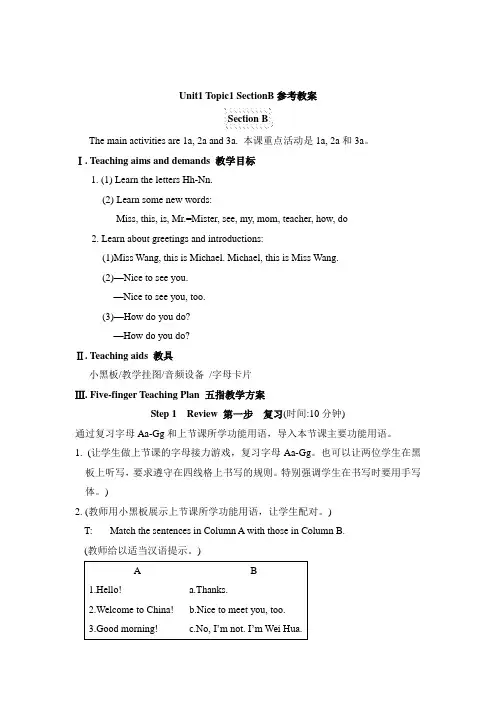
Unit1 Topic1 SectionB参考教案Section BThe main activities are 1a, 2a and 3a. 本课重点活动是1a, 2a和3a。
Ⅰ. Teaching aims and demands 教学目标1. (1) Learn the letters Hh-Nn.(2) Learn some new words:Miss, this, is, Mr.=Mister, see, my, mom, teacher, how, do2. Learn about greetings and introductions:(1)Miss Wang, this is Michael. Michael, this is Miss Wang.(2)—Nice to see you.—Nice to see you, too.(3)—How do you do?—How do you do?Ⅱ. Teaching aids 教具小黑板/教学挂图/音频设备/字母卡片Ⅲ. Five-finger Teaching Plan 五指教学方案Step 1 Review 第一步复习(时间:10分钟)通过复习字母Aa-Gg和上节课所学功能用语,导入本节课主要功能用语。
1. (让学生做上节课的字母接力游戏,复习字母Aa-Gg。
也可以让两位学生在黑板上听写,要求遵守在四线格上书写的规则。
特别强调学生在书写时要用手写体。
)2. (教师用小黑板展示上节课所学功能用语,让学生配对。
)T: Match the sentences in Column A with those in Column B.(教师给以适当汉语提示。
)A B1.Hello! a.Thanks.2.Welcome to China! b.Nice to meet you, too.3.Good morning! c.No, I’m not. I’m Wei Hua.(核对答案,教师讲解并让学生两人一组练习所学功能用语。
仁爱版英语七年级上册Unit 1 Topic 3《What class are you in》(Se

仁爱版英语七年级上册Unit 1 Topic 3《What class are you in》(SectionC)教学设计一. 教材分析本课选自仁爱版英语七年级上册Unit 1 Topic 3《What class are you in》(Section C),主要介绍了学科名称和学科教师。
本节课通过引入新的词汇和句型,帮助学生更好地进行日常交流,提高他们的语言运用能力。
教材内容丰富,贴近学生生活,有利于激发学生的学习兴趣。
二. 学情分析七年级的学生已经初步掌握了英语学习的基础知识,具备一定的听、说、读、写能力。
但部分学生在实际运用英语进行交流时,仍存在一定的困难。
针对这一情况,教师应注重培养学生的语言运用能力,激发他们的学习兴趣,提高他们的学习积极性。
三. 教学目标1.知识目标:学生能够掌握学科名称和学科教师的表达方式,正确运用所学知识进行日常交流。
2.能力目标:通过课堂学习,学生的听、说、读、写能力得到进一步提高。
3.情感目标:学生能够积极参与课堂活动,增进与同学之间的友谊,培养团队协作精神。
四. 教学重难点1.重点:学科名称的掌握和运用。
2.难点:正确运用句型进行日常交流。
五. 教学方法采用任务型教学法、情境教学法和交际教学法,通过设定真实的教学情境,引导学生参与课堂活动,实现知识与能力的转化。
六. 教学准备1.教师准备:提前准备教学课件、教材、实物等教学资源。
2.学生准备:预习相关词汇和句型,做好上课准备。
七. 教学过程1.导入(5分钟)教师通过提问方式引导学生回顾上一节课所学内容,如:“Can you remember the classes you have learned?”,激活学生的学习兴趣。
2.呈现(5分钟)教师展示本节课的主题,引导学生关注学科名称和学科教师。
通过展示图片和实物,如课本、黑板等,呈现本节课的关键词汇:math, Chinese, English, music, teacher等。
仁爱版英语七年级上册 Unit 1 topic3 知识归纳
Unit 1Topic 3old/How old课文原句:So, how old are you, Alan?讲解:how old问年龄。
问年龄的两种方式可以互用:How old is ...? = What's sb's age?-How old is your grandfather?-He is 60 years old.old adj. 意为“旧的,陈旧的”,其反义词为new新的。
The story is very old.这个故事十分古老。
年老的,年迈的,其反义词为young年轻的。
Everyone grows old.每个人都会变老。
相识很久的,旧交的。
Bob is an old friend of mine.Bob是我的一位老朋友。
另有常见搭配,如the old days以前,旧日的时光。
与old相关的词汇:elder adj. 前辈的,年纪较长的,常用于兄弟姐妹之间的年龄比较,在句中只用作定语,不作表语。
Did you see her elder sister yesterday?你昨天见到了她的姐姐吗?elderly adj. 年老的;渐老的(委婉用法),其后常跟名词。
2 Spell课文原句:-What's this in English?-It's a map.-Spell it, please.-M-A-P.讲解:spell,实义动词,意为“拼写”。
常用的三种句型:1. How do you spell…?2. 祈使句:Spell it, please.3. Can you spell it please?grade/class1. class n. 班级;课如:-Which class are you in this year?-Class Three.—今年你在哪个班?—三班。
I have a history class at 9 o'clock.我9点钟有历史课。
仁爱版七年级英语上册unit1-topic2-sectionBPPT课件
.
4
Is she from Canada?
She is Jane.
Is he Li Ming?
He is from Japan.
.
5
He is Li Ming.
他是李明。
Is he Li Ming?
他是李明吗?
She is from Canada. 她来自加拿大。
.
6
Is she from Canada?
Yes, she is. Is he Li Ming?
No, he isn’t. He is Yukio.
.
7
一般疑问句的回答 你知道吗?
— Is she from Canada? — _________.
Yes, she is
是的,她是。
— Is he Li Ming?
Байду номын сангаас
She is from Cuba.
Where is she from?
No, she isn’t. She is Maria.
.
10
2a Look at the pictures.Then practice with your partner.
Deng Yaping/China
Stephen Hawking/ England
1a Look, listen and say.
Look! who is she?
She is Jane.
Is she from Canada?
Yes, she is.
.
3
Look,Kangkang! Is he Li Ming?
Where is he from ?
仁爱版七年级上册英语笔记 Unit3 Topic3-Unit4 Topic1知识点总结
U 3 T3—U4 T11.1)would like = wantwould like没有人称和数的变化I would like an egg.=I want an egg.He would like an egg.= He wants an egg.(would like不能加s)2)would like to do = want to doa. He would like to drink some water.(drink)=He wants to drink some water.b. She would like (visit) the Great Wall.=She the Great Wall.3)I would like=I’d like He would like=He’d like4)a. I’d like an egg.(一般疑问句) Would you like an egg?Yes,please./ No,thanks.b. He’d like a hamburger.he a hamburger?. / .5)Would you like some chicken?(用some 加强语气,表示强调)6)I’d like an egg.What would you like?He’d like some fish.he ?2.1)you—yourself(反身代词)2)yoursel f---yoursel ves(pl.)3.help yourself/yourselves to +n.:随便吃……a. Help yourself (you) to some chicken, Tom.b. Help yourselves (you) to some chicken, kids.4.1)可数名词[C]:有单数和复数的形式.2)不可数名词[UC]:一般没有复数的形式.3)常见的不可数名词有:milk,rice,fish(鱼肉),chicken(鸡肉),(apple/orange) juice,water,bread5.fish:1)作为“鱼” , 是可数名词.fish—fish(pl.)2)作为“鱼肉”, 是不可数名词.some fish6.chicken:1)作为“鸡” , 是可数名词.a chicken2)作为“鸡肉”, 是不可数名词.some chicken7.some + n.(pl.),some+ [UC]some eggssome fish/chicken/milk/apple juice/rice8.---Help yourselves.---Thank you.9.---Would you like…? ---Yes, please. /No, thanks.10.What/How about +sb(宾格)/sth?What about him/her/some milk?11.All right.行,好吧(表示对别人的建议表示赞同)---I’d like some rice and chicken.---All right.k for me.13.Me,too.14.表示建议:---What about …? ---Good idea.15.an ideaa good ideaHomework:1.I’d like a hamburger.(一般疑问句) a hamburger?(肯否回答) ./ .2.She’d like some orange juice.she ?3. , boys and girls.(随便吃些鸡肉吧)4.She likes it very much.(否)She it .5..(我想喝些牛奶).6.他们怎么样??Unit 3 T 3 Section B—D1.1)usually:70-80%,often:50-60%2)usually,often放在be之后,行为动词之前.I usually have breakfast at home.2.have…for breakfast/lunch/supper/dinner1)He usually has an egg and some milk for breakfast.2)We usually have some rice and chicken for supper.3.一日三餐前不加a/an/the,后不加s.What do you usually have for/ breakfast?4.1)He usually has some bread for lunch.What does he usually have for lunch?2)We usually have some juice and fish for dinner.usuallyfor dinner?5.have:1)有2)吃,喝:have milk/bread6.[UC]前面不加a/an/the,后不加s.He has / milk and/ bread for breakfast.7.What/How about +sb(宾格)/sth?8.with带着/有,(表示伴随关系)have chicken/fish with vegetables9.some rice10.three meals(餐):breakfast,lunch,supper/dinner11.food:[UC],食物的总称,作主语,谓语用单数.My favorite food is (be) chicken and fish.12.Chinese /English food13.wait(v.)—waiter(指人)(男服务员)---waitress(女服务员)14.take one’s orderMay I take your order?15.something to drink/eat1)修饰词如不定式(to do) ,形容词修饰something时,放在something之后.2)something:某事(肯定句)anything:任何事(否/疑问)nothing:没有什么事(表否定意思的陈述句)3)Would you like +something?Would you likesomething to eat ?16.[UC]表示数量的表达法:1)a glass of apple juice/watera bag of rice /milk2)a glass of apple juice---two/some glasses of apple juice3) a bag of milk---five bags of milk17.wait/just a moment18.Let me see.让我想一想.I see. 我明白了.19.1)Would you like some vegetables?2)some vegetables/rice20.something to drink21.banana juice----Section C1.eat out2.eat---eating(现在分词)3.would like to doWould you like to have (have) dinner with me?4.have / breakfast/lunch/supper/dinner5.with sb(宾格)6.Would you like to have lunch with him?7.Yes, I’d like/love to.(to不能省略)8.1)May/can I help you?=What can I do for you?2)情态动词may/can/could+动原May I help (help) you?9.sir—madam(对应词)10.What would you liketo eat (eat)?11.Why not+动原? =Why don’t you +动原?Why not study (study) with me? = Why don’t you study with me?12.表示建议:1)What about…? 2)Why not…?肯定回答:Good idea.13.Here you are.14.---Would you like sth to drink?---Yes,please./No,thanks.Section D1.in+地点: in China2.many+n(pl.)many friends3.1)all,bothall指三者或三者以上“都”both指两者“都”2)all,both放在be之后,行为动词之前They are all students.We all like school.4.be kind to sbThe teacher is kind to us.5.have dinner with them6.such as +若干例子7.Sichuan food8.be glad to do sthObama is glad to visit (visit) the Great Wall.9.1)here,there是介词,前不加介词.2)be here/thereI’m glad to be (be) here.10.let sb do sthLet me (I) see (see).Homework:1.他晚饭通常吃什么?he usually?2.你可以点菜了吗??3.Tom,为什么不随便吃些汉堡包呢,?,Tom?4.你想喝些什么东西吗?来两杯香蕉汁.Would you like?.5.She’s glad (be) there.6.I’d like (work) with you.7.Would you like something(say)?8.Why not (tell) him about it.= him about it.9.他对我很友善.He .10.I usually have some rice for lunch.usually for lunch?1.---Do you like…?---Yes, I like …very much/a lot/a little.(No, I don’t like …at all.)Section D1.at / homeHe has a dog at home.2.it’s, its(它是)(它的)a cat. name’s Mimi.3.Tommy =Tom4.Zhou Lan likes it a lot.= Zhou Lan likes it very much.(否)Zhou Lan doesn’t like it at all.5.some,anyShe has some pets.(否)She doesn’t have any pets.(疑问)Does she have any pets?6.1)人称代词:主格---宾格I—me,you-you,he-him,she-her,it-itwe-us,they-them2)形物代—名物代my-mine,your-yours,his-his,her-hers,its-its,our-ours,their-theirsThis is a girl. name is Lily. is twelve. We like .(Her,She,her)Unit 4 T1 Section A1.What can I do for you?=Can/May I help you?2.madam---sir(对应词)3.want to do = would like to do1)She wants to have milk and bread.=She would like to have milk and bread.2)Would you like a glass of apple juice?=Do you want a glass of apple juice?3)Would she like some vegetables?=Does she want any vegetables?4.clothes:衣服的总称,复数名词,作主语时,谓语用复数形式。
仁爱版英语七年级上册Unit2Topic3SectionB说课稿

(二)新知讲授
在新知讲授阶段,我将采取以下步骤来逐步呈现知识点:
1.首先,我会介绍本节课将要学习的食物名称,通过图片和发音示例帮助学生记忆。
2.接着,我会教授一般现在时态的疑问句和回答,使用简单的例句和清晰的解释,确保学生理解。
(2)能够运用所学的句型和词汇进行简单的交流,表达自己的喜好。
(3)能够正确书写本节课所学的单词和句子。
2.过程与方法:
(1)通过听、说、读、写的实践活动,培养学生的英语基本技能。
(2)引导学生运用合作、探究的学习方式,提高学生的学习兴趣和自主学习能力。
(3)通过课堂互动,培养学生良好的课堂参与意识和团队合作精神。
(三)互动方式
我计划以下设计师生互动和生生互动的环节:
1.师生互动:在课堂上,我将通过提问、回答和反馈等方式与学生互动,确保学生能够理解和掌握所学内容。
2.小组讨论:学生将被分成小组,就特定的话题进行讨论,共同完成任务,促进生生之间的互动和合作。
3.角色扮演:学生将模拟真实的交流场景,进行角色扮演,提高他们的交际能力和语言运用能力。
3.学习习惯:学生可能已经养成了初步的学习习惯,但还需要进一步培养良好的时间管理和自主学习的能力。
(二)学习障碍
在学习本节课之前,学生可能已经掌握了基本的英语字母和简单的日常用语。然而,以下学习障碍可能存在:
1.前置知识或技能:学生可能对食物名称的英语表达不熟悉,对一般现在时态的疑问句和回答的理解和运用也可能不够熟练。
1.任务型教学法:通过设定具体的交流任务,让学生在实际语境中使用目标语言,提高他们的语言实践能力。
2.情境教学法:创造真实的语言环境,让学生在模拟的日常生活场景中学习,增强学习的趣味性和实用性。
仁爱英语七年上册Unit 3 Topic 1Section B说课稿
Unit 3 Topic 1 Do you like English? Section BGood morning, everyone! My name is Liu Lu. Today, I’d like to talk about my teaching idea about Section B, Topic 1 of Unit 3 in Grade Seven, Project English. The main content of this topic is “Does he/she …?〞I have decided to say the topic from four parts.Part One: Analysis of the Teaching Material1. Status and Function1)To attain “four skills〞request of listening, speaking, reading and writing.2)To help the student learn how to get a pen pals.3)To raise learning interests of students and to improve their spoken English.2. Teaching Aims and DemandsA.Knowledge objects1)Learn some new words and phrases:live, say, visit, great, wall, the Great Wall2)To learn and master the sentence patterns about the simple present tense.--- Does he/she …?--- Yes, he/she does. / No. he/she doesn’t.--- What does he/she say…?--- He/She wants to …B.Ability objects1)To improve the students` abilities of listening, speaking, reading and writing.2)To train the students` ability of working in pairs.3)To develop the students` abilities of communication by learning the usefulstructures.C.Moral objects1)Make the students have successful feeling and achievement.2)Make the students be interested in English study.3)Encourage the students to be more creative.3. Teaching Keys and Difficult Points1)Be able to express words, phrases and sentences in English.2)Let students learn the usage and pronunciation rules of the –(e)s form of verbs inthe simple present tense.3)Let students learn to use simple sentence patterns to talk about pen pals and therelevant information.4. Teaching AidsTape recorder, Power point, one letter, BlackboardPart Two: Teaching Methods and Studying Ways1. Teaching Methods1)Communicative teaching methods;2)Audio-visual teaching methods;3)Task-based teaching methods.Purpose of my designing: I want to make the students the real masters in class while the teacher acts as director. I also hope to combine the language structures with the language functions and let the students receive some moral education while they are learning the English language.2. Studying Ways1) Teach the students how to be successful language learners.2) Make situation and provide meaningful duty, encourage the students to study the text by themselves.Part Three: Teaching ProcedureTask1 Warm-up and Lead-in1. Write down some key words on the blackboard, and ask students to make a dialog out according to these words. If the student can do it well, I will offer him/her a little gift.Key words: could, come from, pen pal. helpPurpose of my designing: In order to review the words and sentence patterns in Section A, at the same time, it will raise learning interests of students.2. Take out a letter to lead to the new lesson. Learn and master the new word “live〞. T: This is a letter. It’s from my friend, Sam. He is my pen pal. Now he lives in England.Purpose of my designing: In order to make the real situation, it is good for the students absorb the new knowledge easily.Task2 Presentation1. Listen to 1a by tape recorder and answer the following questions:1) Does Sam speak Chinese?2) Does Sam live in China now?3) Where does Sam want to visit? (Help students to answer.)Purpose of my designing: To make the students’ get the general idea of the text and also cultivate their ability to study independently.2. Show the picture of the Great Wall and quotes the sentence from the letter by PPT. Learn and master the new words and phrase “say〞, “visit〞, “great〞, “wall〞and “the Great Wall〞. For example:T: Please look at PPT. In the letter, he says he wants to visit the Great Wall. Purpose of my designing: After seeing the photos about the new words, the students can learn them quickly and easily.Task3 Consolidation and Practice1. Listen to 1a again by tape recorder and follow the tape by imitating the pronunciation and intonation. And then ask some students to act it out in pairs. Finish 1a.Purpose of my designing: To help students to get the general idea of the text and practice their abilities of reading.2. Let students discuss with their partner, and complete the conversation in 1b and check the answers. Finish 1b.Purpose of my designing: To cultivate students’abilities of communicating withothers.3. Summarize the sentence patterns by PPT and ask students to master the usage of the –(e)s form of verbs in interrogatives sentences of the simple present tense.1) --- Does he speak Chinese?--- No, he doesn’t.2) --- Does he live in England?--- Yes, he does.3) --- What does he say in the letter?--- He wants to visit the Great Wall.Purpose of my designing: To help students get the main content of this lesson.4. Listen to 2 and ask some students to read the questions and answers aloud. Then check the answer.Purpose of my designing: Let the students have the chance to practice the reading and speaking ability.5. Let students listen to 3 and follow the tape. I will write down the following verbs on the blackboard and compare them with their original forms.speaks →speakknows →knowhelps →helpwants →wantlives →liveAnd then I divide all the students into some groups, and ask every group to make a dialog by using the verbs as follows in the simple present sentence like 4. Finish 3 and 4.“have〞“like〞“want〞“know〞“speak〞“visit〞“help〞and “live〞Purpose of my designing: To develop students’ abilities of communicating with others. And also let students master the usage and pronunciation rules of the –(e)s form of verb in the simple present tense.Task4 Project and Homework1. Make a survey. Ask students to complete a table on the screen about their good friends according their basic information.Purpose of my designing: To develop the students2. HomeworkWrite a passage about the friend with the new sentence learnt this lesson.Purpose of my designing: To improve students’ ability of writing.Part 4 Blackboard DesigningPurpose of my designing: It is good for the students to review the knowledge in this lesson.OK. That’s all. Thanks for your attention.。
仁爱英语七年级上册Unit 1 Topic 3 Section B
Wang Junfeng: Thank you. ___________
Liu Jiajia: Maria: Liu Jiajia: Maria: Liu Jiajia: Maria:
What’s that in English, Maria? It’s a map. Can you spell it , please? Yes, M-A-P, map. Thanks. ___________ ___________ You’re welcome.
Sum up
1. Patterns :
What’s this/that in English?
It’s a/an … How do you spell it? / Can you spell it? Is this/that a/an …? Yes, it is. / No, it isn’t.
2. New words: a/an, spell, can, please
Unit 1 Topic 3 How old are you? Section B
Teaching aims:
1.掌握生词English, eraser, map等正确读音,拼写及用法。
2.句型: 1)What’s this /that in English? 这个/那个用英语怎么说? 2) How do you spell it? 怎样拼写它? 3) Can you spell it,please?请问你能拼写它吗? 4) Is this/that a toy? 这个/那个是一个玩具吗?
注意:问句中的this或that(指物)回答的时候一律用it代替。 3.不定冠词a/an 的用法 1) a 用在以辅音音素开头的单词前。 2). an 用在以元音音素开头的单词前
Unit1Topic3《Whatclassareyouin》教案2(仁爱英语七年级上)
七上仁爱版英语Unit 1 Topic 3 What class are you in?Section A教学设计Ⅰ.Teaching aims and demands 教学目标1. (1)Learn some numeral words:eleven, twelve, thirteen, fourteen, fifteen, sixteen, seventeen, eighteen, nineteen, twenty(2)Learn other useful words and expressions:year, old, year(s) old, How old …?, class, in, grade, that2. Master the special questions and demonstratives:(1)—Who’s that?—That’s Nancy.(2)—What class are you in?—I’m in Class Four, Grade Seven.(3)—How old are you?—I’m twelve.(4)—What grade are you in?—I’m in Grade Seven.(5)—What class is she in?—She’s in Class Eleven, Grade Eight.3. Talk about someone’s age, class and grade.Ⅱ. Teaching aids 教具数字卡片/录音机/投影仪或小黑板/教学挂图Ⅲ. Five-finger Teaching Plan 五指教学方案Step 1 Review 第一步复习(时间:7分钟)1. (做游戏,复习数词0-10。
)游戏规则:一名学生从zero开始报数,其后面的学生按顺序快速报数。
每逢三或三的倍数时,学生不说出该数,只是站起来后迅速坐下,然后下一个学生接着说下一个数。
仁爱版七年级上册英语教学设计:Unit1Topic3SectionA
请学生在完成作业的过程中,注意以下几点:
1.认真对待每项作业,确保作业质量。
2.遇到问题及时与同学或老师交流,共同解决问题。
3.家长协助监督,确保学生按时完成作业,养成良好的学习习惯。
四、教学内容与过程
(一)导入新课,500字
在导入环节,我将采用以下方法激发学生的来自习兴趣,为新课的学习做好铺垫:
1.利用多媒体展示一组家庭成员的图片,引导学生用英语描述图片中的人物关系和职业,如“father, mother, brother, sister”等,为新课的词汇学习打下基础。
2.通过提问方式复习一般现在时的用法,如“Do you know what your parents do?”,让学生尝试用一般现在时回答问题,为新课的语法学习做好过渡。
5.阅读拓展:推荐学生阅读一篇关于不同职业的英文文章,提高他们的阅读理解能力,并要求他们用英语总结文章中提到的至少三种职业的特点。
6.听力训练:布置一份听力练习,选取一段关于家庭成员职业介绍的听力材料,让学生在课后完成,巩固听力技巧。
7.创作练习:鼓励学生发挥创意,编写一个关于家庭成员职业的小故事,要求使用本节课所学的新词汇和语法结构。
2.语法讲解:以一般现在时为例,通过示例句型和练习题,让学生掌握一般现在时的结构(主语+动词原形)及用法。
3.情境对话:展示一段关于家庭成员职业介绍的对话,引导学生模仿、跟读,提高他们的口语表达能力。
4.听力训练:播放一段关于家庭成员职业介绍的听力材料,让学生完成相应的练习,提高他们的听力理解能力。
5.引导学生进行自主探究学习,培养他们独立思考、解决问题的能力。