
中考英语考纲词汇用法详解(E)
中考英语考纲词汇用法详解(E)each[✋♦☞]pron. 各自,各个:Each must do his best. 每个人必须竭尽全力。
/ I will give each of you a book. 我将要给你们每人一本书。
【短语】each other 互相:They speak English to each other. 他们彼此说英语。
/ They ar e exactly like each other. 他们彼此十分相像。
/ We help each other in studying English.在英语学习上我们相互帮助。
ear[✋☜]n. 耳朵:I hear with my ears. 我用耳朵听。
/ She has a good ear for music. 她很有欣赏音乐的能力。
early[ ☜●♓]adj. 早的:He caught an early bus. 他赶上了早班车。
adv.早地:He arri ved home early. 他到家很早。
earth[☜]n. 陆地;大地;地球:The earth is bigger than the moon. 地球比月球大。
/ The earth moves round the sun. 地球绕太阳旋转。
【短语】on earth 在地球上:He is the happiest man on earth. 他是世界上最幸福的人。
/ There is nothing on earth like it. 世上没有这等事。
east[✋♦♦]n. 东方,东部:The sun rises in the east. 太阳从东方升起。
/ China is in th e east of Asia. 中国位于亚洲东部。
adj. 东方的,东部的:He lives on the east coast.他住在东部海岸地区。
easy[ ✋♓]adj. 容易的:I did the sum quickly because it was easy. 我这道算术题做得很快,因为很容易。
/ It’s easy to get to that place. 到那个地方去很容易。
eat[✋♦] (ate, eaten)v. 吃:We eat a lot of cabbages in winter. 冬天我们吃大量的白菜。
/ Have you eaten all the biscuits? 你把所有的饼干都吃完了?【短语】eat up 吃光;吃完:They quickly ate up all of the dinner. 他们很快地就吃完了晚餐。
edge[♏♎✞]n. 边,边缘:The knife has no edge. 这刀子很钝。
education[ ♏♎✞◆♏♓☞⏹]n. 教育,培养:He had a good education. 他受过良好的教育。
/ I had twelve years of education. 我受过12年的教育。
egg[♏♑]n. 蛋:I’ll have fried eggs, please. 请给我煎蛋。
eight[♏✋♦]num.八:His mother died when he was eight. 他8岁时他母亲去世了。
eighteenth[♏♓♦✋⏹]num.第十八:Today he got the eighteenth golden medal in hi s life. 今天他得到了他生命中的第十八块金牌。
eighth[♏♓♦]num.第八:My name is eighth in the list. 我的名字在名单上是第八个。
/ Her eighth birthday is next Monday. 她8岁生日是下个礼拜一。
either[ ♋♓❆☜]adv. 也(不):I don’t enjoy tennis, and I don’t much like swimming, eith er. 我不喜欢网球,也不太喜欢游泳。
/ I haven’t seen it, either. 我也没有看见过它。
/ I can’t read, either. 我也不会读。
【用法】either和too:两者都表示“也”,但too常用于肯定句和疑问句中,而either则用于否定句中。
【短语】either…or…或者……或者……:Either come in at once or leave. 要么马上进来,要么离开。
/ You can have either the apple or the orange. 你可以吃苹果,也可以吃橘子。
elephant[ ♏●♓♐☜⏹♦]n. 象:African elephants have bigger ears. 非洲象的耳朵比较大。
eleven[♓●♏⏹]num.十一:Eleven minus one is ten. 11减1等于10。
empty[ ♏❍☐♦♓]adj. 空的:The boy is feeling empty. 这男孩觉得肚子饿了。
/ Don’t s peak empty words. 不要说空话。
encourage[♓⏹✈❑♓♎✞]v. 鼓励:Her first success encouraged her to work even har der. 她的首次成功鼓舞她更加努力工作。
end[♏⏹♎]n. 末端,终点:The school is at the south end of the town. 学校在城镇的南头。
v. 结束:When the concert ended we went home. 音乐会结束后我们回家了。
【短语】in the end 最后:It was difficult, but I did it in the end. 这事很难,但最后我还是做成了()。
engineer[ ♏⏹♎✞♓⏹♓☜]n. 工程师:He is an engineer in chief. 他是总工程师。
/ He r dream is to be an engineer in charge. 她的梦想是当一名主管工程师。
England[ ♓☠♑●☜⏹♎]n. 英格兰:He visited England last month. 他上月访问了英国。
/I was watching the England Germany football match on TV. 我正在收看电视上播的英德足球赛。
English[ ♓☠♑●♓☞]n. 英语;英国人:What are they in English? 这些东西用英语怎么说?/ The English have a wonderful sense of humor. 英国人的幽默感很强。
adj. 英国的;英国人的:This is English money. 这是英国钱币。
【短语】in English 用英语(表达):How can I speak “王府井”in English? 怎么用英语说“王府井”?enjoy[♓⏹♎✞♓]v. 喜欢;享受……乐趣:He often enjoys music on the radio. 他常常欣赏收音机里的音乐。
/ I enjoy boating. 我喜欢划船。
【短语】enjoy oneself 玩得高兴;过得愉快:I enjoyed myself at the party. 这次聚会我玩得很高兴。
enjoyable[♓⏹♎✞♓☜♌●]adj. 愉快的,有趣的:We had a most enjoyable journey. 我们度过了一次最愉快的旅行。
enough[♓⏹✈♐]adj. 足够的,充分的:There’s enough food for everyone. 有足够每个人吃的食物。
/ One will be enough. 一个就够了。
adv.足够地,充分地:I d idn’t bring a big enough bag. 我带来的包不够大。
【用法】enough用作形容词,通常与复数名词或不可数名词连用,且多放在被修饰名词之前(在正式文体中也可放被修饰名词后)。
如:We have not enough time [♦♓❍♏ ♏⏹☐◆♑♒]. 我们时间不够了。
当enough用作副词修饰形容词时须后置。
He is old enoug h to join the army. 他到了参军的年龄。
enter[ ♏⏹♦☜]v. 进入:Please enter the house by the back door. 请从后门进屋。
【用法】如表示进入某一具体场所、机构、建筑物等,是及物动词,其后一般不接介词int o,如:He entered the sitting-room quietly. 他悄悄地进了起居室。
/ He entered the arm y last year. 他去年参军了。
entrance[ ♏⏹♦❑☜⏹♦]n. 入口:Where is the entrance to this building? 这栋建筑的入口在哪里?/ I’ll meet you at the entrance to the theatre. 我约你在剧院门口见。
environment[♓⏹♋♓☜❑☜⏹❍☜⏹♦]n. 环境:Good home environment is very impor tant for children’s growth. 好的家庭环境对孩子们的成长很重要。
escape[♓♦♏♓☐]n. 逃走:The this jumped into a car and made his escape. 小偷跳上一辆汽车逃走了。
v. 逃走:Two prisoners have escaped. 有两个囚犯逃走了。
especially[♓♦☐♏☞☜●♓]adv. 特别,尤其:Aunt Alice loves animals, especially dogs. 爱丽斯阿姨喜欢动物,尤其爱狗。
/ I love cold drinks, especially in summer. 我很爱喝冷饮,特别是在夏天。
eve[♓]n. 前夕,前日:New Year’s Eve is the day before 1 January. 除夕是元旦的前一天。
/ We are giving a party on Christmas Eve. 我们将在圣诞前夕举行晚会。
【注意】eve指宗教节日、假日的前日或重大事件即将发生的时刻。
中考考纲词汇及用法梳理 (D-E)
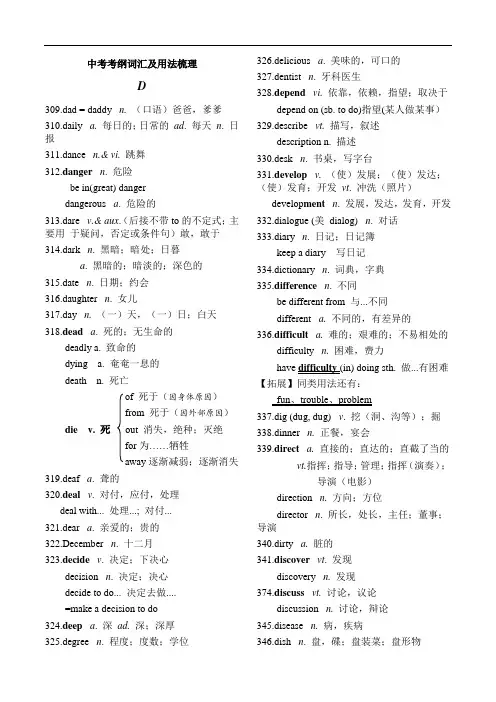
中考考纲词汇及用法梳理D309.dad = daddy n.(口语)爸爸,爹爹310.daily a.每日的;日常的ad. 每天n. 日报311.dance n.& vi.跳舞312.danger n. 危险be in(great) dangerdangerous a. 危险的313.dare v.& aux.(后接不带to的不定式;主要用于疑问,否定或条件句)敢,敢于314.dark n. 黑暗;暗处;日暮a. 黑暗的;暗淡的;深色的315.date n. 日期;约会316.daughter n. 女儿317.day n.(一)天,(一)日;白天318.dead a. 死的;无生命的deadly a. 致命的dying a. 奄奄一息的death n. 死亡of 死于(因身体原因)from 死于(因外部原因)die v. 死out 消失,绝种;灭绝for为……牺牲away逐渐减弱;逐渐消失319.deaf a. 聋的320.deal v. 对付,应付,处理deal with... 处理...; 对付...321.dear a. 亲爱的;贵的322.December n. 十二月323.decide v. 决定;下决心decision n. 决定;决心decide to do... 决定去做....=make a decision to do324.deep a. 深ad.深;深厚325.degree n. 程度;度数;学位326.delicious a. 美味的,可口的327.dentist n. 牙科医生328.depend vi.依靠,依赖,指望;取决于depend on (sb. to do)指望(某人做某事)329.describe vt.描写,叙述description n. 描述330.desk n. 书桌,写字台331.develop v.(使)发展;(使)发达;(使)发育;开发vt. 冲洗(照片)develop ment n. 发展,发达,发育,开发332.dialogue (美dialog) n. 对话333.diary n. 日记;日记簿keep a diary 写日记334.dictionary n. 词典,字典335.difference n. 不同be different from 与...不同different a.不同的,有差异的336.difficult a.难的;艰难的;不易相处的difficulty n.困难,费力have difficulty (in) doing sth. 做...有困难【拓展】同类用法还有:fun、trouble、problem337.dig (dug, dug) v. 挖(洞、沟等);掘338.dinner n.正餐,宴会339.direct a.直接的;直达的;直截了当的vt.指挥;指导;管理;指挥(演奏);导演(电影)direction n.方向;方位director n. 所长,处长,主任;董事;导演340.dirty a.脏的341.discover vt. 发现discovery n.发现374.discuss vt.讨论,议论discussion n.讨论,辩论345.disease n.病,疾病346.dish n. 盘,碟;盘装菜;盘形物347.dismiss vt. 让……离开;遣散;解散;解雇348.disturb vt. 扰乱;打扰349.divide vt. 分,划分~ ... into... 把...分成... (把蛋糕分为3份)seperate...from.. 把...与...分开(把同学们分为3组)350.do (did, done) v. & aux.做,干(用以构疑问句及否定句。
中考英语考纲词汇用法详解.doc

中考英语考纲词汇用法详解⑴I[SH] pron,我:I am a college student.我是一名大学生。
/ I am very busy.我很忙。
/I see.我明白了oice[SK*] n.冰:I am learning to skate on real ice!我正在真正的冰上学溜冰。
/ It is da ngerous to walk on thin ice,在薄冰上行走很危险° / Would you like some ice in your drink?你要在饮料里加些冰块吗?ID[向S3N期£*昌]n.身份证:Please show your ID.请出示你的身份证。
/ If someone ap pears saying he is a policeman, ask for ID.如果有人说他是警察,可要他出示身份证。
【说明】ID的完整形式为identity card。
idea[2B*国£:*P]n.主意;想法;意见:An idea crossed my mind.我突然产生了一个念头。
/ That's not a good idea; it won't work.这不是一个好主意,它行不通的。
if[Kx^] conj,如果;是否:We'll go if the weather stays fine.如果天气好我们就去。
/ I wonder if he is at home.我不知道他是否在家。
【注意】当if作“如果”解时,用来引导条件状语从句;当作“是否”解时,相当于whet her,常用来引导宾语从句。
病的:He has been ill for a long time.他病了彳艮久了。
/ She is ill, so she c an't come.她病了,所以不能来。
【辨析】ill和sick两者均表示“有病的”,ill只用作表语,而sick既可用作定语,也可用作表语。
2020年中考英语复习之重点核心词汇详解4:E字部含答案
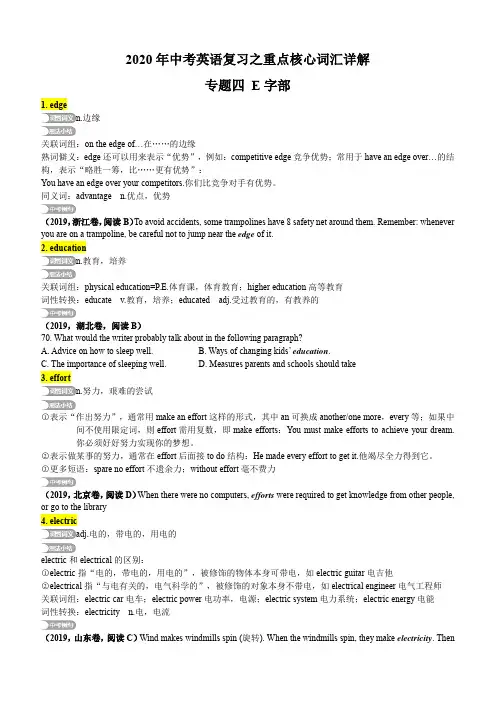
2020年中考英语复习之重点核心词汇详解专题四E字部1. edgen.边缘关联词组:on the edge of…在……的边缘熟词僻义:edge还可以用来表示“优势”,例如:competitive edge竞争优势;常用于have an edge over…的结构,表示“略胜一筹,比……更有优势”:You have an edge over your competitors.你们比竞争对手有优势。
同义词:advantage n.优点,优势(2019,浙江卷,阅读B)To avoid accidents, some trampolines have 8 safety net around them. Remember: whenever you are on a trampoline, be careful not to jump near the edge of it.2. educationn.教育,培养关联词组:physical education=P.E.体育课,体育教育;higher education高等教育词性转换:educate v.教育,培养;educated adj.受过教育的,有教养的(2019,湖北卷,阅读B)70. What would the writer probably talk about in the following paragraph?A. Advice on how to sleep well.B. Ways of changing kids’ education.C. The importance of sleeping well.D. Measures parents and schools should take3. effortn.努力,艰难的尝试○1表示“作出努力”,通常用make an effort这样的形式,其中an可换成another/one more,every等;如果中间不使用限定词,则effort需用复数,即make efforts:You must make efforts to achieve your dream.你必须好好努力实现你的梦想。
第7天 bottle~busy-中考英语考纲必备重点词汇用法详解

box-boxes
4
boy
[bɔɪ]
n.男孩
boy-boys
5
brain
[breɪn]
n.脑
6
brave
[breɪv]
adj.勇敢的
brave-bravely ad.-braveryn.勇敢,勇气
7
bread
[bred]
n.面包
bread不可数名词
25
busy
['bɪzi]
adj.忙碌的;无暇的
busy-busier-busiest
busy-busilyad.
be busydoingsth.忙于做某事
I am busy doing my homework.
be busy with sth.忙于某事
I am busy with my homework.
初中英语必备单词用法详解
本表共收约1600个单词,全部为中考考纲词汇。
第7天
序号
考纲词汇
音标
词义
自测
1
bottom
['bɒtəm]
n.底部;底面
adj.底部的;最后的;尽头的
at theபைடு நூலகம்bottom of在…的底部
2
bowl
[bəʊl]
n.碗
a bowl of soup
3
box
[bɒks]
n.盒;箱
brush
[brʌʃ]
v.(用刷子)刷净n.刷子
brush-brushes
20
build
[bɪld]
v.建筑;建造
21
第17天 enter~exercise-中考英语考纲必备重点词汇用法详解

练习,习题(可数)Please do exercises1 and 2 by yourself.
3
eraser
[ɪ'reɪzə(r)]
n.橡皮;黑板擦Leabharlann aneraser4
especially
[ɪ'speʃəli]
adv.特别;尤其
especially-especial a.特别的
5
Europe
['jʊərəp]
n.欧洲
6
European
[ˌjʊərə'piːən]
adj.欧洲的n.欧洲人
aEuropean
adj.使人兴奋的;令人激动的
exciting修饰物
excited修饰人
excite v.
23
excuse
[ɪk'skjuːz](v.)
[ɪk'skjuːs](n.)
v.原谅;宽恕
n.借口;辩解
anexcuse
24
exercise
['eksəsaɪz]
n.锻炼,运动;习题;练习v.锻炼
v. Iexercisein the park every day.
14
everything
['evriθɪŋ]
pron.每件事;一切
当形容词修饰everything, something, nothing, anything不定代词时,要放在不定代词的后面
everythinguseful
somethinginteresting
15
everywhere
['evriweə(r)]
2024年中考英语考纲词汇
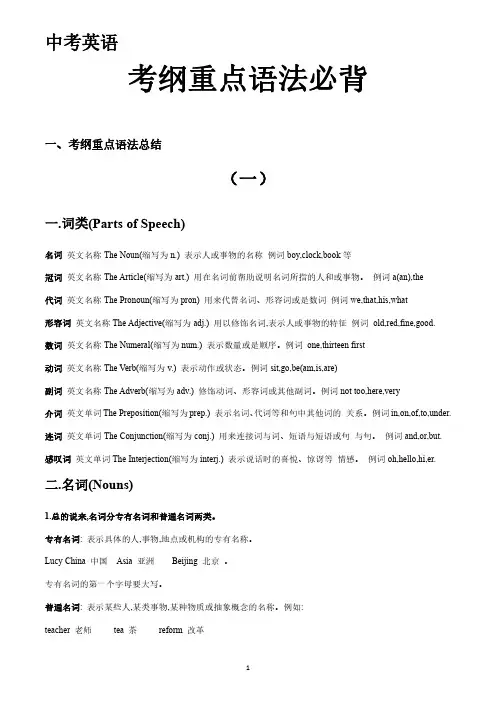
考纲重点语法必背一、考纲重点语法总结(一)一.词类(Parts of Speech)名词英文名称The Noun(缩写为n.)表示人或事物的名称例词boy,clock,book等冠词英文名称The Article(缩写为art.)用在名词前帮助说明名词所指的人和或事物。
例词a(an),the代词英文名称The Pronoun(缩写为pron)用来代替名词、形容词或是数词例词we,that,his,what形容词英文名称The Adjective(缩写为adj.)用以修饰名词,表示人或事物的特征例词old,red,fine,good.数词英文名称The Numeral(缩写为num.)表示数量或是顺序。
例词one,thirteen first动词英文名称The Verb(缩写为v.)表示动作或状态。
例词sit,go,be(am,is,are)副词英文名称The Adverb(缩写为adv.)修饰动词、形容词或其他副词。
例词not too,here,very介词英文单词The Preposition(缩写为prep.)表示名词、代词等和句中其他词的关系。
例词in,on,of,to,under.连词英文单词The Conjunction(缩写为conj.)用来连接词与词、短语与短语或句与句。
例词and,or,but.感叹词英文单词The Interjection(缩写为interj.)表示说话时的喜悦、惊讶等情感。
例词oh,hello,hi,er.二.名词(Nouns)1.总的说来,名词分专有名词和普通名词两类。
专有名词:表示具体的人,事物,地点或机构的专有名称。
Lucy China中国Asia亚洲Beijing北京。
专有名词的第一个字母要大写。
普通名词:表示某些人,某类事物,某种物质或抽象概念的名称。
例如:teacher老师tea茶reform改革普通名词又可进一步分为四类1)个体名称:表示单个的人和事物。
中考英语考纲表-江苏淮安
代码 内容
代码
E1 听力
E11
E2
语音、语法 和词汇
E21
E22
E23 E24
E25 E26 E27
英语考纲表
二级考点
内容
听力知识
代码
E111 E112 E113
名词
E211
代词 数词 介词和介词短语
连词 形容词 副词
E212 E213 E214 E221 E222 E223 E224 E225 E231 E232 E233 E234 E241 E242 E243 E244 E245 E246 E251 E252 E253 E254 E255 E261 E262 E263 E264 E271 E272 E273
E2e 词汇知识
E2e1
E2e2
E2e3
E2e4
E2e5
E2f 主从复合句
E2f1
E2f2
E2g 语音
E2g1
E2h 词汇运用
E2h1
E2h2
E2i 句意理解
E2i1
E3 阅读与写作 E31 交际功能
E311
E32 完形填空
E321
E33 阅读 E34 写作
E331 E332 E341
纲表
三级考点
阅读理解 任务型阅读 短文写作
内容
句子理解 对话理解 短文理解
可数名词的单、复数形式
不可数名词 专有名词 名词所有格 人称代词 物主代词 反身代词 指示代词 不定代词 基数词和序数词 千以内数字的写法 年、月、日及钟点的表达方法 数词的某些特殊用法 介词表时间 介词表方式 介词表地点 介词表所属关系 介词词组 介词的其他用法 并列连词 选择连词 转折连词 因果连词 从属连词 形容词作定语(前置、后置) 形容词作表语 形容词作宾语补足语 形容词比较级和最高级的构成和用 法 副词用法 副词位置 副词比较级和最高级的构成和用法
中考1600词汇详解(E组60个)
中考1600词汇详解E1.each adj. & pron各个;各自;每一个短语:each other彼此2.ear n.耳朵;听觉短语:ear-ring 耳环3.early adj. & adv. 提早的(地);及时的(地)短语:in early spring在早春4.earth n. 地球;海洋5.easily adv. 容易地;非常6.east n.& adj. 东方;东部7.easy adj. 容易的;不费劲的短语:easy come,easy go 来得容易去得快8.eat v. 吃饭;吞咽;咀嚼短语:eat up 吃光9.edge n. 边界;边缘;界限cation n. 教育;传统教育短语:further education 深造11.effort n.力气;尽力;努力12.egg n.蛋;卵13.eight num. 八;八号14.either adj. conj & adv.(两者间)任意一个;近义词辨析:either / both / neitherboth 是“两个都……”的意思;neither表示“两者中的任何一个都不……”。
either表示“两者中的任何一个”;使用时,both后面接名词复数,neither/either修饰名词的单数形式。
注意:表示“两个都不……”,不用both…not而应使用Neither15.elder n. 年长的;岁数大的;16.electric adj.电的;带电的17.elephant n. 象18.eleven num.十一(的);十一号19.else adj. & adv.此外;其他人20.E-mail n.电子邮件短语:send an E-mail发邮件21.empty adj.空的;来往人的短语:on an empty stomach22.enable v.有权做;开启23.encourage v.鼓励;督促短语:encourage sb to lose weight 鼓励某人减肥24.end n. & v. 末尾;终点短语:in the end最后25.enemy n. 敌人;敌国26.energy n.精力;活力能量短语:be full of energy 精力充沛27.engineer n.工程师;技师28.England n.英国29.English n. & adj.英国的;英语的30.enjoy v.欣赏;喜爱短语:1. enjoy doing 喜爱做… 2.enjoy oneself31.enough adj. adv. & n.足够的;充足的短语:1.good enough 足够好32.ensure n. 确保;保证33.enter v.进入;上台34.eraser n.消除用具;橡皮擦35.especially adv.尤其;格外36.Europe n.欧洲;37.European n.欧洲的;欧洲人38.even adv.甚至;短语:even better甚至更好39.evening n.傍晚;晚上短语:in the evening 在晚上 2. on Sunday evening 在周日的晚上40.ever adv. 1.(用在否定句、疑问句、条件状语从句中)曾经,在任何时候;2.(用于特殊疑问句,加强语气)究竟。
中考英语知识点归纳2024
中考英语知识点归纳2024一、词汇。
1. 重点单词。
- 动词。
- be动词(am/is/are/was/were)- 用法:用于表示人或事物的状态、性质等。
例如:I am a student.(一般现在时)He was at home yesterday.(一般过去时)- 实义动词。
- 及物动词(vt.):如like,后面直接跟宾语。
I like English.- 不及物动词(vi.):如run,不能直接跟宾语。
He runs fast.- 名词。
- 可数名词:有单复数形式。
如book - books,规则变化包括加 - s (books)、加 - es(boxes)等,还有不规则变化,如man - men,child - children等。
- 不可数名词:如water,milk等,没有复数形式,作主语时谓语动词用单数形式。
- 形容词和副词。
- 形容词:用于修饰名词,说明事物的特征。
例如:a beautiful flower。
形容词有原级、比较级(一般加 - er或more + 形容词原级,如taller,more beautiful)和最高级(加 - est或most+形容词原级,如tallest,most beautiful)的变化。
- 副词:用于修饰动词、形容词或其他副词。
例如:He runs quickly. 副词的比较级和最高级变化规则与形容词相似。
2. 词汇拓展。
- 前缀:如un -(unhappy,unlucky)表示否定;re -(reuse,rewrite)表示“再,重新”。
- 后缀:- er(worker,teacher)表示人;- ful(careful,helpful)表示“充满……的”。
3. 固定搭配。
- 动词短语。
- look forward to(期待),后面接名词或动名词。
I'm looking forward to your reply.- pay attention to(注意),同样接名词或动名词。
第05讲字母E词汇语法精选非谓语动词中考题型套餐-九年级暑假课暨过
第五讲词汇(字母E)、语法精选(非谓语动词)、题型套餐(首字母+完形填空)词汇打卡读一读背一背(带◆号为2023年上海中考新增词汇)单词音标词性中文1earthquake ['ɜːθkweɪk]n. 地震2economy[ɪ'kɒnəmi]n.经济3education [edʒu'keɪʃn] n. 教育,培养4effect [ɪ'fekt]n.效果5effort ['efət]n. 努力;艰难的尝试;精力6electricity[ɪlek'trɪsəti]n.电7elementary[elɪ'mentri]adj.初级的;基本的8enable[ɪ'neɪbl]v. 使……能够,使……有能力9encourage [ɪn'kʌrɪdʒ] vt. 鼓励10engineer [endʒɪ'nɪə(r)] n. 工程师;技师11enjoyable [ɪn'dʒɔɪəb l] adj.使人愉快的;使人欢乐的12entrance['entrəns]n.入口;入场13environment [ɪn'vaɪrən mən t] n. 环境14equal['iːkwəl]adj./v.平等的;等于15escape[ɪ'skeɪp]n. & v. 逃跑;逃脱16European [jʊərə'piːən] a.&n. 欧洲的;欧洲人的17excellent ['eksələnt] a. 极好的;优秀的18exchange[ɪks'tʃeɪndʒ]v.交换;交流19excite [ɪk'saɪt] vt. 使兴奋,使激动20experience [ɪk'spɪəriən s] n. 经验;经历21experiment [ɪk'sperɪmən t] n. 实验22explain [ɪk'spleɪn] vt. 解释;说明23express [ɪk'spres] vt. 表达;表示24expect[ɪk'spekt]vt. 预料;盼望25expensive[ɪk'spensɪv] a. 昂贵的26extra ['ekstrə]adv.adj,另外;非常;额外的◆27eraser [ɪˈreɪzə(r)]n..橡皮擦;黑板擦◆28electronic[ɪˌlekˈtrɒnɪk] adj◆◆◆◆◆29energetic[ˌenəˈdʒetɪk] adj.◆◆◆◆◆◆30expert [ˈekspɜːt] n..◆◆想一想写一写根据句意用所给单词的适当词性填空1. Don't leave the lights on it wastes __________. (electric)2. Who got to the cinema the __________in our class? (early)3. Join us, and you’ll find learning English can be __________ and wonderful. (enjoy)4. He is the __________ twin of the two. (elderly)5. He got into the car and then started the__________. (engineer)6. Jane gets angry __________. She'd better get rid of it. (easy)7. University Tours, which are quite popular these days, are very _______ (education) to teenagers.8. The bird's large wings __________ it to fly very fast. (able)9. He went to bed much __________ last night than usual because he had a bad cold. (early)10. It's __________ to get there on foot than by car. (easy)11. We need ______ to face all the difficulties. (encourage)12. Quite a few cars wait at the ______ to the famous kindergarten every afternoon. (enter)13. They began to shout and jump ______ when they heard the ______ news. (excite)14. The actor is ______ what we are looking for. (exact)15. Next month our ______ friends will pay a visit to Shanghai. (Europe)【答案】1.electricity2.earliest3.enjoyable4.elder5.engine6.easilycational8.enable9.earlier 10.easier 11.courage 12.entrance 13.excitedly 14.exactly 15.European语法精选:非谓语动词动词不定式1.作表语;2.信号词:wish, hope, dream, work, task, duty, ambition,etc. etc.1. My wish is to bee a teacher.2. The first thing I want to do is to visit my grandfather.作定语(后置)I have nothing___________(send)you.We must never miss the chance _______( show) 1. I have nothing to say about that thing.2. Sorry, I can’t go with you; I have a lot of clothes to wash.3. China is the third country to send its astronauts into the space.语法专题即学即练1.(2022·上海·统考中考真题)The young player spends four hours _______ volleyball every day. A.practise B.practising C.to practise D.practised【答案】B【详解】句意:这位年轻运动员每天花四个小时练习排球。