
北师大版八年级英语上册 Unit 4 笔记
一、重点短语
11、have the flu 得流感 12、take some medicine 吃药 13、twice a day 一天两次 14、stay at home 呆在家里 15、get plenty of rest 得到充分休息 16、drink lots of water 喝大量水 17、make your body strong 使你身体强壮 18、brush one’s teeth 刷牙 19、eat healthy food 吃健康的食物 20、play sports 做运动
Unit 4 Healthy Living
重点知识
书写格式
一、重点短语 二、关键句型
三、知识梳理
四、语法解析
五、课堂笔记
一、重点短语
1、go to the doctor 看医生 2、go to the dentist 看牙医 3、what’s the matter ?怎么了 4、have a cough 咳嗽 5、have a headache 头疼 6、have a stomachache 胃疼/肚子疼 7、have a sore throat 嗓子疼 8、have a runny nose 流鼻涕 9、have a fever 发烧 10、take a deep breath 深呼吸
三、知识梳理பைடு நூலகம்
6. be+adj+enough to do 表示“某人/某物足够…可以做 某事”例如: He is old enough to decide by himself. 他已经足够大,可以自己做决定了。 The policeman was fast enough to catch the thief. 这个警察足够足够快,抓住了那个小偷。 7. 部分名词或动词后加-ful, 构成形容词。例如: care-careful, help-helpful, use-useful, wonderwonderful, harm-harmful 8. 反义词 sick-healthy, weak-strong, tall-short, fast-slow
二、关键句型
1. My headache is a lot better. 我头疼好了很多。 2. A lot of people like the book. 很多人喜欢这本书。 3. Smoking is harmful to your body. 吸烟对你身体有害 4. At the moment, it’s very hard for people to get bird flu. 目前,人们很难感染禽流感。 5. It’s good to wash your hands because it helps you stay healthy. 洗手有益,因为这能帮助你保持健康。
3. 描述身体不适的句型 (1)主语+be动词/feel +形容词 I am sick. I feel dizzy. 我感到头晕 I don’t feel well today. 我今天感到不舒服。
三、知识梳理
3. (2)主语+have/ has +a+ 症状名词 I have a cough. I have a bad cold. 我得了重感冒 4. 介词 across, through, over across “横穿”,指从表面走过或从一边到另一边 through “纵贯”,指从空间内穿过 over “跨越”,从上方空中穿越。 5. It is + adj.+for sb. to do sth. 表示“对某人来说做某 事是…的” It’s good for your health to keep your hands clean.
一、重点短语
31、make +宾语+adj. 使…怎么样 32、make sure 确保 33、on earphones 用耳机(介词短语) 34、use earphones 用耳机(动词短语) 35、stay/keep healthy 保持健康 36、make sth. clean 使某物干净 37、plenty of = a lot of = lots of 许多 38、 a lot 非常;很多(程度副词) 39、be +adj. +enough to do 某人/某物…足够 做某事 40、move away 移走
三、知识梳理
1. a lot of, lot’s of, plenty of 表示“许多,大量的、充足的”既可以修饰可数名词又可以 修饰不可数名词。 2. a lot 用于动词之后,表示程度 You really helped me a lot.
I listen to loud music a lot.
一、重点短语
21、sleep well 睡得好 22、take a shower 淋浴;洗澡 23、walk to school 步行去学校 24、wash one’s face/ hands 洗手/脸 25、take one’s temperature量体温 26、make sb. deaf 使某人耳聋 27、at the moment 目前、现在 28、be harmful to = be bad for 对…有害 29、it is/ was +adj+(for sb) to do sth. (对某人来说)做某事是…样的 30、feel sleepy 感到困倦的
二、关键句型
6. Although they are very light, bones are strong enough to support our weight. 尽管骨骼很轻,但是他们足以支撑我们的体重。 7. When people sneeze, we get the flu from the air. 当人们打喷嚏的时候,我们从空气中感染流感。 8. Bones are important because they helps us move freely. 骨骼很重要,因为他能够帮助我们自由活动。
北师大版英语八年级上册Unit 4 Healthy Living 重难点知识归纳总结

北师大版英语八年级上册Unit 4 Healthy Living【重点单词】1. health /helθ/ n.健康;身体状况2. cough /kɒf/ n., v.咳嗽3. fever /ˈfiːvə(r)/ n.发烧,发热4. headache /ˈhedeɪk/ n.头痛5. runny /ˈrʌni/ adj.流鼻涕的6. sore /sɔː(r)/ adj.疼痛的,酸痛的7. throat /θrəʊt/ n.咽喉,喉咙8. stomachache /'stʌməkeɪk/ n.胃痛9. toothache /ˈtuːθeɪk/ n.牙痛10. plenty /ˈplenti/ pron.大量;充足11. dentist /ˈdentɪst/ n.牙医12. matter /ˈmætə(r)/ n.问题;事情13. temperature /ˈtemprətʃə(r)/ n.体温;温度,气温14. deep /diːp/ adj.深(呼吸)的;深的15. breath /breθ/ n.一次呼吸的空气16. flu /fluː/ n.流行感冒17. serious /ˈsɪəriəs/ adj.严重的;严肃的18. twice /twaɪs/ adv.两次,两遍19. note /nəʊt/ n.(病假)证明;笔记20. patient /ˈpeɪʃnt/ n.病人21. date /deɪt/ n.日期22. symptom /ˈsɪmptəm/ n.症状23. treatment /ˈtriːtmənt/ n.治疗24. cold /kəʊld/ n.感冒;冷 adj.寒冷的25. once /wʌns/ adv.一次26. advice /ədˈvaɪs/ n.建议,劝告27. sleepy /ˈsliːpi/ adj.困倦的,瞌睡的28. harmful /ˈhɑːmfl/ adj.有害的29. sneeze /sniːz/ v.打喷嚏 n.喷嚏30. soap /səʊp/ n.肥皂31. time /taɪm/ n.次,回;时间32. air /eə(r)/ n.空气;空中33. earphone /'ɪəfəʊn/ n.耳机34. volume /ˈvɒljuːm/ n.音量;体积35. harm /hɑːm/ v.伤害,损害36. care /keə(r)/ n.照顾,小心 v.关注,在意37. wonder /ˈwʌndə(r)/ v.想知道;感到惊讶 n.惊讶;奇迹38. bone /bəʊn/ n.骨头39. blood /blʌd/ n.血40. hold /həʊld/ v.拿着41. although /ɔːlˈðəʊ/ conj.尽管,虽然42. outside /ˌaʊtˈsaɪd/ n.外面,外部 adj.外面的 adv.在(或向)外面 prep.在……外面43. inside /ˌɪnˈsaɪd/ n.里面,内部 adj.里面的 adv.在(或向)里面 prep.在……里面44. nutrient /ˈnjuːtriənt/ n.营养;营养物45. waste /weɪst/ n.废物;浪费 v.浪费46. calcium /ˈkælsiəm/ n.钙47. solid /ˈsɒlɪd/ adj.坚硬的48. vitamin /ˈvɪtəmɪn/ n.维生素,维他命49. stair /steə(r)/ n.楼梯50. lunchtime /ˈlʌntʃtaɪm/ n.午餐时间51. ping-pong /ˈpɪŋ pɒŋ/乒乓球52. less /les/ adj.较少的,更少的53. letter /ˈletə(r)/ n.字母;信函54. blank /blæŋk/ n.空白处 adj.空白的【重点短语】1. plenty of 许多;大量2. for example 例如3. bird flu 禽流感4. potato chip 薯片5. take a shower 淋浴6. go to the doctor 去看医生7. take medicine 吃药8. have a fever/headache/runny nose/cold 发烧/头痛/流鼻涕/感冒9. once/twice a day 一天一次/两次10. get the flu 得流感11. stay fit 保持健康12. make sure 确保13. be afraid of 害怕14. be bad for 对……有害15. a bit of 一点儿16. do a survey 做调查17. junk food 垃圾食品18. be able to 能够【重点句型】1. We spent a lot of/lots of/plenty of money on it.我们在这上面花了很多钱。
北师大版英语八年级上册Unit4 名师指导:状语从句知多少
名师指导:状语从句知多少状语从句,指的是在复合句中作状语的从句,修饰主句中的动词、形容词或副词等。
状语从句放在主句之前时,常用逗号分开;假设放在主句之后,一般不用逗号。
按其意义和作用划分,可以分为以下几种:◆时间状语从句一般来说,时间状语从句常由连词when, before, after, as soon as或until引导。
在使用时,从句一般不用一般将来时态。
假设主句为一般将来时态或是含有将来的意味时,时间状语从句常用一般现在时态来代替将来,即“主将从现〞。
例如:I will tell him the news as soon as he comes back. 他一回来,我就告诉他这个消息。
When I grow up, I will join the army. 当我毕业了,我就要去参军。
◆条件状语从句条件状语从句常由if〔如果〕或as long as〔只要〕来引导,同样适用于“主将从现〞。
例如:We will stay at home if it rains tomorrow. 如果明天下雨了,我们就会呆在家。
As long as I live, I shall work hard. 只要我活着,我就要努力工作。
◆原因状语从句原因状语从句常由because〔因为〕,since〔既然;由于〕或as〔由于〕来引导。
在使用时,注意because和so〔所以〕不能用在同一个句子中。
例如:Since you can’t help me, I’ll find someone else. 既然你帮不了我,那我就找其他人吧。
I was late for school this morning because the traffic was busy.= The traffic was busy, so I was late for school this morning.因为早晨交通堵塞,所以我迟到了。
Unit 4复习讲义-北师大版英语八年级上册
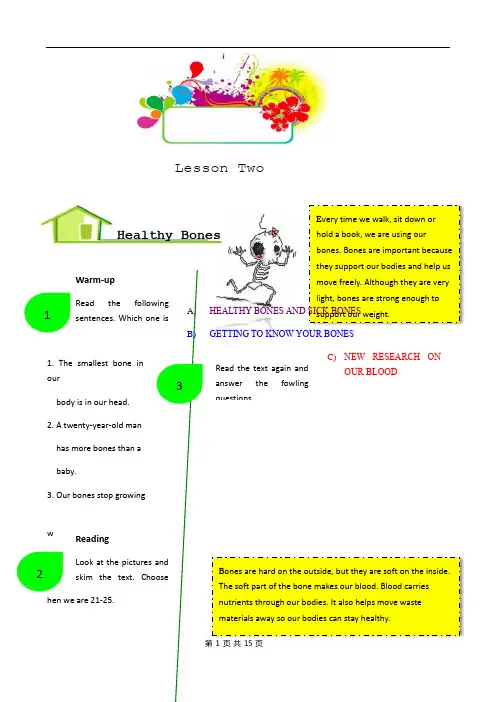
第 1页 共 15 页 E very time we walk, sit down orhold a book, we are using our bones. Bones are important becausethey support our bodies and help us move freely. Although they are verylight, bones are strong enough tosupport our weight. B ones are hard on the outside, but they are soft on the inside.The soft part of the bone makes our blood. Blood carries nutrients through our bodies. It also helps move waste materials away so our bodies can stay healthy.Healthy Bones1. The smallest bone in ourbody is in our head. 2. A twenty -year -old man has more bones than a baby.3. Our bones stop growing when we are 21-25.HEALTHY BONES AND SICK BONES GETTING TO KNOW YOUR BONESC) NEW RESEARCH ONOUR BLOOD1Lesson Two2Warm -upRead thesentences. Which Readingskim the text. Read the text again andanswer the fowlingquestions.第 2 页 共 15 页 C alcium makes our bones solid, so weneed to get enough of it each day. We can get calcium easily from milk, some vegetables and other foods.V itamin D is also important because it helps calcium work well in our bodies. Although we get vitamin D from food like fish and eggs, we can also get it from the sun! Try to get a bit of sun every day so you can have healthier bones!Exercise improves our bone health too, so make it a habit. Running, jumping and dancing are all good exercise, but even daily activities like walking and climbing stairs can help keep our bones healthy and strong!1. Are bones weak?2. Are bones hard on theinside?3. What do bones make?4. Why is blood important?Word BankWords Meaning Comments1. hold v. 握着,抱着v.抓住;承受;阻止;容纳;持有;举行hold on2. important adj. 重要的n. importance be important = be of importance3. support v. 支撑v. 支持;资助;供养4. light adj. 轻的n. 光adj. 光线充足的;浅色的v. 照亮;点燃light up 照亮;点燃;使发亮5. weight n. 体重v. 称重;权衡weigh one’s words斟酌词句What/ How much do you weigh?6. hard adj. 坚硬的adj. 困难的;辛苦的;冷酷无情的be hard onadv. 努力地;剧烈地;急剧地;严重地7. carry v. 输送v. 拿,携带;承载carry out实行;履行;执行8. through prep. 穿过through & cross & crosslook through & go through & get through9. waste adj. 废弃的n. 浪费It’s a waste of time/ energy to do sth.v.浪费10. work v.奏效v. 起作用;运转;工作n. 工作11. improve v.改善v.增加;改善;提高第3 页共15 页12. habit n. 习惯fall/ get into/ form the habit of doing sth.13. healthy adj. 健康的keep/ stay healthyn. health现学现卖单项选择1.______ I don’t know the old man, I would like to help him.A. AlthoughB. ButC. BecauseD. So2. -- 80% people think _______ is good for our _______.-- Keeping healthy is important.A. get more exercise; healthB. taking more exercise; healthC. taking more exercise; healthyD. do more exercise; healthy3. -- How do you relax after work?-- I think the best way is ________ exercise.A. byB. throughC. forD. in第4 页共15 页4. The old man _______ a simple life _______ he has much money.A. have; butB. has; asC. lives; althoughD. live; because5. Some students got in ______ the window because the classroom was closed.A. throughB. thoughC. acrossD. past6. -- ______ do many students go online?-- Often.A. How longB. How oftenC. How manyD. How many hours7. It’s helpful to _______ a good habit of reading in language learning.A. takeB. showC. developD. match8. It doesn’t usually rain at this time of year, but today it is raining _______.A. heavyB. hardC. hardlyD. healthy9. -- What can I help you?-- No, thanks. The box is ______ I can manage it.A. heavyB. healthyC. lightD. hard10. -- What’s the ______ of the little panda at birth.-- It’s about 100g at birth.A. weightB. weighC. lengthD. long11. -- Mr. Wu, do you think I can study English well?-- Yes, it’s ______ for you to learn it well if you work hard.A. cleverB. possibleC. impossibleD. important12. _____ more exercise and it keeps you _______.A. Taking; healthB. Taking; healthyC. Take; healthyD. Take; health第5 页共15 页第 6页 共 15 页 标志性时间状语:1. We get up early to study hard every morning.2. The earth moves aroundthe sun.3. To be or not to be, it is a question.4. I feel sad because I’mfatter and fatter.5. I will go back to the countryside if I have another chance.Grammar早睡早起学习抓紧我能怎么办?我也想减肥呀!可是美食那么多,割舍不下啊…总经常,有每没,复星周(always, usually, often, sometimes, every…, seldom, hardly, never, twice a week, on Sundays, on weekends )来来来,聪明的你萌,根据图片来总结一下一现的规律吧!一般现在时第 7页 共 15 页 先划出关键词,然后开始你的表演!单项选择1. She always does very well in the English exams. But she can _____ understand English radio programs. A. alwaysB. hardlyC. alreadyD. easily2. -- Zhang Lili, “ the most beautiful teacher”, has moved us deeply. -- Yes, and she is _______ popular with her students.A. sometimesB. neverC. alwaysD. hardly3. Love will ______ last if we love the whole fine things around us.A. seldomB. alwaysC. neverD. sometimes语法加气站1. 表示_________或_________的动作2. 表示____________3. 格言或警句4. 表示现阶段的______________________________时态时间状语我俩紧密相连,找到时间状语,就知道我啦!4. There’s no time left. I’m afraid I can ______ finish the work.A. hardB. almostC. hardlyD. nearly5. -- Can you understand what I meant?-- Sorry, I can ______ follow you.A. alwaysB. almostC. nearlyD. hardly6. -- Miss Green is very popular with kids.-- Yes. She _____ tells interesting stories and sings songs to them.A. seldomB. neverC. sometimesD. always7. -- I saw you come to school by bus this morning.-- Oh, I _____ come to school by bus, but it is raining today.A. hardlyB. alwaysC. sometimesD. usually8. There ______ still some apple juice in the fridge. It’s not necessary forus to go to the supermarket now.A. wasB. wereC. isD. are9. I will send you an e-mail as soon as I _____ in Canada.A. arriveB. arrivedC. am arrivingD. will arrive10. -- Can Peter play games with us, Mrs. Hawking?-- Wait a minute. He ______ a shower.A. is takingB. takesC. tookD. was takingCloze明确句中时间状语是确定时态的关键。
八年级英语上册U4知识点汇总
Unit 4 An old man try to move the mountains?词形转换1.shoot(c. )射击过去式:发射shot 过去分词shot2.weak(adj. )虚弱的;无力的反义词strong强壮的同音词week(n. )周;星期3.silly(adj. )愚蠢的;不明事理的一同义词stupid4.hide(v, )隐藏;隐蔽-过去式hid-过去分词hidden5.excite(v. )使激动;使兴奋adj exciting令人激动的excited 激动的;兴奋的N. excitement 激动;兴奋6.western(adj. )西方国家的;西方的,adj west西方西部7.fit(v. )适合;合身过去式fitted/fit-过去分词fitted/fit8.marry(v. )结婚adj .married 已婚的9.prince(n. )王子对应词-princess公主10.emperor(n. )国王一对应词queen王后短语归纳1. Journey to the West《西游记》2. Yu Gong Moves a Mountain《愚公移山》3. Hou Yi Shoots the Suns《后羿射日》4. Nu Wa Repairs the Sky《女娲补天》5.try to do sth. 尽力/努力做某事6.work on 从事;忙于;致力于work on doing sth. 致力于做某事7.as soon as. 一。
就·8.be moved by. . . 被·····感动9.continue to do sth. 继续做某事10.take sth.away 把某物带走/移走11.a good way to solve the problem 一种解决问题的好方法12. a little bit 有点;稍微13.keep doing sth. 持续/不停地做某事14.give up(doing sth. )放弃(做某事)15.agree with sb. 同意某人的观点/想法;赞同某人16.instead of doing sth. 代替做某事17.for example 例如18. have different opinions about. . .对···. ···有不同的观点19.neither of you 你们两个都不20.be able to do sth. 能够做某事21.a new TV program called. . .一部叫··的新电视节目22.for the first time 首次23.the main character 主要人物24. in the traditional Chinese book 在中国传统的书籍里25.in fact 事实上26.make 72 changes 做出72种变化27.turn. . .into. . . 把······变成··28.a magic stick一根魔棍29. at other times 平时;在其他时候30.excite sb. =make sb.excited 使某人激动e out 出版;发表;出来32.help the weak 帮助弱者33.more than(+数词)=over 多于;超过34.become/be interested in. . . 对······感兴趣35.one of the most popular stories 最受欢迎的故事之一36.once upon a time 从前37.it takes sb.some time to do sth.某人做某事花费多少时间38.have no time to do sth. 没时间做某事39.fall in love with. . . 爱上。
八年级上册英语第4单元笔记

八年级上册英语第4单元笔记一、重点单词。
1. theater.- 可数名词,意为“剧院;剧场”。
例如:There is a new theater in our city.(我们城市有一个新剧院。
)- 其复数形式为“theaters”。
2. comfortable.- 形容词,意为“使人舒服的;舒适的”。
例如:The seat is very comfortable.(这个座位很舒服。
)- 反义词为“uncomfortable”(不舒服的)。
3. seat.- 可数名词,意为“座位;坐处(如椅子等)”。
例如:I can't find my seat.(我找不到我的座位了。
)- 也可作动词,意为“使坐下;使就座”。
例如:He seated himself on the chair.(他在椅子上坐下。
)4. screen.- 可数名词,意为“银幕;屏幕”。
例如:The movie is shown on the big screen.(这部电影在大屏幕上放映。
)5. close.- 形容词,意为“(在空间、时间上)接近”。
例如:My home is close to the school.(我家离学校近。
)- 也可作动词,意为“关闭;关上”。
例如:Please close the window.(请关上窗户。
)- 其形容词比较级为“closer”,最高级为“closest”。
6. ticket.- 可数名词,意为“票;入场券”。
例如:I bought a movie ticket.(我买了一张电影票。
)7. worst.- 形容词bad和副词badly的最高级形式,意为“最差(的);最坏(的);最糟(的)”。
例如:This is the worst movie I have ever seen.(这是我看过的最糟糕的电影。
)8. cheaply.- 副词,意为“便宜地;低廉地”。
例如:You can buy things cheaply in this store.(你可以在这家商店便宜地买到东西。
八年级上册单元知识点复习unit4,推荐文档
Unit 4 Our WorldTopic1 we share the world with plants and animals一.重点词语1. share …wit与.. 共享2. play with 玩弄,玩耍3. in danger 在危险之中4. feed on 以…… 为食5. think about 考虑,思考6. enjoy nature 享受自然7. at night 晚上8. in the daytime 白天9. summer vacation 暑假10. thousands of 成千上万11. in fact 事实上12. find out 查明,发现13. in nature 在自然界二.重点句型1. P lants are more beautiful than animals. 植物比动物更漂亮。
2.The pla nts stay green Ion ger there. 那儿的植物能更长时间保持绿色。
3.The rainforests are very important to us. (热带)雨林对我们很重要。
4 .Water is necessaryfor all plants.It is the most important thing to all living things,we must save every drop of water. 水对所有植物是必需的。
它对所有生物都重要,我们必须节约每一滴水。
5.Isn ' t it interestin? 是不是很有趣呀?6.It is one of the most dangerous fish in the world. 它是世界上最危险的鱼之一。
7.It is so strange! 太奇怪了!三.语法学习(一.)形容词的比较级和最高级的构成1.规则变化:(1.) 一般在词尾加一er或一est.如:fresh—fresher—freshest.(2.)以字母e结尾的形容词,加r或st,如:late—later —latest.(3.)以重读闭音节结尾的词,词尾只有一个辅音字母时,应双写这一辅音字母,再加er或est.如:big —bigger —biggest.(4.)以辅音字母+ y结尾的双音节词,先改y为i,再加er或est.happy—happier —happiest. (5.)部分双音节词和多音节词前面加more 或most 构成比较级或最高级。
八上英语unit4笔记
八上英语unit4笔记
八年级英语Unit4的笔记主要包括以下内容:
1.单词和短语:
o arrive in/arrive at:到达(用于大地方)
o get to/reach:到达(用于小地方)
o train station:火车站
o bus stop:公共汽车站
o taxi stand:出租车站
o subway entrance:地铁入口
o take the subway:乘地铁
o take a bus:乘公共汽车
o take a taxi:乘出租车
o take a train:乘火车
2.句型:
o How do you get to school?你怎么去学校?
o How does she get to work?她怎么去工作?
o I take the subway to school. 我乘地铁去学校。
o He takes the bus to work. 他乘公共汽车去工作。
3.阅读理解:
o阅读短文,回答问题。
o短文内容关于不同的交通方式和上学方式。
4.语法:
o学习使用how引导的特殊疑问句来询问交通方式和上学方式。
5.写作练习:
o写一篇关于自己上学方式的短文。
6.听力练习:
o听录音,完成填空。
o听力内容关于不同的上学方式和交通方式。
7.课堂活动:
o与同学进行对话,练习使用how引导的特殊疑问句来询问上学方式和交通方式。
英语八上第四单元笔记
英语八上第四单元笔记
1.单词:掌握本单元的生词,包括单词的拼写、发音和意思。
2.语法:掌握一般现在时的用法,了解第三人称单数动词的变化
规则和动词加-s/-es的规则。
3.重点句型:掌握以下句型:It’s + 时间+ (for sb.) + to do sth.
和It’s +形容词+ to do sth.。
4.听力:练习听懂本单元的听力材料,了解听力问题的正确答案。
5.阅读:阅读本单元的课文和其他相关材料,了解文章的主旨和
细节信息。
6.写作:练习写作本单元的作文,掌握作文的基本结构和常用表
达方式。
7.练习:完成本单元的练习册和相关练习题,巩固所学知识和提
高语言技能。
总之,英语八上第四单元的笔记需要重点掌握单词、语法、句型和听力、阅读、写作等方面的内容,同时通过练习来巩固所学知识和提高语言技能。
北师大版英语八年级上册Unit 4单词及短语
Unit 4 Healthy LivingLesson 10 Going to the Doctor名词Nouns1. health健康;身体状况e.g.: Smoking can seriously damage your health.2. fever发烧,发热e.g.: Do you have a fever?3. headache头痛e.g.: I have a headache and a runny nose.4. throat咽喉,喉咙e.g.: He held the knife to her throat.5. stomachache胃痛e.g.: The patient’s stomachache stopped after he took the medicine.6. toothache牙痛e.g.: I’ve got a toothache.7. dentist牙医e.g.: I have to go to the dentist tomorrow.8. matter问题;事情e.g.: What’s the matter?9. temperature体温;温度,气温e.g.: The temperature has risen (by) five degrees.10. breath一次呼吸的空气e.g.: He recited the whole poem in one breath.11. flu流行感冒e.g.: The whole family has the flu.12. note(病假)证明;笔记e.g.: Please make a note of the dates.13. patient病人e.g.: There is one particular patient I’d like you to see.14. date日期e.g.: I can’t come on that date.15. symptom症状e.g.: Symptoms include a headache and sore throat.16. treatment治疗e.g.: He is receiving treatment for shock.形容词Adjectives1. runny 流鼻涕的e.g.: Symptoms are streaming eyes, a runny nose, headache and a cough.2. sore疼痛的,酸痛的e.g.: His feet were sore after the walk.3. deep深(呼吸)的;深的e.g.: She’s always been a deep one, trusting no one.4. serious严重的;严肃的e.g.: They pose a serious threat to security.副词Adverbs1. twice 两次,两遍e.g.: I don’t know him well; I’ve only met him twice.2. once一次e.g.: Take it once a day in the morning.代词Pronouns1. plenty 大量;充足e.g.: You should get plenty of rest.兼类词Words with Multiple Part of Speech1. cough n., v.咳嗽e.g.: I couldn’t stop coughing.2. cold n.感冒;冷adj.寒冷的e.g.: I’ve got a cold.短语Expressions1. plenty of 许多;大量e.g.: There are plenty of snacks for everyone.Lesson 11 Health Advice名词Nouns1. advice建议,劝告e.g.: They give advice for people with HIV and AIDS.2. soap肥皂e.g.: Should we wash our hands with soap 20 times a day?3. time次,回;时间e.g.: You don’t need to wash your hands 20 times a day.4. air空气;空中e.g.: Let’s go out for some fresh air.5. earphone耳机e.g.: It can hurt your ears when you listen to very loud music on earphones.6. volume音量;体积e.g.: You should make sure the volume is not too high.形容词Adjectives1. sleepy 困倦的,瞌睡的e.g.: You don’t want to feel sleepy during the day.2. harmful有害的e.g.: My dad smokes. He doesn’t think it’s harmful.兼类词Words with Multiple Part of Speech1. sneeze v.打喷嚏n.喷嚏e.g.: When people sneeze, we can get the flu from the air.2. harm n., v.伤害,损害e.g.: He may look fierce, but he means no harm.3. care n.照顾,小心v.关注,在意e.g.: How much do men share housework and the care of the children?4. wonder v.想知道;感到惊讶n.惊讶;奇迹e.g.: I wonder who she is.短语Expressions1. for example 例如e.g.: Let us suppose, for example, that you are married with two children.2. bird flu禽流感e.g.: At the moment, it’s very hard for people to get bird flu.Lesson 12 Healthy Bones名词Nouns1. bone骨头e.g.: The smallest bone in our body is in our head.2. blood血e.g.: The soft part of the bone makes our blood.3. nutrient营养;营养物e.g.: Blood carries nutrients through our bodies.4. calcium钙e.g.: We can get calcium easily from milk, some vegetables and other foods.5. vitamin维生素,维他命e.g.: Vitamin D is also important because it helps calcium work well in our bodies.6. stair楼梯e.g.: Running, jumping and dancing are all good exercise, but even daily activities like walking and climbing stairs can help keep our bones healthy and strong!7. lunchtime午餐时间e.g.: We always eat a good breakfast. We aren’t hungry before lunchtime.动词Verbs1. hold 拿着e.g.: Every time we walk, sit down or hold a book, we are using our bones.形容词Adjectives1. solid 坚硬的e.g.: Calcium makes our bones solid, so we need to get enough of it each day.连词Conjunctions1. although 尽管,虽然e.g.: Although we get vitamin D from food like fish and eggs, we can also get it from the sun.兼类词Words with Multiple Part of Speech1. outside n.外面,外部adj.外面的adv.在(或向)外面prep.在……外面e.g.: Bones are hard on the outside, but they are soft on the inside.2. inside n.里面,内部adj.里面的adv.在(或向)里面prep.在……里面e.g.: Inside the box was a gold watch.3. waste n. 废物;浪费v.浪费e.g.: It also helps move waste materials away so our bodies can stay healthy.Communication Workshop名词Nouns1. ping-pong乒乓球e.g.: I play ping-pong once a month, but I’m not very good at it.2. letter字母;信函e.g.: There’s a letter for you from your mother.形容词Adjectives1. less 较少的,更少的e.g.: I have a lot of good habits, but I need to eat less junk food and exercise more.兼类词Words with Multiple Part of Speech1. blank n.空白处adj.空白的e.g.: She turned to a blank page in her notebook.短语Expressions1. potato chip 薯片e.g.: I sometimes eat junk food, like hamburgers and potato chips.。
北师大版八年级上册英语单词默写表
adj. 彻底的, 完整的, 已完成的 vt. 完成; 使圆满, 使完美
vi. 像是,似乎
aux. 能,可以 n. 罐头 vt. 罐装 vt. 炒某人鱿鱼
n. 块;片;段;碎片
adj. 完成(了)
v. 乱扔
张贴
n. 通告,通知;注意 v. 意识到;注意
请求,要求
回答,答复
Unit 5: Lesson 14 Helping Each Other
n. 棍;条 v. 粘贴
v. 争论,争辩
v. 选择
v. 建议,提议
adj. 优秀的,杰出的,极好的
adj. 差的;贫穷的
v. 参加,参与
n. 任务,工作;活动
v. 容忍;忍受;站立
n. 演讲;发言
Unit 2: Lesson 6 A Special Team
adj. 特殊的,特别的
v. 持续,延续
n. 夫妻
n. 交流,谈话
n. 语法
n. 章节,段落
n. 发音;读音
n. 词汇,词汇量
adv. 相当
n. 规则
n. 经验;实践 v. 经历;体验
adv. 仔细地
记笔记
Unit 1: Lession 3 The Big Game
n. 运动场;田地
adv. 极其;非常
adj. 健壮的,健康的 v. 适合;合身
v. 同意;赞成
v. 意识到,领会
n. 无线电广播
n. 睡衣裤
事实上,实际上
Unit 6: Communication Workshop
叫醒;醒来
and Names
n. 法国
n. 德国
n. 日本