
牛津译林版英语七年级下册 Unit 6 知识点总结
江苏专版译林七下U6知识点总结1.I want to go riding. 我想去骑马。
解析:go riding为动词短语,意为“去骑马”,为“go + v.ing”结构,常指一些户外活动。
Riding,名词,意为“骑马”,相当于horse riding。
如:➢ At Christmas you can go riding to enjoy the view.在圣诞节你可以骑马欣赏风景。
➢ Riding is her favourite sport.骑马是她最喜欢的体育运动。
拓展:ride,动词,意为“骑(马、自行车等)”。
固定短语:ride a horse骑马;ride a bicycle骑自行车。
如:➢ Can you ride a horse?你会骑马吗?2.Hurry up,Eddie. 快点,埃迪解析:hurry,动词,意为“急忙,匆忙”。
hurry up意为“快点,赶快”,常用于祈使句,不能用于否定句中。
常用短语:hurry to someplace 急忙赶往某地;hurry (up) to do sth 急忙做某事。
如:➢ Hurry up, or you'll be late for class.快点,否则你上课要迟到了。
➢ She hurried to the airport.她急忙去机场。
➢ They hurried to see if everything was OK.他们急忙去看一切是否正常。
拓展:① hurry 还可作名词,意为“匆忙;仓促;急忙”,固定短语in a hurry意为“匆忙地”。
如:➢ He was in a hurry to leave.他匆忙地要离开。
② hurry off/away意为“匆匆离开”。
如:➢ Miss Zhao hurried off to look after the man.赵老师匆匆离开去照看那个男人。
3.Outdoor fun 户外乐趣解析:outdoor,形容词,意为“户外的",在句中只能作定语。
如:➢ Outdoor sunlight is very good for our heath.户外的阳光对我们的健康有很大好处。
拓展:4.You complain too much. 你真会抱怨。
解析:complain,动词,意为“抱怨”。
如:➢ You have no reason to complain.你没有理由抱怨。
拓展:如:➢ She often complains about the price of food.她经常抱怨食品的价格。
➢ I have to complain to the manager about it.我不得不向经理抱怨它。
5.cycling 骑自行车运动解析:cycling,名词,意为“骑自行车运动”,动词形式为cycle(骑自行车)。
如:➢ Beijing is a good place for cycling.北京是一个骑自行车运动的好地方。
➢ They cycled 10 kilometres around the lake.他们围着湖骑行了10千米。
拓展:英语中有许多动词的ing形式也可表示其相应的名词:shop v. 购物→ shopping n. 购物camp v. 野营→ camping n. 野营read v. 阅读→ reading n.阅读skate v. 溜冰→ skating n. 溜冰6.She looked up and saw a white rabbit in a coat passing by.她抬起头看到一只穿着外套的白色兔子经过。
(1)解析:look up在这里意为“抬头看;往上看”。
look up还有“查阅”之意。
如:➢ My brother looked up from his book as I walked into his room.当我走进我弟弟的房间时,他从书里抬起头看了看。
➢ The students went to the library to look up the information.学生们去图书馆查信息了。
(2)解析:pass,动词,意为“经过”,后接名词或代词作宾语;当没有宾语时常用pass by表示“经过”。
如:➢ I passed the shop on my way to the library.我在去图书馆的路上经过了那家商店。
拓展:① pass 作动词,还可表示“通过;度过”。
如:➢ In the end, I passed the English exam.最后,我通过了英语考试。
② pass作动词,还可表示“传、递”。
pass sb. sth = pass sth. to sb.,意为“把某物递给某人”。
如:➢ Pass me some bread, please.请递给我些面包。
(3)解析:by,副词,意为“经过”,常与动词go, walk,run等连用。
如:➢ I saw Tom walking by, carrying two books.我看到汤姆拿着两本书走过去了。
拓展:by还可作介词,意为“靠近;在....旁边;通过;被;经由”。
如:➢ The house by the lake is a restaurant.湖边的那座房子是家饭店。
➢ Do you often go to school by bike?你经常骑自行车去上学吗?➢ Please learn the new words by heart.请用心学习这些生词。
7.Alice did not want to let the rabbit get away, so she jumped down the hole too. 爱丽丝不想让兔子逃脱,因此她也跳到洞里。
解析:get away意为“逃脱”。
如:➢ The robbers rushed into the car and got away quickly.抢劫犯冲进小汽车,迅速逃脱了。
拓展:get away还可表示“离开”。
如:➢ I hope to get away early in the morning.我希望一早就离开。
联想:run away意为“逃离,跑开”。
8.It took a watch out of its pocket and looked at the time.它从口袋里拿出一块手表看了看时间。
解析:take out是固定短语,意为“取出;拔出;除掉”。
其中out是副词,名词作宾语放在out前后都可以;但若是代词作宾语,须放在take 与out之间。
若表示“从.....取出某物”用介词of。
如:➢ He opened his schoolbag and took out a notebook/took a notebook out.他打开他的书包,取出了一本笔记本。
➢ Your pen is in the box. Please take it out.你的钢笔在盒子里。
请把它取出来。
拓展:take out还可表示“把....带出去”。
如:➢ My father will take me out to go for a drive.我父亲要带我出去兜风。
9.Alice fell for a long time,and then she hit the ground.爱丽丝向下掉了很长时间,然后才落地。
(1)解析:fall动词,意为“落下,掉落;倒”。
如:➢ Babies often fall when they are learning to walk.婴儿学走路时常会跌倒。
拓展:如:➢ Please climb down the tree, or you will fall down.请从树上爬下来,不然你会摔下来的。
(2)解析:hit,动词,意为“到达;击中,撞”,后面直接跟人或物作宾语。
如:➢ Look out! Don't hit the tree.当心!不要撞在树上。
拓展:hit作动词,还可表示“袭击..遭受”。
如:➢ A typhoon hit Fujian last month.上个月,一场台风袭击了福建。
10.She found herself alone in a long, low hall.她发现自己一个人在一个长而低的厅里。
(1)解析:find oneself意为“发现自己(处于某种意外的状态)”,后接形容词或地点状语。
如:➢ I found myself excited when I watched the football match.当我看足球赛的时候,我发现自己很兴奋。
➢ She found herself in a strange place.她发现自己在一个陌生的地方。
联想:固定结构“find+宾语+形容词”,意为“发现某人/某物处于某种(意外的)状态"。
find作动词,还可表示“认为,觉得”。
如:➢ I find English very important.我认为英语很重要。
拓展:类似的结构:keep/ make/ think/... +宾语+形容词。
如:➢ We must keep our classroom clean.我们必须保持教室干净。
➢ His words made us happy.他的话使我们高兴。
(2)解析:low,形容词,意为“低的,矮的”,一般指有形物体的高度、温度、价格声音等方面的“低”,作定语或表语。
反义词为high(高的)。
如:➢ The temperature is high/ low these days.这些天温度高/低。
11.There were doors all around, but they were all locked.周围都是门,但它们都是锁着的。
解析:locked,形容词,意为“锁上的",动词形式为lock(锁上;锁好),过去式为locked。
如:➢ The building was locked, and all of us felt safe.大楼被锁上了,我们所有人都感到安全了。
➢ Are you sure you locked the front door?你确定你锁了前门吗?拓展:在词尾加-ed构成其形容词的动词:interest使感兴趣→ interested 感兴趣的frighten使害怕→ frightened害怕的12.Then Alice noticed a small door and put the key into it.这时爱丽丝注意到一扇小门并把钥匙插进去。
牛津译林英语(深圳沈阳)版七年级下册Unit6-Electricity-重点词汇短语句型讲解课件
electrical : _a_d . 有___关__电的____;
e.g.: The keyboard was connected to my computer.
【考题链接】
请打开电脑并连接因特网。
Pl__e_ase____t_u_r_n_o__n__th__e_c__o_m__
Words
12. A moment later, Daisy came back.
moment: n.___瞬__间;___片刻_____;
e.g.: Water, in a way, is people’s most important need. e.g.: In a way, he is right. in a way 可放句首,句中,句末
【拓展】
in many ways
在___很多___方__面
in some ways
___;
on one’s/the way to ...在___去…在_一__些的方___路_面__上
Words
4. Talk about safety rules at home.
rule: n.__规__则____;(可数名词) e.g.: Everyone must obey the rules.
【拓展】 obey the rule(s)
遵守规则 __ __ __ _____;
break the rule(s) 违__反__规__则_____;
七年级下英语Unit6知识点(译林版)
2.It took a watch out of its pocket and looked at the time.它从口袋里拿出一只表,看了看时间。 take out 是固定短语,表示“取出;拔出;除掉”。其中 out 是副词,名词作宾语放在 out 前后都可以;但 若是代词作宾语须放在 take 与 out 之间。若表示“从...取出某物”用介词 of e.g: He opened his schoolbag and took out a notebook/took a notebook out.他打开书包,拿出了一个笔记本。 Your pen is in the box. Please take it out.你的钢笔在盒子里。请取出来。 [拓展]take out 还表示“把...带出去” e.g: My father is taking me out to go for a drive.我父亲要带我出去兜风。 [提醒]out of 短语后若无宾语,则应将 of 省略
牛津译林版七年级英语下册Unit6重点短语、句型 、语法 、单元作文汇总
牛津译林版七年级英语下册Unit6重点短语、句型、语法、单元作文汇总★重点单词1.快点,赶快hurry up2.去野营go camping3.l o o k u p向上看4.t a k e ...o u t o f ...把……从……拿出来5.站起来stand up6.追赶run after7.g e t a w a y逃脱;离开8.p u t i n t o放入9.跳下去jump down10.撞到地上hit the ground11.a l l a r o u n d四周12.o n t h e o t h e r s i d e在另一边13.用木头做一只鸟make a bird out of wood14.从那时起from then on15.i n t h e13t h c e n t u r y在13世纪16.u s e b a m b o o t o m a k e k i t e s用竹子制作风筝17.因……而变得著名become famous for ...18.足够……去做某事... enough to do sth19.w a l k t o w a r d s t h e d o o r走向大门20.t a s t e s w e e t尝起来甜21.感觉有一点不舒服feel a little ill22.太……以致不能……too ... to ...23.c l i m b u p爬上去24.f o r g e t a b o u t t h e k e y忘记钥匙★词语点将台★f a l lf a l l用作动词时,意为“落下,掉落;倒”,如例句1;f a l l o f f意为“从……掉下”,如例句2;f a l l还可用作连系动词,意为“变得”,后接形容词a s l e e p,i l l等作表语,如例句3;f a l l a s l e e p意为“入睡”;f a l l i l l意为“生病”。
(牛津译林)英语7年级下册U6知识点
(牛津译林)英语7年级下册U6知识点一、hurry的用法:“赶紧”或“急忙”(去哪里或做某事),1、hurry+adv构成短语:①hurry back着急回来②hurry down着急下来③hurry in急着进来④hurry up快点、赶快⑤hurry off /away意为“匆匆离开”Miss Zhao hurried off to school. 赵老师匆匆离开去学校。
2、hurry+prep构成短语:①hurry with (v.+prep.)急忙做某事;=hurry for+sth/sb为某事/某人着急3、hurry to someplace 急忙赶往某地;She hurried to the airport. 她急忙去机场。
4、hurry (up) to do sth 急忙做某事。
They hurried to see if everything was OK. 他们急忙去看一切是否正常。
5、be in a/no hurry to do sth着急做某事/不急着做某事①Dave was in a hurry to go back home.戴夫急于回家。
②He was in a hurry to leave. 他匆忙地要离开。
二、carry,支撑; 携带; 输送; 运1、carry+名词带着……东西。
2、carry out 展开执行;carry out such an exacting task. 执行如此艰巨的任务。
3、carry on继续、参与That's it, carry on! 对啦!继续!三、complain的用法抱怨、投诉complaint n. 抱怨,投诉1、complain sth. 抱怨某事。
Many studens complain the food ofshool.2、complain to sb about sth,向某人抱怨某事。
①I have to complain to the manager about it.我不得不向经理抱怨它。
Unit6 知识讲义-牛津译林版英语七年级下册

1、You complain too much.(P68)(1)complain 为动词,意为抱怨。
complain to sb. about sth/of sth. 向某人抱怨某事。
He complained to his mother about his old schoolbag.(2)too much放在动词或动词词组的后面,不可数名词的前面。
too many 后面跟可数名词的复数much too 后面跟形容词1、She looked up and saw a white rabbit in a coat passing by.(P70)(1)look up 此处意为抬头向上看;look up 还意为查阅,指在字典里查找。
You can look up this word in a dictionary.(2)in a coat意为穿着外套in+颜色表示穿着什么颜色的衣服She is always in black.(3)see sb. doing sth.看见某人正在做某事,强调所看到的动作正在进行。
I saw her dancing in the park at six yesterday.see sb do sth 看到某人做了或经常做某事。
I often see her dance in the park.2、How amazing!(P70)由how引起的感叹句How +形容词/副词(+主语+谓语)!How beautiful the girl is!How fast he runs!由what引起的感叹句:(1)what+a/an+形容词+单数名词(+主语+谓语)!What a nice girl!(2) what+形容词+可数名词的复数或不可数名词What cheap clothes!What delicious food!3、She found herself alone in a long, low hall.(P 70)(1)find oneself+形容词/介词短语意为发现自己处于某种状态。
Unit6Reading知识清单牛津译林版英语七年级下册
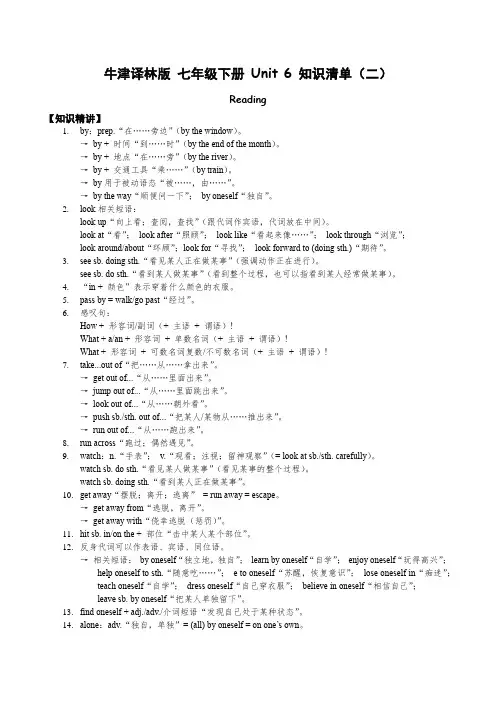
牛津译林版七年级下册 Unit 6 知识清单(二)Reading【知识精讲】1.by:prep.“在……旁边”(by the window)。
→by + 时间“到……时”(by the end of the month)。
→by + 地点“在……旁”(by the river)。
→by + 交通工具“乘……”(by train)。
→by用于被动语态“被……,由……”。
→by the way“顺便问一下”;by oneself“独自”。
2.look相关短语:look up“向上看;查阅,查找”(跟代词作宾语,代词放在中间)。
look at“看”;look after“照顾”;look like“看起来像……”;look through“浏览”;look around/about“环顾”;look for“寻找”;look forward to (doing sth.)“期待”。
3.see sb. doing sth.“看见某人正在做某事”(强调动作正在进行)。
see sb. do sth.“看到某人做某事”(看到整个过程,也可以指看到某人经常做某事)。
4.“in + 颜色”表示穿着什么颜色的衣服。
5.pass by = walk/go past“经过”。
6.感叹句:How + 形容词/副词(+ 主语+ 谓语)!What + a/an + 形容词+ 单数名词(+ 主语+ 谓语)!What + 形容词+ 可数名词复数/不可数名词(+ 主语+ 谓语)!7.take...out of“把……从……拿出来”。
→get out of...“从……里面出来”。
→jump out of...“从……里面跳出来”。
→look out of...“从……朝外看”。
→push sb./sth. out of...“把某人/某物从……推出来”。
→run out of...“从……跑出来”。
8.run across“跑过;偶然遇见”。
Unit6知识点讲解牛津译林版七年级下册英语
译林七年级英语下册第六单元知识点讲解一、Hurry up, Eddie.(1)hurry用作不及物动词,表示“匆忙”之意。
hurry up_________________ hurry to do sth_________________(2)hurry用作名词,虽然是不可数名词,但是可以和不定冠词连用。
in a hurry_______________例如Hurry up, or you will be late for the first class.They are in a hurry to catch the bus.【巩固练习】1.________or you will miss the early bus.A. No hurryB. In a hurryC. HurryD. Hurry up2.-It’s seven fifty! _______ or you will be late. -Oh, no!A.ReallyB. Hurry upC. SureD. Of course二、You complain too much.1.(1)too much ___________,用来修饰______________。
(2)too many ___________,用来修饰______________。
(3)much too____________,用来修饰_______________。
2. complain 抱怨(不及物动词)向某人抱怨某事______________________________例如She never complains to us about her hard work.【巩固练习】1.-- Little Tom is ________ fat.-- I agree. I think she should not eat _________ meat.A.much too; too muchB.much too; too manyC.too much; too manyD.too much; much too2.-Would you like to go shopping with me?-I’m afraid I can’t because I have ______housework to do.A.too muchB. too manyC. much tooD. many too3.My cousin is _____ heavy because he often eats ____ fast food.A.too much; too manyB. too many; too muchB.much too; too much D. too much;much too4.More and more students ______ too much homework and they are really tired of it.plain aboutB. care aboutC. learn aboutD. hear about三、She looked up and saw a white rabbit in a coat passing by.(1)与look相关的词组:look for___________ look after ____________look at___________ look out_____________(2)see的用法:①see sb. doing sth. _____________________②see sb do sth._________________________例如I saw him going into the room.I saw him go into the room.【巩固练习】1. He heard a whisper from the tree. He _______ and saw a bird on it.A. looked aroundB. looked downC. looked backD. looked up2. When I came into the room, I saw him ________ TV.A. watchingB. watchC. to watchD. watched四、Alice fell for a long time, and then she hit the ground.fell是fall的过去式,意为____________________和fall有关的短语有:fall asleep_______________ fall off _______________fall behind ______________【巩固练习】1.Yesterday he _________ the bike, but he wasn’t hurt badly.A. fell downB. felt offC. felt downD. fell off2.-What happened to Mare?-He fell ____ the bike ____a snowy morning.A.off; inB. down;atC. off;on五、She found herself alone in a long, low hall.(1)alone______________,相当于__________________。
Unit6知识点江苏省牛津译林版七年级英语下册
七年级(下)英语Unit6知识点一、词组、句型二、词汇运用1. He was __________________ (surprise) to see many birds in the zoo.2. There are lots of flowers on both __________________ (side) of the river.3. Lucy is too young to look after __________________ (she) well.4. After hearing the good news, we were all __________________ (excite).5. Jim usually walks to school, but he __________________ (ride) to school this morning.6. That man lived in the Warring States __________________ (时期)7. Simon was very fat and he couldn't go __________________ (通过) the small door.8. She __________________ (跌落) down from her bike and hurt her leg.9. Jim __________________ (击中) the ball and won (赢) the game.10. Did you ________________ (注意) the special bowl five ________________ (世纪) ago?三、单项选择1. He said he saw ___________ UFO yesterday, and he took ___________ photo of it.A. a; aB. an; theC. a; theD. an; a2. Nanjing is famous ___________ an old city ___________ a long history.A. as; hasB. for; withC. as; withD. for; has3. A note on the desk ___________ “I'll be back in three hours.”A. wroteB. spokeC. sayD. said4. Can Lily speak English?Yes, but only ___________.A. fewB. a fewC. littleD. a little5. This girl wanted to keep fit so she decided ___________ sports.A. to doB. didC. doingD. of doing6. This flat isn't ___________. We have to buy a bigger one.A. small enoughB. big enoughC. enough smallD. enough big7. He was ___________ tired ___________ the bag. He stopped to have a rest.A. so; to carryB. too; carryingC. too; to carryD. that; carrying8. Andy ___________ her homework again. The teacher was very angry.A. forgot bringingB. forgets to bringC. forgets bringingD. forgot to bring9. Can you ___________ the sugar here?No. Would you please pass it to me?A. reachB. wantC. needD. like10. He ___________ to China last year and ___________ in love with this country.A. goes; fallsB. went; fellC. went; feltD. went; were11. It is very important not to give rabbit ___________ carrots.A. much tooB. too manyC. much tooD. many too12. Jim, I am sorry I used your puter while you were away this morning.___________.A. That's all rightB. e onC. That's rightD. All right四、动词填空1. Andy drank a little. It __________________ (taste) sweet.2. Do you know what __________________ (do) next?3. __________________ he __________________ (play) his guitar yesterday?No, she practiced __________________ (play) the piano.4. The girl stopped __________________ (cry) after his mother gave him a toy.5. ______________ (not forget) ______________ (taste) the fish before you give it to others.6. They often __________________ (write) to each other when they were young.7. Who __________________ (teach) you English 6 years ago?8. There __________________ (be) a football match on TV yesterday morning,but he __________________ (have) no time to watch it.五、句型转换1. He used wood to make the first bird in history. (改为同义句)He ___________ the first bird in history ___________ ___________ wood.2. She has enough free time. She can help you with the work. (改为同义句)She is___________ ___________ ___________ help you with the work.3. Sandy did some cleaning at home last weekend. (改为否定句)Sandy ___________ ___________ ___________ cleaning at home last weekend.4. After they walked into the museum, the teacher gave them books. (对画线部分提问)_________ ________ the teacher _________ them after the students _________ the museum?5. Simon, don't forget to bring your mobile phone here. (改为同义句)Simon, ___________ ___________ bring your mobile phone here.六、完成句子1、上海以其发展闻名全世界。
牛津译林版七年级英语下册全套PPT课件Unit6课件汇总
牛津译林版七年级英语下册全套PPT课件汇总Unit6Unit 6 Outdoor fun Comic strip and Welcome to the unitLook and discussDo you like outdoor activities? Which of them do you like doing best?Look and sayWhat outdoor activity are Eddie and Hobo doing? They are hiking.Listen and answer1. How does Eddie feel?2. Why can’t Eddie hurry up?Listen and answer 1. How does Eddie feel? Eddie feels tired.Listen and answercome on2. Why can’t Eddie hurry up?Because the bag is too heavy.Practice:快点,否则我们要错过电影的开头了。
Hurry up miss beginning______ _____, or we will_____ the __________ of the film.Read and answer1. What does Hobo think of Eddie?2. What does Hobo think of the bag?Answer and learn 1. What does Hobo think of Eddie?Hobo thinks Eddie complain s too much.Practice :她从不对任何事抱怨太多。
She ________ ___________ too much about __________.never complains anything /kəm'pleɪn/Answer and learnso heavy2. What does Hobo think of the bag?Hobo thinks the bag is not that heavy .Practice :这个宝宝还走不了那么远。
牛津译林版英语七年级下册 Unit 6 重点内容总结
牛津译林版英语七年级下册 Unit 6 重点
内容总结
本单元主要涵盖了以下几个重点内容:
1. 单词和短语:本单元的重点单词包括ship, island, festival, celebrate等。
短语部分包括go on vacation, take part in等。
学生需要熟练掌握这些单词和短语的拼写和用法。
2. 语法:本单元主要研究了一般现在时和过去式的用法。
学生需要学会根据不同的情况使用这两种时态,并且能够正确地变化动词的形式。
3. 阅读理解:本单元的阅读理解主要涉及到介绍节日和旅行的文章。
学生需要通过阅读理解文章,获取相关信息并回答问题。
4. 听力:本单元的听力主要涉及到询问和回答有关旅行和节日的问题。
学生需要通过听力理解问题并正确回答。
5. 写作:本单元的写作任务是写一篇关于自己参加过的节日活动的经历。
学生需要描述活动的内容和感受,并使用正确的语法和词汇。
总体来说,本单元的重点内容是单词和短语的掌握、语法的运用、阅读理解的技巧、听力理解能力和写作能力的提高。
学生应通过课堂练和自主研究,加强对这些内容的掌握和应用。
以上是对牛津译林版英语七年级下册 Unit 6 重点内容的简要总结。