
小学四年级英语下学期Unit9教案_2
小学四年级英语下学期Unit9教案第一课时一.教学内容《义务教育课程标准实验教科书·牛津小学英语》4B第九单元第一教时(Look, read and learn, Ask and answer和Fun house 2 Play a game)二.教学目标1.知识目标(1) 能听得懂,会说,会读和会拼写单词a knife, a glass, a cup, a bottle(2)能听得懂,会说和会读单词a spoon, chopsticks, a cupboard(3)能听得懂,会说,会读和会写句型Where’s/ Where are the /my …?It’s / They’re … .2.能力目标(1)让学生在特定的情境下运用所学的知识,培养学生实际运用英语的能力。
(2)能使学生在课堂上多合作,多动脑,多游戏,提高学生课堂参与精神和学习英语的兴趣。
三.教学重,难点1.能听得懂,会说,会读和会拼写单词a knife, a glass, a cup, a bottle2.能听得懂,会说,会读和会写句型Where’s/ Where are the /my …?It’s/ They’re … .四.课前准备1.教具准备:图字卡,多媒体课件2.教学准备:教师准备好一个色彩鲜艳的玻璃杯,一双筷子,教师和学生各准备好六张背景图(asitting-room, a kitchen, a study, a bedroom, a bathroom)和各种剪贴画(a knife, a glass, sspoon, s cup, a cupboard, chopsticks)五.教学过程A. Say a rhyme.(出示课件) 《Where’s my broom?》让学生有表情地说这首歌谣,复习旧知,活跃课堂气氛。
B. Presentation and practice.(一)介绍生词a cupboard, chopsticks, a spoon, a bottle.1.(出示课件)屏幕上出现一个空厨房,教师问学生What’s in the kitchen? Guess!学生回答:a cup/a glass/ a knife每猜出一件物品,教师在屏幕上点击出相应的物品。
2.板书a cup, a glass, a knife ,让学生拼读单词,并提示学生,根据读音规则理解记忆单词。
3.T::What else is in the kitchen?教师点击,屏幕上出现cupboard 图片和单词,学习单词cupboard。
4.同法教授单词a bottle, a spoon, chopsticks, 并板书,贴上图字卡。
5.Listen and repeat.让学生跟着课件读单词。
6.Play a game “Clever Parrot”游戏规则:教师指着一个单词读,如果读对了,学生就跟读;如果教师有意读错,学生就不跟读。
游戏目的:巩固所学单词读音。
(二)介绍句型:Where’s my /the …? It’s … . Where are my/the …? They’re……1.T:I’m thirsty. I want to drink a glass or water. But where’s my glass?呈现句型Where’s my /the ……? 并板书。
学生回答:It’s on the desk。
(在这一步骤中,教师可把杯子课前就放在教室的讲台上)2.(课件出现几幅图画)让学生看图,同桌练习句型Where’s my /the …? It’s in /on…3.T: I’m hungry. I’d like some noodles. But where are the chopsticks?(作出寻找筷子状)Oh, they’re in my desk.(拿出筷子)呈现句型:Where are ……? They’re……C.Practice. (Part C)1.教师拿出自制的dining-room背景图,放入剪贴图chopsticks.引导学生用Where are the…? They’re…的句型问答练习。
2.把剪贴图chopsticks 放在不同的背景图中,让学生用这个句型进行问答。
3.学生看C部分图片,ask and answer。
4.让各小组学生拿出自己课前准备好的六张背景图和剪贴画,让学生把剪贴图摆放在自己想摆放的位置上,然后学生看图相互交谈.D.Consolidation.Play a game “Hide and find”.1.游戏目的:(1)巩固所学的单词a knife, a cup, a bottle, a spoon, a glass, a cupboard 和chopsticks.(2)巩固所学的句型Where’s / Where are the / my …?It’s / They’re … .2.游戏规则教师叫一男生和一女生上前,蒙住眼睛,教师把一物品藏在教室的某个角落,然后让他们寻找物品,其他学生问Where ’s/ Where are the …? 比一比谁先找到,进行男女生比赛。
E.Assigh homework.1.Read and copy the new words and sentences.2.Make cards for this lesson.六.板书设计Unit 9 BreakfastWhere ’s / Where ’re my / the …?It ’s / They ’re …第二课时(二)一.教学内容《义务教育课程标准实验教科书·牛津小学英语》4B 第九单元第二教时(Look, read and learn 和Look and say )二.教学目标1. 知识目标(1)能听得懂,会说,会读和会拼写单词a plate, bread, rice(2)能听得懂,会说和会读单词 a fork, a bowl(3)能听得懂,会说,会读和会写句型There ’s no … in / on … .2.能力目标(1) 通过创设情境,使学生感受并学会运用语言,进一步培养学生的口语表达能力。
(2) 通过有趣的游戏活动,力图激发学生学习英语的浓厚兴趣,培养学生多说,多练,多用的学习语言的好习惯。
三.教学重.难点1.能听得懂,会说,会读和会拼写单词 a plate, bread, rice.2.能听得懂,会说,会读和会写句型There ’s no … in / on … .四.课前准备1.教具准备:多媒体课件2.教学准备:装有水的瓶子,装有茶的杯子,装有桔子汁的玻璃杯,装有饭的碗,装有勺子的盘子和放有小刀和叉的桌子。
五.教学过程A.Sing a song(出示课件)《In the classroom》复习巩固There be 句型,为新知识作铺垫,并能活跃气氛.B.Review.1.利用图片复习单词 a knife, a cup, a bottle , a spoon, a glass, a cupboard, chopsticks,并能将图片贴在黑板上.2.Play a game: What’s missing?1)游戏目的:复习七个单词2)游戏准备:将七个单词的图片依次排列在黑板上。
3)游戏方法:学生看图,静听教师说出其中的六个单词,如教师说:a knife, a cup, a bottle, a spoon, aglass,a cupboard, 然后说What’s missing?学生立即回答:chopsticks.同法依次复习其它六个单词。
C.Presentation and practice1.(拿出一个装有一片面包的盘子)T: (指着面包问)What’s this in English?Ss:Bread.T:Where’s the bread?T: (自问自答) It’s on the plate.学习单词plate,并拼读单词(注意语音教学,引导学生找出发音规则,并复习plane)2.T: I can use a fork to eat the bread.用叉子叉起一片面包,并吃一口,然后指着叉子学习单词a fork.3.(在黑板上画一个碗),学习单词a bowl.(又在碗里画上米饭),复习单词rice, 并拓展词组a bowl of rice.4.Listen and repeat.跟读Part B的所有单词。
5.Play a game.游戏规则:请一位男生和女生到台前,面朝黑板,教师面朝其他学生,学生看教师口型大声地说出单词,台前两位学生指认单词,看谁指得快,培养学生听说读的能力。
6.教师拿出一个装有茶的杯子,说There’s some tea in the cup.并板书该句子,然后喝掉杯子里的茶后说:There’s no tea in the cup. 在学生跟读的同时,教师板书该句子。
(教师可多用实物说数遍,让学生感受理解新句型)D.Consolidation(Part D)1.拿出课前准备的物品,让学生分小组用There is /are …in / on … .的句型,描述所见到的物品。
2.学生喝掉容器里的饮料,然后练习句型。
There’s no …in /on … .3.让学生看着D 部分的图片相互讨论交流。
E .Assign homework1.Practice the sentences with the pictures of Part D or the things in the life after class.2.Copy the words and sentences.六.板书设计Unit 9 BreakfastThere ’s … in / on … .There ’s no … in / on … .第三课时一.教学内容《义务教育课程标准实验教科书.牛津小学英语》4B 第九单元第三教时(Read and say 和Fun house3 Say a rhyme)二.教学目标(1)能正确理解,掌握对话内容,并能朗读,初步表演对话。
(2)复习本单元所学单词。
(3)进一步掌握句型Where ’s /where are the/my …?It ’s/They ’re ……There ’s no …… in/on ……(4)能听得懂,会说和会读日常交际用语.What ’s for breakfast? Have some juice then.(5)会诵读歌谣. It ’s one in the afternoon.2. 能力目标通过多种方法和手段,为学生营造语言环境,提高语言整合能力,并使学生在真实或模拟真实的语言情境中弄清所学句子的含义,达到学以致用的目的。
外研版小学英语四年级下册教案

外研版小学英语四年级下册教案你知道怎么写外研版学校英语四年级下册教案吗?一般状况下,第一单元呈现本模块所要学习的语言内容,其次单元供应若干任务型练习,包括一首歌或小诗。
一起看看外研版学校英语四年级下册教案!欢迎查阅!外研版学校英语四年级下册教案1一、学情分析四年级从上个学期的状况来看在英语学习上把握较好,主要表现为学习成果层次上很匀称,英语学习爱好很高,口语朗读上较为扎实。
四年级的大部分同学对英语有着较深厚的学习爱好,但也有少数同学由于遇到困难,学习爱好会随之减弱。
尤其从这学期开头,对同学又提出了新的要求:培育听、说、读、写的技能。
所以我们应当面对全体同学,以同学的进展为宗旨,始终把激发同学的学习爱好放在首位,引导同学端正学习态度,把握良好的学习方法,培育同学良好的学习习惯。
二、教材分析本册教材是供学校四年级下学期使用的。
全书共分10个模块,内含一个期末复习模块。
每一个模块分为两个单元。
一般状况下,第一单元呈现本模块所要学习的语言内容,其次单元供应若干任务型练习,包括一首歌或小诗。
歌谣或小诗的学习,目的有三:一是培育同学的语感和节奏感;二是提高发音的正确性;三是通过这些英语国家儿童所熟知的歌谣,介绍肯定的西方文化。
其中的一些不常用的单词,不要求同学在歌谣之外学会使用。
在本册中,我们将学习星期的表达方法,谈论有关郊游的状况,初步了解有关伦敦和美国的基础学问;我们将进一步学习如何表达力量,如何谈论将来发生的事情;我们还将学习如何描述过去的动作与状态,特殊是如何在讲故事的进修叙述过去的动作与状态。
三、教学目标1、提升同学学习英语的爱好,养成良好的朗读书写的习惯;2、发音精确、朗读流利,精确把握书中的重点内容;3、能够进行简洁的日常用语的沟通,能够用简洁的句子进行写作;4、强调语言运用。
本教材体现交际教学思想,注意同学语言应用力量的培育。
在起始阶段采纳全身动作反应法,让同学在做中学,在唱中学,在玩中学。
四年级英语下学期Moudle 9复习课(教案)外研版一起
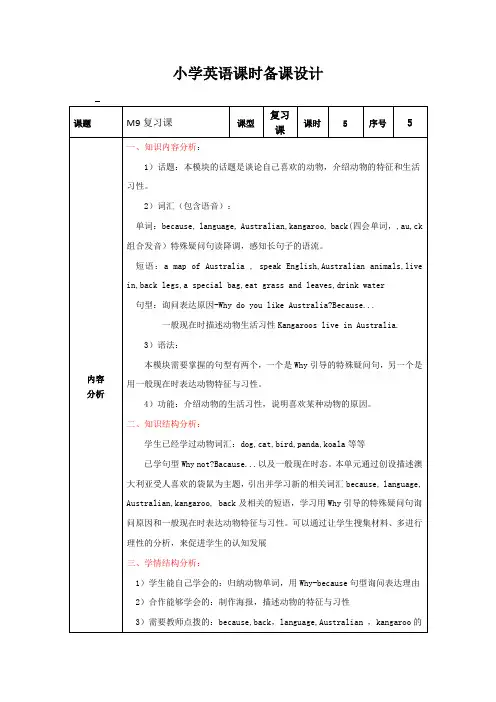
小学英语课时备课设计1.Greetings2.Sing a song师生同唱M9U2T43.Free talkT:What is the girl looking for?Ss:She is looking for a kangaroo kite.Where do kangaroos live? Ss: They live in Australia. 利用单词卡片,分音节复习kangaroo Australia3.Choose and sayT:(ppt呈现地图)Here are four maps.Which map is Australia? Ss: A.T:Good.Let’ taLk about these maps.Ss:Here is a map of...师生利用四幅地图练习Here is a map of...,师给与评价激励1&2&3& 1.Lead inT:What language do they speak?Ss: They speak English.T:What language do we speak? Ss: We speak Chinese.利用单词卡片,分音节认读,复习speak,language2.Free TalkT:Can you introduce Australia?Ss:生根据ppt提示,从各个角度介绍。
3.Ask and answerT:Do you love Australia? Why?Ss:Because...(自由发挥)师生问答,复习why-because句型。
4.复习Unit1(1)watch and repeatT:Does Amy love Australia? Ss:Yes.T:Why? Please watch andrepeatSs:(跟读完成)Because she loves Australian animals. (2)Brain stormT:What Australian Animals do you know?(上课时作业)Ss:...(英语/汉语均可)(3)情感教育T:播放视频,帮助学生了解澳大利亚动物。
(冀教版)四年级英语下册教案unit2Lesson9WhenIsIt

Lesson 9: When Is It?
教学目标:
1. 知识与技能:本节课主要复习上节课内容,掌握生词yesterday , today , tomorrow 和句式When is ____ ? ______ . 了解怎样用英语表示新年、春节、国际劳动节、教师节、儿童节、国庆节等节日。
要求学生能够读、说出并听懂六个节日的英文表达,以及用语When is it? It is_______.能运用所学句型进行对话表演和口语交际。
2. 过程与方法:.由于上节课才刚刚学过了序数词,可能有的学生对于日期的表达法还不能熟练掌握,因此在学这部分之前,这些内容进行适当复习。
在此基础上引出新课内容。
在教授新课过程,充分发挥学生学习的主动性。
总之,通过本课的学习,培养学生的学习兴趣,使他们建立起学习英语的自信心,让他们在活动中学习英语,感受英语学习的快乐。
3. 情感态度与价值观:使学生了解传统节日和法定节日,培养爱国主义情怀。
二、教学重难点:
教学重点:掌握四会单词,要求学生能够读、说出并听懂六个节日及昨天、今天、明天的英文表达,以及用语When is it? It is ____. What day is it?What day is tomorrow? It is ______. What day was yesterday? It was _______ .
教学难点:使学生能够运用所学内容进行实际交流,达到能够灵活运用。
三、教学过程。
Module9Unit2Didyouhaveaniceholiday?(教案)-英语四年级下册

外研版四年级下册英语Module 9《Unit 2 Did you have a nice holiday?》教案一、教材分析:本课是外研版四年级下册Module 9《Unit 2 Did you have a nice holiday?》,主要围绕假期的话题展开。
通过本课的学习,学生将学习新词earth,掌握句型Did you...?,并能够阅读和理解课文大意。
二、教学目标:语言知识目标:1. 全体学生能够在所给的语境中理解本课的新词earth的含义。
2. 全体学生能理解并运用Did you...?这一句型。
3. 能够阅读和理解课文大意。
语言技能目标:1. 全体学生能认读earth生词。
2. 全体学生听懂并进行Did you...?的问答。
3. 大部分学生能通过阅读技巧,抓关键信息,读懂文本。
学习策略目标:1. 主动学习,初步感知和运用阅读方法。
2. 积极思考,并与他人交流合作,共同完成学习任务。
三、教学重难点教学重点:1. 学生掌握阅读方法,理解课文大意。
2. 在活动中渗透阅读技巧,提取Who,where,what,How,Why的关键信息。
教学难点:1. 掌握阅读技巧。
2. 培养学生的质疑能力,提升学生的思维品质。
四、学情分析:学生是四年级的学生,已经掌握了一定的英语基础知识,具备一定的听说读写能力。
他们对于新词和句型的学习具有一定的接受能力,但在阅读理解方面可能存在一定的困难。
因此,在教学过程中需要设计多样化的活动,引导学生主动思考和合作交流。
五、教学过程:Step 1: Warmup1. Greet the students and ask them about their recent holidays. For example, "Good morning, class! How are you today?I hope you all had a great holiday. Now, can you raise your hand and share one fun thing you did during your holiday?"2. Show pictures of different holiday activities, such as swimming, hiking, or visiting a museum. Ask the students to discuss in pairs or small groups what they did during their holidays. Encourage them to use plete sentences to describe their activities.3. Have a class discussion and elicit responses from the students. Ask followup questions to encourage more detailedanswers, such as "Did anyone go swimming? Where did you go swimming? How was it?"Step 2: Presentation1. Introduce the new word "earth" by showing a picture or using real objects related to the earth, such as a globe or a map. Hold up the object and say, "This is the earth. Can you repeat after me? Earth."2. Elicit the meaning of "earth" from the students by asking questions like, "What do we call the planet we live on?" or "What is the name of our home planet?" Listen to their answers and provide a simple definition if needed, such as "The earth is the planet we live on."3. To practice the pronunciation of "earth" together as a class, lead a repetition exercise. Say the word clearly and have the students repeat it several times, emphasizing the correct pronunciation and intonation. Encourage them to pay attention to the vowel sound in the word.Teacher: "Now let's practice saying the word 'earth' together. Repeat after me: 'earth'."Students: "Earth."Step 3: Language Practice1. Introduce the sentence pattern "Did you...?" by askingthe students questions about their holidays using this structure. For example, "Did you go swimming? Did you visit any interesting places?" Model the correct responses and encourage the students to answer using the same sentence pattern.Teacher: "Now, let's talk about your holidays using the sentence pattern 'Did you...?' For example, I can ask, 'Did you go swimming?' and you can answer, 'Yes, I did. I went swimming at the beach.' Let's try it together."Student 1: "Did you go swimming?"Student 2: "Yes, I did. I went swimming at the pool."Teacher: "Great job! Now, let's continue with more questions and answers."2. Organize a pair or group activity where students take turns asking and answering questions about their holidays using "Did you...?" For example, one student can ask, "Did you go hiking?" and the other student can respond, "Yes, I did. I went hiking in the mountains."Teacher: "Now, I want you to work in pairs or small groups. Take turns asking and answering questions about your holidays using the sentence pattern 'Did you...?' Remember to use plete sentences. You can start with questions like 'Did you visit any interesting places?' or 'Did you try any new activities?'"Students work in pairs or groups, asking and answering questions about their holidays using the sentence pattern "Did you...?" The teacher moves around the classroom, monitoring the students' conversations and providing assistance when needed.Teacher (providing guidance): "That's great! Now, try asking followup questions to get more information. For example, if your partner says they went hiking, you can ask 'Where did you go hiking?' or 'How was the hiking trail?'"Step 4: Reading prehension1. Divide the class into small groups and distribute copies of the reading passage to each group. The passage should be related to holidays or vacation experiences.2. Explain the purpose of the reading task and introduce the key questions: Who, where, what, how, why. Write these questions on the board.3. Instruct the students to read the passage silently and underline or circle the answers to the key questions. Encourage them to read carefully and pay attention to the details.4. After reading, encourage the students to discuss their answers within their groups and justify their choices. They can take turns sharing their answers and discussing any differences or similarities.5. Conduct a class discussion to check the students' understanding and elicit their answers to the key questions. Ask different groups to share their answers and provide feedback on their prehension.Step 5: Consolidation and Application1. Ask the students to work individually and write a short paragraph about their own holidays using the sentence pattern "Did you...?" For example, "Write a paragraph about your holiday activities. Start each sentence with 'Did you...?' and describe what you did during your holiday."2. Provide a writing template or guide to support the students in organizing their ideas. Include sentence starters like "Did you go to any interesting places? Did you try any new activities? Did you meet any new friends?"3. Encourage the students to share their paragraphs witha partner and give feedback on each other's writing. They can discuss what they liked about their partner's paragraph and offer suggestions for improvement.六、板书设计:Unit 2 Did you have a nice holiday?Did you...?Who? Where? What? How? Why?七、教学反思:本节课通过引导学生讨论假期活动、介绍新词并练习句型,以及进行阅读理解活动和写作练习,全面培养学生的听说读写能力。
小学四年级英语下册 unit9(2)名师课件 苏教牛津版

L_e_t_’s_ go to the _s_u_p_e_rm__a_rk_e_t_ after breakfast. John: OK. Shall we go _b_y_c_a_r_?
Milk, bread and eggs.
2. What’s on the table? There’s some bread and two eggs.
Or: There are two eggs and some bread. 3. What’s for drinking? Some orange juice.
Mrs Black: All right. But where’s my key?
Nancy: It’s _o_n_ the TV. Mrs Black: Oh, yes.Thank you, Nancy.
Goodbye!
A: What’s on the chair? B: There’s a hamburger on the chair.
There’s no hamburger on the chair. Have some bread then, OK?
Questions: 1. What’s for breakfast?
cupboard
碗橱,小橱
Questions: (There’s/There are…)
1.What’s on the fridge? There’s a hamburger on the fridge.
四年级英语下册教案 Unit9 I can fly 辽师大版(三起)
Unit9 I can fly【课时安排】3课时【第一课时】【教学目标】1.能听懂、会说本单元Listen and say中的I can句型,并能在实际情景中运用.2.能听懂、会说本单元所学的常用动词.3.能用本单元所学的单词和句子进行简单的会话交流.4.能与同学合作完成Game time的游戏.5.通过学习本课,学会和别人交朋友.【教学重难点】(一)重点掌握情态动词can的用法.(二)难点walk like a duck的读音和用法.【教学准备】小动物的头饰,电子课本、课文录音.【教学过程】Step 1: Warm-up1.T: Good morning/ afternoon, boys and girls. How is everything going?Ss: Just fine. Thank you.教师告诉学生How is everything going?与How are you?意思相同,让学生用多种方式问候他人.2.建议教师先向学生提问What can you do?了解学生的单词储备,如果学生在课前就掌握了许多表示动作的单词,就可以在学习课文中的单词后,拓展更多表示动作的单词.Step 2: Presentation1.教师跟学生们说:Today, I bring you some friends.同时,手拿几个小动物头饰,让学生们与Step6: Homework【第二课时】【教学目标】1.能听懂、会说本单元Let's act部分课文语言,并能在实际情景中运用.2.能听懂、会用I can...表达自己的能力,回答相关问题.3.能读懂Try to do的谜语,并能与伙伴们交流,写出答案.4.能用所学单词和句子进行简单的会话交流.5.能认读元音字母Ii,并了解其在单词中的基本发音及其简单的拼读规律.6.能听懂、会说绕口令:A little pig is fishing near the hill.7.通过学习本课,学会了解别人的长处,与别人合作,共同完成任务.【教学重难点】(一)重点能听懂、会说I can...并能在实际情景中运用.(二)难点听懂会说短语guard the door, make the bubbles, catch a mouse.【教学准备】美猴王的图片和头饰,写有动词或动词短语的纸条、课文录音、电子课本.教学过程Step 1: Warm-up1.教师发出指令,学生在座位上做动作.除了书中的指令之外,可以增加其他指令如:Walk like a cat. Swim like a fish. Run like a dog. Fly like a bird.等等.这个活动也可以在学习小组内进行,看哪组合作愉快.2.T: I can play ping-pong. What can you do?Ss: I can...教师要鼓励学生们都参与对话练习,也可以以小组形式进行.Step 2: Presentation1.建议教师出示美猴王孙悟空的头饰.这是个学生们熟悉的人物,教师可以让学生们先进行小组讨论,记录下他都能做些什么.然后,用What can he do? He can...做问答练习.教师应鼓励学生们畅所欲言.2.以小组为单位分角色朗读课文.学生们熟练后,可以让学生进行分角色表演.由一位学生表演孙悟空,其他学生练习与他对话,看哪组活动活跃、合作愉快.这个活动可多进行几组,直到学2.学习成果评价仿照例句,改写句子.(1)I can run very fast. I can't run very fast.He can swim. ________________________.(2)I can sing and dance. Can you sing and dance?She can play ping-pong. _________________________?(3)I can read and write. What can you do?My mother can speak English. ________________________? Step6: Homework【第三课时】【教学目标】1.能读懂Read and say短文,并能独立填补短文的空缺.2.能听懂、会说本单元所学有关can的各种句型并能在实际情景中运用.3.能听懂、会用I can...表达自己的能力,并能回答相关问题.4.能熟练朗读chant.5.能与同桌就Reward time内容进行自评和互评.6.通过本课学习,学会了解别人的长处,与别人合作,共同完成任务.【教学重难点】(一)重点能听懂、会说I can...并能在实际情景中运用.(二)难点会用I can...表达自己的能力,回答相关问题.【教学准备】老虎的图片和头饰,写有动词或动词短语的图片、课文录音、电子课本.【教学过程】Step 1: Warm-up1.教师组织学生们把自己编写的新谜语与大家分享,可以先在小组内交流,然后推选一人参加班级展示,看谁的新谜语编得最好.2.说绕口令比赛.比赛可在小组之间进行,小组成员先站立,每人都说绕口令,说错的请坐下.看谁站到最后,谁是获胜者.Step 2: Presentation1.教师先介绍小老虎,让学生列出小老虎能做的事情,再引导学生和同桌阅读Read and say,经过讨论理解后,将空缺之处补充完整,使短文完整、正确.2.建议教师以自由问答的方式和学生共同总结我们人类能够做的事情,让学生畅所欲言.3.教师再引导学生和同桌合作朗读课文Read and say.学生自行练习后,选择一组学生示范朗读,教师纠正出现错误的地方.4.教师鼓励学生以同桌的形式合作表演Read and say,看哪组表演得最好.5.出Let's chant部分图片.教师一边读句子,一边做夸张动作.然后,让学生模仿教师做动作,待学生熟练后,教师指导学生朗读chant,使每个学生都能流畅读出歌谣.6.请学生听录音,跟读chant,学生逐句跟读歌谣,再复述歌谣.此时,应该有些学生可以复述下来了,对于这样的学生要及时表扬和鼓励,并顺势把这个任务作为课后作业布置下去.Step 3: Practice2.学习成果评价完成句子.(1)I can ______ (run) very fast, but I ______ swim.(2)I can sing ______ dance, but I can't ______ (play) ping-pong.(3)I can read and write. And I can ______ (speak) English. Step6: Homework。
象山县二小四年级英语下册Unit9Howmuchisit教案湘少版三起
Unit 9 How much is it?教学目标:1. 通过学习句型:“How much is it? How much are they?”及答语,使学生掌握有关购物时询问价格的功能句,并能够在正确的语境下使用。
2. 掌握四会单词knife,crayon,brush,notebook,ball,toy car, schoolbag 能听懂会说how much。
3.能用“Can I help you”询问顾客需要;并能用how much is it?或者It is .......yuan.谈论物品价格。
4.鼓励学生自设情景,创编、表演对话,培养学生综合运用语言的能力。
教学重点:掌握“How much is it? 的重点句型,使学生掌握有关购物时询问价格的功能句,并能够在正确的语境下使用。
教学难点:crayon的发音,以及对表示价格的数字的掌握。
教学准备学生的文具、单词卡片、教学磁带教学步骤:Step 1. Warming up1、师生问候简单的交流,让学生进入英语的学习氛围中来。
How are you? What day is it today? What is the weather like?2、设置情景,导入新课(假设学生走进一个文具店会看见什么?让学生用英语把会看到的说出来)3、教师对学生说出来的物品用英语板书出来。
Step 2. Presentation1、板书课文标题2、导入新课,对学生未想到的单词老师帮助补充,对新单词进行教学。
3、教师通过展现学生的文具作为实物来教学单词,让学生能更清楚的理解单词意思。
4、通过一个小游戏来检测学生对单词掌握的情况。
(1)教师把之前所教的单词按不同方向书写,板书在黑板上,让事先分好组的每一组的成员按个到黑板上指出来。
指对的组员为本组赢取一分,最后哪一组分数多为获胜组。
(2)教师点评掌握单词的情况,纠正发音不准的单词。
5、通过教学挂图或书本图画对课文进行教学,由浅入深的让学生理解文章对话内容。
(冀教版)四年级英语下册《Unit 2 Lesson 9》教案设计
(冀教版)四年级英语下册《Unit 2 Lesson 9》教案设计一、教学目标1.能够听、说、读、写单词和词组:different, colour, red, yellow, blue, green2.能够运用所学单词和词组进行简单的交流,表达自己的意愿和观点3.能够正确理解并运用文章中的句子,理解文章大意并进行简单的问答二、教学重点1.能够读、写、说单词和词组:different, colour, red, yellow, blue, green2.能够进行简单的交流,运用所学单词和词组表达自己的意愿和观点3.能够理解并正确运用文章中出现的句子三、教学难点1.能够灵活运用不同颜色单词和词组进行简单的交流2.能够理解文章大意并进行简单的问答3.能够熟练运用变化的句式进行表达四、教学过程1. Warming up1.Greeting and leading in.2.Ask the students if they like colours, and let them share with the class their favourite colour and why.2. Presentation1.Show the pictures and teach the students the new words and phrases: different, colour, red, yellow, blue, green .2.Ask the students to repeat the words and phrases after the teacher, and let them do a few examples themselves.3. Practice1.Ask the students to look at the picture and describe what they see.2.Let the students use the words and phrases they have learnt to answer simple questions or express their own ideas.3.Play games like。
Unit 9《Day and night》word教案
Unit 9 Day and night单元教材分析本单元是北师大版小学英语四年级下学期的第九单元,是在七、八单元学习了星期和钟点的表达法的基础之上的进一步延续。
主要涉及的知识点是一天中morning,afternoon,evening,night的表达法和breakfast, lunch, dinner,频度副词always, usually,often,sometimes,never以及日常生活中一些行为动词及短语get up, go to bed, eat,sle ep 等。
根据词不离句的教学理念,我将本课单词的教学放在When do you…? Ialways/ usually…at…in the morning/ afternoon.的句型中进行巩固和运用。
单元教学目标教学目标:1、知识目标(1)能听懂、会说以下单词:breakfast, lunch, dinner, morning, afternoon,sleep , when,等表示日常活动或行为的单词,及认读always, usually, often, sometimes, never等频度的单词,能在交流中运用。
(2)能听懂、运用以下日常交际用语:句型When do you…? I always/usually… at… in the…. 。
2、能力目标:能用所学的知识简单的表述自己想询问别人时间的安排。
能运用句型When do you…? I always/usually… at… in the…. 。
3、情感目标:(1)增强学生运用所学英语进行交际的意识和勇气。
(2)通过鼓励学生在真实的语言情景中学会养成生活有规律的意识和习惯。
教学重点1.本课表示三餐的词语breakfast, lunch, dinner,动词及短语get up, go to bed, eat, sleep,频率副词always, usually,often,sometimes,never2.句型When do you…? I always/usually… at… in the…. 。
四年级下册英语教案-Unit 2 Lesson 9-人教精通
四年级下册英语教案-Unit 2 Lesson 9-人教精通教材信息•教材:人教精通英语四年级下册•单元:Unit 2•课时:Lesson 9教学目标1.掌握本课时的词汇:daughter, picnic, fruit, sandwich, juice。
2.学会运用主语、谓语、宾语构建句子。
3.学会运用所学内容描述自己和家人的野餐活动。
教学重点1.掌握本课时的词汇和基本句型。
2.练习听、说、读、写的语言技能。
教学难点1.学习如何使用新的英语词汇和语言文本描述野餐活动。
2.学会如何表达自己和家人的情感和经历。
教学过程课前准备1.PPT课件。
2.课堂布置为课外野餐的场景。
3.课堂环境需要安排要有一些果汁、三明治、水果等道具。
课堂要点1.情境呈现:在场景中呈现出野餐的状态,展示课堂中所需要的道具,激发学生的学习兴趣和主动参与。
2.热身运动:让学生逐个报出家庭成员、自己喜欢吃的水果,为进一步学习打下基础。
3.词语学习:呈现并学习课本所提供的词汇,使用PPT解释、展示图片、做语音练习等方法帮助学生掌握英语词汇。
4.句型学习:通过教师的模拟和带领,学生所学词汇进行基本的语法搭配,让学生掌握所学词汇的基本构思,并造出自己的句子。
5.练习活动:教师可以提供练习过程,让学生在练习中对所学内容进行深化理解,并引导学生探讨句型运用及意义,提供学习技巧。
6.语言输出:让学生在二人小组里进行语言交流,进行口语输出,并有一名小组代表到讲台上述说所做野餐活动,能够运用课堂所学知识描述野餐活动中的内容和自己的感受。
课后作业1.家校合作任务:让学生在家庭中能够用英语描述所做的家庭野餐活动,与父母交流交流,尝试运用所学词汇发表自己的观点、描述自己的感受。
2.复习课件内容,并背诵所学的英语词汇和句型。
总结通过本节课对四年级下册英语教学的学习,能够帮助学生掌握英语词汇、基本句型和语言交流能力,让学生从日常生活中能够运用英语进行沟通。