
轧钢机中英文对照外文翻译文献
中英文翻译(文档含英文原文和中文翻译)基于振动监测的设备故障诊断技术在大型轧钢机械上的应用摘要对基于振动的设备故障诊断技术做了较全面和深入的介绍,通过实例介绍了该诊断技术在轧钢机械领域的应用。
指出该诊断技术可同时对一个测点进行复杂的时域、频域、相关域、统计域等分析,具有一定的趋势预测分析能力。
关键词轧钢机械; 振动监测; 故障诊断1前言轧钢机械属于大型的旋转机械,是轧钢厂的关键设备。
转轴组件是轧机的核心部分,它包括旋转轴、齿轮传动件、联轴器、滑动和滚动轴承等。
人们通过长期观察和实践,发现旋转机械的绝大多数前期故障都会表现出异常的振动,因此掌握机械振动的一般规律就能从振动信号中识别出常见的设备故障。
通过对振动信号波形进行简单的时域、频域以及小波分析可对振动进行一般的识别,振动的可识别性是对机械故障进行振动噪声测试分析的技术前提。
因此,采用在设备诊断技术领域较成熟的振动分析技术作为技术的突破口对轧钢机进行日常振动状态监测,就能在设备运行中或基本不拆卸全部设备的情况下,掌握轧机运行状态,判定产生故障的部位和原因,并预测未来的技术状态,从而可在早期有效地发现,以及在后期及时地抑制故障,保障生产的可持续发展。
2信号识别与获取任何机器设备在运行中都会产生振动,机器的振动信号中包含了丰富的机器运行的状态信息。
当设备发生异常或故障时,振动将会发生变化,一般表现为振幅加大。
由不同类型、性质、原因和部位产生的故障所激发的振动具有不同的特征,这些特征表现为频率成分、幅值大小、相位差别、波形形状和能量分布状况等。
振动信号的性质和特征不仅与故障有关,还与系统的固有特性有关,具体表现为同一故障发生的部位不同、故障激励传递通道(即传递函数)不同,其振动特征和响应亦会有较大的差别。
总之,设备的振动是由故障激励和系统特性所共同决定的,但很多情况下,振动特征和故障类型之间并不是一一对应的关系,不能简单地对号入座,这就给振动的识别带来一定的困难。
因此,振动的识别对于设备诊断技术的完善是至关重要的。
轧钢机械工作时轧件是非连续地被轧制的,其转速并不恒定、功率更是从空载到满负荷间周期地波动。
从原动机到轧辊间有庞大的传动和减速机构,可能出现的故障类型很多,因此检测设备、测点、点检方式和点检时间的选择对诊断的准确与否起关键作用。
为保证所测数据具有可比性,在测定数据时应遵循以下几点原则: ①每次测量要在同一测点进行,否则由于激振源到测点的传递函数不同,而使测量的结果相差很大。
②保持每次测量时机器的工况相同。
③保持测量的参数相同,一般来说,频率在10~100Hz的振动应以位移作为数采器的输出参数,频率在100~1 000Hz的振动应以速度作为数采器的输出参数,频率在1000Hz以上的振动应以加速度作为数采器的输出参数。
④使用的仪器相同和测量的方法(如传感器及其固定方式)相同。
在测振过程中,测点的选择同样影响监测结果,其选择原则是:(1) 测点应选择在振动信号传递的通道上而且路线最短的位置,尽量减少中间传递介质。
(2) 测点应选在信号反应比较敏感的部位,如轴承座、机座等。
(3) 测点应选择在便于多方位测量的位置。
一般测振动要选定三个方向(水平X、垂直Y、轴向A)来评定,特别对低频振动,更要强调其方向性(高频振动对方向不敏感) 。
(4) 对于大型机械设备,受传递函数的影响,应多点检测。
3轧钢机械等旋转机械的常见故障及其诊断方法旋转机械的常见故障,按转子类型和振动性质的不同,可分为:转子不平衡、转子不对中、基座或装配松动、转子与定子摩擦、感应电机振动、滚动轴承故障、齿轮机构的振动等。
利用振动监测技术对这些常见机械故障可进行较为准确的诊断。
3. 1转子不平衡不平衡是旋转机械中最常见的一种故障。
引起不平衡的原因较多,如安装不良造成偏心、配合松动、轴弯曲变形、加工制造误差以及长期运行中产生不均匀磨损等。
我们从离心力的计算公式易知,不平衡振动对转速的变化是最敏感的。
转子不平衡的振动特征是:刚性转子在启动时振幅随转速的增大而增大,柔性转子在启动时振幅是先增大而后减小。
在频率特征方面,不平衡振动的频率成分单一而明朗,主要表现为转子的基频;在相位方面,水平和垂直方向的振动相差90œ,且通常水平方向的振动比垂直方向的大、径向振动比轴向振动要大。
3. 2转子不对中转子不对中是指转子中心与轴承中心不对中,或多转子系统中各转子的轴线不对中,也是旋转机械的一类多发性的典型故障。
不对中有三种类型,即平行不对中、角度不对中、综合不对中。
其产生的原因有:转子及支座安装不良、轴承支座不均匀膨胀引起变形、地基变形以及热不对中等。
转子不对中的振动特征是:当转子不对中时将产生一种附加弯矩,形成附加激励,故轴向振动往往是存在不对中的一种征兆。
在振动频率特征方面,平行不对中主要激起2倍转频,角度不对中则表现为同频振动突出,它们的共同点是以旋转频率的2 倍频或4 倍频为主,尚伴有高次倍频。
在相位特征方面,平行不对中时,转子两端径向振动相位相差180œ;角度不对中时,联轴器两端轴向振动相位相差180œ,而径向相位相同。
3. 3基座或装配松动松动常和不平衡相伴生,表现为非线形的振动特征。
地脚松动引起的振动方向特征很明显,表现在垂直方向的振动很强烈。
由零件配合松动引起的振动,其方向特征不明显。
在振幅方面,松动引起的振动随负荷的增加而增大,但对转速表现出无规律的变化,忽大忽小,呈跳跃式变化。
在振动频率特征方面,除基频成分外,基频的奇数倍频突出(常高于基频的幅值) ,伴有3倍、5倍、7倍及0. 3~0. 5倍的谐波成分,频谱结构成梳状。
3. 4转子与定子摩擦此类摩擦属干摩擦,大多表现为径向摩擦。
摩擦振动属于非线性振动,频带范围很宽,除基频外,还有2倍、3倍以及1 /3、1 /2 等谐波成分。
在时域波形上,常表现为削波状态,“截头余弦”形状的波形是摩擦故障特有的重要标志。
在某些特殊情况下,摩擦还可能激起系统的固有频率振动。
3. 5感应电机振动故障特征电动机是一种典型的旋转机械,在机械故障的表现方面具有旋转机械的共同特点,如存在转子不平衡、不对中、松动、摩擦等故障类型。
感应电机的振动故障的一大特点是包括机械和电气两方面内容,发生的故障除机械因素外还与电气相关,如转子与定子间磁隙不均匀、电压不稳定、匝间短路等也会引起电机的异常振动。
当电动机在运行中突然给它断电,其时如果振动立即下降为零,即说明电动机存在电气方面的故障,否则,属于机械故障。
3. 6 滚动轴承故障滚动轴承是旋转机械转子系统的重要支撑部件,其基本结构包括外圈、内圈、滚动体、保持架等元件。
对滚动轴承实施振动诊断的基本方法是频率分析,因为滚动轴承每一个元件都有其各自的故障特征频率。
理论上,通过频率分析不但能判断轴承有无故障,而且可以具体判断轴承中损坏的元件。
滚动轴承的故障特征频率(简化计算)为:内圈通过频率F = 0. 6Z •Fr,外圈通过频率F = 0. 4Z •Fr,保持架通过频率F = 0. 4Fr,其中Z 为滚动体个数, Fr 为轴承内圈回转频率。
还需指出的是滚动轴承的振动与安装也有关,如安装滚动轴承的旋转轴系弯曲、轴承装歪、轴承紧固过松或过紧都会引起振动,其振动频率成分也含有滚动体通过频率和高次谐波。
3. 7 齿轮机构的振动特征及诊断齿轮是旋转机械的重要部件,其运行状态的好坏直接影响到整个机组的正常工作。
在齿轮箱中的各类零件中,失效比例分别为齿轮60%、轴承19%、轴10%、箱体7%、紧固件3%、油封1% ,可见在所有零件中齿轮自身的失效比例最大。
根据国外抽样统计的结果表明,齿轮的各种损伤的概率为: 断齿41%、齿面疲劳31%、齿面磨损10%、齿面划痕10%、其它故障8%。
在理想渐开线齿形及齿轮刚度无穷大的假设下,一对齿轮在啮合运动中是不会产生振动的,但由于制造、安装及齿轮刚度不可能为无穷大等方面的问题,一对新齿轮在啮合运动中也会产生振动。
通过对齿轮运动方程的分析可知,正常齿轮传动中由于啮合刚度的周期性变化会引起参数振动;由于齿形误差的随机激励可能会引起齿轮弹性系统的共振;当齿轮出现故障时,振动往往会加剧,也会产生一些新的频率成分,这些都是齿轮的特征频率。
齿轮特征频率主要有3种,即齿轮啮合频率、齿轮自振频率和齿轮边频带。
定轴转动的啮合频率为F = Z •Fr , 行星轮系的啮合频率为F = Z( Fr ±Fc) ,其中Z 为齿轮齿数、Fr 为齿轮旋转频率、Fc 为转臂旋转频率。
直齿圆柱齿轮自振频率为F =2/)/(21m k π,其中k 为齿轮副的弹簧常数、m 为齿轮副的等效质量, 其它类型齿轮的自振频率一般由试验测定(不随转速改变而恒有的频率分量通常就是系统的固有频率, 齿轮固有频率一般为1 ~10kHz) 。
当齿轮存在故障时,由于载荷波动而产生幅值调制,由于转速波动而产生频率调制,因此在啮合频率或固有频率两旁产生等间隙( 1X)的一簇边频。
通过振动诊断判别齿轮状态,最有效可行的方法是分析齿轮振动功率谱的变化,其次是分析倒频谱(如果仪器的信噪比高, 倒频谱分析效果也很好) 。
首先看啮合频率幅值的消长;二是要看啮合频率谐波的分布;三是看边频,随着齿轮故障的发展和振动能量的增加,边频越来越丰富,幅值也增加(边频分析通常要先将谱细化) 。
4诊断实例分析对轧机进行日常振动状态检测所需的工具主要有振动传感器、数据采集器、配套软件等,目前市面上已有此类成套的设备出售。
我们选用的是北京圣迪公司的振通904型振动动平衡一体化仪器。
它的主要功能是检测振动信号并进行采集记录和预处理,通过RS232C标准串行口与微机( P486以上)通讯后可以将记录在仪器中的各种数据送入微机中,借助仪器附带的波形分析软件可对采集到的数据进行时域、频域、统计域等方面的分析,做更精细的设备故障分析和诊断,建立设备状态数据库,预报设备状态发展趋势等。
运用该仪器可以对轧机日常运行时的振动进行检测,掌握轧机的运行状态、发现和跟踪轧机的早期故障、提出维修计划、跟踪维修质量等。
以广钢连轧厂12#轧机为例,利用基于振动的设备故障诊断技术对其进行一次全面的分析诊断。
根据测点选择原则,我们选取了3个测点(图6中ZJ12 - 1、ZJ12 - 2、ZJ12 - 3) 。
2005年3月29日12#轧机被诊断为发生了齿轮断齿故障。
当天的点检现象:轧机无异响、但振值和波形有故障迹象,尤其是ZJ12 - 1测点的信号特别明显。
诊断过程用到了振值表(表1,其数值为最近6个月内的数值) 、时域波形(图1) 、自相关图形(图2) 、幅值谱图(图3) 、概率密度图(图4) 、倒频谱图(图5) 。
通过对表1、图1、图2、图3、图4、图5和图6对12#轧机进行的全面分析诊断如下:(1) 振值表:在6个月里振值表内各项指标没有明显增大现象,表明振动级数和能量在故障前后未有明显变化,小部分断齿对振值表内各项指标不敏感,这也解释了故障时设备无异响的原因。
热轧工艺外文文献翻译、中英文翻译、外文翻译
附件1热轧工艺该轧机的主要功能是将半成品钢重新加热到接近其熔点,然后通过由共计7.7万的大功率连续滚动驱动马力发动机带动的12道连续轧制使钢板变得更薄更长,最后卷曲被拉长的钢板以运输到下一道工序。
热轧板卷的重量高达30吨至30”和74”。
将8至9英寸厚、36英尺长的钢板被卷成薄如16英寸和1 / 2英里长的带钢。
线圈由两个内径('眼睛')为30”卷取机,外径上限分别为72”和74”分别与850和1000磅每英寸宽(PIW)相对应的两个卷曲机产生。
该厂为每一个CSI提供售后业务,以及负责运输成品给CSI顾客。
大部分材料是由一种自动线圈处理系统运出轧机,通过运输线被分批运往轧机的东侧,直到它被冷却到足以载入铁路车辆。
加热炉对于热轧工艺至关重要的是它的步进梁加热炉,国家的最先进的设备,现在优于三老一辈(推车)式炉。
额定生产速度为每小时270吨,效率和与板温一致的方面得到改善以使生产率能比计划提高25﹪。
把这些钢从室温加热到2200~2400摄氏度需每天消耗约10立方米的天然气。
就像板材是按订单分配,日程安排是规定的,材料被热轧厂最西端的板厂的铁路小车和起重机分批运输。
在一条轧制线上,每一放一个轧板。
因为轧板被放置在南侧加热炉的控制门的前边,所以其规模和重量是确定的。
当炉内的空间足够,大型电镀机械推拉臂能够将板材移到炉内。
一旦进入内部,板材由大约8英尺长的炉板支撑,它是通过冷却水的耐火涂层管也被称为滑轨。
为了降低钢板残留的冰点(滑板标记),滑板间距变化大约为熔炉内部空间的三分之二。
两个独立的滑轨装置,一个固定,一个运动,轮流支撑钢板当它在炉内运动时经过一个由一对大型液压缸提供能量的机架。
该炉内部的宽是38'9”,从地面到天花板有15英尺,142’长。
它分为管制区内的温度:预热,顶面和底,加热,顶部和底,浸泡,顶和底,东和西。
预热和加热区燃烧一种天然气的混合物,同时通过在熔炉侧边的大量燃烧器预燃空气,加热钢板的上部和底部到接近其排气温度。
不锈钢钢材机械外文文献翻译、中英文翻译、外文翻译

外文原文:Stainless SteelPetro-chemical industry with its own production of some of the features, such as its operating temperature range, low-temperature conditions up to -196 ℃, temperatures can reach more than 500 ℃; operating pressure there is external pressure, vacuum, atmospheric pressure, medium pressure, high pressure, ultra-high pressure (more than 100MPa); In addition, the operating environment in the medium complexity, such as the existence of corrosion, wear and tear, and flammable, explosive, toxic and other solid, gaseous, liquid and a variety of mixed media chloride, sulfide and other salt category. Therefore, the petrochemical industry in the use of stainless steel, the requirements of stainless steel has strong corrosion resistance, including anti-chloride, sulfide and other corrosive salts; resistant to high temperature and low temperature performance. Among them, the petrochemical plant at 500 ~ 600 ℃, the equipment and pipe materials in general to choose a variety of austenitic stainless steel-based, such as 304H, 316,321, such as austenitic stainless steel has been widely used; and for oil exploration, the development of the field of stainless steel with anti-called carbon dioxide, hydrogen sulfide corrosion properties. At present, China's crude oil exploration, development is mainly used in 3Cr, 9Cr, 13Cr, super 13Cr and containing more than Cr22 stainless steel thick-walled, non-magnetic drill collar and drill pipe.At present, China's petrochemical industry in the stainless steel variety of choice, in general to 304 mainly, steel plate thickness of 6 to 22 millimeters, the main polymer used in the construction of storage tanks, heat exchanger shell. In addition, some pieces of the use of reactor tower 316L, TP347, etc., the thickness of 2 ~ 6 mm. Glacial acetic acid and liquid delivery vehicles (train tanker) General use of 304 and 306 plate. In addition, production of the device because of the existence of urea carbamate amine condensate, a highly corrosive, generally stripper, separation, and the use of 316L stainless steel condenser. On the stainless steel clad plate, such plate mainly used in oil refining equipment reaction tower, commonly used for 20R +0 Cr13AL, 16MnR +0 Cr13AL, 20R +0 Cr13 such. Due to the substrate, rehabilitation materials and productionmethods, equipment limitations, domestic composite steel plate thickness, length far from being able to fully meet the demands of the petrochemical industry. In addition, the domestic stainless steel plate splicing, heat treatment, testing and other means yet to be improved.As a result of a wide range of stainless steel, petrochemical industry, currently used for the type of austenitic stainless steel, of which 304 brands of stainless steel plate, tube forgings largest amount, 316,304 L, 316L of the plate, tube, forging a larger amount, ASTM standard TP321, TP347, TP316 brands of boiler tubes, heat exchanger is also gradually increasing dosage. In addition, a special two-way stainless steel as a result of corrosion resistance, Chiang Kai-shek in the petrochemical industry has been rapid promotion and use, of which two-way gradually increasing the amount of stainless steel tubes. At present, China's petrochemical industry in the use of stainless steel is about 70,000 tons, of which stainless steel plate (8 mm or more) the amount of approximately 10,000 tons, stainless steel composite plate is about 15,000 tons, stainless steel seamless steel tube is about 40,000 tons , stainless steel pipe is about5000 tons.Domestic stainless steel in the petrochemical field of application of thereasons for not widespreadAt present, the domestic stainless steel in the petrochemical field of application is not extensive, mainly in the following reasons: First, do not support the issue of standards. China's petrochemical industry has been formed to meet the development needs of the standard system; at home and abroad for high-pressure, high-sulfur, carbon dioxide high "three high" natural gas production equipment, material smelting, manufacturing, testing, testing technology subsidiary norms and standards is still incomplete. Second, product problems. In this regard, mainly stainless steel plate, tube, forging, welding material is not matching. Third, the issue size. Domestic metallurgical industry needs of the petrochemical industry in the thick wide board, large-diameter, thick-walled steel pipe production capacity is very limited. Fourth, quality issues, product qualitystainless steel tube instability. Fifth, research and development problems. New varieties of the domestic stainless steel R & D and production is still unable to meet the petrochemical industry's development needs. Inaddition, the stainless steel research, production and exchange of information between users of the existence of the problem poor. As a result of these factors, the need for stainless steel and petrochemical industries there are many varieties of domestic enterprises can not provide, such as four meters wide of the heavy plate production in China is not yet, there are many forms of stainless steel equipment is imported. In addition, domestic enterprises in product development with foreign enterprises is still lagging behind compared to, for example, some steel companies in Europe every year to launch a dozen new varieties of stainless steel, and Chinese enterprises in this respect, the work is notenough.The five major trends in the petrochemical proposed new requirementsfor stainless steelThe future of China's petrochemical industry will move towards the top five trends in the development of stainless steel products and higherrequirements. First of all, the future of China's oil and gas field exploration and development efforts will further increase. Such as carbon dioxide will be injected back underground ways to reduce carbon dioxide emissions and improve the oil recovery rate. At the same time, China's natural gas exploration and development efforts will be greater than the crude oil exploration and development, and to the high sulfur content, carbon dioxide area development (16% hydrogen sulfide content, carbon dioxide content of about 8%), and will further deepen the depth of wells, land Sham Tseng will exceed the 8000 meters. Second, the petrochemical plant will be large scale. Ethylene production of single device will exceed one million tons; refining single factory refining capacity more than 15 million tons; of purified terephthalic acid (PTA) production capacity of a single plant more than 800,000 tons; stainless steel tanks to the large-scale development. The third is run petrochemical plant will be a long-term development, and gradually overhaul the current cycle of thetransition to 3 years. Fourth, the petrochemical production will diversify the source of materials development. With the improvement of the requirements of environmental protection and energy consumption structure, using natural gas as raw materials of chemical industry is developing rapidly. As a result of natural gas at minus 160 ℃ can be achieved under the conditions of liquefaction, so the need for stainless steel storage and transportation equipment. In addition, as China's LNG imports increase in coastal areas need to receive large-scale construction, working capital and storage facilities, can be expected in this regard will be very large stainless steel consumption.These petrochemical industry development trend of stainless steel products, specifications and varieties have put forward new demands. From anti-corrosion requirements, the petrochemical industry production device temperature, pressure, media are major changes have taken place, stainless steel used in a more harsh environment, anti-corrosion performance by a single change to the composite performance. In the processing performance, the requirements of stainless steel a higher intensity, better toughness, weldability and good processability. In geometry, the requirements of stainless steel products and high precision, width increased, large-diameter steel pipe, steel pipe wall thickness increased. In the standards, stainless steel production as soon as possible with international standards. In addition, the petrochemical industry as a result of each of wells, each set of conditions of service refining device there is a difference, related stainless steel production enterprises should be based on the actual situation in the provision of personalized services. In addition, with the increased usage of stainless steel, stainless steel used in economics is even more important. Therefore, the domestic iron and steel enterprises, especially the steel pipe industry should improve the technological content of products and value-added, high-end product market occupation. At present, many European steel is no longer the production of low value-added oil well pipes, and will focus entirely on high added-tube, the preparation for these high-end products occupied theChinese market. (FocusRecently, China Special Steel Enterprises stainless steel branch of Li Cheng, executive president of the stainless steel industry in talking about China's problems in the development pointed out that the stainless steel to replace imports from the side, although capacity has been able to achieve self-sufficiency, but in fact only part of to replace imports, it is necessary to fully or largely replaced by imports, but also depends on our variety and quality products can meet the various requirements. He also pointed out that the market of fake and shoddy products that seriously endangers the users of stainless steel, it is proposed to increase the relevantdepartments the crackdown.Said Li Cheng, China's stainless steel production capacity from the already self-sufficiency can be achieved, but only a partial substitute for imports. Common market of the four most common grades, namely, 316 and 304 Austenitic. Ferrite 409 and 430, including 304 in the world, accounting for 50 percent of consumption, the use of nearly a hundred years of history. But it is not a single species to the new production of the 304 as an example, in order to meet the varying demands of customers, they will have a brand dozens of varieties, the same as a result of the 304 different varieties in the market price per ton can also be a difference of several hundred dollars to a thousand dollars, we can see the value of a good product, there are markets. This value needs to be done can be. 430 the past two years has developed very rapidly, in fact, this is an in production is not easy to master the varieties, r value of the performance of stamping a crease resistance, it is difficult to achieve, and now the world's more advanced r ≥ 1.2, At a time when there was virtually no punching fold, China and some production plants in both there are still some problems; 409 brands, it seems easier to see the production of components, but it's forming, and welding of the automobile industry to meet the requirements of the development will not be easy.In recent years, the development of China's manufacturing of stainless steel materials for many new requirements, such as power generation, petrochemical, and automobile industries are faced with the newrequirements of the material. Power generation systems need a lot of supercritical required stainless steel pipe, China is now still can not produce, the number of heat exchanger tubes we find it difficult to adapt, petrochemical development needs of some special stainless steel We are also in the trial. Automobile manufacturing, a number of special varieties of high-quality stainless steel requirements, we simply have not yet produced. To meet the needs of users and the use of the industry is necessary to combine joint research, innovation through research in order to solve the problem. In short, we can not just the manufacturingenterprises in the advanced hardware, we are in process technology, smelting technology and the development of both species have a larger gap, attracted the greatest attention to and constantly strive to improve.China's stainless steel market is facing a prominent issue is that the market is flooded with fake and shoddy products. In this regard, Li Cheng pointed out that in recent years because of soaring nickel prices do not appear in accordance with international and domestic standards of the low production of low nickel chromium high manganese so-called "200"series of steel, poor corrosion resistance, in which steel Based on the more serious occurred, the evolution of the market is now known as the "double-free steel" of inferior goods. The so-called double-free is no nickel, non-magnetic, this so-called "double-free" Steel does not have the non-rust and corrosion-resistant properties, which cause great harm to the user at the same time, for the jerry-built illegal producers and sellers the opportunity to bring huge profits, a very serious problem. Another is the emergence of stainless steel decorative tube size and thickness specifications for the production of non-serious "shrink", does not have the necessary stiffness of stainless steel tubes, so all kinds of deception users, to the credibility of stainless steel brought the crisis.At present the country is building a number of major projects, such as the Beijing Olympics and Shanghai World Expo project works, if only to keep the prices down in the tender, it will naturally arise in a cheap fake and shoddy products. Therefore, he called on the community especially the construction of the developers, must be quality-oriented, to avoid allkinds of hidden dangers and accidents to avoid failure and lead to very serious consequences as a result of the material. We should be treated in good faith users of harm to reputation and the interests of consumers of stainless steel act. Suggested that the state departments intensify thecrackdown.Development history::The invention of stainless steel is the world's metallurgical history of a significant achievement. The early 20th century, khazrajiya (LBGuillet) in 1904 -1906 and Porter million (AMPortevin) in 1909-1911 in France; Giessen (W. Giesen) in the years 1907-1909, respectively, in the United Kingdom found Fe - Cr and Fe-Cr-Ni alloy resistance to corrosion.蒙纳尔茨(P. Monnartz) in 1908-1911 in Germany put forward a theory of stainless steel and passivation of the many viewpoints.The inventor of stainless steel for industrial use are: Brearley (H. Brearly) 1912-1913 was developed in the United Kingdom with Cr12% -13% of the martensitic stainless steel; Dan Qi Zeng (C. Dantsizen) 1911-1914 in The United States has developed with Cr14% -16%, C0.07% -0.15% of ferritic stainless steel; Maurer (E. Maurer) and Strauss (B. Strauss) 1912-1914 was developed in Germany with C <1%, Cr15% -40%, Ni <20% of austenitic stainless steel. In 1929, Strauss (B. Strauss) made of low carbon 18-8 (Cr-18%, Ni-8%) stainless steel patent.In order to solve 18-8 steel sensitized state Intergranular corrosion, in1931 Germany's Huo译文:不锈钢石油化工行业生产具有自身的一些特点,例如其操作温度范围宽,低温条件时可达-196℃,高温时可达500℃以上;操作压力有外压、真空、常压、中压、高压、超高压(大于100MPa);此外,操作环境中介质复杂,如存在腐蚀性、磨损性、易燃、易爆、有毒等固态、气态、液态以及各种混合介质氯化物、硫化物和其他盐类。
ASMEB焊接和无缝轧制钢管中英对照)

ASMEB焊接和无缝轧制钢管中英对照)Welded and Seamless Wrought Steel Pipe 焊接和无缝轧制钢管Date of Issuance: October 25, 2004 公布日期:2004年10月25日This Standard will be revised when the Society approves the issuance of a new edition. There will be no addenda or written interpretations of the requirements of this Standard issued to this edition.当ASME批准公布新的版本时,将修订标准。
本标准的那个版本没有增补或书面的条款说明ASME is the registered trademark of the American Society of Mechanical Engineers. ASME是美国机械工程师学会的注册商标This code or standard was developed under procedures accredited as meeting the criteria for American National Standards. The Consensus Committee that approved the code or standard was balanced to assure that individuals from competent and concerned interests have had an opportunity to participate. The proposed code or standard was madeavailable for public review and comment that provides an opportunity for additional public input from industry, academia, regulatory agencies, and the public-at-large.本规范或标准是按照被认可为符合美国国家标准准则的程序制定的。
H型钢制作工艺外文文献翻译、中英文翻译

外文资料H-beam production processWith the development of industrialization and the arrival of information age, more and more advanced equipment for production of the liberation of a large number of labor, create more social value, increase the production safety coefficient at the same time. In terms of welding h-beam production, h-beam group to the emergence of machine and the use of gantry submerged arc welding welding technology has brought significant technological innovation.Since h-beam automatic group on the machine put into use, due to the decisive role of h-beam technical parameters to ensure become indispensable in the group of process equipment. H-beam automatically set to the preferred cutter blanking machine work, after flat steel (including flange plate and web plate) in the group of orbit of the machine, with a group of machine clamping device for wing plate and web plate initial clamping positioning, the active entry table input artifacts to host, host prior to adjust benchmark web and flange size, namely artifacts can be accurate positioning spot welding, automatic cycle button, then the head location and spot welding, and then use some good h-beam gantry crane hanging from the group, after the machine into the next procedure. H-beam set of machine is one of the important equipment, ensure the h-beam technical parameters is mainly composed of four large transmission mechanism, specific include: web roller drive mechanism, wing on the two positioning clamping mechanism, about web positioning clamping mechanism and input/output roller transmission mechanism, etc. Pressure on web wheel transmission mechanism adopts hydraulic clamping, use by hydraulic cylinder transfer of power is the highest roller, roller center external use V groove design, to ensure that regulations within the scope of different width of accurate positioning and automatic web for accurate, do not need to reset every time; On roller thrust bearing on inside, can not only convenient for h-beam transmission on the roller table, still can make the h-beam web can fully contact with wing during transmission, for guarantee of h-beam section height size, played an important role.Through a large number of instances prove that operation, including automatic h-beam group on the machine and gantry submerged arc welding, a large number of the application of advanced instruments and equipment, saving the cost and reduce the time limit for a project, to ensure the quality of reliable, ensure no potential safety hazard and so on. Steel alloy steel, high-quality steel bar mill rebuilding project of 3000 t welded h-beam applied the new equipment, h-beam welding qualified rate reached 99%, greatly improved the production quality and reliability, and productivity increased five times, and the whole project of the welding process in the traditional group saves about $200000, created a considerable economic benefits.In welding h-beam production, h-beam group to the emergence of machine and the use of gantry submerged arc welding welding technology has brought the significant technical innovation, respectively, analyzing their working principle are introduced, and the group in the welded h-beam production and welding process improvement techniques, through a largenumber of instances prove that operation, including automatic h-beam group on the machine and gantry submerged arc welding, a large number of the application of advanced instruments and equipment, saving the cost and reduce the time limit for a project, to ensure the reliability of the quality, ensure no safe hidden trouble, etc., can be used effectively provide a reference for similar projects.中文译文H型钢制作工艺随着工业化的发展和信息化时代的到来,越来越先进的生产设备解放了大量的劳动力,创造了更多的社会价值,同时增加了生产安全系数。
轧钢 外文翻译 外文文献 英文文献
附录 1 冷轧横向偏移量的控制性能摘要一些先进的轧机考虑到工作棍和支撑棍在板带所在平面内的偏移量,允许棍在三个方向变形。
这个模型用来探究冷扎横向偏移量控制系统的灵敏度对冷扎三个方向精度的影响。
它最终揭示水平工作棍偏移量的影响最大,构成了主要激励。
这种影响随偏移的程度和工作棍的直径的变化而变化,而激励的主要成分的影响尤其显著。
另外,水平轧制偏移量本身可以成为激励信号,尽管它的灵敏度大大的改变了偏移程度。
1.引言板带材冷扎机的设计需要在两个物理因素之间协调衡量:当增大轧辊直径时,总轧制力会增大;当减小轧辊直径时,变形量又会增大。
轧辊的变形使板带的材质不均匀性减小,但是使产品的外形尺寸精度和平面度得不到保证。
设计轧机时应协调这些因素,并应通过可控制的激励对因材料不均匀性引起的变形进行补偿。
一些更先进的轧机允许工作棍或支撑棍在水平面内可控制的窜动,这是靠轴承在与被轧板带平行的平面内移动实现的。
图 1 示意了这个过程。
这样的水平窜动是为了更好的保证被轧板带的平面度,但是没有专著论述这种方法,因为这方面的论文都假定所有的轧辊都在一个平面内。
但是事实上,轧机的轧辊即使没有任何的滚动偏移,也会因为摩擦力的不平衡在水平面内变形。
已经发表了的关于轧制偏斜的分析论述中最早的是 Townsend 和 Shohet,他们的模型已经大大扩展并得到了广泛印证。
他们的方法是把所有偏斜向轴向和水平方向分解,再用数学方法描述每一种变形。
Pawelski, Rasp 和 Rieckman 证实了这种模型适用于六棍轧机,而且他们和 Wang, Pan 证明了连续不确定变化拱形是怎么形成的,在这里,一对扎根反对称拱形轴向窜动可以被联系起来。
这些模型都是用简单的一维形式,建立在与轧辊和轧辊变形都垂直的方向上。
更精确一点,板带对轧辊的压力场应该是二维的,为此 Berger Pawelski 和Funke 给出了轧辊表面压扁率这样一个更精确的描述。
冷轧中英文对照
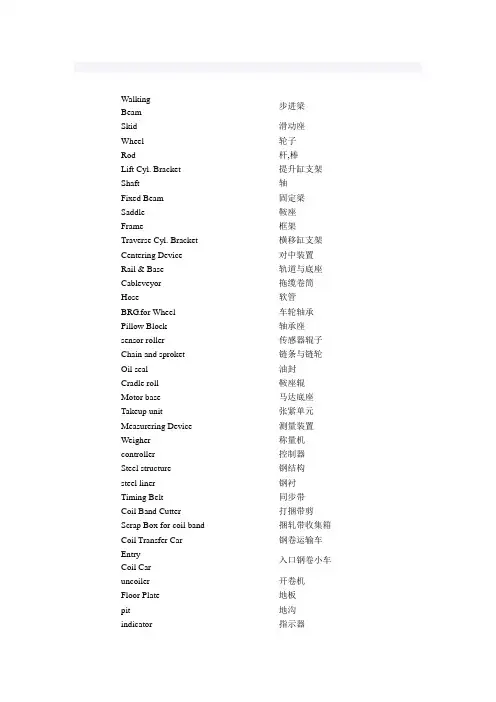
Walking步进梁BeamSkid 滑动座Wheel 轮子Rod 杆,棒Lift Cyl. Bracket 提升缸支架Shaft 轴Fixed Beam 固定梁Saddle 鞍座Frame 框架Traverse Cyl. Bracket 横移缸支架Centering Device 对中装置Rail & Base 轨道与底座Cableveyor 拖缆卷筒Hose 软管BRG.for Wheel 车轮轴承Pillow Block 轴承座sensor roller 传感器辊子Chain and sproket 链条与链轮Oil seal 油封Cradle roll 鞍座辊Motor base 马达底座Takeup unit 张紧单元Measurering Device 测量装置Weigher 称量机controller 控制器Steel structure 钢结构steel liner 钢衬Timing Belt 同步带Coil Band Cutter 打捆带剪Scrap Box for coil band 捆轧带收集箱Coil Transfer Car 钢卷运输车Entry入口钢卷小车Coil Caruncoiler 开卷机Floor Plate 地板pit 地沟indicator 指示器slide liner 滑动衬板Pay-Off Reel 开卷机Rotary joint 旋转接头breaker roll 抗折弯辊Pump 泵Mandrel 心轴Pinion 小齿轮Gear 齿轮Mandrel neck 轴颈Gear coupling 齿轮联轴器Coil Opener 开卷器Hyd. Motor 液压马达Hyd.Cyl.for swing 摆动液压缸Hyd.Cyl.forclamp 夹紧液压缸Wedge Roll 楔辊Chain coupling 链条联轴器Tyre coupling 轮胎联轴器Wedge 楔oiless bush 含油轴承Snubber Roll 缓冲辊Hyd. Cyl. 液压缸Strip Clamp Car 带钢夹持车Processor 处理机Base 底座Housing 机架Screwdown Device 压下装置Pinch Roll夹紧辊轴承座ChockLevelling Roll 矫直辊Reducer 减速机Hyd.Cyl.forpinch 夹紧液压缸switch 开关U.J for leveller 矫直机万向联轴器pulley 滑轮Levelling Roll 矫直辊Screw jack 螺旋千斤顶protector 保护器intermesh 啮合Dividing Shear 切分剪Double Cut Shear 双切剪Knife Block 剪刃刀箱Knife Holder 剪刃刀架Apron 护板Guide 导轨Knives 剪刃Hand pump 手动泵Lever 杠杆Universal Joint 万向联轴器Air Cyl. 气缸Jig 夹具Scrap 废料Scrap Chute 废料溜槽Scrap Bucket 废料桶Tensionner 张紧器Bearing Box 轴承箱Screw Shaft 丝杆轴Guide Roll 导向辊子Carryover Table 辊道运输台板scrap chute 废料溜槽Chock 轴承座Welder 焊机Flash Welding Machine 闪光焊机Pneumatic System 气动系统Flash shielded chamber 闪光保护室Transformer 变压器control panel 控制面板Thyristor panel 可控硅面板Local operation panel 现场操作面板Main operated panel 主操作面板Auxiliary Equipment 辅助设备Notcher 月牙剪Puncher 冲孔机Sencer 传感器Trimmer 刮刀Looper 活套Bag Filter 布袋过滤器Earth clamp 接地夹子Air blast 空气喷吹装置Wiring on the machine 机上配线Piping on the Machine 机上配管Flash suction duct 闪光吸入管terminal 终端polyurethane Lining 聚胺脂衬Bridle Roll 张紧辊子Swing Roll 摆动辊子Spring 弹簧cam 凸轮Drum 卷筒Steering Roll 纠偏辊子Bush 套Detector 检测器Tension Meter Roll 张力计辊子Leveller Driving System 破鳞机驱动系统Bevel Gear 锥齿轮Differential Gear 差动齿轮Stretching Gear Reducer 拉伸齿轮减速机Levelling Mill 破鳞机Splash Cover 飞溅罩Shutter 卷帘门Wringer roll 挤干辊WR 工作辊BUR 支撑辊DEFR 转向辊Rinse Tank 漂洗槽Brick Lining 砖衬Rubber Lining 橡胶衬Cover Lifter 盖提升机Strip Lifter 带钢提升机Dam Roll 坝辊Hold Down Roll 压下辊Spray Header 喷射集管Spray Nozzle 喷嘴Resin parts 树脂部件Middle roll 中间辊Acid feeding system 酸液喂入系统Inhibitor Unit 抑制剂单元valve 阀sump 地坑check valve 单向阀Suction strainer 吸入过滤网Mechanical level gauge 机械液位表Ladder 梯子stair way 走道Heating circuit 加热循环Heat exchanger 热交换器Reducing valve 减压阀Relief valve 安全阀Pressure gauge 压力表Thermo meter 温度表Fume exhaust system 废气排放系统Scrubber unit 洗涤塔单元Fan 风扇Stack 烟囱Duct 管道Damper 挡板Expansion joint 膨胀节Solenoid V alve 电磁阀Dryer 干燥机Stainless steel 不锈钢Rubber Sleeve 橡胶套Delivery Section Equipment 出口区设备Looper Car 活套小车Base 底座Frame 框架Arm 臂Spherical Bush 球面套Side Trimmer 切边剪Side Notcher 月牙剪Cable veyor 电缆卷筒Spindle 轴Coupling 联轴器Burr Masher 去毛刺机Stay 支柱Scrap Chopper 碎边剪Casing 外壳Base 底座Ball Screw Jack 滚珠丝杆千斤顶Traverse Device 横移装置Auto flex coupling 自动柔性联轴器Knife grinding 剪刃磨削Inspection Table 检查台Inspection Mirror 检查镜Wire Support Roll 钢丝绳支撑辊子Auxiliary Equipment 辅助设备Acc stand 蓄能器架V alve stand 阀台Filtering unit 过滤单元Grease System 润滑脂系统Grease gun 润滑脂枪setting Tank 沉淀池Flow meter 流量Potable pump 饮用水泵Air ventilation system 抽风系统Fire alarm system 火警系统Foundation Bolt &Nuts 地脚螺栓&螺母Washer 垫圈Acid Resistance mortar 耐酸涂料Deck 盖板Manual Hoist beam 手拉葫芦梁carbon steel 碳钢insuration material 绝热材料Hydraulic Oil 液压油Grease 润滑脂Lubrication Oil 润滑油Grease nipple 干油嘴distributor 分配器commercial parts 通用件Ball bearing 滚珠轴承Rubber coupling 弹性接手Mill Stands 轧机牌坊WS Mill housing 工作侧牌坊DS Mill housing 操作侧牌坊Back-up roll changing rails支撑辊换辊轨道Wedged plates 斜楔板Stepped plates 阶梯板Wiper 擦拭器Cover,Retainer,Thrust ring 端盖、挡环、止推环Hook 钩socket bolts 内六角螺栓Dust seal 挡尘圈Rocker 摇杆eck radial bearings径向轴承neck thrust bearings 推力轴承Quick joint 快速接头Rolls 轧辊Shifting Devices 窜动装置Fitting bolts 紧固螺栓Keeper plate for IMR 中间辊锁紧板Pin 销子Hyd.cylinder for IMR shift 窜动缸Hyd.cylinder for IMR keeper plate 锁紧缸Roll Bending 弯辊Project block 平衡块Shift block 窜动块Top/Bottom WRBendingcy linder(Positive)上、下工作辊正弯辊缸Top/BottomWR Bending cylinder(Negative) 上、下工作辊负弯辊缸Top BUR Balance cylinder 上支撑辊平衡缸Wearing plates for project block windows 平衡块耐磨衬板Ram 推杆V-packing,O-ring V型密封、O型圈Rod,Block,Button,Cartridge,Spring case 杆、挡块、筒体、弹簧盒flange 法兰Roll Force System 轧制力控制系统Load cells 测压头plug 插头Cubicle 控制柜Relay unit 继电器Isolating amplifier 放大器Bush 衬套Stop valve 停止阀Flow sight 流量显示器Needle valve 针形阀Ball valve 球阀Gauge valve 仪表阀Oil plug 油塞high pressure 高压low pressure 低压Mill Hood 轧机护罩Splash plate,Door 防溅板、门Ratchet wheel 棘轮Nail 钉Mark plate 标牌Mill Entry and Exit Guides轧机入口和出口导板Cobble guard 防缠导板Worm jack 蜗杆Spray header for delivery strip cooling 出口钢带冷却喷射集管ON-OFF air valve, 气动开关阀Air Wipers 空气吹扫装置Mill Wash Down Unit 轧机清洗装置Rubber cord 绝缘线V-ring, V型环Retaining ring 定位环Speed Meter Mountings 测速仪支架Motor cylinder for side shift 侧移马达缸Push pull car 推拉车Gear coupling 齿式接手Patrol light 巡逻灯Cable reel 电缆卷筒Gear box 齿轮箱Upper drum,Lower drum 上刀架、下刀架Carrousel type Tension Reel Carrousel式张力卷取机V entilator 通风机slip ring 集电环Flow meter, 流量计Disk spring 碟形弹簧Belt Wrapper 皮带助卷器Guide rod 导向杆Delivery Coil Car 卸卷小车control valve 控制阀Cam follower 随动轴承Pillow block 轴台Foot chain 脚链Measuring valve 测量阀Mill Exit Protection Cage 轧机出口防护罩Hand rail 扶手Synthetic resin plate 合成树脂板Swivel joint 回转接头distributor 分配器Sleeve ramp 套筒滑道Sleeve feeder 装套器Eccentric wheel 偏心轮Bevel gear box 伞齿轮箱Sleeve 钢套Torque limitter 扭矩限制器Solenoid valve, 电磁阀Air filter 空气过滤器Silencer 消音器Regulator 调节器Combination tool 组合工具Label Printer 票据打印机Coil Marking Unit 钢卷打印机Rotary cylinder 旋转缸Clutch 离合器Air clutch 气动离合器Steam heater 蒸汽加热器butterfly valve 蝶阀Flexible joint 柔性接头Level gauge 液位计Globe valve, Gate valve 球形阀, 闸阀Coolant Oil Supplying System 供乳系统Agitator 搅拌器Magnetic separator 磁性分离器Pressure reducing valve 减压阀Strainer 过滤器Air breather 空气滤清器Spray V alve 喷射阀storage tank 储存槽mixing tank 混合槽Insulation 隔热材料Remote control valves 远程控制阀Electrical heater 电加热器Thermostat 温控器Oil cooler 油冷却器Hydraulic V alve Stands 液压阀台Mate flanges 成对法兰Differencial pressure switch 差压开关Thermometer 温度计Twin basket type filter 双筒式过滤器Centrifugal separator 离心式分离器Barrel pump 桶式泵Eliminator 分离器Centrifugal fan 离心式风机V olume damper 流量挡板Flexible duct 柔性管道Fire damper 防火挡板Fume exhaust 烟雾抽排Maintenance Hoist 吊车维护Eye bolt 调环螺拴intermediate roll 中间辊Housing lifting beam 牌坊吊梁Gratings 隔栏Paint 油漆让冷轧薄板性能更优良冷轧薄板表面粗糙度形貌是影响板材质量(深冲性能、涂镀性能)的一个重要因素,而板面的形貌是要通过轧辊表面毛化来实现的。
轧制过程中的热传递外文文献翻译、轧钢机机械外文翻译、中英文翻译
附录Heat Transfer During the Rolling Process1 WORKPIECE TEMPERATURE CHANGE IN HOT STRIP MILLAfter reheating a slab to a desired temperature, it is subjected to rolling. A rolling cycle in a typical hot strip mill includes the following main steps:1、Descaling of the slab prior to flat rolling by using high-pressure water descaling system in combination, in some cases, with edging.2、Rough rolling to a transfer bar thickness which may vary from 19 to 40 mm. The rough rolling is usually accompanied by edging and inter pass descaling.3、Transfer of the transfer bar from roughing mill to a flying shear installed ahesd of finishing mill. The shear is usually designed to cut both head and tail ends of the bar.4、Descaling of the transfer bar prior to entering the finishing mill.5、Finish rolling to a desired thickness with a possible use of interstand descaling and strip cooling.6、Air and water cooling of the rolled product on run-out table.7、Cliling of the rolled product.Various types of heat transfer from the rolled workpiece to its surrounding matter occur during the rolling cycle. Some of the lost heat is recovered by generating heat inside the workpiece during its deformation.The main components of the workpiece temperature loss and gain in hot strip mill are usually identified as follows:1、loss due to heat radiation,2、loss due to heat convection,3、loss due to water cooling,4、loss due to heat conduction to the work rolls and table rolls,5、gain due to mechanical work and friction.The analytical aspects of these components are briefly described below.2 TEMPERATURE LOSS DUE TO TADIATIONTwo methods have been employed to derive equations for temperature loss due to radiation.In the first method, the temperature gradient within the material is assumed to be negligible. The amount of heat radiated to the environment is then calculated using the Stefan-Boltzmann law:d qr =S dtTTAar)(44-ξWhererA—surface area of body subjected to radiation, m2;]d q'r—amount of heat radiated by a body,J;S—Stefan-Boltzmann constant;T—temperature of rolled material at time,K;Ta—ambient temperature,K;t—time,s;ξ—emissivity.The amount of heat lost by a body d q''ris give by:d q''r =dTcVr ρWhere c—specific heart of rolled material, J/(kg·K);Vr—volume of body subjected to radiation, m3ρ—density of rolled material, kg/m3。
热轧生产线2050精轧机出口及层流冷却功能说明中英文对照翻译
1Run-out roller table behind finishing mill stands (2)2Compact cooling equipment SMS Solution - Pending (4)2.1Compact Cooling with roller table behind FM (4)2.2Pinch roll unit (8)2A Ultra fast colling (UFC) Solution – Pending (32)3Laminar cooling system with roller table (12)3.1Run—out roller table below laminar cooling (12)3.2Laminar cooling (14)3.3Maintenance platform for laminar cooling system (20)4Run-out roller table behind laminar cooling system (21)1 Run-out roller table behind finishing mill stands6010 ArrangementAt measuring device area behind the last finishing stand.FunctionUsed for conveying the hot strip and accommodation of measuring systems. Technical dataQuantity 1Roller table length app. 11 675 mm(between last mill stand and start of lami-nar strip cooling)Number of rollers app. 30Roller dimensions app. Ø300 x 2 100 mmRoller speed max. 22 m/sRoller spacing app. 320 mm depending on requirement,in measuring equipment area also biggerin particular casesMotor data p = 9.6 kWn = 0 –1 400 rpmDescriptionRoller table frames table frame as steel beam structure con-nected with cross beams in welded struc-ture, foundation mounted, accommodatesthe roller units.Table roller unit quick-change unit, each unit consisting ofroller, bearing housing, coupling and mo-tor, mounted on an individual frame, thisframe is fixed on the roller table frame bymeans of clamp-type locking bars.Rollers wear resistant shell-type rollers with stain-less steel layer, welded hubs and flangedshafts at both endsRoller cooling internal cooling, cooling water is fed intothe roller body through a pipe flanged onthe bearing housing and through a boredhole in the roller neck. The cooling waterflows back through the gap between thebored holes of the roller neckRoll bearing assembly self aligned roller bearings in steel bearinghousings on operator side (OS) and driveside (DS)Roller drive individually driven rollers via electric mo-tors and flexible couplings, arranged onoperator sideFixed side guides welded construction, bolted to bearinghousings, operator side with cover plateabove the drivesLubrication roller bearings connected to the central-ized forced feed grease lubrication system Reference drawing2 Compact cooling equipment SMS Solution - Pending2.1 Compact Cooling with roller table behind FMArrangementThe compact cooling system is arranged behind the measuring house of the finishing mill and it is used for flexible cooling of the strip.FunctionStrip water cooling before coiling to achieve defined metallurgical properties and tem-peratures. Cooling system can be operated in compact and combination mode.In compact mode a booster pump station increased the incoming water pressure. In combination mode the system is using the water from the laminar overhead tank. The flow is controllable by means of control valves for both modes. Roller table conveying the hot strip and support the bottom cooling headers including cross spray units. Roller with extended length to allow improved cooling water flowing off from the top side.Technical dataMax. water flow quantity approx. 18229 m³/hWater pressure approx. 3,5 barQuantity 1Number of tilting groups 8 (top)Cooling groups 8Total number of headers- top 8 x 3 = 24- bottom 8 x 6 = 48Width of application app. 2050 mmtotal length ofcooling system approx. 19760 mmRoller table frame length Single frame app. 4000 to 5500 mm, de-pending on arrangement areaNumber of rollers 54Roller dimensions Ø300 x 2100 mmRoller speed According to motor and component list Roller spacing app. 380 mmCylinder data 8 x 140/80 x app. 800mmDescriptionCooling groups System subdivided into different coolinggroups, each group consists of severalswitchable zones. Water quantity of everygroup can be adjusted by means of watercontrol valves. For maintenance and incase of cobbles each group of top coolingheaders can be swiveled upwards by hy-draulic cylinders.Cooling zones Each zone is subdivided into top and bot-tom zone and is individually switchable.Top cooling headers Welded steel structure made of squarebars, welded up with head plates, spraypipes glued in plates, plates screw-fas-tened with square bar.Bottom cooling headers Steel pipes with spraying pipes. Nozzlesarranged at the top of the spraying pipes.Fastened to the roller table frame andconnected to supply lines via hoses.Swivel mechanism Tubular cross-beam of thick-walled steelpipes, flange connection with the fixedpipe parts through rotary joint. Mechanismmoved by means of hydraulic cylinder(s). Longitudinal spraying Removes the water from the strip surface.Arranged at the entry and exit side of thecompact cooling. At exit side mounted atthe pinch roll rocker arm.Cross-sprays Arranged inside of the compact coolingsystem between the cooling groups. Eachunit consists of 2 tongue type nozzles andconnected to supply lines by hoses.Pipe work The pipe lines from the laminar tank to thebooster pump station and to the coolinggroups are part of the interconnecting pipework.Roller table frame Single frame as steel beam structure con-nected with cross beams in welded struc-ture, accommodates the roller units andbottom cooling headers.Table roller unit Quick-change unit, each unit consisting ofroller, bearing housing, coupling and mo-tor, mounted on connecting plate and fas-tened via connecting plate on roller tableframe.Rollers Wear resistant shell-type rollers withwelded hubs and flanged shafts at bothends. Extended length.Roller cooling External water cooling by means of cool-ing pipes.Roll bearing assembly Self aligned roller bearings in steel bear-ing housings on operator side (OS) anddrive side (DS).Roller drive Through flexible coupling, drive on opera-tor side (OS).Fixed side guides Welded structure, screw-mounted to bear-ing housings, operator side with coverplate above the drives.Water valves and pump system According to specification of water sys-tems.Measuring units According to specification of water sys-temsLubrication Manual and automatic grease lubrication2.2 Pinch roll unitThe pinch roll unit is arranged behind the compact cooling system.The pinch roll unit is provided to collect the water inside the compact cooling box and to apply a specific strip tension.The upper pinch roll can be raised and lowered by two hydraulic cylinders. It is position and force controlled. The upper pinch roll is balanced to eliminate bearing clearances by two spring-loaded tensioning elements.The upper and lower pinch roll is direct driven by universal joint shafts.All rolls are inner cooled.Technical DataNumber provided 1Bottom pinch roll, max./min. 400/380 x 2100 mmTop pinch roll, max./min. 400/ 380 x 2100 mmHousing rollers 4 x 300 x 2100 mmMax opening betweenpinch rolls approx 700 mmMotor rating pinch roll drives 2 x 100 kWDesignHousing solid weldment, partly made of thickplates, both halves connected by crossplates, faces for receiving the lower pinchroll provided with hardened wear plates.Rocker arm for receiving the upper pinch roll, weld-ment, supported on pivot in anti-frictionbearings, equipped with two hydraulicpress-on cylinders and two spring-loadedbalancing elements, rocker arm with facesfor the bearing housings of the upperpinch rollTop and bottom pinch roller Hollow rolls, solid hard faced and wear re-sistant surface built up welding, bearinghousings with anti-friction bearing assem-bly.Roller drives pinch rollers direct driven by cross-pintype spindlesBreast rollers two hollow table rollers arranged on entryside of the bottom pinch roller and t rolleron exit side, with sinter-fused hard facedwear resistant surface, anti-friction bearingassembly, inner cooled.Guide aprons steel weldment, arranged ahead andbehind the lower pinch roll, aprons heightadjustable.Lifting and gap setting cylinders arranged between housing and rocker armfor setting the gap between the pinch rollstwo hydraulic cylinders with integrated po-sition transducersDrive support for pinch roll and breast roller motors,made as steel weldmentincluding supporting structure for drivespindles, used during pinch roll changing Top and bottompinch roll cooling internal water cooled by means of rotarypipe tube, arranged on operator side.Longitudinal spraying spraying pipe with nozzles on entry of PR,attached to rocker arm.Lubrication connected to centralized grease lube sys-tem.Piping for hydraulics, cooling water and for cen-tralized grease lube system attached tothe pinch roll unit2A Ultra fast colling (UFC) Solution – Pending To be prepared by other competitor if applicable3 Laminar cooling system with roller table6011 3.1 Run—out roller table below laminar coolingArrangementArea of laminar cooling systemFunctionConveying of the hot strip and support of bottom cooling headers including cross spray unitsTechnical dataQuantity 1Roller table length app. 73 720 mmNumber of rollers app. 195Roller dimensions app. Ø300 x 2 100 mmRoller speed max. 22 m/sRoller spacing app. 380 mm.Motor data p = 9.6 kWn = 0 – 1 400 rpmDescriptionRoller table frame table frame as steel beam structure con-nected with cross beams in welded struc-ture, foundation mounted, accommodatesthe roller units and bottom cooling head-ersTable roller unit quick-change unit, each unit consisting ofroller, bearing housing, coupling and mo-tor, mounted on an individual frame, thisframe is fixed on the main table frame bymeans of clamp-type locking bars.Rollers wear resistant shell-type rollers with stain-less steel layer, welded hubs and flangedshafts at both endsRoller cooling external cooling,Roll bearing assembly self aligned roller bearings in steel bearinghousings on operator side (OS) and driveside (DS)Roller drive individually driven rollers via electric mo-tors and flexible couplings, arranged onoperator sideFixed side guides welded construction, screw-mounted tobearing housings, operator side with coverplate above the drivesLubrication roller bearings connected to the central-ized forced feed grease lubrication system Reference drawing3.2 Laminar coolingArrangementAbove and below the run-out roller table. The cooling system consists of several cool-ing groups with different water application. For maintenance in case of cobbles each group of top cooling headers can be swiveled upwards by hydraulic cylinderFunctionWater cooling of the strip prior to coiling to achieve defined metallurgical properties and temperaturesTechnical dataType laminar flow type for top and bottom head-ersApplication width approx. 2 050 mmApplication length approx. 73 720 mmMax. water flow, approx. 16 600 m³/h design valueQuantity of cooling groupsmicro groups 7reinforced groups 6trimming groups 2Quantity of cooling zones (individual switchable)micro groups 4 top and 4 bottom with flow monitoringreinforced groups 6 top and 6 bottom with flow controltrimming groups 8 top and 8 bottom with flow monitoringQuantity of headers per cooling groupmicro groups 4 top and 12 bottomreinforced groups 6 top and 12 bottomtrimming groups 8 top and 16 bottomWater flow per header, approx..micro groups 88 m³h top and 35 m³/h bottomreinforced groups 118 m³h top and 71 m³/h bottomtrimming groups 59 m³h top and 35 m³/h bottomTilting cylindersCylinder dimensions approx. Ø 140/80 x 910 mmHydraulic pressure 210 barQuantity of edge masking systems 13DescriptionTop cooling headers carbon steel pipes with stainless steelgooseneck pipes, fastened to distributionpipes through flangesDistribution pipes steel pipes with flanges, connected to pipecolumn via rotary jointPipe column ensures water supply, accommodates therotary joint of the distribution pipes and thehydraulic cylinder for tilting top coolingheadersEdge masking controls the distributions of the top coolingwater over strip width in order to get anequalized width temperature distribution,Edge masking unit mounted on top of thetop cooling headers, electromechanicaldriven deflector plates, can be driven sep-arately for asymmetrical masking, Meas-urement of the temperature distributionacross the strip by scanner located be-tween laminar cooling and down coilerBottom cooling headers carbon steel pipes with stainless steelspraying pipes, fastened to the roller tableframe and connected to supply lines byhosesCross-sprays 1 unit arranged behind last finishing stand,1 unit arranged in front of each coolinggroup,2 units arranged behind the last coolinggroup,each unit consist of 2 tongue type nozzlesand connected to supply lines by hosesPipe work the pipe lines from the laminar tank to thepipe columns, bottom cooling headers andcross-sprays are part of the interconnect-ing pipe workLubrication exclusively manual grease lubricationReference drawingSuper- and reinforced cooling groupsMicro groupsTrimming groupsCross sectionEdge masking3.3 Maintenance platform for laminar cooling system6015 ArrangementOn the drive side near the pipe columns of the laminar cooling-line areaFunctionWalkway with access to certain sections of the run out roller table andlaminar cooling line, accommodating of valve standsTechnical dataQuantity 1DescriptionMade of steel with stairs, ladders, covers and railingsReference drawing4 Run-out roller table behind laminar cooling system6017 ArrangementBetween laminar cooling and housing rollers of first pinch roll unitFunctionConveying the hot strip.Technical dataQuantity 1Roller table length app. 20 740 mmNumber of rollers app. 56Roller dimensions app. Ø300 x 2 100 mmRoller speed max. 22 m/sRoller spacing app. 380 mmMotor data p = 9.6 kWn = 0 – 1 400 rpmDescriptionRoller table frame table frame as steel beam structure con-nected with cross beams in welded struc-ture, foundation mounted, accommodatesthe roller unitsTable roller unit quick-change unit, each unit consisting ofroller, bearing housing, coupling and mo-tor, mounted on anindividual frame, thisframe is fixed on the roller table frame bymeans of clamp-type locking bars requiredfor changing the table rollers.Rollers wear resistant shell-type rollers with stain-less steel layer, welded hubs and flangedshafts at both endsRoller cooling external cooling, in the area of bottom sur-face inspection internal coolingRoll bearing assembly self aligned roller bearings in steel bearinghousings on operator side (OS) and driveside (DS)Roller drive individually driven rollers via electric mo-tors and flexible couplings, arranged onoperator sideFixed side guides welded construction, screw-mounted tobearing housings, operator side with coverplate above the drivesLubrication roller bearings connected to the central-ized forced feed grease lubrication system1精轧机后的输出辊道 (2)2紧凑型冷却设备 (4)2.1精轧机后的带紧凑型冷却的辊道 (4)2.2夹送辊单元 (8)2A超快冷(UFC) (32)3带辊道的层流冷却系统 (12)3.1层流冷却下的输出辊道 (12)3.2层流 (14)3.3层流的检修平台 (20)4层流后的输出辊道 (21)5精轧机后的输出辊道6010 布置在最后一架轧机后的测量设备区域功能用于输送热带钢和放置测量系统技术数据数量 1辊道长度app. 11 675 mm(between last mill stand and start oflaminar strip cooling)辊数app. 30辊子尺寸app. Ø300 x 2 100 mm辊速max. 22 m/s辊间距app. 320 mm depending on requirement,in measuring equipment area also big-ger in particular cases电机数据p = 9.6 kWn = 0 –1 400 rpm描述辊道架辊架作为钢梁结构与横梁连接在焊接结构上,安装在基础上,容纳滚子单元。
英文文献翻译(机械类)
冷轧厂工作轴过早发生故障的分析济南钢铁有限公司技术中心,济南250101,中国收到2006年9月12日,在2007年1月15日收到,2007年1月18日2007年5月23日网上提供澳大利亚,新南威尔士州2522,Wollongong,Wollongong大学,机械学院,材料和机械电子工程概述在本文中,对几个冷连轧机工作轴过早失效进行了调查。
为了研究工作轴表面特性和破坏机理,化学成分,微观结构和轧轴材料的硬度进行了研究。
已计算在工作轴剥落面积的压力,确定应力状态。
在研究中,轧轴磨损和损坏的原因已经查明。
对工作轴表面图像进行了研究,发现了已损坏的轧轴磨损特性的特点。
人们已经发现,经营的因素和冶金缺陷将影响在冷轧带钢轧轴的使用寿命。
2007 Elsevier B.V保留所有权利。
关键词:穿;工作轴冷轧;应力分布1.介绍目前,冷轧带钢生产上的冷连轧带钢轧机或倒车的冷连轧机工作轴破坏为[1]非圆形变形[2]。
应用于冷连轧,板形好,型材和平整度[3,4]得到控制模型的基础上。
在冷连轧机工作轴发挥主导作用,使带钢的变形来实现所需的形状,轮廓和尺寸。
然而,工作轴在极其恶劣的条件下运作,在经营成本的冷连轧机的最重要环节之一,是有关工作轴[5]。
工作轴磨损的材料,变形,热凸度,氧化铁皮及带钢表面粗糙度等的影响,[6-14]已查处,并为混合润滑摩擦模型[15]。
工作轴的磨损,影响热轧带钢质量和工作轴使用寿命显着。
在轧钢工作轴的过程中,受高循环荷载和水平高的耐磨性。
与热轧相比,冷轧钢轧制材料的抗变形能力是非常高。
在轧轴咬轧轴表面受到高压力是大于10000 MPa和进一步剪应力产生摩擦[16]在轴/带接口。
工作轴过早失效滚动不仅增加成本,而且还轧机停机时间,生产力显着影响。
伪造合金钢工作轴过早失败的原因可能是操作技术和冶金轧轴因素的综合影响。
经营的因素,包括轧制负荷,润滑,轧制速度,运营商的经验,如轧制参数的选择。
工作轴的质量,包括非金属夹杂物的存在,铸造缺陷和相变[16]。
轧钢操作系统英文对照
absolute MMC 绝对MMC acceleration 加速act. 实际值actual实际值AGC compensation AGC补偿all reject 全剔除ATC 自动定尾austenitic rolling 奥氏体轧制backup roll 支撑辊banding pattern 打捆模型bank 段(例如水冷段)base ratio 基础比率bending 弯辊bending force 弯辊力bite speed 咬入速度bottom cooling 后段冷却BUR 支撑辊BUR sled latch支撑辊滑座门销button 按钮BZ reset 报警蜂鸣重置cal. 标定calculate 计算caster 连铸机change value 改变值(窜辊) chemical component 化学成分chock select 轴承座选择clamp 夹住coil 带卷coil car C型小车coil date input 带卷日期输入coil NO. 带卷号码coil safety pos. 带卷安全位置coiling temp.卷取温度cold run 冷运行command 命令completion 完成CONV 运输机conveyor运输机cooling pattern 冷却模式crop shear 切头剪cross follower 交叉随动crown 凸度CT 卷曲温度CTC calculation pattern 层流冷却计算模型CTC control mode 层流冷却控制模式CTC cooling method 层流冷却冷却方法current 当前customer 用户DC 地下卷取机DC Ent TBL 卷取机入口辊道delivery 出口delivery PR 出口夹送辊destination 目的地deviation 偏差,波动dia. 直径diameter直径display 显示draft 压下drive side 驱动侧dummy table 填充辊道dust killing spray 除尘喷淋edge large 边部大entrance condition 入口条件entrance inhibition 入口禁止entry 入口entry PR 入口夹送辊EXE 执行execute执行extend 膨胀extract temp. 出炉温度extraction backup 出炉备份FD 精轧出口C-bend prevention cooling C弯预防冷却CC 连铸center large 中间增大center small 中间减小change interval 改变间隔(窜辊)FE-temp. 精轧入口温度fine bank 精调段flatness 平直度flow max. 最大流量flow min. 最小流量FM 精轧机FM delivery temperature 精轧出口温度FM entry temperature精轧入口温度force distribute 轧制力分配force ratio 轧制力比率FPC 变规轧制front stage cooling 前段冷却FSB 精轧除鳞机FSB common valve精轧除鳞机备用阀FSB unload valve精轧除鳞机工作阀gap 辊缝gate swing 摆动门gaugemeter AGC 厚度计AGCcut 剪切cylinder calibration 液压缸标定data 数据date correct 日期纠正date/time 日期/时间information 信息initial setup 原始设定ins.line monitor 检查线监控仪inspection scrap bucket检查线料斗interstand cooling机架间冷却ISC flow 机架间冷却流量last grind date 最近研磨日期length 长度light 轻(型)load cell reset 压头重置load distribution 负载分配local 地面站looper 活套looper angle 活套角度lower 降低lubrication change 润滑方式更改maintenance维护maker 制造商FDT 精轧出口温度feed roll 机架辊ferritic rolling 铁素体轧制FET 精轧入口温度MMC 轧机弹跳计算mode 模式monitor 监控器monitor AGC 监控AGCnext roll cancel 取消一个辊next roll select 选择下一个辊no use 无效,不使用normal bank 粗调段off-gauge 超差offline 离线on gauge 符合公差online 在线operator input 操作员输入out dia. 外径oxide killer 除尘pair cross 交叉handing mode 处理模式hard dummy 硬甩head 头部heat ID 炉号heavy 重(型)history 历史纪录HMI 人机接口hood (除鳞机)盖hot rolling oil 热轧制油hyd. 液压IMC 中间冷却IMC heat holding 中间保温层profile 板型pull out old roll 旧辊抽出pulpit 操作台push in new roll 新辊推入quick open 快速打开ratio modify 比率修改RCH 粗轧换辊RDT 粗轧出口温度rear stage cooling 后段冷却reason 原因receive date 接受日期reject 剔除request 发出请求RET 粗轧入口温度Return 返回RM 粗轧机manual手动MD芯轴mandrel 芯轴mandrel exp 芯轴膨胀material code 材料代码MD outer cooling芯轴外部冷却MD support 芯轴支撑measured time 测量时间mill constant 轧机常数(弹跳)sample 取样品screen lock 屏幕锁定semi-endless 半无头轧制sensor selection传感器选择sequence 顺序SG 侧导板SGC/SGF 钢种Shift 窜动shift amplitude 窜动量shift direction 窜动方向shrink 收缩shuttle car 梭车side & cross spray 侧喷,交叉喷simulation 模拟slab 板坯slab delete request 板坯删除请求part reject 部分删除pass line 轧制线PC angle 交叉角PC/bender交叉/弯辊PDI 原始数据输入pg down 下翻页pg up 上翻页pivot 轴点prep for rolling 准备轧制preset 预调pervious 前一个product time 生产时间target 目标target crown 目标凸度temperature 温度tension strength 抗张强度tension 张力TF information 加热炉信息thickness 厚度threading speed 穿带速度tolerance 偏差TOP 上部torque 扭矩total 合计track spray 跟踪喷淋track. clear 跟踪清除turn over entry arm clamp 翻转台(上小表面检查)入口夹具roll change 换辊roll cooling 轧辊冷却roll eccentricity control 轧辊偏心控制roll gap 轧辊辊缝roll shift 窜辊rolling 轧制rolling force 轧制力rolling L 轧制长度rolling oil 轧制油ROT 输出辊道RSB apron 粗轧除鳞机裙板RSB hood lift 粗轧除鳞机盖提升running 运行running speed 运行速度transition carriage monitor 横移车监控line monitor 在线监控shuttle car 梭车STN 站(1级TC—NET)drive IF 传动接口ASC 自动板型控制gap correction coefficient 辊缝修正系数cradle roll 托卷辊metering pump 计量泵protection 保护slab NO. 板坯号snubber roll 压紧辊soft dummy 软甩speed reference 速度参考spindle lift 接轴提升stand 机架start interlock 开始连锁status 状态steel grade 钢种strip tail end compensation 带钢尾部补偿strip tension 带钢张力stripper car 卸卷小车tail 尾部taper 锥度yield stress 屈服强度zone 区WR floor plate 工作辊换辊翻版stage 阶段park pos. 停止位deceleration 减速collapse 收缩air blower 空气鼓风机lead 超前lag 滞后unclamp 松开unit roll 助卷辊up cut shear 上切剪upper 上部WR助卷辊utility 公辅UTL公辅valve 阀门valve test 阀门测试walking beam 步进梁wedge 锲型weight 重量width 宽度width ADJ. 宽度调节width tolerance 宽度偏差work roll 工作辊work side 工作侧WR 工作辊WR change 工作辊换辊WR shift 工作辊窜辊strainer 过滤器coiler sump pit 卷取机集水坑indirect water 间接水(迂回水)sump pump 集水坑泵direct water 直接水torque RMS 力矩二次均方根judgment 判断abort 故障.紧急停车error 错误shut off valve 截止阀remote 远程(操纵台)circulation 循环fan 风机jog 点动adj 调整swivel 旋转wrap 缠绕.圈offset 偏差demand 要求flushing 冲洗load relay 负载继电器pair release 对放弃delivery confirm 出库确认column NO. 列号FDP 精轧出口凸度仪carbon equivalent 碳当量SSc 短行程控制ASFC自动平直度控制object machine 目标机器equipment 设备existence 存放home POS 中心位置relief 解除lateral clamp 横向夹紧chart 图表filter clogged 过滤器堵塞stand BY 备用gear 齿轮pinion 小齿轮centrifuge system 离心系统storage tank 储存油箱plate air 工厂用压缩空气tank level 油箱液位source资源cerate 创建yard name 码名FDH 精轧出口测厚仪FDT 精轧出口温度仪order thickness 厂家订货厚度LLTC 无活套微张力控制RPC 轧辊热凸度补偿booster pump 增压泵mixer 混合器piping line 管线FM scale sluice 精轧氧化铁皮排除沟spindle spotting 按轴定位Grease hose 干油软管Disconnect 断开WR traverse pos detect 工作辊换辊小车位置检测Rubber wiper pushing 推入橡胶擦拭器DEL bottom stripper retract 出口下卫板拉回Top coupling support 上联轴节支撑DEC 减少INC 增加exit 出口pay attention 注意air supply system 空气供给系统modify 修改row NO. 行号FDW 精轧出口测宽仪FDF 精轧出口平直度仪inspection code 检查线代码(是否进)ASPC 自动板形控制FFC 轧制力跟随控制CONY 传统活套控制main menu 主菜单combustion menu 燃烧菜单tracking menu 跟踪菜单common menu 通用菜单level 2 menu 2级菜单maintenance menu 维护菜单CCS(combustion control system)燃烧控制系统MHS (material handing system)物料处理系统line A A线炉line B B线炉furnace 加热炉FCE“A” A线炉FCE“B” B线炉heating zone 加热区shuttle zone 横移区holding zone 保温区RQ 二次板线性均方overview 观察画面zone control 区域控制recuperator 换热器recuperator 1-3 1-3区换热器recuperator 4-5 4-5区换热器shuttle press 横移区压力recuperator holding 保温区换热器ramp control 梯度控制furnace pressure 炉压thermocouples 热电偶TC 热电偶fuel usage 燃耗trend menu 趋势菜单level 2 control 2级控制furnace “A” ramp temperature set point A线炉温度梯度设定NO. ramp 无梯度APC 自动位置控制SP (set point) 设定值PV (process value) 实际值TEMP 温度gas 煤气air 空气ratio 比例FIC 流量阀位FCE A zone 1 A线炉1区zone control mode 区域控制模式unknown 未知use flow control 使用流量控制gas FIC 煤气流量阀位控制air FIC 空气流量阀位控制position 位置cross limit 交叉限幅main 主画面tracking overview 跟踪观察画面comb overview 燃烧观察画面main gas 主煤气main gas flow 主煤气流量gas Carrie 煤气热值main gas Carrie主煤气热值comb air fan 助燃空气风机combustion air fan助燃空气风机DIL fan稀释风机dilution fan稀释风机comb air pressure 助燃空气压力comb air temperature 助燃空气温度roll cooling water 炉辊冷却水current temp. 当前温度ramp set point 梯度设定communications 通讯normal 正常HAB 热风放散hot air bleed valve 热风放散阀gas temp. 煤气温度open 开度WG temp. 烟气温度PLC control PLC控制manual pos. SP 手动位置设定manual position set point 手动位置设定shuttle furnace pressure 横移区炉压zone thermocouple 区域热电偶furnace “A” thermocouple status“A”线热电偶状态excess air 过剩空气excess air value 过剩空气值excess air SP 过剩空气设定ramp status 梯度设定not active 没有激活HTZ 加热区SHZ 横移区HDZ 保温区PLC clock PLC锁定shuttle combustion air pressure横移区助燃空气压力furnace 1 trend menu A线炉趋势菜单waste gas temperature 烟气温度mixed gas temperature 煤气温度mixed gas pressure 煤气压力charge temperature 入炉温度all zone temperature control 所有区域温度控制down 5 degrees 降5℃up 5 degrees 升5℃all zone set point 所有区域设定all press control 所有压力控制all furnace set point 所有炉压设定charge pyrometer 入炉侧高温计caster PYRO 铸机高温计manual 手动FCE A HT 1 comb air press A线炉加热1区助燃空气压力proportionate constant K p 比例常数integrating constant Ti 积分常数differentiating constant Td 微分常数unheated 不加热WG inlet 烟气入口侧recoup MID 换热器中部WG outlet 烟气出口侧air outlet 空气出口侧gas outlet 煤气出口侧safety status 安全状态historical trend 历史趋势tracking system menu 跟踪系统菜单main overview 主画面line “A” overview details “A”线炉详细画面line “B” overview details “B”线炉详细画面utility menu 实用菜单manual desk 手动设定台面enabled 可用disabled 禁用FCE “A” fuel summary “A”线炉燃耗总表current shift 当班current day 当天shift ending 班组累计day ending 天累计choose zone to be trended 选择趋势区域pins 定位销mill not ready 轧机没有准备好mill ready 轧机准备好model temp. 模型温度pyrometer 高温计request level 2 要求启用2级AUTO manipulated MV 自动操作man manipulated 手动操作zone 1 temp. 1区温度zone air flow 区域空气流量zone gas flow 区域煤气流量zone average temp. 区域平均温度zone temp. set point 区域温度设定historical trend furnace zone 1 A炉1区历史趋势HA ZN1 A flow 加热1区空气流量HA ZN1 G flow 加热1区煤气流量HA ZN1 T SP 加热1区温度设定HA ZN1 T PV 加热1区实际温度slab exiting furnace 板坯出炉温度hydraulic pumps 液压泵photocell control 光电管控制location 位置VFD 变频器caster 连铸机CAB 缓冲时间manual speed 手动速度roll motor status 炉辊电机状态force hold 强迫保持force feed 强迫喂钢OP hold 操作员保持shuttle mode 横移模式strip info 板坯信息shuttle moves 横移车移动状态shuttle permissive 横移许可head 板坯头部tail 板坯尾部long 板坯长度level 2 off 2级关闭creat slab 生成板坯transfer point 传输点HTZ hold 加热区保持SHT hold 横移区保持fuel total 燃耗tracking system utility menu 跟踪系统实用菜单photocell override 光电管禁用roll motor faults 炉辊电机失误roll encoder override 炉辊编码器禁用VFD status 变频器状态shuttle pin override 横移车定位销禁用level 2 permissive 2级许可level 2 transfer point control permissive 2级传输点控制许可level 2 communications 2级通讯level 2 mode ready 2级模型准备就绪selection 选择encoder 编码器override 禁用line “A” variable frequency drive status A线变频器状态drive 传动mode 模式status 状态roll motor number 炉辊电机号shuttle A at line A prox. switches A线横移车在A线接近开关proximity 大约,近似shuttle B at line A prox. switches B线横移车在B线接近开关origin 板坯来源time 在炉时间strip I.D. 板坯号furnace speed setup 加热炉速度设定minimum 最小速度transfer line A A线传输速度transfer line B B线传输速度oscillate 摆动速度gap create 间歇产生速度return to furnace 回炉速度current 当前速度shuttle A at line B prox. switchesA线横移车在B线接近开关shuttle B at line B prox. switchesB线横移车在B线接近开关level 2 sequencer per missives2级定序器许可 level 3 sequencer ready 3级定序器准备就绪shuttle movement in AUTO横移车移动处于自动模式HMI manual control HMI手动控制heating zones AUTO/ manual 加热区自动/手动选择HTZ manual oscillate加热区手动摆动shuttle zones AUTO/ manual横移区自动/手动选择SHT manual oscillate 横移区手动摆动holding zones AUTO/ manual保温区自动/手动选择HDZ manual oscillate保温区手动摆动forward 向前reveres向后VFD A man SP A组VFD速度手动设定VFD B man SP B组VFD速度手动设定accept 接受current alarms当前报警past alarms/events历史报警/事件terminal ID终端IDfan control风机控制cooling water status 冷却水状态acknowledge 已确认报警unack alarm 报警未确认PC comm.计算机通讯hardware 硬件software软件dilution air fan control稀释风机控制combustion air fan control 助燃风机控制local 现场控制ready 准备就绪caster abort buffer缓冲时间caster & mill speed铸速与轧机速度line “A” and line “B” cast speed A线和B线的铸速drives A&B 传动速度A&Bfilter clogged 过滤器堵塞tank level 油箱液位tank temperature油箱温度suction valve吸力阀LO limit 低极限LOLO limit超低极限PLC constants PLC常数Alarm limits 报警极限CW alarm limits 冷却水报警极限zone excess air 区域过剩空气shift end and day end setup当班累计和当天累计设定air : gas set point空燃比设定all sync to A所有辊速和A速同步line SHT to HTZ 横移区匹配加热区line HDZ to SHT 保温区匹配横移区RTF 回炉door open打开炉门door close 关闭炉门desk active 激活台面VFD to PLC 由PLC控制VFDHI limit 高极限HIHI limit 超高极限furnace alarm limits 加热炉报警极限cooling water 冷却水cooling water supply temp. 进水温度cooling water return temp. 回水温度cooling water supply flow. 进水流量cooling water return flow 回水流量run 运行fault 失误shut down value 自动关断值tracking system 跟踪系统设定low oscillate range 低速摆动范围low oscillate limit 低速摆动极限high oscillate range高速摆动范围high oscillate limit高速摆动极限shuttle mode selection横移模式选择both shuttle 双线横移shuttle A only 仅A线横移车横移shuttle B only仅B线横移车横移combustion E—stop 燃烧急停slab thermal analysis 板坯热学分析maximum 最大level 2 overview 2级观察L2 strip data 2级板坯数据L2 defaults 2级默认ratio set point 比率设定level 1 set point 1级设定level 2 set point 2级设定local panel 现场控制面板in use 使用当中default setting 默认设定length of new piece 新板坯长度material handling E—stop 物料处理急停COLD 冷却水报警温度predicted discharge 预计出炉温度cooling water supply pressure 进水压力cooling water return pressure 回水压力AIM discharge temp. 目标出炉温度offset 补偿incoming temp. 入炉温度default ID 默认IDblocking valve 关断阀nitrogen purge 氮气吹扫ignition 点火ignition panel 点火盘temperature switch 温度开关DELTA 温差predicted DELTA 预计温差工艺常用英语gap 辊缝coil car 卷取小车Acc 加速度补偿Apc 自动位置控制lpc 活套位置控制Table speed 辊道速度Status 情况,状况Bending 弯曲度Force 压力Set up 设定,提升, 装配Pair cross 错辊Roll drive 轧辊互串Main drive主传动SG 侧导板Tension 张力Looper 活套器Operation mode 操作模式Spindle 芯轴Entrance condition 进入条件Description 描述Plant 设备Specification 说明书Application 应用Carbon 碳Capacity 容量Base 基数,底部Alloy 合金Output 产量,输出量Plate 金属板Sheet 薄片Low alloy steel低合金钢Quality carbon structure 优质碳结构钢Code 代码Strip 板带Weld 焊接Tube 管Medium 中等Mild 温和Peritectic 铁素体Barrel 桶Superiol 较高等的atmospheric 天气的Corrosion 腐蚀,因腐蚀而生成之物(如锈) Container 集装箱Concept 概念Site 地点,部位Purchase 购买Mitsubishi 三菱Corporation 法人,有限公司Layout 安排,陈列configuration 结构,表面配置Sensor 传感器Instrument 仪器Panel 控制板,操纵盘Pulpit 操纵室,控制室Specification 规格,说明Classification 分类,分级Flexible 柔韧的,易变的Slab 板坯Cast 浇铸Extra 额外的,特佳的Interstitial 有空隙的,裂缝的Reduction 缩小Batch一炉, 一批Case 事例Semi 半Option 选择Monitor 监控器Sump 污水坑,机油箱Tunnel 隧道Furnace 火炉Entry 进口,入口Intermediate 中等的Shift 替换,转移Scope 范围,观测器Shear 剪切Bank银行, 堤,浅滩, 一堆(土),储藏所(库) Laminar由薄片或层状体组成的, 薄片状的Dummy 模型Master 主人的, 熟练的, 高明的, 主要的gauge 标准尺寸,测量仪tension 张力prifile 侧面,轮廓,数据表inspection 检查Shuttle 短程穿梭运动conveyor 传送带marker 标志absolute纯粹的,绝对的interlock使连锁relay 接替, [电工]继电器circuit 电路linear 浅的motion 运动switch 开关proximity 接近,亲近strainer 拉紧者cycle循环, 自行车, 一段时间, (电学)周波clog 阻碍spray 喷雾take into account 重视,考虑slab caster 板坯连铸机be proportional to 与…成比例summation 相加proportionality 比例,常/系数voltage source 电压源current source电流源derive 取得magnitude 幅值equivalent electrical circuit 等效电路inductor voltage 电感电压CTC 卷取温度控制Furnace 炉子Automatic 自动的Finisher 精轧AWC 自控宽度控制LLTC 微张控制FGC 规格快速控制Banker 打捆Emergency 紧急情况Actuator 传动装置Regenerative 再生的,蓄热的Servo 随动,跟踪Hydraulic 水力的,液压的Cylinder 液压缸Device 安装设备Coolant 冷却剂Header 底板Crop 修剪Swing 摆动Pinch 夹紧Semi endless 半环状Frame 结构Mandrel 芯轴Expand 扩张Inverter 变换器Creep 爬 Occur 发生Thread 穿过 装入Transmission 传感Error 错误Output 输出Pulpit 操纵室。