
高中英语人教版必修3教案:Unit 3 Period 1 Warming up and reading
Unit 3The Million Pound Bank Note单元规划类别课程标准要求掌握的项目话题Forms of literature and art: short story and drama; how to act out a play词汇birthplacen.出生地; 故乡Embassy n. 大使馆; 大使及其官员phrasen.短语; 词组; 惯用语Seek vt. & vi. 寻找; 探索; 寻求adventure n. 奇遇; 冒险patience n. 耐性; 忍耐novel n.小说; 长篇故事adj. 新奇的; 异常的contrary n. 反面; 对立面adj. 相反的;相违的authorn.著者; 作家Envelope n. 信封scenen.(戏剧)一场; 现场; 场面;景色Permit vt. & vi. 许可; 允许; 准许n. 通行证; 许可证; 执照wander vi. 漫游; 漫步; 漂泊steak n. 肉块; 鱼排; 牛排pavement n. 人行道pineapple n. 菠萝businessman n. 商人dessert n. 餐后甜点unbelievable adj. 难以置信的amount n. 数量aheadad v. 在前; 向前; 提前rude adj. 粗鲁的; 无礼的bayn.海湾mannern.礼貌; 举止; 方式stare vi. 凝视; 盯着看scream vi. 尖声叫n. 尖叫声; 喊叫声fault n. 过错; 缺点; 故障genuine adj. 真的; 真诚的bow vi. & n. 鞠躬; 弯腰rag n. 破布; 碎布passage n. 船费; 通道; (一)段indeed adv. 真正地; 确实; 实在account vt. & vi. 认为; 说明; 总计有n. 说明; 理由; 计算;账目spot vt. 发现; 认出n. 斑点; 污点;地点短语bring up抚养; 培养; 教育; 提出in rags衣衫褴褛go ahead前进; (用于祈使句)可以; 往下说as for关于; 至于by accident偶然; 无意中; 不小心do with对待; 处理; 处置stare at盯着看; 凝视make a bet打赌account for导致; 做出解释be lost迷路; 倾心于某事on the contrary与此相反; 正相反permit sb. to do sth. 准许某人做某事take a chance冒风险; 碰运气in a. . . manner以……的举止(态度) 重要句型1. Young man, would you step inside a moment, please? (request)3. . . . I found myself carried out to sea by a strong wind. (find+O. +O. C. )4. And it was the ship that brought you to England. (it is/was. . . that. . . )5. The fact is that I earned my passage by working as an unpaid hand. . . (noun clause as thepredicative)8. Well, why don’t you explain what this is all about? (suggestion; noun clause as the object)功能 1. RequestWould you please come in?Could you offer me some kind of work?Would you mind waiting just a few minutes?I wonder, Mr. Adams, if you mind us asking a few questions?May I ask you how much money you have?—Well, to be honest, I have none.—Go right ahead.2. Ordering foodI’d like some ham and eggs and a nice big steak.I’ll have a nice long glass of beer.3. Shopping语法 1. Noun clauses as the objectI can’t say that I have any plans.. . . and he does not know what he should do.I did not know whether I could survive until morning.2. Noun clauses as the predicativeThat’s why we’ve given you the letter.The fact is that I earned my passage by working as an unpaid hand. . .教学重点1. Get students to know about forms of literature and art: short story and drama; how to act out aplay.2. Have students learn some useful new words and expressions in this unit.3. Enable students to grasp and use the expressions of request and ordering food.4. Let students learn the new grammar item: noun clauses as the object and predicative.5. Develop students’ listening, speaking, reading and writing abilities.教学难点1. Enable students to master the new grammar item: noun clauses as the object and predicative.2. Let students learn how to act out a play.3. Develop students’ integrative skills.课时安排Periods needed: 7Period 1 Warming up and readingPeriod 2 Learning about language: Important language points Period 3 Learning about language: Grammar Period 4 Using language: Reading, acting and speaking Period 5 Using language: Listening, writing and speaking Period 6 Using language: Listening, reading and writing Period 7 Revision: Summing up and learning tip Period 1Warming up and reading整体设计教材分析This is the first teaching period of this unit. At the beginning of the class, the teacher can lead in the topic of the unit by having a free talk with students about the background knowledge, talking about Mark Twain and his play.Mark Twain is probably one of the few American writers with whom students are already familiar. The Warming Up is intended to discover just how much students know about this 19th century writer and let those who do n’t know about him know about him before they read the play. The teacher can use this part to introduce information that Chinese students should have.Exercise 1 in the Pre-reading provides students with an important choice. For some, knowing what they would do with the money is easy to decide. For others, it may pose a real dilemma, especially if they feel obligated to help others with the money. Whatever choice students make here, they should be ready to offer their classmates a good reason for it. Exercise 2 is to check whether students have read the story or have seen the film and for students to be ready for the next part Reading.The reading passage is a play which is adapted from Mark Twain’s short story by the same title. It briefly describes that Henry, a San Francisco businessman, is rescued at sea by a British ship that takes him to London where he finds himself without money, friends, or the prospect of a good job. Hungry and alone, he walks along the streets of the city when unexpectedly he is summoned to a mansion. Two rich brothers, Roderick and Oliver, have made a secret bet. Roderick believes that a man cannot survive in the city for a month with only a million pound bank note in his possession but Oliver believes he can. The play takes us alo ng on Henry’s misadventures with humor and surprise to discover who will win the bet.Students are encouraged to preview the text and find out the new words and structures themselves. They should try to work out the meaning of the new words through the context. Then if necessary, they can look them up in the dictionary or turn to the teacher for help.Plays will enable students to read and hear natural language in a dramatic context. Just as importantly, reading and acting plays aloud will increase students’ self-confidence in usingEnglish, which in turn will increase their overall motivation to learn English. Through their active participation in reading characters’ parts in a play, students relive what others have said. When reading a play aloud, students not only speak to the teacher but directly to their classmates. This oral interaction can contribute to greater class cooperation, especially if reading the play results in trying to act it out. In doing so, students can learn how to interpret language through the tone of voice and body language, gaining a greater appreciation of the various verbal and non-verbal ways in which language works. Therefore, provide students with the opportunity to interpret language by acting out a few scenes of the play.To consolidate the contents of the reading passage, students should be required to give a brief introduction to the story The Million Pound Bank Note in their own words and act out Scene 3 of this play with their group members at the end of the class. In order to arouse students’ interest, the teacher can hold a competition between groups.教学重点1. Let students learn more about Mark Twain and his play.2. Get students to learn different reading skills.3. Have students learn how to act out this play.教学难点1. Dev elop students’ reading ability.2. Enable students to act out this play.三维目标知识目标1. Get students to learn the useful new words and expressions in this part: birthplace, novel, adventure, phrase, author, scene, wander, pavement, businessman, permit, ahead, bay, stare, fault, spot, passage, account, embassy, seek, patience, contrary, envelope, bring up, go ahead, by accident, stare at, account for, on the contrary2. Let students learn about Mark Twain and his play.能力目标1. Develop students’ reading ability and let them learn different reading skills.2. Enable students to talk about Mark Twain and his play.3. Enable students to act out this play.情感目标1. Stimulate students’ interests of learning English by reading and acting this play.2. Develop students’ sense of cooperative learning.教学过程设计方案(一)→Step 1 Warming upTalk about background knowledge about Mark Twain and his play.1. Getting to know a great literary giant: Mark TwainLet students read the following information about Mark Twain and his works.Real name of Mark Twain Samuel Langhorne ClemensYear of birth 1835Places where he lived Raised in Hannibal, Missouri; traveled much of the US;lived for a long time in Europe Names of three of his famous stories The Adventures of Tom SawyerThe Adventures of Huckleberry FinnLife on the MississippiEvaluation of him American short story writer, novelist, humorist, andpublic speaker. American best known literary giant2. Getting to know the story The Million Pound Bank Note.Two rich gentlemen in London made a bet on what would happen to a person if he was given a million pound bank note. An American young man who sailed too far was carried out to sea, but was saved by a British ship for London. So he was now in London, tired, hungry and penniless. . . .→Step 2 Pre-readingDiscuss with students: Have you read the story The Million Pound Bank Note? Have you ever seen the film? If ever, what do you think of it?→Step 3 While-readingTry to gain as much information as possible from the story through reading and train reading skills.1. ScanningReading strategy: Go through the play for specific information. Don’t read sentence by sentence.Fill in the blanks.1)Time: ________________2)Characters:Henry Adams:_________________Roderick and Oliver:_________________3)EventsAbout a month ago Henry was ______________ out of the bay.Towards nightfall Henry was ______________ out to sea by a strong wind.The next morning Henry was ______________by a ship.Lastly Henry arrived in ______________ by working as an unpaid hand on the ship.Now Henry was ______________ in London and ______________ in the street.Just at that time Roderick ______________ him and asked him to step in.To Henry’s surprise Roderick gave Henry ______________ with money in it.Suggested answers:1)the summer of 19032)Henry Adams: a lost American businessman in LondonRoderick and Oliver: two brothers and rich Englishmen3)About a month ago Henry was sailing out of the bay.Towards nightfall Henry was carried out to sea by a strong wind.The next morning Henry was spotted by a ship.Lastly Henry arrived in London by working as an unpaid hand on the ship.Now Henry was lost in London and wandering in the street.Just at that time Roderick called him and asked him to step in.To Henry’s surprise Roderick gave Henry an envelope with money in it.2. SkimmingReading strategy: Go through the play for the gist.1)Answer the following questions:(1)Where does Henry Adams come from? Does he know much about London?(2)What did he do in America?(3)Why did he land in Britain?Suggested answers:(1)Henry comes from San Francisco.No, he doesn’t know London at all.(2)He worked for a mining company.(3)He was sailing out the bay when he was carried out to sea by a strong wind and was rescued by a ship for London.2)Put the following events in a correct order to form a short passage:Henry wandered in London streets.About a month ago Henry Adams was sailing out of the bay.The next morning he was spotted by a ship.Towards nightfall he found himself carried out to sea by a strong wind.On the ship he earned his passage by working as an unpaid hand.Suggested answers:About a month ago Henry Adams was sailing out of the bay. Towards nightfall he found himself carried out to sea by a strong wind. The next morning he was spotted by a ship. On the ship he earned his passage by working as an unpaid hand. Henry wandered in London streets.3. Detailed-readingReading strategy: Read the play carefully and try to get as much information as possible. Try to keep them in mind.Fill in the blanks and retell the story.Henry was an ____________. One day he had an accident in a ______________. Luckily he was rescued by a ship for _____________. He arrived in London by earning his passage without pay. He was _____________ in the street in ______________. To his surprise an ______________ thing happened. Two rich brothers gave him a million pound bank-note because they had made a ______________.Suggested answers:American; bay; London; wandering; rags; incredible; bet4. Reading aloud and underliningAsk students to read the play aloud to the tape and let them pay attention to the pronunciation and the pauses within each sentence. Tell them to pick out all the useful expressions or collocations from the passage while reading and copy them to the notebook after class as homework.→Step 4 Post-reading1. Discussing and talkingWhat kind of person do you think Henry is? Why do you think so? Find some of his words to prove.1)Is Henry honest?It is my first trip here.Well, to be honest, I have none. (no money)Well, I can’t say that I have any plans.2)Is Henry hard-working?I earned my passage by working as an unpaid hand.Could you offer me some kind of work here?I don’t want your charity; I just wan t an honest job.3)Is Henry direct/straightforward?Well, it may seem luck to you but not to me.If this is your idea of some kind of joke, I don’t think it’s very funny.Now, if you’ll excuse me, I think I’ll be on my way.2. Acting1)Listen to the text again.2)Complete the table.Characters Actions Attitudes DecisionNarratorOliverRoderickHenryServant3)Act out the play in groups of four or five, including the narrator.4)Invite two or three groups to perform before the class.3. DiscussionHave a discussion with students.Suppose you get a large amount of money by buying lottery tickets and become a millionaire. What will you do with the money?4. WritingRewrite the play into a story.→Step 5 Homework1. Learn the useful new words and expressions in this part by heart.2. Read the play again and again and try to act it out with your classmates.3. Enjoy the movie The Million Pound Bank Note.设计方案(二)→Step 1 Leading in1. Talk about characters of short stories and dramas.2. Ask students some questions:1)Do you like dramas? Can you list some famous dramas and their writers?2)Do you know about Mark Twain and his play The Million Pound Bank Note?→Step 2 Warming up1. Show the picture of Mark Twain and ask students: What do you know about him?2. Let students read the short passage and take notes to fill in the chart.Real nameMeaning of his pen nameBirth dateBirth placePlace where he grew upHis famous stories→Step 3 Pre-readingLet students discuss the following questions with their partners and then ask them to report their work. Encourage them to express their opinions freely.1. Imagine somebody gives you a large sum of money to spend as you like. What would you do with it?Students have a discussion on this question. Whatever choice students make, they should beready to offer their classmates a good reason for it.2. Have you ever read the story The Million Pound Bank Note? Have you ever seen the movie? If ever, what did you think of it?→Step 4 Reading1. Give students 3 minutes, and ask them to skim the passage for information to find the answers to the questions.1)How did Henry come to England?2)Why did he land in Britain?3)Where did Henry work before?4)Why did the two gentlemen give him the envelope?5)When can he open it?After students discuss the questions, check the answers with the whole class.2. Give students 5 minutes to read the passage carefully, and then do the exercises in Comprehending on Page 19.After most of them finish, check the answers with the whole class.3. ExplanationHelp students analyze some difficult, long and complex sentences and guess the meaning of some new words and expressions. Encourage them to try to deal with the language points in the context.1)a large amount of: a large quantity of; a great deal ofThey bought a large amount of furniture before they moved their new house.2)make a bet: make an arrangement to risk money, etc. on an event of which the result is doubtfulWe made a bet on the result of the match.3)permit sb. to do something: allow somebody to do somethingMy mother doesn’t permit me to ride in the street after it rained.4)by accident: as a result of chanceI only found it by accident.5)stare at: look at somebody or something with the eyes wide open in a fixed gaze (in astonishment, wonder, fear, etc. )Do you like being stared at?6)to be honest: to tell you the truth; to be frankTo be honest, I don’t think we have a chance of winning.4. Listening and reading aloudPlay the tape of the text for students and let them pay attention to the pronunciation and intonation. Then ask them to take roles to read the text aloud after the tape.→Step 5 DiscussionAfter students read the play, let them discuss these questions in groups.1. Why do you think that the brothers chose Henry for their bet?2. What kind of person do you think Henry is? Why do you think so?→Step 6 Closing down by acting1. Have students get prepared in 3 minutes or so and then ask them to act out the play.2. Ask as many groups as possible to perform before the class.→Step 7 Homework1. Go over the text and try to learn all the useful words and expressions in this part by heart.2. Finish the exercises in Comprehending on Page 19.3. Rewrite the play into a short story in your own words.板书设计Unit 3The Million Pound Bank NoteWarming Up and Reading1. Time: the summer of 19032. Characters:Henry Adams: a lost American businessman in LondonRoderick and Oliver: two brothers and rich Englishmen3. Events:About a month ago Henry was sailing out of the bay.Towards nightfall Henry was carried out to sea by a strong wind.The next morning Henry was spotted by a ship.Lastly Henry arrived in London by working as an unpaid hand on the ship.Now Henry was lost in London and wandering in the street.Just at that time Roderick called him and asked him to step in.To Henry’s surprise Roderick gave Henry an envelope with money in it.活动与探究Work in groups. Go to the library or surf the Internet to find out more information about Mark Twain. Make a list of his life and his major works. Be ready to give a short report on this to the class.。
2019-2020学年高中英语人教版必修三Unit3全单元导教案设计
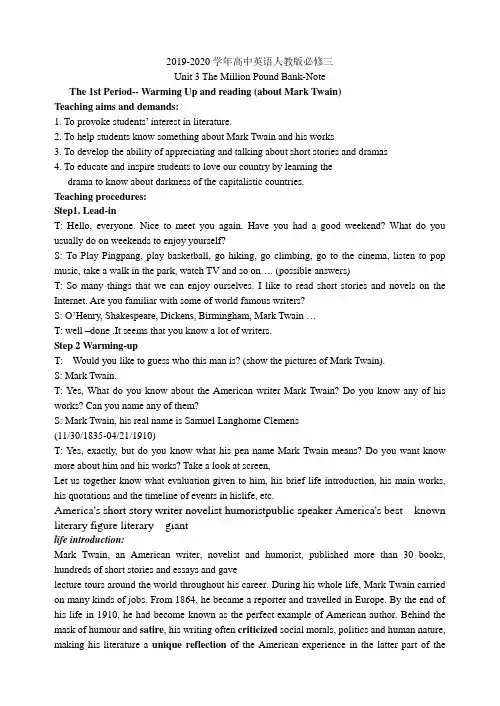
2019-2020学年高中英语人教版必修三Unit 3 The Million Pound Bank-NoteThe 1st Period-- Warming Up and reading (about Mark Twain)Teaching aims and demands:1. To provoke students’ interest in literature.2. To help students know something about Mark Twain and his works3. To develop the ability of appreciating and talking about short stories and dramas4. To educate and inspire students to love our country by learning thedrama to know about darkness of the capitalistic countries.Teaching procedures:Step1. Lead-inT: Hello, everyone. Nice to meet you again. Have you had a good weekend? What do you usually do on weekends to enjoy yourself?S: To Play Pingpang, play basketball, go hiking, go climbing, go to the cinema, listen to pop music, take a walk in the park, watch TV and so on…. (possible answers)T: So many things that we can enjoy ourselves. I like to read short stories and novels on the Internet. Are you familiar with some of world famous writers?S: O’Henry, Shakespeare, Dickens, Birmingham, Mark Twain …T: well –done .It seems that you know a lot of writers.Step 2 Warming-upT:Would you like to guess who this man is? (show the pictures of Mark Twain).S: Mark Twain.T: Yes,What do you know about the American writer Mark Twain? Do you know any of his works? Can you name any of them?S:Mark Twain, his real name is Samuel Langhorne Clemens(11/30/1835-04/21/1910)T: Yes, exactly, but do you know what his pen name Mark Twain means? Do you want know more about him and his works? Take a look at screen,Let us together know what evaluation given to him, his brief life introduction, his main works, his quotations and the timeline of events in hislife, etc.America's s h o r t s t o r y w r i t e r n o v e l i s t h u m o r i s t p u b l i c s p e a k e r America's best known literary figure literary giantlife introduction:Mark Twain, an American writer, novelist and humorist, published more than 30 books, hundreds of short stories and essays and gavelecture tours around the world throughout his career. During his whole life, Mark Twain carried on many kinds of jobs. From 1864, he became a reporter and travelled in Europe. By the end of his life in 1910, he had become known as the perfect example of American author. Behind the mask of humour and satire, his writing often criticized social morals, politics and human nature, making his literature a unique reflection of the American experience in the latter part of thenineteenth century. In the 1890s Mark Twain became very poor. To recover from the bankruptcy, he started a world lecture tour, during which one of his daughters died. The death of his wife and his second daughter darkened his later years.Mark Twain died on April 21, 1910.Time line of the events1835- Haley's Comet welcomed the birth of Samuel Langhorn Clemens. He was born in Florida, MO on November 30. His mom was Jane and his dad was John. He was six of seven kids.1857- The Clemens family moved to Hannibal, MO.1862- Mark Twain's dad, John Marshall died at age 49.1847- 1856- He worked for his brother for newspapers then went to St. Louis, New York City, Philadelphia and Cincinnati to work at a print shop. Then went to help his brothers with the newspaper in Kakoki, Iowa.1858- Mark made his plans to travel to South America, but when he started down Mississippi River, he took a break from the river and went to New Orleans. While he was there, he met Horace Bixby and made him teach him how to be a riverboat pilot.1859- In April, Mark Twain became a licensed riverboat pilot.1863- Clemens began to work for the newspaper in Virginia City, Nevada. This is when he started to use the name, "Mark Twain." Mark Twain means safe water.1866- Twain traveled to Hawaii to write articled in the newspaper. He stayed there for a long while.1870- Samuel thought his writing was better than newspapers and magazines, so he started traveling, writing, and lecturing.1870- Clemens got married to Olivia.1874- Twain moved to Hartford, Conn.1910- Mark Twain died on April 21, in Redding, Conn. From heart disease. Haley's Comet visited again just like the year of his birth.「苦行記」(Roughing It),「密西西比河上的生活」(Life on the Mississippi),「湯姆歷險記」(The Adventures of Tom Sawyer, 1876)、「頑童流浪記」(The Adventures o f Huckleberry Finn, 1884) 、「鍍金時代」(The Gilded Age, 1873)、「海外浪跡」(A Tramp Abroad, 1880)、「王子與貧民」(The Prince and the Pauper, 1882)、「亞瑟王廷之康乃迪克佬」(A Connecticut Yankee in King Arthur's Court, 1889)、「傻威爾遜之悲劇」(The Tragedy of Pudding Head Wilson, 1891)、「聖女貞德回憶錄」(Personal Recollections of Joan of Arc, 1896),The writer’s introduction to The Adventures of Tom Sawyer (1876)Most of the adventures recorded in this book really happened; one or two were experiences of my own, the rest those of boys who were schoolmates of mine. Huck Finn is drawn from life; Tom Sawyer also, but not from an individual —he is a combination of the three boys whom I knew. Although my book is intended mainly for the entertainment of boys and girls, I hope it will not be shocked by men and women, for part of my plan has been to try to pleasantly remind adults of what they once were themselves, and of how they felt and thought and talked, and what strange adventures they sometimes took part in.The Adventures of Tom SawyerThis edition presents Twain's classic American novel in an unabridged text with a reader's guide that's suitable for both children and adults. Mark Twain's classic novel, The Adventures ofHuckleberry Finn, tells the story of a teenaged misfit who finds himself floating on a raft down the Mississippi River with an escaping slave, Jim. In the course of their perilous journey, Huck and Jim meet adventure, danger, and a cast of characters who are sometimes menacing and often hilarious. Though some of the situations in Huckleberry Finn are funny in themselves (the cockeyed Shakespeare production in Chapter 21 leaps instantly to mind), this book's humor is found mostly in Huck's unique worldview and his way of expressing himself. Describing his brief sojourn with the Widow Douglas after she adopts him, Huck says: "After supper she got out her book and learned me about Moses and the Bulrushers,and I was in a sweat to find out all about him; but by and by she let it out that Moses had been dead a considerable long time; so then I didn't care no more about him, because I don't take any stock in dead people." Underlying Twain's good humor is a dark subcurrent of Antebellum cruelty and injustice that makes The Adventures of Huckleberry Finn a frequently funny book with a serious message.His quotation: "Love your enemy, it will scare the hell out of them.”“The man who does not read books has no advantage over the man that cannot read them.”“Always tell the truth; then you don’t have to remember anything.”Humor has been well defined as thinking in fun while feelingin earnest.”幽默被人正确地解释为“以诚挚表达感受,寓深思于嬉笑”。
人教版高中英语必修三Unit_3《The_Million_Pound_Bank-Note》说课稿课件

Oliver believes that with a million pound bank note a man could survive a month in London. I wonder, Mr Adams, If you’d mind us asking a few questions. May we ask what you’re doing in this country and what your plans are?...
Act Two Scene 1 练习册的“Talking”部分 Scene 2 练习册的“Listening”部分 Scene 3 练习册的“Listening task”部分 Scene 4 练习册的“Reading and speaking”部分
四、教学建议---课时安排
Period 1 Period 2 Period 3 Period 4 Period 5 Period 6
5. LISTENING TASK 包括听第二幕的第三场,讨论并写下听力部分的续文。 6. READING AND SPEAKING TASK 阅读并表演剧本的第二 幕的第四场。
7. WRITING TASK
*8. PROJECT
9. CHECKING YOURSELF
(三)剧本的整体安排:
Act One Scene 1&2 教师教学用书的附录部分 Scene 3 学生用书的“Reading”部分 Scene 4 学生用书“语言运用”的“Reading, acting and speaking”部分 Scene 5 学生用书“语言运用”的“Listening, writing and acting”部分
人教版高中英语必修三 unit1 warming up and reading 教学设计

Unit1Warming up and Reading教学设计整体设计教材分析This is the first teaching period of this unit. At the beginning of the class, the teacher can lead in the topic of the unit by having a free talk with students about their winter holidays and the Spring Festival.The Warming Up is intended to have students start thinking about the variety of events and festivals that are celebrated in China, and connect them with seasons of the year and reasons for the celebrations. The teacher can use this part to introduce inform ation that Chinese students should have about their country’s cultural events.The Pre-reading is a continuation of the Warming Up and it moves the discussion to a more personal level. It is intended to help students enter imaginatively into a discussion of festivals and their importance to the society. It also directs their attention to the variety of events and activities those festivals include. The teacher should let students discuss the questions and predict what kind of information will be introduced in the Reading.The reading passage titled FESTIV ALS AND CELEBRATIONS briefly describes the earliest kinds of festivals with the reasons for them, and then four different kinds of festivals that occur in most parts of the world. Encourage students to look at the pictures and the heading of each section to guess what the text might be about. Then let them skim for the general idea for each section, and scan for further understanding. Because this passage introduces a lot of useful new words and expressions which are only used for festivals, in order not to let students feel much difficult, the teacher should deal with any language problems while they are reading. After reading, students are required to do the four exercises in the Comprehending to see how much they have understood the reading passage. The teacher can first let them work in pairs or in groups to find the answers cooperatively, and then check their answers with the whole class.To consolidate the contents of the reading passage, students should be required to talk about festivals in their own words at the end of the class. In order to arousestudents’ interest, the teacher can hold a competition between groups.教学重点1. Let students learn more about history and basic knowledge of festivals.2. Get students to learn different reading skills.教学难点1. Develop students’ reading ability.2. Enable students to talk about festivals and celebrations.三维目标知识目标1. Get students to learn the useful new words and expressions in this part: beauty, harvest, starve, origin, religious, ancestor, Mexico, feast, bone, belief, poet, arrival, gain, independence, gather, agriculture, award, rooster, admire, energetic, Easter, clothing, Christian, custom, take place, in memory of, dress up, play a trick on, look forward to, day and night, as though, have fun with2. Let students learn about history and basic knowledge of festivals both in and out of China.能力目标1. Develop students’ reading ability and let them learn different reading skills.2. Enable students to talk about festivals and celebrations.情感目标1. Stimulate students’ love for their own national culture and customs.2. Develop students’ sense of c ooperative learning.教学过程设计方案(一)→Step 1 Leading-inHave a free talk with students. Ask them the following questions:Did you have a good time in your winter holidays?When did you feel most happy and excited? Why?(At the Spring Festival. Because it’s t he most important festival in our country. . . )→Step 2 Warming up1. Let students brainstorm the other Chinese festivals.(Lantern Festival, Pure Brightness Festival, Dragon Boat Festival, Mid-Autumn Festival, New Year’s Day, Chung Yeung Festival. . . )2. Let students read the information about Chinese festivals below and discuss another three Chinese festivals:When does the festival come?What do people celebrate?What do people do?Festivals Date Festivals DateNew Year January 1st Teachers’ Day September 10th InternationalWomen’s DayMarch 8th National Day October 1stArbor Day March 12th The Spring Festival Lunar New YearInternational Labor Day May 1st Dragon BoatFestivalthe fifth day of the fifthlunar monthInternational Children’s Day June 1st Mid-AutumnFestivalthe 15th day of the 8thlunar monthArmy Day August 1st Lantern Festival the 15th day of the 1stlunar monthChinese Youth Day May 4th Pure BrightnessDayApril the fifth3. Ask students to fill in the following form and ask some to share their opinions with the whole class. The first one is given as an example.Festivals Time of year/date What it celebrates What people doMid-Autumn Festival autumn/fall the beauty of thefull moon, harvest,time with familyand friendsgive/eat mooncakes and watchthe full moon withfamily and friends4. Talk about some foreign festivals with students.(Christmas, April Fools’ Day, Easter, Halloween, Valentine’s Day, Thanksgiving Day, . . . )→Step 3 Pre-reading1. Let students discuss the following questions:What festivals or celebrations do you have in your city or town? What part of a festival do you like best—the activities, the music, the sights, the food or the people who visit?2. Ask students to look at the pictures and title of the passage in Reading. Discuss in pairs what kind of information will be introduced in the passage.→Step 4 Reading1. Fast readingAsk students to skim the reading passage and then fill in the following chart.Kinds of Festivals Names of Festivals Countries FestivalsFestivalsHarvestSpring(Let students look through the chart and then read the text silently. Three minutes later, check the answers with the whole class. Show the suggested answers on the screen. )2. Intensive readingAllow students to read carefully this time to understand the main ideas of each paragraph and the important details, and then finish the following:1)Choose the best answer to each question or to finish each sentence according to the text.(1)Why do Japanese people light lamps during the Festival of the Dead?A. Because they want to make the festival colorful.B. Because they want to light up their rooms.C. Because they want to light up their way.D. Because they want to lead their ancestors to return to earth.(2)Which of the following was not mentioned as a famous person in the text?A. Mohandas Gandi.B. Christopher Columbus.C. Abraham Lincoln.D. Qu Yuan.(3)The place where people will usually decorate churches and town halls with flowers and fruits is ______________.A. IndiaB. AmericaC. EuropeD. China(4)Easter is held in memory of the return of Jesus for Christians and also celebrates ______________.A. the coming of springB. the autumn harvestC. the Lunar New YearD. the end of a yearSuggested answers: (1)D(2)C(3)C(4)A2)Use the information from the reading passage to answer the following questions.(1)What are festivals of the dead usually for?(2)What makes autumn festivals happy events?(3)What do people usually do at spring festivals?(4)What is one important reason to have festivals and celebrations?(5)Compare the festivals of the dead in Mexico, Japan and China. What things are similar? What things are different?3. Reading and discussionRead the text a third time and then work in pairs to do the following.1)Based on the reading passage, what do most festivals seem to have in common? Why do you think these things might be important to people everywhere? Talk with your partner and fill in the chart below.Three common things Reasons why they are important to people everywhere1.2.3.2)Discuss in pairs which festivals you think are the most important and which are the most fun. Then fill in the chart with your ideas.Type of festival Example of festival Reasons for yourchoiceMost importantMost fun(Let students have enough time to read the passage carefully and discuss the questions and charts with their partners. Encourage them to expand their answers according to their own experiences. )4. ExplanationHelp students analyze some difficult, long and complex sentences and guess the meanings of some new words. Encourage them to try to deal with the language points in the context.Discuss the following important sentences and phrases in the passage.1)Some festivals are held to honour the dead, or to satisfy the ancestors, who might return either to help or to do harm.2)in memory of3)India has a national festival on October 2 to honour Mohandas Gandhi, the leader who helped gain India’s independence from Britain.4)People are grateful because their food is gathered for the winter and the agricultural work is over.5)The most energetic and important festivals are the ones that look forward to the end of winter and to the coming of spring.6)The country, covered with cherry tree flowers, looks as though it is covered with pink snow.Suggested explanations:1)The sentence contains a non-restrictive attributive clause who might return either to help or to do harm. It means people hold some festivals either to show respect to the dead or to make their ancestors happy in case they might come back to do harm.2)in memory of: serving to recall sb. , to keep him fresh in people’s mindsHe wrote a poem in memory of his dearest wife, who died in an accident.in honor of: showing great respect or high public regard3)the leader who helped gain India’s independence from Britain: a noun phr ase followed by an attributive clause as the appositive4)two clauses for reason5)energy n. → energetic adj. : full of or done with energylook forward to: “to” is a preposition here.I’m looking forward to hearing from you.be devoted to; be/get used to; get down to; stick to. . .6)covered with cherry tree flowers: a past participle phrase equal to “which is covered with cherry tree flowers”as though: as ifHe talks as though he knew all about it.He looks as if he had seen a ghost.5. Reading aloud and underliningAsk students to read the passage aloud to the tape and let them pay attention to the pronunciation of each new word and the pauses within each sentence. Tell them to pick out all the useful expressions or collocations from the passage while reading and copy them to the notebook after class as homework.→Step 5 ConsolidationAsk students to talk about festivals in their own words according to the text. Then let them complete the following passage with proper words or phrases.There are all kinds of festivals and ______________ around the world, which are held for different ______________. The ancient festivals were mainly held at three times a year—the end of the cold ______________, planting in spring and ______________ in autumn. Some festivals are held to ______________ the dead or ______________ the ancestors, who might return either to help or ______________, while other festivals are held to honor famous people or to the ______________, such as Dragon Boat Festival, Columbus Day, and so on. Harvest and ______________ festivals are happy events because their food is ______________ for the winter and the ______________ work is over, to which Mid Autumn Festival belongs. And the most ______________ and important festivals are the ones that ______________ the end of winter and to the coming of ______________ such as the Lunar New Year, at which people have a very ______________.Suggested answers: celebrations; reasons; weather; harvest; honor; to satisfy; to do harm; gods; Thanksgiving; gathered; agricultural; energetic; look forward to; spring; good time→Step 6 Homework1. Learn the useful new words and expressions in this part by heart.2. Read the reading passage again and again and try to talk about festivals both in and out of China.板书设计Unit 1Festivals around the worldFestivals and celebrationsKinds of Festivals Names of Festivals Countries FestivalsFestivalsHarvestSpring活动与探究Group discussion & speechAs is known from the reading passage, festivals of all kinds are celebrated around the world. Most festivals have celebrations that include food, music, clothing and dances. These events originated from some similar ideas, but they take different forms in different regions and societies. What festivals and celebrations do you know all over the world? Have you ever taken part in them and enjoyed yourself? Discuss festivals in groups and then make speeches.Step 1: The teacher divides the class into four groups and gives the tasks to students in each group. Group 1 will list the festivals around the world as many as possible, and then categorize them according to the origins of these festivals. And they should prepare for a short speech. Group 2 will discuss two traditional Chinese festivals and prepare for their presentation. Group 3 will discuss two Western festivals and prepare for their presentation. Group 4 will discuss the differences between Chinese festivals and Western festivals, then contrast and compare their styles, celebrations, dates and so on. And they should prepare for a short speech.Step 2: Groups 1, 2 and 3 give their speeches on the festivals they have discussed. Group 4 gives their speech on the differences between Chinese festivals and Western festivals.Step 3: The teacher makes proper remarks about students’ speeches and sums up the different cultural practices between China and other countries according to them.。
Unit 3 高一英语Unit3教案[整理六个]人教版
![Unit 3 高一英语Unit3教案[整理六个]人教版](https://360docs-1393072327.cos.ap-beijing.myqcloud.com/798883553d1ec5da50e2524de518964bcf84d2d7.webp)
Unit Three Going placesEdited by Xuesong Bingquan LiuQiong Jianwen复习直接间接引语复习动词时态知识目标描述交通工具描述留有探险种类掌握其他语言知识Consider / regard / treat / think of / look on / have ...as; means及其短语;/way / method; get awayfrom / get out of / get down to / get along with / get rid of / get through with / get up / get on / getaround; watch out / watch it / watch for / watch over / watch one’s step; protect / prevent / stop /defend / free / save / keep... from; wear / have on / clothe / dress / put on / pull on / be in; in + 时段/ after +时段/ after +时点;see / send sb. off; keep off / take off / throw off / turn off / get off / put off/ cut / off; combine ... with / in combination with / connect ...with /mix ...with; if ... not / unless;travel / trip / tour / journeyNatural 自然的,天真的/幼稚的,无经验的;go for 举行,进行,应用,使用于,去找能力目标(略)形成目标:作旅行计划(Make a plan for trip)作旅游报告(Tips on trip)开发生态旅游,保护环境,增加收入(Develop eco-travel, be friendly to the environment anddevelop local economy)在旅游中寻找乐趣,发现生活,缓解压力(Have fun in trip, enjoy knife, relieve pressure)健康取决于运动,请你吃饭不如请你流汗,现代都市新时尚(Health depends on movement,Sweating is more important than eating as for weight problem, be fashionable and be new man.)教材重组与课时分配(allocation):Period 1: Warming up and listeningPeriod 2: SpeakingPeriod 3/4: ReadingPeriod 5: Language study and grammarPeriod 6: Reading, writing and tips 参考:Aims for traveling 要求学生列举50项以上Transportation for traveling要求学生列举5种以上Kinds of traveling要求学生列举20项以上What is traveling? 要求学生用不同的答案回答。
人教版高中英语必修三全套教案

Module3 Unit 1 Festivals around the worldTeaching aims and demands1.topic: 1>Festivals2> how festivals begin3>how to celebrate festivals2.function: 1>RequestEg: Could you please…?Could I have …? I look forward to doing…2>ThanksEg: It’s a pleasure. /Don’t mention it.It’s very kind of you to…I’d love to …Thank you very much./Thanks a lot.You are most welcome.3.vocabulary:4.grammar:Jin can speak English well. (ability)Could you please show me the way to …? (request)May we see the awards for the team? (permission)She might give you … (possibility)The whole family will come for dinner. (promise)Often he would dress up like a rich man. (pass habit)We would be there with our friends. (promise)II.Key pointsPeriod 1-2 Warming up and fast reading1.Greetings2.Warming upStep 1 discussing the following questionsa.How was your holiday/spring festival?b.Did you go traveling?c.How much pocket money did you get?Step 2 talking1). Name some festivalsSpring Festival Dragon Boat Festival Lantam Festival Mid-Autumn Festival Army Day May Day Teachers’ Day New Year National Day Mother’s Day Children’s Day Father’s D ay Christmas Day Halloween carnival Easter Valentine Day Oben2).Ss work in groups of four and list five Chinese festivals and siscuss when theytake place , what they celevrate and one thing that people do at that time. Festivals Time of year/date Celebrate for Things to do Mid-Autumn DaySpring FestivalDragon Boat DayTomb sweeping DayLantern Festival3.Pre-reading1) What’s your favourite holiday of the year? Why?2) What festivals or celebration do you enjoy in your city or town? Do you likespending festivals with your family or with friends? What part of a festival do you like best—the music, the things to see, the visits or the food?4. Fast reading and find the answers to the following questions.A.What did ancient festivals celebrate?B.What are festivals of the dead for ?C.Why are autumn festivals happy events ? three things people do at spring festival ?Period 3-4 Intensive reading1.Read the passage paragraph and find the main ideas of each paragraphParagraph 1: All kinds of celebration in ancient time.Paragraph 2: The purpose to honour the dead and three examplesFestivals Time Things people doObenDay of the DeadHalloweenParagraph 3: The reasons Why we honour peopleFestivals Who does it celebrate ?Dragon Boat FestivalsClumbus DayIndian National FestivalParagraph 4: Autumn festivals are happy eventsParagraph 5: How people celebrate in spring festivals2.Language pointsa.They would starve if food was difficult to find…starve (v.)饿死;挨饿eg. Millions of people starved to death during the war.Starve for sth 渴望…Eg. The homeless children starve for love.Starvation (n.) 饿死Eg. Die of starvationStarvation wages 不够维持基本生活的工资b.The most ancient festivals would celebrate the end of the cold weather, plantingin spring and harvest in autumn.Celebrate (vt./vi.) 庆祝,赞颂,赞美,举行(仪式)Eg.We celebrate the new year with a party.Their courage was celebrated in all the newspaper.Celebrated (adj.) = famous 著名的,驰名的c. …because they thought these festivals would bring a year of plenty.days/years/…of plenty :富裕(尤指事物和钱)的日子,年月,生活等。
高中英语人教版必修1《Unit 3 Period 1》课件
• 完成句子 • ①I prefer to walk there ________(也不愿意乘公共汽
车). • 【答案】rather than take a bus • ②I prefer spending the weekend at home to
________________(也不愿和他们一起去郊游). • 【答案】going on an outing with them
• 我宁愿读书而不愿闲坐在那儿。
• I prefer to do this rather than that.
• 我喜欢做这件事而不愿做那件事。
• (3)prefer sb to do…愿意让某人做某事
• I'd prefer him to paint the door blue. • 我宁愿他把门漆成蓝色。 • 【温馨提示】 • prefer不可用more,most来修饰。 • Which of these hats do you prefer best?(误) • Which of these hats do you like best?(正) • I prefer this more than that.(误) • I prefer this to that.或I like this more than that.(正)
• 4.…the air ________ ________ ________ ________ ________(会呼吸困难)
• 【答案】would be hard to breathe
• Ⅳ.预读理解 • 回答下列问题 • 1.________ is the first one that had the idea to cycle
• 【答案】have dreamed about ta a great bike trip
高中英语必修三第三单元教案最新
Unit 3The Million Pound Bank Note单元规划类别课程标准要求掌握的项目话题Forms of literature and art: short story and drama; how to act out a play词汇birthplacen.出生地; 故乡Embassy n. 大使馆; 大使及其官员phrasen.短语; 词组; 惯用语Seek vt. & vi. 寻找; 探索; 寻求adventure n. 奇遇; 冒险patience n. 耐性; 忍耐novel n.小说; 长篇故事adj. 新奇的; 异常的contrary n. 反面; 对立面adj. 相反的;相违的authorn.著者; 作家Envelope n. 信封scenen.(戏剧)一场; 现场; 场面;景色Permit vt. & vi. 许可; 允许; 准许n. 通行证; 许可证; 执照wander vi. 漫游; 漫步; 漂泊steak n. 肉块; 鱼排; 牛排pavement n. 人行道pineapple n. 菠萝businessman n. 商人dessert n. 餐后甜点unbelievable adj. 难以置信的amount n. 数量aheadad v. 在前; 向前; 提前rude adj. 粗鲁的; 无礼的bayn.海湾mannern.礼貌; 举止; 方式stare vi. 凝视; 盯着看scream vi. 尖声叫n. 尖叫声; 喊叫声fault n. 过错; 缺点; 故障genuine adj. 真的; 真诚的bow vi. & n. 鞠躬; 弯腰rag n. 破布; 碎布passage n. 船费; 通道;(一)段indeed adv. 真正地; 确实; 实在account vt. & vi. 认为; 说明; 总计有n. 说明; 理由; 计算;账目spot vt. 发现; 认出n. 斑点; 污点;地点短语bring up抚养; 培养; 教育; 提出in rags衣衫褴褛go ahead前进; (用于祈使句)可以; 往下说as for关于; 至于by accident偶然; 无意中; 不小心do with对待; 处理; 处置stare at盯着看; 凝视make a bet打赌account for导致; 做出解释be lost迷路; 倾心于某事on the contrary与此相反; 正相反permit sb. to do sth. 准许某人做某事take a chance冒风险; 碰运气in a. . . manner以……的举止(态度)重要句型1. Young man, would you step inside a moment, please? (request)2. I wonder, Mr. Adams, if you’d mind us asking a few questions. (I wonder if. . . )3. . . . I found myself carried out to sea by a strong wind. (find+O. +O. C. )4. And it was the ship that brought you to England. (it is/was. . . that. . . )5. The fact is that I earned my passage by working as an unpaid hand. . . (noun clause as thepredicative)6. You mustn’t think we don’t care about you. (double negative)7. That’s why we’ve given you the letter. (noun clause a s the predicative)8. Well, why don’t you explain what this is all about? (suggestion; noun clause as the object)功能 1. RequestWould you please come in?Could you offer me some kind of work?Would you mind waiting just a few minutes?I wonder, Mr. Adams, if you mind us asking a few questions?May I ask you how much money you have?—Well, to be honest, I have none.—Go right ahead.2. Ordering foodI’d like some ham and eggs and a nice bi g steak.I’ll have a nice long glass of beer.3. Shopping语法 1. Noun clauses as the objectI can’t say that I have any plans.. . . and he does not know what he should do.I did not know whether I could survive until morning.2. Noun clauses as the predicativeThat’s why we’ve given you the letter.The fact is that I earned my passage by working as an unpaid hand. . .教学重点1. Get students to know about forms of literature and art: short story and drama; how to act out aplay.2. Have students learn some useful new words and expressions in this unit.3. Enable students to grasp and use the expressions of request and ordering food.4. Let students learn the new grammar item: noun clauses as the object and predicative.5. Develop students’ listening, speaking, reading and writing abilities.教学难点1. Enable students to master the new grammar item: noun clauses as the object and predicative.2. Let students learn how to act out a play.3. Develop students’ integrative skills.课时安排Periods needed: 7Period 1 Warming up and readingPeriod 2 Learning about language: Important language points Period 3 Learn ing about language: Grammar Period 4 Using language: Reading, acting and speaking Period 5 Using language: Listening, writing and speaking Period 6 Using language: Listening, reading and writing Period 7 Revision: Summing up and learning tip Period 1Warming up and reading整体设计教材分析This is the first teaching period of this unit. At the beginning of the class, the teacher can lead in the topic of the unit by having a free talk with students about the background knowledge, talking about Mark Twain and his play.Mark Twain is probably one of the few American writers with whom students are already familiar. The Warming Up is intended to discover just how much students know about this 19th century writer and let those who don’t know about him know about him before they read the play. The teacher can use this part to introduce information that Chinese students should have.Exercise 1 in the Pre-reading provides students with an important choice. For some, knowing what they would do with the money is easy to decide. For others, it may pose a real dilemma, especially if they feel obligated to help others with the money. Whatever choice students make here, they should be ready to offer their classmates a good reason for it. Exercise 2 is to check whether students have read the story or have seen the film and for students to be ready for the next part Reading.The reading passage is a play which is adapted from Mark Twain’s short story by the same title. It briefly describes that Henry, a San Francisco businessman, is rescued at sea by a British ship that takes him to London where he finds himself without money, friends, or the prospect of a good job. Hungry and alone, he walks along the streets of the city when unexpectedly he is summoned to a mansion. Two rich brothers, Ro derick and Oliver, have made a secret bet. Roderick believes that a man cannot survive in the city for a month with only a million pound bank note in his possession but Oliver believes he can. The play takes us along on Henry’s misadventures with humor and surprise to discover who will win the bet.Students are encouraged to preview the text and find out the new words and structures themselves. They should try to work out the meaning of the new words through the context. Then if necessary, they can look them up in the dictionary or turn to the teacher for help.Plays will enable students to read and hear natural language in a dramatic context. Just as importantly, reading and acting plays aloud will increase st udents’ self-confidence in usingEnglish, which in turn will increase their overall motivation to learn English. Through their active participation in reading characters’ parts in a play, students relive what others have said. When reading a play aloud, students not only speak to the teacher but directly to their classmates. This oral interaction can contribute to greater class cooperation,especially if reading the play results in trying to act it out. In doing so, students can learn how to interpret language through the tone of voice and body language, gaining a greater appreciation of the various verbal and non-verbal ways in which language works. Therefore, provide students with the opportunity to interpret language by acting out a few scenes of the play.To consolidate the contents of the reading passage, students should be required to give a brief introduction to the story The Million Pound Bank Note in their own words and act out Scene 3 of this play with their group members at the end of the class. I n order to arouse students’ interest, the teacher can hold a competition between groups.教学重点1. Let students learn more about Mark Twain and his play.2. Get students to learn different reading skills.3. Have students learn how to act out this play.教学难点1. Develop students’ reading ability.2. Enable students to act out this play.三维目标知识目标1. Get students to learn the useful new words and expressions in this part: birthplace, novel, adventure, phrase, author, scene, wander, pavement, businessman, permit, ahead, bay, stare, fault, spot, passage, account, embassy, seek, patience, contrary, envelope, bring up, go ahead, by accident, stare at, account for, on the contrary2. Let students learn about Mark Twain and his play.能力目标1. Develop students’ reading ability and let them learn different reading skills.2. Enable students to talk about Mark Twain and his play.3. Enable students to act out this play.情感目标1. Stimulate students’ interests of learning English by reading and acting this play.2. Develop st udents’ sense of cooperative learning.教学过程设计方案(一)→Step 1 Warming upTalk about background knowledge about Mark Twain and his play.1. Getting to know a great literary giant: Mark TwainLet students read the following information about Mark Twain and his works.Real name of Mark Twain Samuel Langhorne ClemensYear of birth 1835Places where he lived Raised in Hannibal, Missouri; traveled much of the US;lived for a long time in Europe Names of three of his famous stories The Adventures of Tom SawyerThe Adventures of Huckleberry FinnLife on the MississippiEvaluation of him American short story writer, novelist, humorist, andpublic speaker. American best known literary giant2. Getting to know the story The Million Pound Bank Note.Two rich gentlemen in London made a bet on what would happen to a person if he was given a million pound bank note. An American young man who sailed too far was carried out to sea, but was saved by a British ship for London. So he was now in London, tired, hungry and penniless. . . .→Step 2 Pre-readingDiscuss with students: Have you read the story The Million Pound Bank Note? Have you ever seen the film? If ever, what do you think of it?→Step 3 While-readingTry to gain as much information as possible from the story through reading and train reading skills.1. ScanningReading strategy: Go through the play for specific information. Don’t read sentence by sentence.Fill in the blanks.1)Time: ________________2)Characters:Henry Adams:_________________Roderick and Oliver:_________________3)EventsAbout a month ago Henry was ______________ out of the bay.Towards nightfall Henry was ______________ out to sea by a strong wind.The next morning Henry was ______________by a ship.Lastly Henry arrived in ______________ by working as an unpaid hand on the ship.Now Henry was ______________ in London and ______________ in the street.Just at that time Roderick ______________ him and asked him to step in.To Henry’s surprise Roderick gave Henry ______________ with money in it.Suggested answers:1)the summer of 19032)Henry Adams: a lost American businessman in LondonRoderick and Oliver: two brothers and rich Englishmen3)About a month ago Henry was sailing out of the bay.Towards nightfall Henry was carried out to sea by a strong wind.The next morning Henry was spotted by a ship.Lastly Henry arrived in London by working as an unpaid hand on the ship.Now Henry was lost in London and wandering in the street.Just at that time Roderick called him and asked him to step in.To Henry’s surprise Roderick gave Henry an envelope with money in it.2. SkimmingReading strategy: Go through the play for the gist.1)Answer the following questions:(1)Where does Henry Adams come from? Does he know much about London?(2)What did he do in America?(3)Why did he land in Britain?S uggested answers:(1)Henry comes from San Francisco.No, he doesn’t know London at all.(2)He worked for a mining company.(3)He was sailing out the bay when he was carried out to sea by a strong wind and was rescued by a ship for London.2)Put the following events in a correct order to form a short passage:Henry wandered in London streets.About a month ago Henry Adams was sailing out of the bay.The next morning he was spotted by a ship.Towards nightfall he found himself carried out to sea by a strong wind.On the ship he earned his passage by working as an unpaid hand.Suggested answers:About a month ago Henry Adams was sailing out of the bay. Towards nightfall he found himself carried out to sea by a strong wind. The next morning he was spotted by a ship. On the ship he earned his passage by working as an unpaid hand. Henry wandered in London streets.3. Detailed-readingReading strategy: Read the play carefully and try to get as much information as possible. Try to keep them in mind.Fill in the blanks and retell the story.Henry was an ____________. One day he had an accident in a ______________. Luckily he was rescued by a ship for _____________. He arrived in London by earning his passage without pay. He was _____________ in the street in ______________. To his surprise an ______________ thing happened. Two rich brothers gave him a million pound bank-note because they had made a ______________.Suggested answers:American; bay; London; wandering; rags; incredible; bet4. Reading aloud and underliningAsk students to read the play aloud to the tape and let them pay attention to the pronunciation and the pauses within each sentence. Tell them to pick out all the useful expressions or collocations from the passage while reading and copy them to the notebook after class as homework.→Step 4 Post-reading1. Discussing and talkingWhat kind of person do you think Henry is? Why do you think so? Find some of his words to prove.1)Is Henry honest?It is my first trip here.Well, to be honest, I have none. (no money)Well, I can’t say that I have any plans.2)Is Henry hard-working?I earned my passage by working as an unpaid hand.Could you offer me some kind of work here?I don’t want your charity; I just want an honest job.3)Is Henry direct/straightforward?Well, it may seem luck to you but not to me.If this is your idea of some kind of joke, I don’t think it’s very funny.Now, i f you’ll excuse me, I think I’ll be on my way.2. Acting1)Listen to the text again.2)Complete the table.Characters Actions Attitudes DecisionNarratorOliverRoderickHenryServant3)Act out the play in groups of four or five, including the narrator.4)Invite two or three groups to perform before the class.3. DiscussionHave a discussion with students.Su ppose you get a large amount of money by buying lottery tickets and become a millionaire. What will you do w ith the money?4. WritingRewrite the play into a story.→Step 5 Homework1. Learn the useful new words and expressions in this part by heart.2. Read the play again and again and try to act it out with your classmates.3. Enjoy the movie The Million Pound Bank Note.设计方案(二)→Step 1 Leading in1. Talk about characters of short stories and dramas.2. Ask students some questions:1)Do you like dramas? Can you list some famous dramas and their writers?2)Do you know about Mark Twain and his play The Million Pound Bank Note?→Step 2 Warming up1. Show the picture of Mark Twain and ask students: What do you know about him?2. Let students read the short passage and take notes to fill in the chart.Real nameMeaning of his pen nameBirth dateBirth placePlace where he grew upHis famous stories→Step 3 Pre-readingLet students discuss the following questions with their partners and then ask them to report their work. Encourage them to express their opinions freely.1. Imagine somebody gives you a large sum of money to spend as you like. What would you do with it?Students have a discussion on this question. Whatever choice students make, they should beready to offer their classmates a good reason for it.2. Have you ever read the story The Mi llion Pound Bank Note? Have you ever seen the movie? If ever, what did you think of it?→S tep 4 Reading1. Give students 3 minutes, and ask them to skim the passage for information to find the answers to the questions.1)How did Henry come to England?2)Why did he land in Britain?3)Where did Henry work before?4)Why did the two gentlemen give him the envelope?5)When can he open it?After students discuss the questions, check the answers with the wh ole class.2. Give students 5 minutes to read the passage carefully, and then do the exercises in Comprehending on Page 19.After most of them finish, check the answers with the whole class.3. ExplanationHelp students analyze some difficult, long and complex sentences and guess the meaning of some new words and expressions. Encourage them to try to deal with the language points in the context.1)a large amount of: a large quantity of; a great deal ofThey bought a large amount of furniture before they moved their new house.2)make a bet: make an arrangement to risk money, etc. on an event of which the result is doubtfulWe made a bet on the result of the match.3)permit sb. to do something: allow somebody to do somethingMy mother doesn’t permit me to ride in the street after it rained.4)by accident: as a result of chanceI only found it by accident.5)stare at: look at somebody or something with the eyes wide open in a fixed gaze (in astonishment, wonder, fear, etc. )Do you like being stared at?6)to be honest: to tell you the truth; to be frankTo be honest, I don’t think we have a chance of winning.4. Listening and reading aloudPlay the tape of the text for students and let them pay attention to the pronunciation and intonation. Then ask them to take roles to read the text aloud after the tape.→Step 5 DiscussionAfter students read the play, let them discuss these questions in groups.1. Why do you think that the brothers chose Henry for their bet?2. What kind of person do you think Henry is? Why do you think so?→Step 6 Closing down by acting1. Have students get prepared in 3 minutes or so and then ask them to act out the play.2. Ask as many groups as possible to perform before the class.→Step 7 Homework1. Go over the text and try to learn all the useful words and expressions in this part by heart.2. Finish the exercises in Comprehending on Page 19.3. Rewrite the play into a short story in your own words.板书设计Unit 3The Million Pound Bank NoteWarming Up and Reading1. Time: the summer of 19032. Characters:Henry Adams: a lost American businessman in LondonRoderick and Oliver: two brothers and rich Englishmen3. Events:About a month ago Henry was sailing out of the bay.Towards nightfall Henry was carried out to sea by a strong wind.The next morning Henry was spotted by a ship.Lastly Henry arrived in London by working as an unpaid hand on the ship.Now Henry was lost in London and wandering in the street.Just at that time Roderick called him and asked him to step in.To Henry’s surprise Roderick gave Henry an envelope with money in it.活动与探究Work in groups. Go to the library or surf the Internet to find out more information about Mark Twain. Make a list of his life and his major works. Be ready to give a short report on this to the class.Unit 3The Million Pound Bank NotePeriod 3Learning about language: Grammar整体设计教材分析This is the third teaching period of this unit. To test whether students have grasped the important and difficult language points they learned in the last period, the teacher should first offer them some revision exercises. Then lead in the new lesson.This teaching period mainly deals with the new grammar items: 1. noun clauses as the object;2. noun clauses as the predicative. Students often feel noun clauses abstract and difficult to learn, so it is necessary to make the lesson interesting and lively, and connect it with their daily life in order to let it easy to accept and understand. Firstly, the teacher can ask students to read the play The Million Pound Bank Note again, tick out all the sentences from the play where noun clauses are used as the object and the predicative, and then translate them into Chinese. Secondly, compare and discover the uses of each noun clause by giving a lot of example sentences. Thirdly, do the exercises in Discovering u seful structures on Page 21 and more exercises for students to master the related noun clauses. Finally, summarize the use of noun clauses as the object and the predicative and let students make it clear how each noun clause is being used in the situations.At the end of the class, ask students to do the exercises in Using structures on Page 57 and additional exercises for consolidation.教学重点Get students to understand and use noun clauses as the object and the predicative.教学难点Enable students to learn how to use noun clauses as the object and the predicative correctly.三维目标知识目标1. Get students to know more about noun clauses.2. Let students learn noun clauses as the object.I can’t say that I have any plans.. . . and he does not know what he should do.I did not know whether I could survive until morning.3. Have students learn noun clauses the predicative.That’s why we’ve given you the letter.The fact is that I earned my passage by working as an unpaid hand. . .能力目标Enable students to use noun clauses as the object and the predicative correctly and properly according to the context.情感目标1. Get students to becom e interested in grammar learning.2. Develop students’ sense of group cooperation.教学过程设计方案(一)→Step 1 Revision1. Check the homework exercises.2. Dictate some new words and expressions.→Step 2 Leading-in by a gamePlay the game of “Pass the message”. Show the same written message to the first person in each team of the class. Ask the person to pass the message on orally in indirect speech as quickly as possible. The first team that finishes it must put up their hands and the last person tells the class the message. If he/she has got it right, that team has won the game.Example 1:Message: There will be no homework tonight.S1: The teacher said that there would be no homework tonight.Example 2:Message: The fact is that she has been ill for 3 days.S1: The teacher said the fact was that she had been ill for 3 days.→Step 3 Grammar learning1. Reading and discoveringAsk students to turn back to Page 17 to read through the play The Million Pound Bank Note, let them pick out the sentences using noun clauses as the object and the predicative, read them aloud, and then translate them into Chinese.Suggested answers:Sentences using noun clauses as the object:1. Oliver believes that with a million pound bank note a man could survive a month in London.奥利弗相信一个拥有一张百万英镑钞票的人可以在伦敦生存一个月。
【最新】人教版高中英语必修三课件:Unit+3+Section+Ⅱ+Warming+Up+&+Reading+—+Language+Points
一、这样记单词 记得准·写得对
Ⅰ.基础词汇 1. permit vt.&vi. n. 2. spot vt. n. 3. scene n. 许可;允许;准许 通行证;许可证;执照 发现;认出 斑点;污点;地点 (戏剧)一场;现场;场面;景色
认为;说明;总计有 说明;理由;计算;账目 凝视;盯着看 过错;缺点;故障 反面;对立面 相反的;相违的
Ⅱ.拓展词汇 1. penniless adj.身无分文的→penny n.分;便士 2. businessman n.商人→business n.生意;商业 3. unpaid adj.未付款的;不受报酬的→paid adj.付清的;已付的 4. patience n.耐心;耐性;忍耐→patient adj.有耐心的n.病人
on
the scene when the accident happened.
事故发生时,他在现场。 ③He is an important man behind the scenes. 他是一个幕后的重要人物。
[辨析比较]
scene, scenery, sight, view
指展现在眼前的情景,也可以指scenery的一部分,
do not I
that
引导表语
know
从句,只起连
anything about him.
接作用,不作 句子成分。
事实是我对他一无 所知。
1.(教材P17)He was brought up in Hannibal, Missouri, along the Mississippi River. 他生长在密西西比河畔密苏里州的汉尼拔市。 bring up 抚养;培养;教育;提出;呕吐
人教版高中英语必修三教案:unit3+Warming-up+and+Pre-reading.doc
单元(章品味人生1、不管鸟的翅膀多么完美,如果不凭借空气,鸟就永远飞不到高空。
想象力是翅膀,客观实际是空气,只有两方面紧密结合,才能取得显着成绩。
2、想停下来深情地沉湎一番,怎奈行驶的船却没有铁锚;想回过头去重温旧梦,怎奈身后早已没有了归途。
因为时间的钟摆一刻也不曾停顿过,所以生命便赋予我们将在汹涌的大潮之中不停地颠簸。
3、真正痛苦的人,却在笑脸的背后,流着别人无法知道的眼泪,生活中我们笑得比谁都开心,可是当所有的人潮散去的时候,我们比谁都落寂。
4、温暖是飘飘洒洒的春雨;温暖是写在脸上的笑影;温暖是义无反顾的响应;温暖是一丝不苟的配合。
5、幸福,是一种人生的感悟,一种个人的体验。
也许,幸福是你风尘仆仆走进家门时亲切的笑脸;也许,幸福是你卧病床上百无聊赖时温馨的问候;也许,幸福是你屡遭挫折心灰意冷时劝慰的话语;也许,幸福是你历经艰辛获得成功时赞赏的掌声。
关键的是,你要有一副热爱生活的心肠,要有一个积极奋进的目标,要有一种矢志不渝的追求。
这样,你才能感受到幸福。
6、母爱是迷惘时苦口婆心的规劝;母爱是远行时一声殷切的叮咛;母爱是孤苦无助时慈祥的微笑。
7、淡淡素笺,浓浓墨韵,典雅的文字,浸染尘世情怀;悠悠岁月,袅袅茶香,别致的杯盏,盛满诗样芳华;云淡风轻,捧茗品文,灵动的音符,吟唱温馨暖语;春花秋月,红尘阡陌,放飞的思绪,漫过四季如歌。
读一段美文,品一盏香茗,听一曲琴音,拾一抹心情。
8、尘缘飞花,人去楼空,梦里花落为谁痛?顾眸流盼,几许痴缠。
把自己揉入了轮回里,忆起,在曾相逢的梦里;别离,在泪眼迷朦的花落间;心碎,在指尖的苍白中;淡落,在亘古的残梦中。
在夜莺凄凉的叹息里,让片片细腻的柔情,哽咽失语在暗夜的诗句里。
9、用不朽的“人”字支撑起来的美好风景,既有“虽体解吾犹未变兮”的执着吟哦,也有“我辈岂是蓬蒿人”的跌宕胸怀;既有“我以我血荐轩辕”的崇高追求,也有“敢教日月换新天”的豪放气魄。
33 我是一只蜜蜂,在祖国的花园里,飞来飞去,不知疲倦地为祖国酿制甘甜的蜂蜜;我是一只紫燕,在祖国的蓝天上,穿越千家万户,向祖国向人民报告春的信息;我是一滴雨点,在祖国的原野上,从天而降,滋润干渴的禾苗;我是一株青松,在祖国的边疆,傲然屹立,显示出庄严的身姿。
高中英语-unit-3-Life-In-the-Future-全单元教案
高二上学期第三次教案设计人:Unit 3 Life In the FuturePeriod 1 & 2 Warming Up & Pre-reading, ReadingTeaching Goals:1.To illustrate Ss’ imagination of future life.2.To arouse Ss to pay more attention to the problems that probably appeared in thefuture life.3.To make Ss know the difference of life between the past, present and future. Teaching Procedures:Step 1 Leading-inPurpose: To talk about past and future changes of life.1. Group workLet Ss discuss the questions in groups of four.(1)How do you usually get to school?(2)Where do you live, in a city or in the countryside?(3)Where would you like to live in the future?(4)Do you live in a flat or a house?(5)Do you have a room of you won? Can you describe the room in the picture?(6)What kind of housing would you like to have in the future?(7)What would you like to have in your room?(8)What can we use to build houses? (brick, stone , steel , glass, ice, wood , plasticbamboo, …)2. ConclusionThis unit introduces what life in the future might be like to Ss. By discussing and answering the questions above can make Ss have a general understanding of the present and future life and can also illustrate Ss’ imagination about the future life.Step 2. Warming Up1. Pair workIn pairs let Ss list the changes in housing, transport, jobs, families and education will happen in the next century.2. Individual workAccording to the result of the above Pair work, fill in the chart.Step 3. Pre-reading1. Pair workAsk Ss to discuss the following questions in pairs.(1)Make a list of the problems human beings are facing today.(2) What problems do you think people will have overcome in one thousand years? Which ones do you think will still exist in AD 3008?Suggested Answers:①The first problem I would like to point out is the decline of morality.(道德沦丧)②The second problem is the racial bias problem. (种族歧视)③The third problem , which is a most serious problem , is the rapid depletion of resources on the Earth. (资源匮乏)④Now I come to the fourth problem, the problem of the large gap between the poor and the rich . (贫富悬殊)⑤The fifth problem is the pollution problem.(环境恶化)⑥Now I would like to talk about the sixth problem, the expensive arms race problem. (军备竞争)。