
经典中国古文英语翻译
但愿人长久,千里共婵娟。
We wish each other a long life so as to share the beauty of this graceful moonlight, even though miles apart.独在异乡为异客,每逢佳节倍思亲。
A lonely stranger in a strange land I am cast, I miss myfamily all the more on every festive day.大江东去,浪淘尽,千古风流人物。
The endless river eastward flows; with its huge waves are gone all those gallant heroes of bygone years.二人同心,其利断金。
If two people are of the same mind, their sharpness can cut through metal.富贵不能淫,贫贱不能移,威武不能曲,此之谓大丈夫。
It is a true great man whom no money and rank can confuse, no poverty and hardship can shake, and no power and force can suffocate.海内存知己,天涯若比邻。
A bosom friend afar brings distance near.合抱之木,生于毫末,九层之台,起于累土;千里之行始于足下。
A huge tree that fills one’s arms grows from a tiny seedling;a nine-storied tower rises from a heap of earth; a thousand li journey starts with the first step.祸兮,福之所依;福兮,祸之所伏。
Misfortune, that is where happiness depends; happiness, that is where misfortune underlies.见贤思齐焉,见不贤而内自省也。
On seeing a man of virtue, try to become his equal; on seeing a man without virtue, examine yourself not to have the same defects.江山如此多娇,引无数英雄尽折腰。
This land so rich in beauty has made countless heroes bow in homage.举头望明月,低头思故乡。
Raising my head, I see the moon so bright; withdrawing my eyes, my nostalgia comes around.俱往矣,数风流人物,还看今朝。
All are past and gone; we look to this age for truly great men.君子成人之美,不成人之恶。
The gentleman helps others to achieve their moral perfection but not their evil conduct.君子独立不惭于影,独寝不愧于魂。
A righteous man never feels ashamed to face his shadow when standing alone and to face his soul when sleeping alone.君子之交淡如水,小人之交甘如醴。
君子淡以亲,小人甘以绝。
The friendship between men of virtue is light like water, yet affectionate; the friendship between men without virtue is sweet like wine, yet easily broken.老吾老以及人之老,幼吾幼以及人之幼。
Expend the respect of the aged in one’s family to that of other families; expend the love of the young ones in one’s family to that of other families.礼尚往来。
往而不来,非礼也;来而不往,亦非礼也。
Propriety suggests reciprocity. It is not propriety not to give out but to receive, or vice versa.两情若是长久时,又岂在朝朝暮暮。
If love between both sides can last for aye, why need they stay together night and day?路漫漫其修远兮,吾将上下而求索。
The way ahead is long; I see no ending, yet high and low I’ll search with my will unbending.民为贵,社稷次之,君为轻。
The people are the most important element in a state; next are the gods of land and grain; least is the ruler himself.千丈之堤,以蝼蚁之穴溃;百尺之屋,以突隙之烟焚。
A long dike will collapse because of an ant-hole in it; a tall building will be burned down by a spark from a chimney’s chink.锲而舍之,朽木不折,锲而不舍,金石可镂。
Carve but give up half way, even a decayed piece of wood will not break; carve without stop, even metal and stone can be engraved.人有悲欢离合,月有阴晴阳缺,此事古难全。
People have sorrow and joy; they part and meet again. The moon dims or shines; it waxes or wanes. Nothing is perfect, not even in the olden days.人之于文学也,犹玉之于琢磨也。
Learning and culture are to a person what polished and grinding are to jade.三人行,必有我师焉。
择其善者而从之,其不善者而改之。
Among any three people walking, I will find something to learn for sure. Their good qualities are to be followed, and their shortcomings are to be avoided.士不可以不弘毅,任重而道远。
仁以为己任,不亦重乎?死而后己,不亦远乎?An educated gentleman cannot but be resolute and broad-minded, for he has taken up a heavy responsibility and a long course. Is it not a heavy responsibility, which is to practice benevolence? Is it not a long course, which will end only with his death?士之为人,当理不避其难,临患忘利,遗生行义,视死如归。
A moral intellectual is one who escapes no danger in face of truth, discards personal interests in front of disaster, practices righteousness at the expense of life, and looks upon death as going home.逝者如斯夫!不舍昼夜。
The passage of time is just like the flow of water, which goes on day and night.顺天者存,逆天者亡。
Those who follow the Heaven’s law will survive; those who go against it will perish.天将降大任于斯人也,必先苦其心志,劳其筋骨,饿其体肤,空乏其身,行拂乱其所为,所以动心忍性,增益其所不能。
When Heaven is about to place a great responsibility on a great man, it always first frustrates his spirit and will, exhausts his muscles and bones, exposes him to starvation and poverty, harasses him by troubles and setbacks so as to stimulate his spirit, toughen his nature and enhance hisabilities.天生我才必有用。
Heaven has endowed me with talents for eventual use.天时不如地利,地利不如人和。
Opportunities vouchsafed by Heaven are less important than terrestrial advantages, which in turn are less important than the unity among people.天行健,君子以自强不息。
从中国顶级翻译官张璐看神级古文经典翻译

从中国顶级翻译官看神级古文经典翻译为何是双语?重要的不是翻译本身,而是翻译背后对跨语种文化的理解。
1.守职而不废处义而不回。
I will not waver and carry out my duties, and will remain true to my conviction.2.入则恳恳以尽忠,出则谦谦以自悔。
Goes officials should serve as loyal as they can conscientiously when they are in office and engage in modest self-reflection when their terms end.3.知我罪我,其惟春秋。
There are people who will appreciate what I have done but there are also people who will criticize me,ultimately, history will have the final say.4.苟利国家生死以,岂因祸福避趋之。
In line with the conviction that I will do whatever it takes to serve my country even at the cost of my own life,regardless of fortune or misfortune to myself.5.骨肉之亲,析而不殊。
Brothers, though geographically apart will always be bound by their blood ties.6.如将不尽,与古为新。
It is only with reform that we can ensure continuous existence and growth.7.行百里者半九十。
用古文翻译英语初中生作文
用古文翻译英语初中生作文
吾有一徒,年方十三,其文如下:
昔有少年,名曰汤姆,居于乡间。
汤姆性善,好读书,尤喜自然之趣。
一日,汤姆游于林中,见一鸟巢,巢中有雏鸟数只,其声啾啾,引人
怜爱。
汤姆驻足观之,心中喜悦。
忽有一恶猫,悄然而至,欲捕雏鸟。
汤姆见状,心生不忍,遂驱猫而去。
鸟巢得保,雏鸟无恙。
汤姆归家,心中甚慰。
翌日,汤姆复至林中,欲再观雏鸟。
至则见巢空,鸟已飞去。
汤姆怅
然若失,然知鸟之成长,终须离巢,自翔蓝天。
汤姆悟,凡物皆有其时,人亦然。
师曰:此文虽简,然意深远。
汤姆之善,见于护鸟;其悟,见于鸟飞。
少年当如此,怀善心,明事理,知进退,方能成大器也。
古文英译:郑人买履

古文英译:郑人买履大家好,本期我们将给大家带来寓言故事:《郑人买履》的英文翻译。
同时,在译文注释部分,我们将对翻译中的难点进行解释,希望对大家有所帮助。
原文:郑人有欲买履者,先自度其足,而置之其坐。
至之市而忘操之。
已得履,乃曰:“吾忘持度!”反归取之。
及反,市罢,遂不得履。
人曰:“何不试之以足? ”曰:“宁信度,无自信也。
”汉语译文:有一个郑国人想买鞋,他先量好自己的脚,然后把量好的尺码放在座位上。
到了集市上,却忘了带上尺码。
他挑好了鞋,对卖鞋的人说:“我忘了带尺码。
”于是就回家去取。
等他返回时,集市已经散了,他最终没有买到鞋子。
有人问:“你为什么不用自己的脚去试鞋呢?”他说:“我宁可相信量好的尺码,也不相信自己的脚。
”英语译文:A Man from the State of Zheng Bought ShoesA man from the State of Zheng wanted to buy himself a pair of shoes. He measured his feet and put the measurement on the seat. Then he went to the market. When he selected a pair of shoes that was to his liking, he found that he had left the measurement at home. “Sorry, I forget to bring the measurement here,” he said to the salesperson, and hurried back home for the measurement. But when he returned to the market, it had closed.Someone asked him, “Why don’t you try the shoes on to see if they fit well?”He replied, “I trust the measurement of my feet rather than my feet.’’英语译文注释:1.“吾忘持度”的意思是“我忘了带尺码”,这里的“带”应该理解为“带来、拿来”,应选用bring,指从别处把某物带到说话人所在之处。
奥巴马访华引用的古诗文如何翻译
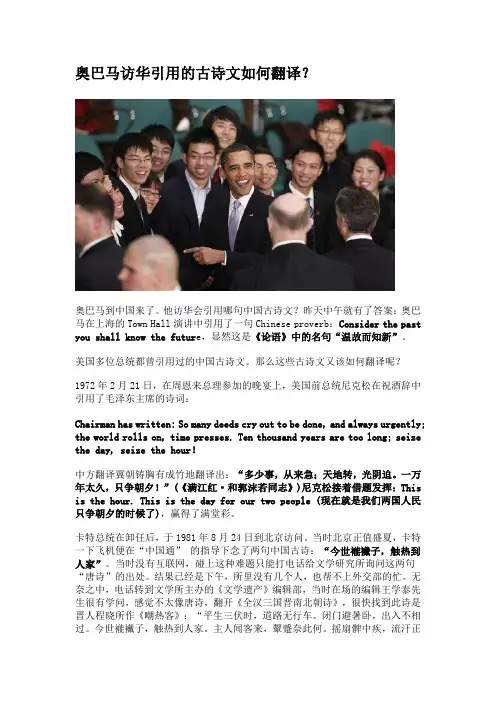
奥巴马访华引用的古诗文如何翻译?奥巴马到中国来了。
他访华会引用哪句中国古诗文?昨天中午就有了答案:奥巴马在上海的Town Hall演讲中引用了一句Chinese proverb:Consider the past you shall know the futur e,显然这是《论语》中的名句“温故而知新”。
美国多位总统都曾引用过的中国古诗文。
那么这些古诗文又该如何翻译呢?1972年2月21日,在周恩来总理参加的晚宴上,美国前总统尼克松在祝酒辞中引用了毛泽东主席的诗词:Chairman has written: So many deeds cry out to be done, and always urgently; the world rolls on, time presses. Ten thousand years are too long; seize the day, seize the hour!中方翻译冀朝铸胸有成竹地翻译出:“多少事,从来急;天地转,光阴迫。
一万年太久,只争朝夕!”(《满江红·和郭沫若同志》)尼克松接着借题发挥:This is the hour. This is the day for our two people (现在就是我们两国人民只争朝夕的时候了),赢得了满堂彩。
卡特总统在卸任后,于1981年8月24日到北京访问。
当时北京正值盛夏,卡特一下飞机便在“中国通” 的指导下念了两句中国古诗:“今世褦襶子,触热到人家”。
当时没有互联网,碰上这种难题只能打电话给文学研究所询问这两句“唐诗”的出处。
结果已经是下午,所里没有几个人,也帮不上外交部的忙。
无奈之中,电话转到文学所主办的《文学遗产》编辑部,当时在场的编辑王学泰先生很有学问,感觉不太像唐诗,翻开《全汉三国晋南北朝诗》,很快找到此诗是晋人程晓所作《嘲热客》:“平生三伏时,道路无行车。
闭门避暑卧,出入不相过。
中华文化经典外译作品

中华文化经典外译作品中华文化有许多经典著作,对外译作品在国际间产生了广泛的影响和认可。
以下是一些中华文化经典外译作品,按不同领域进行划分。
1. 文学经典:- 《红楼梦》:这是中国古代四大名著之一,被翻译成多种外文版本,如《Dream of the Red Chamber》和《A Dream of Red Mansions》。
- 《西游记》:这是另一部中国古代四大名著之一,被翻译成多种外文版本,如《Journey to the West》和《Monkey》。
- 《水浒传》:这是中国古代四大名著之一,被翻译成多种外文版本,如《The Water Margin》。
- 《论语》:这是孔子及其弟子的言行录,被翻译成多种外文版本,如《The Analects of Confucius》。
2. 哲学经典:- 《道德经》:这是中国古代哲学家老子的著作,被翻译成多种外文版本,如《Tao Te Ching》。
- 《孙子兵法》:这是中国古代军事家孙武的兵法著作,被翻译成多种外文版本,如《The Art of War》。
3. 文化经典与经济:- 《论语》:这是孔子及其弟子的言行录,除了被翻译成多种外文版本,在国际间也广泛影响了人们对中国文化的认知,为中华文化的传播出做出了贡献。
- 《周易》:这是中国古代一部重要经典,被翻译成多种外文版本,为国际读者提供了了解中国古代哲学和预测未来的手段。
4. 诗歌与文学:- 《唐诗三百首》:这是唐代诗歌的代表作,被翻译成多种外文版本,向世界介绍了中国古代诗词的优雅和艺术特点。
- 《古文观止》:这是一部汇集了中国古代文言文的精华作品,被翻译成多种外文版本,帮助国际读者了解和欣赏古代文学的魅力。
这些中华文化经典外译作品,通过不同形式和语言版本的传播,让国际读者有机会了解和感受中华文化的博大精深。
这在一定程度上促进了中华文化在世界舞台上的影响力和传播力。
古文英译
3、古今、通假和词能消长
先秦两汉古籍中通假字很多,不明通假就会误译。
请看下例:八月剥枣。(《诗经· 七月》) “剥”就是 通假字,剥者,击也。
此句许渊冲译成: In eighth moon down the dates we beat. (八月 打下大红枣。)
再比较下面两个句子中的“说”字。 (1)成事不说,遂事不谏,既往不咎。(《论语· 八 佾》)。 (2)非不说子之道,力不足也。(《论语· 雍也》)。 第1句中的“说”字古义今义相同,该句可译成: It is bootless to discuss accomplished facts, to protest against things past remedy, to find fault with bygone things. 第2句中的“说”同“悦”,不明古今就可能将 “说”字译错。理雅各译成: It is not that I do not delight in your doctrine, but my strength is insufficient.
三、汉语文言与现代英语的 比较及翻译
(一)汉语文言与现代英语句法结构的主要相似 点及其翻译 1、文言判断句与英语SVC句型 2、文言被动句与英语的被动句 (二)汉语文言与现代英语句法结构的主要差异 及其翻译 1、意合与形合 (parataxis vs. hypotaxis) 2、汉语动词优势与英语名词、介词、分词优势 3、重复与替代 (repetition vs. substitution) 4、省略与完备 (omission vs. comprehensiveness)
Limited, 1925)
中国对联,诗歌等的英文翻译
和气生财 Harmony brings wealth. 既往不咎 let bygones be bygones 脚踩两只船 sit on the fence 留得青山在不怕没柴烧 Where there is life, there is hope. • 赔了夫人又折兵 throw good money after bad • 茅塞顿开 be suddenly enlightened • 前事不忘后事之师 Past experience, if not forgotten, is a guide for the future. • • • •
课文学习
• 瑞雪兆丰年 A timely snow promises a good harvest. • 人之初性本善 Man's nature at birth is good. • 塞翁失马焉知非福 Misfortune may be an actual blessing. • 说曹操,曹操到Talk of the devil and he comes. 说曹操,曹操到Talk • 新官上任三把火a new broom sweeps clean 新官上任三把火a • 有情人终成眷属 Jack shall have Jill, all shall be well • 韬光养晦hide one's capacities and bide one's time 韬光养晦hide
课文学习
重重叠叠山, 重重叠叠山, 曲曲环环路, 曲曲环环路, 丁丁冬冬泉, 丁丁冬冬泉, 高高下下树。 高高下下树。
The hills ---- range after range ; The trails ---- winding and climbing ; The creeks ---- murmuring and gurgling ; The trees ---- high and lowly.
关于唯美古文的英文句子及翻译
今日种种,似水无痕。 明夕何夕,君已陌路。
51、有缘相遇,无缘相聚,天涯海角,但愿相忆。有幸相知,无幸相守,苍海明月,天长地久。
52、相见得恨晚,相爱的太慢,进退让我两难缘过了远分,缘过了聚散,是否回头就能够上岸 53、天凉了,凉尽了天荒 地老 了,人间的沧桑爱哭了,这么难舍 心都空了,想放不能放天亮了,照亮了泪光 泪干了,枕边地彷徨 54、心微动奈何情己远. 物也非,人也非,事事非,往日不可追 55、渺渺时空,茫茫人海,与君相遇,莫失莫忘。 56、如果换我先开口,日子是否还 一样细水长流 57、也许是前世的姻 也许是来生的缘 错在今生相见 徒增一段无果的恩怨 58、人道海水深,不抵相思半。
帘外雨潺潺,春意阑珊,罗衾不耐五更寒。梦里不知身是客,一晌贪欢。独自莫凭栏,无限江山,别时容易见时难。流水落花 春去也,天上人间!
无言独上西楼,月如钩,寂寞梧桐深院锁清秋。剪不断,理还乱,是离愁,别是一般滋味在心头
林花谢了春红,太匆匆,无奈朝来寒雨晚来风。胭脂泪,相留醉,几时重?自是人生长恨水长东
寒蝉凄切,对长亭晚,骤雨初歇,都门帐饮无绪。留恋处,兰舟催发,执手相看泪眼,竟无语凝噎。念去去,千里烟波,暮霭 沉沉楚天阔。多情自古伤离别,更那堪,冷落清秋节。今宵酒醒何处,杨柳岸,晓风残月。此去经年,应是良辰好景虚设。便 纵有千种风情,更与何人说?
28.念君化烛,泪尽相思灼,旧时堂燕今朝何漂泊。29.回首间,站在桥上抬眼看,只看见,桃花漫天尽飞散。
30.原来姹紫嫣红开遍,似这般都付与断井颓垣。二谁,执我之手,敛我半世癫狂; 谁,吻我之眸,遮我半世流离。
谁,抚我之面,慰我半世哀伤; 谁,携我之心,融我半世冰霜;谁,扶我之肩,驱我一世沉寂。 谁,唤我之心,掩我一生凌 轹。
海水尚有涯,相思渺无畔。 59、醉眼看别人成双作对, 60、无人处暗弹相思泪。
英语中关于诗句的翻译
• 但愿人长久,千里共婵娟。
May we all be blessed with longevity Though far apart, we are still able to share the beauty of the moon together.
见或不见
• 你见,或者不见我 我就在那里 不悲不喜 你念,或者不念我 情就在那里 不来不去 你爱,或者不爱我 爱就在那里 不增不减 你跟,或者不跟我 我的手就在你手里 不舍不弃 来我的怀里 或者 让我住进你的心里 默然 相爱 寂静 欢喜
• 世界上最遥远的距离,不是生与死 而是我就站在你的面前,你却不知道我爱 你
•The furthest distance in the world is not when I stand in front of you yet you can't see my love but when undoubtedly knowing the love from both yet cannot be together.
• 世界上最遥远的距离,不是明明无法抵挡 这股想念,却还得故意装作丝毫没有把你 放在心里 而是用自己冷漠的心对爱你的人掘了一条 无法跨越的沟渠。
那那朋在而 是不友你当 我是啊身你 凋花 後终 零瓣 落於 的 了无 心 一视 地地 的走 过
是那请当 我颤你你 等抖细走 待的听近 的叶 热 情
朵慎阳 朵重光 都地下 是开 我满 前了 世花 的 盼 望
长佛求我为 在於佛已这 你是让在 必把我佛 经我们前 的化结求 路做一了 旁一段五 棵尘百 树缘年
在如 我何 最让 美你 丽遇 的见 时我 刻
席 慕 容
一 颗 开 花 的 树
在 我 最 美 丽 的 时 刻
诗经《蒹葭》译文赏析
蒹葭萋萋,白露未晞。所谓伊人,在水之湄。 溯洄从之,道阻且跻。溯游从之,宛在水
中坻。
Close grow the rush leaves, Their white dew not yet dry. He whom I love Is at the water’s side. Up stream I sought him; But the way was difficult and steep. Down stream I sought him, And away in mid-water There on a ledge,
The reed(许渊冲译本) Green, green the reed, Dew and frost gleam. Where’s she I need? Beyond the stream. Upstream I go, the way is long. Downstream I go, She’s there among.
1)增补引导词there 2)增补虚词it 3)增补动词 2,古汉语里偏正词组的中心词可能省略 ,英译时可 能需要补出这个中心词。 3,古文中意合法的复句很多 ,这类句子英译时要根 据句义增补各种关联词语。
(二) 转换
转换是一个广泛的概念。它可以指词类、成分、 语态、正反、语序等各方面的转换。
《诗经》中《蒹葭》的 译文赏析
一,古文英译的难点
(一) 译语中无对等词 通常的处理办法有四点: 1,用近义词语加注解的方法加以处理; 2,将近义词大写使之专有化; 3,音译加注解; 4,造词。 (二) 多义和歧义 (三) 古今、通假
二,基本翻译技巧
(一) 词量增补 1, 无主句英译时至少有三种增补的可能: