
21世纪大学英语第二册第二单元教案
1 period Translation The teacher
and
A. leaves the sentence translation exercise as
Writing,
the students’ homework;
Time to B. helps the students learn how to write a
F. checks the answers in a meaningful way, e.g., paraphrasing the relevant details.
Review The teacher A. gives a brief review of what students have
learned in the first period of listening practice; B. makes a meaningful transition to Text A;
Unit eriods
Review of Themerelated Listening Sections
Plan
E. plays the second dialogue once, or twice if necessary, and then asks students to do the listening comprehension exercises;
Plan
Text A The teacher A. discusses the whole text with the students; B. guides the students through the exercises,
focusing on certain items or leaving some exercises as the students’ homework, depending on their levels.
Time
Contents
Plan
C. plays the song “I Believe I Can Fly” in class and lets the students sing along with the singer;
D. if possible, plays the video in the Workbook in class and lets the students do the exercise based on the video.
The teacher A. fully understands what the exercises are
intended to do; B. in Ex. 1 goes through the list of useful
expressions to see what is new to students and then makes sure students know what two categories are before they do the exercises as required;
Unit 2 Inspirations
Time
Contents
Plan
Text C This text should be read by the students themselves as their homework or as fast-reading in class
1 period
Speaking
Unit 2 Inspirations
I. Objectives
From studying this unit, students are expected to 1. have listening and speaking practices to explore what
makes a good teacher and acquire the theme-related expressions and their functional structures; 2. understand the main idea of Text A and Text B, as well as master the useful sentence structures, words and expressions found in the first two texts’ follow-up exercises; 3. appreciate the rhetorical device of repetition; 4. be able to write a résumé.
Unit 2 Inspirations
II. Suggested Teaching Plan for Unit 2
Time Contents
Plan
1 period Themerelated Listening
Section 1 & 2 To start the new unit, the teacher A. plays the short talk once before handling Useful
Unit 2 Inspirations
Academic Grading in the United States Doctor of Medicine
Unit 2 Inspirations
I. Objectives II. Suggested Teaching Plan III. Background Information IV. Class Presentation
Unit 2 Inspirations
Part I Listening Part II Reading Part III Speaking Part IV Translation & Writing Part V Time to Relax Video Exercises
Unit 2 Inspirations
Time
Contents
Plan
Text A & Starter
Text-related After finishing the listening tasks, the teacher Exercises turns to Text A of the unit. To begin, the teacher
B. gives the students 10 minutes to read Text A and get a general idea of the whole text.
Unit 2 Inspirations
Time Contents
2 periods Text B, Text C & Text-related Exercises
calls the students’ attention to sentence which contains repetition; C. lets the students work on the vocabulary and language use exercises either in or after class.
Text B The teacher A. asks the students to go over the text and do
the subsequent multiple choice questions; B. while discussing the text with the students,
Unit 2 Inspirations
Time
Contents
Plan
Sections 3, 4 & 5 A. keeps the theme in mind while making a
transition from the short talk to the two dialogues; B. handles Useful Language in a unique way, e.g., asking students to describe a person with the words; C. plays the first dialogue once, or twice if necessary, and asks students to do the T/F exercise as required to explore the main idea; D. plays the first dialogue once more for the details so that students will have no trouble answering the questions;
Unit 2 Inspirations
Time
Contents
Plan
C. asks class to read loud the dialogue in Ex. 1 before doing the role-play either with or without the script;
D. in Ex. 2 asks class to recall how the teacher’s story ends to elicit the importance of saying thank you, and then asks one student to read loud the example monologue before encouraging some students to carry out the task.
Relax &
résuméby doing the first exercise in Practical
Workbook Writing, and then requires them to do the
21世纪大学实用英语综合教程第二册课程设计

21世纪大学实用英语综合教程第二册课程设计一、教学目标本课程的教学目标主要包括以下几个方面:1.帮助学生提升英语听、说、读、写等方面的综合能力,培养学生运用英语进行有效沟通的能力。
2.提高学生的文化素养,加强跨文化交流的能力,为学生今后的国际化职业发展打下坚实的基础。
3.帮助学生在实际工作和生活中运用英语的能力,掌握相关的实用英语知识和技能,提高英语应用能力,增强自信心和对英语的兴趣。
二、教学内容本课程的教学内容主要涵盖以下几个方面:1.多样化的听力材料,如英语电影、纪录片、新闻报道等,帮助学生提高听力水平,掌握日常对话和商务英语对话。
2.阅读理解训练,如英语短篇小说、新闻报道、商务合同等,帮助学生提高阅读理解能力和学术英语写作能力,掌握阅读技巧。
3.口语训练,包括口语发音、口语表达、口语交际训练等,帮助学生提高英语口语水平,自信讲英语。
4.写作训练,如商务邮件、表格报告、学术论文等,帮助学生提高英语写作能力,掌握写作技巧。
5.翻译训练,如英汉互译、商务口译等,帮助学生掌握翻译技巧和方法,提高翻译能力。
三、教学方法针对本课程的教学目标和教学内容,我们将采用多种教学方法来帮助学生提高英语综合能力,包括:1.互动式教学法,通过提问、互动、讨论等形式,引导学生主动参与课堂,培养学生思考和创新能力。
2.探究式教学法,通过实践性任务、小组合作、角色扮演等方式,激发学生学习兴趣和学习动力,培养解决问题的能力。
3.语境式教学法,通过将课堂教学和现实情境相结合,促进学生在实际环境中学习和练习英语,培养学生的实际应用能力。
4.多媒体教学法,通过电子板书、多媒体配图和音频视频等方式,为学生打造更为生动、直观的学习环境,促进学生的学习效果。
四、教学评估本课程的教学评估主要包括两个方面:1.学生成绩评定,根据学生的听、说、读、写等能力测试成绩,对学生的英语综合能力进行评估。
2.学生反馈评价,通过教学问卷、德育评价、班会纪要等方式,收集学生对课程和教学的反馈,了解教学的效果和存在的问题。
大学英语读写教程第二册Unit2OurChangingLifestyleTrendsandFads

Unit Two Our Changing Lifestyle: Trends and Fads Teaching aims and demands:To develop students ability of listening and speaking, reading and writing. To make students grasp some new words and expressions, everyday speaking sentences and grammarEmphasis points: Section A and exercisesDifficult point: Section CTool: Loud speakerMethods: listening and speaking, reading and writing.Processes:Section A: New words and expressions1 to go through the words with teacher2 to read after teacher3 learn them by heartQuestions:1 Ask students to read the text with these questions2 to read the text together in detail3 ask students to read loudly and correct their pronunciationDetailed Study of Text A1. Our Changing Lifestyle: Trends and FadsMeaning: Our lifestyle is changing all the time and there are different trends and fads at different times.2. It is more than just clothing and hairstyles that are in style one year and out of date the next; it's a whole way of living.Meaning: Not only clothing and hairstyles, but also whole lifestyles, are changing rapidly: they come into fashion one year, and go out of fashion the next. This tendency has become a whole way of living.more than just: not just不仅仅Survival depends on more than just right treatment.要活下来光靠正确的治疗还不够。
21世纪大学实用英语教案2册
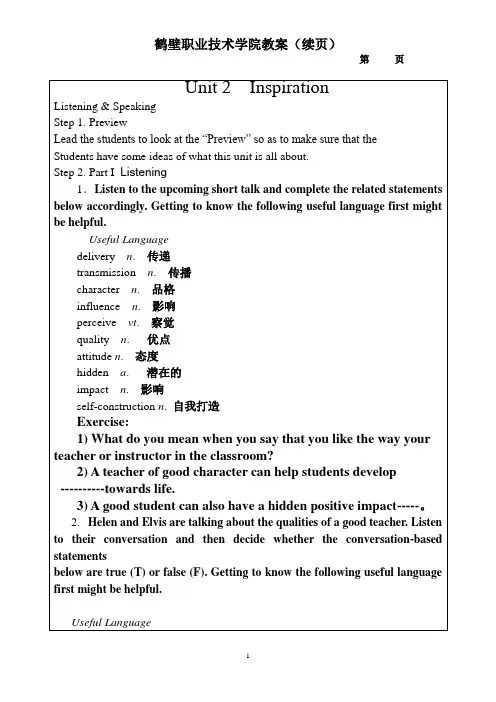
D) It is your own duty to learn.
4) What has Margaret come to understand?
A)What her teacher teaches.
B) Why her teacher is so popular.
C) How her teacher raises questions.
Helen: Actually, I think I have just met one. I tend to learn fast with him. I don’t know why I have betterconcentration andunderstand better in his classthan in others, but I do.
B)Students’positive learning.
C) Students’years of education.
D) Training for the real world.
2) How, according to Karen, does a good teacher build a good learning environment?
5.此外,marking his papers with a red pen, making bold X’s and then putting a big“F”at the top of his papers这三个动名词结构同属短语动词take delight in的宾语。F表示failure(不及格)。美国学校常用5个字母代表成绩等级,即A(优)、B(平均以上/良)、C(一般水平/中)、D(平均以下)和F(不及格)。
21世纪大学实用英语综合教程第二册第2单元

He was mistaken for the mayor of New York.
PREV.
NEXT
Topics for Discussion. 1. What do you think Mark Twain did after he knew that he was mistaken for
the mayor of New York? 2. Do you agree that the people in this story are mostly snobbish(势利的)?
He felt it was a heavy blow to his dignity. 4. Why did Mark Twain mention his name the second time he talked to the
local official? Because he wanted to take advantage of his fame to get onto the train.
BACK
NEXT
Paragraph Main Idea
2-5
Mark Twain was invited
by the conductor to get
onto the train.
Details
_A_y_o_u_n_g__p_o_rt_e_r_ whispered something to the conductor while _n_o_d_d_in_g__ towards Mark Twain. At once the conductor came to Mark Twain and invited him t_o_t_h_e__b_ig_f_a_m_i_ly__c_o_m_p_a_r_tm__e_n_t on the train.
21世纪大学英语S版综合教程第二册课件u

21世纪大学英语S版综合教程第二册课件课件概述本课件是21世纪大学英语S版综合教程第二册的教学课件,旨在帮助学生提高英语听说读写能力。
该课程涵盖了各种主题和语言技能,旨在培养学生的语言综合运用能力。
课件内容本课件分为以下几个单元,每个单元都包含了相关的主题和对应的语言技能训练。
Unit 1: My Daily Routine该单元主要介绍学生的日常生活,包括起床、吃早餐、上学等。
通过这个单元的学习,学生将能够描述他们的日常活动,并询问别人的日常活动。
课件内容:•词汇练习:学生将学习与日常活动相关的词汇,并进行练习;•句型训练:学生将学习描述自己和他人日常活动的句型,并进行相关句型训练;•对话练习:学生将通过对话练习,演练日常生活中的对话场景。
Unit 2: Jobs and Careers该单元主要介绍不同的职业和职业生涯规划。
通过这个单元的学习,学生将能够描述不同的职业,并探索自己的职业兴趣和目标。
课件内容:•词汇练习:学生将学习与职业相关的词汇,并进行练习;•句型训练:学生将学习描述职业和职业规划的句型,并进行相关句型训练;•情景模拟:学生将通过情景模拟,演练不同职业场景下的交流。
Unit 3: Travel and Adventure该单元主要介绍旅行和冒险的主题。
通过这个单元的学习,学生将能够描述旅行经历和冒险活动,并了解不同地方的文化和风俗习惯。
课件内容:•词汇练习:学生将学习与旅行和冒险相关的词汇,并进行练习;•句型训练:学生将学习描述旅行和冒险的句型,并进行相关句型训练;•地理知识:学生将了解不同地方的地理知识和文化背景。
Unit 4: Health and Fitness该单元主要介绍健康和健身的主题。
通过这个单元的学习,学生将能够谈论健康生活的重要性,以及如何保持身体健康和良好的体形。
课件内容:•词汇练习:学生将学习与健康和健身相关的词汇,并进行练习;•句型训练:学生将学习描述健康和健身的句型,并进行相关句型训练;•健身知识:学生将了解健身知识和保持健康的方法。
21世纪大学实用英语综合教程2 unit2 课件

the Listening and Speaking
section and invites a few students to tell their classmates their opinions on
PREV.
NEXT
Time
Contents
Plan
the topic of “Do college students handle well situations that need an apology?” Then,
Practical Writing
2) Practical Writing
The teacher tells as well as shows the students how to reply to an invitation by doing Ex.12 of
PREV.
NEXT
Time
Contents
Preview Ⅰ. Objectives Ⅱ. Suggested Teaching Plan Ⅲ. Background Information Ⅳ. Class Presentation
Preview
This unit looks at some human encounters. In the
2) Making and Responding to an Apology
21世纪大学实用英语综合教程2 unit2 课件
UNIT 2
Time
Contents
Plan
the topic of “Do college students handle well situations that need an apology?” Then, the teacher turns to the Reading and Writing section. (These activities should be completed in 15 minutes.)
PREV.
NEXT
UNIT 2
Time
Contents
Plan 3) Listening Practice Before ending, the teacher tells the students how to do Ex. 5-10 as their assignment. The teacher also tells them that they should be prepared to answer the questions in Ex. 9 and give an oral presentation on the topic in Ex.10 when next they come to class.
PREV.
NEXT
UNIT 2
Time
Contents
Plan G. Finally, study the structures presented in Ex. 4, and create situations for dialogues in which students blame someone for his/her mistake or fault and expect them to make both apologies and excuses with the help of the language they have picked up in Ex. 1 and the expressions from Ex. 4.
大学英语基础教程(北大修订版)教案第二册Unit Two
Unit TwoTeaching Objectives:By the end of this unit, the students will be expected to be able to1. talk about some results brought by TV and other useful and interesting communicative methods;2. use about 30 new words and 8 new phrases and expressions in brief conversations and translation;3. review grammar on the attributive clause:1) attributive clause with relative adverbs; 2) attributive clause with as/which;4. read material on a similar topic and with a similar degree of difficulty.Teaching Methods: Lecture, Discussion, Role-playUnit Duration: 8 class hours (45 minutes each)Teaching procedures:I. Preparatory1. Words and Phrases Learned In Display1. ignore syn. neglect; disregard2. argue syn. claim3. view syn. watch4. tolerate syn. permit; bear; suffer5. respond syn. reply; react6. reckon syn. regard; consider7. belong to 为……成员I belong to those who have decided to live without TV.8. switch on 开(电灯、电视、电器等)When my child switches on TV, he doesn't want to do anything else.9. tune in (to) 收听广播;收看电视What program do you usually tune in?10. be determined to do sth. 决心做某事,决定做某事My family was determined to stop watching TV.11. agree to 同意做某事,赞成My father agreed to give me a computer.12. take up 从事于,专注于We decided to take up other interesting activities to spend our holidays.13. be keen on 对某人或某事非常喜爱,热衷于做某事The old man was keen on playing with his grandson.2. Key to Expressions Learned in Display1. was determined to2. switched on3. agreed to4. belonged to5. keen on6.tunes in (to)7. take upII. Language in Context1. Preview Questionsi. Do you like watching TV? And what kind of TV programs do you usually watch? ii. If one day you don't watch TV any more, what else can you do?iii. What is your attitude towards TV?2. Information Related To the Texti. TelevisionTelevision is a telecommunication system for broadcasting and receiving moving pictures and sound over a distance. The term has come to refer to all the aspects of television programming and transmission as well. The word television is a hybrid word, coming from both Greek and Latin. “Tele-” is Greek for “far,” while “-vision” is from the Latin “visio,” meaning “vision” or “sight.” It is often abbreviated as TV.The earliest television sets were radios with the addition of a television device consisting of a neon tube with a mechanically spinning disk (the Nipkow disk, invented by Paul Gottlieb Nipkow) that produced a red postage-stamp size image. The first publicly broadcast electronic service was in Germany in March 1935. It had 180 lines of resolution and was only available in 22 public viewing rooms. One of the first major broadcasts involved the 1936 Berlin Olympics. The Germans had a 441-line system in the autumn of 1937.Television usage skyrocketed after World War II with war-related technological advances and additional disposable income. Prior to the war, in the 1930s, TV receivers cost the equivalent of US$7000 in 2001, and had little available programming.For many years different countries used different technical standards. France initially adopted the German 441-line standard but later upgraded to 819 lines, which gave the highest picture definition of any analogue TV system, approximately four times the resolution of the British 405-line system. Eventually the whole of Europe switched to the 625-line standard, once more following Germany’s example. Meanwhile in North America the original 525-line standard was retained.A television with a VHF “rabbit ears” antenna and a loop UHF antenna. Television in its original and still most popular form involves sending images and sound over radio waves in the VHF and UHF bands, which are received by a receiver (a television set). In this sense, it is an extension of radio. Broadcast television requires an antenna (aerial). This can be an external antenna mounted outside or smaller antennas mounted on or near the television. Typically this is an adjustable dipole antenna called “rabbit ears” for the VHF band and a small loop antenna for the UHF band.Color television became available in the U.S. on December 30 of 1953, backed by the Columbia Broadcasting System (CBS) network. The government approved the color broadcast system proposed by CBS, but when RCA came up with a subcarrier system that made it possible to view color broadcasts in black and white onunmodified old black and white TV sets, CBS dropped their own proposal and used the new one (see NTSC).The first publicly announced experimental TV broadcast of a program using RCA’s “compatible color” system wa s an episode of Kukla, Fran and Ollie on August 30, 1953. NBC was the first network to have a regularly scheduled color program on the air (Bonanza, started in 1959).Television was not invented by a single inventor, instead many people working together and alone, contributed to the evolution of TV.ii. Television JunkiesJunkie is someone who is so ardently devoted to something that it resembles an addiction; “a golf addict;” “a car nut;” “a news junkie.” Television junkies refer to the people who are addicted to watching television without doing anything else. According to scientific research, the conditions of TV viewing cause a physiological high, much in the same way as all those other less socially acceptable forms of drug use.iii. CartoonA cartoon is a form of art with diverse origins and even more diverse modern meanings. In its historical original meaning, a cartoon is a full-size drawing made on paper as a study for a further artwork, such as a painting. However, cartoons were typically used in the production of frescoes in order to accurately link the component parts of the composition when painted onto newly applied fresh plaster over a series of days. Cartoons by painters such as Raphael and Leonardo da Vinci are highly prized in their own right.Nowadays a cartoon is a humorous drawing of some description. This usage dates from the 1840s when Punch magazine applied the terms to satirical drawings in its pages. The first of these parodied frescoes in the then-new Palace of Westminster. The original title for such drawings in Punch was Mr Punch’s Pencillings and the title “cartoon” was intended to be ironic—these were still essentially line-art drawings in pencil and/or ink.Over time, more cartoons in Punch made other satirical points and, eventually, came merely to be humorous drawings, usually (although not always) with a punchline caption at the bottom. Many early examples of these are reproduced on the Punch website and are impenetrably obscure by today’s standards.The modern understanding of “cartoon” falls into two further categories—comic strips and animated cartoons.Comic strips are found daily in newspapers worldwide and are frequently compiled into books. Animated cartoons are usually shown on television or cinema screens and are created by drawing thousands of individual drawings which are shown rapidly in succession to give the impression of movement.3. Language Points1. I belong to one of the two per cent of British families who have decided to live without a television set.belong to1) be a member of 为……成员Which party do you belong to?你属于哪一个党派?I belong to the music club on our campus.我是校园音乐俱乐部的成员。
21世纪大学实用英语视听说2
21世纪大学实用英语视听说教程(第二册教案)21 Century Pratical College English Viewing, Listening & Speaking(Book TWO)李蔚郑州旅游职业学院旅游外语系Unit 1 Expressing Surprise at Meeting Someone Unexpectedly Teaching Contents: Unit OneTeaching objectives1. Understand and use the language for expressing surprise at unexpectedly meetingsomeone they know.2. Appreciate the rich variety of expressions used in such satiations.3. Learn how to speak on a specific topic using these newly-acquired expressions.4. Focus on monetary units when listening.Teaching Important and Difficult points1. How to express Surprise at Meeting Someone Unexpectedly2. To increase the familiarity and use of the expressions in the listeningcomprehension.Teaching MethodsVideo watching; listening practice; dialogue practicing in groups of three or four; group discussionTime AllotmentTwo PeriodsTeaching ProceduresStep I Lead- inWe live in a small world. Wherever you go, it is likely that we will unexpectedly meet someone we know. At such moments, we express surprise at suddenly meeting the person. What do we say in English to express this feeling? In this unit we’ll learn expressions useful for communicating surprise in unexpected situations.Step II Learning Video Episode: What a Surprise Meeting You Here!1.Show a picture from the Video Episode for the students to think and discuss thefollowing questions:1)What do you say in English when you unexpectedly run into someone you know?2)Are there any differences between native English-speaking cultures and Chineseculture when expressing surprise at unexpectedly running into someone you know?3)How would you act out such differences?2.Ask the students to listen to 7 sentences which are used to express surprise atunexpectedly meeting someone and complete each one with the missing words.1) What a surprise meeting you here!2) Fancy meeting you here!3) Never thought I’d see you here!4) Where’ve you been hiding yourself?5) What have you been up to?6) Certainly didn’t expect I’d run into you here!7) Certainly had no idea I’d meet you here!3. Words and expressions concerning this Video Episode:explore / historic town / You’re great! / mountain bike / You’re on (= absolutely I agree ) / hide / Good for you! / You bet (= You’re on ) / give it a try4. Play the video for the students to watch and answer the questions on Page 4 to Page6.5.Let the students watch the video and do Shelley’s voice, Michael’s voice respectively to practice the conversation in the video episode.6. Choose some students to do all the voices for the whole conversation.Step III. Intensive Listening1. Play the video for the students to listen and complete all the exercises in Listening Focus on Page8, Page 9 and Page 10.2. Play the video for the students to listen to the five mini-dialogues and answer the questions on Page10-11.3. Play the video for the students to listen to the conversation Lunchtime and complete all the exercises on Page12 and Page13.4. Play the video for the students to listen to the passage The Most Beautiful Thing and complete all the exercises on Page13 and Page 14.Step IV. DiscussionAsk the students work in pairs to discuss how to express surprise at unexpectedly meeting someone they know.Step V. Homework1.Practice the conversation in the video episode.2.Memorize the seven useful expressions on Page 2.Step VI. SummarySummarize the main points covered in this unit, remind the students of these useful expressions for expressing surprise at meeting someone unexpectedly.Unit 2 Stating That You Have Been BusyTeaching Contents: Unit 2Teaching objectives1.Understand and use the language fro stating that you have been busy.2.Appreciate the rich variety of expressions that indicate just how busy you have been.3.Learn how to speak on a specific topic using these newly-acquired expressions.4.Focus on time units when listening.Teaching Important and Difficult points1. Appreciate the rich variety of expressions that indicate just how busy you havebeen.2. To increase the familiarity and use of the expressions in the listeningcomprehension.3. Time units in intensive listening.Teaching MethodsVideo watching; listening practice; dialogue practicing in groups of three or four; group discussionTime AllotmentTwo PeriodsTeaching ProceduresStep I Lead- inWe are growing more time-conscious because we are living at a faster pace. It seems, however, that the more time we save, the more things we do. We are generally rushed, acting hastily, and losing our sense of control. V oicing such feelings of being too busy, even overwhelmed, occur regularly in our daily conversations. There are many expressions in English that communicate these feelings. Let’s learn some useful expressions in this unit that convey just how busy we feel.Step II Learning Video Episode: I Don’t Even Have Time to Breathe!1.Ask the students to think and discuss the following questions:1)What do you say in English when you have been very busy?2)Do you other expressions that express the same thing?2. Ask the students to pick out sentences that emphasize just how busy one is from among the 10 expressions.1) Keeping myself busy. ( √ )2) That’s what I want to say. ( )3) Not a moment to spare. (√ )4) I don’t even have time to breath e. (√ )5) Everything’s going my way. ( )6) Ah, that explains why you’re so late. ( )7) There aren’t enough hours in the day. (√ )8) I’m snowed under. (√ )9) I’m sorry I have to run off. ( )10) I’m looking forward to it. ( )3. Words and expressions concerning this Video Episode:spare / breathe / course / I must say… / demanding / up to the ears / final / instructor / teams / oops4. Play the video for the students to watch and answer the questions on Page 23 to Page24.5.Let the students watc h the video and do Shelley’s voice, Michael’s voice respectively to practise the conversation in the video episode.6. Choose some students to do all the voices for the whole conversation.Step III. Intensive Listening1. Play the video for the students to listen and complete all the exercises in Listening Focus on Page27 and Page28.2. Play the video for the students to listen to the five mini-dialogues and answer the questions on Page29-30.3. Play the video for the students to listen to the conversation Being a Teacher and complete all the exercises on Page30 and Page31.4. Play the video for the students to listen to the passage You Were the Closet and complete all the exercises on Page32.Step IV. DiscussionDiscuss the meaning or significance of the next two expressions:1)One thing at a time.2)Easy does it.Step V. Homework1)Practice the conversation in the video episode.2)Memorize the seven useful expressions on Page 26.Step VI. SummarySummarize the main points covered in this unit, remind the students of these useful expressions for expressing one is busy.Unit 3 Expressing personal interestsTeaching Contents: Unit 3Teaching objectives1. Understand and use the language for expressing personal interests.2. Respond appreciatively to the questions about one`s personal interests.3. Learn how to speak on a specific topic using these newly-acqired expressions.4. Focus on measurements when listening.Teaching Important and Difficult points1. How to express personal interests2.To increase the familiarity and use of the expressions in the listeningcomprehension.3. Measurements in intensive listeningTeaching MethodsVideo watching; listening practice; dialogue practicing in groups of three or four; group discussionTime AllotmentTwo PeriodsTeaching ProceduresStep I Lead- inEverybody has personal interests. Indeed, it is difficult to think of a person who might live a meaningful life with no personal interests. People enjoy talking about their personal interests in their conversations with others. This activity occurs in all cultures of the world. Thus, to learn how to express personal interests is part of learning English as a foreign language. Let’s learn some useful expressions in this unit for talking about one’s pe rsonal interests.Step II Learning Video Episode: I`m More Interested in Outdoor Activities! 1.Ask the students to think and discuss the following questions:1)What is the most popular thing that people are doing today? Are you interested init?2)What do you like or enjoy doing on weekends?3)What do you dislike or avoid doing in your spare time?2.Ask the students to identify the topic of each of the following sentences, and insertthe corresponding letter in the brackets.A.Asking about Personal InterestsB.Stating LikesC.Stating DislikesD.Expressing Preference1)I am crazy about her. ( B )2)Are you into cartoons? ( A )3)I am not fond of eating meat. ( C )4)I can’t stand fast food / waiting in line. ( C )5)I like pizza / going Dutch better. ( D )6)I prefer a quiet room / studying in groups. ( D )7)I am sick and tired of the same food every day. ( C )8)I’m rather / quite keen on travel / making friends. ( D )9)Do you have much interest in sports / watching sports? ( A )10)Are you interested in action movies / going to the movies? ( A )11)I’m not over / particularly keen on Mongolian hot pot. ( C )12)I really like gadgets / chatting online. ( B )13)I’m rather more interested in a big company / working alone. ( D )14)Do you happen to have much interest in outing/ going online? ( A )15)I tend to prefer / be rather more interested in a challenging job / starting a newbusiness. ( D )16)I find the film / idea/ weather / lecture pretty good / really fantastic / rather terrible/ quite enjoyable / extremely interesting. ( B )3. Words and expressions concerning this Video Episode:on a health kick / work out / That’s for sure. / aerobics / muscle buildup / treadmill / try out / strengthen / tone / favorite4. Play the video for the students to watch and answer the questions on Page 41 to Page43.5.Let the students watch the video and do Shelley’s voice, Michael’s voice respectively to practise the conversation in the video episode.6. Choose some students to do all the voices for the whole conversation.Step III. Intensive Listening1. Play the video for the students to listen and complete all the exercises in Listening Focus on Page47, Page 48 and Page49.2. Play the video for the students to listen to the five mini-dialogues and answer the questions on Page49 and Page50.3. Play the video for the students to listen to the conversation Getting to Know About Being a Waitress and complete all the exercises on Page50 and Page51.4. Play the video for the students to listen to the passage How to Become Rich and complete all the exercises on Page52.Step IV. DiscussionAsk the students to discuss their hobbies and their attitude towards hobbies in general. Step V. Homework1. Practice Mini-dialogues on Page47 after class by employing useful expressions learned in this unit.2. Familiarize themselves with the short responses to questions asking about personal interests, likes, dislikes and preferences on Page 45.Step VI. SummarySummarize the main points covered in this unit, remind the students of these useful expressions about one’s pers onal interests.Unit 4 Stating that you understand and making sure you are understood Teaching Contents: Unit FourTeaching objectives1. Appreciate the importance of stating that you understand and make sure you areunderstood.2. Comprehend and use the language associated with talking about something andensuring you are understood about something.3. Learn how to speak on a specific topic using these newly-acquired expressions.4. Focus on decimals when listening.Teaching Important and Difficult points1. How to state that you understand and make sure you are understood2. To increase the familiarity and use of the expressions in the listening comprehension.3. Decimals in intensive listening.Teaching MethodsVideo watching; listening practice; dialogue practicing in groups of three or four; group discussionTime AllotmentTwo PeriodsTeaching ProceduresStep I Lead- inMisunderstandings often occur between people. To avoid them, in conversations we regularly tend to affirm when we understand, and, when necessary, use language that confirms we have been understood. This is done constantly in English conversation, particularly if we do not want to misunderstand or be misunderstood. In this unit, let’s learn some useful expressions which affirm we understand something and confirm we have been understood about something.Step II Learning Video Episode: You Know What I Mean?1. Ask the students to think and discuss the following questions:1) What do you say if you want to state you understand something?2) What do you say if you want to make sure you are understood?2. Ask the students to identify the topic of each of the following sentences and then insert the corresponding letter in the brackets.A. Stating that You UnderstandB. Making Sure You Are Understood1) I get you point. (A )2) I can see that. (A )3) Do you get the message? (B )4) Do you see what I mean? (B )5) I see what you’re saying. (A )6) I hear what you’re saying. (A )7) Does that make any sense? (B )8) Do you know what I mean? (B )9) I know what you’re talking about. (A )10) Do you know what I’m talking about? (B )3. Words and expressions concerning this Video Episode:The sales are on / special offers / nothing in particular / good bargains / discount / wrought silk / 30% off / It takes a while. / temptation / credit card / a shopping spree 4. Play the video for the students to watch and answer the questions on Page 61 and Page62.5.Let the students watch the video and do Shelley’s voice, Michael’s voice respectively to practise the conversation in the video episode.6. Choose some students to do all the voices for the whole conversation.Step III. Intensive Listening1. Play the video for the students to listen and complete all the exercises in Listening Focus on Page66 and Page 67.2. Play the video for the students to listen to the five mini-dialogues and answer the questions on Page67 and Page 68.3. Play the video for the students to listen to the conversation Getting to Know About Being an Automobile Mechanic and complete all the exercises on Page69.4. Play the video for the students to listen to the passage I’m Not Taking Your Advice and complete all the exercises on Page70-71.Step IV. DiscussionAsk the students to discuss the topic What Can Cause A Breakdown In Communication in groups.Step V. Homework1. Ask the students to familiarize themselves with the expressions on Page 64 and Page 65.2. Practise the conversation in the Video Episode.Step VI. SummarySummarize the main points covered in this unit, remind the students of these useful expressions learned.Unit 5 Stating Your Agreement and ConcurrenceTeaching Contents: Unit FiveTeaching objectives1. Understand and use the language for stating agreement and concurrence;2. Ensure the students to learn how to speak on a specific topic using the newly-acquired expressions.Teaching Important and Difficult points1. Appreciate the rich variety of expressions that voice agreement and concurrence.2. Improve the students’ listening com prehension in general.Teaching MethodsVideo watching; listening practice; dialogue practicing in groups of three or four; group discussionTime AllotmentTwo PeriodsTeaching ProceduresStep I Lead- inYou cannot help making your response to an opinion or an attitude made by the speaker you are talking with; that’s the nature of conversation. Your quick response helps promote two-way communication. What will your response be if you agree with the speaker? Do you know what to say and how to say in English when you want to state your agreement and concurrence? Let’s learn some useful expressions in this unit to handle just such conversational situations successfully.Step II Learning Video Episode: What a Surprise Meeting You Here!1. Ask the students to think and discuss the following questions:1) When do people state their agreement or concurrence during a conversation?2) Do you know how to state your agreement or concurrence in different ways?2. Ask the students to complete the following sentences with the missing words while listening.1) I agree.2) You bet.3) Right on. / Right you are!4) You got it.5) You’re right.6) By all means.7) So it is.8) That’s true / right.9) That’s for certain / sure.10) I agree with you 100%.3. Words and expressions concerning this Video Episode:Mother’s Day / celebrate / I couldn’t agree with you more. / independent / tied to somebody’s apron strings / relax / honor / local / flower shop /virtue / respect /elder 4. Play the video for the students to watch and answer the questions on Page 79 to Page83.5.Let the students watch the video and do Shelley’s voice, Michael’s voicerespectively to practise the conversation in the video episode.6. Choose some students to do all the voices for the whole conversation.Step III. Intensive Listening1. Play the video for the students to listen and complete all the exercises in Listening Focus on Page 85.2. Play the video for the students to listen to the five mini-dialogues and answer the questions on Page85-86.3. Play the video for the students to listen to the conversation Planning a School Report and complete all the exercises on Page87.4. Play the video for the students to listen to the passage Mending the Doorbell and complete all the exercises on Page88-89.Step IV. DiscussionAsk the students to discuss the following topic in groups:What is usually said to elicit agreement or concurrence?Step V. HomeworkAsk the students to familiarize themselves with the expressions with which they can state agreement or concurrence on Page84.Step VI. SummarySummarize the main points covered in this unit, remind the students of these useful expressions for stating agreement or concurrence.Unit 6 Stating Your DisagreementTeaching Contents: Unit SixTeaching objectives1. Understand and use the language for stating disagreement;2. Learn how to speak on a specific topic using these newly-acquired expressions. Teaching Important and Difficult points1. How to state disagreement.2. To increase the familiarity and use of the expressions in the listeningcomprehension exercises.Teaching MethodsVideo watching; listening practice; dialogue practicing in groups of three or four; group discussionTime AllotmentTwo PeriodsTeaching ProceduresStep I Lead- inJust as you cannot help stating your agreement and concurrence, you will occasionally want to disagree with an opinion or an attitude voiced by the person you are talking with. Equally, you will want to express your disagreement in an argument or during a debate. What will your response be when you disagree with the speaker on these occasions? Do you know what to say and how to say it in English when you want to state your disagreement? Lets’ learn some useful expressions in this unit for voi cing disagreement.Step II Learning Video Episode: I Don’t Buy that Story at All!1. Ask the students to think and discuss the following questions:1) On what topics do people tend to state their disagreement? And why?2) Do you know appropriate ways to state your disagreement in English?2. Ask the students to listen and fill in the blanks of the following sentences with the missing words.Stating Simple Disagreement1) No.2) Nope.3) Uh-uh.4) You’re off.5) Not so.6) I don’t think so.Stating Strong Disagreement1) That’s not true / right.2) You’ve got that / it wrong.3) You’ve got it all wrong.4) Wrong!5) You couldn’t be more off-base.6) No way.7) Not a chance.Stating Categorical Disagreement1) I completely disagree.2) I couldn’t disagree w ith you more.3) Lies!4) That’s a lie.5) That’s a big, fat lie.6) Horse feathers!7) That’s a lot of baloney!8) You’re dead wrong.3. Words and expressions concerning this Video Episode:I’d rather do something. / uh-uh / skip / protein / nutrient / deadline / reduce/ tolerance / vitamin pills / make up for / deficiency / I don’t buy the story. / overdose / harmful / balanced4. Play the video for the students to watch and answer the questions on Page 98 to Page100.5.Let the students watch the video and do Shelley’s voice, Michael’s voice respectively to practise the conversation in the video episode.6. Choose some students to do all the voices for the whole conversation.Step III. Intensive Listening1. Play the video for the students to listen and complete all the exercises in Listening Focus on Page102 Page 103.2. Play the video for the students to listen to the five mini-dialogues and answer the questions on Page103.3. Play the video for the students to listen to the conversation Planning a Trip and complete all the exercises on Page104 and Page105.4. Play the video for the students to listen to the passage Which Tire Was Flat? and complete all the exercises on Page106.Step IV. DiscussionAsk the students to discuss the following topic in groups:Do college students have a right to get married?Step V. HomeworkAsk the students to make a list of the expressions they have learned and use them to state disagreement.Step VI. SummarySummarize the main points covered in this unit, remind the students of these useful expressions for stating disagreement.Unit 7 Expressing Acceptance or RefusalTeaching Contents: Unit SevenTeaching objectives1. Understand and use the language for accepting or refusing.2. Appreciate the rich variety of expressions used in such satiations.3. Learn how to speak on a specific topic using these newly-acquired expressions.4. Train the students to listen for both specific details and general ideas.Teaching Important and Difficult points1. Realize the importance of mastering the skill to express acceptance or refusal.2. To increase the familiarity and use of the expressions in the listeningcomprehension.Teaching MethodsVideo watching; listening practice; dialogue practicing in groups of three or four; group discussionTime AllotmentTwo PeriodsTeaching ProceduresStep I Lead- inWhat do you say in response to someone’s idea, suggestion, or plan? Your response will surely result in your acceptance or refusal. To express your acceptance or refusal is also a way of voicing your opinion on a certain subject. In general, people like it when you are direct. Do you know what to say and how to say it in English when you want to express acceptance or refusal? Let’s learn some useful expressions in this un it for you to use when you want to accept or reject a point of view, suggestion, plan of action, etc.Step II Learning Video Episode: I’m All for It!1. Ask the students to think and discuss the following questions:1) Can you imagine an important situation in which you would express acceptance or refusal? What would it be?2) Do you think that each situation calls for a particular way of expressing acceptance or refusal? Why?2. Ask the students to listen and fill in the blanks of the following sentences which are different ways to express acceptance or refusal.Expressing Acceptance1) It’s / That’s true.2) It’s / That’s good enough.3) It’s / That’s satisfactory.4) It’ll / That’ll do.5) It’ll / That’ll serve the purpose.6) I think it’s / that’s gre at.7) It’s / That’s ideal / perfect.8) I’m all for it!9) This is second to none.10) This is far and away the best!11) Couldn’t be better!12) I’ve never seen anything like this!13) That’s just what I needed!14) It gets two thumbs up.Expressing Refusal1) No way.2) Not a chance.3) Couldn’t be more off.4) You are out of luck.5) Not likely.6) Absolutely not!7) Forget it.8) Save your breath.9) When pigs fly.10) When hell freezes over.11) Only in your dreams!12) Not in your wildest dreams!13) Not in a million years!14) You’re barking up the wrong tree.3. Words and expressions concerning this Video Episode:assignment / come along / online / browse the Net / come up with / joint task / teamwork / Give me a break! / Save your breath. / topic / What’s the rush?4. Play the video for the students to watch and answer the questions on Page 114 to Page117.5.Let the students watch the video and do Shelley’s voice, Michael’s voice respectively to practise the conversation in the video episode.6. Choose some students to do all the voices for the whole conversation.Step III. Intensive Listening1. Play the video for the students to listen and complete all the exercises in Listening Focus on Page121 Page 122.2. Play the video for the students to listen to the five mini-dialogues and answer the questions on Page122-123.3. Play the video for the students to listen to the conversation A Surprise and complete all the exercises on Page125.4. Play the video for the students to listen to the passage Ground Rules and complete all the exercises on Page 125-126.Step IV. DiscussionAsk the students to discuss the following topic in groups:Flattery will get you nowhere.Step V. HomeworkAssign the first task in After Watching on Page118 as homework for the students to complete.Step VI. SummarySummarize the main points covered in this unit, remind the students of these usefulexpressions for expressing acceptance or refusal.Unit 8 Ask Someone to Get to the Point and Speak PlainlyTeaching Contents: Unit EightTeaching objectives1. Understand and use the language for requesting someone to get to the point andencourage someone to speak plainly.2. Appreciate the rich variety of expressions used to request or encourage others to speak clearly and directly.3. Learn how to speak on a specific topic using these newly-acquired expressions.4. Focus on implicit meanings when listening.Teaching Important and Difficult points1. How to request or encourage others to speak plainly.2. Improve the student s’ listening comprehension.Teaching MethodsVideo watching; listening practice; dialogue practicing in groups of three or four; group discussionTime AllotmentTwo PeriodsTeaching ProceduresStep I Lead- inHow do you feel about someone who beats around the bush? You must be direct when you request that person to get to the point and encourage him or her to speak plainly. We exercise this communicative skill both in formal meetings and during small talks. Do you know what to say and how to say it in English when you want to request that someone get to the point or when you want to encourage someone to speak plainly? Let’s learn some useful expressions in this unit that will help you get others to talk straight to you.Step II Learning Video Episode: Get to the Point!1. Ask the students to think and discuss the following questions:1) Do you know what to say in English when you want the speaker to get quickly to the most important issue, focus on the heart of the matter, or reach the central question or fact? What do you say?2) Do you know the different English expressions used to encourage someone to speak plainly? What are they?2. Ask the students to read each of the following expressions and decide whether it is used to request the speaker to get to the point or to encourage someone to speak more plainly.A. Requesting the Speaker to Get to the PointB. Encouraging Someone to Speak Plainly1) Out with it! (B )2) Get to the point. (A )3) Don’t mince words. (B )4) Give it to me straight. (B )。
21世纪大学实用英语综合教育教案第二册课后规范标准答案
Unit1.Listening & Speaking1, what has been said, mentioned earlier, two-way interaction, a breakdown, even confusion, a native speaker, going on3,1), be fun, I don’t think, it depends, What’s that, what you mean, got it, what would you say;Tom Chang.It depends.He’ll tell them a little white lie.It’s an innocent social fib or excuse.Not mentioned.2), serious hearing problems, to hear 100%, is perfect, hear again, listen to the conversations, three times;What did you say? Would you speak louder please?No. I’ve been having serious hearing problems for years. I can’t hear people well. That’s why I’m here.What do you mean by hearing aid? What’s that?Oh, I haven’t told my family yet. I just sit around and listen to the conversations.You know what? I’ve changed my will three times!5, BADCA6, DACCB7, FTTFF8, complaining about, does everything, every 10 hours, every 2 hours, every 24 hours, in one hour, damn near, from down the hall, I just realized9, They are talking about Nurse Nancy.Because she did everything absolutely backwards.1)One doctor told her to give a patient 2 milligrams ofmorphine every 10 hours. She gave him 10 milligrams every 2 hours.2)The other doctor told her to give a petient an enema every 24 hours. She tried to give him 24 enemas in one hour.They heard a blood-curdling scream from down the hall.She was boiling a patient.Text A5/ 1.passengers 2.immediately 3.similar 4.wond er 5.continent 6.traffic 7.misunderstanding 8.e mbarrassed 9.flights mon 11.serious 12. searched6/ 1.got on 2.head for 3.on the shoulder 4.pull over 5.resulted in 6.feel like 7.By the time 8.turn out all right 9.in the end 10.instead of71. By the time I got home, I was too tired to do anything active.2. The two girls look too similar for people outside the family to tell them apart from each other.3. What in the world does mm stand for? The abbreviations that people use on the BBS are too confusing for me to understand.4. Because of TV, most people have become too lazy to make the effort to go to the cinema.5. Anne made a serious mistake yesterday because the test gave her too little time to decide on the correct choice.81. until I have really learnt the basics of the language.2. until the end of the book3. until they have finished their speeches4. until my teacher explained them in class with several examples5. until I saw Sam Ward leave the building6. until he got on a city bus91. Because of the heavy snow, the passengers had to wait at the airport until midnight when the snow stopped.2. Twenty minutes after the train started, the two boys found that they had got on a train heading for Hangzhou instead of their hometown, Suzhoul.3. Similar-sounding English words often result in misunderstandings among English-speaking people.4. The driver heard an unusual sound from the car engine, so he pulled over immediately to check, but it turned out all right in the end.5. Mr. Lee felt very embarrassed when he realized that he had made a very common mistake among speakers of English as a second language.6. Mary felt like learning English and hoped she could learn it quickly, but soon found it was too difficult for her to learn in a short period of time.101. giving us heat and light2. ranging in age from 4 to 163. Being invited to speak here4. your encouraging words5. sitting between Mary and Tom6. leaving today’s work for Tomorrow7. playing in the playground8. taking a break9. leaving me alone10. taking mechanical things apart111. Mr. LiXinyang, the president of Nanjing Technical College.2. To celebrate the tenth anniversary of the founding of Nanjing Technical College.3. At the Guest Center of NTC.4. On July2, 2004 from 12:30 to 13:30 p.m.5. On Wednesday, may12, 2004.6. To celebrate Mr. David Brown’s retirement from McMillan Investment Company.7. At the Grand Hall.12Dear WuJi,You are invited to attend a graduation party at my house on Sunday, June27. The party will startimmediately after our graduation ceremony, at about 4:00. Your parents and friends are welcome, too.I do hope you can come.Sincerely,WangJunText B141. mysteries2. mysterious3. meanings4. stared5. estimate6. imagined7. figured8. board9. pronounce10. weighed11. presented12. object151. Take a look2. get right3. objected to4. at least5. makes no sense6. beside himself7. dawn on8. think ofText C16/ 1.A 2.C 3.C 4.A 5.D 6.D 7.C17/ 1.B 2.C 3.A 4.D 5.CUnit 2Listening & speaking1.in some way, when this occurs, do so, in a polite way, in society, my interrupting you, being late, step on you,forgotten your name, what I have said, forgotten your birthday, the delay, hurt your feelings.3. what happened, calling you, any reason, an interesting lecture, turn it off, reach me, I’m terribly sorry, excuse me, make up for, stop it, the saying.Because she couldn’t reach LiMing on the cell phone.It was WangYing’s birthday.Because he was attending a lecture.He was sorry for forgetting WangYing’s birthday.She said that she could understand.at the airport, a window seat, an aisle seat, a 20-minute delay, in about half an hour, baggage claim checks.Okay.Make it a window seat, but if there aren’t any left, I’ll take an aisle seat.I sure hope that’s the only delay. Oh, where are my baggage claim checks?Great! Uh, thanks a lot.5. CADAB6. CABDC7. TTFFT8. in a loud voice, particularly interesting, in the same room, in curing them, left alone, had a talk, suffering from a delusion, who are you?9. He announced that he was the famous British naval hero, Lord Nelson.He decided to put the two men in the same room.No disturbance was heard from the room that night.He had a talk with the new inmate.He said that he had been suffering from a delusion and he was not Lord Nelson, but Lady Nelson.Text A5/ 1.bother bother panion 3.Shame 4.off icials 5.notice 6.recognized 7.vacant 8.scene 9 .politely 10.describe6/ 1.cut short 2.at the disposal 3.at the sametime 4.in face 5.turn your back on 6.a coupleof 7.turned inside out 8.Look around71. must have seen the tickets for tonight’s play2. must have been here many times3. may have gone bad4. may not have received the present81. Nancy was glad to have quit her part-time job before her final exams.2. Aren’t you ashamed to have eaten all the fruit in the basket?3. We are really grateful to have received so much care during our visits here.4. Henry was foolish to have trusted such a liar.1. The public noticed that since that local official left, his position had been vacant for a couple of months.2. Seeing the girl looking around helplessly on the platform, the young porter asked politely if she needed any help.3. I recognized your companion the minute he appeared at the door. He looked just as you had described.4. We didn’t bother to find a hotel, for my good friend invited us to stay in her house and put a luxurious car at our disposal.5. While the professor was turning the suitcases inside out to find his glasses, his wife was sitting comfortably in an armchair watching the whole scene.6. I turned my back on her because she expected me to treat her like a queen.1. seeing a doctor as soon as possible2. working for another hour3. buying a new car4. going to the cinema5. having been to New York6. quitting my job7. speaking it8. being recognized9. spending all that money10. losing my job11kind invitation, will be pleased to attend, be held at the Holiday Inn, they are unable to attend due to a previous engagement.12An informal letter of acceptance:June24, 2004Dear WangJun,After graduation is a great time to have a party. Being at your house is always lots of fun. My boyfriend, Tom, will be coming, too.Thanks for the invitation.Best,WuJiAn informal letter of refusal:June24, 2004Dear WangJun,I wish I could attend your graduation party. I know it will be lots of fun. Unfortunately, my parents have already invited some of our relatives over for a celebration. I wonder if you could come by on Mondayeverning so you can tell me all about the party. Let me know if you can.Best,WuJiText B14/ 1.automatic 2.apologize 3.situation 4.sort 5.arises 6.impatient 7.responsing 8.rushed 9.cus tomers 10.relations15/ 1.for free 2.get the bestof 3.see through 4.in sight 5.be delt with 6.in reply to 7.flooded into8.give awayText C16/ 1.B 2.D 3.B 4.C 5.A 6.D 7.D17/ 1.A 2.C 3.D 4.B 5.BUnit 3,Listening & Speaking1,have decided to do? a driving force, without a firm belief, a certain degree of optimism, improve yourchances, move to Shanghai, do it right now, find a part-time job, taking TOEFL, change my plan, going abroad for further studies, achieving my goal, my success, win, make a success of the plan, everything will be fine, the results, my promotion, OK.3,1), as your second foreigh language? out of the question, at the same time, learning Japanese, smell the flowers, the more chances, I’m very optimistic about, working hard on it.She’s decided to study Japanese as her second foreigh language.It’s impossible to manage two foreigh languages at the same time.He asks her not to work so hard.It’s so strong that nobody can change her mind.Yes. Because she has realized the importance of speaking more languages in this rapid-changing society.2), has set her mind, a little girl, going to college, how hard it is, make a success of her future career.Why? Because I’m blind? Michael, I’ve had my heart set on getting a college degree ever since I was a little girl. My blindness has never stopped me from going to college.Sure it is. But I’ve made a decision to give it a try no matter how hard it is. You know, I’ve always dreamed of going to college one way or another. Nothing can stop me from achieving my goal.Thanks. I’m sure I’ll make it. I’ve no doubt of my success. I don’t think you’d be any different.You bet. Nothing is impossible for a determined mind.5, BBCCBD6, CAADD7, FFTTT8, half full? Seeing the world, long-term successes, in color, the thoughts and opinions of others, an attitude of, constantly look to, more enjoyable.9, Is the glass half empty or half full?It can have a far-reaching influence on everything from our day-to-day lives and selections of mates, to our career choices and long-term successes.They think in color. They are open-minded to newideas and situations and enjoy the thoughts and opinions of others.They think that change is a good and necessary thing.They appreciate good feedback and take criticism with a grain of salt.Text A51. salesman2. mental3. taste4. failure5. challenge6. puzzle7. reasonable8. otherwise9. realistic10. level61. step by step2. have …in mind3. apply to4. move on to5. had come through6. built up7. concentrate on8. leading to71. That’s how he became a world-famous basketball star.2. that’s why you couldn’t sing a song.3. that’s when the trouble really began.4. That’s where I studied in my childhood.5. That’s what he should d now.81. If you ran as fast as you could, you would come first in the 100-meter dash.2. If she worked as hard as she could, she would catch up with her classmates.3. If you tried as hard as you could, you would overcome the difficulties.91. He has given up running in order to focus on the long jump.2. In his book I Can’t Accept Not Trying, Michael Jordan looks back on how he approached the challenges he faced.3. If you had tried as hard as you could, you would have long achieved your goal of becoming a starter on the varsity.4. Even if you fail the final examination, don’t get down on yourself, because you can take the examination again at the beginning of next term.5. If you ultimate goal is to become an English teacher, then the first thing you have to do is to learn English well.6. Not everyone is going to be world-famous. But if you have done your best, you can still be considered a success.101. smoking2. to stay3. to think4. to bring5. bursting6. buying7. to stay8. trying9. traveling10. meeting, seeing11Mr.Steve Anderson, General Manager.Brain wishes to go back home to spend Spring Festival with his family.January22, 2003.from January 25th to February 7th.WeiDaxing’s father is seriously ill and he wants to see him in the hospital.12June5, 2004Deat Mr. Smith,I’m sorry to tell you that I’m not feeling well today and had best not come to work. The doctor has told me that I have caught a bad cold and has advised me to stay in bed for a few days. Now I’m writing to ask for several sick leave days. I’ll come back to work as soon as I feel better.I appreciate your understanding.Yours truly,WangYingText B141. willing2. anxious3. definitely4. detail5. Furthermore6. partly7. type8. perform151. carried out2. looking forward to3. In most cases4. fell in love with5. Getting ahead6. contributed to7. stand out8. dedicated …toText C16/ 1.B 2.D 3.A 4.B 5.C 6.C 7.A 8.B171.disagree: dis + agree: not agree 不同意psychologist: psychology + ist: someone who is trained in psychology心理学家3.unconditional: un + conditional: not limited by or depending on any condition(s)无条件的4.postgraduate: post + graduate 研究生的5.modernize: modern + ize使现代化UNIT 4Listening & Speaking11.to knowa strong desire3.the unknown4.around us5.What’s going on6.global warming7.where human curiosity comes from8.this interesting fact9.how the law of gravity works10.the secretwhy people ehave this way12.the real reason behind this13.what’s in your mind14.how does it work3.11.understand this2.get its messageI’m most curious4.Do you happen to know5.trying to tell us6.the beauty7.so much curiosityAnswers to questions1.In an art gallery.2.They were talking about an impressionistic picture.She was keen to know about the meaning of the colors,dabs and strokes.4.He asked her to use her imagination.5.He said that she is an inquisitive person.3.21.the first time2.the exact fare3.a fare card4.how it worked on the businquisitive needs1.Excuse me. Do I have to pay the exact fare for the bus?2.What’s that?3.I wonder whether I can use it on the subway.4.This is my first time to visit the city of Shanghai.5.Thanks. I hope you don’t mind my asking, but how does the fare card work here on the bus?6.Yes.7.Thank you.1.C2.A3.C4.D5.B61.D2.C3.A4.B5.B 71.T2.T3.F5.T81.as we do2.they cannot tell us3.get the answer4.by their color5.in front of a red card6.tell colors apart7.were found outas a color9.for human beings91.They tried to find out whether animals can see color.2.Because they were curious to know whether bees tell flowers apart by their color.3.They put a bit of syrup in front of a blue card, and no syrup in front of a red card.4.The bees would come to the blue card, no matter where it was placed, even if it had no syrup in front of it.Bees don’t see color as we do.Text A51.enables2.arguing3.comments4.despite5.planetpretending7.cruel8.pollutted9. particularly10.freedom61.have no use forplaying with3.dwell on4.get together5.on behalf of6.on earth7What do you guess has made him change his mind?2.Who do you guess is the winner of the speech contest?3.When do you suppose the results of the exam will come out?4.Where do you imagine they spent their vacation?81.I don’t think he will agree with us.I don’t think Alice can understand such a difficult question.3.I don’t think you are taller than your brother.4.I don’t think they have made up their minds.91.This report dwells on how some species were exterminated because of the polluted environment.2.To tell the truth, I think a snide comment made out of prejudice is better than faked praise given by a hypocrite.Mary countered the manager on behalf of all the employees by arguing that it’s cruel to limit the employees freedom and it will eventually affect the company’s reputation.4.What on earth has enabled some people, particularly certain high officials, to abuse their powers despite the law?5.I don’t think success is merely related to intelligence. In fact, many good qualities, such as innocence, honesty, humor and loyalty, can help us succeed, too.6.Strangely enough, the joke did not bring about hearty laughter, not even a hint of any. Could it be that the audience was pretending to be serious?GRAMMAR REVIEW101.John isn’t here. Try phoning his home number to see if he’s there.2.Walking along the street, he stopped to take a picture.3.I forgot to ask him for his address.4.We regret to inform you the model you want is out of stock.5.They tried to pass the exam.6.I remember turning the lights off before we came out.I’ll never forget hearing this piece of music when I was lonely.8.I regret giving up the job.9.I stopped eating chocolate last year.10.She first told us her plan and then went on to tell us how she would carry it out.Pratcical Writing(写作):11Charles2.Dryden3.reduced4.051-4488-2279121.Peter2.Gerald3.Jim rang about the training course you are interested in. It’s called “Managing People”and the next oneis on July 13th. If you’re interested, call Joanna Little at 032-4388-7762.TEXT B141.amazing2.disappoint3.suspicious4.Scientistsreasoning6. replaced7.signal8. suspect9.was divided10. intelligent151.lost interest2.tell time3. disagree with4.before long5.lined up6.No doubt7.make sure8.why notTEXT CSuggested Answers to the Questions in Text CPassenger Pigeons1. They looked attractive with a blue back and a pink breast.2. Over 300 million birds an hour.3. They lived throughout Eastern North America and they ate acorns and beechnuts.4. They were suffocated; fed grain soaked in alcohol; beaten down with long sticks,killed with shotguns, caught in nets or trapped with a stool pigeon.Great Auk1. The Great Auk looked like the penguin.2. They lived in the North Atlantic.3. Between 1785 and 1844.4. They were hunted mainly for their feathers which were used for mattress andpillow stuffing.5. Two fishermen.11.C2.B3.D4.D5.A6.C17.1,Main Idea: Clever Hans proved to be an excellent student.Example 1: Facing his teacher, he would stand quietly during each lesson.。