
高一英语人教版必修1 Unit 1 Friendship 教学设计
高一英语人教版必修1 Unit 1 Friendship 教学设计人教版必修一 Unit 1 Friendship教学设计一、教材内容分析本单元是高中一年级的第一单元,刚开学没多久,大家相互之间还不是很熟识,需要了解、沟通,友谊是他们生活当中必不可少的,他们每个人对友谊的认识不同,见解不一。
1.本节课的Warming up 我采用情景描述法,让学生自己用几个单词描述自己心目中的朋友或写下朋友的三个特征,让其他学生猜猜他描述的是班上哪个人。
并把相关的词汇、句型写在黑板上,有利于词汇的积累。
第一种方法适合基础差的学生,第二种方法适合成绩好的学生。
2.在导入的时候我采用提问法,激起学生思考(1)Which kind of friend do you think is the best friend? (2)What else can be our friends besides human beings?对于第一个问题每个学生的答案不同,但有一个共识:患难见真情,他们需要的是永久的友谊而不是由于利益关系等短暂的友谊。
第二个问题,一般很少有学生把人类以外的事物当成最好的朋友,有个别的把宠物当成好朋友。
3.快速阅读:弄懂文章大意4.细读:弄清细节,找出生词、难句并完成课后的练习1、2。
5.精读:讲解新单词、有用的短语、句型,并让学生自己举例应用。
6.深入了解文章的思想、写作风格并提出相关问题。
(1).What's the advantages and disadvantages of the diary as a friend?(2).Why did Anne say that she had seen the night face to face on the dark, rainy evening?7.讨论如下问题:Ask students if they are only allowed to have five things with you in the hiding place because there is very little room, what would they choose?8.课后练习Can you give us some background knowledge of World War and some historical material of Jews? You may use the library or the Internet.二、学生分析高中一年级的形式已经在初中阶段的英语学习中,已经积累了一定的词汇基础,并掌握了一些简单的学习策略和技巧,具有初步的英语听说读写能力。
这个班的英语水平参差不齐,教学既要进一步培养尖子的学习能力又要保证差生能听懂,调动他们的积极性,使他们愿意学,在学习的过程中享受到乐趣。
他们已具备了直接思维和抽象思维的能力,正处于发展、培养创造性思维能力的最佳时期和智力向高水平发展的关键时期,他们有极强的好奇心和求知欲。
他们对老师的期望也大大提高,不仅希望老师传授科学文化知识,更期望从老师那里获得更多的学习策略与技巧,分享人生经验。
三、教学目标1.语言知识目标通过对朋友的讨论,帮助学生发散式记忆积累相关描述人的性格、特征的词汇、习惯用语,并运用于听说读写当中。
适当运用I thank so. I agree. I don' think so .I don't agree exactly. I am afraid not .Of course not.表明自己的态度和肯定程度。
2.语言技能目标培养和提高阅读(浏览、寻读主要事实)的能力,形成用英语获取信息、处理信息分析问题、解决问题的能力,以及用英语思维和表达相关话题,复述课文及运用所学知识描述朋友的能力。
3.文化意识目标通过与话题相关的图片、课文的学习,逐渐形成跨文化交际意识和培养基本的跨文化的交际能力,拓宽国际视野,理解各国的文化,进行反法西斯教育,为以后深入学习中外文化奠定基础。
4.情感态度目标通过讨论友谊激发学生保持对英语学习的浓厚兴趣;有利与帮助他们树立正确的人生观、价值观;通过对课文学习的小组讨论等形式,帮助学生养成团结、协作的品质。
5.学习策略目标注重引导学生借助上下文联想及猜测生词,如set down a series of facts 记流水账的意思,引导学生自学、自做、自悟,即指导学生形成自主学习的意识,掌握合适的学习策略。
启发学生通过发散式思维积累词汇;指导学生发现规律,对所学内容进行整理和归纳;引导学生抓住信息词或关键词来理清段落大意。
另外,引导学有余力的学生通过网络、图书馆来拓宽学习中外文化的渠道,并在学习活动中强化互助与共享的必要性。
四、教学策略1.努力创设情境的原则让学生想象自己待在一个隐蔽的地方,允许只能做的五件事,他们如何选择将学生直接带入课文的语境中。
2.任务驱动的原则让学生带着问题去阅读,找出相关答案,并分析整理形成自己的观点。
3.交际法教学在Warming up,让学生自己用几个单词描述自己心目中的朋友或写下朋友的三个特征,让其他学生猜猜他描述的是班上哪个人,体现了交际的功能。
五、设计思想根据《高中英语教学大纲》的要求,在课堂教学中,必须以学生为主体,为中心进行教学,教师在教学中起主导作用。
因此我采用任务型教学方式,每一部分都设有一定的任务,引导学生自主或者合作完成。
阅读活动由整体入手,由易到难,步步推进,层层深入。
整个教学活动以教材为载体,以学生为中心。
在课堂教学中,学生应该跟老师学学习方法,提高阅读速度和阅读技巧,查找﹑分析﹑处理信息的能力以及写作能力。
积极参与小组的各项活动,展现自己和小组的能力,并培养团队协作能力。
在整个教学活动中,学生充分调动其各个感官进行听、说、读、写,积极主动的学习。
六、教学媒体1. the multimedia teaching system2. the blackboard七、教学过程Unit 1 FriendshipTeaching approaches: situational approaches, communicative approaches and task-based approachesLearning objectives and demands:1. The activity is designed to encourage students to think about friends and friendship and to activate relevant vocabulary.2. Ask the students to describe a good friend and give examples of situations where friends have helped them. Use the activity as a brainstorming session done either in groups or with the whole class.3. Language use: speaking practice: readingTeaching procedures:Step 1. Warming upStudents are asked to describe themselves and a friend. You can use these questions in at least two different ways. One alternative is to ask the students to think about three words to describe themselves and then let each student tell the class the three characteristics they have chosen. A second alternative would be to ask the students to write down the three characteristics and let other students guess who is being described.Which words can be used to describe the characteristic? Brave: courage fearless heroicScared : astonish fearful frightened horrified shocked terrified timidLoyal: devoted faithfulWise: bright clever cute gifted intelligent smart well-learned wittyBeautiful: attractive breath-taking charming cool cute elegant eye-catching good-looking graceful inviting lovely neat pretty splendid stunningStep2. Leading inAsk Students questions:1. Which kind of friend do you think is the best friend? Any answer is possible. Everyone may have his own reasons. But when you answer the question, you should remember the old saying" A friend in need is a friend indeed", The best friend should be a man whom you can depend on forever, not in a certain period of time.2. What else can be our friends besides human beings?There are many answers to this question. e. g. a dog, a cat, a dictionary, a computer, a toy car, a mobile phone, a TV set... Step 3.While -reading(1)Fast-reading :Got main ideal and finished comprehending exercise 1 and exercise 2(2) Intensive reading :1.What's the advantages(优点)and disadvantages of the diary as a friend?Possible answers:Advantages: a. He accepts all that you said to him. b. He is never angry with you. etc.Disadvantages: a. He has no feelings and thoughts. b. He can not speak to you. etc.2.Why did Anne say that she had seen the night face to face on the dark, rainy evening?There may be several reasons. Use your imagination to find out the possible reasons according to what you think of.e. g.a. It is dark and safe on such a night.b. Anne hasn't experienced the nature so closely for a long time.c. On such a night she can throw away all her worry and other unhappy feelings. etc.Step 4. Explain the new words and phrases in the content 短语1.set down放下,记下,登记; set up建立,搭起;set about doing sth.着手(开始)做某事; set out出发,动身,开始2.join in加入,参加join sb. in sth. / doing sth.; join加入(某一伙人或某个组织)take part in参加(有组织有纪律的活动)3.put away把......收拾起来,放好; put back放回原处; put down 记下,写下,放下put off推迟,拖延4. be prepared for = be ready for为......作好准备; prepare for为......作准备; prepare sb. for使某人为......作准备; get sth. ready / prepared把......准备好句式1.I haven't been outdoors for so long that I've grown so crazy about everything to do with nature.(1)so ... that ... 如此...以至...,引导结果状语从句;so放在句首时,句子要倒装。
人教版高中英语必修一教案Unit 1 Friendship (含答案)
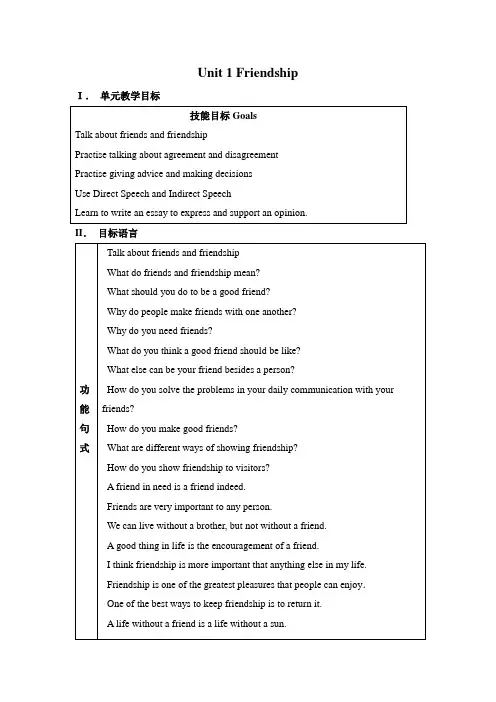
Unit 1 Friendship I.单元教学目标II.目标语言III. 教材分析和教材重组1. 教材分析本单元以Friend和Friendship为话题,旨在通过单元教学使学生通过讨论什么是好朋友,什么是真正的友谊,如何交友和保持友谊等问题,使学生树立正确的交友观。
并针对日常交友过程中经常遇到的实际问题,指导学生发表自己的见解和看法,通过进一步讨论提供有效的解决方案。
并能就此以编辑的身份写出指导信,对相关谚语写出观点明确、论证有力的短文。
1.1 Warming Up以调查问卷的形式,通过对学生在日常交友过程中所遇到的五个问题,展开调查,使学生对是否擅长交友做出评价,激发学生对本单元的中心话题产生兴趣;同时也使教师本单元的授课更具有针对性,从而有效地帮助学生树立正确的交友观。
1.2 Pre-Reading通过四个问题引导学生讨论交友的重要性以及自己心目中好朋友的概念和标准,并使学生认识到不仅人与人,人与物(如日记)也可以成为好朋友。
继续探究并树立正确交友观,并为阅读作好了准备。
1.3 Reading讲述第二次世界大战的纳粹统治时期,犹太人Anne一家过着滇沛流漓,与世隔绝的生活。
Anne在孤独中只能以日记Kitty 为友,倾诉衷肠,伴其渡过两年的逃亡生涯。
控诉了纳粹党的残暴统治给犹太人民带来了深重的灾难,并以日记的形式表达了以主人公Anne为代表的全世界人民憎恨战争渴望和平的共同心愿。
学生学习了新的词汇、句型,提高了阅读水平。
文中选用了主人公的一篇日记,使学生进一步感受到了挚友的可贵,对主人公内心世界的描写有了更深刻的理解。
1.4 Comprehension 设计了三种题型。
其中前两个是考查学生对READING文章细节内容的理解,最后一题是开放性问题,学生可以在更深入理解主人公内心世界的基础上各抒己见,使学生养成勤于思考勇于探究的良好的学习习惯,现时也培养了学生的想象力,进一步提高了阅读水平。
人教版高一英语必修一《Unit1 Friendship》说课稿

人教版高一英语必修一《Unit1 Friendship》说课稿1. 教材信息•课时数:2课时•教材版本:人教版•适用年级:高一•课题:Unit 1 Friendship•单元内容:词汇、语法、听说读写2. 课时目标通过本课的学习,学生将能够:•了解友谊的重要性及如何建立和维护友谊;•学会运用正确的语法结构来描述个人经历与感受;•提高听说读写能力;•提高团队合作能力和表达能力。
3. 课前准备3.1 教师准备•教材:《人教版高一英语必修一》课本 Unit 1 Friendship•多媒体设备:投影仪、电脑•板书工具:彩色马克笔、擦布3.2 学生准备•学生已预习并了解本课的单元主题和词汇;•学生准备了笔和纸。
4. 教学过程4.1 导入新课 (10分钟)•利用投影仪播放一段关于友谊的短视频,引发学生对友谊的思考和讨论。
•提问一些问题激发学生的兴趣,如:你觉得友谊对人的生活重要吗?你曾经遇到过怎样的好朋友?他们对你有什么样的影响?请和同桌讨论一下。
4.2 新课讲解 (20分钟)•向学生介绍本单元的主题:Friendship(友谊)。
•通过示范和解释演示本单元的词汇,如friend(朋友)、trust(信任)、support(支持)等,以及常用短语如make friends(交朋友)、build up friendships(建立友谊)等。
•引导学生思考并讨论友谊对个人成长的重要性以及如何建立和维护友谊。
4.3 语法与写作练习 (30分钟)•通过示范和解释演示本单元的语法结构,如使用过去完成时来描述个人经历和感受。
•提供一些例句,让学生观察并尝试使用过去完成时来描述自己的经历和感受。
•让学生进行小组活动,在小组内分享自己的经历和感受,并使用过去完成时进行描述。
鼓励学生进行互动和合作,提高口语表达能力和团队合作能力。
•引导学生将小组活动中的一些经历和感受写成短文,并进行班内展示,提高写作能力和表达能力。
4.4 听力和口语训练 (30分钟)•通过播放录音和提供听力材料,让学生进行听力训练。
人教版高中英语必修1《Unit1Friendship》教案

⼈教版⾼中英语必修1《Unit1Friendship》教案 ⼈教版⾼中英语必修1《Unit 1 Friendship》教案【⼀】 教学准备 教学⽬标 1、掌握下列词汇和短语: reason, list, share, feelings, Netherlands, German, outdoors, Crazy, nature, dare, thundering, entirely, power, trust, indoors, go through, hide away, set down, a series of, on purpose, in order to, face to face, according to. 2、进⼀步学习有关“朋友”的知识信息,启发学⽣对朋友和友谊的思考。
3、了解《安妮⽇记》的背景知识,在感受外国⽂化的同时,深刻理解安妮⽇记的内涵,同时提⾼学⽣⽂化意识。
4、训练学⽣⼀定的阅读技巧,使他们掌握⼀些有效的学习策略,从⽽提⾼阅读速度和理解的准确性,并养成⼀定的⾃主学习能⼒。
5、培养学⽣快速阅读的能⼒、捕捉信息的能⼒及运⽤语⾔进⾏交际的能⼒。
6、通过个⼈活动、⼩组活动和班级活动等⽅法,培养学⽣的合作互助精神,分享英语学习的经验,感受⽤英语交流的成功和喜悦。
教学重难点 教学重点: 1、了解《安妮⽇记》的背景知识,在感受外国⽂化的同时,深刻理解安妮⽇记的内涵,同时提⾼学⽣⽂化意识。
2、训练学⽣的阅读技巧,提⾼学⽣阅读速度和理解能⼒。
教学难点: 对所获得的信息进⾏处理、加⼯和学习,形成有效的学习策略。
教学⼯具 ppt课件 教学过程 ... 板书 Uint1 Reading Anne’s Best Friend Qualities: easy-going ,warm-hearted ,helpful,… Questions: Skimming Summarize Discussion: 1> style 2> ideas ⼈教版⾼中英语必修1《Unit 1 Friendship》教案【⼆】 教学准备 教学⽬标 ■To help students learn to express attitudes, agreement & disagreement and certainty ■To help students learn to read the text and learn to write diaries in English ■To help students better understand “friendship” ■To help students learn to understand and use some important words and expressions ■To help students identify examples of Direct Speech & Indirect Speech (I): statements and questions in the text 教学重难点 Words upset, ignore, calm, concern, settle, suffer, recover, pack Expressions add up, calm down, have got to, be concerned about, go through, set down, a series of, on purpose, in order to, at dusk, face to facer, no longer/ not …any longer, suffer from, get/ be tired of, pack (sth.) up, get along with, fall in love, join in Patterns “I don’t want to set down a series of facts in a diary as most people do,” said Anne. →Anne said that she didn’t want to set down a series of facts in a diary as most people do. I stayed awake on purpose until half past eleven… …it was the first time in a year and a half that I’d seen the night face to face… 教学⼯具 ppt 教学过程 Hello, everyone. I’m so glad to be your teacher of English. I’d like to make friends with you, to build up a close friendship with you. Today we shall take Unit 1. The topic of this unit is Friendship. What do you think friendship is? 1. Warming up ⑴ Warming up by defining friendship Hello, everyone. I’m so glad to be your teacher of English. I’d like to make friends with you, to build up a close friendship with you. Today we shall take Unit 1. The topic of this unit is Friendship. What do you think friendship is? Yeah, there are many explanations about friendship. However, friendship is a relationship that can’t be restricted(限制)by definition(定义). It can only be experienced. True friendship can exist between any two souls, be it between people or animals. It can happen at any moment, to anyone. Even to lifeless things, like a diary, a ball, a friendship can happen. Then what is your opinion about friendship? Do you think that friendship is important to our life? Why? ⑵Warming up by learning to solve problems Nice to meet you, class. We shall be friends from now on. For everybody needs friends. But being a good friend can sometimes be hard work. Learning how to solve problems in a friendship can make you a better friend and a happier person. Discuss the situation below and try to solve the problems wisely. Common problems among teenagers Solution Some of the common problems include forgetting friends’ birthday, not keeping promises, letting out friends’ secrets and so on. Maybe we can have a heart-to-heart talk with our friends to ask for forgiveness. Situation 1: Friends get angry with each other when they try to talk about something difficult. Try to understand your friend/ Try to talk about the problem in a different way. Situation 2: Friends don’t know how to apologize Start by telling each other that you are sorry. A simple apology is often enough and is a good starting point. Situation 3: Some friends don’t know how to keep secrets. Keep your secrets to yourself Tips on being a good friend Treat your friends the way you want to be treated. Keep secrets that are told to you. Pay attention when your friend is talking. Keep your promises. Share things with your friend. Tell your friend the truth. Stick up for your friend. ⑶Warming up by doing a survey Good morning, class. I am your teacher of English. Glad to be here with you. Today we shall take Unit 1 Friendship. To be frankly, I’d like very much to keep a close friendship with you, my dear students, in the following years. How about you then? Ok, thanks. I do hope to be your good teacher as well as your helpful friend (良师益友). Now please do the survey on page one. Add up your score according to the scoring sheet on page 8. You don’t have to tell your results. You can just keep it a secret.。
高中英语 Unit 1 Friendship教案 新人教版必修1
新课标高一必修1 英语教案Unit 1 FriendshipPart One: Teaching Design (第一部分:教学设计)Period 1: A sample lesson plan for reading(ANNE’S BEST FRIEND)AimsTo talk about friendshipTo read about friendshipProceduresI. Warming up1. Warming up by assessingA lot of people have only few possibilities of getting feedback about their own personality. In this exercise you will have the opportunity to get some feedback and to discuss it with a partner. While paring your mutual judgments, certain prejudices or misunderstandings may appear, as people often do not know each other thoroughly enough to judge others correctly. Try to be honest!Self assessmentOf the following characteristics choose 5 that are particularly applicable to you personally.sociable, honest, friendly, easygoing, nervous, open-minded, anxious, careful, talented, talkative, nosy, thoughtful, generous, carefree, pessimistic, peaceful, optimistic, interesting, reliable, helpful, active, careless, caring, exact, adventurous, imaginative, hot-blooded, well-organised, trustworthy, patient, responsible, outgoing, kind, brave, warm-hearted, selfless, tolerantPartner assessmentNow choose 5 characteristic features which you think are especially applicable to your partner.sociable, honest, friendly, easygoing, nervous, open-minded, anxious, careful, talented, talkative, nosy, thoughtful, generous, carefree, pessimistic, peaceful, optimistic, interesting, reliable, helpful, active, careless, caring, exact, adventurous, imaginative, hot-blooded, well-organised, trustworthy, patient, responsible, outgoing, kind, brave, warm-hearted, selfless, tolerant2. Warming up by describingHave the students get into groups of four to describe their own ideal friend. Individual students must decide on TOP 5 character adjectives that could be used to describe the ideal friend and insist they have good reasons for their choice. Then let the group leader give the class a description of their ideal friend.3. Further applyingYou may also have the students do the survey in the textbook, following the stepsbelow.1. Get the students to make a list of three qualities a good friend should have.2. Have the students get into groups of four to find out what each has listed.3. Have a member of each group report on what their lists have in mon and list them on the board.4. Ask the class whether or not they agree with all the qualities listed.5. Then have the students do the survey in the textbook.6. Have the students score their survey according to the scoring sheet on page 8.7. The teacher ask some students how many points they got for the survey and assess their values of friendship:★4~7 points: You are not a good friend. You either neglect your friend’s needs or just do what he/she wants you to do. You should think more about what a good friend needs to do.★8~12 points: You are a good friend but you sometimes let your friendship bee too important, or you fail to show enough concern for your friend’s needs and feelings. Try to strike a balance between your frien d’s needs and your own responsibilities.★13+ points: You are an excellent friend who recognizes that to be a good friend you need balance your needs and your friend’s. Well done.(You may also show your students the results above and let themselvesself-reflect upon their own values of friendship)II. Pre-readingTo focus the Students’ attention on the main topic of the reading passage.To activate their previous knowledge on the topic.III. Talking and sharingWork in groups of four. Tell your group mates how you reflect on these questions.1. Why do you need friends? Make a list of reasons why friends are important to you.2. What do you think a good friend should be like? List what a good friend should do and share the list with your partners.3. Does a friend always have to be a person? What else can be a friend?4. Do you think a diary can bee your friend? Why or why not?Instructions: The teacher can give each group one of these questions above to talk about. Then let the class share their ideas. It’s better to stimulate the students to challenge their classmates’ opinions about these questions. Possible answersQ1: Reasons I need friends:※to cope with stressful situations in life※to share my worries and secrets in my inner world※to show my concern for other people※to let other people share my happiness ※to unfold to other people the secrets in my heart (to name but few.)Q2: A good friend should:※tell me the truth (honest)※be good to me (friendly)※be willing to consider or accept others’ideas or opinions (open-minded)※be willing to help others (generous or helpful)※be good-tempered※think about what others need and try to help them (caring)※be loyal to their responsibility (responsible)※not easily upset (easy-going) ※be out-going (like to meet and talk to new people)※be tolerant (allow other people to have different opinions or do something in a different way)※be selfless (to name but few)Q3: What else can be a friend?Answers can be various. (omitted)Q4: Students’ answers may vary but must include a reason.Yes. I think it can be, because I can set down how I feel every day in my diary, and let other people read it to share my feelings some time later. Above all, it feels good to write down my thoughts and feeling on paper when I am sad or lonely. IV. Reading1. Looking and guessingWork in pairs. Look at the pictures and the heading and guess what the text might be about.1). Imagine what it might be like if you had to stay in your bedroom for a whole year. You could not leave it even to go to the WC or to get a cup of tea. How would you feel?2). What would you choose if you are only allowed to have five things with you in the hiding place because there is very little room?2. Reading to summarise the main idea of each paragraph.Skim the text and summarise the main idea of each paragraph in one sentence. Para. One: Anne made her diary her best friend whom she could tell everything.Para. Two: Anne’s diary acted as her true friend during th e time she and her family had to hide away for a long time.Para. Three: Having been kept indoors for so long, Anne grew so crazy about everything to do with nature.3. Language focusNext you are to read and underline all the useful expressions or collocations in the passage. Copy them to your notebook after class as homework.laugh at, go through, make/call + O +Noun (as O.C.), hide away, set down, grow crazy about, do with…, there was a time when…, keep sb. spellbound, on purpose, in order to do sth., far too +adj./adv, happen to do sth., it was the first/second time that …, face to faceV. Closing downClosing down by doing exercisesTo end the lesson you are to do the prehending Exercises 1 and 2.Closing down by discussion of ideasWork in groups of four. Discuss the ideas put forward in the reading passage. Itdoes not matter whether you agree or disagree. What is important is that you should have a reason for what you say. Also you can put forward your own ideas, either criticising the text or using it as a support:★What would you do if your family were going to be killed just because they did something the Emperor did not like?★Where would you plan to hide?★How would you arrange to get food given to you every day?What would you do to pass the time?Language chunks from Unit 1 Friendshipadd up, get sth. done, calm sb. done, have got to, go on holiday, talk care of, walk the dog, get loose, pay for sth, cheat in the exam, should have done, someone else’s, laugh at, go through, hide away, set down, a series of, a hiding place, I wonder if…, grow/be/bee crazy about, could have done, keep sb.spellbound, keep doing, stay awake, on purpose, in order to, by oneself, far too much, it was(is) the first time that…, face to face, feel lonely/sit alone, save one’s life, be concerned about, with so many clothes on, have trouble with sb, at the moment, get along (well) with sb./ sth, enjoy doing, be/bee/make friends with, be/fall in love (with), try sth. out on sb. ask for advice, give sb. some a dvice on…, make an effort to do sth., join in sth., show one’s interest in, far and wide, pay attention to, look to one’s own concern, share one’s thoughts and feelings with sb, e to a conclusion, be prepared to do sth., a heart-to-heart talk, hurt one’s feelings, change one’s mind, live in peace, go on a piic, get away with, feel at home, in needPeriod 2: A sample lesson plan for Learning about Language(Direct & Indirect Speech(Ⅰ) statements & questions)AimsTo discover useful words and expressionsTo discover useful structuresProceduresI. Warming upWarming up by discovering useful words and expressionsTurn to page 4 and do Exercises 1, 2, 3 and 4 first. Then check your answers with your class partner.II. Learning about grammar: Direct and Indirect Speech1.Direct SpeechIn direct speech, the original speaker's exact words are given and are indicated by quotation marks.★“I don’t know what to do,” said Dean.In some grammar books, ‘said Dean’ is referred to as a reporting clause. “I don't know what to do,” is referred to as the reported clause.2. Indirect SpeechIn indirect speech, the exact meaning of the speaker’s words is given, but the exact words are not directly quoted.★Dean said that he didn’t know what to do.To convert direct speech into indirect speech:If the main verb is past tense, present tense verbs in ‘that clause’ must also be changed to past tense.Dean said that he didn’t know what to do.First and second person pronouns must be changed to third person pronouns. Dean said that he didn’t know what to do.(The word ‘that’ can often be left out: Dean said he didn’t know what to do.) 3. Indirect QuestionsDirect question: “Did Marama’s horse win a prize?” Owen asked.Indirect questions: Owen asked whether (or if) Marama’s horse had won a prize. The same rules apply to indirect questions as to indirect statements. The difference is that a wh- clause is used instead of a that clause.Direct question: “Why won’t you marry me?” asked Donald.Indirect question: D onald asked her why she wouldn’t marry him.In telling a story or recounting events, a speaker using direct speech has all the resources of intonation to produce a lively account. Because indirect speech is always speech reported by someone else, the account is more reserved and restrained.“What shall we do?” asked Bev.“Don’t worry, Bev,” said Duncan, “I’ve got a plan.”Bev asked Duncan what they should do. He told her not to worry and that he had got a plan.The ability to change direct speech into indirect speech is a useful skill for those engaged in taking the minutes of a meeting or reporting on events.Direct speech: “First of all, I would like to thank everybody who helped with the fair. The results were very good, and we will now be able to b uy two more puters.” Indirect speech: The principal said that he would like to thank everybody who had helped with the fair. He announced that the results were very good and that the school would now be able to buy two more puters.III. Discovering words and expressionsDo exercises 1, 2, 3 and 4 on page 4 and 5. Check your work with your partner’s. IV. Discovering structuresDo exercise 1 and 2. Check your work with your partner’s.Period 3: A sample lesson plan for Using Language (A letter from a student to the editor of The 21st Century)AimsTo listen to a letter about friendshipTo speak about a questionnaire about friendshipTo write advice about friendshipTo write a few lines describing a friendProceduresI. Warming up1. Read the letter to Miss Wang and find out what was upsetting Lisa.2. Listen to what Miss Wang says, and then answer the questions in Exercise 2.3. Listen to the tape again and try to spell out the missing words in Ex 3.II. Talking about designing a questionnaireWork in groups of four. Design a questionnaire to find out what kind of friends your classmates are. Ask the Students to use the quiz in the Warming Up as an example.Note: The students should be talking while they are doing the task. This provides the students with the opportunity to practise expressing thought and concern in matters of immediate concern and interest. Tell the students to follow these steps: Step1: In your group, e up with four situations among friends. Design four questions accordingly with three possible answers.Step2: Put the four questions together and form a questionnaire.Step3: Check the questionnaire through and try it out on your own group.Step4: Share your questionnaire with another group and try each other’s questionnaires.Sample questionnaire:This questionnaire has four questions, and each question is followed by a set of possible answers. Please read the questions, and then consider which response fits you best.1.Why am I close friends with this person now?A. Because being friends with him/her helps me feel important.B. Because my friend would be upset if I ended the relationship.C. Because he/she is someone I really enjoy sharing emotions and special events with.2. Why do I spend time with my friend?A. Be cause my friend would get mad at me if I didn’t.B. Because it is fun spending time with him/her.C. Because I think it is what friends are supposed to do.3.Why do I listen to my friend’s problems, or to what my friend has to say?A. Because my friend praises me and makes me feel good when I do.B. Because it’s interesting and satisfying to be able to share like that.C. Because I really value getting to know my friend better.4.Why do I keep promises to my friend?A. Because I believe it is an important personal quality to live up to my promises to a friend.B. Because it would threaten our friendship if I were not trustworthy.C. Because I would feel bad about myself if I didn’t.Scoring Sheet:Q1 A 1pointQ2 A 1pointQ3 A1 pointQ4 A3 pointsB 2points B 2points B2 points B2 pointsC 3points C 3points C3 points C1 point☆4~6 points: You are not a good friend. You either neglect your friend’s needs or just do what he/she wants you to do. You should think more about what a good friend needs to do.☆7~9 points: You are a good friend but you sometimes let your friendship bee too important, or you fail to show enough concern for your friend’s needs and feelings. Try to strike a balance between your friend’s needs and your own responsibilities.☆10+ points: You are an excellent friend who recognizes that to be a good friend you need balance your needs and your friend’s. Well done.Students work in groups and try their own questionnaires in the school to collect more information about studen ts’ reflection of the values of friendship.III. Guided writing1. Read the letter to the editor from Xiaodong and make sure you know what problem Xiaodong has.2. Discuss in groups of four. Think what advice you can give Xiaodong.3. Write your advice to Xiaodong as an editor individually.Sample writing:Dear Xiaodong,Some people like talking with others, but some people are shy. If you fall into the second group, it can be hard to make friends. But you can change the situation. What are you interested in? If you like basketball, for example, you could talk with some of your classmates who like basketball. The easiest way to start talking to people is to find something you have in mon.If you are standing beside a group of your classmates, join in their discussion if you know something about the subject they are discussing. But if you don’t, you shouldn’t feel afraid to say, for example, “That sounds interesting, what is it about?” Once you start talking to one person, it will get easier to talk t o others. Find one person you have something in mon with, and once you bee friends with him, his friends will start talking to you too.Good luck!EditorIV. Writing assessment1. Can you give Xiaodong some good advice?2. I s your letter well developed?3. Are your ideas well organized to the point?4. Do you have a good choice of words and idioms in your writing?5. Do you get a good mastery of plex structures of language?6. What kind of mistakes have you made in your writing? What can you do to avoid such mistakes?V. Further ApplyingHere are some proverbs about friends and friendship. Read them carefully andpay attention to the sentence stress and intonation. Then write a passage. Choose some you agree and explain why. Then choose some you disagree and explain why.■You may also have the students plete the task as homework after class.Part Two: Teaching Resources (第二部分:教学资源)Section 1: Background reading on friendshipFriendship QuotesI. Questions about friendship1.What is the main problem in friendship? (leaving someone out)2.How do you keep a friend? (treat someone like you want to be treated)3.What is a good friend? (somebody whom you can depend on)4.What if your friend said they wouldn’t be your friend if you were anotherpe rson’s friend? (That “friend” would not mind if she were really your friend.)★“True friendship is like sound health; the value of it is seldom known until it be lost.”--- Charles Caleb Colton★“A friend is one who walks in when others walk out”---Walter Winchell★“A friend is one who believes in you when you have ceased to believe in yourself.” --- Lysha★“The better part of one's life consists of his friendships.”--- Abraham Lincoln ★“Advice is like snow; the softer it falls, the longer it dwells upon, and the deeper it sinks into the mind.” --- Samuel Taylor Coleridge★“Friendship is the golden ribbon that ties the world together.” ---Kristina Kentigian★“Friends are the sunshine of life.”---John Hay★A friend in need is a friend indeed.II. Tips on being a good friend※Treat your friends the way you want to be treated.※Keep secrets that are told to you.※Pay attention when your friend is talking.※Keep your promises.※Share things with your friend.※Tell your friend the truth.※Stick up for your friend.III. What kind of friend are you?1. If your friend tells you a secret that isn’t bad but you promised not to tell anyone, you will________.A. tell everyoneB. keep the promise2. If you know your friend is planning to cheat on a test, you will________.A. tell your teacherB. let your friend cheatC. help your friend study for the test so she won't feel she needs to cheat3. If your friend tells you a secret and it may cause his or her death, youwill________.A. tell a trusted adultB. keep it a secretC. tell your friendsYou may print this sheet and answer the questions. Then discuss the answers withyour friends.A true friendship should:☉encourage you to live your dream.☉support you toward your goals.☉sympathize for your losses and help you find a silver lining.☉build your self-esteem.If happiness and life-satisfaction are your goals, your friends should be chosen on the basis of how well they can acplish those four goals.Happiness is a personal choice that es from within. But, as the friendship poem says, it surely doesn’t hurt to have supportive friendships that help us achieve our goals.IV. Self-reflection upon friendshipRead the following statements and then tick Yes (√) or No( ×) to show your opinions upon friendship.1. Friendship is very important to me.2. I have a lot of friends.3. There can be true friendship between a schoolboy and a schoolgirl.4. I am very kind to my friends.5. I think everyone should have friends.6. Friends must have the same character.7. I keep a diary and think it is my close friend.8. When my friend is in trouble, I am always ready to help.9. I don’t like to talk to others very much. I like to be alone.10. I keep a pet animal and treat it like a friend.A friendship poemChoose friends wisely, the portrait they paintIs who you are and who you ain’t.Friendship is life’s great supportWhen friends are of the right sort.For all your dreams do they make room,Or bring you down with doom and gloom?You will know a friendship is true.When it brings out the best in you.It’s true. You can tell a person by the pany she keeps. Our friendships not only tell a lot about who we are --- they make us who we are. The friendship poem above says it all. You will know a friendship is true when it brings out the best in you. Take a look at your friends. Do they bring out the best in you? That might seem like a silly question. We all tend to think, “Of course they bring out the best in me.I wouldn’t be friends with them otherwise.”Section 2: Vocabulary teaching strategyI. The role of vocabulary teachingIn the context of learning English as a foreign language, a learner is forced to be autonomous and independent and make conscious effort to learn vocabulary outside the classroom simply because the exposure to the target language is limited in class. So teachers cannot rely on their students ‘picking up’ lexical items.This makes explicit vocabulary teaching necessary. However, vocabulary is notoriously difficult if not impossible to teach because of the plexity of its linguistic, semantic and psycho-cognitive aspectsII. Best approachThere are no universally useful strategies and they contribute to vocabulary learning in different ways. Students use a number of strategies, often simultaneously. The efficiency of vocabulary learning depends on how students bine individual strategies. If students bine and employ individual strategies from different groups they will be more successful in developing the target language lexicon. Thus, the ideal bination would be that of strategies from all four groups. The teacher should create activities and tasks (to be done both in and outside class) to help students to build their vocabulary and develop strategies to learn the vocabulary on their own. Students experiment and evaluate and then decide which to adopt or reject since strategies are not intended to be prescriptive. III. Practical activitiesHere is a selection of practical activities that direct learners towards using strategies of vocabulary learning.1. The useful alphabet (self-initiated independent learning)Each student gets a letter and has to find 5, 10 or 15 words he or she thinks would be useful for him or her. He or she then report to the class, perhaps as a mingle activity, using word cards (on one side they write the letter, on the other the information on the word - spelling, pronunciation, definition).2. Word bag (formal practice)This is to get your students to write down new words they hear in class.At the beginning of the term/course, divide students into groups of about 5 and give each group a number (e.g. 1-6). At the beginning of each class, give each group about 10 cards on which they write the number of their group and the new words they hear in class. At the end of each class, they put their cards into the “word bag” and every 2 weeks you check whether they still know those words and which group has the most cards. In the end there are two winners: the group that has the most cards, and the one that knows more words.3. Especially for you (Functional practice)The teacher prepares a list of words. Each student gets one word, which is prepared especially for him or her. The trick is that each student gets a word whose initial letter is the same as t he initial of the student’s first name, e.g. Linda gets listless. Each student must look it up in the dictionary during the class and after a few minutes report to the class. E.g. “My name is Linda and I’m listless. That means that I am ... (definition)...”. For homework students can do the same using their surname.4. Word tour (memorizing)Instructions for your students: Think of a town or city you know well. Imagine that you are organizing a sightseeing tour. Think of 5 places you would include on your tour and write down the order in which the tourists would visit them. Learn your tour off by heart so that you can picture it in your mind. Whenever you have 5 newEnglish words to learn, imagine these words are the tourists on your tour and picture the words in the places on your tour like this.Tour: Trafalgar Square; Buckingham Palace; Houses of Parliament; Westminster Abbey; Downing Street. Words to learn: apron, dustpan, vacuum cleaner, feather duster, broom. Imagine Nelson on his column in Trafalgar Square wearing an apron, the queen brushing the floor in Buckingham Palace and using a dustpan... Section 3: Words and expressions from Unit 1 Friendshipadd v.1. put something with something else or with a group of other things: Do you want to add your name to the list? 2. to put two or more numbers together in order to calculate the total: Add 6 and 6 to make 12. 3. to increase the number: The sales tax adds 15% to the price of clothes. 4. to say some more that is related to what has already been said: That’s all I want to say. Is there anything you’d like to add.Other verbal phrases of “add”add to: to make something larger and more noticeable: Our explanation seemed only to add to his bewilderment.add up: to calculate the total of several numbers: Add your scores up and we’ll see who won.add up to: to have a particular result: His schooling added up to no more than one year.point: n. 1. small spot: The stars shone like tiny points of light in the sky. 2. sharp end: a knife with a very sharp point. 3. a unit used to show the score in a game or sport: She lost three points for that fall.(in a skating match)upset: 1. vt. & vi. to make someone feel unhappy or worried: I’m sorry, I didn’t mean to upset you. 2.adj. (not before noun) unhappy and worried: She was still upset about the argument that she had had with Harry.ignore: vt. 1. to behave as if you had not seen or heard someone or something(不理睬): Either she didn’t see me wave or she deliberately ignored me. 2. to pay no attention to something that you have been told or that you know about(忽视): Some drivers simply ignore speed limits.calm: 1. adj. quiet and without excitement, nervous activity or strong feelings: Keep calm, and try not to panic. 2. vt.& vi. to make someone or something quiet after strong emotion or nervous activity: Charlie tried to calm the frightened children. 3. calm down: vt &vi. to bee quiet or make someone quiet after strong emotion or nervous activity: Calm down and tell me what happened. concern: 1. n. worry: something that worries you or a feeling of worry: There is growing concern about/over the effects of pollution on health. The rise in unemployment is of great concern to the government. 2.vt. to make someone feel worried or upset: The fact that she spends so much money on her own really concerns me. More and more people are concerning themselves with/about environmental problems. 3. be concerned about/for/with: Ross has never been concerned about what other people think of him. Rescuers are concerned for the safety of those trapped in the mine. This story is concerned with a Russian familyin the 19th century.cheat: 1.vi. to behave in a dishonest way in order to win or to get a advantage in a petition, game or examination: Jack always cheats at cards. 2. vt. to trick someone who trusts you.share: vi & vt. e equally: The last bus had gone, so the three of us shared a taxi. I shared a room with him at college. 2. to have the same opinion, experience, feeling etc as someone else: I share your concern about this problem. 3. to tell other people about an idea, secret, problem: It’s always better to share your worries. 4. n. part of sth.: I do my share of the housework. Don’t worry---you’ll get your fair share.set down: to write down something so that you have a record of it: I want to set downmy feelings on paper.Other verbal phrases of “set”set apart: to make someone or somebody different from other people or things. set aside: to keep some money or time for a special purposeset off: to start to go somewhere/ to cause a explosionset out: to start a journey/ to talk about something in an organized wayset up: to start an organization/ to build somethingcrazy adj. 1. impractical; foolish: That’s the craziest idea I’ve ever heard. 2. mad; ill in the mind: Turn that music down---it’s driving me crazy. 3. be crazy about=to like sb. very much, or be very interested in something: The boy is crazy about football. 4. like crazy=very hard: We have to work like crazy to get this finished on time.purpose: 1. n. an intention or plan; the feeling of having an aim in life: The discussion serves a twin purpose---instruction and feedback. Tom went for a walk, with no definite purpose in mind. 2. on purpose=deliberatelytrust: 1. n. a strong belief in the honesty, goodness etc. of someone or something e.g. You shouldn’t put your trust in a man like that. 2. vt. to believe that someone is honest and will not harm you or cheat you: I trusted Max, so I lent him the money. Can he be trusted to look after your pet dog?suffer: vt. & vi. 1. to experience physical or mental pain: At least he died suddenly and didn’t suffer a lot. 2. to be in a very bad situation that makes things very difficult for you: If you break the law, you must be prepared to suffer the punishment. She was very generous to him but she suffered for it when he ran away with all her money.3. to experience something unpleasant: The car suffered severe damage in the accident.get along (with): 1. to have a friendly relationship: If you two are going to share a room, you’d better learn how to get along. I’ve always found him a bit difficult to get along with. 2. to progress you are doing: How are you getting along with your English studies?Other verbal phrases of “get”:get about/around: (news)get widespreadget away: to succeed in leaving a place。
最新人教版高中英语必修一+Unit+1++Friendship全单元教案(精品)名师优秀教案
人教版高中英语必修一 Unit 1 Friendship全单元教案(精品)Unit 1 Friendship知识目标:本单元需要学习的重点单词为:add point upset ignore calm concern loose cheat reason list share feelingNetherlands German outdoors crazy nature purpose dare thunder entirely poweraccording trust indoors suffer teenager advice questionnaire quiz situation editorcommunicate habit本单元需要学习的重点词组为:add up calm down have got to be concerned about walk the dog go through hideaway set down a series of on purpose in order to in one’s power face to faceaccording to get along with fall in love join in make an effort show one’s interest inspread far and wide pay (no)attention to in the past本单元需要学习的重点句型为:1. You want to see a very interesting film with your friend, but your friend can’t go until he or she finishes cleaning the bicycle. (not. . . until. . . )2. When he or she borrowed it last time, he or she broke it and you had to pay to get itrepaired. (get sth. done)3. While walking the dog, you were careless and it got loose and was hit by a car. (while doing; get+adj. )4. Your friend, who doesn’t work hard, asks you to help him or her to cheat in the exam by looking at your paper, what will you do? (the Attributive Clause)5. I don’t want to set down a series of facts in a diary as most people do, but I want this diary itself to be my friend. (as. . . )6. I wonder if it’s because I haven’t been able to be outdoors for so long time that I’ve grownso crazy about everything to do with nature. (I wonder if/whether; it’s . . . that. . . )7. . . . I stayed awake on purpose until half past eleven one evening in order to have a goodlook at the moon for once by myself. (stay+adj. ; in order todo. . . )8. But as the moon gave far too much light, I didn’t dare open a window. (don’t dare(to)do. . . )9. . . . it was the first time in a year and a half that I’d seen the night face to face. . . (It is/was the first/second. . . time that+现在/过去完成时)10. Although I really try to talk to my classmates, I still find it hard to make good friendswith them. (find it+adj. /n. +to do. . . )本单元需要掌握的交际功能用语为:1. 态度(attitudes)Are you afraid that. . . ? I’ve grown so crazy about. . . I didn’t dare. . .2. 同意和不同意(agreement and disagreement)I agree. I think so. Exactly.I don’t agree. I don’t think so. I’m afraid not.3. 肯定程度(certainty)That’s correct. Of course not.本单元需要掌握的语法为:直接引语和间接引语(?):陈述句和疑问句1. 陈述句“I don’t want to set down a series of facts in a diary, ” said Anne.? Anne said that she didn’t want to set down a series of facts in a diary.2. 一般疑问句He asked, “Are you leaving tonight? ”? He asked us whether we were leaving that night.3. 特殊疑问句“When did you go to bed last night? ” father said to Anne.? Father asked Anne when she went to bed the night before.能力目标:1. 能运用所学语言讲述朋友间发生的事情以及朋友间的友谊和友情。
新课标人教版英语必修1:Unit1FriendshipPeriod1听说课教案
Unit 1 Friendship单元整体设计思路:第一课时听说课Warming up (p. 1); Listening (p. 41) and speaking第二课时阅读课Pre-reading (p. 2); Reading (p. 2); Comprehending (p. 3)第三课时语法课Discovering useful structures (p. 5); Using structures (p. 42-43)第四课时语言学习课Discovering useful words and expressions (p. 4); Using words and expressions (p. 41-42)第五课时综合语言练习课Reading and listeni ng (p. 6); Speaking (p.6); Listening task (p. 43) 第六课时写作课Reading and writing (p. 7); *Writing Task (p. 46, 选做)第七课时综合评价练习课Reading task (p. 44); Self-evaluation, Summing up and self-test/exercises第一课时听说课一、教学内容:Warming Up (p. 1); Listening (p. 41) and speaking二、教学目标:1.能力目标在本节课结束时,学生能够●就“朋友应具备什么品质”这一话题表达自己的看法,使用适当的形容词并通过简单举例来描述人的品质。
●在与其他人交流观点时使用同意或不同意的交际用语。
●理解听力材料中主人公对交友问题的看法,在教师的提示和帮助下简明扼要地归纳中心内容。
●在提供的语境中猜测新词汇的含义,并根据朋友应具有的品质这一话题,通过联想记忆扩展词汇量。
2.目标语言●重点词汇和短语upset, loose, ignore, add up, walk the dog,●重点句型结构calm … down, have got to, be concerned about, cheat in the exam3.文化目标领会友谊和朋友的真正内涵,懂得正确处理与朋友之间的问题。
Unit 1 Friendship教学设计【人教版高中必修1】
Unit 1 Friendship教学设计【人教版高中必修1】【人教版高中英语必修1 Unit 1 Friendship 教学设计】教学目标:1. 通过本单元的学习,使学生积累一些用于描述朋友的单词和短语,并能够熟练运用于实际情境中。
2. 培养学生的阅读技巧,能够理解文章主旨,捕捉关键细节,并进行推理判断。
3. 培养学生的写作能力,使其能够用英语写一篇关于友谊的短文。
4. 培养学生的合作意识和互相尊重的精神,使其能够团结合作,共同完成各种任务。
教学重难点:1. 通过阅读文本和进行听力练习,提高学生的读写能力。
2. 运用所学的单词和短语,描述朋友的外貌特征、性格特点、兴趣爱好等。
3. 通过小组合作学习和讨论,培养学生的合作意识和批判思维能力。
教学准备:1. 教材:人教版高中英语必修1 Unit 1 Friendship2. 多媒体设备:电脑、投影仪等3. 音频设备:录音机、音频CD等4. 录音材料:Unit 1 Friendship相关的听力材料5. 实物:图片、海报等教学过程:Step 1 导入新课(约5分钟)1. 向学生介绍本单元的主题——Friendship,并引导学生思考以下问题:你认为朋友是什么?你对友谊有什么看法?2. 让学生用几句话回答上述问题,并鼓励他们互相交流讨论。
3. 引入本单元的活动:学生们将在本单元学习如何谈论朋友,并通过小组合作练习互相了解彼此的朋友。
Step 2 阅读文本(约15分钟)1. 让学生阅读教材中的课文,并要求他们理解文章的主旨。
2. 学生们可以用关键词的形式记录下文章的主旨,并与同桌分享。
3. 引导学生找出文章中的生词和短语,并进行词义推测。
4. 学生们可以用自己的话对文章进行简单的概括,以检测其对文章的理解程度。
Step 3 听力练习(约15分钟)1. 播放与文章相关的听力材料,让学生进行听力理解练习。
2. 学生们可以用关键词的形式记录听到的信息,并与同桌分享。
人教版高中英语Unit1-Friendship-优秀教案
教案人教版高一英语《英语1》第一单元Friendship第1课时:Warming up and Pre-reading一.教学目的①学问目的:⑴让学生驾驭以下生词与短语: survey add point upset ignore calm concern loose cheat add up calm down have got to be concerned about walk the dog⑵让学生学会运用以下构造来表达看法,同意与不同意与确定语气: Are you afraid that. . . ? I (don’t)think. . . In my opinion, . . . I (don’t)think so, I (don’t)agree, I believe. . . , I’m afraid not, Exactly, That’s correct, Of course not.②技能目的:1.让学生学会用英语描绘自己的挚友。
2.列出挚友间通常存在的问题,并找的不同方法来解决这些问题。
3.激励学生用本课学到的一些短语与构造来思索与议论挚友与友情。
③情感目的1.让学生学会如何解决挚友间可能出现的问题。
2.培育学生在高中阶段形成学习英语的好习惯。
二.教学重点1.用给定的形容词与句子构造来描绘他们的一个挚友。
2.学习评价挚友与友情。
三.教学难点1.与伙伴合作并描绘他们的一个好挚友。
2.与伙伴探讨并找出解决问题的方法。
四.教学方法1.任务型教学法2.合作学习法3.探讨法五.教学打算多媒体与其他常规教学工具六.教学过程1.导入新课:第一步:导入Lead-in上课前,老师可以通过展示一个友情天长地久的视频来激发学生的学习爱好,。
这是新学期的第一节课。
所以在一开场,请学生用他们喜爱的方式来谈谈关于新学校与挚友的话题。
1. How did you spend your summer holidays? How did you feel? What did you do in your summer holidays? What did you do in your spare time?2. What do you think of our new school? Do you like it? Could you say something about it?3. Do you like making friends? How do you get in touch with your friends? Do you have many friends? Where are they now? Do you have any old friends in our school? Have you made any new friends in our class?(其他关于本单元的话题导入的建议:1。
人教版高中英语必修1教案Unit1Friendship
Unit 1 Friendship(1) 课题:Friendship (2) 教材分析与学生分析:本单元的中心话题是“友谊”,几乎所有的内容都是围绕这一中心话题展开的。
Warming Up部分以调查问卷的形式引导学生了解日常生活中朋友之间发生的真实问题以及解决这些问题的方法;Pre-Reading部分的几个问题启发学生对“友谊”和“朋友”进行思考,使学生明确不仅人与人之间可以做朋友,日记也可以成为人们的朋友;Reading部分Anne’s Best Friend以日记形式讲述了犹太女孩安妮的故事;Comprehending部分通过连句、多项选择和问答形式帮助学生对课文内容、细节进行更深入的理解; Using about Language 部分教学本课重点词汇和重点语法项目。
(3) 课时安排:The first period: Speaking: Warming Up andPre-Reading The second period: ReadingThe third period: GrammarThe forth Period:ListeningThe fifth period: Writing(4)教学目标:①知识与技能:Talk about friends and friendship; Practise talking about agreement and disagreement, giving advice and making decisions; Use direct speech and indirect speech; Learn to write an essay to express and support an opinion.②过程与方法:本单元在读前阶段就提出问题,让学生思考是不是只有人与人之间才能交朋友,然后在阅读中通过安妮的日记向学生说明我们也可以与动物及无生命的日记交朋友。
人教版高一英语必修1 Unit 1 friendship 全单元教案设计
Unit 1 friendship2.Suggested teaching notes1). Analyses of the teaching contentsThis unit is about friendship, and nearly all the teaching materials center on it. Warming up---The questionnaire leads students to think and talk aboutfriendship, get to know the problems between friendsand seek solutions, which makes preparations for thefurther teaching in topics, background and vocabulary.Pre-reading---The questions prompt students to think critically aboutfriends and friendship in reality, alerting them to the factthat besides people, a diary can be a friend, too.Reading--- The diary by theJewish girl Anne gave a glimpse of her lifeduring her family’s shelter in Amsterdam from the GermanNazis’ killing in world war 2. she treats the diary as her best friend, and in it reveals her longing for a normal life and close contact withnature, which helps her get through the days.Comprehending---It helps students further understand the text by doingmultiple choices, questions and answers, andmatching.Learning about language---It teaches the important expressions andstructures and grammar: direct and indirectspeeches.Using language---The two letters, listening, questionnaire design, letterwriting and fun writing prepares students to furthertalk about friendship, especially the problems withmisunderstanding, and unfriendliness, thusstrengthening students’ abilities to practicelanguage, discover, and solve problems.Summing up---It summarizes the whole contents of this unit from theaspects of topics, vocabulary and grammar.Learning tip--- This part encourages students to form the habit of writinga diary.Integrating skills--- The text introduces the way Hawaiians expressfriendship, to get students to realize the culturaldifferences in the values of friendship in additionits importance in all cultures.2) Making of the teaching planThis unit centers on friends and friendship, exploring different types of friendship with particular attention to that one can develop with oneself,i.e., the comfort and support one seeks from an imaginary friend.Students are expected to come to be truly aware of the qualities andconducts that make a good friend, display and develop the ability tocope with misunderstanding, conflicts and problems related tofriendship, and give advice on it. The concept that even an ordinarything can be a friend should break down the traditional belief in theinterpersonal nature of friendship. Also, the comparison of similarities dissimilarities in friendship comprehension between the East and theWest leads students to know better the values of friendship in Westerns’eyes. All in all, this unit promises to unveil the true essence of friendshipand helps students to lead a more friendly and harmonious life.Thus, based on the theme, contents and teaching objectives, the whole3. Teaching plans for each periodPeriod 1 Warming-up and Speaking1. Teaching objectives:1) Target languageI (don’t) think…… I (don’t) think so. I (don’t) agree.I believe…… That’s correct. In my opinion, ……2) Ability goalsa.Describe your friends in Englishb.Figure out the problems between friends and then find different ways to solvethe problems.3)Learning ability goalsa.To encourage students to think and talk about friends and friendship by usingsome phrases and structures.b.To learn to solve problems that may occur between friends.c. To cultivate the students to form the good habit of learning English in SeniorMiddle School.2. Teaching important points:e the given adjectives and sentence structures to describe one of yourfriends.b.Learn to evaluate friends and friendship.3. Teaching difficult points:a.Work together with partners and describe one of your good friends.b.Discuss with partners and find out ways to solve the problems.4. Teaching methodsa.Task-based teaching and learningb.Cooperative learningc.Discussion5. Teaching aids:CAI6. Teaching procedures and ways:Step 1 Lead-in and Warming-upBefore the lesson, the teacher can arouse the students’ interests by showinga video of Auld Lang Syne .At the beginning of the first class, we can get the students to talk about their summer holidays. The students can talk freely as they like.1.How did you spend your summer holidays? How did you feel? What didyou do in your summer holidays? What did you do in your spare time?2.What do you think of our new school? Do you like it? Could you saysomething about it?3.Do you like making friends? How do get in touch with your friends?Do you have many friends? Where are they now? Do you have any oldfriends in our school? Have you made any new friends in our class? Step 2 Think it over1. Give a brief description of one of your friends. The following phrasesand structures may be helpful:His/Her name is ……He /She is …… years old.He /She likes …… and dislikes ……He /She enjoys …… and hates……He /She is very kind/friendly/……When /Where we got to know each other.2. What types of friendship do you have? Please tick them out. Then fillin the blanks.girl friends boy friends pen friendslong -distance friends friends of the same agee-friends (friends over the internet) friends across generationsunusual friends like animals, books……1).______ is /are most important to you.2). You spend most of your free time with ____.3). You will share your secrets with _____.4). When in trouble, you will first turn to _____.Step 3 Make a survey1. List some qualities of a good friend or your ideal friend. Have the students get into groups of four to find out what each has listed.Tell your partner your standards of good friends by using the following structure:I think a good friend should (not) be……In my opinion, a good friend is someone who……1.Have a member of each group report on what their lists have in common and listthem on the board.2.Ask the class whether or not they agree with all the qualities listed.3.Then have the students do the survey in the textbook.4.Have the students score their survey according to the scoring sheet on page 8.5.The teacher ask some students how many points they got for the survey and assesstheir values of friendship:★ 4~7 points: You are not a good friend. You either neglect your friend’s needs or just do what he/she wants you to do. You should think more about what a good friend needs to do.★ 8~12 points: You are a good friend but you sometimes let your friendship become too important, or you fail to show enough concern for your friend’s needs and feelings. Try to strike a balance between your friend’s needs and your own responsibilities. ★ 13+ points: You are an excellent friend who recognizes that to be a good friend you need balance your needs and your friend’s. Well done.(You may also show your students the results above and let themselves self-reflect upon their own values of friendship)Step 4 Talking and sharing( work in pairs)1. If your best friend does something wrong, what will you do?Try to use the following phrases:I (don’t) think…… I (don’t) think so.I (don’t) agree. I believe……A British newspaper once offered a prize for the best definition(定义) of a friend. If you were the editior, choose the best one from the following entries(条目), and explain why.One who understands my silence.A friend in need is a friend indeed.Friends are just the people who share your happiness and sorrow.When you look at your watch at 4 am, but still know you can callthem and wake them up, and they’ll still want to talk to you ,that’s friendship.To have a friend, you need to be a good friend.Step 5 Group work (output)The teacher can give each group one of these questions below to talk about. Then let the class share their ideas. It’s better to stimulate the students to express their own opinions about these questions.1.Do you think it is a good idea to borrow money from your friend?Why and Why not?2. What factors may cause the breakdown of a good friendship?3. What can be your unusual friend besides human beings? And why?Step 6 homework1.Write down a short passage about your ideas /the factors/your unusualfriends.2.Prepare for the new lesson.Period 2 Reading “Anne’s Best Friend”1. Teaching objectives:1) To develop the students’ reading ability, learn to use some reading strategies such as guessing, key sentences, skimming and so on;2). To get the students to realize the importance of friends and friendship, and to tell true friends from false friends;3). To grasp some useful words and expressions in this passage, such as on purpose, be crazy about etc.;4). To learn the writing style of this passage.2. Teaching method: Task-based teaching3). Teaching procedure:Step 1.Pre-reading1. Please enjoy three pieces of music and find out what they are about.2 .Why do you think friends are important to you?3. What do you think a good friend should be like? List the good qualities a good friend should have .4. Have you ever considered making friends with animals, plants or even an object? Why or why not?Step 2.Reading1. Try to guess what Anne’s friend is and what the passage is about by reading the title and having a quick at the pictures in this passage without reading it.2. Skimming the first two paragraphs to confirm your guessing.1) What was Anne’s best friend? Why did she make friends with it?2) Did she have any other true friends then? Why?3) What is the difference between Anne’s diary and those of most people?4) Do you keep a diary? What do you think most people set down in their diaries?5) We are going to read one of Anne’s diaries .but before reading ,can you tell me what the diary is about with the help of one key sentence in the 2nd paragraph?3. Reading of Anne’s diaryHow she felt in the hiding placeTwo examples to show her feelings thenStep 3.Post-reading1.What would you miss most if you went into hiding like Anne and her family? Give your reasons.2.Group workWork in groups to decide what you would do if your family were going to be killed just because they did something the Emperor did not like.Where would you plan to hide?How would you arrange to get food given to you every day?What would you do to pass the time?------3. Discovering useful words and expressionsComplete the following sentences, using words and expressions from Reading1) She has grown _______ about computer games.2) Was it an accident or did David do it on _______?3) From the beginning ,Paul made it clear that he would be ______ (完全地)in control.4) He used to work _______ even in the middle of winter.5) Just the _______ of more food made her feel sick.6) You had better have a _________ talk with him.7) Born in a poor family, the manager _________ lots of hardships in his childhood.8) A diary is often kept to ________ what happens in people’s daily lives. Step 4.Talking about friends and friendship1.There are many proverbs about friends and friendship. Choose the one you agreewith and explain why, then choose one you disagree with and explain why.A friend in need is a friend indeed.Friends are like wine; the older, the better.A friend to all is a friend to none.The same man cannot be both friend and flatterer(阿谀奉承者).False friends are worse than open enemies.Walking with a friend in the dark is better than walking alone in the light. 2. We have talked about friends and friendship today, can you write one or two sentences to express your understanding of friends and friendship.Step 5.Homework:1. Interview a high school student, a businessman, a police officer and a housewife to find out their opinions about friends and friendship. Write a report to share it with the whole class.2. Describe one of your best friends following the writing style of this passage. Ending: Let’s sing this song about friends togetherPeriod3 Grammar1.Teaching objectivesLearn to use direct speech and indirect speech2. Teaching important pointSummarize the rules of Direct Speech and Indirect Speech.3. Teaching difficult pointLearn about the special cases in which the tenses shouldn’t be changed.4. Teaching methodsDiscussing, summarizing and practicing.5. Teaching proceduresStep1 Lead inT: In the last lesson, we learned Anne Frank’s story. She is telling her stories to two of her friends—you and Tom. Tom has something wrong with his ears,so you have to repeat Anne’s sentences, using indirect speech. Sometimes you explain Tom’s sentences to Anne.“I have to stay in the hiding place.” said Anne. →Anne said she had to stay in the hiding place.“Do you feel sad when you are not able to go outdoors?” Tom asked Anne. →Tom asked Anne if/whether she felt sad when she was not able to go outdoors.“I don’t want to set down a series of facts in a diary,” said Anne.→Anne said that she didn’t want to set down a series of facts in a diary. “What do you call your diary?” Tom asked. →Tom asked what she called her diary.Ss go on this topic by themselves.Step2 GrammarT: Now let’s look at these sentences again. If we want to change Direct Speech into Indirect Speech, what should be changed?Ss discuss by themselves.Ss: sentence structures, tenses, pronouns, adverbials of time and place and verbs should be changed.T: Quite right. Look at the form on the screen. These are the rules.直接引语变成间接引语时,要注意以下几点:人称变化、时态变化、宾语从句要用述句语序。