
人教七下Unit10_语法专项课件(可数名词和不可数名词)
如:a book; two boys
可数名词变复数 2.1 规则变化
类别
构成方法
一般情况
词尾加-s
以s, x, ch, sh等结尾的 词尾加-es
名词
以“辅音字母+y”结 把y改为i,再加-es
尾的名词
以f或fe结尾的名词 以o结尾的名词
把f或fe变为v,再 加-es 有生命的加-es, 无生命的加-s
埃及人 an Egyptian—Egyptians 德国人 a German—Germans
口诀记忆 中日不变英法变,其余s加后面。
可数名词变复数 2.3 复合名词的复数形式
构成方法 一般的复合名词,只用把中心 词变为复数形式(中心词一般
是第二个名词) 由man和woman构成的复合名
词,二者均变为复数形式
much, little, a little只能修饰不可数名词。
易错点3 不可数名词的“量”
不可数名词没有复数形式,表示量的时候需要借助于“数词/ 冠词+量词+of+不可数名词”的结构来表示。 注意:1)量词可以是单数也可以是复数。
2)量词如果是复数形式,谓语动词则用复数。 例: There are two glasses of milk on the table. 桌子上有两杯牛奶。
可数名词变复数 2.2 不规则变化
① 改变名词中的元音字母或其他形式 foot — feet, tooth — teeth, goose — geese
man — men, woman — women, child — children, mouse — mice
②单复数同形词 deer, sheep, fish等 由汉语音译表示度量、币值等单位量词,如:five yuan
4) 在特殊疑问句中,用how many修饰可数名词。
例:How many pens do you have? 你有多少支钢笔?
不可数名词的特点
1)不可数名词前可以用much, a little, a lot of等修饰。
例:much bread 很多面包;a little tea 一点儿茶
2)不可数名词作主语时,谓语动词用单数形式。
a kilo of meat 一千克肉
a drop of water 一滴水 a bar of chocolate 一条巧克力
不可数名词的特点
4) 特殊疑问句中,对不可数名词前的修饰语提问,用 how much。
例:How much milk is there in the glass? 玻璃杯中有多少牛奶?
例词 cat—cats , bag—bags
class—classes , box—boxes
family—families , baby—babies
life—lives , wife—wives
zoo—zoos , radio—radios tomato—tomatoes, hero—heroes
2)可数名词可以直接用不定冠词a/an、数词或many, some, any, a lot of, lots of等修饰。
例:an apple ;three chairs ; some students
可数名词的特点
3) 可数名词单数形式作主语时,谓语动词用单数形式; 复数形式或两个(或两个以上)单数名词作主语时,谓语 动词用复数形式。 There is a pen on the desk. 桌子上有一支钢笔。 There are many students in the classroom. 教室里有很多学生。
three apple trees 三棵苹果树 但是man和woman作定语时,它们的单复数要和后面被修饰 的词保持一致。 例:two women teachers 两位女教师
易错点2 万能词
可数名词和不可数名词前都可以用some, any, a lot of, lots of 等 来修饰,表示“一些,许多”,被称为“万能词”。 例: There are some oranges on the desk. 桌子上有一些桔子。 There is a lot of water in the bottle. 瓶里有许多水。 但是,many, few, a few 只能修饰可数名词的复数形式;
例:There is some money in the purse. 钱包里有一些钱。
不可数名词的特点
3) 不能用不定冠词a/an或数词直接修饰。若要表示数量, 则需要借助一定的单位词来表示。
借助表示“张”“片”的单位词 piece 借助表示容量的词 借助表示重量的词
借助表示形状的词
a piece of paper 一张纸 a piece of bread 一片面包 a bottle of water 一瓶水 a cup of tea 一杯茶
5) 有些名词既可以作可数名词,又可以作不可数名词。 但它们的汉语意思有差别。
例: fish 鱼(可数),鱼肉(不可数); chicken 小鸡(可数),鸡肉(不可数); glass 玻璃杯(可数),玻璃(不可数)。
易错点1 名词作定语
名词作定语时一般用单数形式。 例:an apple tree苹果树;
初中英语人教版七年级下册
Unit10
语法专项课件 (可数名词和不可数名词)
可数名词VS不可数名词
可数名词
不可数名词
能用数目直接进行计数的 不能用数目直接进行计数
定义
名词。
的名词。
有无复 有单、复数形式。
数形式
没有复数形式。
直接用不定冠词a/an或具体
数量的
不能用不定冠词或数词直
的数词修饰。
表达
接修饰。
例词 apple tree—apple trees pencil box—pencil boxes
man doctor—men doctors woman teacher—women teachers
可数名词的特点
1)可数名词有单、复数之分。
例:a bird 一只鸟;many birds 很多只鸟
可数名词变复数
2.2 不规则变化
③ 表示某国人的名词复数变化:
中国人 a Chinese—Chinese
日本人 a Japanese—Japanese
英国人 an Englishman—Englishmen 法国人 a Frenchman—Frenchmen
美国人 an American—Americans 阿拉伯人 an Arab—Arabs
【典例3】
There are a lot of _____ in our school. They work very
hard.
A. woman teachers
B. women teachers
C. womans teachers
D. woman teacher
考查可数名词和不可数名词。 woman和man在句中作 定语修饰名词时,它们的单复数要和后面名词的单复 数保持一ave for breakfast?
—I often have______ and ______.
A. breads; eggs
B. bread; egg
C. breads; egg
D. bread; eggs
考查可数名词和不可数名词。bread为不可数名词, 没有复数形式,而egg为可数名词,在句中应变为复 数。句意:我经常吃面包和鸡蛋。故选D。
【典例2】
British people eat_____ a lot, and they’re usually cooked
in different ways.
A. chicken
B. beef
C. fish D. potatoes
考查可数名词和不可数名词。根据句中的“they’re” 可知,应选复数名词,而chicken, beef, fish都是不可 数名词。故选D。
合集下载
Unit10_语法专项课件(可数名词和不可数名词)

例:There is some money in the purse. 钱包里有一些钱。
考点大观
易错辨析
通关训练
不可数名词的特点
3) 不能用不定冠词a/an或数词直接修饰。若要表示数量,
则需要借助一定的单位词来表示。
借助表示“张”“片”的单位 a piece of paper 一张纸 词piece 借助表示容量的词 借助表示重量的词 借助表示形状的词 a piece of bread 一片面包
构成方法 词尾加-s 词尾加-es
以“辅音字母+y”结
尾的名词
把y改为i,再加-es 把f或fe变为v,再 加-es 有生命的加-es, 无生命的加-s
以f或fe结尾的名词
life—lives , wife—wives
zoo—zoos , radio—radios tomato—tomatoes, hero—heroes
是第二个名词) 由man和woman构成的复合名 词,二者均变为复数形式
pencil box—pencil boxes
man doctor—men doctors woman teacher—women teachers
考点大观
易错辨析
通关训练
可数名词的特点
1)可数名词有单、复数之分。
例:a bird 一只鸟;many birds 很多只鸟
解析
考查可数名词和不可数名词。根据句中的“they’re”
可知,应选复数名词,而chicken, beef, fish都是不可
数名词。故选D。
考点大观
易错辨析
通关训练
【典例3】 There are a lot of _____ in our school. They work very hard. A. woman teachers B. women teachers
考点大观
易错辨析
通关训练
不可数名词的特点
3) 不能用不定冠词a/an或数词直接修饰。若要表示数量,
则需要借助一定的单位词来表示。
借助表示“张”“片”的单位 a piece of paper 一张纸 词piece 借助表示容量的词 借助表示重量的词 借助表示形状的词 a piece of bread 一片面包
构成方法 词尾加-s 词尾加-es
以“辅音字母+y”结
尾的名词
把y改为i,再加-es 把f或fe变为v,再 加-es 有生命的加-es, 无生命的加-s
以f或fe结尾的名词
life—lives , wife—wives
zoo—zoos , radio—radios tomato—tomatoes, hero—heroes
是第二个名词) 由man和woman构成的复合名 词,二者均变为复数形式
pencil box—pencil boxes
man doctor—men doctors woman teacher—women teachers
考点大观
易错辨析
通关训练
可数名词的特点
1)可数名词有单、复数之分。
例:a bird 一只鸟;many birds 很多只鸟
解析
考查可数名词和不可数名词。根据句中的“they’re”
可知,应选复数名词,而chicken, beef, fish都是不可
数名词。故选D。
考点大观
易错辨析
通关训练
【典例3】 There are a lot of _____ in our school. They work very hard. A. woman teachers B. women teachers
2016春人教版七年级下册英语课件Uint10 单元语法聚焦十(PPT).ppt
please.
some 5. He is going to visit ________ places of interest in Beijing tomorrow.
英 语
新课标(RJ)·七年级下册
单元语法聚焦十
词 法 点 击
一、可数名词与不可数名词
英语中名词可分为可数名词和不可数名词。简单地说, 能数出个数的为可数名词,不能数出个数的为不可数名词。 单、复数 之分,而不可数名词没有 可数名词有__________ 复数形式 ____________ 。 可数名词与不可数名词用法对比:
单元语法聚焦十
Ⅱ. 单项填空
( B )1. Would you like some ________?
A. orange juices C. oranges juice B. orange juice D. oranges juices
orange juice为不可数名词,不能加s。
单元语法聚焦十
句。
She wants some juice. 她想要些果汁。 She doesn't want any milk. 她不想要牛奶。 2.any可以用于条件句中。 If you have any trouble, please let me know.
如果你有困难的话,请告诉我。
单元语法聚焦十
3.some可以用于疑问句的情况。 常用于款待用语或问句的实质等于提出一个要求并希望
milk, rice, tea, pancake, meat 1. 可数名词: tomato, noodle, dumpling, onion, pancake ________________________________________________ beef, juice, milk, rice, tea, meat 2. 不可数名词: ________________________________
可数名词与不可数名词课件

一些名词的单复数形式相同
例如,deer(鹿),sheep(羊),fish(鱼),Chinese(中国人),Swiss(瑞士人)。
特殊的复数形式
一些特殊名词的复数形式需要特别记 忆
例如,photo(照片)的复数为photos,tooth(牙 齿)的复数为teeth。
一些复合名词的复数形式是将复合部 分变为复数
CHAPTER 05
可数名词与不可数名词在句 子中的作用
可数名词在句子中的作用源自010203代表具体事物
可数名词用来表示具体、 独立的事物,如 “apple”(苹果)。
用于计数
可数名词可以用于计数, 表示事物的数量,如 “two apples”(两个苹 果)。
描述细节
可数名词可以用于描述事 物的细节特征,如“red apple”(红苹果)。
解释
抽象名词是指那些无法具体量化或触摸的概念或品质。通过使用量词+抽象名词 的组合,可以描述这些概念或品质的数量或种类,使得表达更加丰富和具体。
CHAPTER 04
可数名词与不可数名词的特 殊情况
既可数又不可数的名词
某些物质名词,如
water(水)、bread(面包)、milk(牛奶):这些名词在表示“液体”或“食品”的抽象概念时 ,通常作为不可数名词,但在表示“一个具体的液体量”或“一片面包”、“一杯牛奶”等具体概念 时,则作为可数名词。
money(钱)
通常作为不可数名词,但在描述 不同种类的钱币时,可以作为可 数名词。
通常可数但在某些情况下可以看作不可数的名词
fruit(水果)
通常作为可数名词,但在描述整个水果类别或作为食品类别时,可以作为不可数名词。
clothing(衣物)
通常作为可数名词,但在描述整个衣物类别或作为服装类别时,可以作为不可数名词。
例如,deer(鹿),sheep(羊),fish(鱼),Chinese(中国人),Swiss(瑞士人)。
特殊的复数形式
一些特殊名词的复数形式需要特别记 忆
例如,photo(照片)的复数为photos,tooth(牙 齿)的复数为teeth。
一些复合名词的复数形式是将复合部 分变为复数
CHAPTER 05
可数名词与不可数名词在句 子中的作用
可数名词在句子中的作用源自010203代表具体事物
可数名词用来表示具体、 独立的事物,如 “apple”(苹果)。
用于计数
可数名词可以用于计数, 表示事物的数量,如 “two apples”(两个苹 果)。
描述细节
可数名词可以用于描述事 物的细节特征,如“red apple”(红苹果)。
解释
抽象名词是指那些无法具体量化或触摸的概念或品质。通过使用量词+抽象名词 的组合,可以描述这些概念或品质的数量或种类,使得表达更加丰富和具体。
CHAPTER 04
可数名词与不可数名词的特 殊情况
既可数又不可数的名词
某些物质名词,如
water(水)、bread(面包)、milk(牛奶):这些名词在表示“液体”或“食品”的抽象概念时 ,通常作为不可数名词,但在表示“一个具体的液体量”或“一片面包”、“一杯牛奶”等具体概念 时,则作为可数名词。
money(钱)
通常作为不可数名词,但在描述 不同种类的钱币时,可以作为可 数名词。
通常可数但在某些情况下可以看作不可数的名词
fruit(水果)
通常作为可数名词,但在描述整个水果类别或作为食品类别时,可以作为不可数名词。
clothing(衣物)
通常作为可数名词,但在描述整个衣物类别或作为服装类别时,可以作为不可数名词。
人教版七年级英语下册Unit10_SectionA(Grammar_Focus-3d)名师课件
Read and translate
What kind of noodles I’d like beef noodles,
do you like?
please.
What size would you I’d like a large bowl,
like?
please.
Would you like a large bowl?
any的用法any一般用于疑问句或否定句中意思是任何一些任何一个作定语时可修饰可数或不可数名词
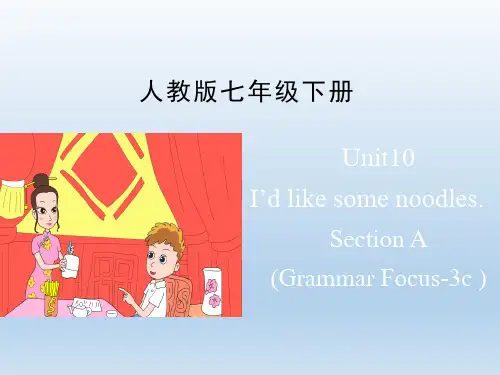
人教版七年级下册
Unit10 I’d like some noodles.
Section A (Grammar Focus-3c )
1.能将食物名称按照可数名词与不可 数名词,以及既可数又不可数进行 分类总结。 2.根据所提供的材料能运用所学的知 识来补全对话。 3.能运用所学的知识在真实情境下订 餐。
Say out the words quickly according to the pictures.
dcuanmmboboepadalgiltnegss
2d Role-play the conversation.
Waitress: Good afternoon. May I take your order? Sally: Yes. Are there any vegetables in the beef soup? Waitress: Yes. There are some tomatoes. Sally: OK. We'd like one bowl of beef soup. Waitress: Sure. What size would you like? Sally: Large, please. Tom: We'd also like gongbao chicken and mapo tofu with rice. Waitress: OK. One large bowl of beef soup, one gongbao chicken, and mapo tofu with rice. Tom: Yes, that's right.
初中英语 人教版七年级下册Unit10 可数名词与不可数名词的用法(PPT24张})
baby boy
babies boys
wolf
wolves
[wulvz]
leaf
leaves
[li:vz]
knife
knives
[naɪvz]
找规律
heroes potatoes
tomatoes
小结:可数名词复数的构成方法:
1.一般在名词后加-s:dog----dogs
2.以s, x, ch, sh结尾的名词加- es
11.Bill has many
(pen) and one pencil.
12. This boy _____(be) his brother. 13. Those vegetables _______(be) good for us.
不可数名词
× a meat
× a water × two milk
_____ uncle
_____ office workee apples
a car
cars
找规律
a banana
three bananas
book
books
watch es
bus es
['bʌsɪz]
box es
[bɒksɪz]
factory
factories
an apple
用a 或者an来填空:
______ book
______ apple
______ car ______ brother ______ sister ______ sofa ______ boy _____ girl
______ orange ______ egg ______ eraser ______ eraser _____ old man ______ English book _____ aunt
Unit10Grammar课件人教版英语七年级下册
Exercises
Ⅰ.单项选择。
1. --Would you like some more?
-- _____. I’m full.
A. Yes, please
B. I’d love to
C. No, I would not
D. No, thanks
2.There are few____in the fridge. Let’s go
B. Chicken with vegetables and two bowls of rice.
C. Chickens with vegetable and two bowl of rices.
按要求完成句子
1. I'd like a large bowl of noodles. ( 对画线部分提问)
would like 想让某人 I would like you to come sb. to do sth. 干 某事 to my birthday party.
beef soup
two apple trees
three bowls of beef noodles
①但当man 和woman作定语修饰另一个名词时,
3. I'd like gongbao chicken. ( 改为一般疑问句)
Would you
like gongbao chicken?
4. I'd like a large bowl of noodles. ( 对画线部分提问)
__W__h_a_t ___s_i_ze__ ___b_o_w_l_ ___o_f___ __n_o_o_d_l_e_swould you like?
—Yes, please. /No, thanks.
Unit 10 单元知识点总结课件 七年级英语下册(人教版)
apple trees
(1) 规则:起修饰作用的名 词一般为单数(adj. 无单复 数之分)
tomato and egg noodles a shoe shop two shoe shops
2.定语的数
(2)例外
man 和 woman 修饰名 词时单复数与被修饰
词保持一致 a woman teacher two women teachers
2. The little girl asked her mother to buy her a nice pair of ____________, so her
mother went to some ____________ stores.
A. shoes; shoes
B. shoes; shoe
C. shoe;
3. All the ____________ teachers and ____________ students are having an important
meeting now.
A. women; girl
B. woman; girl
C. woman; girls
4. ——What kind of dumplings would you like?
many, a lot of Some apples are on the table.
2.不可数名词: 不可以计数(肉
类,液体)
谓语动词用单数/三单
The meat is on the table. The meat tastes delicious.
可用量词表数量(量词有单复数);谓语动词 要和量词的数保持一致
Would like some ...?
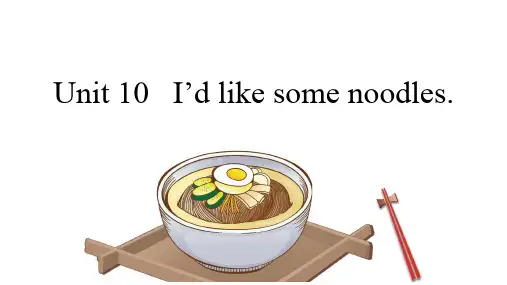
Unit10I'dlikesomenoodles可数名词和不可数名词的用法课件七年级下册
两片面包对于我来说足够了。
two pieces of bread
Uncountable nouns
3. 有些不可数名词也可以作可数名词,但它们的意义有所不同
paper
a paper
hair
She’s got a long hair. She’s got long hair.
fish
There is a fish in the bowl. We eat a lot of fish.
Countable nouns
Rules
3. 以“ 辅音字母+y“结尾的可数名词,要先将y 改为i 再加“es” “以元音字母+y“结尾的可数名词,词尾直接加“s”
candy-candies, boy-boys
4. 以字母f 或fe 结尾的名词,要将f 或fe 改为v ,再在词尾加“es”
knife-knives, leaf-leaves
——人教版 七年级英语——
Countable and Uncountable Nouns
可数名词和不可数名词
What is a noun?
person
人物
Noun
place
地点
thing
事物
This is my teacher. She is from America . She has a book .
牛肉尝起来不是很好。
Uncountable nouns
2. 有些不可数名词可以与量词连用,表示“可数”的概念
a packet of rice
three cups of coffee
Uncountable nouns
2. 有些不可数名词可以与量词连用,表示“可数”的概念
two pieces of bread
Uncountable nouns
3. 有些不可数名词也可以作可数名词,但它们的意义有所不同
paper
a paper
hair
She’s got a long hair. She’s got long hair.
fish
There is a fish in the bowl. We eat a lot of fish.
Countable nouns
Rules
3. 以“ 辅音字母+y“结尾的可数名词,要先将y 改为i 再加“es” “以元音字母+y“结尾的可数名词,词尾直接加“s”
candy-candies, boy-boys
4. 以字母f 或fe 结尾的名词,要将f 或fe 改为v ,再在词尾加“es”
knife-knives, leaf-leaves
——人教版 七年级英语——
Countable and Uncountable Nouns
可数名词和不可数名词
What is a noun?
person
人物
Noun
place
地点
thing
事物
This is my teacher. She is from America . She has a book .
牛肉尝起来不是很好。
Uncountable nouns
2. 有些不可数名词可以与量词连用,表示“可数”的概念
a packet of rice
three cups of coffee
Uncountable nouns
2. 有些不可数名词可以与量词连用,表示“可数”的概念
可数名词和不可数名词PPT课件
考点一 可数名词
规则变化: 5.以o结尾的名词有4个词加es,其他的都加s, 请看加es的四个单
词的口诀: 加es:黑人 (Negro) 喜欢吃土豆 (potato);英雄 (hero) 喜欢
吃西红柿 (tomato) 6.以f或fe结尾的名词,通常先变f或fe为v再加es。可用以下口诀来
SUCCESS
2019/6/25
26
考点链接
C( )Mickey Mouse is one of the most famous ________ in
American ________.
A.symbol; culture C.symbols; culture
B.symbol; cultures D.symbols; cultures
解析:C 考查名词单复数。固定用法“one of the+最高级+可数名词复数” 决定famous后面的名词要用复数;culture 是不可数名词,所以答案是C。
答案:C
考点三 名词所有格
名词所有格用来表示名词和名词之间的所属关系。
1.有生命的名词的所有格
(1)一般名词(不以s结尾)的所有格是在词尾加“'s”。如:
sisters。 但如果由man, woman作前置定语构成的复合名词变复数时,则man或woman与后面的名词都 要变复数。如:two men teachers, some women doctors。 注意:(1)有些名词的单复数形式的意义不同。如:
two fish 两条鱼 two fishes 两类鱼 some people 一些人 some peoples 一些民族 (2)有些名词形式上是以s结尾,但意义上是单数,一般看作单数名词。如: news, maths, physics, politics, the United States等。
可数名词和不可数名词课件
不可数名词不能用数字或量词 进行计数或量化,但可以用量 词短语表示数量或数量的单位
。
不可数名词可以与量词短语一 起使用,表示数量或数量的单
位。
04
可数名词和不可数名词的特
殊情况
可数名词的特殊情况
01
02
03
抽象名词具体化
某些抽象名词在特定语境 下可以具体化为可数名词 ,例如“success”可以 表示“一个成功的人”。
类
可数名词的分类
个体名词
集体名词
物质名词
抽象名词
表示个体或个体的集合 ,如“person”, “family”。
表示一个整体或集合, 如“team”,“class”
。
表示物质或材料的名称 ,如“water”, “air”。
表示抽象的概念或情感 ,如“happiness”,
“love”。
不可数名词的分类
在此添加您的文本16字
详细描述:可数名词和不可数名词在词义上存在差异,通 过对比相同或相似含义的单词在不同分类下的用法,帮助 学生深入理解。
练习题二:可数名词和不可数名词的用法选择
总结词:单复数选择 总结词:量词选择
详细描述:在句子中,需要根据语境选择正确的单复数 形式,通过练习让学生掌握可数名词的复数形式变化规 则。
集体名词可数化
某些集体名词在特定语境 下可以表示个体,例如 “team”可以表示“一个 团队成员”。
物质名词量化
某些物质名词可以用量词 表示一定的数量,例如“ 一杯水”、“一碗饭”。
不可数名词的特殊情况
抽象名词具体化
某些抽象名词在特定语境下可以 具体化为不可数名词,例如
“happiness”可以表示“一件 幸福的事”。