
三年级英语下册第五单元第二课时教案
让学生猜猜那个图片水果消失了,看谁猜的又对又快。
(2)Free talk
教师问:Do you like…?学生让学生说句子Yes, I do或No,I don’t.操练几遍后让学生画出自己喜欢的水果做小组对话练习。
(3)Relax
师播放歌谣apple tree一起放松心情引导同学们对水果的认识,了解每种水果都有自己的营养就价值,建议同学们吃多种类的水果才能均衡营养。
Orange banana
Do you like ...?
Yes, I do./No, I don’t.
(3)以此类推教读pear, orange, banana
(4)Taster time
师生一起品尝水果引出Let’s chant中的句子I eat...并用肢体语言让学生理解yummy和tummy的意思。
(5)Let’s chant
师生一起说唱Letice)
(2)Guess fruit
教师拿出包裹着的苹果用颜色来描述“It’s round and red”让学生来猜(apple)师领读“apple apple It’s an apple.然后师拿出两个苹果教读“apples”T:I like apples .Do you like apples?引导学生用“Yes,I do./No,I don’t”来回答。
StepⅣHomework
1.在家和自己的爸爸、妈妈画出今天学的四种水果,教会爸爸、妈妈用英语说出这四种水果。
2.用Do you like apples/pears...?来询问同学喜欢或不喜欢的水果!
板
书
设
计
Unit 5 Do you like pears?
Let's learn
applepear
⒉Enjoy a song
教师播放《I like apples》的歌谣,学生边听边拍手有节奏地吟唱,导入新课。
StepⅡ呈现新课(Presentation)
(1)通过歌谣,教师询问:“同学们从这首歌谣里听到了那些单词?”同学们自由发言Say:“apple”引出水果。师导入新课领读课题“Do you like pears?”
课型
新授
教具
课件、水果实物单词卡片
教法、学法及
个性化设计
教
学
内
容
与
过
程
StepⅠ热身、复习(Warm-up/Revision)
1. Greeting
T:Hello,boys and girls. Ss:Hello,teacher。T:Nice to see you. Ss:Nice to see you,too.
课题
Unit 5 Do you like pears
Part A Let's learn & Let’s chant
教学目标
1.能够掌握“三会”单词pear orange apple和banana。
2.运用句型“Do you like pears?”“Yes, I do.“/“No, I don’t.”来询问和表达自己的喜好
3.能听懂、会唱“Let’s chant”部分的歌谣.
4.培养学生对水果的兴趣。
教学重点
1.掌握“三会”单词pear orange apple和banana。
2.能运用句型“Do you like...?”询问他人的爱好并进行回答。
教学难点
1.对名词的复数有初步的认识
2. oranges的发音
3. banana的发音
三年级英语下册 Unit5 第二课教案 人教PEP

Unit 5 Where is my ruler?第二课时教学设计一、教学设计思路本课时主要教学内容是bus, taxi, bike, jeep的听、说、认读。
本课时中,教师首先通过让学生观察不同玩具的位置,和学生一块chant,导入本课内容。
然后,教师通过简笔画,让学生猜测物品,进行新词的教学;接着,教师采取任务型教学,将学生分组并制定任务:观看视频或或画面展开讨论,活动结束后,进行组与组之间的互评。
最后,通过看图猜词等游戏对本课时单词及一学过的颜色词进行巩固。
二、教学目标(一)知识听、说、认读单词:bus, taxi, bike, jeep(二)能力能够在实际生活中运用这些词。
(三)情感培养学生说英语,作游戏的兴趣以及乐于模仿,积极参与的学习习惯。
三、教学重点单词bus, taxi, bike, jeep难点:短语“Look out!”的理解和运用。
四、教学媒体1.玩具car, bus, taxi, jeep, bike及图片。
2.教学课件。
五、教学过程1.导入教师将不同物品分别放到不同位置,(或者播放课件中的画面)如:将玩具car放到桌子上,将玩具taxi放到桌子里边,将玩具bus放到椅子下边,然后教师和学生一块表演chant:T: Where is the car?S: On, on, on the desk.T: Where is the taxi?S: In, in, in the desk.T: Where is the bus?S: Under, under, under the chair.…2.呈现新课1)教师画简笔画呈现新课A. 教师首先画两个圆形, 即bike的轮廓,让学生猜测:T: What is it?S: It is a bike.(教师画几笔让学生猜测一次,如果学生猜测正确,教师播放课件或录音让学生跟读;如果猜测不正确,教师接着画……)B. 用同样的方法出现其它交通工具bus, jeep, taxi。
三年级英语下册 Unit5 第二课时教案 牛津译林版
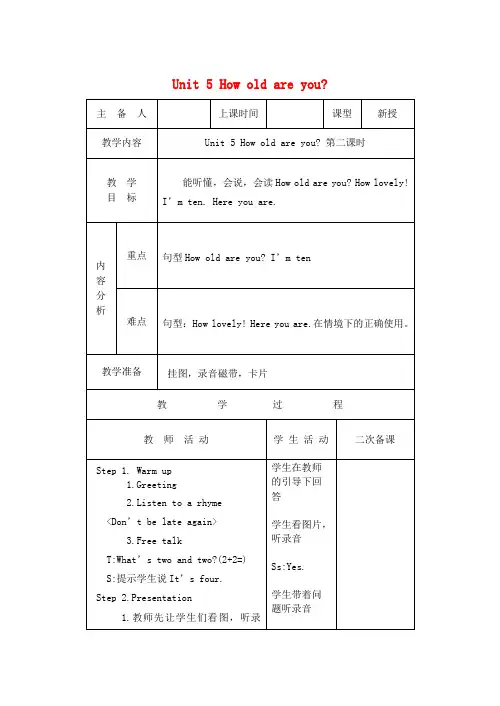
Unit 5 How old are you?中国书法艺术说课教案今天我要说课的题目是中国书法艺术,下面我将从教材分析、教学方法、教学过程、课堂评价四个方面对这堂课进行设计。
一、教材分析:本节课讲的是中国书法艺术主要是为了提高学生对书法基础知识的掌握,让学生开始对书法的入门学习有一定了解。
书法作为中国特有的一门线条艺术,在书写中与笔、墨、纸、砚相得益彰,是中国人民勤劳智慧的结晶,是举世公认的艺术奇葩。
早在5000年以前的甲骨文就初露端倪,书法从文字产生到形成文字的书写体系,几经变革创造了多种体式的书写艺术。
1、教学目标:使学生了解书法的发展史概况和特点及书法的总体情况,通过分析代表作品,获得如何欣赏书法作品的知识,并能作简单的书法练习。
2、教学重点与难点:(一)教学重点了解中国书法的基础知识,掌握其基本特点,进行大量的书法练习。
(二)教学难点:如何感受、认识书法作品中的线条美、结构美、气韵美。
3、教具准备:粉笔,钢笔,书写纸等。
4、课时:一课时二、教学方法:要让学生在教学过程中有所收获,并达到一定的教学目标,在本节课的教学中,我将采用欣赏法、讲授法、练习法来设计本节课。
(1)欣赏法:通过幻灯片让学生欣赏大量优秀的书法作品,使学生对书法产生浓厚的兴趣。
(2)讲授法:讲解书法文字的发展简史,和形式特征,让学生对书法作进一步的了解和认识,通过对书法理论的了解,更深刻的认识书法,从而为以后的书法练习作重要铺垫!(3)练习法:为了使学生充分了解、认识书法名家名作的书法功底和技巧,请学生进行局部临摹练习。
三、教学过程:(一)组织教学让学生准备好上课用的工具,如钢笔,书与纸等;做好上课准备,以便在以下的教学过程中有一个良好的学习气氛。
(二)引入新课,通过对上节课所学知识的总结,让学生认识到学习书法的意义和重要性!(三)讲授新课1、在讲授新课之前,通过大量幻灯片让学生欣赏一些优秀的书法作品,使学生对书法产生浓厚的兴趣。
最新人教PEP版小学英语三年级下册 Unit 5 第2课时 优质课教学设计

最新人教PEP版小学英语三年级下册 Unit 5 第2课时优质课教学设计一、教学目标1.能听懂、会说日常生活中的物品名称;2.能读和写本课所学单词。
二、教学重难点1.教学重点:学生能够听、说、读、写本课所学单词及其用法;2.教学难点:学生能够正确发音并理解单词的用法。
三、教学准备1.教学课件;2.单词卡片;3.学生本人认识的常见物品。
四、教学过程1. 导入新课(5分钟)1.教师向学生展示常见的日常生活中的物品;2.教师鼓励学生说出物品的名称,并用英语读出来。
2. 学习新词汇(15分钟)1.教师向学生展示本课所学单词;2.教师大声读出单词,让学生模仿跟读;3.教师通过展示图片或物品让学生熟悉单词,并解释单词的意思和用法;4.教师让学生朗读单词,并用单词造句。
3. 扩展与运用(20分钟)1.教师通过图片与学生复习所学单词,并让学生口头描述图片中的物品;2.教师播放跟本课内容相关的英语儿童歌谣或视频,让学生听、看并模仿发音;3.教师让学生自己制作一张单词卡片,在卡片上写下一个英文单词和一个汉语意思,让学生通过卡片交流。
4.总结(10分钟)1.教师让学生回顾本课所学内容;2.通过小游戏或小测试来巩固学生所学内容。
五、课后作业1.教师让学生写出本课所学单词和意思;2.教师鼓励学生将所学内容应用在生活中,在家庭成员中使用所学单词进行交流。
六、教学反思在本堂课中,我在导入环节中通过展示常见物品的方式调动起学生的参与度,并切入本课的主题;在学习新词汇环节中,我结合图片和实物,帮助学生更好地理解单词的意思和用法;在扩展与运用环节,我通过视频和图片等多种形式让学生巩固所学内容。
整堂课设计紧凑,具有很好地可操作性,协调了听、说、读、写四个方面的能力,既注重学生的实际操作,让学生感受到知识的实用性、操作性,也引导学生从字母发音入手,逐渐提升发音、整体理解能力和表达能力。
三年级英语下册新人教版UNIT5第二课时教案
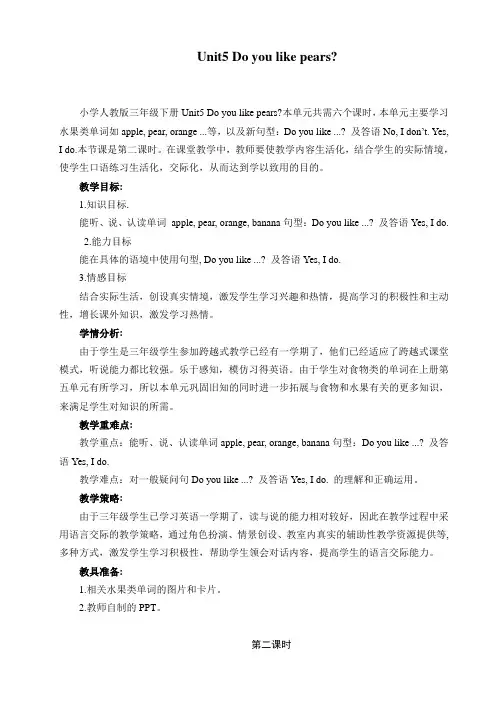
Unit5 Do you like pears?小学人教版三年级下册Unit5 Do you like pears?本单元共需六个课时,本单元主要学习水果类单词如apple, pear, orange ...等,以及新句型:Do you like ...? 及答语No, I don’t. Yes, I do.本节课是第二课时。
在课堂教学中,教师要使教学内容生活化,结合学生的实际情境,使学生口语练习生活化,交际化,从而达到学以致用的目的。
教学目标:1.知识目标.能听、说、认读单词apple, pear, orange, banana句型:Do you like ...? 及答语Yes, I do.2.能力目标能在具体的语境中使用句型, Do you like ...? 及答语Yes, I do.3.情感目标结合实际生活,创设真实情境,激发学生学习兴趣和热情,提高学习的积极性和主动性,增长课外知识,激发学习热情。
学情分析:由于学生是三年级学生参加跨越式教学已经有一学期了,他们已经适应了跨越式课堂模式,听说能力都比较强。
乐于感知,模仿习得英语。
由于学生对食物类的单词在上册第五单元有所学习,所以本单元巩固旧知的同时进一步拓展与食物和水果有关的更多知识,来满足学生对知识的所需。
教学重难点:教学重点:能听、说、认读单词apple, pear, orange, banana句型:Do you like ...? 及答语Yes, I do.教学难点:对一般疑问句Do you like ...? 及答语Yes, I do. 的理解和正确运用。
教学策略:由于三年级学生已学习英语一学期了,读与说的能力相对较好,因此在教学过程中采用语言交际的教学策略,通过角色扮演、情景创设、教室内真实的辅助性教学资源提供等,多种方式,激发学生学习积极性,帮助学生领会对话内容,提高学生的语言交际能力。
教具准备:1.相关水果类单词的图片和卡片。
小学英语PEP人教版三年级下册《Unit 5 Where is my ruler》教案第二课时
小学英语PEP人教版三年级下册《Unit 5 Where is my ruler》教案第二课时一. 教材分析《Unit 5 Where is my ruler》是人教版PEP小学英语三年级下册的一单元,主要学习方位词以及一般疑问句。
本课时为第二课时,主要通过各种任务型活动让学生在实际情境中运用一般疑问句和方位词进行交流。
教材内容丰富,插图生动,有利于激发学生的学习兴趣。
二. 学情分析三年级学生已经掌握了基本的日常英语用语,具备一定的听说读写能力。
但对于一般疑问句的构成和运用还不够熟练,对于方位词的理解和运用也处于初级阶段。
因此,在教学过程中,需要注重学生语言实践的机会,让学生在真实的语境中学习、理解和运用语言。
三. 教学目标1.知识目标:学生能够听懂、会说、会读方位词nearby, far, here, there以及一般疑问句Where is my ruler? Is your ruler here?2.能力目标:学生能够在图片或情景的帮助下,正确使用本节课所学的一般疑问句和方位词进行简单的交流。
3.情感目标:培养学生热爱生活,热爱学习的良好情感。
四. 教学重难点1.重点:学生能够掌握并能熟练运用方位词以及一般疑问句进行交流。
2.难点:学生能够正确运用一般疑问句询问物品的位置。
五. 教学方法采用任务型教学法,通过各种实际情境让学生在实践中学习、理解和运用语言。
同时,运用情境教学法和交际教学法,让学生在真实的语境中学习,提高学生的语言运用能力。
六. 教学准备1.准备教材、PPT等教学资料。
2.准备与课程相关的水果、文具等物品。
3.准备教室环境,以便于学生进行实际操作。
七. 教学过程1.导入(5分钟)通过歌曲或游戏,引导学生进入学习状态。
然后,教师向学生提问:“Can you find your ruler?”,引导学生回答:“Yes, I can.”或“No, I can’t.”,为新课的学习营造轻松的氛围。
(完整)新人教版小学英语三年级下册第五单元教案.docx
(完整)新人教版小学英语三年级下册第五单元教案.docx新人教版小学英语三年级下册第五单元教案Unit 5 Do you like pears ?第一课时主备教师:教学时间: 2015 年月日第周星期教学内容:(A ) Let's talk教学目标:熟掌握本句型:Do you like ? ? Yes, I do. No, I don ’ t. What about ? ? I like ? very much. Let ’ s have some?及水果:pear, orange, apple教学重点:句型Do you like ? ? Yes, I do. No, I don ’ t. What about ?? I like ? very much.Let’ s have some?教学难点:和句型的掌握教学准备:音、卡片教学过程:1 热身、复习(Warm-up/Revision)(1)学生自编日常对话及口语练习。
(2)教师播放歌曲,师生共同演唱。
2 呈现新课(Presentation)(1)教师出示果篮,果篮里装有实物pears, oranges, apples注意:教师果篮中的每种水果应为2 个以上,以便学生理解并运用单词的复数形式。
(2)教师手举“梨”讲述单词 pear ,手举“2 个或 2 个以上梨”讲述 pears 。
以次类推学习 oranges, apples,(3)学生各自拿着自己准备好的水果(也可用图片代替)练习句型,先自己喜的水果,再方是否吃I like ? Do you like??回答:Yes, I do. / No, I don’t.(4)教播放Let’s talk 部分的教学磁学生跟Let’s talk 部分的内容。
特Do you like peaches? Yes, I do. No, I don’t.3 趣味操(Practice)(1)按照Let’s talk 部分的内容,更所学,。
三年级英语下册Unit5第二课时教案人教PEP
人教PEP三年级下册英语Unit 5 Where is my ruler?第二课时【教学目标】1.能听、说、读、写表示交通工具的单词:bus, taxi, jeep, bike以及短语“look out”。
2.给学生提供一个在实际生活中运用语言的机会,巩固询问和回答物品所在的位置的句型Where’s …? 及其It’s in / on / under…【教学重点】1.表示交通工具的单词:bus, taxi, jeep, bike。
2.短语“look out”的理解及其恰当使用。
3.熟练且正确使用提问和回答物品所在位置的句型:Where’s …? 及其It’s in / on / under…【教学难点】物品方位的准确表达,并能在现实生活中灵活运用本课时所学的重要句型。
【教学准备】1.与本课时相关的教学挂图和配套录音。
2.教师和学生都准备所学单词的玩具。
3.教师准备所学单词的卡片和图片。
4.教师给学生准备作为奖励的小礼物。
【教学过程】Step 1:Warm-up1.教师热情地和学生打招呼问好,就上个课时的教学内容做Free Talk。
这是学生喜欢的一项活动,只有通过师生或生生间大量的语言交流,才能培养学生用英语交际的能力。
课堂上的Free Talk 是培养学生听说能力的有效方式。
2.教师请几组同学到台前来表演上个课时所学的对话内容,让学生在自由的表演复习再现所学知识,鼓励学会可以自己增减单词或者句子,提高了课文对话练习的趣味行,也为学生搭建了自主学习的平台。
最后教师要对在练习中表现优秀的同学给与一定形式的奖励,以激发学生学习的热情,达到更好的英语学习效果。
Step 2: Presentation1.教师用简笔画首先画两个圆形, 问:What is it? 学生回答: It is a bike.之后用同样的方法出现交通工具bus, taxi。
2.教师故意让bus 和taxi相撞,然后说:“Look out!”借助图画让学生明白这个词组的意思是“当心,留神”。
三年级英语下册 Unit5 第二课时教案 人教PEP
当堂检测:
Listen and draw
(1) Draw a bus .
( 2)Draw a red taxi .
(3)Draw a bike on the chair.
Let’s check (P57书)
3.圈出所学单词并翻译成汉语。
(1) abikefh_______ ________
2.Read after the teacher all the words.
3.Listen to the tape.听音跟读,听音模仿。
4.游戏:猜猜在哪里?
规则:教师在黑板上画一张大桌子,请一位学生背对黑板,然后教师画着taxi等玩具的图片贴在桌子的不同位置,全班学生问:Where is the taxi ?让背对着黑板的学生猜,给他(她)两次机会,如猜对了可以给本组加分,最后评出胜利的一组给予奖励。
重点:听、说、认读单词bus , taxi , jeep ,bike会在实际生活中运用。
难点:短语look out的理解、连读及运用。
三、教学准备
图片、单词卡片、录音机、玩具或自制卡片。
四、教学过程
教学步骤
个案分析
情景引入:
Greeting .
T: Hello, boys and girls.
S: Hello,teacher.
交流研讨(交流记忆单词的好方法)
生生交流
师生交流
质疑答疑
教师做bus与taxi相撞的动作,然后说“Look out.”让学生猜意思“当心”教师及时肯定。
(教师可利用纸团等东西做要打到某个学生的动作来巩固look out.)
专项训练
1.学生分组把自己的玩具或图片由组内一名学生藏起来,问本组其他学生Where is my car?其他组员猜。可用句子In the _____? On the ____? Under the _____?
小学英语三年级下册第五单元教案4篇
小学英语三年级下册第五单元教案4篇小学英语三年级下册第五单元教案篇1教学目标:1.能听懂特殊疑问句What is this并能根据情况用It is a...回答。
2. 能使用特殊疑问句What is this向他人询问和确认某件物品,语音语调正确。
3. 能听懂,会说duck, cow, pig, dog, cat的单数形式,发音准确。
重点难点:1. 能听懂特殊疑问句What is this并能根据情况用It is a...回答。
2. 能使用特殊疑问句What is this向他人询问和确认某件物品,语音语调正确。
教学过程:一、Warmup1. Sing a song(歌曲营造活跃轻松的气氛。
)2. Read the words one by one.3. Each group introduces aname of animal themselves.(热身环节让学生复习学过的单词,为本课学习打下基础。
同时,发挥学生的主动性,让他们为自己组取一个动物名字进行小组竞赛。
有趣的同时,从一开始就培养他们的合作精神。
并由此开始了一个过程性评价。
)二、Revision1. Ask and answer.T: Do you like animals What is thisSs: It’s a dog.T: Now we are on a farm. Theclass is a farm.Ss: Ok.T: Let’s listen to the tape.T: Now read after teacher:What’s this(学生跟读句型,师相机纠正学生读音。
)Ss: Read one by one.T: What’s this (师出示动物图片,提问。
)Ss: It’s acow/dog/pig/cat/duck.2. A riddle: It’s an animal.It’s big. It has a big nose and big ears. It has small eyes.What is it3. Draw a pig on theblackboard.(通过问答,复习所学的动物名词。
人教版三年级下册英语第五单元第二课时教学设计
人教版三年级下册英语第五单元第二课时教学设计全文共3篇示例,供读者参考篇1Title: Lesson Plan for Unit 5, Lesson 2 of Grade 3 English textbookGrade: Grade 3Unit: Unit 5 - In the countrysideLesson: Lesson 2 - What’s in the village?Objectives:1. Students will be able to identify and recognize common places and objects in a village.2. Students will be able to use the phrases "There is" and "There are" to describe what is in a village.3. Students will be able to ask and answer questions about the village using the phrases learned.Materials needed:1. Pictures of different places and objects in a village2. Flashcards of vocabulary words3. Whiteboard and markers4. Worksheets for practiceWarm-up (10 minutes):1. Greet the students and review the vocabulary words learned in Lesson 1.2. Show pictures of different places in a village (e.g. school, park, supermarket) and ask students to identify them.3. Practice pronunciation of the words and ask students to repeat after you.Presentation (15 minutes):1. Introduce the new vocabulary words for Lesson 2: "There is" and "There are."2. Use flashcards to show different objects and places in a village and model sentences using the new phrases (e.g. "There is a school in the village").3. Explain the difference between "There is" (singular) and "There are" (plural) using examples.4. Practice pronunciation and use of the phrases with the students.Practice (20 minutes):1. Divide the students into pairs or small groups.2. Give each group a set of flashcards with pictures of objects and places in a village.3. Students take turns asking and answering questions using the phrases "Is there...?" and "Are there...?" (e.g. Student A: "Is there a park in the village?" Student B: "Yes, there is.")4. Circulate around the classroom to provide assistance and correct any mistakes.Production (15 minutes):1. Give each student a worksheet with pictures of a village scene.2. Students write sentences using "There is" and "There are" to describe the objects and places in the village.3. Encourage students to be creative and use their imagination to describe the village scene.4. Review and discuss the sentences as a class.Wrap-up (5 minutes):1. Review the vocabulary words and phrases learned in the lesson.2. Ask students to share their favorite place in the village and why they like it.3. Assign homework for students to practice writing sentences using "There is" and "There are."Assessment:1. Observe students during the practice and production activities to assess their understanding and use of the new phrases.2. Review students' worksheets to check for comprehension and correct usage of the vocabulary words and phrases.Reflection:Overall, this lesson plan is designed to engage students in learning about places and objects in a village through interactive and communicative activities. By incorporating vocabulary practice, pronunciation, and sentence structure, students are able to develop their speaking and writing skills in English. The use of visuals and hands-on activities helps reinforce the new concepts and allows for active participation from all students.篇2Title: Teaching Plan for Grade 3 Unit 5 Lesson 2 of People's Education EditionIntroduction:In this teaching plan, we will discuss the teaching strategies, activities, and assessments for Grade 3 Unit 5 Lesson 2 of the People's Education Edition. This lesson focuses on the topic of daily routines, specifically on the activities people do in the morning.Key Vocabulary:- Get up- Wash- Brush- Dress- Eat breakfast- Go to schoolObjectives:- Students will be able to understand and use the key vocabulary related to daily routines.- Students will be able to describe their own morning routine.- Students will be able to identify the daily routines of others.Teaching Strategies:1. Engage students by starting a discussion about their morning routines. This can be done through a brainstorming activity or a show-and-tell where students share items related to their morning routines.2. Introduce the key vocabulary through flashcards, visuals, and gestures to aid comprehension.3. Use realia such as a toothbrush, towel, and clothes to demonstrate the actions related to the vocabulary words.4. Practice the vocabulary through activities such as matching exercises, fill-in-the-blank sentences, and role-playing scenarios.5. Encourage students to create their own morning routine charts using the key vocabulary.Activities:1. Warm-up: Sing a song or play a game related to daily routines to energize students.2. Vocabulary Practice: Have students match pictures to key vocabulary words.3. Speaking Activity: Pair students and have them take turns describing their morning routines to each other.4. Listening Activity: Play an audio recording of a morning routine and have students write down the actions they hear.5. Role-Playing: Divide students into groups and have them act out a morning routine skit.Assessment:- Observations during speaking and role-playing activities- Written quizzes or worksheets on the key vocabulary- Individual student presentations on their morning routinesConclusion:By incorporating engaging activities, real-life examples, and varied assessments, students will be able to master the key vocabulary related to daily routines and confidently describe their own morning routines. This teaching plan aims to create adynamic and interactive learning environment for Grade 3 students in Unit 5 Lesson 2 of the People's Education Edition.篇3Title: Lesson Plan for Unit 5, Lesson 2 of People's Education Press Third Grade English BookObjective:1. Students will be able to identify and use vocabulary related to daily routines.2. Students will be able to describe their own daily routines using simple sentences.3. Students will be able to ask and answer questions about daily routines.Materials:- Flashcards with pictures of daily routines activities (e.g. brush teeth, eat breakfast, go to school)- Worksheet with sentences describing daily routines- Whiteboard and markers- CD player with the audio for the lesson- Copies of the textbookProcedure:1. Warm-up (10 minutes):- Begin the lesson by reviewing vocabulary from the previous lesson (e.g. colors, numbers).- Play a quick game of Simon Says using actions related to daily routines (e.g. brush teeth, comb hair).- Ask students questions about their own daily routines to activate prior knowledge.2. Presentation (15 minutes):- Introduce new vocabulary related to daily routines using flashcards. Model the pronunciation and use of each word.- Play the audio for the lesson and have students repeat after the speaker.- Use the whiteboard to write down the vocabulary words and their meanings.3. Practice (20 minutes):- Divide the class into pairs or small groups and give each group a worksheet with sentences describing daily routines.- Have students match the sentences to the correct pictures of daily routines activities.- Encourage students to practice asking and answering questions about daily routines with their partners.4. Production (15 minutes):- Ask students to create a simple daily routines timetable for themselves on the whiteboard.- Have students take turns presenting their timetables to the class, using the vocabulary and sentences they have learned.5. Review and Assessment (10 minutes):- Play a quick review game with the flashcards, asking students to match the words to the correct pictures.- Ask students to describe their own daily routines to a partner, using the vocabulary and sentences from the lesson.- Provide feedback and assess students' understanding of the lesson objectives.6. Homework (5 minutes):- Assign homework to reinforce the lesson objectives, such as writing a short paragraph about their daily routines orcompleting a worksheet with additional exercises on daily routines.Overall, this lesson is designed to engage students in learning vocabulary related to daily routines and practicing speaking and listening skills in a fun and interactive way. By the end of the lesson, students should feel comfortable using the new vocabulary and be able to talk about their own daily routines confidently.。