
初一下学期英语笔记
作文范文My favourite movie star is Zhou xingchi.His English name is Stephen Chow.His birthday is in June 22nd.He is 33 years old now.He is from China.He lives in Hong Kong.He can speak Chinese and a little English.His favourite color is green.He likes swimming very much.His hobby is singing.He often sings songs with friends on weekends.But he can’t sing well.He has a brother and 3 sisters is his family.I like comedies and I like him very much.My favourite movie is Kung Fu.I think it is interesting.I think Stephen Chow is a successful actor.Unit 11. be from=come from 来自(有be动词不用come)e.g. I am from Dongguan=I come from Dongguan.Where are you from=Where do you come from?2. 某过人的复数变化口诀:中日不变,英法变,其余s加后面。
3. 国籍nationality 要用国家的形容词形式来回答。
4. 英语中小单位在前,大单位在后。
Beijing,China Class 2,Grade 15. in:一段时间on:具体某一天at:多少点6. speak:+语言say:+说话内容tell:+故事,笑话talk:talk about sth talk with/to sb 谈论7. a little:一点+不可数名词little:几乎没有+不可数名词a few:几个+可数名词few:几乎没有+可数名词8. like doing sth=like to do sth 喜欢做某事Would like to do sth 愿意做某事9. write to sb=write a letter to sb 写信给某人e.g. He often writes to his pen pals.10. tell sb about…告诉某人有关…tell sb to do sth 叫某人做某事e.g. Please tell them to come in.重点短语①be from=come from 来自②讲日语和法语speak Japanese and French③a little 一点点④喜欢做某事like doing sth=like to do sth⑤go to the movies with friends 和朋友去看电影⑥too difficult 太难了⑦write to me soon 尽快写信给我⑧在周末on weekends ⑨tell me about yourself 告诉我关于你自己的事⑩tell sb to do sth 告诉某人要做某事⑪Where is your pen pal from? She is from Australia. 你的笔友来自哪里?他来自澳大利亚。
⑫Where does Tom’s friend live?He lives in Tokey,Japan.Tom的笔友住在哪里?他住在日本,东京。
⑬What language does Mr Green speak?He speaks English and Chinese.格林先生讲什么语言?他讲英语和中文。
⑭I like going to the movies with friends and playing sports.我喜欢和朋友去看电影和做运动。
⑮My favourite subject is music,because it’s fun..我最喜欢的科目是音乐,因为它很有趣。
Unit 21. There be 句型(1)就近原则:be动词应该跟最近的主语保持一致。
(2)一般疑问句把be动词放在句首,回答用there。
(3)否定句在be动词后面加not。
(4)There be 强调“某地方存在某事物”have/has 强调“主语拥有某事物”2.方位介词:across from=on the other side of 在…对面between A and B 在…和…之间in front of 在…前面in the front of 在…前半部分My pen palI have a pen pal.His name is Tom King.His first name is Tom.His last name isKing .He is 14 years old.And he is from Australia.He speaks English.He has a brotherand a sister.His favourite sport is soccer.He often plays soccer with friends onweekends.He likes music at schools.It’s fun.His favourite movie is The LongWeekend.It’s an action movie.He often writes to me and tell me about him self.3. Let sb do sth=make sb do sth 让/使某人做某事。
e.g. Let him come in.4. (on)the way to (在)去…的路上e.g. on the way to schoolon the way home5. arrive in 到达(大地点)(如城市,国家)arrive at 到达(小地点)(如车站,学校,医院)get to 到达reach+地点到达*arrive还可以单独使用:arrive和get后面如果跟地点副词,要省略介词。
reach后面一定要跟地点,不能单独使用。
6. across:横穿街道、河流、桥梁等,强调在物品面前越过。
cross:v.=go cross/walk a crossthrough:穿过森林,公园、窗户、门等,强调在物体内部空间通过。
over:在物体上方横跨。
7. enjoy doing sth 喜欢做某事,享受做某事。
e.g. I enjoy reading books on rainy days.8. with:(1)和…一起(2)具有,带有。
(3)用某种工具或方式。
都是表示伴随状态。
(不做主语)9. at the beginning of=at the start of 在…的开头。
10. “to+动词原形”称为不定式结构、可以放在名词后面做宾语,起修饰作用。
e.g. I have lots of homework to doa good place to have fun11. 问路方法:(1)Excuse me 开头(2)Where is the…?/Is there a…near hear?/Can you tell me the way to the…?How can I get to the…? Could you tell me how I can get to the…?(3)Thank you all the same 同样要感谢你13. have fun 玩得开心=have a good time=enjoy+反身代词重点短语(1)go straight 直走(2)go down 沿着…走下去(3)turn left/right 向左/右(4)on the left/right 在左边/右边(5)in the neighborhood=near here 在附近(6)Let sb do sth 让某人做某事(7)on the way to 在…的路上(8)walk through the park 穿越公园(9)walk across the street 横过马路(10)across from 在…对面(11)between…and…在…和…之间(12)take a taxi 做的士(13)take a walk 散步(14)have a good trip 旅途愉快(15)arrive in/at=get to 到达(16)enjoy doing sth 享受/喜欢做某事(17)have fun/have a good time/enjoy oneself 玩得开心(18)a good place to have fun(19)at the beginning of 在开头(20)a busy street 一条繁忙的街道(21)an old hotel 一间旧旅馆(22)keep quiet 保持安静Unit 31. Let’s do sth=Let us do sth 让我们做某事 Let sb do sth 让某人做某事e.g. Let’s go to school. Let him come in.2. kind(1)种类:a kind of 一种…this kind of 这种…many kinds of 许多种…all kinds of 各种各样…(2)kind of=a little 有一点,有几分。
3. friendly:adj. 友好的 be friendly to sb 对某人友好unfriendly:不友好的e.g. Chinese people arefriendly to foreigners(外国人)4. other:泛指“其他的” other+名词=othersthe other:特指某种范围内的其他人或事物 the other+名词=the othersanother:“另一个,又一个”常指三个或三个以上同类事物中可选择另一个,再一个。
※常见搭配:(1)one…the other…(两者中)一个…另一个(2)each other 互相My Favourite AnimalsMy favourite animals are pandas.Because they’re cute.They have big ears and eyes.They’re black and white.They’re from China.They like to eat bamboos and play with friends.I think they’re very intertesting and kind of shy.I don’t like elephants because they are too big and too strong.And I don’t think they are beautiful.I have a good friend.His name is Tom.He likes dolphins very much.Because they are clever and smart.They can help people in water.Tom does n’t like lions.Because they’re ugly.They are from South Africa.Tom thinks they are sacry.重点短语①a map of China 一幅中国地图②kind of shy 有点害羞③south Africa 南非④like to play with friends 喜欢和朋友玩⑤eat grass and leaves 吃草和叶子⑥Please be quiet 请安静⑦during the day=in the day 在白天⑧at night=in the evening 在晚上⑨relax for an hour 放松一小时⑩an interesting elephant 一头有趣的大象⑪Why do you like pandas? Because they’re scary and ugly.你为什么喜欢熊猫?因为它们友好又聪明。
初一下册英语 第72页的笔记

初一下册英语第72页的笔记一、星期(week /wi:k/ ):Sunday /'sʌndei/ 星期日Monday /'mʌndei/ 星期一Tuesday /'tju:zdei/ 星期二Wednesday /'wenzdei/ 星期三Thursday /'θəzdei/ 星期四Friday /'fraidei/ 星期五Saturday /'sætədei/ 星期六二、月份:(month /mʌnθ/ )January /'dʒænjuəri/ 一月February /'februəri/ 二月March /ma:tʃ/ 三月April /'eiprəl/ 四月May /mei/ 五月June /dʒu:n/ 六月July /dʒu'lai/ 七月August /'ɔ:gəst/ 八月September /sep'tembə/ 九月October /ɔk'təubə/ 十月November /nəu'vembə/ 十一月December /di'sembə/ 十二月三、称谓:aunt /a:nt/姑母boy /bɔi/ 男孩brother /'brʌðə/ 兄弟classmate /'kla:smeit/ 同班同学cousin /'kʌzn/ 堂兄(弟、姐、妹)daughter /'dɔ:tə/ 女儿father /'fa:ðə/ 父亲;爸爸friend /frend/ 朋友girl /gə:l/ 女孩mother /'mʌðə/ 母亲;妈妈Mr. /'mistə/ 先生Mrs. /'misiz/ 夫人Ms. /miz/ 女士parent /'peərənt/ 父(母)亲sister /'sistə/ 姐;妹son /sʌn/ 儿子student /'stju:dnt/ 学生uncle /'ʌŋkl/ 叔叔woman /'wumən/ 女子四、食物:(food /fu:d/)apple /'æpl/ 苹果banana /bə'na:nə/ 香蕉bread /bred/ 面包breakfast /'brekfəst/ 早餐carrot /'kærət/ 胡萝卜chicken /'tʃikin/ 鸡肉fruit /fru:t/ 水果hamburger /'hæmbə:gə/ 汉堡包ice-cream /ais'kri:m/ 冰激凌lunch /lʌntʃ/ 午餐milk /milk/ 牛奶orange /'ɔrindʒ/ 橙子pear /peə/ 梨rice /rais/ 大米;米饭salad /'sæləd/ 沙拉strawberry /'strɔ:bəri/ 草莓tomato /tə'ma:təu/ 西红柿vegetable /'vedʒtəbl/ 蔬菜五、球类:baseball /'beisbɔ:l/ 棒球basketball /'ba:skitbɔ:l/ 篮球bat /bæt/ 球拍soccer /'sɔkə/ (英式)足球tennis /'tenis/ 网球volleyball /'vɔlibɔ:l/ 排球六、颜色(color /'kʌlə/ =colour):black /blæk/ 黑色(的)blue /blu: 蓝色(的)brown /braun/ 棕色(的)green /gri:n/ 绿色(的)purple /'pə:pl/ 紫色(的)red /red/ 红色(的)white /wait/ 白色(的)yellow /'jeləu/ 黄色(的)七、科目(subject /'sʌbdʒekt/):art /a:t/ 美术Chinese /tʃai'ni:z/ 语文geography /dʒi'ɔgrəfi/ 地理history /'histri/ 历史math /mæθ/ 数学P.E. /pi: 'i: 体育science /'saiəns/ 科学八、基数词:zero /'ziərəu/ 零one /wʌn/ 一two /tu: 二three /θri: 三four /fɔ: 四five /faiv/ 五six /siks/ 六seven /'sevn/ 七eight /eit/ 八nine /nain/ 九ten /ten/ 十eleven /i'levən/ 十一twelve /twelv/ 十二thirteen /θə:'ti:n/ 十三fifteen /fif'ti:n/ 十五eighteen /ei'ti:n/ 十八twenty /'twenti/ 二十thirty /'θə:ti/ 三十。
最新人教版七年级英语下册课堂笔记

人教版七年级英语下册课堂笔记------------------------------------------作者xxxx------------------------------------------日期xxxx七年级英语下册课堂笔记 ---2014。
4第一单元1. play the guitar弹吉他2. want to do sth 想做某事3. join the music club 加入音乐俱乐部4。
speak English说英语5. play chess 下棋6。
be goodat telling s tories擅长讲故事be good at doing sth。
擅长做某事do well in doing sth。
擅长做某事be good with sb 善于与某人相处7. a little + 不可数名词一点儿……8。
like to do/doing喜欢做某事9。
sounds good 听起来好10.talk to /with sb跟某人谈话11。
after school 放学后12. do kung fu 表演功夫13。
play gameswith 和…做游戏14。
can + 动词原形能/会做某事15。
have fun doing 做事情很有趣16. on the weekend 在周末17. call sb at 给某人打电话18. helpsb do 帮助某人help sb with sth 帮助某人做事19。
English-speaking 说英语的20。
play the piano 弹钢琴21. tell stories讲故事22. be free / bebusy 空闲的/繁忙的23。
be good with 和某人相处好24。
make friends with和某人交朋友25.or 或者,用于否定句和疑问句中;2 / 202and和,用于肯定句中26. music音乐—musician 音乐家1.in用在年、月、季节、早中晚前in 1992, in May, inspring, in the morning;2.on用在星期、具体某一天或具体某一天早中晚前on Monday,on October1ston themorningof on October1st3.at 用在钟点前atsix1.play后接球类运动及棋牌不加theplay football,play chess2.play后接乐器加theplay the guitar1.can + 动词原形2.can not构成否定ﻬ第二单元1。
七下英语笔记

have to must
必须;不得不 必须
强调外界客观因素要求主语“不得不做某事”,表示客观上的需要, 强调被迫性,含有不情愿的色彩,有时态、人称和数的变化,其后 接动词原形。 don’t / doesn’t have to 意为“不必;不必要”,相当于 needn’t 表示说话人的主观意志和看法,含有自觉、自愿的色彩,不能用于 过去时或将来时,也没有人称和数的变化,mustn’t表示“禁止;不 允许;一定不要”
She is strict with her students and strict in her work.她对她的学生和工作要求严格。
My teacher is strict in/about my study. 我的老师对我的学习要求严格。
My mother is strict with me.
我们得努力工作。
I have to study hard.
我不得不努力学习。
I must study hard.
我必须努力学习。
You don’t have to tell him about it. 你没必要把这件事告诉他。
You mustn’t tell him about it.
你一定不要把这件事告诉他。
别一直待在屋里。让我们到外面玩吧。
形容词:an outside toilet
户外厕所
Outside workers need warm clothes in winter. 冬天,户外作业的工人需要暖和的衣服。
The outside wall is painted white.
外面的墙被刷成了白色。
Please look at the book, boys!
男孩们,请看书。
人教版七下英语Unit4笔记资料
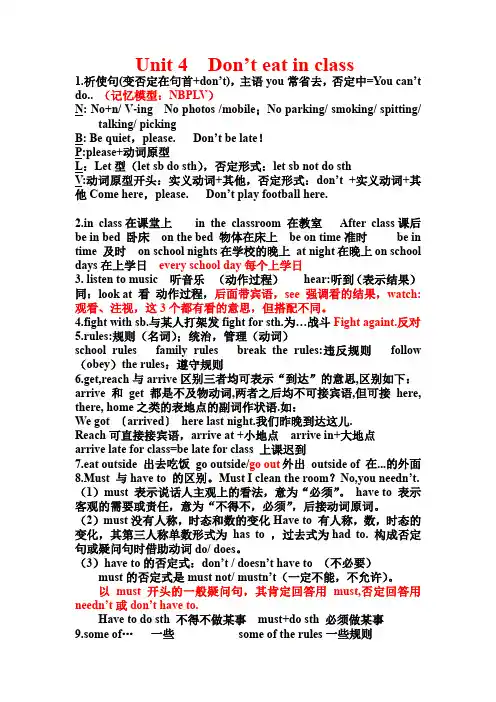
Unit 4 Don’t eat in class1.祈使句(变否定在句首+don’t),主语you常省去,否定中=You can’t do.. (记忆模型:NBPLV)N: No+n/ V-ing No photos /mobile;No parking/ smoking/ spitting/ talking/ pickingB: Be quiet,please. Don’t be late!P:please+动词原型L:Let型(let sb do sth),否定形式:let sb not do sthV:动词原型开头:实义动词+其他,否定形式:don’t +实义动词+其他Come here,please. Don’t play football here.2.in class在课堂上in the classroom 在教室After class课后be in bed 卧床on the bed 物体在床上be on time准时be in time 及时on school nights在学校的晚上at night在晚上on school days在上学日every school day每个上学日3. listen to music 听音乐(动作过程)hear:听到(表示结果)同:look at 看动作过程,后面带宾语,see 强调看的结果,watch:观看、注视,这3个都有看的意思,但搭配不同。
4.fight with sb.与某人打架发fight for sth.为…战斗Fight againt.反对5.rules:规则(名词);统治,管理(动词)school rules family rules break the rules:违反规则follow (obey)the rules:遵守规则6.get,reach与arrive区别三者均可表示“到达”的意思,区别如下:arrive 和get都是不及物动词,两者之后均不可接宾语,但可接here, there, home之类的表地点的副词作状语.如:We got 〔arrived〕here last night.我们昨晚到达这儿.Reach可直接接宾语,arrive at +小地点arrive in+大地点arrive late for class=be late for class 上课迟到7.eat outside 出去吃饭go outside/go out外出outside of 在...的外面8.Must 与have to 的区别。
人教版七年级下册英语1-12单元学霸笔记

人教版七年级下册英语1-12单元学霸笔记Unit1小结笔记一、重点单词guitar, sing, swim, dance, join, club, story, violin, people, center, teach, musician.二、形转换:music(人) tooth(复数)swim (ing形式)art(人) piano (人) teach(人)三、短语:play chess, play the guitar, swimming club, speak English, be good at, play the drums, play the piano, play the violin, a little, do Chinese kungfu, tell stories, sounds good, students wanted, make friends, talk to sb, the girl in red, on the weekend/on weekends, English-speaking students,四、句子:1. can you swim?以及回答2. what club do you want to join?五、语法结构:1. can 的用法Can you swim?—yes, I can.Tom can sing well.I can’t draw.2. want to do sth = would like to do sthShe wants to play soccer.=She would like to play soccer.3. be good at/ with/for4. help sb (to)do sth=help sb with sthHe often helps me (to)study English.=He often helps me with my English.5.play basketball, play the guitar, play with snow,Unit2小结笔记一、重点单词:usually, forty, never, early, job, funny, exercise, best, clean, sometimes , taste, life二、词形变换:tooth(复数) early (反义词)job(同义词)run(名词)life(复数)三、短语:get up, get dressed, take a shower, radio station, at night, on weekends, half an hour, a quarter to ten, do one’s homework, take a walk, e ither…or…, lots of, go to school/work, an interesting job, eat dinner, half past six, go home, go to bed early, eat quickly, get home, after school,四、句子:1、what time do you usually get up?2、when does she go to work?3、I sometimes play basketball for half an hour.4、that’s a funny time for breakfast.五、语法结构:1、when/what time +do/does+主语+动词原形+其他?2、时间表达法:顺读法如:7:20读作seven-twenty倒读法:此方法是“先读分钟数”,再读“钟点数”,使用此方法要注意两点:A、如果分钟数在30以内,就用“分钟数+past+钟点数”表示,介词past意为“过”。
英语七下第1单元短语笔记。

英语七下第1单元短语笔记。
English Phrases for Grade 7, Unit 1Good morning/afternoon/evening! 早上好/下午好/晚上好!How are you?你好吗?I'm fine, thank you. And you?我很好,谢谢。
你呢?Nice to meet you.很高兴认识你。
Nice to meet you, too.我也很高兴认识你。
What's your name?你叫什么名字?My name's ...我叫……Goodbye!再见!See you later!待会儿见!Be careful!小心!Thank you!谢谢!You're welcome!不客气!Sorry, I'm late.对不起,我迟到了。
That's OK.没关系。
Hello!你好!Hi!嗨!This is ...这是……And these are ...而这些是……Is this your pencil?这是你的铅笔吗?Yes, it is. Thank you!是的,谢谢!No, it isn't. Mine is blue.不,不是。
我的是蓝色的。
What about this one? Is this yours?那这个呢?这是你的吗?Yes, that's mine.是的,那是我的。
How do you spell it?你如何拼写它?Can you spell it, please?请你拼写一下好吗?What color is it?它是什么颜色的?It's black and white.它是黑白相间的。
The key is yellow.这把钥匙是黄色的。
The cup is my sister's.这个杯子是我姐姐的。
The jacket is nice.这件夹克很好看。
人教版七年级英语下课堂笔记整理
人教版七年级英语下课堂笔记Unit1一、重点短语1. at the old people's home在敬老院2. be good at singing 善于唱歌3. be good at swimming 善于游泳4.be good at dancing 跳舞5. be good with old people与老人相处得好6. be in our school music festival参加我们学校的音乐节7 come and show us来给我们展示一下8. come to the Students' Sports Center来学生运动中心9. do Chinese kung fu表演中国功夫10.English-speaking students说英语的学生11. help with sports在运动方面提供帮助12. in the music room在音乐室13. in the school music club在校音乐俱乐部14. in the school show在学校汇演中15.join the swimming club加入游泳俱乐部16.like drawing/like to draw喜欢画画17. make friends with sb. 和某人交朋友18. musicians wanted 招聘音乐家19. need help to teach music需要帮助去教音乐20. on the weekend/on weekends(在)周末21 play chess下国际象棋22. play games with people与人玩游戏23. play the drums敲鼓"24. play the guitar弹吉他25. play the piano 弹钢琴26. play the violin 拉小提琴"27. students wanted for the school show为学校演出招募学生28. tell stories讲故事29. the story telling club讲故事俱乐部30. talk with sb. about sth. 和某人谈论某事二、重点句型1.—Can you play the guitar or the violin?你会弹吉他还是拉小提琴?—I can play the guitar.我会弹吉他。
英语笔记初一下册
英语笔记初一下册一、重点单词。
1. 名词。
- guitar:吉他。
例如:I can play the guitar.(我会弹吉他。
)- club:俱乐部;社团。
如:I want to join the music club.(我想加入音乐俱乐部。
)- story:故事;小说。
He likes reading stories.(他喜欢读故事。
)- dress:连衣裙。
She has a beautiful dress.(她有一条漂亮的连衣裙。
)- rule:规则;规章。
We must follow the school rules.(我们必须遵守学校规则。
)2. 动词。
- speak:说(某种语言);说话。
Can you speak English?(你会说英语吗?)- join:参加;加入。
Let's join the art club.(让我们加入美术俱乐部吧。
)- draw:画。
He can draw very well.(他画得很好。
)- write:写;写作。
I often write letters to my friends.(我经常给我的朋友写信。
)- arrive:到达。
We arrive at school at 7:30.(我们7:30到达学校。
)3. 形容词。
- friendly:友好的。
My classmates are very friendly.(我的同学们非常友好。
)- quiet:安静的。
The library is a quiet place.(图书馆是一个安静的地方。
)- noisy:吵闹的。
Don't be noisy in class.(不要在课堂上吵闹。
)二、重点短语。
1. play the guitar/piano/violin:弹吉他/钢琴/小提琴。
注意乐器前要加the。
2. want to do sth:想要做某事。
例如:I want to play basketball.(我想要打篮球。
2024年初一英语笔记
2024年初一英语笔记一、单词。
(一)重点单词。
1. name.- 词性:名词/动词,作名词时表示“名字;名称”,例如:My name is Tom. 作动词时表示“命名;名叫”,例如:They named their baby girl Lily.2. nice.- 词性:形容词,意为“美好的;令人愉快的;友好的”,例如:She is a nice girl.3. to.- 词性:介词/不定式符号,作介词时表示“到;向;(表示时间、方向)朝……方向”,例如:Go to school. 作不定式符号时用于构成动词不定式,例如:I want to play football.4. meet.- 词性:动词,意为“遇见;相逢”,例如:Nice to meet you.5. too.- 词性:副词,有“也;太;非常”的意思,例如:I like apples, too.(表示“也”);This box is too heavy.(表示“太”)6. your.- 词性:形容词性物主代词,意为“你的;你们的”,例如:Your book is on the desk.(二)单词记忆方法。
1. 联想法。
- 对于“name”这个单词,可以联想一个有名字的人或者事物,比如名人的名字。
像“Taylor Swift”,她的名字全世界很多人都知道,这样就容易记住“name”这个单词的含义。
2. 对比记忆法。
- 对比“too”和“to”。
“too”有“也”的意思,在句子中经常用于句末,而“to”更多的是表示方向或者用于构成不定式。
例如:I go to school.(“to”表示方向),I like music, too.(“too”表示“也”)二、短语。
1. nice to meet you.- 用法:用于初次见面时的问候语,回答通常是“Nice to meet you, too.”- 例句:A: Nice to meet you. B: Nice to meet you, too.2. be from.- 用法:表示“来自……”,后面接地点名词。
七下英语人教版第三单元笔记
七下英语人教版第三单元笔记 Unit 3 Notes.Section 1: A Trip to the Zoo.Vocabulary:animal (动物)。
zoo (动物园)。
tiger (老虎)。
lion (狮子)。
elephant (大象)。
giraffe (长颈鹿)。
monkey (猴子)。
bird (鸟)。
fish (鱼)。
Grammar:Simple Present Tense (一般现在时)。
Present Continuous Tense (现在进行时)。
Section 2: Animals and Their Homes.Vocabulary:habitat (栖息地)。
forest (森林)。
grassland (草原)。
desert (沙漠)。
ocean (海洋)。
river (河流)。
lake (湖泊)。
Grammar:Prepositions of Place (方位介词)。
Section 3: Animal Behavior.Vocabulary:behavior (行为)。
instinct (本能)。
learned behavior (习得行为)。
communication (交流)。
migration (迁徙)。
Grammar:Modal Verbs (情态动词)。
Section 4: Animal Conservation.Vocabulary:conservation (保护)。
endangered species (濒危物种)。
habitat destruction (栖息地破坏)。
pollution (污染)。
poaching (偷猎)。
Grammar:Passive Voice (被动语态)。
中文回答:第一单元,动物园之旅。
词汇:动物(animal)。
动物园(zoo)。
老虎(tiger)。
狮子(lion)。
大象(elephant)。
长颈鹿(giraffe)。