
2014年12月英语四级真题试卷(第3套)
2014年12月英语四级考试真题试卷(3)Part I Writing (30 minutes) Directions: For this part, you are allowed 30 minutes to write a short essay about a campus activity that has benefited you most. You should state the reasons and write at least 120 words but no more than 180 words.注意:此部分试题在答题卡1上________________________________________________________________________ ________________________________________________________________________ ________________________________________________________________________Part II Listening Comprehension(30 minutes) Section ADirections: In this section, you will hear 8 short conversations and 2 long conversations. At the end of each conversation, one or more questions will be asked about what was said. Both the conversation and the questions will be spoken only once. After each question there will be a pause. During the pause, you must read the four choices marked A), B), C) and D), and decide which is the best answer. Then mark the corresponding letter on Answer Sheet 1 with a single line through the centre.注意:此部分试题请在答题卡1上作答。
1. A) She will go purchase the gift herself.B) The gift should not be too expensive.C) The man is not good at balancing his budget.D) They are going to Jane's house-warming party.2. A) It takes patience to go through the statistics.B) He has prepared the statistics for the woman.C) The woman should take a course in statistics.D) He is quite willing to give the woman a hand.3. A) The man wants to make some change in the scripts.B) The woman does not take the recording seriously.C) They cannot begin their recording right away.D) Page 55 is missing from the woman's scripts.4. A) A significant event in July.B) Preparations for a wedding.C) The date of Carl's wedding.D) The birthday of Carl's bride.5. A) The man was in charge of scheduling meetings.B) The man was absent from the weekly meeting.C) They woman was annoyed at the man's excuse.D) The woman forgot to tell the man in advance.6. A) The woman is a marvelous cook.B) The man cannot wait for his meal.C) The woman has just bought an oven.D) The man has to leave in half an hour.7. A) Whether the man can keep his job.B) Where the man got the bad news.C) What items sell well in the store.D) How she can best help the man.8. A) The woman can sign up for a swimming class.B) He works in the physical education department.C) The woman has the potential to swim like a fish.D) He would like to teach the woman how to swim.Questions 9 to 11 are based on the conversation you have just heard.9. A) He teaches in a law school.B) He loves classical music.D) He is a wonderful lecturer.C) He is a diplomat.10. A) Went to see a play.B) Watched a soccer game.C) Took some photos.D) Attended a dance.11. A) She decided to get married in three years.B) Her mother objected to Eric's flying lessons.C) She insisted that Eric pursue graduate studies.D) Her father said she could marry Eric right away.Questions 12 to 15 are based on the conversation you have just heard.12. A) Editor. B) Teacher. C) Journalist. D) Typist.13. A) The beautiful Amazon rainforests.B) A new railway under construction.C) Big changes in the Amazon valley.D) Some newly discovered scenic spot.14. A) In news weeklies.B) In newspapers’ Sunday editions.C) In a local evening paper.D) In overseas editions of U.S. magazines.15. A) To be employed by a newspaper.B) To become a professional writer.C) To sell her articles to news service.D) To get her life story published soon.Section BDirections: In this section, you will hear 3 short passages. At the end of each passage, you will hear some questions. Both the passage and the questions will be spoken only once. After you hear a question, you must choose the best answer from the four choices marked A), B), C) and D). Then mark the corresponding letter on Answer Sheet 1 with a single line through the centre.注意:此部分试题请在答题卡1上作答。
Passage OneQuestions 16 to 18 are based on the conversation you have just heard.16. A) Nodding one's head.B) Waving one's hand.C) Holding up the forefinger.D) Turning the right thumb down.17. A) Looking away from them.B) Forming a circle with fingers.C) Bowing one's head to them.D) Waving or pointing to them.18. A) Looking one's superior in the eye.B) Keeping one's arms folded while talking.C) Showing the sole of one's foot to a guest.D) Using a lot of gestures during a conversation.Passage TwoQuestions 19 to 21 are based on the passage you have just heard.19. A) They had to beg for food after the harvest.B) They grew wheat and corn on a small farm.C) They shared a small flat with their relatives.D) The children walked to school on dirt roads.20. A) Tour Ecuador's Andes Mountains.B) Earn an animal income of $2,800.C) Purchase a plot to build a home on.D) Send their children to school.21. A) The achievements of the Trickle Up Program.B) A new worldwide economic revolution.C) Different forms of assistance to the needy.D) The life of poor people in developing countries.Passage ThreeQuestions 22 to 25 are based on the passage you have just heard.22. A) They are highly sensitive to cold.B) They are vitally important to our life.C) They are a living part of our body.D) They are a chief source of our pain.23. A) It has to be removed in time by a dentist.B) It is a rare oral disease among old people.C) It contains many nerves and blood vessels.D) It is a sticky and colorless film on the teeth.24. A) It can change into acids causing damage to their outer covering.B) It greatly reduces their resistance to the attacks of bacteria.C) It makes their nerves and blood vessels more sensitive to acid food.D) It combines with food particles to form a film on their surface.25. A) Food particles.B) Gum disease.C) Unhealthy living habits.D) Chemical erosion.Section CDirections: In this section, you will hear a passage three times. When the passage is read for the first time, you should listen carefully for its general idea. When the passage is read for the second time, you are required to fill in the blanks required to fill in the blanks with the exact words you have just heard. Finally, when the passage is read for the third time, you should cheek what you have written.注意:此部分试题请在答题卡1上作答。
2014年12月四级真题(第三套)

2014年12月四级真题(第三套)2014年12月四级真题(第三套)1. A. Give his ankle a good rest.B. Treat his injury immediately.C. Continue his regular activities.D. Be careful when climbing steps.2. A. On a train.B. On a plane.C. In a theater.D. In a restaurant.3. A. A tragic accident.B. A sad occasion.C. Smith's unusual life story.D. Smith's sleeping problem.4. A. Review the details of all her lessons. 、B. Compare notes with his classmates.C. Talk with her about his learning problems,D. Focus on the main points of her lectures.5. A. The man blamed the woman for being careless.B. The man misunderstood the woman'sapology.C. The woman offered to pay for the man's coffee.D. The woman spilt coffee on the man's jacket.6. A. Extremely tedious.B. Hard to understand.C. Lacking a good plot.D. Not worth seeing twice.7. A. Attending every lecture.B. Doing lots of homework.C. Reading very exteusively.D. Using test-taking strategies.8. A. The digital TV system will offer different programs.B. He is eager to see what the new system is like.C. He thinks it unrealistic to have 500 channels.D. The new TV system may not provide anything better.Questions 13 to 15 are based on the conversation you have just heard.13. A. Marketing consultancy.B. Professional accountancy.C. Luxury hotel management.D. Business conference organization.14. A. Having a good knowledge of its customs.B. Knowing some key people in tourism.C. Having been to the country before.D. Being able to speak Japanese.15. A. It will bring her potential into full play.B. It will involve lots of train travel.C. It will enable her to improve her Chinese.D. It will give her more chances to visit Japan.Section BDirections: In this section, you will hear 3 short passages. At the end of each passage, you will hear some questions. Both the passage and the questions will be spokenonly once. After you hear a question, you must choose the best answer from the four choices marked A., B., C. and D.Then mark the corresponding letter on Answer Sheet 1 with a single line through the centre.注意:此部分试题请在答题卡1上作答。
2014年12月全国大学英语四级考试第三套 参考答案
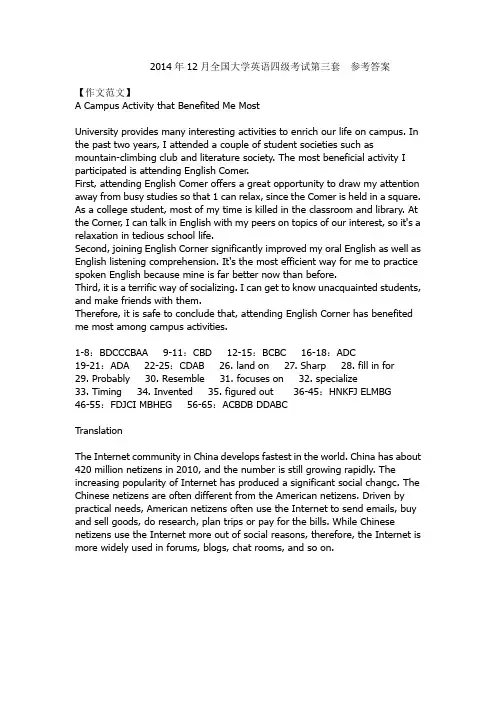
2014年12月全国大学英语四级考试第三套参考答案【作文范文】A Campus Activity that Benefited Me MostUniversity provides many interesting activities to enrich our life on campus. In the past two years, I attended a couple of student societies such as mountain-climbing club and literature society. The most beneficial activity I participated is attending English Comer.First, attending English Comer offers a great opportunity to draw my attention away from busy studies so that 1 can relax, since the Comer is held in a square. As a college student, most of my time is killed in the classroom and library. At the Corner, I can talk in English with my peers on topics of our interest, so it's a relaxation in tedious school life.Second, joining English Corner significantly improved my oral English as well as English listening comprehension. It's the most efficient way for me to practice spoken English because mine is far better now than before.Third, it is a terrific way of socializing. I can get to know unacquainted students, and make friends with them.Therefore, it is safe to conclude that, attending English Corner has benefited me most among campus activities.1-8:BDCCCBAA9-11:CBD12-15:BCBC16-18:ADC19-21:ADA22-25:CDAB26. land on27. Sharp28. fill in for29. Probably30. Resemble31. focuses on32. specialize33. Timing34. Invented35. figured out36-45:HNKFJ ELMBG46-55:FDJCI MBHEG56-65:ACBDB DDABCTranslationThe Internet community in China develops fastest in the world. China has about 420 million netizens in 2010, and the number is still growing rapidly. The increasing popularity of Internet has produced a significant social changc. The Chinese netizens are often different from the American netizens. Driven by practical needs, American netizens often use the Internet to send emails, buy and sell goods, do research, plan trips or pay for the bills. While Chinese netizens use the Internet more out of social reasons, therefore, the Internet is more widely used in forums, blogs, chat rooms, and so on.。
历年英语四级试题

2024年6月大学英语四级考试真题(第二套)Part I Writing (30 minutes)(请于正式开考后半小时内完成该部分,之后将进行听力考试)Directions: Suppose your university is seeking students opinions on whether university sports facilities should be open to the public. You are now to write an essay to express your view. You will have 30 minutes for the task. Youshould write at least 120 words but no more than 180 words.Part II Listening Comprehension (25 minutes)Section ADirections: In this section you will hear three news reports. At the end of each news report you will hear two or three questions. Both the news report and the questions will be spoken only once. After you hear a question you must choose the best answer from the four choices marked A B C andD. Then mark the corresponding letter on Answer Sheet I with a single line through the Centre Questions 1 and 2 are based on the news report you have just heard1. A) Due to a fire alarm in their apartmentsB) Because of the smoke and heat damage.C) Due to the water used to extinguish the flames.D) Because of the collapse of the three-story building.2. A) investigating the cause of the incident.B) Helping search for the suspect of the crime.C) Rescuing the businessmen trapped in the building.D) Checking town records for the property developer.Questions 3 and 4 are based on the news report you have just heard3. A) It plays a less important role in one’s health than nutrient intakeB) It impacts people’s health to a lesser degree than sun exposure.C) It is associated with people’s mental health conditions.D) It is linked with older adults’ symptoms of depression.4. A) It was indefiniteB) It was systematic.C) It was straightforward.D) It was insignificant.Questions 5 to 7 are based on the news report you have just heard.5. A) It has helped solve several murder cases.B) It has become a star police dog in Beijing.C) It has surpassed its mother in performance.D) It has done better than naturally born dogs.6. A) To speed up investigation into criminal cases.B) To test the feasibility of cloning technology.C) To cut down training expenses.D) To reduce their training time.7. A) Cloning is too complicated a process.B) The technology is yet to be accepted.C) Cloning is ethically controversial.D) The technology is too expensive. Section BDirections: In this section you will hear two long conversations. At the end of each conversation you will hear four questions. Both the conversation and the questions will be spoken only once. After you hear a question you must choose the best answer from the four choices marked A B C andD . Then mark the corresponding letter on Answer Sheet I with a single line through the Centre. Questions 8 to 11 are based on the conversation you have just heard.8. A) He read it somewhere online.B) He heard about it from a coworkerC) He read an article reviewing it.D) He watched a TV series based on it.9. A) His publicationsB) His first book.C) His address.D) His name.10. A) Collect a lot more data.B) Relax a bit less often.C) Clarify many new concepts.D) Read more reference books.11. A) Find out the show’s most interesting episodes.B) Watch the series together with the woman.C) Get an e-copy of the book to read.D) Check to see when the show starts.Questions 12 to 15 are based on the conversation you have just heard12. A) To check the prices of his farm produce.B) To ask the way to the Newcastle City Hall.C) To inquire about the vegetarian food festival.D) To seek the mans help with her work on the farm.13. A) Bakers.B) Vendors.C) Vegetarians.D) Organizers.14. A) The issuing of certificates to vendorsB) The completion of the baking task.C) The festival they are organizing.D) The deadline for application15.A) The closing date of submission C) The details of the ceremony.B) The website of his company. D) The organizer’s address.Section CDirections: In this section you will hear three passages. At the end of each passage you will hear three or four questions. Both the passage and the questions will be spoken only once. After you heara question you must choose the best answer from the four choices marked A B C and D. Thenmark the corresponding letter on Answer Sheet I with a single line through the Centre. Questions 16 to 18 are based on the passage you have just heard.16. A) Most scenic sites have been closed. C) Health experts advise going outdoors.B) Access to official campsites is limited. D) People have more time during the summer.17. A) It is strongly opposed by nearby residents. C) It has caused environmental concerns.B) It leads to much waste of public money. D) It has created conflicts among campers18. A) Look for open land in Scotland C) Avoid getting close to wilderness.B) Leave no trace of their camping D) Ask for permission from authorities.Questions 19 to 21 are based on the passage you have just heard.19.A) They outcompete mythical creatures. C) They truly exist in the Amazon regionB) They usually mind their own business. D) They resemble alarmingly large snakes.20. A) Scar tissue from dolphins fighting. C) Unhealed wounds from snake bitesB) Skin infection from water pollution. D) Swimming along in seasonal floods.21. A) It has been shrinking at an astonishing pace.B) It has been placed under international protection.C) It has been appealing to both freshwater and sea dolphins.D) It has been abandoned as a battleground for male dolphins.Questions 22 to 25 are based on the passage you have just heard.22. A) About 58% of young adults call parental support the new normal.B) Most adult children enjoy increasing sources of financial support.C) A full 70% of the young adults cannot afford to buy a car by them.D) Most early adults cannot sustain their lifestyles without parental support.23. A) It renders them dependent. C) It makes them mentally immature.B) It causes them to lose dignity. D) It hinders them from getting ahead24. A) It challenges ones willpower. C) It calls for due assistance.B) It results from education. D) It defines adulthood.25. A) Current lifestyles.B) Poor budgeting.C) College loans.D) Emergency expenses.Part III Reading Comprehension (40 minutes)Section ADirections: In this section there is a passage with ten blanks. You are required to select one word for each blank from a list of choices given in a word bank following the passage. Read the passagethrough carefully before making your choices. Each choice in the bank is identified by a letter.Please mark the corresponding letter for each item on Answer Sheet 2 with a single linethrough the Centre. You may not use any of the words in the bank more than once.A team of researchers led by Priyanka Joshi examined the degree to which men and women relied on communicative abstraction " to verbally convey their ideas and emotions. Communicative abstraction, according to the researchers, reflects the tendency of people to use "abstract speech that focuses on the broader picture and 26 purpose of action rather than concrete speech focusing on details and the means of 27 action." Interestingly, they found that men were far more likely to speak in the abstract than were women.To arrive at this 28_, the researchers examined the linguistic (语言的) patterns of men and women in over 600, 000 blog posts written on websites. To do this, the researchers computed abstractness ratings for29 40, 000 commonly used words in the English language. Words considered to be concrete could be easily visualized, such as "table” or “chair". Words that were more _30 to visualize, for example, “ justice" or “morality" were considered to be more abstract. They found that men used 31 moreabstract languages in their blog posts.What is the_ 32_ of this effect? The researchers suggest that power differences between the genders —that is, men having more power in society—might be a key determinant (决定因素). For instance, in a follow-up study conducted with a sample of 300 students, the researchers_33 power dynamics in an interpersonal setting to see if this would influence communicative abstraction. They found that participants in a high-power interviewer role were more likely to give abstract descriptions of behaviors than were participants in a low-power interviewee role. This suggests that communicating more abstractly does not reflect a 34 tendency of men or women but rather _35 within specific contexts.Section BDirections:In this section you are going to read a passage with ten statements attached to it. Each statement contains information given in one of the paragraphs. Identify the paragraph fromwhich the information is derived. You may choose a paragraph more than once. Eachparagraph is marked with a letter. Answer the questions by marking the corresponding letteron Answer Sheet ".How to better work towards long-term goals[A] Hal Hirschfield, a psychologist at the UCLA Anderson School of Management, wanted to know why people weren’t saving for retirement. Across the board, people are living longer. Logically, they’ll need more money to live comfortably in their post-work years. And yet, savings rates in the U. S. have gone down in recent decades, not up.[B] To help explain this seemingly irrational behavior, Hirschfield and his team scanned the brains of study participants while asking them to what degree various traits (特征)—like“honorable" or" funny"—applied to their current self, their future self, a current other, or a future other. As participants answered, Hirschfield’s team recorded which parts of their brains lit up. Unsurprisingly, people’s brains were most active when thinking about their current selves and least active when thinking about a current[C] Other. But the team found that participants brain activity while considering their future selves more closely resembled their brain activity while thinking about a current other rather than the current self.[D] Put in practical terms, when thinking of yourself in a month or a year or a decade, your brain registers that person in ways similar to how it would register Taylor Swift or the mailman. Understood in that way, saving for retirement is the equivalent of giving money away to someone else entirely.[E] In light of Hirschfield’s study, one simple question arises: Is it possible to make our present selves give a damn about our future selves? The answers are anything but simple.[F] Seen through the lens of the present self-versus the future self, our self-defeating actions-like choosing to watch television rather than go to the gym-suddenly make perfect sense. We get to enjoy the very concrete, immediate benefits of our actions while someone else (namely, our future selves) suffers the hypothetical (假设的),far-off consequences. As a result, the decisions we make for our present selves often look very different from our decisions for our future selves. We believe that tomorrow will be different. We believe that we will be different tomorrow; but in doing so, we prioritize our current mood over the consequences of our inaction for the future self.[G] Understanding our procrastination (拖延) through the lens of the present and future selves, were left with three possible solutions: The first is to force your future self to do whatever your present self doesn’t want to do. The second is to convince your present self that your future self is, in fact, still you. If the central problem is that we think of our future selves as other people, it follows that trying to identify more closely with our future selves will encourage us to make better long-term decisions.[H] In a follow-up study, Hirschfield wanted to explore ways to bridge the disconnect between the present and future selves and encourage people to save more for retirement. He and his team took photos of study participants, and then used image processing to visually age their faces. Participants were then placed in a virtual reality setting where they could look into a mirror and see their aged selves looking back at them. Participants who saw their aged selves said they would save 30% more of their salary for retirement than the control group.[I] The third solution is to forget about your future self and use your present self’s love of instant Gratification(满足感)to your advantage. While the two tactics (手段)above can be effective in making better long-term choices, in the end, you’re still struggling against human nature. Our brains are hard-wired for instant gratification. Instead of fighting your present self’s need for immediate rewards, why not use it to your advantage? When most of us set goals, we focus on long-term results we want to see-e.g., losing weight, getting a promotion, retiring in comfort, etc. While those visions of our future selves can be inspiring, when it comes to actually doing the day-to-day work, it may be more effective to reframe activities in terms of their immediate, or at least very near-term, rewards.[J] Take writing this article, for instance. It’s easy for me to imagine how amazing it will feel at the end of the workday to have this article done. This isn’t just my opinion. Research partners Kaitlin Woolley of Cornell University and Ayelet Fishbach of the University of Chicago have made a career out of studying the differences between the goals that people achieve and the ones that fall to the wayside.[K] “In one study, we asked people online about the goals they set at the beginning of the year. Most people set goals to achieve delayed, long-term benefits, such as career advancement, debt repayment, or improved health. We asked these individuals how enjoyable it was to pursue their goal, as well as how important their goal was. We also asked whether they were still working on their goals two months after setting them. We found that enjoyment predicted people’s goal persistence two months after setting the goal far more than how important they rated their goal to be," Woolley said.[L] This pattern held true across a wide variety of goals from exercising to studying to eating healthier foods. For example, people ate 50% more of a healthy food when directed to focus on the good taste rather than the long-term health benefits. Other studies have shown a greater uptake of exercise in people who were told to think of the enjoyment of doing the exercise now rather than future health gains.[M] These findings suggest that when it comes to achieving your goals, enjoying the process itself is more important than wanting the long-term benefits. In other words, present self-trumps (战胜) future self. Who says instant gratification has to be a bad thing? By all means, set ambitious long-term goals for your future self, but when it comes to actually following through day-to-day, make sure your present self knows what’s in it for her too.36. Our brains are genetically determined to satisfy immediate desires.37. Taken in a practical way, saving for post-work years is like giving money away to others.38. Research found that, as regards achievement of ones goals, it is important to focus more on enjoying the process than the long-term benefits.39. Regarding our future selves as still being ourselves will help us make better long-term decisions.40. Savings rates in America have dropped in recent decades even though peoples life expectancy has increased.41. Researchers found that enjoyment rather than importance enabled people to persist in their goals.42. When making decisions, we give priority to our current frame of mind without thinking much of the consequences.43. People ate more of a healthy food when they focused on its good taste instead of its long-term benefits.44. As was expected, when people thought of their present selves, their brains were observed to become more active.45. Researchers found that participants who saw the images of their aged selves would save more for their later years than those who didn’t.Section CDirections:There are 2 passages in this section. Each passage is followed by some questions or unfinished statements. For each of them there are four choices marked A B C and D. Youshould decide on the best choice and mark the corresponding letter on Answer Sheet 2 with asingle line through the Centre.Passage OneQuestions 46 to 50 are based on the following passage.People often wonder why some entrepreneurs have greater success than others. Is it habits, connections, luck, work ethic or any other behavior? I believe the key to success is willpower. Willpower is the ability to control yourself. It is a strong determination that allows you to do something difficult. It is a behavior we are born with more than one we learn; however, it is possible to not only learn it, but also strengthen it with constant exercise.Willpower is just like a muscle; to keep it strong you need to constantly exercise it. People with a great amount of willpower have the discipline to develop positive, successful habits. Even with an incredible amount of talent, without the discipline and motivation to create positive habits, it can be difficult to achieve success.Willpower and habits go hand in hand. It is critical to create good habits and take the actions necessary to stick to those habits day in and day out for greater success. Almost half of our daily actions are part of our habits and not decisions, so once the correct habits are in place, you will automatically perform those tasks on a day-to-day basis.The best way to create and stick to a habit is to have strong motivation. Its easier to change your habits to lose weight if you have a health issue and you want to be around longer for your kids, or if your business is something youre passionate about. Having a valuable outcome associated with a habit will help you stick to that habit permanently.The art of self-control is one that most successful individuals have mastered. Self-control enables you to avoid behaviors that don’t contribute to your success and adopt those that do.Because there is a delayed satisfaction associated with self-control, it can be easy to get off track. However, if you work on sticking to those small positive habits one day at a time, it becomes easier to stay strong and achieve that delayed reward. Once a reward is achieved, it is much easier to continue sticking to your habits.46. What does the author say we need to do to strengthen our willpower?A) Keep it under control.B) Apply it continuously.C) Learn from entrepreneurs.D) Aim at success determinedly.47. How are almost half of our daily actions performed according to the passage?A) Out of habit.B) With determination.C) Like muscle building.D) By self-discipline.48. What will help people stick to doing something constructive automatically?A) Practising it on a day-to-day basis.B) Associating it with improving healthC) Possessing a reasonable amount of talent.D) Foreseeing the desired outcome it will yield.49. How does the art of self-control help us succeed?A) By allowing us to remain clear-headed permanently.B) By enabling us to alter our behaviors constantly.C) By enabling us to take positive actions.D) By allowing us to avoid taking risks.50. Why can it be difficult for us to maintain self-control?A) Most of us are not in the habit of exercising self-controlB) We may not get immediate rewards from self-control.C) Self-control tends to be associated with pains.D) Self-control only brings about small benefits.Passage TwoQuestions 51 to 55 are based on the following passage.Today, most scientific research is funded by government grants, companies doing research and development, and non-profit foundations. As a society, we reap the rewards from this science, but we also help pay for it. You indirectly support science through taxes you pay, products and services you purchase, and donations you make.Funding for science has changed with the times. Historically, science has been largely supported through private patronage (资助), church sponsorship, or simply paying for the research yourself. Today, researchers are likely to be funded by a mix of grants from various government agencies, institutions, and foundations. Other research is funded by private companies. Such corporate sponsorship is widespread in some fields. Almost 75% of U. S. clinical trials in medicine are paid for by private companies. And, of course, some researchers today still fund small-scale studies out of their own pockets. Most of us can’t afford to do nuclear research as a private hobby, but birdwatchers, rock collectors, and others can do real research on a limited budget.In a perfect world, money wouldn’t matter—all scientific studies would be completely objective. But in the real world, funding may introduce biases. Drug research sponsored by the pharmaceutical (制药的)industry is more likely to end up favoring the drug under consideration than studies sponsored by government grants or charitable organizations. Similarly, nutrition research sponsored by the food industry is more likely favoring the food under consideration than independently funded research to end up.So what should we make of all this? Should we ignore any research funded by companies or special interest groups? Certainly not. These groups provide invaluable funding for scientific research. Furthermore, science has many safeguards in place to catch instances of bias that affect research outcomes. Ultimately, misleading results will be corrected as science proceeds; however, this process takes time. Meanwhile, it pays to examine studies funded by industry or special interest groups with extra care. Are the results consistent with other independently funded studies? What do other scientists have to say about this research? A little examination can go a long way towards identifying bias associated with the funding source.51. What does the passage mainly discuss regarding scientific research?A) Its foundationB) Its rewardsC) Its prospect.D) Its funding.52. What do we learn from the passage about researchers like birdwatchers and rock collectors?A) They have little access to government funding.B) They can do research with limited resources.C) They can do amateur work in their own fields.D) They have no means for large-scale research.53. What would scientific studies look like in a perfect world according to the author?A) They would be totally unbiased.B) They would be independently funded.C) They would be responsibly conducted.D) They would be strictly supervised.54. What does the author say about companies and special interest groups?A) They try hard to pull down the safeguards for research.B) They make extra efforts to research their own products.C) They provide valuable resources for scientific research.D) They reap the most benefits from scientific research.55. What does the author think of research funded by industry or special interest groups?A) Its recommendations should be examined for feasibility.B) Its misleading results should be corrected in time.C) Its validity should be checked with additional care.D) Its hidden biases should be identified independently.Part IV Translation (30 minutes)Directions: For this part you are allowed 30 minutes to translate a passage from Chinese into English. You should write your answer on Answer Sheet 2.农历(the lunar calendar)起源于数千年前的中国,根据太阳和月亮的运行规律制定。
2014年12月大学英语四级考试真题(第3套)

2014年12月大学英语四级考试真题(第3套)Part I Writing (30 minutes)Directions:For this part,you are allowed 30 minutes to write a short essay about a campus activity that has benefited you most. You should state the reasons and write at least 120 words but no more than 180 words.Part II Listening Comprehension (30 minutes)略Part ⅢReading Comprehension (40 minutes)Section ADirections: In this section, there is a passage with ten blanks. You are required to select one word for each blank from a list of choices given in a word bank following the passage. Read the passage through carefullybefore making your choices. Each choice in the bank is identified by a letter. Please mark thecorresponding letter for each item on Answer Sheet 2 with a single line through the centre. You maynot use any of the words in the bank more than once.Questions 36 to 45 are based on the following passage.For decades, Americans have taken for granted the United States' position in the development of new technologies. The innovations (创新) resulted from research and development during World War II and afterwards were __36__ to the prosperity of the nation in the second half of the 20th century. Those innovations, upon which virtually all aspects of __37__ society now depend, were possible because the United States __38__ then the world in mathematics and science education. Today, however, despite increasing demand for workers with strong skills in mathematics and science, the __39__ of degrees awarded in science, math, and engineering are decreasing.The decline in degree production in what are called the STEM disciplines (science, technology, engineering, and math) seems to be __40__ related to the comparatively weak performance by U.S. schoolchildren on international assessments of math and science. Many students entering college have weak skills in mathematics. According to the 2005 report of the Business-Higher Education Forum, 22 percent of college freshmen must take remedial (补习的) math __41__. and less than half of the students who plan to major in science or engineering __42__ complete a major in those fields.The result has been a decrease in the number of American college graduates who have the skills, __43__ in mathematics, to power a workforce that can keep the country at the forefront (前沿) of innovation and maintain its standard of living. With the __44__ performance of American students in math and science has come increased competition from students from other countries that have strongly supported education in these areas. Many more students earn __45__ in the STEM disciplines in developing countries, especially China, than in the United States.A)acceleratingB)actuallyC)closelyD)contemporaryE)coursesF)criticalG)decliningH) degrees I)especially J)futureK)ledL)metM)procedures N)proportions O)spheresSection BDirections: In this section, you are going to read a passage with ten statements attached to it. Each statement contains information given in one of the paragraphs. Identify the paragraph from which theinformation is derived. You may choose a paragraph more than once. Each paragraph is marked witha letter. Answer the questions by marking the corresponding letter on Answer Sheet 2.Ban sugary drinks that will add fuel to the obesity warA)On a train last Thursday, I sat opposite a man who was so fat he filled more than one seat. He was pale anddisfigured and looked sick to death, which he probably was: obesity(肥胖的)leads to many nasty ways of dying. Looking around the carriage, I saw quite a few people like him, including a couple of fatty children with swollen checks pressing against their eyes. These people are part of what is without exaggeration an epidemic(流行病)of obesity.B)But it is quite unnecessary: there is a simple idea- far from new- that could spare millions of such people alifetime of chronic(长期的)ill health, and at the same time save the National Health Service(NHS)at least £14 billion a year in England and Wales. There would, you might think, be considerable public interest in it.This simple idea is that sugar is as good- or as bad- as poison and should be avoided. It is pure, white and deadly, as Professor John Yudkin described it 40 years ago in a revolutionary book of that name. The subtitle was How Sugar Is Killing Us.C)In its countless hidden forms, in ready meals, junk food and sweet drinks, sugar leads to addiction(瘾), tohormonal upsets to the appetite, to metabolic(新陈代谢的)malfunctions and obesity and from there to type 2 diabetes(糖尿病)and its many horrible complication. If people really grasped that, they would try to kick the habit, particularly as Britain is the ― fat man of Europe‖ . They might even feel driven to support government measures to prevent people from consuming this deadly stuff. Yet so far this idea has met little but resistance.D)It is not difficult to imagine the vested interests(既得利益集团)lined up against any sugar control- all thefood and drink manufacturers, processors, promoters and retailers who make such easy pickings out of the magic powers of sugar. Then there are the liberals, with whom I would normally side, who protest that government regulation would be yet another instance of interference in our lives.E)That is true, but people should realize that you cannot have a welfare state without a nanny state(保姆国家),to some degree. If we are all to be responsible for one another’s health insurance, through socialized medicine, then we are all closely involved in one another’s health, including everyone’s eating and drinking.That has already been admitted, finally, with smoking. But it has yet to be admitted with overeating, even though one in four adults in this country is obese and that number is predicted to double by the year 2050.Quite apart from anything else, obesity will cripple the NHS.F)Recently, though, there have been signs that the medical establishment is trying to sound the alarm. Lastmonth the Academy of Medical Royal Colleges(AMRC)published a report saying that obesity is the greatest public health issue affecting the UK and urging government to do something.G)The report offers 10 recommendations, of which the first is imposing a tax of 20 percent on sugary drinks forat least a year, on top of the existing 20 percent value-added tax. That at least would be an excellent start. The amounts of sugar in soft drinks are horrifying, and turn straight to fat. As Professor Terence Stephenson, head of the AMRC, has said, sugary soft drinks are ―the ultimate bad food. You are just consuming neat sugar.Your body didn’t evolve to handle this kind of thing.‖H)Precisely. The risks of eating too much fat or salt(which are very different)pale into insignificant comparedwith the harm done by sugar. And it is everywhere.I)It is difficult to buy anything in a supermarket, other than plain, unprepared meat, fish or vegetables, thatdoesn’t have a large amount of sugar in it. This has come about because the prevailing scientific views of the 1960s and 1970s ignored the evidence about sugar, and instead saw fat as the really serious risk, both to the heart and other organs, as well as the cause of obesity.J)The fashion was to avoid fat. But finding that food with much of its fat removed is not very appetizing, food producers turned to sugar as a magic alternative flavor enhancer, often in the forms of syrups(糖浆)that had recently been developed from corn, and put it generously into most prepared foods and soft drinks.K)This stuff is not just fattening. It is addictive. It interferes with the body’s metabolism, possibly via the activity of an appetite-controlling hormone. There’s plenty of evidence for this, for those who will accept the truth.L)Theoretically, people ought to make “healthy choices”and avoid overeating. But sugar additives are not easy to identify and are hard to avoid. So the snacking, over-drinking and over eating that makes people fat is not really their own fault: obesity is in large part something that is being done to them. It should be stopped, or rather the government should stop it.M)Going round my local supermarket, I am constantly astonished that it is still legal to sell all the poisons stacked high on the shelves. The problem is that they are worse than useless. They are poisonous. They are known to be addictive. They are known to make people obese. And giving small children sweet drinks or bottles of fake juice all day long is nothing less than child abuse.N)Clearly, the sale of such stuff ought to be illegal. I hate to think of yet more government regulation. But a bit of tax on sweet soda and a little more health education, a bit of cooking in schools and banning vending machines(自动售货机)here and there —as suggested try the AMRC report — is not going to achieve very much. Labelling is quite inadequate. What is needed is legislation banning high levels of sugary syrups used in foods and drinks.O)In June 2012, the then minister for public health said the government was not scared of the food industry and had not ruled out legislation, because of the costs of obesity to the NHS. However, nothing has happened yet.Why not have another Jammie Dodger biscuit and forget about it.46.Avoiding over-consumption of sugar can improve people’s health as w ell as save medical expenses.47. Laws should be passed to make it illegal to produce overly sweet foods or drinks.48.Giving small children sweet juices to drink all the time is equal to child abuse.49.Looking around.the author found obesity quite widespread.50.The number of obese people is expected to increase quickly in the next few decades51.If people really understood the horrible consequences of sugary foods and drinks,they would support government measures against sugar consumption.52.It would be a very good beginning to impose an additional tax on sugary drinks53. The government has not yet taken any action to regulate sugar consumption although it Indicated its intention to do so some time ago.54.Sugar is far more harmful to health than fat and salt55.Consumers of sweet foods are not really to blame because they cannot tell what food is sugary.Section CDirections: There are 2 passages in this section. Each passage is followed by some questions or unfinished statements. For each of them there are four choices marked A), B), C) and D). You should decide onthe best choice and mark the corresponding letter on Answer Sheet 2 with a single line through thecentre.Passage OneQuestions 56 to 60 are based on the following passage.The rise of the Internet has been one of the most transformative developments in human history, comparable in impact to the invention of the printing press and the telegraph. Over two billion people worldwide now have access to vastly more information than ever before, and can communicate with each other instantly, often using Web-connected mobile devices they carry everywhere. But the Internet’s tremendous impacts has only just begun.“Mass adoption of the Internet is driving one of the most exciting social, cultural, and political transformations in history, and unlike earlier periods of change, this time the effects are fully global,”Schmidt and Cohen write in their new book. The New Digital Age.Perhaps the most profound changes will come when the five billion people worldwide who currently lackInternet access get online. The authors do an excellent job of examining the implications of the Internet revolution for individuals, governments, and institutions like the news media. But if the book has one major shortcomin g, it’s that authors don’t spend enough time applying a critical eye to the role of Internet businesses in these weeping changes.In their book, the authors provide the most authoritative volume to date that describes —and more importantly predicts —how the Internet will shape our lives in the coming decades. They paint a picture of a world in which individuals, companies, institutions, and governments must deal with two realities, one physical, and one virtual.At the core of the book is the idea that “technology is neutral, but people aren’t.”By using this concept as a starting point, the authors aim to move beyond the now familiar optimist vs. pessimist dichotomy(对立观点)that has characterized many recent debates about whether the rise of the Internet will ultimately be good or bad for society. In an interview with TIME earlier this week, Cohen said although he and his co-author are optimistic about many aspects of the Internet, they’re also realistic about the ri sks and dangers that lie ahead when the next five billion people come online, particularly with respect to personal privacy and state surveillance(监视).56.In what way is the rise of the Internet similar to the invention of the printing press and the telegraph?A) It transforms human historyB)It facilitates daily communication.C)It is adopted by all humanity.D)It revolutioniz es people’s thinking.57. How do Schmidt and Cohen describe the effects of the internet ?A)They are immeasurableB)They are worldwide.C)They are un predictable.D)They ale contaminating.58. In what respect is the book The New Digital Age considered inadequate?A)It fails to recognize the impact of the Internet technology.B)It fails to look into the social implications of the Internet.C) It 1acks an objective evaluation of the role of Internet businesses.D) It does not address the technical aspects of Internet communication.59. What will the future be like when everybody gets online?A)People will be living in two different realities.B)People will have equal access to information.C)People don’t have to travel to see the world.D)People don't have to communicate face to face60. What does the passage say about the authors of The New Digital Age?A)They leave many questions unanswered concerning the InternetB)They are optimistic about the future of the Internet revolution.C)They have explored the unknown territories of the virtual world.D)They don't take sides in analyzing the effects of the Internet.Passage TwoQuestions 61 to 65 are based on the following passage.In 1950, a young man would have found it much easier than it is today to get and keep a job in the auto industry. And in that year the average autoworker could meet monthly mortgage(抵押贷款)payments on an average home with just 13.4 percent of his take-home pay. Today a similar mortgage would claim more than twice that share of his monthly eamings.Other members of the autoworker’s family, however might be less inclined to tried the present f or the past.His retired parents would certainly have had less economic security back then. Through-out much of the 1960s, more than a quarter of men and women and women age 65 and older lived below the poverty level, compared to less than 10 percent in 2010.In most stales, his wife could not have taken out a loan or a card in her own name. In 42 states, a homemaker had no legal claim on the earnings of her husband. And nowhere did a wife have legal protection against family violence.Most black workers would not want to return to a time when, on average they earned 40 percent less than their white counterparts(职位相当的人),white racially restrictive agreements largely prevented them from buying into the suburban neighborhoods being built for white working –class families.Today, new problems have emerged in the process of resolving old ones, but the solution is not to go back to the past. Some people may long for an era when divorce was still hard to come by. The spread of no -fault divorce has reduced the bargaining power of whichever spouse is more interested in continuing the relationship. And the breakup of such marriages has caused pain for many families.The growing diversity of family life comes with new possibilities as well as new challenges. According to a recent poll, more than 80 percent of Americans believe that their current family is as close as the one in which they grew up, or closer. Finding ways to imaginary golden age.61. What do we learn about American autoworkers in 1950?A)They had less job security than they do today.B)It was not too difficult for them to buy a house.C)Their earning were worth twice as much as today.D)They were better off than workers in other industries.62.What does the author say about retired people today?A)They invariably long to return to the golden past.B)They do not depend so much on social welfare.C)They feel more secure economically than in the past.D)They are usually unwilling to live with their children63 Why couldn't black workers buy a house in a white suburban neighborhood?A)They lacked the means of transportation.B)They were subjected to racial inequality.C)They were afraid to break the law.D)They were too poor to afford it.64.What is the result of no-fault divorce?A)Divorce is easier to obtain.B)Domestic violence is lessenedC)It causes little pain to either side.D)It contributes to social unrest65 What does the author suggest society do?A)Get prepared to face any new challenges.B)Try to better the current social security net.C)Narrow the gap between blacks and whites.D)Improve the lives of families with problems.Part ⅣTranslation (30 minutes) Directions:For this part, you are allowed 30 minutes to translate a passage from Chinese into English. You should write your answer on Answer Sheet 2.大熊猫(giant panda)是一种温顺的动物,长着独特的黑白皮毛。
2014年12月大学英语四级真题试卷(三)(题后含答案及解析)

2014年12月大学英语四级真题试卷(三)(题后含答案及解析)题型有:1. Writing 2. Listening Comprehension 3. 4. Reading Comprehension 5. TranslationPart I Writing1.For this part, you are allowed 30 minutes to write a short essay about a campus activity that has benefited you most. You should state the reasons and write at least 120 words but no more than 180 words.正确答案:The Most Beneficial Activity on Campus Every university offers numerous kinds of activities to enrich students’ extracurricular life. As one of the young college students, I have learnt a lot from all of these well-organized activities.But the one that has benefited me most is the debate competition I took part in last year. That was a debate competition between different majors and the topic was about theoretical knowledge versus practice.What matters most is not the result of the debate, but what I have learnt from it.That is, no individual could accomplish a challenging task all by herself or himself. Joint efforts are of great importance in winning any competition. It was really lucky for me to take part in the debate competition, from which I got the most precious gift for future: cherishing team spirit and joint efforts, which will help me sweep away every block falling in my way to success.解析:一、指出大学校园中最让“我”受益的活动(benefited me most)二、阐述该活动让“我”受益之处1.描述活动(a debate competition)2.活动所得(what I have learnt from it)三、升华主题,指出“我”从活动中得到了对未来而言最珍贵的礼物(the most precious gift for future)Part II Listening ComprehensionSection A听力原文:W:Simon, could you return the tools I lent you for building the bookshelf last month? M:Oh, well, I hate to tell you this, but I can’t seem to find them. Q:What do we learn from the conversation?2.A.The man hates to lend his tools to other people.B.The man hasn’t finished working on the bookshelf.C.The tools have already been returned to the woman.D.The tools the man borrowed from the woman are missing.正确答案:D解析:女士问上个月她借给男士做书架用的工具是否可以归还;男士回答说他似乎找不到了,故答案为D。
2014.12 英语四级考试真题试卷(第三套)阅读

Growing Up Colored[A] You wouldn't know Piedmont anymore—my Piedmont, I mean—the town in West Virginia where I learned to be a colored boy.[B] The 1950s in Piedmont was a time to remember, or at least to me. People were always proud to be from Piedmont—lying at the foot of a mountain, on the banks of the mighty Potomac. We knew God gave America no more beautiful location. I never knew colored people anywhere who were crazier about mountains and water, flowers and trees, fishing and hunting. For as long as anyone could remember, we could outhunt, outshoot, and outswim the white boys in the valley.[C] The social structure of Piedmont was something we knew like the back of our hands. It was an immigrant town; white Piedmont was Italian and Irish, with a handful of wealthy WASPs (盎格鲁撒克逊裔的白人新教徒) on East Hampshire Street, and "ethnic" neighborhoods of working-class people everywhere else, colored and white.[D] For as long as anyone can remember, Piedmont's character has been completely bound up with the Westvaco paper mill: its prosperous past and doubtful future. At first glance, the town is a typical dying mill center. Many once beautiful buildings stand empty, evidencing a bygone time of spirit and pride. The big houses on East Hampshire Street are no longer proud, as they were when I[E] Like the Italians and the Irish, most of the colored people migrated to Piedmont at the turn of the 20th century to work at the paper mill, which opened in 1888. All the colored men at the paper mill worked on "the platform"—loading paper into trucks until the craft unions were finally integrated in 1968. Loading is what Daddy did every working day of his life. That's what almost every colored grown-up I knew did.[F] Colored people lived in three neighborhoods that were clearly separated. Welcome to the Colored Zone, a large stretched banner could have said. And it felt good in there, like walking around your house in bare feet and underwear, or snoring right out loud on the couch in front of the TV—enveloped by the comforts of home, the warmth of those you love.[G] Of course, the colored world was not so much a neighborhood as a condition of existence. And though our own world was seemingly self-contained, it impacted on the white world of Piedmont in almost every direction. Certainly, the borders of our world seemed to be impacted on when some white man or woman showed up where he or she did not belong, such as at the black Legion Hall. Our space was violated when one of them showed up at a dance or a party. The rhythms would be off. The music would sound notquite right: attempts to pat the beat off just so. Everybody would leave early.[H] Before 1955, most white people were just shadowy presences in our world, vague figures of power like remote bosses at the mill or tellers at the bank. There were exceptions, of course, the white people who would come into our world in ritualized, everyday ways we all understood. Mr. Mail Man, Mr. Insurance Man, Mr. White-and-Chocolate Milk Man, Mr. Landlord Man, Mr. Police Man: we called white people by their trade, like characters in a mystery play. Mr. Insurance Man would come by every other week to collect premiums on college or death policies, sometimes 50 cents or less.[I] "It's no disgrace to be colored," the black entertainer Bert Williams famously observed early in the century, "but it is awfully inconvenient." For most of my childhood, we couldn't cat in restaurants or sleep in hotels, we couldn't use certain bathrooms or try on clothes in stores. Mama insisted that we dress up when we went to shop. She was carefully dressed when she went to clothing stores, and wore white pads called shields under her arms so her dress or blouse would show no sweat. "We'd like to try this on," she'd say carefully, uttering her words precisely and properly. "We don't buy clothes we can't try on," she'd say when they declined, and we'd walk out in Mama's dignified (有尊严的) manner. She preferred to shop where we had an account and where everyone knew who she was. [J] At the Cut-Rate Drug Store, no one colored was allowed to sit down at the counter or tables, with one exception: my father. I don't know for certain why Carl Dadisman, the owner, wouldn't stop Daddy from sitting down. But I believe it was in part because Daddy was so light-colored, and in part because, during his shift at the phone company, he picked up orders for food and coffee for the operators. Colored people were supposed to stand at the counter, get their food to go, and leave. Even when Young Doc Bess would set up the basketball team with free Cokes after one of many victories, the colored players had to stand around and drink out of paper cups while the white players and cheerleaders sat down in comfortable chairs and drank out of glasses.[K] I couldn't have been much older than five or six as I sat with my father at the Cut-Rate one afternoon, enjoying two scoops of caramel ice cream. Mr. Wilson, a stony-faced, brooding Irishman, walked by."Hello, Mr. Wilson," my father said."Hello, George."[L] I was genuinely puzzled. Mr. Wilson must have confused my father with somebody else, but who? There weren't any Georges among the colored people in Piedmont. "Why don't you tell him your name, Daddy?" I asked loudly. "Your name isn't George.""He knows my name, boy," my father said after a long pause. "He calls all colored people George."[M] I knew we wouldn't talk about it again; even at that age, 1 was given to understand that there were some subjects it didn't do to worry to death about. Now that I have children, I realize that what distressed my father wasn't so much the Mr. Wilsons of the world as the painful obligation to explain the racial facts of life to someone who hadn't quite learned them yet. Maybe Mr. Wilson couldn't hurt my father by calling him George; but I hurt him by asking to know why.注意:此部分试题请在答题卡2上作答。
2014年12月英语四级仔细阅读真题(总三套题)及问题详解
2014年12月四级真题(第1套)第一套:Passage OneQuestions 56 to 60 are based on the following passage.The rise of the Internet has been one of the most transformative developments in human history,comparable in impact to the invention of the printing press and the telegraph. Over two billion people worldwide now have access to vastly more information than ever before, and can communicate with each other instantly, often using Web-connected mobile devices they carry everywhere. But the Internet's tremendous impact has only just begun."Mass adoption of the Internet is driving one of the most exciting social, cultural, and political transformations in history, and unlike earlier periods of change, this time the effects are fully global,"Schmidt and Cohen write in their new book, The New Digital Age.Perhaps the most profound changes will come when the five billion people worldwide who currently lack Internet access get online. The authors do an excellent job of examining the implications of the Internet revolution for individuals, governments, and institutions like the news media. But ff the book has one major shortcoming, it's that the authors don't spend enough time applying a critical eye to the role of Internet businesses in these sweeping changes.In their book, the authors provide the most authoritative volume to date that describes--and more importantly predicts--how the Internet will shape our lives in the coming decades. They paint a picture of a world in which individuals, companies, institutions, and governments must deal with two realities,one physical, and one virtual.At the core of the book is the idea that"technology is neutral, but people aren't." By using this concept as a starting point, the authors aim to move beyond the now familiar optimist vs. pessimist dichotomy (对立观点) that has characterized many recent debates about whether the rise of the Internet will ultimately be good or bad for society. In an interview with TIME earlier this week, Cohen said although he and his co-author are optimistic about many aspects of the Internet, they're also realistic about the risks and dangers that lie ahead when the next five billion people come online, particularly with respect to personal privacy and state surveillance (监视).注意:此部分试题请在答题卡2上作答。
大学英语四级2014年12月第3套
2014年12月大学英语六级考试真题(三)答案与详解PartⅠWriting审题思路本作文话题为大学校阿中令你受益最多的一项活动,非常贴近大学生的生活。
因此,在构思时可以用自己的亲身经历作为材料,着重阐述活动的有益之处。
考生首先应该指明是什么校园活动让你受益最多;接着应对该活动进行描述,说明它让你受益之处,最后总结全文、升华主题。
写作提纲一、指出大学校园中最让“我”受益的活动(benefited me most)二、阐述该活动让“我”受益之处:1、描述活动(a debate competition)2、活动所得(what I have leamt from it)三、升华主题:指出“我”从活动中得到了对未来而言最珍贵的礼物(the most precious gift for future)范文点评1全文翻译最有益处的大学活动每个大学都为学生提供多种多样的校园活动以丰富他们的课外生活。
作为一个年轻的大学生,我从这些精心组织的活动中学到了很多。
但是让我受益最多的是去年参加的那场辩论赛。
那是一次有不同专业学生参与的辩论赛,辩题是理论知识与实践。
最重要的不是辩论的结果,而是我从中学到了什么。
那就是,没有哪个人能够单凭自己就可以完成一项极具挑战性的任务。
要赢得任何一项竞赛,共同努力都极为重要。
我很幸运参加了那场辩论赛,从中我收获了对未来而言最珍贵的礼物:珍惜团队精神和共同努力,这将帮我扫清通往成功道路上的每一个障碍。
PartⅡListening ComprehensionSection A1.W:Simon,could you return the tools I lent you for building the bookshelf last month?M:Oh,well,I hate to tell you this,but I can't seem to find them.Q:What do we learn from the conversation?1.A)The man hates to lend his tools to other people.B)The man hasn’t finished working on the bookshelf.C)The tools have already been returned to the woman.D)The tools the man borrowed from the woman are missing.【预测】选项中多次出现了tools—词,且出现了lend,returned和borrowed,由此可推测对话很可能与工具的借和还有关。
2016年12月大学英语四级真题及完整答案(共两卷)
2016年12月大学英语四级真题(第一套)Part I Writing (30minutes)Directions:For this part, you are allowed 30 minutes to write an essay. Suppose you have two options upon graduation: one is to take a job in a company and the other to go to a graduate school. You are to make a choice between the two. Write an essay to explain the reasons for your choice. You should write at least 120 words but no more than 180 words.Part II Listening Comprehension (25 minutes)Section ADirections: In this section, you will hear three news reports. At the end of each news report, you will hear two or three questions. Both the news report and the questions will be spoken only once. After you hear a question, you must choose the best answer from the four choices marked A), B), C) and D). Then mark the corresponding letter on Answer Sheet 1 with a single line through the centre.Questions 1and 2 are based on the news report you have just the heard.1. A) It was going to be renovated. C) It was dangerous to live in.B) He could no longer pay the rent. D) He had sold it to the royal family.2. A) A storm. C) A forest fire.B) A strike. D) A Terrorist attack.Questions 3and 4 are based on the news report you have just heard.3. A) They lost contact with the emergency department.B) They were injured by suddenly falling rocks.C) They sent calls for help via a portable radio.D) They were trapped in an underground elevator.4. A) They provided the miner with food and water.B) They sent supplies to keep the miners warm.C) They released the details of the accident.D) They tried hard to repair the accident.Question5 to7 are based on the news report you have just heard.5. A) Raise postage rates. C) Close some of its post offices.B) Improve its services. D) Redesign delivery routes.6. A) Closing offices on holidays. C) Computerizing mail sorting processes.B) Shortening business hours. D) Stopping mail delivery on Saturdays.7.A)A lot of controversy will ariseB) Taxpayers will be very pleasedC) Many people will begin to complainD) Many post office staff will lose their jobsSection BDirections:In this section,you will hear two long conversations.At the end of eachconversation,you will hear four questions. Both the conversation and the questions will be spoken only once. After you hear a question, you must choose the best answer from four choice marked A),B),C) and D).Then mark the corresponding letter an Answer sheet1 with a single line though the centre.Question8 to 11 are based on the conversation you have just heard.8.A)He will lose part of his pay. C)He will be given a warning.B)He will go through retraining. D)He is go good terms with his workmates.9.A)He is an experienced press operator. C)He is always on time.B)He is trustworthy guy. D)He is go good terms with his workmates.10.A)She is a trade union representative. C)She is better at handing such matters.B)She is a senior manager of the shop. D)She is in charge of public relation.11.A)He is always trying to stir up trouble.B)He is skilled and experienced.C)He is very close to the manager.D)He is always complaining about low wages.Question12 to 15 are based on the conversation you have just heard.12.A)Open. C)Selfish.B)Reserved. D)Friendly.13.A)They read a book. C)They stay quiet.B)They talk about the weather D)They chat with fellow passengers.14.A)She was unwilling to make friends with workmates.B)She was never invited to a colleague’s home.C)She was eager to visit an English castle.D)She was always treated as a foreigner.15.A) House are much more quiet. C) They want a garden of their own.B) They want to have more space. D) Houses provide more privacy. Section CDirections:In this section,you will hear three passages.At the end of each passage,you will hear three or four questions.Both the passage and the questions will be spoken only once.After you hear a question,you must choose the best answer from the four choices marked A),B),C) and D).Then mark the corresponding letter on Answer Sheet 1 with a single line through the centre.Questions 16 to 18 are based on the passage you have just heard.16.A) They will automatically be given hiring priority.B) They don’t have to go through job interviews.C) They are likely to get much higher pay.D) They don’t have much choice of jobs.17.A) Visit the school careers services. C) Look at school bulletin boards.B) Ask their professors for help. D) Go through campus newspapers.18.A) Providing students with information about the library.B) Helping students arrange appointments with librarians.C) Supervising study spaces to ensure a quiet atmosphere.D) Helping students find the books and journals they need.Questions 19 to 21 are based on the passage you have just heard.19.A) It tastes better. C) It is easier to grow.B) It may be sold at a higher price. D) It can better survive extreme weathers.20.A) It can grow in drier soil. C) It will replace green tea one day.B) It is immune to various diseases. D) It is healthier than green tea.21.A) It does not have a stable market.B) It has made tea farmers’ life easier.C) It does not bring the promised health benefits.D) It has been well received by many tea drinkers.Questions 22 to 25 are based on the passage you have just heard.22. A) They care more about environment.B) They decorate their homes themselves.C) They prefer unique objects of high quality.D) They need decorations to show their status.23. A) They made great contributions to society.B) They could only try to create at night.C) They were proud of their creations.D) They focused on the quality of their products.24. A) Identify fake crafts. C) Design handicrafts themselves.B) Make wise choices. D) Learn the importance of creation.25. A) To attract foreign investments. C) To arouse public interest in crafts.B) To preserve the traditional culture. D) To boost the local economy.Part III Reading Comprehension (40 minutes)Section ADirections:In this section, there is a passage with ten blanks. You are required to select one word for each blank from a list of choices given in a word bank following the passage. Read the passage through carefully before making your choices. Each choice in the bank is identified by a letter. Please mark the corresponding letter for each item on Answer Sheet 2 with a single line through the centre. You may not use any of the words in the bank more than once.Many men and women have long bought into the idea that there are “male” and “female” brains, believing that explains just about every difference between the sexes.A new study(26)that belief, questioning whether brains really can be distinguished by gender.In the study, Tel Aviv University researchers(27)for sex differences the entire human brain.And what did they find? Not much. Rather than offer evidence for(28)brains as “male” or “female,” research shows that brains fall into a wide range, with most people falling right in the middle.Daphna Joel, who led the study, said her research found that while there are some gender-based(29), many different types of brain can’t always be distinguished by gender.While the “average” male and “average” female brains were(30)different, you couldn’t tell it by lo oking at individual brain scans. Only a small(31)of people had “all-male” or “all-female” characteristics.Larry Cahill, an American neuroscientist (神经科学家),said the study is an important addition to a growing body of research questioning(32)beliefs about gender and brain function. But he cautioned against concluding from this study that all brains are the same,(33)of gender.“There’s a mountain of evidence(34)the importance of sex influences at all levels of brain function,” he told The Seattle Times.If anything, he said, the study(35)that gender plays a very important role in the brain “even when we are not clear exactly how.”Section BDirections: In this section, you are going to read a passage with ten statements attached to it. Each statement contains information given in one of the paragraphs. Identify the paragraph from which the information is derived. You may choose a paragraph more than once. Each paragraph is marked with a letter. Answer the questions by marking the corresponding letter on Answer Sheet 2.Can Burglars Jam Your Wireless Security System?[A]Any product that promises to protect your home deserves careful examination. So it i sn’t surprising that you’ll find plenty of strong opinions about the potential vulnerabilities of popular home-security systems.[B]The most likely type of burglary (入室盗窃) by far is the unsophisticated crime of opportunity, usually involving a broken window or some forced entry. According to the FBI, crimes like these accounted roughly two-thirds of all household burglaries in the US in 2013.The wide majority of the rest were illegal, unforced entries that resulted from something like a window being left open. The odds of a criminal using technical means to bypass a security system are so small that the FBI doesn’t even track those statistics.[C]One of the main theoretical home-security concerns is whether or not a given system is vulnerable to being blocked from working altogether. With wired setups, the fear is that a burglar (入室盗贼) might be able to shut your system down simply by cutting the right cable. With a wireless setup, you stick battery-powered sensors up around your home that keep an eye on windows, doors, motion, and more. If they detect something wrong while the system is armed, they’ll transmit a wireless alert signal to a base station that will then raise the alarm. That approach will eliminate most cord-cutting concerns—but what about their wireless equivalent, jamming? With the right device tuned to the right frequency, what’s to stop a thief from jamming your setup and blocking that alert signal from ever reaching the base station?[D]Jamming concerns are nothing new, and they’re not u nique to security systems. Any device that’s built to receive a wireless signal at a specific frequency can be overwhelmed by a stronger signal coming in on the same frequency. For comparison, let’s say you wanted to “jam” a conversation between two people—all you’d need to do is yell in the listener’s ear.[E] Security devices are required to list the frequencies they broadcast on—that means that a potential thief can find what they need to know with minimal Googling. They will, however, need so know wha t system they’re looking for. If you have a sign in your yard declaring what setup you use, that’d point them in the right direction, though at that point, we’re talking about a highly targeted, semi-sophisticated attack, and not the sort forced-entry atta ck that makes up the majority of burglaries. It’s easier to find and acquire jamming equipment for some frequencies than it is for others.[F] Wireless security providers will often take steps to help combat the threat of jamming attacks. SimpliSafe, winner of our Editor’s Choice distinction, utilizes a special system that’s capable of separating incidental RF interference from targeted jamming attacks. When the system thinks it’s being jammed, it’ll notify you via push alert(推送警报).From there, it’s up to you to sound the alarm manually.[G] SimpliSafe was singled out in one recent article on jamming, complete with a video showing the entire system being effectively bypassed with handheld jamming equipment. After taking appropriate measures to contain the RF interference to our test lab, we tested the attack out for ourselves, and were able to verify that it’s possible with the right equipment. However, we also verified that SimpliSafe’santi-jamming system works. It caught us in the act, sent an alert to my smartphone, and also listed our RF interference on the system’s event log. The team behind the article and video in question make no mention of the system, or whether or not in detected them.[H]We like the unique nature of that software. It means that a thief likely wouldn’t be able to Google how the system works, then figure out a way around it. Even if they could, SimpliSafe claims that its system is always evolving, and that it varies slightly from system to system, which means there wouldn’t be a universal magic formula for cracking it. Other systems also seem confident on the subject of jamming. The team at Frontpoint addresses the issue in a blog on its site, citing their own jam protection software and claiming that there aren’t any documented cases of successful jam attack since the company began offering wireless security sensors in the 1980s.[I] Jamming attacks are absolutely possible. As said before, with the right equipment and the right know-how, it’s possible to jam any wireless trans mission. But how probable is it that someone will successfully jam their way into your home and steal your stuff?[J] Let’s imagine that you live in a small home with a wireless security setup that offers a functional anti-jamming system. First, a thief is going to need to target your home, specifically. Then, he’s going to need to know the technical details of your system and acquire the specific equipment necessary for jamming your specific setup. Presumably, you keep your doors locked at night and whil e you’re away. So the thief will still need to break in. That means defeating the lock somehow, or breaking a window. He’ll need to be jamming you at this point, as a broken window or openeddoor would normally release the alarm. So, too, would the motion detectors in your home, so the thief will need to continue jamming once he’s inside and searching for things to steal. However, he’ll need to do so without tripping the anti-jamming system, the details of which he almost certainly does now have access to.[K]At the end of the day, these kinds of systems are primarily designed to protect against the sort of opportunistic smash-and-grab attack that makes up the majority of burglaries. They’re also only a single layer in what should ideally be a many-sided approach to securing your home, one that includes common sense things like sound locks and proper exterior lighting at night. No system is impenetrable, and none can promise to eliminate the worst case completely. Every one of them has vulnerabilities that a knowledgeable thief could theoretically exploit. A good system is one that keeps that worst-case setting as improbable as possible while also offering strong protection in the event of a less-extraordinary attack.36. It is possible for burglars to make jamming attacks with the necessary equipmentand skill.37. Interfering with a wireless security system is similar to interfering with aconversation.38. A burglar has to continuously jam the wireless security device to avoid triggeringthe alarm, both inside and outside the house.39. SimpliSafe provides devices that are able to distinguish incidental radiointerference from targeted jamming attacks.40. Only a very small proportion of burglaries are committed by technical means.41. It is difficult to crack SimpliSafe as its system keeps changing.42. Wireless devices will transmit signals so as to activate the alarm once somethingwrong is detected.43. Different measures should be taken to protect one’s home from burglary inaddition to the wireless security system.44. SimpliSafe’s device can send a warning to the house owner’s cellphone.45. Burglars can easily get a security device’s frequency by Internet search.Section CDirections:There are 2 passages in this section. Each passage is followed by some questions or unfinished statements. For each of them there are four choices marked A),B),C) and D).You should decide on the best choice and mark the corresponding letter on Answer Sheet 2 with a single line through the centre.Passage OneQuestions 46 to 50 are based on the following passage.As a person who writes about food and drink for a living. I couldn’t tell you the first thing about Bill Perry or whether the beers he sells are that great. But I can tell you that I like this guy. That’s beca use he plans to ban tipping in favor of paying his servers an actual living wage.I hate tipping.I hate it because it’s an obligation disguised as an option. I hate it for thepost-dinner math it requires of me. But mostly, I hate tipping because I believe I would be in a better place if pay decisions regarding employees were simply left up to their employers, as is the custom in virtually every other industry.Most of you probably think that you hate tipping, too. Research suggests otherwise. You actually love tipping! You like to feel that you have a voice in how much money your server makes. No matter how the math works out, you persistently view restaurants with voluntary tipping systems as being a better value, which makes it extremely difficult for restaurants and bars to do away with the tipping system.One argument that you tend to hear a lot from the pro-tipping crowd seems logical enough: the service is better when waiters depend on tips, presumably because they see a benefit to successfully veiling their contempt for you. Well, if this were true, we would all be slipping a few 100-dollar bills to our doctors on the way out their doors, too. But as it turns out, waiters see only a tiny bump in tips when they do an exceptional job compared to a passable one. Waiters, keen observers of humanity that they are, are catching on to this; in one poll, a full 30% said they didn’t believe the job they did had any impact on the tips they received.So come on, folks: get on board with ditching the outdated tip system. Pay a little more upfront for your beer or burger. Support Bill Perry’s pub, and any other bar or restaurant that doesn’t ask you to do drunken math.46. What can we learn about Bill Perry from the passage?A) He runs a pub that serves excellent beer.B) He intends to get rid of the tipping practice.C) He gives his staff a considerable sum for tips.D) He lives comfortably without getting any tips.47. What is the main reason why the author hates tipping?A) It sets a bad example for other industries.B) It adds to the burden of ordinary customers.C) It forces the customer to compensate the waiter.D) It poses a great challenge for customers to do math.48. Why do many people love tipping according to the author?A) They help improve the quality of the restaurants they dine in.B) They believe waiters deserve such rewards for good service.C) They want to preserve a wonderful tradition of the industry.D) They can have some say in how much their servers earn.49. What have some waiters come to realize according to a survey?A) Service quality has little effect on tip size.B) It is in human mature to try to save on tips.C) Tips make it more difficult to please customers.D) Tips benefit the boss rather that the employees.50. What does the author argue for in the passage?A) Restaurants should calculate the tips for customers.B) Customers should pay more tips to help improve service.C) Waiters deserve better than just relying on tips for a living.D) Waiters should be paid by employers instead of customers.Passage TwoQuestions 51 to 55 are based on the following passage.In the past, falling oil prices have given a boost to the world economy, but recent forecasts for global growth have been toned down, even as oil prices sink lower and lower. Does that mean the link between lower oil prices and growth has weakened?Some experts say there are still good reasons to believe cheap oil should heat up the world economy. Consumers have more money in their pockets when the y’re paying less at the pump. They spend that money on other things, which stimulates the economy.The biggest gains go to countries that import most of their oil like China, Japan, and India, But doesn’t the extra money in the pockets of those countries’ consumers mean an equal loss in oil producing countries, cancelling out the gains? Not necessarily, says economic researcher Sara Johnson. “Many oil producers built up huge reserve funds when prices were high, so when prices fall they will draw on their reserves to support government spending and subsidies(补贴) for their consumers.”But not all oil producers have big reserves, In Venezuela, collapsing oil prices have sent its economy into free-fall.Economist Carl Weinberg believes the negative effects of plunging oil prices are overwhelming the positive effects of cheaper oil. The implication is a sharp decline in global trade, which has plunged partly because oil-producing nations can’t afford to import as much as they used to.Sara Johnson acknowledges that the global economic benefit from a fall in oil prices today is likely lower than it was in the past. One reason is that more countries are big oil producers now, so the nations suffering from the price drop account for a larger share of the global economy.Consumers, in the U.S. at least, are acting cautiously with the savings they’re getting at the gas pump, as the memory of the recent great recession is still fresh in their mind. And a number of oil-producing countries are trimming their gasolinesubsidies and raising taxes, so the net savings for global consumers is not as big as the oil price plunge might suggest.51. What does the author mainly discuss in the passage?A) The reasons behind the plunge of oil prices.B) Possible ways to stimulate the global economy.C) The impact of cheap oil on global economic growth.D) The effect of falling oil prices on consumer spending.52. Why do some experts believe cheap oil will stimulate the global economy?A) Manufacturers can produce consumer goods at a much lower cost.B) Lower oil prices have always given a big boost to the global economy.C) Oil prices may rise or fall but economic laws are not subject to change.D) Consumers will spend their saving from cheap oil on other commodities.53. What happens in many oil-exporting countries when oil prices go down?A) They suspend import of necessities from overseas.B) They reduce production drastically to boost oil prices.C) They use their money reserves to back up consumption.D) They try to stop their economy from going into free-fall.54. How does Carl Weinberg view the current oil price plunge?A) It is one that has seen no parallel in economic history.B) Its negative effects more than cancel out its positive effects.C) It still has a chance to give rise to a boom in the global economy.D) Its effects on the global economy go against existing economic laws.55. Why haven’t falling oil prices boosted the global economy as they did before?A) People are not spending all the money they save on gas.B) The global economy is likely to undergo another recession.C) Oil importers account for a larger portion of the global economy.D) People the world over are afraid of a further plunge in oil prices.Part IV Translation (30minutes)Directions: For this part,you are allowed 30minutes to transtate a passage from Chinese into English.You should write your answer on Answer Sheet 2.在中国文化中,红色通常象征着好运、长寿和幸福,在春节和其他喜庆场合,红色到处可见。
2018年12月英语四级考试真题试卷 (完整版 第3套)
Part I. Writing (30 minutes)Directions: For this part, you are allowed 30 minutes to write a short essay on the challenges of starting a career after graduation. You should write at least 120 words but no more than 180 words.Part III. Reading Comprehension (40 minutes)Section ADirections: In this section, there is a passage with ten blanks. You are required to select one word for each blank from a list of choices given in a word bank following the passage. Read the passage through carefully before making your choices. Each choice in the bank is identified by a letter. Please mark the corresponding letter on Answer Sheet 2 with a single line through the centre. You may not use any of the words in the bank more than once.A few months ago, I was down with a terrible cold which ended in a persistent bad cough. No matter how many different __ 26__ I tried, I still couldn't get rid of the cough Not only did it __ 27__ my teaching but also my life as a whole Then one day after class, a student came up to me and __28__ traditional Chinese medicine. From her description, Chinese medicine sounded as if it had magic power that worked wonders. I was __ 29__ because I knew so little about it and have never tried it before. Eventually, my cough got so much __ 30__ that I couldn't sleep at night, so I decided to give it a try. The Chinese doctor took my pulse and asked to see my tongue, both of which were new __ 31__ to me because they are both non-existent in Western medicine. Then the doctor gave me a scraping(刮)treatment known as "Gua Sha". I was a little __ 32__ at first because he used a smooth edged tool to scrape the skin on my neck and shoulders A few minutes later, the __ 33__ strokes started to produce a relieving effect and my body and mind began to __ 34__ deeper into relaxation. I didn't feel any improvement in my condition in the first couple of days, but after a few more regular visits to the doctor, my cough started to __ 35__. Then within a matter of weeks, it was completely gone!A) deepenB) experiencesC) hesitantD) inconvenienceE) lessenF) licensesG) pressuredH) recommendedI) remediesJ) scaredK) sensitiveL) sinkM) temporaryN) trembleO) worseSection BDirections: In this section, you are going to read a passage with ten statements attached to it. Each statement contains information given in one of the paragraphs Identify the paragraph from which the information is derived. You may choose a paragraph more than once. Each paragraph is marked with a letter. Answer the questions by marking the corresponding letter on Answer Sheet 2.Is it really ok to eat food that's fallen on the floor?A) When you drop a piece of food on the floor, is it really OK to eat if you pick it up within five seconds? An urban food myth contends that if food spends just a few seconds on the floor, dirt and germs won't have much of a chance to contaminate it. Research in my lab has focused on how food becomes contaminated, and we've done some work on this particular piece of wisdom.B) While the "five-second rule" might not seem like the most pressing issue for food scientists to get to the bottom of, it's still worth investigating food myths like this one because they shape our beliefs about when food is safe to eat.C) So is five seconds on the floor the critical threshold(门槛)that separates a piece of eatable food from a case of food poisoning? It's a bit more complicated than that. It depends on just how many bacteria can make it from floor to food in a few seconds and just how dirty the floor is.D) Wondering if food is still OK to eat after it's dropped on the floor is a pretty common experience. And it's probably not a new one either A well-known, but inaccurate, story about Julia Child may have contributed to this food myth. Some viewers of her cooking show, The French Chef, insist they saw Child drop lamb on the floor and pick it up, with the advice that if they were alone in the kitchen, their guests would never know.E) In fact it was a potato pancake, and it fell on the stovetop, not on the floor Child put it back in the pan, saying, "But you can always pick it up and if you're alone in the kitchen, who's going to see it?" But the misremembered story persists. It's harder to pin down the origins of the oft-quoted five- second rule, but a 2003 study reported that 70% of women and 56% of men surveyed were familiar with the five-second rule and that women were more likely than men to eat food that had dropped on the floor.F) So what does science tell us about what a few moments on the floor means for the safety of your food? The earliest research report on the five-second rule is attributed to Jillian Clarke, a high school student participating in a research project at the University of Illinois. Clarke and her colleagues introduced bacteria to floor tiles(瓷砖)and then placed cookies on the tiles for varying times. They reported bacteria were transferred from the tiles to the cookies withinfive seconds, but didn't report the specific amount of bacteria that made it from the tiles to the food.G) But how many bacteria actually transfer in five seconds? In 2007, my lab at Clemson University published a study in the Journal of Applied Microbiology. We wanted to know if the length of time food is in contact with a contaminated surface affected the rate of transfer of bacteria to the food. To find out, we introduced bacteria to squares of tile, carpet or wood. Five minutes after that, we placed either bacon or bread on the surface for 5, 30 or 60 seconds, and then measured the number of bacteria transferred to the food. We repeated this exact procedure after the bacteria had been on the surface for 2, 4, 8 and 24 hours.H) We found that the number of bacteria transferred to either kind of food didn't depend much on how long the food was in contact with the contaminated surface--whether for a few seconds or for a whole minute. The overall number of bacteria on the surface mattered more, and this decreased over time after the initial introduction. It looks like what's at issue is less how long your food stays on the floor and much more how contaminated with bacteria that patch of floor happens to be.I) We also found that the kind of surface made a difference as well. Carpets, for instance, seem to be slightly better places to drop your food than wood or tile. When a carpet was contaminated, less than 1% of the bacteria were transferred. But when the food was in contact with tile or wood, 48-70% of bacteria were.J) Last year, a study from Aston University in the UK used nearly identical parameters(参数)to our study and found similar results. They also reported that 87% of people asked either would eat or had eaten food fallen on the floor.K) Should you eat food fallen on the floor then? From a food safety standpoint if you have millions or more bacteria on a surface, 0. 1% is still enough to make you sick. Also, certain types of bacteria are extremely harmful, and it takes only a small number to make you sick. For example, 10 bacteria or less of an especially deadly strain of bacteria can cause severe illness and death in people with compromised immune systems. But the chance of these bacteria being on most surfaces is very low.L) And it's not just dropping food on the floor that can lead to bacterial contamination. Bacteria are carried by various "media", which can include raw food, moist surfaces where bacteria have been left, our hands or skin and from coughing or sneezing(打喷嚏). Hands, foods and utensils(器皿)can carry individual bacteria living in communities contained within a protective film. These microscopic layers of deposits containing bacteria are known as biofilms and they are found on most surfaces and objects. Biofilm communities can harbor bacteria longer and are very difficult to clean. Becteria in these communities also have an enhanced resistance to sanitizers(清洁剂)and antibiotics compared to bacteria living on their own.M) So the next time you consider eating fallen food, the odds are in your favor that you can eat it without getting sick. But in the rare chance that there is a micro-organism that can make you sick on the exact spot where the food dropped, you can be fairly sure that the bug is on the food you are about to put in your mouth.N) Research or common sense tells us that the best thing to do is keep your hands, utensils and other surfaces clean.36. A research project found bacteria made their way to the food on the floor in five seconds.37. Whether food is contaminated depends much on the number of bacteria that get onto it.38. Food contamination may result from various factors other than food dropping on the floor.39. Males are less likely than females to eat food that may have been contaminated.40. The author's research centers around how food gets contaminated.41. Keeping everything clean is the best way to stay healthy.42. Chances are you will not fall sick because of eating food picked up from the floor.43. For a long time people have had the experience of deciding whether or not to eat food picked up from the floor.44. Some strains of bacteria are so harmful that a tiny few can have deadly consequences.45. Researchers found how many bacteria got onto the food did not have much to do with how long the food stayed on a contaminated floor.Section CDirections: In this section, you will hear a passage three times. When the passage is read for the first time,you should listen carefully for its general idea.When the passage is read for the second time,you are required to fill in the blanks with the exact words you have just heard. Finally,when the passage is read for the third time,you should check what you have written.Passage OneQuestions 46 to 50 are based on the following passage.The latest in cat research reveals that the lovely animal seems to have a basic grasp on both the laws of physics and the ins and outs of cause and effect.According to a newly published study, cats seem to be able to predict the location of hiding prey(猎物)using both their ears and an inborn(天生的)understanding of how the physical world worksIn a recent experiment, Japanese researchers taped 30 domestic cats reacting to a container that a team member shook Some containers rattled(发出响声); others did not. When the container was tipped over, sometimes an object fell out and sometimes it didn't.It turns out that the cats were remarkably smart about what would happen when a containerwas tipped over. When an object did not drop out of the bottom of a rattling container, they looked at it for a longer time than they did when the container behaved as expected."Cats use a causal-logical understanding of noise or sounds to predict the appearance of invisible objects," lead researcher Saho Takagi says in a press release. The researchers conclude that cats' hunting style may have developed based on their common-sense abilities to infer where prey is, using their hearing.Scientists have explored this idea with other endearing creatures: babies. Like cats, babies appear to engage in what's called "preferential looking"—looking longer at things that are interesting or unusual than things they perceive as normal.When babies' expectations are violated in experiments like the ones performed with the cats, they react much like their animal friends. Psychologists have shown that babies apparently expect their world to comply with the laws of physics and cause and effect as early as two months of age.Does the study mean that cats will soon grasp the ins and outs of cause and effect? Maybe, Okay, so cats may not be the next physics faculty members at America's most important research universities. But by demonstrating their common sense, they've shown that the divide between cats and humans may not be that great after all.46. What do we learn from a newly published study about cats?A) They can be trained to understand the physical world.B) They know what kind of prey might be easier to hunt.C) They have a natural ability to locate animals they hunt.D) They are capable of telling which way their prey flees.47. What may account for the cats' response to the noise from the containers?A) Their inborn sensitivity to noise. C) Their special ability to perceive.B) Their unusual sense of direction. D) Their mastery of cause and effect.48. What is characteristic of the way cats hunt, according to the Japanese researchers?A) They depend on their instincts. C) They wait some time before attack.B) They rely mainly on their hearing. D) They use both their ears and eyes.49. In what way do babies behave like cats?A) They focus on what appears odd. C) They do what they prefer to doB) They view the world as normal. D) They are curious about everything.50. What can we conclude about cats from the passage?A) They have higher intelligence than many other animals.B) They interact with the physical world much like humans.C) They display extraordinarily high intelligence in hunting.D) They can aid physics professors in their research work.Passage TwoQuestions 51 to 55 are based on the following passage.Imagine you enter a car with no steering wheel, no brake or accelerator pedals(踏板). Under a voice-activated command, you say an address. "The fastest route will take us 15.3 minutes. Should I take it?" You say "yes" and you are on your way. The car responds and starts moving all by itself. All you have to do is sit back and relax.How weird would it be if, one day in the future, everyone had such a car No crazy driving,no insults,no cutting in; traffic laws would be respected and driving much safer. On the other hand, imagine the cost savings for local police enforcement and town budgets without all those speeding and parking tickets.A new technology has the potential to change modem society in radical ways. There's no question that self-driving vehicles could be an enormous benefit. The potential for safer cars means accident statistics would drop: some 94% of road accidents in the U.S. involve human error. Older drivers and visually-or physically-impaired people would gain a new level of freedom. Maintaining safe speeds and being electric, self-driving cars would drastically reduce pollution levels and dependency on non- renewable fuels. Roads would be quieter, people safer.But we must also consider the impact of the new technology on those who now depend on driving for their livelihoods. According to the U.S Department of Labor, in May 2015 there were 505,560 registered school bus drivers. The American Trucking Association lists approximately 3.5 million professional truck drivers in the U.S.The companies developing self-driving vehicles should be partnering with state and federal authorities to offer retraining for this massive workforce, many of whom will be displaced by the new technology. This is similar to what's happening in the coal and oil industries, a situation that fuels much of the current political discontent in this country.New technologies will, and should, be developed. This is how society moves forward. However, progress can't be one-sided. It is necessary for the companies and state agencies involved to consider the ethical consequences of these potential changes to build a better future for all.51. What would be the impact of the extensive use of driverless cars?A) People would be driving in a more civilized way.B) It would save local governments a lot of money.C) More policemen would be patrolling the streets.D) Traffic regulations would be a thing of the past.52. How would the elderly and the disabled benefit from driverless cars?A) They could enjoy greater mobility. C) They would have no trouble driving.B) They would suffer no road accidents. D) They could go anywhere they want.53. What would be the negative impact of driverless cars?A) The conflict between labor and management intensify.B) The gap between various sectors of society would be widened.C) Professional drivers would have a hard time adapting to new road conditions.D) Numerous professional drivers would have to find new ways of earning a living.54. What is the result of the introduction of new technologies in energy industries?A) Political dissatisfaction. C) Fossil fuel conservation.B) Retraining of employees. D) Business restructuring.55. What does the author suggest businesses and the government do?A) Keep pace with technological developments.B) Make new technologies affordable to everyone.C) Enable everyone to benefit from new technologies.D) Popularize the use of new technologies and devices.Part Ⅳ Translation (30 minutes)Directions: For this part, you are allowed 30 minutes to translate a passage from Chinese into English. You should write your answer on Answer Sheet 2.过去几年里,移动支付市场在中国蓬勃发展随着移动互联网的出现,手机购物逐渐成为一种趋势。