
仁爱英语七年级下Unit 5 Topic 1 Section C
goes to bed
6:20
7:00
7:30
in the morning
12:10
in the afternoon
after school
5:15
5:30/7:00
after dinner
then
9:45
1c. Talk with your partner about your day with the help of 1a. Then report it to the class.
go to bed
go swimming
read books in the library
listen to music
play basketball
play soccer
Listen to 1a carefully and complete the table.
Time 6:20 a.m. 7:00 a.m. 7:30 a.m. 12:10 p.m. after school 5:30 p.m. after dinner 9:45 p.m.
(1)When do the classes begin?
Classes begin at eight.
(2)How many classes does she have in the morning?
She has four classes in the morning.
(3)Where does she have lunch?
从不
0%
很少
有时
时常
通常
总是
100%
never seldom sometimes often usually always
位于行为动词前,be动词/助动词/情态动词后
他总是步行去学校。 He always walks to school. You are usually right. 你通常是对的。
Activity name Wang Li watch TV in the evening walk to school play computer games help your play parents basketball
once a week
…
Report it to the class
You may report it like this: Wang Li watches TV in the evening once a week…
Activity gets up has breakfast goes to school has lunch plays soccer gets home does her homework goes to bed
Read the passage and answer the questions.
What does Wen Wei usually do after school?
Wen Wei go swimming go fishing
He usually goes swimming, but het does Ellen usually do after school?
Tell the time
8:00
eight o’clock nine o five/ five past nine
9:05
10:15 ten fifteen / a quarter past ten 11:30 eleven thirty / half past eleven 12:45 twelve forty-five / a quarter to one 17:50 seventeen fifty / ten to eighteen
Frequency(频度)
once a week twice a week three times a week very often every day seldom never
A: Do you often read books in the library? B: Yes, I do. / No, I don’t. A: How often do you come to the library? B: Three times a week.
4a. Read and write the words.
read
feet
head great bridge
4b. Read the following sentences aloud, paying attention to the rising tone( ) and the falling tone ( ).
She has lunch at school. She plays soccer after school.
(5) How does she go home?
在学校
(4)When does she play soccer with her classmates? 放学后
She takes the subway home.
Ellen listen to music watch TV She usually listens to music, but she doesn’t watch TV.
What does Wang Junfeng usually do after school? Wang Junfeng do his homework go to the park He usually does his homework, but he doesn’t go to the park.
频度副词提问用:How often
How often 频度副词: 频度副词提问用: 一次: once twice 两次: 一星期/月/天/年一次 once a week /month /day /year 一星期两次 twice a week
three times 一年三次 three times a year 三次:
3. Work in pairs. Make up new conversations with the words and phrases in the box.
Activity(活动)
meet friends watch TV listen to music read books cook go to the zoo play soccer
Read and understand.
gets up
has breakfast
goes to school
has classes
has lunch
has classes
plays football takes the subway
has dinner
does her homework
watches TV
I usually get up at … in the morning. At … o’clock, I have breakfast … … is my friend/classmate. He/She usually gets up at … in the morning …
Survey your classmates about how often they do the following things and fill in the table. Then report it to the class.
-by bike
-by plane
= ride a bike to+... = fly to+... = walk to+...
-on foot
注:当地点为here, there, home时, to省略
How do you usually come/go to ... ? I usually come/go to ... by.../on foot.
1. Memorize the new words and phrases.
2. Review the present simple tense. 3. Talk about the daily activities.
• 1. The Chinese judge
needs cheese, meat and bread.
• 2. The girl in jeans can cook great beef.
We learn: 1. words: begin, after, basketball, swim listen, music, library, week, once, twice 2. phrases: at school, go to bed, listen to music, play basketball / soccer 3. sentences: What do you usually do after school? We can: 1. talk about the daily activities. eg. I often cook in the evening. 2. use the Present Simple Tense correctly. e.g. She usually gets up at 7:00.
2. Ask and answer questions . What does Han Qing usually do after school? Han Qing play soccer play basketball
He usually plays soccer, but he doesn't play basketball.
four times 一月四次 four times a month 四次:
仁爱英语七年级下册Unit5 Topic1 SectionC 随堂练习
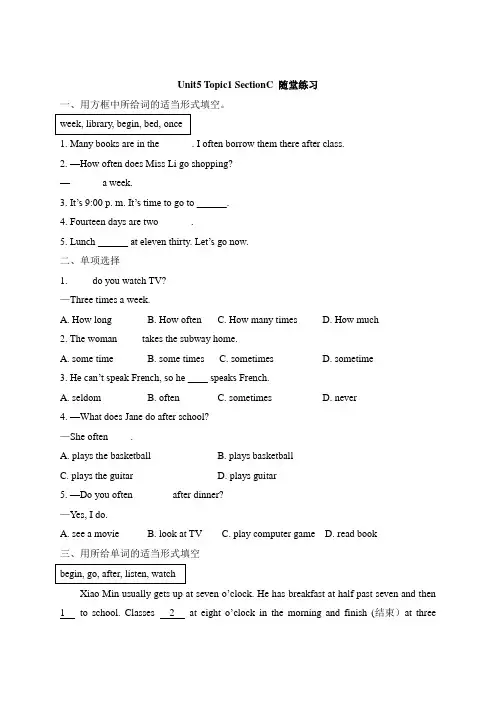
Unit5 Topic1 SectionC 随堂练习一、用方框中所给词的适当形式填空。
1. Many books are in the ______. I often borrow them there after class.2. —How often does Miss Li go shopping?—______ a week.3. It’s 9:00 p. m. It’s time to go to ______.4. Fourteen days are two ______.5. Lunch ______ at eleven thirty. Let’s go now.二、单项选择1. ____ do you watch TV?—Three times a week.A. How longB. How oftenC. How many timesD. How much2. The woman ____ takes the subway home.A. some timeB. some timesC. sometimesD. sometime3. He can’t speak French, so he ____ speaks French.A. seldomB. oftenC. sometimesD. never4. —What does Jane do after school?—She often ____.A. plays the basketballB. plays basketballC. plays the guitarD. plays guitar5. —Do you often _______ after dinner?—Yes, I do.A. see a movieB. look at TVC. play computer gameD. read book三、用所给单词的适当形式填空Xiao Min usually gets up at seven o’clock. He has breakfast at half past seven and then 1 to school. Classes 2 at eight o’clock in the morning and finish (结束)at threeo'clock in the afternoon. 3 school, Xiao Min usually plays games with his classmates. At about half past six, he has dinner with his family. Then he 4 TV for a short time. In the evening he reads books or 5 to music. He goes to bed at half past nine.1. ____2. ____3. ____4. ____5. ____四、根据汉语提示完成句子。
仁爱英语七年级下Unit-5-Topic1-练习题 (1)

Unit 5 Topic 1 SectionA 练习题一、单项选择1.Let’s meet ____ the school on foot.A.inB. toC. atD. for2.It’s time ____ go to bed.A.oftenB. forC.onD.to3.Allen gets to New York ___.A. by the planeB. on planeC.by planeD.in plane4. It’s time ____ supper.A. atB. forC. toD. on5. —_____ you often come to school on your bike?—______ Yes, I _____.A.Do,doB. Are, areC.Does, doesD.Is, is6.—How do you usually come to school?—I usually come to school ____ foot.A.InB. byC. withD.on7. She looks_____. Ask her to help you.A. oldB. sorryC.wellD. kind8.—____ do you usually go to school?—By bike.A.WhatB.WhenC.HowD.Which9.—Happy New Year!—________ !A.Thank youB. Not at allC. The same to youD.You are welcome10. My bool is interesting._____ yours?A.What isB.Whose isC.How aboutD.What is like二、句型转换1. Tom usually drives to work. (变同义句)Tom usually _____ _____ ______ ______ ______.2. 我们中有五人骑自行车上学。
U 5 Topic 1 Section A(同步练习)-试题版七年级英语下册同步精品课堂(仁爱版)
Unit 5 Our School LifeTopic 1 I usually come to school by subway.(Section A 1a-3b)同步训练题基础篇一、英汉互译①by bus ________________ ②步行________________③新年快乐________________ ④by subway ________________⑤去上学_______________ ⑥在学校大门口________________⑦坐飞机________________ ⑧by ship ________________⑨ride a bike ________________ ⑩have classes ________________二、单选题1. —________ do you usually come to school?—By car.A. HowB. WhatC. How oftenD. When2. The Greens usually drive to the park. But today they go to the park _____ foot.A. inB. onC. byD. of3. Sarah often _____ her homework after dinner.A. doB. doesC. doingD. to do4. —What does Wang Hong do in her free time?—She often _____ a movie.A. seesB. watchC. looksD. read5. —_____—The same to you.A. Good morning!B. Happy New Year!C. See you later.D. How do you do?6. Zhao Ming _____ to Shanghai by train often. He usually goes by plane.A. isn’t goingB. doesn’t goC. not goD. don’t go7. —Your new dress looks really nice!—_____A. Yes, it is so nice.B. You’re welcome.C. Thank you.D. That’s all right.8. Wang Hao seldom takes ____ subway to school.A. aB. anC. /D. the三、根据句意、首字母或汉语提示写出所缺的单词1. --Have a good weekend! --The s______ to you!2.They ______ (总是)go to Beijing by train.3. —Does she often ______ (listen) to music?—No, she doesn’t.4. The store is open only on w______.5. I often help my parents do the h__________ on weekends.6. Mike hardly ever talks with his father, but he o__________ talks with his mother.7. He gets up early every day. He h__________ ever goes to school late.8. Jack is a good student. He is n __________late for school.9. My grandma always gets up e______ every day.10. Jenny ______(很少) goes to school by bike. She always takes a bus to school.11. It takes me 40 minutes from home to school by u______.四、用单词的适当形式填空1. You new watch ______ (look) very nice!2. Kangkang often _____ (ride) a bike to the park.3. How about ______ (play) basketball with Jim this evening?4. He often _________ (watch) his favorite program.5.How often do you go to the (movie)?五、用方框中所给单词的恰当形式填空。
七年级英语(仁爱版)下册 Unit-5-Topic-1 知识点总结语言点归纳
知识点七年级英语(仁爱版)下册Unit-5-Topic-1语言点归纳Unit 5 Topic 1I 重点词汇和短语gate, by, always, plane, train, ship, boat, Ms., grandmother, group, weekday, early, bird, catch, seldom, walk, never, sometimes, ride, park, watch, TV, homework, life, American, or, few, day, rest, play, basketball, swim, ball, game, read, listen, library, once, twice, week, every, must, first, music, begin, while, wall, bed.the same to, come on, on foot, by plane, know about, for a while, watch TV, do (one’s) homework, have lunch, at school, have a rest, be different from, go swimming, listen to, go to bed, go to school, have classes.II 语言点Section A1. a) ---Happy New Year! ---- The same to you! / You, too. 新年快乐!也祝你新年快乐!b) ----Happy birthday! -----Thank you! 生日快乐!谢谢!2. How about you? = What about you? 你怎么样?3. Oh, your new bike looks very nice! 哦,你的新自行车看起来很好看。
仁爱英语七年级下五单元topic1 知识点
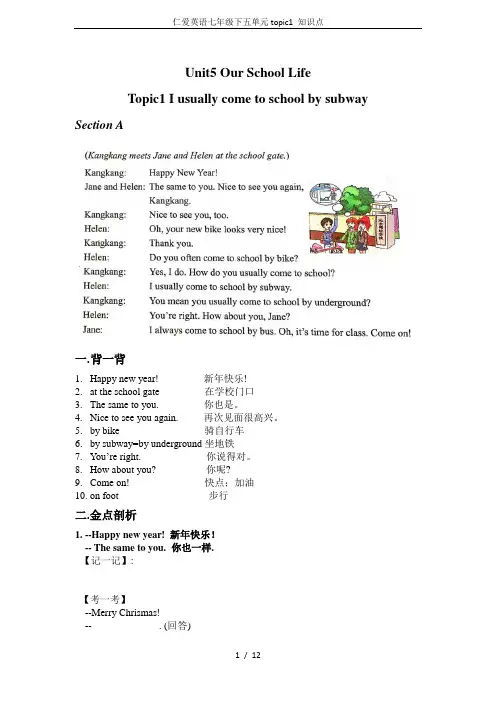
Unit5 Our School LifeTopic1 I usually come to school by subway Section A一.背一背1.Happy new year! 新年快乐!2.at the school gate 在学校门口3.The same to you. 你也是。
4.Nice to see you again. 再次见面很高兴。
5.by bike 骑自行车6.by subway=by underground坐地铁7.You’re right. 你说得对。
8.How about you? 你呢?e on! 快点;加油10.on foot 步行二.金点剖析1. --Happy new year! 新年快乐!-- The same to you. 你也一样.【记一记】:【考一考】--Merry Chrismas!-- _____________. (回答)2. Oh, your new bike looks very nice! 你的新车看起来很漂亮!【记一记】:拓展:look ____ 看look ____ 看上去像look ____ 照看【考一考】1. Ann’s mother is not at home. So Ann has to _________ her sister.2.Jim _______ his father. They both(都) have small eyes.3. Please _______ the photo! It’s wonderful.4. Your dress _____ very nice. May I have a look?A. watchB.seesC. looksD. shows3.--How do you usually come to school? 你平时怎么去上学?-- I usually come to school by subway.【记一记】:注意:① by,on, in 引导的短语在句中只能作状语,与go,come,get等连用。
Unit 5 Topic 1 Section B(22页)仁爱版七年级下册英语课件

Read 1a again and fill in the blanks.
Helen: Michael,what time do you usually _g_e_t _u_p__?(起床) Michael: I always get up _a_t about six o'clock. Helen: The early bird catches the worm. _H_o_w_do you usually come to school? Michael: I usually come to schoolo_n__fo_o_t, but _so_m__e_ti_m_e_sby bike. How about you ? Helen: I _s_e_l_d_o_m_ walk to school . I _o_f_t_en___ come by subway. What about you Sally? Sally: I _n_e_v_e_r _come to school by subway. I _a_lw__ay_s_ take a bus.
Hale Waihona Puke Activity watch TV in Frequency the afternoon
always
usually
often
sometimes
seldom
never
√
play soccer on Sundays
√
see a movie √
课堂总结
We learn: 1. some words: weekday, early, bird, catch, seldom, walk, never, ride, park, watch 2. some phrases: take a bus/car, do one’s homework watch TV, see a movie, play soccer 3. some sentences: The early bird catches the worm. I never come to school by subway.
仁爱英语七年级下Unit 5 Topic 1 Section A.B
1a Look, listen and say.
1.—Happy New Year! —The same to you. 2.—Do you often come to school by bike? —Yes, I do.
3.—How do you usually come to school? —I usually come to school by subway. 4.—It’s time for class.
2a. Study the example to understand the two ways of expressing the same meaning. Then fill in the blanks.
1a. Look, listen and say.
H: get up, on weekdays M: 6:00 H: early bird; how, go to school M: usually, on foot H: seldom, walk; often, by subway S: never, by subway; always, take a bus
for 4.—It’s time ___class.
We learn: 1. some words: gate, plane, train, ship, boat, by, always 2. some phrases: come on, on foot, by bike/car/bus/train/subway/plane/boat 3. some sentences: How do you usually come to school? I usually come to school by subway. We can: talk about the means of transportation. e.g. I often go to school by bike/bus.
Unit 5 Topic 1 Section A(29页)仁爱版七年级下册英语课件
02 新 课 讲 授
What are these?
bike
car
What are these?
subway/underground
bus
What are these?
boat
ship
骑自行车 by bike
(1) look“看起来,好像”,是系动词,后加形容词。 e.g. She looks very beautiful. 她看起来很漂亮。 (2) look 用作行为动词,表示“看”,当后面要跟宾语时,必须要跟介词at。 (3) look 还可以做名词,表示“外貌,长相”。 (4) 与look有关的短语: look at… =have a look at…看一看 look like 看起来像 look the same 看起来一样
I usually come to school by subway.
04 当 堂 检 测
一、根据句意及汉语提示,完成句子 1. Let’s meet at the school gate (大门口). 2. Look at that nice boat (小船). That’s my uncle’s. 3. Mr. Ge often goes to Canada by plane (飞机). 4. Do you usually come to Jinan by train (火车)? 5. Jim wants to go to Shanghai from Chongqing by ship (轮船).
Enjoy the பைடு நூலகம்ideo
Listen again and answer the questions.
七年级英语下册Unit5OurschoollifeTopic1IusuallycometoschoolbysubwaySectionB教案(新版)仁爱版
Unit 5 Our School LifeTopic 1 I usually come to school by subway.Section B一、教学目标1. 能根据已学语音、音标及发音规则,正确朗读下列词汇并运用于情景对话中:weekday, early, bird, catch, worm, sometimes, seldom, walk, never, ride, park, watch, TV, television, watch TV, soccer, football, movie, film2. 在Section A的基础上,复习交通方式,能正确运用always, usually, sometimes, seldom, often, never等频度副词,同时能用介词by加交通工具和动词短语两种不同方法来表示交通方式。
3. 在情景对话中,能够表达“日常的交通方式、某项活动的频度”等语言功能,如:1) I usually come to school on foot, but sometimes by bike.2) I seldom walk to school. I often come by subway.3) I never come to school by subway.4. 使学生明白早睡早起的重要性。
二、教学重点及难点在对话操练、两两问答、小组调查等活动中,学习用频度副词来进行日常活动频率的有关表达,同时还学习和操练用两种不同的表达(介词by加交通工具和动词短语)对交通方式进行问答及切换。
三、教学准备教师:教学课件;多媒体设备学生:课前预习四、相关资源五、教学过程Task 1Step 1 Warming-upFree talk1. Work in pairs based on the following structures.T: How do you usually come to school?S1: By bike.T: How do you usually go to the zoo?S2: By bus.2. Choose a few pairs to act them out.【设计意图】复习上节课所学知识点,培养学生口语表达能力。
最新仁爱版七年级英语下册Unit5 Topic1 SectionA优质课教案
最新仁爱版七年级英语下册Unit5 Topic1 SectionA优质课教案一、教学目标1、知识目标1).掌握单词:subway/underground, plane, train, ship, boat, usually, gate.…2).掌握短语:at the school gate, by boat, on foot..3).掌握句型:—Happy new year!—The same to you.—How do you usually come to school?—I usu ally come to school…2、能力目标1).能正确使用how和by/on来询问及回答日常的交通出行方式。
2).能听懂表达交通方式的简单对话,并能根据图文就交通方式进行口语交流。
3、情感目标1).通过最后的Project联系生活实际,指导学生为不同的目的地选择合理的交通工具,加强学生的生活实践能力。
2).加强校园交通安全意识,珍爱生命。
二、教学重难点教学重点:1).学习表达交通工具的新单词subway/underground, plane, train, ship,boat。
掌握短语at the school gate, by boat, on foot。
2).掌握对交通出行方式提问的句型:How do you usually come to school?教学难点:表达交通出行方式要用by+交通工具,特别注意步行用介词on,即on foot。
三、教学过程Step1.导入(Lead-in)老师通过询问孩子寒假及春节情况来引出歌曲Happy New Year,通过歌曲来调动孩子们学习的积极性。
Step2.热身运动(Warming-up)通过一段与交通工具有关的动画片引出本课的主题,并激发学生对于本堂课的学习兴趣。
其间,设置两个问题1. How many kinds of vehicles are there in the video?2. What are they?让学生带着问题观看动画视频,效果更好。