
人教版新课标高中英语必修三Unit 1《Festivals around the world》(第2课时)ppt课件
•
巧学助记
•
口诀记忆can/could
• • • •
can表能力和可以, 否定、疑问(在否定句及疑问句中)表猜疑。 could为can的过去式, 语气比can更客气。
课堂讲练互动
•
•
(二)may与might的用法
1.表示允许、许可。might在语气上比may更委婉。以may/might开 头的问句在否定回答中要用mustn't。如: ①You may keep the book for 2 weeks. 这本书你可以看两周。 ②—May I use your telephone? 我可以用你的电话吗? —Yes, you may./No, you mustn't. 是的,可以。/不,不可以。
•
⑤Festivals can also be held to honour famous people.
•
课堂讲练互动
•
⑥Harvest and Thanksgiving festivals can be very happy events.
•
(表示“理论上或习惯上的________”)
•
⑦At the Spring Festival in China, people eat dumplings, fish and meat and may give children lucky money in red paper.
•
(表示“________”)
•
④They also light lamps and play music because they think that this will lead the ancestors back to earth.
•
(表示“________”) (表示“________”)
Unit 1
Festivals around the world
课堂讲练互动
Unit 1
第二课时 Learning about Language
情态动词(Ⅰ)
课堂讲练互动
1
课前新知预习
3
课堂达标验收
2
课堂要点探究
4
课后强化作业
课堂讲练互动
课前新知预习
课堂讲练互动
• •
根据句意观察思考下列各句中情态动词的意义。 ①Most ancient festivals would celebrate the end of cold weather, planting in spring and harvest in autumn.
课堂讲练互动
• • • •
•
• •
②When she was 8 years old,she could play the piano very well. 当她八岁时,她能很好地弹钢琴。
•
•
2.表示猜测“可能”,一般用于疑问句和否定句(could是过去式)。
①—Can the lady over there be our boss?
•
(指“________”)
•
②At that time people would starve if food was difficult to find, especially during the cold winter months.
•
(指“________”)
课堂讲练互动
•
③Some festivals are held to honour the dead or to satisfy the ancestors, who might return either to help or to do harm.
•
2.没有人称和数的变化。但有些情态动词,如:can, will, dare有 一般现在时和过去时的变化。
•
课堂讲练互动
•
3.情态动词的“时态”形式并不是区分时间的主要标志,很多情况下, 情态动词的现在时形式和过去时形式都可用来表示现在时间、过去时 间或将来时间。
二、情态动词的基本用法 (一)can与could的用法 1.表示能力(could是过去式)。 ①The clever student can solve such difficult problems in a short time. 这位聪明的学生能够在很短的时间内解决这样难的问题。
• • • •
课堂讲练互动
•
易混辨析
时态 can
内涵 指自身多的时态变化,表示经过一段时间的努 可用于将来时,完 力后所具有的能力,相 be able to 成时和非谓语动词 当于manage to do或 中 succeed in doing
•
After many years'hard work,he was able to achieve his goal.
•
•
——在那儿的那位女士可能是我们的老板吗?
——It can't be her.I saw her in the office just now.
•
• •
——不可能是她。我刚刚在办公室里看到她了。
②My glasses aren't here.Where can I have put them?
我的眼镜不在这里。我可能把它们放哪儿呢?
课堂讲练互动
• • • • •
3.表示请求允许或允许,常用于第一人称或第二人称。 —Can/Could I use your mobile phone?(请求允许) ——我可以用一下你的手机吗? —Of course,you can.——(表示允许) 当然可以。
课堂讲练互动
•
•
名师点拨
(1)在请求允许时,与can相比could语气更为委婉,没有时态、意义上 的区别。 (2)表示允许某人做某事时,用can而不用could。 (3)can表示惊异、怀疑或不相信的态度,主要用于疑问句或否定句。 How can you be so rude? 你怎么能这么粗鲁?
•
(表示“________”)
• •
答案:①过去常常 ②过去将要 ⑤允许 ⑥可能性 ⑦许可
③猜测
④将要做……
课堂讲练互动
课堂要点探究
课堂讲练互动
• •
一、情态动词的定义
情态动词表示说话人的某种感情或语气,对某一动作或状态的某种 态度,表示“需要”“可以”“应该”等意义。情态动词有以下特征: 1.不能单独作谓语,除ought to和used to以外,后面只能接不带 to的不定式。
人教高中英语 必修3 unit1 Festivals around the world
各种各样的 相同种类的 不同种类的 这(那)种 某种
① 我们卖各式各样的鞋。 We sell all kinds of shoes.
= We sell shoes of all kinds. ②那类问题是很难解答的。
That kind of questions is very difficult to answer. = Questions of that kind are difficult to answer.
I mean the room for my bedroom. had meant to 本来打算做 I had meant to do English exercises first.
---You should have thanked her before you left.
---I meant __B___, but when I was leaving I couldn’t find her anywhere.
take place与happen take place:发生,举行;侧重安排或计划 而发生的事,带有“非偶然”的意思。
The Olympic Games take place every four years. happen:常指客观事物或情况偶然、不 可预料地发生。(happen to … 碰巧发生)
A. to do B. to C. doing D. doing so
想一想
2.take place发生,举行
<不及物动词,不用于被动语态> Our school sports meeting will take place next
week. Great changeds have takent. (1) 庆祝;祝贺
新人教版必修三 Unit 1 Festival around the world[教案]
![新人教版必修三 Unit 1 Festival around the world[教案]](https://360docs-1393072327.cos.ap-beijing.myqcloud.com/98f4ece4763231126fdb1122.webp)
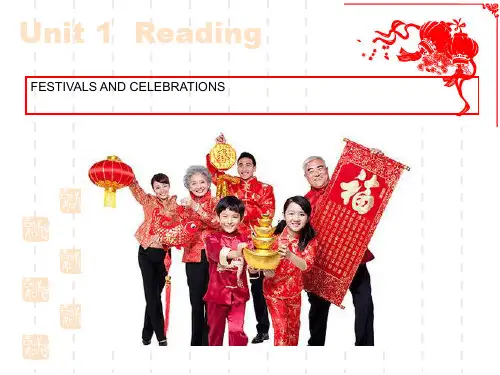
第一单元Reading Festivals and celebrations 教案1. 教学设计理念语言的学习离不开文化,英语教学从某种程度上来讲就是文化教学,对英语文化的了解和理解有利于加深本国文化的学习,培养爱国主义精神,也有利于提高人文素养。
因此传授文化知识、培养文化意识和世界意识,是英语教学中一个非常重要的任务。
①运用任务型语言教学模式,训练培养学生对语言的综合运用能力.②课堂以学生为主体,以任务为主线,重视体验参与,教师起到“设计者、研究者、促进者、协调者〞的作用.③在教学中,突出交际性,注重读写的实用性,要进行情感和策略调整,以形成积极的学习态度,促进语言实际运用能力的提高.④正视个体差异,倡导过程鼓励,以多层次、多角度、多主体的结果与过程并重的评价方式鼓励学生进步.2. 教材分析本单元以节日为话题,介绍古今中外节日的种类、由来、意义以及人们的活动和习俗,旨在通过对世界各地的节日名称、由来及庆祝方式的讨论和学习,让学生在多样的东西方节日、文化中进行比拟,并发现节日文化的共性、多样性和民族独特性,从而增进对多种文化节日的理解,进而拓展社会文化背景、增加跨国文化知识.3. 教学目标①帮助学生了解世界各地的节日.②了解节日的分类并进而理解节日庆祝的意义.③通过阅读材料继续训练学生略读,细读,猜想词义,归纳等阅读技巧.4. 重难点①理解节日的起源及意义,增强文化保护意识②通过学生对多样的东西方节日、文化所进行的比拟,发现节日文化的共性、多样性和民族独特性,从而增进对多种文化节日的理解。
5. 教学步骤Unit 1 Festivals around the worldLearning aims : 1.learn about festivals around the world.2. learn about the kinds of festivals and the reason for celebrating them.3. train reading skills such as skimming and summarizing.Difficult points : the reason for peopke’s celebrating festivalsStep 1 Warming up1.What other traditional festivals in China do you know ?______________________________________________________________2.What festivals of foreign countries do you know?______________________________________________________________ Step 2 ReadingII.Careful reading2). Festivals to Honour People (Match the person with the festival.)1. Qu Y uan a. the Dragon Boat Festival2. Christopher Columbus b. an Indian national festival on Oct. 23. Mohandas Gandhi c. Columbus Day3). Harvest Festivals (Choose the best answer.)Many activities can be held in harvest festivals EXCEPT that people ___.A. get together to have mealsB. decorate houses to admire the moonC. win awards for their farm produceD. enjoy mooncakesTask 2 True or False1. The ancient people needn’t worry about their food.2. Halloween used to be a festival to honor the dead.3. Qu Y uan was a great poet who people honor a lot in China.4. Mid-autumn Festival is held to celebrate the end of autumn.5. Easter celebrates the birth of Jesus.Task 3 Answer the questions1.What are festivals of the dead usually for?2. What makes autumn festivals happy events?3. What do people usually do at spring festivals?4. What is one important reason to have festivals and celebrations?III. Free talkingWhat do most festivals seem to have in common ?Step 3 Discussing◆What is your favourite festival? Why?◆When is it? What is the festival about?◆How long can we have for holiday? What do we usually do in the festival? Step 4HomeworkWrite a short passage about your favorite festival。
新人教高中英语必修三 Unit 1 Festivals around the world 课件
Easter
Easter Bunny
In late March or early April
Popular symbols Easter eggs
Carnival
Brainstorming
festivals of foreign countries Thanksgiving Day Easter Christmas Father’s Day
5. Easter celebrates the birth of Jesus. F
Task 1 Obon
Day of the Dead
Festivals of the Dead
Cherry Blossom Festival Festivals to Honour People Halloween Dragon Boat Festival
Columbus Day
Easter
Harvest Festivals
The Yoห้องสมุดไป่ตู้th Day
Festival Time of What it What people do year/date celebrates Tomb 5th Sweeping April Day honour the dead and satisfy the ancestors
sweep the tombs; give flowers
Christmas
On October 31 children in countries like the US and Canada celebrate Halloween.
Halloween is one of the oldest holidays with origins going back thousands of years.
人教新课标必修3 Unit 1 Festivals around the world Reading 课件(共38张PPT)
1)How do Japanese honour their ancestors?
They have a festival called Obon, when people should go to clean graves and light incense to honour their ancestors. They light lamps and play music.
Christmpasossible. Now Father's Day let’s read theApril Fpooal’ssDsayage and shMoodtwhteiortf’shgoDefteahireyetttrrhhapmeneenkoosptrrloeeerklaoiinvsnedofsnosromffaoftreiotshnti…evamab…l.osuatnd
Words Review
grave incense in memory of Mexico
feast skull bone Halloween belief dress up
n. 坟墓;墓地 n. 熏香;熏香的烟
纪念;追念
n.墨西哥(拉丁美洲国家) n. 节日;盛宴 n. 头脑;头骨 n. 骨;骨头 n. 万圣节前夕;诸圣日前夕 n. 信任;信心;信仰
4) Compare the festivals of the dead in Mexico, Japan and China. which aspects are similar and which are different?
The Chinese, Japanese and Mexican festivals of the dead all have customs to honour the dead. The Chinese and Japanese go to clean their ancestors’ graves, and the Mexicans offer food, flowers and gifts to the dead. However, there are some dpecial food that looks like bones, something the Chinese and Japanese do not do.
人教版英语必修3 Unit1 Festivals around the world
Unit1 Festivals around the worldTeaching aims:1. TopicFestivals; how festivals begin; how to celebrate festivals2. Useful words and expressions:Starve plenty satisfy ancestor lamp lead feast bone origin trick poet arrival national gain independence gather agricultural European custom award watermelon handsome rooster admire energetic forward Easter clothing religious social Christian daily permission possibility fool apologise drown sadness obvious wipe lovely couple weep announcer forgiveTake place in memory of dress up play a trick look forward to day and night as though have fun with turn up keep one’s word hold one’s breath 3. Functional items:1)RequestCould /Would you please…?Could I have…?Could we look at…?I look forward to ….May I see…?2)ThanksIt’s very kind of you…Thank you very much/thanks a lot.I’d love to.It was a pleasure….Don’t mention it.You are most welcome.4. Structures情态动词can, could, may, might, will, would, shall, should, must, can’t 等的用法。
人教版高中英语必修三Unit1Festivalsaroundtheworld课文知识点解析

happy memories of his stay in London
对在伦敦幸福的记忆
8.lead the ancestors back to earth
把祖先带回到地球
lead sb. to...把某人带到……
e.g. He led us to his home.
plenty n./pron. 足够;大量
e.g. years of peace and plenty 太平丰收年
There is plenty of room in my bag.
我包里还很空。
6.Some festivals are held to honor the dead,or satisfy and please the ancestors,who could return either to help or do harm.
一些人可能因为他们的动物,花,果实和蔬菜而赢得奖品。
award[C] n. 评价 报酬 奖品
e.g.He has won the best actor award.
他已经获得了最佳男演员奖。
19.In China and Japan there are mid-autumn festivals,when people admire the moon and give gifts of mooncakes.
People mean festivals to celebrate important events.
(1)mean vt. mean sb. or sth. to do sth.=intend sb. or sth. to do sth.
Unit1Festivalsaroundtheworld(新课标版高一英语必修三教案教学设计)
Unit 1 Festivals around the world(新课标版高一英语必修三教案教学设计)Unit 1 Festivals around the worldThe First Period (Warming up & Pre-reading)Step One: Lead-inFree Talk: Did you have a good time in your winter holidays?When did you feel most happy and excited? Why?( At the Spring Festival. Because it's the most important festival in our country....)Step Two: Warming up1. Let the Ss think about the other Chinese festivals.( Lantern Festival, Pure Brightness Festival, Dragon Boat Festival, Mid-Autumn Festival, New Year's Day, Chung Yeung Festival....)2. Discussion One1)Let the Ss look at the information about Chinese festivals and discuss another four Chinese festivals according to the example in warming up: When does the festival come?What do people celebrate?What do people do?Festivals Date festivals DateNew Year January1st Teachers' Day September 10thInternational Women's Day March 8 National Day October 1stArbor Day March 12th The Spring Festival Lunar New Year International labor Day May 1st Dragon Boat Festival the fifth day of the fifth lunar monthInternational Children's Day June 1st Mid-Autumn Festivalthe 15th day of the 8th lunar monthArmy Day August 1st Lantern Festival the 15th day of the 1st lunar monthChinese Youth Day May 4th Pure Brightness Day April the fifth2) Let the Ss fill in the form in the warming up and ask some to share their opinions with the whole class.3 Discussion TwoTalk about some foreign festivals.( Christmas, April Fools Day, Easter Day, Halloween, Valentine's Day, Thanksgiving Day, Obon...)Step three: Pre-readingLet students think about the questions:1) What is your favourate holiday of the year? Why?2)What festivals or celebrations do you enjoy in your city or town? Do you like spending festivals with your family or with friends? What part of a festival do you like best- the music, the things to see, the visits or the food?Step Four: Language Points1.mean to do 打算做某事mean doing 意味着….I never meant him to work for us.Passing the entrance examination means being admitted into college.2. celebrate vt.(1) do sth to show that a day or an event is important 庆祝;祝贺celebrate Christmas / one’s birthday / a wedding anniversary / a victory(2) praise and honor 赞扬;称颂The names of many heroes are celebrated by the poets.词语辨析:celebrate, congratulatecelebrate后常接日期、事情或场合。
人教新课标高中英语必修三Unit 1 Festivals around the world全章教案
人教新课标高中英语必修三Unit 1 Festivals around the world全章教案I.教学内容分析本单元的中心话题是“节日”,主要讲述了不同地区不同种类的节日。
Warming Up部分设计了小组活动,通过图表填写让学生区分中国的传统节日与别国节日的异同,目的在于激活学生已有的节日背景知识,引出主题,为以后几堂课学习热身。
Pre-reading 通过几个问题,调动学生已有的知识和经验,激发学生想了解更多节日的好奇心,让他们主动参与到主题教学活动中,为下面学习阅读文章作铺垫。
Reading 部分先简要介绍了一下早期各种节日的起源以及存在的原因,然后又分别介绍了几种世界各地的节日,依次的顺序是亡灵节、纪念名人的节日、丰收节、春天的节日等。
Comprehending由四个部分组成。
第一、三、四部分通过表格形式,第二部分通过让学生回答问题的方式,鼓励学生积极思考,加深对课文的理解。
Learning about Language 部分主要突出了本单元的语法项目——情态动词的用法。
这些情态动词主要有:can,could,may,might,will,would,shall,should,must,can’t 等的用法。
Using Language 部分中包括了听、说、读、写几个部分的内容。
学生可通过对Trinidad Carnival、情人节等一些节日的学习,分析问题,锻炼自己的思维能力。
阅读后的习题及讨论不仅帮助学生理解文章的主旨大意,更重要的是让学生寻找解决问题的方法。
Learning Tip部分主要建议学生搜集各种资料,查询与世界各地节日有关的信息,了解各种节日的来源与内涵。
II.教学重点和难点1. 教学重点(1) 本单元的生词和短语;(2) 掌握一些情态动词的基本用法;(3) 了解有关节日和民俗,掌握有关词汇,如custom,religious等。
2. 教学难点(1) 增进学生对中国节日的理解,了解和感悟外国的节日;(2) 提高学生的社会文化素质,加强跨国文化素质;(3) 培养学生运用资源策略。
高一英语人教新课标必修三 Unit1 Festivals around the world
mask
Halloween in Western countries
:Festivals to Honour People
Match the festivals with the proper people.
National Festival The Dragon Boat Columbus on October 2 Festival Day
India
China
USA
thanksgiving festivals mid-autumn festivals
Are harvest festivals always happy events? Why or why not ?
Harvest festivals are always happy events because people are _______ (thankful) that food is gathered grateful the agricultural work for the winter and __________________ (农活) is over How do people celebrate the festivals (key verbs)? • decorate…with… • get together to … • win awards for … • admire… enjoy…
Skimming(略读,浏览) Para 1 and sub-heading (副标题)
Festivals of all kinds have many________: origins • some religious ________, • some ________, seasonal • some for special _________________. people or events
高一英语必修三教材全解答案
高一英语必修三教材全解答案人教版高中英语必修三教材答案。
Unit1 Festivals around the world1. 那照片让她想起淹死在海里的爱人,她哭了。
当她走出房间时,尽管已拭去了泪水,但仍掩盖不住脸上的悲伤。
(remind…of; drown; weep; wipe; sadness )The photo reminded her of her lover who had drowned at sea, and she wept. Although she had wiped all her tears away when she came out of the room, she could not hide the sadness on her face.2. 多年来,这位身居墨西哥的老人日夜梦想着回到自己的祖国。
(Mexico; day and night)For many years this old man who lives in Mexico has been dreaming day and night about going back to his homeland.3. 这位精力旺盛的诗人也没有能够找出这些词的起源。
(energetic; poet; origin)The energetic poet could not find the origins of the words.4. 我们又见面了,他为自己没有信守诺言而向我道歉,并希望我能原谅他。
(keep one’s word; apologize; forgive)When we met again, he apologized to me for not having kept his word and asked me to forgive him.5. 根据专家们的预测,他会荣获今年金鸡奖的最佳男演员奖。