
【牛津上海版】2019学年七年级英语下册Unit 2 Going to see a film同步练习卷附答案
【牛津上海版】2019学年七年级英语下册同步练习卷Module1Unit2同步验收练习Part1I.Translate the following phrases into English(将下列词组翻译成英语):1.电影指南___________________2.关于冒险的影片3.在太空中__________________4•太空战争________________________5.讨论要看哪部电影__________6.动作电影____________________________7.看一看_____________________8.本周日__________________________II.Choose the best answer(选择最恰当的答案)()1.They don’t like the films_______cowboys.A.aboutB.ofC.withD.on()2.Kitty would like_______a cartoon.A.seesB.to seeC.seeingD.see()3.—I’d like to have a cup of fruit juice.—_______A.Neither did I.B.Neither would I.C.So would I.D.So did I.()4.Excuse me,how can I get to______nearest cinema?A.aB.anC.theD./()5.Be quiet!I’ve got_________to tell yo u.,A.an important newsB.a piece of important newsC.many important newsD.some piece of important news()6.Jogging is________in summer,I think.A.a great funB.great funC.great funsD.greatfunny()7._________film are we going to see this weekend?Shall we see Swan Lake"!A.WhichB.WhereC.WhenD.Why()8._________a rainy day,Kitty and her parents have to stay at home.A.WithB.InC.ForD.Onplete the sentences with the given words in their proper forms(用括号中所给单词的适当形式完成下列句子。
每空格限填一词):1.Police Story is a film with a lot of____.(act)2.The boys over there are new—___in the restaurant,(wait)3.Have you seen Mark Twain’s The_____of Tom Sawyer?(adventurous)4.The Stupid Clown is full of___and fun.(laugh)5.My parents still keep their__________as usual,(diary)plete the following sentences as required(根据所给要求,完成下列句子.每空格限填一词):1.Alice had bread and milk for breakfast this morning.(改为否定句)Alice________bread and milk for breakfast this morning.2.Mr Smith has never been to the other countries•(改为反意疑问句)Mr Smith has never been to the other countries,_______?3.She’d like to see the film Monkey King.(对划线部分提问)____film____she like to see?4.How heavy is that suitcase?(保持句意基本不变)____the____of that suitcase?5.It cost me most of my pocket money to buy these tapes.(保持句意基本不变)I____most of my pocket money____these tapes.V.Choose the best words or expressions and complete the passage(选择最恰当的单词或词语完成短文)Nowadays the question___1___the elderly has become a hot topic.It is said that almost every family has old people to look st year a horrible story shocked people that an old lady stayed in the corridor of a Shanghai’s hospital,but her daughters and sons__2___to come to take care of the old lady.I don’t think the reported story is commonly(普通地)seen but surely we have some things to consider(考虑)about the old people.They worked hard for their family,for their children and for their country when they were___3__.Now,most of them are staying at home___4___.They sometimes don’t have children around them.Some people often ignore(忽视)their old parents with the__5____that they are too busy with the work.Have you ever heard the saying“An old man is treasure of a family”?So let’s take good care of our parents,our grandparents and respect all the old.() 1. A.about B.in C.with D.of() 2. A.wanted B.asked C.wished D.refused() 3. A.old B.young C.strong D.ill() 4. A.busily B.excitedly C.alone D.happily() 5. A.reason B.study C.business D.excusepart2Reading and Writing(共40分)I.Reading comprehension.(30分)AWhat’s your favourite weather?Do you like sunny or rainy days? Many people like sunshine a lot.They don’t like rain.They think rain can make them feel sad.During a long holiday,they like going to the beach to enjoy the sunshine.Sunshine can make them feel good and happy.I like sunshine very much,but I also enjoy rain.I enjoy the sound of rain.It can make me feel quiet.On rainy days,I like listening to music and reading books,or just looking at the rain and daydreaming(做白日梦).Sunshine can make one run around and rain can make one quiet,so I hope you can feel happy no matter it rains or shines.True of false.(5分)()1.Sunshine can make people feel good and happy.()2.People go to the beach to enjoy the sunshine or the rain.()3.Rain can make everybody feel sad.()4.The sound of rain may make people feel quiet.()5.Maybe daydreaming is a good way to relax when it rains.BPeople use money to buy food,books,bicycles and hundreds of other things they need.When they work,they usually get paid in money.Most of the money used today is made of metal(金属)or paper.Butin ancient times people used to use all kinds of things as money.One of the first kinds of money was shells.In China,cloth and knives were used as money.Elephant tusks, monkey tails and salt were used as money in some parts of Africa.Rice was also a kind of money used by ancient people on some islands.Cows and other animals were used as money,too.The first copper(铜)coins were made in China.They were round and had a square hole in the centre.Different countries had used different metals for their ter some countries began to make coins of gold and silver.But gold and silver coins were heavy to carry when people need a lot of coins to buy something expensive.The Chinese were the first to use paper money.The first paper money looked more like a note from one person to another than paper money we use today. Choose the right answer.(5分)()1.______can be used as money today.A.Metal coinsB.ShellsC.AnimalsD.Cloth()2.People gave up gold and silver coins because______.A.they were too heavyB.they were difficult to makeC.they were too expensiveD.they didn’t like to use them()3.______first used paper money.A.IndiansB.AmericansC.ChineseD.English()4.African people used______as money in ancient times.A.cloth and knivesB.elephant tusks,monkey tails and saltC.cows and other animalsD.coins used today()5.The text is about______.A.Paper moneyB.Chinese and African moneyC.money in ancient timesD.coins used todayCOnce a general(将军)lost a battle(战争),and his enemies were after him.He was running away with a servant.They were tired,hungry and thirsty.But they didn’t dare(敢)to go into any town because they were afraid of being discovered and caught by the enemies.Towards evening,they arrived at a mountain where there was a small cave.“Let us hide here,”said the servant.“This will be a safe place.”“No,”the general said,“I’m afraid the enemies will try everywhere to find us.We cannot stop to rest.”But they were too tired to go.They entered the cave for a short rest. And soon they were fast asleep inside.In the morning,they heard steps nearby.A group of enemy soldiers were coming near the cave’s entrance.“Let’s look in here,”said one of the soldiers.“Don’t be foolish,”said another.“No one could be hiding inside.”“How do you know?”“Don’t you see the spider’s web(蜘蛛网)?It covers the entrancefrom one side to the other.How could anyone enter?”True.There was a huge spider’s web which completely covered the entrance.So the soldiers continued on their way.The general and the servant were grateful to the spider,which had woven(织)the web across the cave’s entrance during the night. Answer the questions.(5分)1.What happened to the general one day?____________________________________2.Did the general go to any town to find some food?____________________________________3.Where was the general in the evening?____________________________________4.Who came to the cave in the morning?____________________________________5.What made the soldiers think that there was noone in the cave?____________________________________DChoose the words or expressions and complete the passage.(5分) We moved into our new house on a warm September day.It was not __1__a new house.It was a hundred and four years old,but it was new to us.The house had running water,gas and electricity,but for__2__ reason there was no electric light in the kitchen.We had not__3__this shortage(不足)when we first looked over the house.It was something we didn’t expect(预料):a house with electricity,but__4__a kitchen light. It was even terrible because our kitchen was a large room,perhaps thelargest in the house.I telephoned an electrician.He came and__5__it for us.And he asked$85for his work.()1.A.just B.reallyC.nearlyD.real()2.A.some B.anyC.theD.a()3.A.looked B.feltC.noticedD.wanted()4.A.have not B.has notC.withoutD.no()5.A.did B.madeC.gaveD.fixedERead the passage and fill in the blanks with proper words.(10分)A smile on your face shows you are happy.Tears in your eyes tell others you are sad.It’s just like our school life.School life is always colourful.Besides studying we can do many(1)o______interesting things.But at school,study comes first,so we have to(2)s______most of the daytime having classes or doing our homework.Everyone has his hobbies,like playing basketball(3)o______football,reading books, listening to music and so on,so we usually do these things after class. After a week’s hard work we always look forward to the(4)c______ Saturday,because on Saturday evening we can relax(5)o______.We all enjoy our school life.1. 2. 3.4. 5.II.Writing.(10分)Write at least sixty words about the topic“Go to the cinema”. Suggestions:1)Do you like seeing films?How often do you go to see a film?2)Say something about the film you have just seen.Go to the Cinema________________________________________________________________________________________________________________________________12 ________________________________________________________________________________________________________________________________24 ________________________________________________________________________________________________________________________________36 ________________________________________________________________________________________________________________________________48 ________________________________________________________________________________________________________________________________60Part1I.1.film guide2.films about adventures3.in space4.Space Wars5.discuss which film to see6.action film7.take a look8. this SundayⅡ.1.A 2.B 3.C 4.C 5.B 6.B7.A8.DⅢughters5.diariesⅣ.1.didn’t have2.has he3.What;would4.What’s",weight 5.spent...on/paid...for V.1.A2.D3.B4.C5.DPart2【答案】:Vocabulary and GrammarI.1—5BDCAD6—10CCBAC11—15DDADC16—20ACABBII.1.surprising 2.action3.robbery,robbers4.international5.excitingIII.1.hasn’t got2.Which dress3.does he4.What an 5.It tookReading and WritingI.A.1—5TFFTT B.1—5AACBCC.1.He lost a battle and his enemies were after him.2.No,he didn’t.3.He was in a small cave.4.A group of enemy soldiers.5.A huge spider’s web which completely covered the entrance.D.1—5BACCDE.1.other 2.spend3.or ing 5.ourselvesII.One possible version:Go to the CinemaI like seeing films very much.I usually see a film once a st night I went to the cinema with my parents.The film Country Road is really very interesting.I think it’s one of the best films I have ever seen.There are many famous film stars in it.The story was exciting. The music of the film was wonderful.We enjoyed every minute of it.We talked about it on the way home.。
牛津上海版七年级下英语Unit2综合练习含答案

七年级下英语U2综合练习I. 单项选择( )1. There’s no buses. He has to there his bicycle.A. go to; onB. go to; byC. go; onD. go; by( )2. — How many pencils are there in your pencil box? — .A. NobodyB. NotC. NoneD. No one( )3. — Is this your room, Mr. White? —No, it’s __ ___ room.A. the childrenB. the children’sC. of the childrenD. the childrens’( )4. — Who is the man in the blue car? —He is ______ father.A. Kate’s and Mary’sB. Kate and Mary’sC. Kate and MaryD. Kate and Mary of( )5. We can’t see _______ sun at _________ night.A. a; /B. a; theC. the; /D. the; the( )6. What do you want to buy?A. otherB. elseC. else thingsD. others( )7. You can choose book you like in the library.A. someB. manyC. aD. any( )8. The boy the toys this.A. like; likeB. like; likesC. likes; likeD. is like; are like( )9.There is ____ ___ “x” in ___ ___ word “six”.A. a; theB. a; anC. an; theD. a; a ( )10.There’s ___ ___ egg on the plate. __ ___ egg is for you.A. a; AB. an; AnC. an; TheD. the; An ( )11. orange juice there in the bottle?A. How many; isB. How many; areC. How much; isD. How much; are( )12.I don’t know sheep there on the farm.A. how many; isB. how many; areC. how much; isD. how much; are( )13. of the students bring any food or drinks here.A. NoB. NotC. NoneD. Some ( )14. ___ ___ office is much larger than _______.A. Ours; yoursB. Our; yoursC. Their; ourD. Your; their’s ( )15. We study Chinese, English and some _______ subjects(科目).A. the otherB. otherC. othersD. another ( )16. — Would you like _______ milk in your tea? —Yes, just _______.A. any; littleB. some; a littleC. much; a fewD. a little; some ( )17. If you don’t have enough rest(休息), you _______ ill.A. maybeB. areC. may beD. may( )18. Please take your dog __________. You should look after it well.A. to homeB. homeC. hereD. to here( )19. Alice __________ to climb a ladder to get into her house.A. haveB. is havingC. hasD. don’t have ( )20. There is _______ beef on this plate than on that one.A. muchB. littleC. lessD. a littleII. 用所给单词的正确形式填空1. In the packet ____________ (be) some chips.2. There are lots of fun and interesting things ___________ (see).3. Tell him _____________ (not look) out of the window in class.4. The radio says it will be ___________ (sun) tomorrow.5. Kitty goes to the _____________ (near) supermarket every Saturday afternoon.6. How many (loaf) of bread should be enough?7. I want to know more about (west) culture(文化).8. There’s more water in my glass than that in__________ (she).III. 根据句意完成句子1. 他每天骑自行车上学要花半小时。
牛津上海版七年级英语下册优秀教学案例:Unit2Goingtoseeafilm

4.学生根据教师的反馈,调整自己的学习方法,不断提高自己的英语水平。
五、案例亮点
1.情境创设:本案例以学生感兴趣的电影为主题,通过丰富的情景创设,如播放电影预告片、展示电影图片等,激发学生的学习兴趣,使他们能够在真实语境中感知和运用英语。这种情境创设的方式不仅符合学生的认知特点,也有利于提高他们的语言运用能力。
2.问题导向:教师在本案例中设计了一系列问题,引导学生思考和讨论电影的起源、类型及特点等。这些问题既有助于激发学生的学习兴趣,又能培养他们的思维能力和批判性思维。通过问题导向的方式,学生能够在探讨问题的过程中自然而然地掌握所学知识。
3.小组合作:本案例中,教师组织了多种小组活动,如小组讨论、小组竞赛等,让学生在合作中发现问题、解决问题,培养他们的团队合作精神和自主学习能力。小组合作的方式不仅有助于提高学生的参与度,还能促进他们之间的交流和互助。
4.反思与评价:教师在本案例中注重引导学生进行反思与评价,让学生在总结与反思中巩固所学知识,提高自主学习能力。同时,教师还关注学生的成长与进步,通过评价与反馈,为学生提供指导与鼓励,帮助他们不断提高。
5.教学策略:本案例中,教师运用了多种教学策略,如情景创设、问题导向、小组合作等,使学生在多样化的教学活动中提高英语综合运用能力。此外,教师还注重关注学生的个体差异,调整教学策略,以满足不同学生的学习需求。这种人性化的教学方式有助于提高学生的学习兴趣和自信心。
2.通过提问,引导学生关注电影中的文化元素,提高他们的跨文化交际意识。
3.结合学生的生活经验,提出问题,激发他们探索和分享自己的观影经历。
4.设计辩论活动,让学生就电影观看的利弊展开讨论,培养他们的批判性思维。
【牛津上海版】2019学年七年级英语下册Unit 5 What can we learn from others同步练习卷附答案
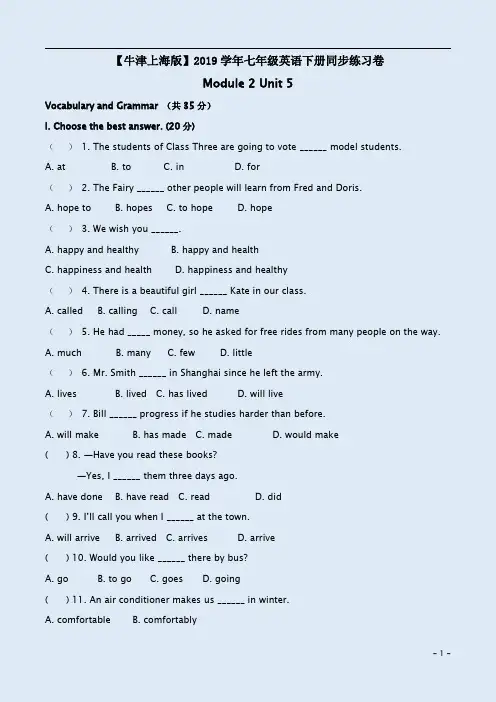
【牛津上海版】2019学年七年级英语下册同步练习卷Module2Unit5Vocabulary and Grammar(共35分)I.Choose the best answer.(20分)() 1.The students of Class Three are going to vote______model students.A.atB.toC.inD.for() 2.The Fairy______other people will learn from Fred and Doris.A.hope toB.hopesC.to hopeD.hope() 3.We wish you______.A.happy and healthyB.happy and healthC.happiness and healthD.happiness and healthy() 4.There is a beautiful girl______Kate in our class.A.calledB.callingC.call() 5.He had_____money,so he asked for free rides from many people on the way.A.muchB.manyC.fewD.little() 6.Mr.Smith______in Shanghai since he left the army.A.livesB.livedC.has livedD.will live()7.Bill______progress if he studies harder than before.A.will makeB.has madeC.madeD.would make()8.—Have you read these books?—Yes,I______them three days ago.A.have doneB.have readC.readD.did()9.I’ll call you when I______at the town.A.will arriveB.arrivedC.arrivesD.arrive()10.Would you like______there by bus?A.goB.to goC.goesD.going()11.An air conditioner makes us______in winter.fortablefortablyC.more comfortablyD.more uncomfortable()12.______maths is difficult for Kitty,she never gives it up.A.SoB.AlthoughC.AndD.But()13.Which is______away from Beijing,Shanghai or Guangzhou?A.farB.fartherC.furtherD.farthest()14.Fred and Doris______each other.A.smileB.smiles toC.smiled atD.smiled with()15.There is______old small hut behind Mary’s house.A.aB.anC.theD./()16.______do you think is a model student?A.WhatB.WhenC.WhoD.Where()17.In the past,______of the buses was air-conditioned.A.neitherB.allC.noneD.either()18.—You look so beautiful today.—______A.No,I am not beautiful.B.Thank you.C.Not at all.D.I’m not so beautiful as you.()19.______he isn’t the cleverest student in the class,______he becomes the best student by working hard.A.Although,butB.Although,/C./,/D.But,although()20.Who is the model student in your class?What can you learn from______?A.she or heB.her or heC.her or himD.hers or hisplete the sentences with the given words in their proper forms.(5分)1.She won two______(golden)medals.2.You’d better give up______(smoke)from now on.3.______(lucky),it is raining so heavily that we can’t go for a picnic.4.I wish you______(healthy)forever.5.The Lucky Fairy gave her wish to the happy farmer and his wife,then she______(appear).III.Rewrite the following sentences as required.(10分)1.My cousin has lunch at school every day.(改为一般疑问句)______your cousin______lunch at school every day?2.He’s never seen the film before.(改为反意疑问句)He’s never seen the film before,____________?3.I have been to the Bund twice.(对划线部分提问)How____________have you been to the Bund?4.It took me about eight hours to fly from Shanghai to Beijing.(改为同义句)I______about eight hours______from Shanghai to Beijing.5.The little Fairy can give Fred and Doris a big new house.(改为同义句)The little Fairy can______a big new house______Fred and Doris.Reading and Writing(共40分)I.Reading comprehension.(30分)AGary was a policeman.He liked boiled eggs.He often had one for breakfast.One morning in December,he was on duty on the road in his car.At ten o’clock,he went into a small caféby the roadside for breakfast.He asked for a boiled egg,a drink and a sandwich.When the waiter brought them to him,he found that the egg was not cooked enough.He decided to cook his egg a little longer.He put the egg inside the microwave oven(微波炉)and turned on the switch(开关).He cooked the egg for one minute.Then he took it out and went back to his table.He picked up his spoon and was ready to eat the egg.Suddenly there was a loud explosion(爆炸声)and all the other people rushed to hide under the tables because they thought someone had thrown a bomb(炸弹)into the building. But when they saw Gary’s face,they all laughed because he had egg all over it.Gary had made a big mistake:Eggs must never be cooked in a microwave oven.True or false.(5分)()1.Gary often had a boiled egg for breakfast.()2.One morning,he had breakfast in a small caféby the roadside.()3.A waitress brought a boiled egg,a drink and a sandwich to him.()4.He cooked the egg inside the microwave oven because it was not cooked enough. ()5.All the other people rushed out of the caféwhen they heard a loud explosion.BWe call the Chinese New Year the Spring Festival.There is a name for each Chinese year. We may call it the year of the sheep,the year of the monkey or the year of the dog.And this year is the year of the tiger.Before New Year’s Day,people are busy shopping and cleaning their houses.On New Year’s Eve,there is a big family dinner.After dinner,all the families stay up late to welcome the New Year.On the first day of the New Year,people put on their new clothes and go to visit their friends.They say“Happy New Year”and some other greetings to each other. People usually have a good time during the festival.Choose the right answer.(5分)()1.How do Chinese people usually spend New Year’s Eve?A.They put on new clothes and go to the park.B.They are busy shopping and cleaning their houses.C.They have a big dinner and stay up late to welcome the New Year.D.They visit their friends and talk about the New Year.()2.On New Year’s Day,people say“______”to each other when they meet.A.How are you?B.Happy New YearC.good luckD.glad to meet you()3.The Spring Festival means______.A.Christmas DayB.New YearC.the year of the snakeD.the Chinese New Year()4.The year of2010is the year of______.A.the tigerB.the monkeyC.the sheepD.the dog()5.The name for each Chinese year is according to______.A.the familyB.the plantsC.the animalsD.the friendsCAn old friend from France was coming to stay with me for a week.He telephoned from the airport to tell me that he had arrived.I was still at the office at that time,but I had got everything ready for him.I told him where my new flat was and that I had left the key under the doormat(擦鞋垫).Because I came home rather late,I told him where I had put the food and drink,and I told him to help himself to them.Two hours later my friend telephoned me from my flat.He said he was listening to some of my records.He also told me that he had had a good meal and he hoped I would join himsoon.When I asked him whether he had got my flat without difficulty,he answered that he had not been able to find the key under the doormat,but luckily the window of the sitting room by the apple tree had been open,so he had climbed in.Oh,dear!There was no apple tree in front of my sitting room,but there was one in front of my neighbour’s.Answer the questions.(5分)1.What was the writer doing when his friend arrived?2.Did the writer tell his friend his address?3.Where did the writer put the key to his flat?4.What did the writer’s friend do two hours later?5.How did the writer’s friend get into the house?DChoose the words or expressions and complete the passage.(5分)Someone says,“Time is money.”But I think time is__1__important than money.Why? Because when money is spent,we can get it back.However,when time is lost,it’ll never come back.That is__2__we mustn’t waste time.Time is usually limited(有限的).Even a second is very important.We should make full use of our time to do__3__useful.Some people don’t know the importance of time.They spend their limited time smoking,drinking and playing cards.They don’t know that wasting time means wasting part of their own__4__.In a word,we should save time.We shouldn’t__5__today’s work for tomorrow. Remember that we have no time to lose.()1.A.much B.less C.much less D.even more()2.A.why B.what C.that D.because()3.A.nothing B.something C.anything D.things()4.A.time B.food C.money D.life()5.A.stop B.leave C.let D.giveERead the passage and fill in the blanks with proper words.(10分)More and more Japanese teenagers read novels on mobile phones,n__1__on the paper. The phone novels are usually written by young writers.Several novels have been turnedinto real books.Love Sky,a story a__2__a boy with cancer,has sold more than1.3million books and has been made into a f__3__.Many of the phone novels are influenced(受影响的)by comic books b__4__comic books are very popular in Japan.A mobile phone novel website,Maho i-Land,which started several years ago,now has six million members and a million novels on the site.However,some traditional writers are angry about phone novels.They complain that phone novels are short of scene(缺少情景)and character development.Koichiro Tomioka,a professor at Kanto Gakuin University,said it was a new w__5__for writers to become known.He said,“It’s interesting.The problem is:Can this new type of writer keep on writing books as a professional writer?”1.______2.______3.______4.______5.______II.Writing.(10分)Write at least60words about the topic“A Model Student in My Eyes”. Suggestions:1.Who is the model student in your eyes?2.Why do you think he/she is a model student?(Give at least two reasons.)3.What can you learn from him/her?A Model Student in My Eyes_____________________________________________________________________________________________________________________________________________________________________【答案】:Vocabulary and GrammarI.1—5DBCAD6—10CACDB11—15ABDCB16—20CCBBCII.1.gold 2.smoking 3.Unluckily 4.health 5.disappearedIII.1.Does,have 2.has he 3.many times 4.spent,flying 5.give,toReading and WritingA.1—5TTFTFB.1—5CBDACC.1.He was working.2.Yes,he did.3.Under the doormat.4.He telephoned the writer from the flat.5.From the window.D.1—5DABDBE.1.not 2.about 3.film 4.because 5.wayII.One possible version:A Model Student in My EyesIn my eyes,a model student must have good grades and be knowledgeable.That’s the first.Secondly,the student should be healthy,he should have more energy to do anything. That means he must have a healthy body.I think he should join some sports groups,such as playing basketball,playing tennis,and so on.He should give his body some time to relax.He can help others with his healthy body.Thirdly,I think a model student should have some hobbies,like singing,playing the piano and painting.He should have freedom and do what he loves to do.Anyway,being a model student may be difficult,but if you work hard,your dream will come true.。
牛津上海版英语七下Module 2《Unit 2 Going to see a film》word教案(一)
Module 2 Garden City and its neighboursUnit 2 Going to see a film1Language focus:Using formulaic expressions to start a telephone conversation.e.g. Hello. May I speak to Kitty Li, please?Using adjectives to describe objectse.g. I love exciting films.Using imperatives to give instructions.e.g. Hold on. I’ll be back in a moment.Using the simple present tense to express feelings.e.g. We love e xciting films, but your mum doesn’t like this kind of film.Language skills:ListeningRecognize differences in the use of intonation in questions, statements (including approval and disapproval), commands, and respond appropriately.Use visual clues, context and knowledge of the world to work out the meaning o f an unknown word and a complete expression.Understand the speaker’s intention, attitude and feelings through his/her choice and use of language, gesture and facial expressionSpeakingUse gestures and facial expression to convey meaning and intentionMaintain an interaction by replyingReadingUse visual clues, context and knowledge of the world to work out the meaning of an unknown word and a complete expressionUnderstand intention, attitude and feelings stated in a text by recognizing features such as the choice and use of language.Materials:Student’s Book 7B page 33Cassette 7B and a cassette playerWorkbook 7B page 19Preparation:Cue the cassette.Pre-task preparationLanguage learning activity(This section aims at providing students with opportunities to practise the language/vocabulary needed or become familiar with the background for the task that follows.1.Say: I went to the cinema yesterday and saw (name of the film). It’s a/an ___ film. It’s about …Ask the class: Have you been to the cinema recently? Which film did you see? What’s it about? To elicit: I saw (name of the film). It’s a/an _______ film. It’s about…2. Play the recording: Look and read. Students listen and follow in their books.3. Play the recording again. Students listen and repeat.4. Write: ‘So do I ’, ‘Neither do I ’ and ‘So would I ’ on the board. Invite a more able student to come forward and ask and answer questions with you like this:Teacher : What kind of film do you love?Student : I love __ films/films about ______ .Teacher : So do I. What kind of film do n’t you like?Student : I don’t like ____ films/films about ______ .Teacher : Neither do I. What would you rather see: ______ films or _____ films?Student : I’d rather see ____ films.Teacher : So would I.5. You may have students work in pairs and conduct a similar dialogue to talk about the kinds of films they like and do not li ke. Walk around, offering help and guidance to the less able students if necessary.ConsolidationGrammar Practice Book 7B page 25Workbook page 192Language focus:Asking ‘Wh-’ questions to find out about a specific objecte.g. Which film would you like to see?Using adverbials to express degreee.g. No, I don’t like ________ films very much.Using the simple present tense to express feelingse.g. I like this kind of film.Language skills:ListeningListen for specific informationUnderstand the spea ker’s intention, attitude and feelings through his/her choice and use of language, gestures and facial expressionSpeakingUse gestures and facial expression to convey meaning and intentionUse appropriate intonation and stress, and vary volume, tone of voice, and speed to convey intended meanings and feelingsOpen an interaction by eliciting a responseMaintain an interaction by replyingReadingUse visual clues, context and knowledge of the world to work out the meaning of an unknownword and a complete expression.Materials:Student’s Book 7B page 34Some English film poster from magazines/ newspapers.Preparation:Collect some English film poster from magazines/new spapers and bring them to class.ConsolidationGrammar Practice Book 7B page 263Language focus:Using modals to make suggestionse.g. Can we see the two-five show in the afternoon?Using prepositions to indicate time.e.g. Can we see the ten show in the morning?Using formulaic expressions to respond to suggestionse.g. S orry, Kitty. I can’t make it thenLanguage skills:ListeningRecognize differences in the use of intonation in question,statements (including approval and disapproval), commands, and respond appropriatelyListen for specific informationSpeakingUse appropriate intonation and stress, and vary volume, tone of voice, and speed to convey intended meanings and feeling.Use gesture and facial expression to convey meaning and intention.Open an interaction by eliciting a responseMaintain an interaction by replyingMaintain an interaction by asking and responding to others’ opinions.WritingGather and share information, ideas and language bu using strategies such as brainstorming, listing, questioning, and interviewingMaterials:Student’s Book 7B page 35Cassette 7B and a cassette playerPhotocopiable page 30Preparation:Cue the cassette. Make a copy of Photocopiable page 30for each student.Pre-task preparation1. Ask students to look at the film guide on page 34 of the student’s Book again. Teach them how to read the show times aloud, e.g. 10:20 a.m.-the ten twenty show in the morning, 2:45 p.m.-the two forty –five show in the afternoon, 7:30 p.m.-the seven thirty show in the evening, etc.2. Play the recording: Read and think. Students listen and follow in their books.3. Have the whole class read the text in Read and think carefully. Ask: Which show can Kitty. Mrs Li and peter see? To elicit: They can see the five forty show in the evening. You may invite a more able student to explain why.4. Tell students to complete Ask and answer on their own. Remain them to refer to the film guide again to find the answers. When everyone has completed the exercise, check answers orally.4Language focus:Using adverbs to express sequencee.g. First, turn right.Using imperatives to give instructionse.g. Walk along Greet Street.Using connectives to link similar idease.g. Next, turn left and walk along Tree Road.Using prepositions to indicate positione.g. You will find City Cinema on your right.Language skills:ListeningListen for specific informationUnderstand the connection between ideas by recognizing linking words and phrasesSpeakingConnect ideas by using linking words or phrasesMaintain an interaction by replyingReadingUnderstand the connection between ideas by identifying linking words or phrasesWritingPlan and organize information and ideas by deciding on the sequence of contentDevelop written texts by using appropriate linking words or phrasesMaterials:Student’s Book 7B page 36Cassette 7B and a cassette playerWorkbook 7B page 20Photocopiable pag e 31Preparation:Cue the cassette. Make a copy of Photocopiable page 31 for each pair of students.Pre-task preparation1. Review the adverbs of time: first, next, then and finally with students first. You may tell them how you go to school, e.g. First, I walk to the bus stop. Next, I take bus No.3. Then I get off the bus at Sunset Road. Finally, I walk for three minutes and arrive at our school. Invite a more able student to tell the class how he/she goes to school using the time adverbs.2. Draw a big map like the one in Read and say on the board. Give students a few minutes to read Kitty’s instruction s in Picture 2.3. Play the recording: Read and say. Students listen and follow in their books.4. Play the recording again. Invite a students to come forward and draw the route on the board while the rest of the class are listening to the recording for the second time.5. The whole class then checks whether their classmate has drawn the route correctly or not .Post-task activityW orkbook page 20ConsolidationGrammar Practice Book 7B page 275Language focus:Using adverbs to express sequencee.g. First, turn __.Using prepositions to indicate positione.g. You will find City Cinema on your ______.Using prepositions to indicate direction.e.g. Next, turn _______ into Tree Road.Using imperatives to give instructions and directionse.g. Turn ___ and walk along _____Language skills:ListeningListen for specific informationSpeakingConnect ideas by using linking words or phrasesMaintain an interaction by replyingReadingUnderstand the connection between ideas by identifying linking words or phrasesSelf-correct by using strategies such as reading further to clarifyWritingPlan and organize information and ideas by deciding on the sequ ence of contentDevelop written texts by using appropriate linking words or phrase.Materials:Student’s Book 7B page 37Pre-task preparationReview the time adverbs: first, next, then and finally with students again. Draw a simple street map on the board like the one on page 36 of the student’s Book. Ask a few of the more able students: How do you get to (a place) from (another place)? To elicit: first,…Next,…Then … Finally, …ConsolidationGrammar Practice Book 7B page 28 to 29。
沪教牛津版英语七年级下册第二单元作文

沪教牛津版英语七年级下册第二单元作文English:In the second unit of Oxford Shanghai English Grade 7 Book of China, students have learned about different festivals and celebrations around the world. From Chinese New Year to Halloween, students have explored the unique customs, traditions, and symbols associated with each festival. They have also practiced using simple future tense to talk about their plans for future celebrations and holidays. Furthermore, students have honed their reading comprehension skills by reading various texts about festivals and answering questions to demonstrate their understanding. Through group discussions and sharing sessions, students have further deepened their cultural awareness and empathy towards different traditions and customs. Overall, this unit has not only expanded students' knowledge of global cultures but also fostered a sense of appreciation and respect for diversity in the world.中文翻译:在中国上海牛津七年级下册的第二单元中,学生学习了世界各地不同的节日和庆祝活动。
七年级英语下册 Unit 2 单元测试卷-牛津上海版(含答案)

七年级英语下册 Unit 2 单元测试卷-牛津上海版(含答案)Part 1 听力略Part 2 V ocabulary and Grammar(第二部分词汇和语法)Ⅴ. Choose the best answer(选择最恰当的答案)(15分)( )26. I don’t understand you. What do you mean ____ that?A. withB. byC. ofD. about( )27. What does a cross (十字形) stand for on maps? It’s the ______ for a church.A. score C. symbol C. star D. sale( )28. We were without electricity for two hours but it’s _____ again now.A. onB. awayC. offD. alone( )29. Before going to the History Museum, our teacher told us to _______ the public rules. A. break B. know C. obey D. have( )30. _____ is necessary for you to lock the car when you do not use it.A. ItB. ThisC. ThatD. There( )31. Millie has a silk ______. Listen, she is singing in the next room!A. lookB. noiseC. accentD. voice( )32. Water covers most parts of the earth. About ______of the earth is covered with water.A. one fourthB. a halfC. one thirdD. two thirds( )33. Your advice ________ very good. I'd like to have a try.A. feelsB. soundsC. tastesD. smells( )34. Remember _____ water. It’s precious, like liquid golden.A. not polluteB. not to polluteC. don’t polluteD. didn’t pollute( )35. Don’t do any other things while you are doing your homework. So please ____ your MP3.A. turn onB. turn downC. turn upD. turn off( )36. S ome people won’t realize the importance of their heal th ______ they have lost it.A. afterB. whenC. untilD. as( )37. Though it was raining hard outside, we could see ___ people in the street.A. fewB. a fewC. a littleD. little( )38. In our school library, there ______ a number of books on science and the number of them is growing larger and larger.A. isB. areC. hasD. have( )39. —______ time do you watch TV every day?—About two hours.A. How muchB. How manyC. How longD. How often( )40. Which sign means “Save Water”?Ⅵ. Complete the following passage with the words or expressions in the box. Each can only be used once(将下列单词或短语前的字母填入空格。
牛津沪教版英语七年级下重点知识复习
牛津沪教版英语七年级下重点知识复习
本文将对牛津沪教版英语七年级下学期的重点知识进行复回顾。
Unit 1: My School Life
1. 介绍自己的学校、班级,以及相关的场景词汇;
2. 表达日常活动和课程安排;
3. 掌握一些谈论学校生活的简单句型。
Unit 2: I Love Learning English
1. 谈论个人研究英语的心得和方法;
2. 研究动词-ing形式的用法;
3. 研究询问及表达兴趣的句型。
Unit 3: My Weekend
1. 谈论自己和朋友的周末活动;
2. 掌握时间状语的用法;
3. 掌握一些听力技巧。
Unit 4: Jobs
1. 研究表示职业的词汇;
2. 表达及询问个人志愿和理想。
Unit 5: Food and Drink
1. 研究食物和饮品的词汇;
2. 掌握询问及表述食物喜好和不喜好的方法。
Unit 6: Sports and Hobbies
1. 研究表示不同体育项目和爱好的单词;
2. 表达及询问个人感受和喜好。
Unit 7: Travelling
1. 谈论旅游的相关话题;
2. 表达和询问喜欢或不喜欢旅游的理由和偏好。
Unit 8: Festivals and Celebrations
1. 研究表示节日和庆祝活动的单词;
2. 谈论家庭或朋友间的庆祝活动。
总结
以上是牛津沪教版英语七年级下学期的重点知识复习,希望对大家的英语学习有所帮助。
七年级英语下册Unit2Goingtoseeafilm教案(新版)牛津上海版(新)
七年级英语下册U n i t2G o i n g t o s e e a fi l m教案(新版)牛津上海版(新)-CAL-FENGHAI-(2020YEAR-YICAI)_JINGBIANUnit 2 Going to see a film一、单元分析(Unit Analysis)(一)单元地位(Unit Position)1 本课中出现了较多的交际用语。
如May I speak to…,please/Speaking./ Hold on./ Hi, … This is… /So would I./ Neither would I.等。
虽然这些句式已经出现过,但是作为功能性语言,教师有必要在课堂教学中加以一定的机械性训练来复习巩固。
2 have got to …的用法在课本中首次出现。
要求学生能正确区分have got to和have got的不同用法。
3 I can’t make it.在课文中作为“我没空”解释虽然在本册M1中已经出现过,但是学生并不熟悉,要求学生加以适当的操练。
4 本课中出现了的路名及地名,教师在新授前可让学生先熟练朗读,为操练作好铺垫。
1本单元结束时,可先完成本模块的More oral practice中的Think and discuss 部分。
2本课中出现了大量的钟点,建议课前先复习钟点的两种不同读法。
如:12:40p.m.,8:20a.m., 7:14p.m.(二)单元目标(Unit Target)1 运用So…I./Neither…I.来表达“一致”及“不一致”。
如: I love exciting films.So do I.2 操练用固定表达开始一个电话交谈。
如:Hello, may I speak to…,please Speaking.(三)单元重点(Unit Points)1 关键词:1)电影名称:Swan Lake, Space War, Monkey King, Batman and Joker, Country Road, Police Story。
【牛津上海版】2019学年七年级英语下册Unit 5 What can we learn from others同步练习卷附答案
【牛津上海版】2019学年七年级英语下册同步练习卷Module 2 Unit 5Vocabulary and Grammar (共35分)I. Choose the best answer. (20分)()1. The students of Class Three are going to vote ______ model students.A. atB. toC. inD. for()2. The Fairy ______ other people will learn from Fred and Doris.A. hope toB. hopesC. to hopeD. hope()3. We wish you ______.A. happy and healthyB. happy and healthC. happiness and healthD. happiness and healthy()4. There is a beautiful girl ______ Kate in our class.A. calledB. callingC. callD. name()5. He had _____ money, so he asked for free rides from many people on the way.A. muchB. manyC. fewD. little()6. Mr. Smith ______ in Shanghai since he left the army.A. livesB. livedC. has livedD. will live()7. Bill ______ progress if he studies harder than before.A. will makeB. has madeC. madeD. would make( ) 8. —Have you read these books?—Yes, I ______ them three days ago.A. have doneB. have readC. readD. did( ) 9. I’ll call you when I ______ at the town.A. will arriveB. arrivedC. arrivesD. arrive( ) 10. Would you like ______ there by bus?A. goB. to goC. goesD. going( ) 11. An air conditioner makes us ______ in winter.A. comfortableB. comfortablyC. more comfortablyD. more uncomfortable( ) 12. ______ maths is difficult for Kitty, she never gives it up.A. SoB. AlthoughC. AndD. But( ) 13. Which is ______ away from Beijing, Shanghai or Guangzhou?A. farB. fartherC. furtherD. farthest( ) 14. Fred and Doris ______ each other.A. smileB. smiles toC. smiled atD. smiled with( ) 15. There is ______ old small hut behind Mary’s house.A. aB. anC. theD. /( ) 16. ______ do you think is a model student?A. WhatB. WhenC. WhoD. Where( ) 17. In the past, ______ of the buses was air-conditioned.A. neitherB. allC. noneD. either( ) 18. —You look so beautiful today.—______A. No, I am not beautiful.B. Thank you.C. Not at all.D. I’m not so beautiful as you.( ) 19. ______ he isn’t the cleverest student in the class, ______ he becomes the best student by working hard.A. Although, butB. Although, /C. /, /D. But, although( ) 20. Who is the model student in your class? What can you learn from ______?A. she or heB. her or heC. her or himD. hers or hisII. Complete the sentences with the given words in their proper forms. (5分)1. She won two ______ (golden) medals.2. You’d better give up ______ (smoke) from now on.3. ______ (lucky), it is raining so heavily that we can’t go for a picnic.4. I wish you ______ (healthy) forever.5. The Lucky Fairy gave her wish to the happy farmer and his wife, then she ______ (appear).III. Rewrite the following sentences as required. (10分)1. My cousin has lunch at school every day. (改为一般疑问句)______ your cousin ______ lunch at school every day?2. He’s never seen the film before. (改为反意疑问句)He’s never seen the film before, ______ ______?3. I have been to the Bund twice. (对划线部分提问)How ______ ______ have you been to the Bund?4. It took me about eight hours to fly from Shanghai to Beijing. (改为同义句)I ______ about eight hours ______ from Shanghai to Beijing.5. The little Fairy can give Fred and Doris a big new house. (改为同义句)The little Fairy can ______ a big new house ______ Fred and Doris.Reading and Writing (共40分)I. Reading comprehension. (30分)AGary was a policeman. He liked boiled eggs. He often had one for breakfast. One morning in December, he was on duty on the road in his car. At ten o’clock, he went into a small café by the roadside for breakfast. He asked for a boiled egg, a drink and a sandwich. When the waiter brought them to him, he found that the egg was not cooked enough. He decided to cook his egg a little longer. He put the egg inside the microwave oven (微波炉) and turned on the switch (开关). He cooked the egg for one minute. Then he took it out and went back to his table. He picked up his spoon and was ready to eat the egg.Suddenly there was a loud explosion (爆炸声) and all the other people rushed to hide under the tables because they thought someone had thrown a bomb (炸弹) into the building. But when they saw Gary’s face, they all laughed because he had egg all over it. Gary had made a big mistake: Eggs must never be cooked in a microwave oven.True or false. (5分)( ) 1. Gary often had a boiled egg for breakfast.( ) 2. One morning, he had breakfast in a small café by the roadside.( ) 3. A waitress brought a boiled egg, a drink and a sandwich to him.( ) 4. He cooked the egg inside the microwave oven because it was not cooked enough.( ) 5. All the other people rushed out of the café when they heard a loud explosion.BWe call the Chinese New Year the Spring Festival. There is a name for each Chinese year. We may call it the year of the sheep, the year of the monkey or the year of the dog. And this year is the year of the tiger.Before New Year’s Day, people are busy shopping and cleaning their houses. On New Year’s Eve, there is a big family dinner. After dinner, all the families stay up late to welcome the New Year. On the first day of the New Year, people put on their new clothes and go to visit their friends. They say “Happy New Year” and some other greetings to each other. People usually have a good time during the festival.Choose the right answer. (5分)( ) 1. How do Chinese people usually spend New Year’s Eve?A. They put on new clothes and go to the park.B. They are busy shopping and cleaning their houses.C. They have a big dinner and stay up late to welcome the New Year.D. They visit their friends and talk about the New Year.( ) 2. On New Year’s Day, people say “______” to each other when they meet.A. How are you?B. Happy New YearC. good luckD. glad to meet you( ) 3. The Spring Festival means ______.A. Christmas DayB. New YearC. the year of the snakeD. the Chinese New Year( ) 4. The year of 2010 is the year of ______.A. the tigerB. the monkeyC. the sheepD. the dog( ) 5. The name for each Chinese year is according to ______.A. the familyB. the plantsC. the animalsD. the friendsCAn old friend from France was coming to stay with me for a week. He telephoned from the airport to tell me that he had arrived. I was still at the office at that time, but I had got everything ready for him. I told him where my new flat was and that I had left the key under the doormat (擦鞋垫). Because I came home rather late, I told him where I had put the food and drink, and I told him to help himself to them.Two hours later my friend telephoned me from my flat. He said he was listening to some of my records. He also told me that he had had a good meal and he hoped I would join him soon. When I asked him whether he had got my flat without difficulty, he answered that he had not been able to find the key under the doormat, but luckily the window of the sitting room by the apple tree had been open, so he had climbed in. Oh, dear! There was no apple tree in front of my sitting room, but there was one in front of my neighbour’s.Answer the questions. ( 5分)1. What was the writer doing when his friend arrived?2. Did the writer tell his friend his address?3. Where did the writer put the key to his flat?4. What did the writer’s friend do two hours later?5. How did the writer’s friend get into the house?DChoose the words or expressions and complete the passage. (5分)Someone says, “Time is money.” But I think time is __1__ important than money. Why? Because when money is spent, we can get it back. However, when time is lost, it’ll never come back. That is __2__ we mustn’t waste time.Time is usually limited (有限的). Even a second is very important. We should make full use of our time to do __3__ useful. Some people don’t know the importance of time. They spend their limited time smoking, drinking and playing cards. They don’t know that wasting time means wasting part of their own __4__.In a wo rd, we should save time. We shouldn’t __5__ today’s work for tomorrow. Remember that we haveno time to lose.( ) 1. A. much B. less C. much less D. even more( ) 2. A. why B. what C. that D. because( ) 3. A. nothing B. something C. anything D. things( ) 4. A. time B. food C. money D. life( ) 5. A. stop B. leave C. let D. giveERead the passage and fill in the blanks with proper words. (10分)More and more Japanese teenagers read novels on mobile phones, n__1__ on the paper.The phone novels are usually written by young writers. Several novels have been turned into real books. Love Sky, a story a__2__ a boy with cancer, has sold more than 1.3 million books and has been made into a f__3__.Many of the phone novels are influenced (受影响的) by comic books b__4__ comic books are very popular in Japan. A mobile phone novel website, Maho i-Land, which started several years ago, now has six million members and a million novels on the site.However, some traditional writers are angry about phone novels. They complain that phone novels are short of scene (缺少情景) and character development.Koichiro Tomioka, a professor at Kanto Gakuin University, said it was a new w__5__ for writers to become known.He said, “It’s interesting. The problem is: Can this new type of writer keep on writing books as a professional writer?”1. ______2. ______3. ______4. ______5. ______II. Writing. (10分)Write at least 60 words about the topic “A Model Student in My Eyes ”.Suggestions:1. Who is the model student in your eyes?2. Why do you think he / she is a model student? (Give at least two reasons.)3. What can you learn from him / her?A Model Student in My Eyes_____________________________________________________________________________________________________________________________________________________________________【答案】:Vocabulary and GrammarI. 1—5 DBCAD 6—10 CACDB 11—15 ABDCB 16—20 CCBBCII. 1. gold 2. smoking 3. Unluckily 4. health 5. disappearedIII. 1. Does, have 2. has he 3. many times 4. spent, flying 5. give, toReading and WritingA. 1—5 TTFTFB. 1—5 CBDACC.1. He was working.2. Yes, he did.3. Under the doormat.4. He telephoned the writer from the flat.5. From the window.D. 1—5 DABDBE. 1. not 2. about 3. film 4. because 5. wayII. One possible version:A Model Student in My EyesIn my eyes, a model student must have good grades and be knowledgeable. That’s the first. Secondly, the student should be healthy, he should have more energy to do anything. That means he must have a healthy body. I think he should join some sports groups, such as playing basketball, playing tennis, and so on. He should give his body some time to relax. He can help others with his healthy body.Thirdly, I think a model student should have some hobbies, like singing, playing the piano and painting. He should have freedom and do what he loves to do.Anyway, being a model student may be difficult, but if you work hard, your dream will come true.。
牛津上海版英语七年级下册《Unit 2 Going to see a film》教学设计8
牛津上海版英语七年级下册《Unit 2 Going to see a film》教学设计8一. 教材分析牛津上海版英语七年级下册《Unit 2 Going to see a film》主要围绕看电影这一主题展开,通过学习本单元,学生能够掌握有关电影院、电影类型、电影时间等词汇和表达方式,以及如何询问和描述电影情节。
本单元包括听力、口语、阅读和写作等多个方面的内容,旨在提高学生的综合语言运用能力。
二. 学情分析七年级的学生已经具备了一定的英语基础,对于日常生活中的基本表达和简单句型已能熟练运用。
但他们在语言输出方面仍有一定的困难,需要通过大量的练习来提高。
此外,学生对电影这一主题充满兴趣,有利于激发他们的学习积极性。
三. 教学目标1.知识目标:学生能够掌握本单元的生词和短语,理解课文内容,运用所学语言表达看电影的相关信息。
2.能力目标:学生能够听懂、说清、读准与电影相关的对话和短文,提高口语表达能力和阅读理解能力。
3.情感目标:通过本单元的学习,学生能够培养对电影的兴趣,增进与同学之间的交流。
四. 教学重难点1.重点:电影相关词汇和表达方式的掌握,听力、口语、阅读和写作能力的提高。
2.难点:如何运用所学语言描述电影情节,提高语言输出的准确性。
五. 教学方法1.任务型教学法:通过设置各种任务,让学生在实践中运用所学知识,提高综合语言运用能力。
2.交际型教学法:注重师生、生生之间的互动,培养学生的口语表达能力和团队协作能力。
3.情境教学法:创设真实、生动的电影情境,激发学生的学习兴趣和积极性。
六. 教学准备1.教师准备:对本单元内容进行深入学习,了解相关电影知识,准备教学素材和课件。
2.学生准备:预习本单元生词和短语,了解电影相关知识,准备参与课堂活动。
七. 教学过程1.导入(5分钟)教师通过提问方式引导学生谈论自己喜欢的电影,激发学生的学习兴趣。
例如:“What’s your favorite movie?”, “Have you ever been to the cinema?”等。