
[高中英语]必修五(Unit 2 The United Kingdom Period 5)
Period 5 GrammarThe General Idea of This PeriodThis period lays emphasis on grammar, that is, the past participle used as the object complement, which is also one of the difficult points in Senior English grammar.First, revise what the students have learnt in the last period by checking their homework, including some important phrases and translating some sentences from Chinese into English.In this unit the students should learn about the past particip le used as the object complement. First, the teacher presents one sentence containing a past participle used the object complement, which was taken from the reading passage.Teacher tries to analyze the function of the past participle and help the students have a general idea about it.Then the students are asked to find all the sentences that contain a past participle used as the object complement in the Reading passage.Then the students can come to a conclusion of the basic structure of the past participle used as the object complement, that is, have/get/find/...+object +past participle.Next the teacher will explain the differences between the present participle and the past participle.The teacher compares them when are used as the attributive, predicate, object complement and adverbial.In order to do so, the teacher always shows some typical examples.After that, the students will find out the difference between them.Then they are provided with some exercises for them to consolidate what they have learned.In order to consolidate the grammar points, the students will do some oral practice.In this practice, the students will ask and answer some questions in pairs, using the past participle as the object complement.The students should not only learn about the grammar, but also learn how to use them, which is much more important.Also this part can help the students to communicate with each other using the language that they have learned, and this is the real purpose of learning the target languages.Teaching I mportant PointLearn grammar: the past participle used as the object complement.Teaching DifficultiesKnow the differences between the present participle and the past participle when they are used as the attributive, predicate, object complement and adverbial.Learn to make a choice between the present participle and the past participle according to the different context.Teaching Aidsa tape recordera projectorthe blackboardThree Dimensional Teaching AimsKnowledge AimsLearn the past participle used as the object complement.Know the differences between the present participle and the past participle when they are used as the attributive, predicate, object complement and adverbial.Ability AimsLearn to make a choice between the present participle and the past participle according to the different context.Learn to communicate with each other by using the language that they have learne d.Emotional AimsLearn to cooperate with each other.Teaching ProcedureStep 1 GreetingsTeacher greets the students as usual.Step 2 RevisionT: At the beginning of this period, let’s check your homework.First, please write down the phrases according to the Chinese explanations.S: 1) 与……连结be linked to2) 令某人惊讶的是to one’s surprise3) 到处寻找, 观光look around4) 睁大眼睛keep one’s eyes open5) 在特殊的场合on special occasions6) 为了纪念…… in memory of7) 拍一张照片have a photo taken8) 展出on show9) 为……感到骄傲be proud of10) 遗留, 漏掉leave outT: Good.Now, let’s check your translations of the five sentences.S1: When David Beckham arrived in Japan, the thrilled fans all went to meet him.S2: In order to celebrate my cousin’s wedding, my aunt and uncle had an evening party arranged.S3: It is probably puzzling, but to set an example can help to clarify the puzzle.S3: Don’t be influenced by her words.You must decide for yourself.S4: Polar took the place of her father to treat the guests at the party, since her father was not available to.Step 3 Discovering Useful StructuresT: In the last unit we learnt about the past participle used as the attributive.Now let’s look at the following sentence taken from the passage.Please tell me what function is the past participle.Now when people refer to England you find Wales included as well.S: It is used as the object complement.T: You are right.So in this unit we will learn about the past participle used as the object complement.The structure is often formed with have /get /find/...+object +past participle.Please find three more sentences from the reading passage with past participles used as the object complement.(After several minutes.)S1: To their surprise, the three countries found themselves united peacefully instead of by war.(Para.3)S2: However, just as they were going to get Ireland connected to form the United Kingdom, the southern part of that country broke away to form its own government.(Para.3) S3: You find most of the population settled in the South, but most of the large industrial cities in the Midlands ad North of England.(Para.5)T: Yes, you are very clever.Now, look at Part 2 (Discovering useful structures) on Pages plete the sentences by using the words in brackets and the structure have /get /findsomething done.T: Let’s do No.1 as an example.We are having the house mended now.(After several minutes.)S1: No.2 You look different today.Have you had your hair cut?S2: No.3 Do you want to get the dictionary delivered to your house or would you prefer to come to the shop for it?S3: No.4 Sorry, I haven’t had the film developed yet.S4: No.5 On my way to the station my car broke down.When I got to the repair shop I found it closed.S5: No.6 The computer doesn’t seem to work well.You’d better get it repaired.S6: No.7 Jill and Eric had all their money stolen while they were on holiday.S7: No.8 Chris had some flowers sent to Sarah on her birthday.Then Chris asked Sarah to marry hem and they had it announced in the newspaper.They had no time to arrange their own wedding, so they had it organized by a company.T: Ex cellent.Past participle used as the object complement can also be put after such words as see, hear, notice, watch, keep, make, feel, etc.Please put the following sentences into English.1.她高兴地看到孩子们在托儿所受到很好的照顾.2.我感到心里轻松了好些.3.我们应该让他知道这儿发生的情况.4.你说话至少要让别人听懂.5.他曾听人用德语唱过这支歌.Suggested answers:1.She was glad to see her children well taken care of in the nursery.2.I felt a great weight taken off my mind.3.We should keep him informed of what is going on here.4.When you talk, you have to at least make yourself understood.5.He once heard the song sung in German.T: You did a very good job.Now let’s look at three sentences with“have/get sth.sth.done”. Please try to find out the differences between them.1.I had(=got) my teeth filled yesterday afternoon.2.We must have(=get) the work finished by Tuesday.3.I had my leg broken when I got off the bus.T: Do you think the structure“have /get sth.done”has the same meaning in the three sentences Ss: No.T: Then can you explain the differences?S: In the first sentence, “have /get sth. done”means“to ask someone else to do sth.”.In the second sentence, the subject himself or herself may take part in the work.But in the third sentence, “have /get sth. done”means“to meet with something unpleasant”.T: You are very clever.T: Now, let’s compare the use between the present participle and the past participle.Look at the following examples:The boiling water is hot.You can use the boiled water to make tea.T: Can you tell me the differences between boiling water and boiled water?S: “Boiling water”refers to the water that is boiling at the moment, while“boiled water”refer to the water that has been boiled.T: Yes, they are different both in voices and time.Try to finish the following sentences using the proper forms of the verbs.e tomorrow and give the application to the man __________ (sit) at that desk.2.Is this the book __________ (recomme nd) by our teacher?3.We have to pay duties on goods __________ (import) from abroad.4.The house __________ (stand) at the corner of the street was built in 1955.(Teacher gives the students several minutes to think about these sentences.)T: Now, let’s check your answers.Suggested answers:1.sitting2.recommended3.imported4.standingT: You are right.Please look at the following two sentences.1.This is the most confusing system I have ever seen.2.The children will get confused if asked to learn too much at a time.T: What are the meanings of “confusing”and“confused”?S: “Confusing”means“令人困惑的”and“confused”means“感到困惑的”.T: You are right.When referring to something, we often use the present participle, with the meaning of“令人……的”.When referring to somebody, we often use the past participle, with the meaning of“感到……的”.Look at the following words and wr ite down their meanings in the brackets.amazing () amazed ()annoying () annoyed ()boring () bored ()surprising () surprised ()S: amazing (令人惊讶的) amazed (感到惊讶的)annoying(令人生气的)annoyed(感到生气的)boring(令人厌倦的)bored(感到厌倦的)surprising(令人惊讶的)surprised(感到惊讶的)T: You are right.Now let’s look at another two sentences:1.Don’t keep the vis itor waiting.2.Where did you get your book printed?T: Both“waiting”and“printed”are used as object complement.What’s the difference between them?S: In the first sentence it is the visitor that is waiting.In the second sentence your book is printed.T: So we can summarize the difference as follows: if the object is the logical subject of the participle, we often use the present participle.If the object is the object of the participle, we often use the past participle.Now, try to translate the following sentences into English, using the present participle and the past participle as the object complement.1.忽然他听见有人轻轻敲窗子.2.我进屋时发现他在朗读什么.3.你还是请人把鞋子补一补吧.4.他惊奇地发现房间给彻底地打扫了.(Teacher gives the students several minutes to finish the task.)T: Now, let’s check your answers.Suggested answers:1.Suddenly he heard someone knocking gently on the window.2.When I entered the room, I found him reading something aloud.3.You’d better have your shoes mended.4.He was surprised to find his room thoroughly cleaned.T: You did an excellent job.As we all know, the present participle and the past participle can also be used as adverbial.Look at the following two sentences:1.Entering the room, she found the wall newly painted.2.Written in haste, the essay had some errors.T: Now, I will explain the difference between them.When the act that the participle refers to is done by the subject of the main clause, we often use the present participle.When the subject of the main clause is the object of the participle, we often use the past participle.Next finish the following sentences by filling in the blanks according to the translations in the brackets.1. __________(顺大路往前走)she saw a tall building.2. __________(由于不知道她的地址), we couldn’t get in touch with her.3. __________(由于在农民中工作多年), he knew them very well.4. __________(如果管理得好一些), the cabbages could have grown better.5. __________(在他事迹的影响下), they performed countless good deeds.(After a few minutes.)Suggested answers:1.Walking down the road2.Not knowing her address3.Having worked among the peasants for many years4.Given better attention5.Influenced by his exampleT: Yes, you have done a very good job.Step 4 ConsolidationT: Turn to Page 50, and look at Exercise 1 in Using Structure.Answer the following questions using the past participle as the object complement.Do them with your partner.If you have any trouble, I will come to help you.(The students practice in pairs; meanwhile the teacher goes around the classroom and helps them if they have any trouble.)T: Now I will ask pairs of to ask and answer these questions.S: What did you find had happened to your flower pots when you got home?S: I found it broken.S: What did you do when the paths were covered in snow and you were away?S: I had them cleared up.(Teacher asks other pairs to demonstrate their dialogues.)Step 5 Homework1.Finish Exercises 2 in Using Structures on Page 51.2.Finish the following sentences by filling in the blanks with the correct form of the verbs in the brackets.1) I don’t know the girl __________ (catch)in the snow storm.2) Do you kn ow the girl __________ (seat)on the stone?3) Do you still remember__________ (take)to your hometown ten years ago?4) Charlie Chaplin is considered __________ (make)a great contribution to the film industry.5) When __________ (heat), ice changes into water.6) Professor Li is often seen __________ (write)something in his office.7) __________ (compare)with you, we still have a long way to go.8) They haven’t decided when __________ (leave)for Shanghai.Suggested answers:1.caught2.seated3.being taken4.to have made5.heated6.to writepared8.to leaveThe Design of the Writing on the BlackboardUnit 2The United KingdomPeriod 5 GrammarⅠ.Example:Now when people refer to England you find Wales included as well.Ⅱ.have/get/find...+object +past participleⅢ.Comparing present participle with pa st participleResearch and ActivitiesPlay the game“What did they find?”Write one sentence about what Mr and Mrs Smith found when they came home from work one day.Remember to use the past participle as the object complement.Example: They found the window broken.Divide the class into groups of five.Give a piece of paper to the first person in each group who folds the paper over his/her writing, so the next person cannot see it.Pass the paper to the next person in the group.When the last one in the group has finished writing, he/she comes to the front of the class to read all the ideas of his/her group.The one with the most interesting ideas wins.Reference for Teachinghave sth.done, have sb.do, have sb./sth.doing与have sth.to do等四种句型的区别(1)have sth.done常用来表示“(主语)请别人完成某事”或表示“(主语)遭受某种不幸的情况”, 其中have可用get替换.例如:①Why don’t you have(=get) that suit cleaned?你为什么不请人把那套衣服洗一洗?②I can’t have(=get) the car started.我不能启动这辆车.③I had(=got) my watch broken.我的手表给弄坏了.“have sth.done”用于否定句中时, 表示“不允许……”“不让”.例如: ①I won’t have anything said against her.我不会允许有任何反对她的言论.②I won’t have my house turned into a hotel.我不会让我的房子变成一个旅馆.(2)have sb.do 表示“请某人完成某事”, 可以用“get sb.to do”结构来替换.例: ①I had him repair my bike.(=I got him to repair my bike.) 我请他修理自行车.②Don’t forget to have him co me.别忘了叫他来.“have sb.do”结构还有以下用法:1)表示主语无意识的行为, 这时“have”作“有”解.例: These small animals seem glad to have people visit them.这些小动物很高兴有人看他们.2)主语“经历”某事.例: He had his mother die.他遭丧母.3)在否定句中, 作“容忍”“允许”.例: I won’t have you say such things about her.我不允许你说她这样的话.(3)have sb./sth.doing 常表示“让某人做某事”, “让某情况发生”之意, 含有动作正在进行之意.例: ①He soon had them all laughing.他很快让他们都笑了起来.②I have a car waiting for me.我让一部车在等我.在否定结构中, 表示“不能让”“不允许”.例: We can’t have that sort of thing happening.我们不能让那类事情发生.(4)have sth.to do 表示“有某事要完成”, 其中不定式作定语, 且常用主动形式.例: ①I have some letters to write.我有几封信要写.②He has a large family to support.他有一大家人要养活.如果不定式所表示的动作不是由句子的主语来完成, 该不定式则须用被动形式.例: “Do you have any clothes to be washed today?”the servant asked.佣人问道: “你今天有没有衣服要(我)洗?”Something about the UKEnglish Manners and EtiquetteThe first rule English children come across at an early age is the importance of saying“please”and“Thank you.”Supplication, gratitude and, most important of all, apology are central to English social intercourse.“Excuse me, ”“I’m so rry to tell...”when apology, regret or fear have nothing to do with it are all forms of social lubrication which spare others’ feelings and make life a little easier.It is difficult for outsiders to learn how to wield the vocabulary necessary, but the starting point is to understand that it is almost impossible linguist ically to be over-grateful, over-apologetic or over-polite when it comes to the point.Thus, the English man or woman whose toe you tread on will be“so sorry”presumably earlier.He or she will thank you“so much”when you stop treading on it or, if you do not, ask you to with a routine of pleases and thank-yous that wouldlast any other national half a lifetime.It’s just the English way.The English Sense of HumourThe English have an island culture-quirky(古怪的) and self-contained(持重的, 有自制力的).Much of their humour is highly sophisticated and elusively(难以理解地)subtle(隐晦的, 深奥难测的).The English rarely say what they mean and tend towards reticence(节制)and understatement. So, while in conversation they avoid truths which might lead to confrontation, in their humour they mock(嘲笑)that avoidance.For instance:At dinner in a great country house, one of the guests drinks too much wine, and slumps(陷落)across the table.The host ring s for the butler and says: “Smithers, could you please prepare a room.This gentleman has kindly consented to stay the night.”The English often happily poke fun at plain about some aspect of English life that is quite awful and they will gleefully tell stories of trains that never arrive, of bureau-cratic bungling that has driven honest citizens to suicide, or of food so disgusting even a dog wouldn’t eat it.The English love irony and expect others to appreciate it too.For example, one hill walker to another: “It’s only six miles by the map, yet your navigation made it ten.” Yes, but doing it in ten gives one a much greater feeling of accomplishment.”English Homes and GardensIt is largely thanks to the variable climate in England that the English lavish so much attention on their homes and gardens.They employ their leisure hours with an endless cycle of“home improvements”without which no home can ever be considered fully improved.Inside and out they busy themselves installing electronic gadgets, shower, and built-in furniture.The English man drives his impeccably polished vehicle up on to ramp, which he buys from the DIY shop, and tinkers around underneath it for hours on end.You might think that, with all these self-servicing, self-decorating and improving, English skilled labourers would be out of a job or two.But this is not the case.Sooner or later, these experts have to be called in to make good for the damage caused by the amateur.The English Adore AnimalsIt is an English maxim that a person who likes animals cannot be all bad.The English adore animals—all kinds of animals.They keep them, not, as other nations do, primarily to guard their property, for scientific interest or for status, but for company.Animals, especially pets, are vital to English life.They are not always very good at talking to each other, but they excel in conversation with their animal.Pet owners’ homes are shrines to their animals.The best seats, the warmest spots, the choicest morsels are handed over to these household gods as a matter of course.The British spend around 1.7 billion annually on pet food, twice as much as the total market for tea and coffee.Cats and dogs, parrots and guinea pigs are excused behaviour which if seen in the childrenof the household might well end in assault.They are deemed to be incapable of almost any misdemeanour.So when dog bites man, it is always man’s fault, even if he is just a passer-by.Margaret ThatcherMargaret Thatcher was Britain’s first female prime minister.A graduate of Somerville College, Oxford, with a master of arts degree from the University of Oxford she worked as a researchchemist and a barrister, concentrating on tax law, before being elected to the House of Commons in 1953.She held several ministerial appointments including education minister (1970-1974). Elected leader of her Party (the Opposition) in 1975, she became prime minister in 1979.Known as a strong leader and an“astute Parliamentary tactician, she knew how to handle disagreement, no matter from which bench it issued.In 1982 she ordered British troops to the Falkland Islands to retake them from Argentina.She took a strong stand against the trade unions during the miner’s strik e (1984-1985), and moved Britain toward privatization, selling minor interests in public utilities to the business interests.She also introduced“rate capping”which effectively took control of expenditures out of the hands of city councils, part of her policies aimed at reducing the influence of local governments.In 1989, she introduced a community poll tax.In 1990, her cabinet was divided over issues including the European Community which forced her resignation.In 1992, she entered the House of Lords, created Baroness Thatcher of Kesteven.Her memoirs are being published by Harper Collins.The first volume, “The Downing Street Years”was published in 1993.Oxford UniversityOxford, University of English autonomous institution of higher learning at Oxford, Oxford shire, Eng.It lies along the Upper River Thames, 50 miles (80 km) north-northwest of London.Sketchy evidence indicates that schools existed at Oxford as soon as the early 12th century. By the end of that century a university was well established, perhaps resulting from the barring of English students from the University of Paris about 1167.Oxford was modeled on the University of Paris, with initial faculties of theology, law, medicine, and the liberal arts.During the early history of Oxford its reputation was based on theology and the liberal arts.But it also gave more serious treatment to the physical sciences than did the University of Paris: Roger Bacon, after leaving Paris, conducted his scientific experiments and lectured at Oxford from 1247 to 1257.In the early 16th century professorships began to be endowed, and in the latter part of the 17th century interest in scientific studies increased substantially.During the Renaissance, Desiderius Erasmus carried the new learning to Oxford, and such scholars as William Grocyn, John Colet, and Sir Thomas More enh anced the university’s reputation.Since that time Oxford has traditionally held the highest reputation for scholarship and instruction in the classics, theology, and political science.In the 19th century the university’s enrollment and its professorial st aff were greatly expanded. The first women’s college at Oxford, Lady Margaret Hall, was founded in 1878, and women were first admitted to full membership in the university in 1920.In the 20th century Oxford’s curriculum was modernized.Science came to be ta ken much more seriously and professionally, and many new faculties were added, including ones for modern languages, political science, and economics.Post-graduate studies also expanded greatly in the 20th century.Oxford houses the Bodleian Library and the Ashmolean Museum.The Oxford UniversityPress, established in 1478, is one of the largest and most prestigious university publishers in the world.Oxford has been associated with many of the greatest names in British history, from John Wesley and Cardinal Wolsey to Oscar Wilde and Sir Richard Burton to Cecil Rhodes and Sir Walter Raleigh.The astronomer Edmond Halley studied at Oxford, and the physicist Robert Boyle performed his most important research there.Prime Ministers who studied at Oxford include William Pitt the Elder, George Canning, Sir Robert Peel, William Gladstone, Lord Salisbury, H.H.Asquith, Clement Attlee, Anthony Eden, Harold Macmillan, Edward Heath, Sir Harold Wilson, and Margaret Thatcher.University of CambridgeUniversity of Cambridge is an English autonomous institution of higher learning at Cambridge, Cambridge shire, 50 miles (80 km) north of London.The start of the university is generally taken as 1209, when scholars from Oxford migrated to Cambridge to escape Oxford’s riots of“town and gown”(townpeople versus scholars).To avert possible troubles, the authorities in Cambridge allowed only scholars under the supervision of a master to remain in the town.It was partly to provide an orderly place of residence that (in emulation of Oxford) the first college, Peterhouse, was founded in 1284.Over the next three centuries another 15 colleges were founded, and in 1318 Cambridge received formal recognition as a studium generale from Pope John ⅩⅫ.Cambridge remained fairly insignificant until about 1502, when a professorship of divinity was founded—the oldest in the university.In 1546 Henry Ⅷ founded Trinity College (which was and still remains the largest of the Cambridge colleges).In 1570 Elizabeth Ⅰgave the university a revised body of statutes, and in 1571 the university was formally incorporated by act of Parliament.The new statutes, which remained in force for nearly three centuries, vested the effective government of the university in the heads of colleges.In 1663 the Lucasian professorship of mathematics was founded under the will of a former member of the university, and six years later the first holder resigned in favour of Issac Newton, then a young fellow of Trinity.Newton held the chair for over 30 years and gave the study of mathematics a unique position in the university.In 1871 the university established the Cavendish professorship of experimental physics and began the building of the Cavendish Laboratory.James Clerk Maxwell was the first professor.Here, too, the team of Max Ferdinand and Perutz and John Cowdery Kendrew and the team of Francis Crick and James Watson elucidated the structures of proteins and of the double-helix DNA, to found the modern science of molecular biology.Earlier came the work of Sir Frederick Gowland Hopkins, who, more than perhaps any other man, can be hailed as the founder of biochemistry. Noted Cambridge scholars in other fields have been the naturalist Charles Darwin, the economist John Maynard Keynes, and the historian G.M.Trevelyan.Many of the col lege buildings are rich in history and tradition.King’s College Chapel, begun in 1446, is one of Britain’s most magnificent buildings.The mulberry tree under which the poet John Milton is reputed to have written Lycidas is on the grounds of Christ’s Colleg e.Samuel Pepys’s library, hosed in the original cases, is at Magdalene College.The university library with well over 3 000 000 volumes is one of a handful in the country that is entitled to a copy of every book published in Great Britain.11。
人教版英语必修5Unit2TheUnitedKingdomppt课件
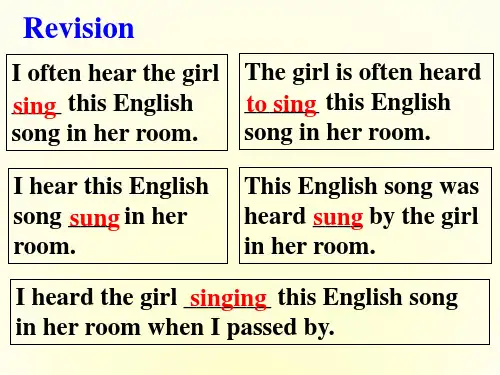
Fill in the blanks with in /to:
1) I took delight _in_ books. 2) T_o_ his delight, he passed the driving
test. 3) She delights _in_ being surrounded by
12. feel / be proud of take pride in 以……为自豪 他以自己的成功自豪。
He takes a pride in his success. He prides himself on his success. He is proud of his success. 他以自己是一个科学家感到光荣。
remain silent at the conference.
√A. invited
B. inviting
C. being invited D. having invited
8. in memory of = in honor of 为了纪念 in celebration of 为了庆祝 The museum was built in memory of the great writer – Lu Xun. A grand party was held in celebration of their victory.
The Statue of Liberty
Royal Observatory in Greenwich
The Meridian Line Longitude 0º
Buckingham Palace
Windsor Castle
Karl Marx
Monument in Highgate Cemetery
高中英语必修五课文及翻译

高中英语必修五课文及翻译集团档案编码:[YTTR-YTPT28-YTNTL98-UYTYNN08]-必修 5Unit 2 The United KingdomReadingPUZZLES IN GEOGRAPHYPeople may wonder why different words are used to describe these four countries: England, Wales, Scotland and Northern Ireland. You can clarify this question if you study British history.First there was England. Wales was linked to it in the thirteenth century. Now when people refer to England you find Wales included as well. Next England and Wales were joined to Scotland in the seventeenth century and the name was changed to "Great Britain". Happily this was accomplished without conflict when King James of Scotland became King of England and Wales as well. Finally the English government tried in the early twentieth century to form the United Kingdom by getting Ireland connected in the same peaceful way. However, the southern part of Ireland was unwilling and broke away to form its own government. So only Northern Ireland joined with England, Wales and Scotland to become the United Kingdom and this was shown to the world in a new flag called the Union Jack.To their credit the four countries do work together in some areas (eg, the currency and international relations), but they still have very different institutions. For example, Northern Ireland, England and Scotland have different educational and legal systems as well as different football teams for competitions like the World Cup!England is the largest of the four countries, and for convenience it isdivided roughly into three zones. The zone nearest France is called the South of England, the middle zone is called the Midlands and the one nearest to Scotlandis known as the North. You find most of the population settled in the south, but most of the industrial cities in the Midlands and the North of England. Although, nationwide, these cities are not as large as those in China, they have world-famous football teams and some of them even have two! It is a pity that the industrial cities built in the nineteenth century do not attract visitors. For historical architecture you have to go to older but smaller towns built by the Romans. There you will find out more about British history and culture.The greatest historical treasure of all is London with its museums, art collections, theatres, parks and buildings. It is the centre of nationalgovernment and its administration. It has the oldest port built by the Romans in the first century AD, the oldest building begun by the Anglo-Saxons in the 1060s and the oldest castle constructed by later Norman rulers in 1066. There has been four sets of invaders of England. The first invaders, the Romans, left their towns and roads. The second, the Anglo-Saxons, left their language and their government. The third, the Vikings, influenced the vocabulary and place-names of the North of England, and the fourth, the Normans, left castles and introduced new words for food.If you look around the British countryside you will find evidence of all these invaders. You must keep your eyes open if you are going to make your trip to the United Kingdom enjoyable and worthwhile.人们可能会奇怪为什么用不同的词语来描述英格兰、威尔士、苏格兰和北爱尔兰这四个国家。
高中英语必修五第二单元课文及翻译
-必修 5Unit 2 The United KingdomReadingPUZZLES IN GEOGRAPHYPeople may wonder why different words are used to describe these four countries: England, Wales, Scotland and Northern Ireland. You can clarify this question if you study British history.First there was England. Wales was linked to it in the thirteenth century. Now when people refer to England you find Wales included as well. Next England and Wales were joined to Scotland in the seventeenth century and the name was changed to "Great Britain". Happily this was accomplished without conflict when King James of Scotland became King of England and Wales as well. Finally the English government tried in the early twentieth century to form the United Kingdom by getting Ireland connected in the same peaceful way. However, the southern part of Ireland was unwilling and broke away to form its own government. So only Northern Ireland joined with England, Wales and Scotland to become the United Kingdom and this was shown to the world in a new flag called the Union Jack.To their credit the four countries do work together in some areas eg, the currency and international relations, but they still have very different institutions. For example, Northern Ireland, England and Scotland have different educational and legal systems as well as different football teams for competitions like the World CupEngland is the largest of the four countries, and for convenience it is divided roughly into three zones. The zone nearest France is called the South of England, the middle zone is called the Midlands and the one nearest to Scotland is known as the North. You find most of the population settled in the south, but most of the industrial cities in the Midlands and the North of England. Although, nationwide, these cities are not as large as those in China, they have world-famous football teams and some of them even have two It is a pity that the industrial cities built in the nineteenth century do not attract visitors. For historical architecture you have to go to older but smaller towns built by the Romans. There you will find out more about British history and culture.The greatest historical treasure of all is London with its museums, art collections, theatres, parks and buildings. It is the centre of national government and its administration. It has the oldest port built by the Romans in the first century AD, the oldest building begun by the Anglo-Saxons in the 1060s and the oldest castle constructed by later Norman rulers in 1066. There has been four sets of invaders of England. The first invaders, the Romans, left their towns and roads. The second, the Anglo-Saxons, left their language and their government. The third, the Vikings, influenced the vocabulary and place-names of the North of England, and the fourth, the Normans, left castles and introduced new words for food.If you look around the British countryside you will find evidence of all these invaders. You must keep your eyes open if you are going to make your trip to the United Kingdom enjoyable and worthwhile.人们可能会奇怪为什么用不同的词语来描述英格兰、威尔士、苏格兰和北爱尔兰这四个国家;如果你研究英国的历史,你就能够弄明白这个问题;首先是英格兰;威尔士于公元13世纪就同英格兰联合起来了;如今只要有人提起英格兰,你就会发现威尔士总是包括在内的;然后,于17世纪英格兰、威尔士同苏格兰联合起来,名字改为大不列颠;令人庆幸的是,当苏格兰的詹姆士国王成为英格兰和威尔士的国王时,这三个国家在无军事冲突的情况下实现了联合;最后在20世纪初通过同样的和平方式,英国政府尽力把爱尔兰也纳入进来,组成了联合王国;然而,爱尔兰的南部却不情愿这样并分离出去建立了自己的政府;因此只有北爱尔兰同英格兰、威尔士、苏格兰联合起来组成了联合王国,这一点从新的联合王国国旗“联合杰克”上就可以看得出来;值得称赞的是:这四个国家在一些方面比方说在货币和国际关系上,它们的确是共同合作的,但是有些制度仍然区别很大;例如,北爱尔兰、英格兰和苏格兰在教育体制和立法体制上都存在着差异,并且它们有着各自的足球队参加像世界杯之类的比赛在这四个国家中,英格兰是最大的;为了方便,它大致可以划分为三个地区;最靠近法国的那个地区叫做英格兰南部,中部地区叫英格兰中部,最靠近苏格兰的那个地区叫英格兰北部;你会发现大部分人口居住在南部,但是大部分工业城市在中部和北部;虽然就全国范围来说,这些城市都不像中国的城市那样大,但是它们都有着世界闻名的足球队,有的城市甚至还有两个队令人遗憾的是这些建于19世纪的工业城市并不能吸引游客;要找历史性的建筑你得去罗马人建造的更古老的但是比较小的城镇;在那儿你能找到更多有关英国历史和文化的东西;。
人教版英语高中必修五Unit 2 The United Kingdom part1 教案
Unit 2 The United Kingdom 教案2(PEZZLES IN GEOGRAPH<PART 1>) Teaching Goals1. Get the students to know the information about the United Kingdom.2. Encourage the students to talk out what they know about the UK and Ireland.3. Help the students learn to get information by listening.Teaching methodsSkimming & scanning methods to make the Ss get a good understanding of the text.1. Discussion methods to make the Ss understand what they’ve learned in class.2. Pair works of group to get every student to take part in the teaching-and-learning activities.3. Competition and role-play method to arouse the Ss’ interestTeaching proceduresStep 1 Warming upSs compete in answering the questions as quickly as possible.Step 2 Pre-readingQ: England can be divided into three main areas. Do you know what they are?The south, the Midlands and the northStep 3 Introduction of the UK.Area: 244,820sq.km.Population: 59,113,439Languages: English, Kymric, GaelicReligion: CatholicismComposing countries: England Wales Scotland Northern IrelandCapitals: London Cardiff Edinburgh BelfastStep 4 Reading1.Fast-readingAsk the students to read the map and the text on P10 and answer the following the questions 1〕The Union Jack flag unite the flags of three countries in the United Kingdom. Which countryis left out? Why?Wales. It is usually considered to be part of the England.2〕What three countries does British Airways represent?England, Scotland and Wales3〕Which grou p of invaders didn’t influence London?The Vikings didn’t influence London.2. Text structure analysisHave the students find out the topic sentences of each paragraphAsk the students to divide the passage into three parts and write down the main idea of each part Part1 (para1-4) What the UK includes and how the UK formed and more detailed information about the four countries in the UKPart2 (para5) The geographical division of England into three zones: their similarities and differencesPart3(para6)The cultural importance of London 3. Careful reading1〕Have the students put the events happening to the form of the UK into the right order.3〕Have the students look at the map of England and Wales. Draw lines across to show the zones of the South, Midlands and North of England.North: Leeds, York, Sheffield, and ManchesterMidlands: Coventry, BirminghamSouth: Reading, London, Brighton, PlymouthStep 5 Teaching new words and structuresStep 6 HomeworkWrite a short summary of the passage.。
高中英语 必修5 Unit 2 The United Kingdom Period 2 优质教案

高中英语必修5 Unit 2 The United Kingdom Period 2 优质教案Period 2ReadingThe General Idea of This PeriodThis period is the highlight of the whole unit.It lays emphasis on reading and understanding.First the teacher should check if the students have mastered thto fill in the blanks of some sentences by using some of the words and phrases that will appear in the reading passage.This part can help the students to learn words and expressions by heart in a certain language Then in Pre-reading part, the students are asked to distinguish the differences between the UK, Great Britaincountry.Provided with two simplpassage fast and find the answers directly in the passage.Next, the students will first listen to the tape with their textbooks closed.In order to make this step efficient, the teacher will provide them with five statements based on the passage.While listening, the students should judge whether these statements are true or false.If it is false, the students should correct it.Then the students will be given several minutes to read the passage silently.They should divide the passage into three parts and write the main ideas of each part.In order to help the students understand the passage better, the teacher can provide some cability of reading comprehension, which is a very important skill.At last, the students will do a speaking task in pairs.One acts as a visitor to England and the other acts as ageography the United Kingdom.This part not only helps the students to revise what the have learned in this part but also provides themTeaching Important PointsTrain the stTeaching DifficultiesTeaching A idsthe blackboThree Dimensional Teaching AimsKnowledge Aimsdebate, clarify, legal, relation, convenience, attraction, influence, collection, construct, puzzle, educational,break away from, leave out, divide...into..., be linked t o, to one’s surprise, as well as, be known as, lookThere is no need to debate any more about why different words are used to describe the four countries: England, Wales, Scotland and Northern IrelAbility AimsTrain the students’ ability to grasp keEmotional AimsKnow about the historical treasures left by the invaderTeaching ProcedureStep 1 GreetingsStep 2 RevisionT: At the beginning of this period, I will check if you have mastered the new words and phrases in this unit.Please finish the following sentences using some words and phrase in this unit.Please pay attention to the forms of the words and phrases.4.8.The explanation in the note__________10.It takes about two years to__________a large bridge.(Give the students several minutes to think about them.)Suggested answers:1.consists of2.puzzling3.legal4.left out5.collection7.break away from8.clarified9.convenienceStep 3 Pre-T: In the first period, you have learned a brief introduction to the UK.Do you know the difference between the United Kingdom, Great BritaT: The official name of the country is“The United Kingdom of Great Britain and Northern Ireland.”The United Kingdom consists of Great Britain and Northern Ireland.Great Britain is the name of the island northwest of France and east of Ireland that can be divided into three regions: England, Wales and Scotland.Therefore,England is part of Great Britain, which is part of the United Kingdom.The puzzling situation was caused by the history.In this unit we will learn about the historical influence on the geography of the country.Step 4 Fast ReadingT: Read the passage entitled“Puzzles in Geography”, and answer the following questions.1.Did the countries of the UK unite peacefully or byS: The countrieS: We should go to some older but smaller towns to appreciate some historical attractions.T: Now I’ll play the tape for you to listen.While listening, please find out whether the following statementsTrue or False Questions:3.The countries in the U5.The Normans influenced the vocabulary and place-names of the North of London.Suggested answers:1.False Because Great2.False5.False Because the Normans left castles and words for food, whilvocabulary and p lace-Step 6 Detailed ReadingT: Now I will give you several minutes to read the passage again.While reading, please try to divide the passage iPart 2: Paragraph 2-Part 3: Paragraph 6 HistoT: Look at the first sentence in Paragraph 1, “There is no need to debate any more about why different words are used to describe the four countries: England, Wales, Scotland and Northern Ireland.”Can you say it in ano therIt is __________ to __________ any more about why people __________ different words to describe theS: It is unnecessary to argue any more about why people use different words to describe the four countries.T: Read the second part.S: The Union Jack.Blue field with the red cross of St George (England) edged in white superimposed on the diagonal red cross of St Patrick (Ireland), which is superimposed on the diagonal white cross of St Andrew (Scotland).It is properly known as the Union Flag, but commonly called the Union Jack.The design and colors (especially the Blue Ensign) have been the basis for a number of other flags including other Commonwealth countries and their constituent states or provinces,S: Wales.Wales was linked to England in the 13th century AD, so when people refer to England, it is included as well.T: Have you found out how the four countries joined together?Use the information from the passage to fill in the blanks.__________→__________→__________→__________S: England → Wales joined England (13th century A.D.) → England, Wales joined Scotland (1603) → England, Wales, Scotland got Northern Ireland connectedT: Often will use England to stand for the UK.One of the reasons is that England is the largest of the four countries.So England is divided into three zones.Do you know the three zones?S: The South, the Midlands andT: Yes.Look at the map in part 2 on Page 11.Draw lines across to show the zones of the South, Midlands andS: BiS: What does “those” mean in the sentence “For those you have to go to older but smaller towns first built bythe historical attractions of other places.”So now do you know what “those” refers to?T: You are very clever.Now try to paraphrase the sentence by finishing the following sentence.__________ you want to __________ some __________ __________, you have to go to older but smaller towns __S: If you want to see some historical attractions, you have to go to older but smaller towns which were first built by the Romans.T: The last part tells us about the invaders’ influence on England and London.Read it and try to fill in theStep 7 Pair WorkThe students work in pairs to make a dialogue.One of them is a native Englishman, while the other is a visitor to England.The visitor is asking the native Englishman about the geography of the United Kingdom.(T(Then the teacher asks one or two pairs to come to the front to demonstrate their dialogues.)One example:B: Yes.I’m veryA: Actually, the whole country is called the UK, which stands for the United Kingdom of Great Britain andB: Then why do peopleB: I see.I have another st time when I watched the World Cup, I noticed there is a football team of England.But there are also teamsA: The four countries do work together in some areas, but they are still very different.For example, Northern Ireland, England and Scotland have developed different educational and legal systems as well as different footballStep 8 Homework1.Try to write a short summary of the passage in aboThe Design of the Writing on the BlackboardUnit 2The United KingdomPeriod 2ReadingⅠ Words & phrases:1.consists of2.puzzling3.legal4.left out6.influen10.constructⅡ Fast-2.Where should we go if we want to appreciate some historical attractions of the UK?Ⅲ Invaders’ influence on England and LondonLondonResearch and ActivitiesRead another passage about the United pare it with the passage “Puzzles in Geography”, paying special attention to the writinBRITAIN AND IRELANDThe island of Britain lies to the east of Ireland.The two are separated by the Irish Sea.The letters“UK”stand for“The United Kingdom of Great Britain and Northern Ireland.”The UK is made up of four countries.In the north is Scotland, with its capital Edinburgh.Scotland has many lakes and mountains, andWales lies to the west of England.Its capital is Cardiff.Everyone there can speak English, but the first language in North Wales is Welsh.There are Welsh newspapers.Programmes on the radio and TV are in Welsh.The countryside here is very beautiful too, with lots of mountains and rivers.There used to be a lot of coal mines in the south, but many of them have been closed, or are about to be closed.England, the larges t country in Britain, is in the southeast.Its capital is London, which is also the capital of the UK.London lies on the River Thames and has a population of seven million. Much of England is rather flat, although there are hills in the northeast and in the centre of the country.Ireland is divided into two countries.In the north, Northern Ireland, with its capital Belfast, is part of the United Kingdom.The Southern part of the island is a separate country, called the Republic of Ireland with DublinGenerally, the weather in Britain is neither too cold in winter nor too hot in summer.It is colder in the north, warmer in the south, drier in the east and wetter in the west.Ireland is especially wet.In all parts of Britain it rains every month of the year; there is no“dry season”.Snow falls in Scotland every winter and sometimes in England*Question for discussion:Both passages are about the United Kingdom, but the two writers focused on different things.What are theReference for TeachingAn Introduction to the United KingdomThe United Kingdom of Great Britain and Northern Ireland is a country in western EuropCommonwealth Realm, and a member of the European Union and ually known simply as the United Kingdom or the UK, it is also often inaccurately named Great Britain, Britain or England (the most populous ofthe home nations).The UK has four constituent parts, three of which—the ancient nations of England, Wales and Scotland—are located on the island of Great Britanin.The fourth part is Northern Ireland, which is located on theThe border between Northern Ireland and the Rep ublic of Ireland forms the United Kingdom’s principal international land border, although there is also a nominal frontier with France in the middle of the Channelveral CrownThe UK was formed by a series of Acts of Union which united the Kingdom of England (which included Wales as a principality) with those of, first, Kingdom of Scotland and then Kingdom of Ireland under a single government in London.The greater part of Ireland left the United Kingdom (then called the United Kingdom of Great Britain and Ireland) in 1922 to form an independent state (in which, until 1949, the King of the United Kingdom was also King of Ireland).This state later became the Republic of Ireland.Six counties in the north-eastern portion of the island, meanwhile, remained a part of the United Kingdom, forming Northern Ireland to this day.The UK is situated off the north-western coast of continental Europe, and has a land border with the Republic of Ireland, but is otherwise surrounded by the North Sea, the English Channel, the Celtic Sea, the Irish Sea, and the Atlantic Ocean.Great Britain, or just Britain, is the geographical name of the largest of the British Isles (often also including its smaller neighboring islands, though never Ireland).Politically, the term Great Britain refers collectively to the nations of England, Wales and Scotland (i.e., the United Kingdom except for Northern Ireland).This political usage of “Great Britain” dates from the personal union of the Crowns of Scotla nd and England (including Wales) in 1603, with the term being used in the sense “all of Britain”.In the early years of the “United Kingdom of Great Britain”, formed by the Act of Union of 1707, it was customary to refer officially to Scotland and to England and Wales as, respectively, “North Britain” and“South Britain”, though the usage never really caught on.It should be noted that the practice by some, the informal media in particular, of using “(Great) Britain” as shorthand for the United Kingdom is an inaccuracy, which can cause offence.The British Isles is a term frequently used to refer to the archipelago which includes the mainland of Great Britain, the mainland of Ireland, and the smaller islands associated with these two, such as the Channel Islands, the Hebrides, the Isle of Man, the Isle of Wight, Orkney, the Shetland Islands, etc.The term is, however, often avoided, especially in Ireland, by those who are cons cious that it is sometimes misunderstood internationally to mean “the islands belonging to Britain (i.e. the United Kingdom)”, a description out of date in the Irish case since 1922.An alternative, the Islands of the North Atlantic(IONA) has been proposed, but is little used outsideKing James ⅠBIOGRAPHYAN INFANT KING.James Charles Stuart was born on June 19, 1566 at Edin burgh Castle in Scotland.His father, Lord Darnley, was murdered in early 1567 before young James was 1 year old.His mother, Mary Queen of Scots, subsequently ascended(上升)to the Scottish throne.Her reign(统治), however was short lived and she was forced to abdicate (退位)in favor of her son on July 24, 1567.Little James was crowned King James Ⅵ of Scotland five days laterat the tender age of 13 months.Reformation leader John Knox preached the sermon at his coronation(加冕礼)James’ mother, Mary, was imprisoned in England by her cousin Queen Elizabeth and 19 years later, in February of 1587, was executed for her part in the conspiracy(阴谋)(暗杀)QueenAnd so, like many monarchs of the time, King James was reared by neither father nor mother but rather by tutors.Of his four tutors, perhaps one of the most influential was George Buchanan, a staunch(坚定的)Calvinist.It was under Mr.Buchanan’s strict teaching methods that King James bec ame one of the most learned and intellectually curious men to ever sit on any throne. Mr. Buchanan was 64 years old when he began tutoring the young king.KING JAMES BEGINS TO REIGN IN SCOTLAND.King James began to rule his native Scotland when he was 19 years old.A few years later, he took Anne of Denmark to be his queen.King James loved his wife and wrote beautiful poetry for her.Together they had nine children.Once, when the King and Queen were out hunting, Queen Anne accidentally killed the King’s fav orite hunting dog, Jewell.The Queen felt badly about this and the King bought her a gift to ease her mind of thisKing James believed in the Divine Right of Kings and the monarch’s duty to reign according to God’s law and the public good.In order to pass on his kingly instruction to his eldest son, Prince Henry, King James wrote Basilicon Doron which means, “the Kingly Gift”.Basilicon Doron was not meant for general publication, but for the instruction of the young prince in the likely event that his father would not survive to instruct him—King James was sickly and survived a number of assassination attempts.The King bound his printer Robert Waldegrave to secrecy and ordered an edition of only seven copies.Somehow, however, intelligence of the book and its contents got abroad.Subsequently, there was so much demand for Basilicon Doron that forged(稳步前进), corrupted copies werebestseller.ItBasilicon Doron is a short treatise(论文), only 153 pages long.It consists of three short volumes, the first of which is “A King’s Christian Duetie towards God.”James D’israeli said, “James had formed the most elevatedIn Basilicon Doron, King James’ understanding o f Christian discipleship, style and prose are at their best.He skillfully intertwines sacred scripture with godly and Christian advice.The King offers his son this importantDiligently read his word, & earnestly...pray for the right understanding thereof.Search the scriptures saithChrist for they will bear testimony of me.The whole Scriptures saith Paul are profitable to teach, to improve, to“The whole Scripture contayneth but two things: a command and a prohibition.Obey in both...The worship ofKing James’ great aspiration to be the first King of both Scotland and England was realized in 1603 upon the death of Queen Elizabeth.When he ascended to the English throne that year he had already been king of Scotland for 36 years.He was now known as King James VI of Scotland & I of England. The king played a masterly political game and kept his kingdom out of war.For the first time a Scottish monarch wielded effective authority over the more far-flung areas of the realm(领域).He supported literature both through his own writing and his patronage(赞助).There was peace during his reign—both with his subjects and foreign powers.As a Scotsman ruling over the English, the King endured much racism and slander—especially from the once powerful English Lords and Ladies who he replaced with his Scottish countrymen.Unfortunately, ma ny of today’s historians look to the writings of hostile sources such as Sir Anthony Weldon and Francis Osborne as accurate descriptions of this great king.One of the king’s detractors(诽谤者), Sir Anthony Weldon, was knighted by King James but was subsequen tly dismissed after King James found racist writings by Weldon about the King’s native Scotland.Many historians today quote Weldon as if he were a reliable his torical source. Examples of Weldon’s racism are found in his treatise entitled, “A Perfect Description of the People and Country of Scotland” where he says that the Scots are a “stinking people” who hold “fornication...but a pastime”.He also said,“...their flesh naturally abhors cleanness.Their breath commonly stinks of pottage...to be chained in m arriage with one of them, were to be tied to a dead carcass, and cast into a stinking ditch...I do wonder that...King James should be born in so stinking a town as Edinburgh in lousy Scotland.”Despite this obvious bias, historians continue to consult thethat King James had inordinate affections towards other men—but he did not do this until 25 years after King James was dead and could not defend himself.Today’s sodomite/ homosexual community is touting the King as one of their own, which he was not.These misinformed sources, virtually without exception, fail to mention that King James and his Queen had nine children together.You can read about the rumors in this article or check out an excellently researched book on the subject by Stephen Coston, Sr.entitled, King James: Unjustly Accused?“They quarrel me (not for any evil or vice in me) but because I was a king, which they thought the highest evil, and because they were ashamed to profess this quarrel they were busy to look narrowly in all my actions, and—James I, Basilicon Doron The religion was also an enemy of king James.Papists (as King James called them) attempted to assassinate him a number of times.Most notably, in 1605 Roman Catholic Guy Fawkes attempted to blow up Parliament when the king was to have been present.The conspiracy was discovered and all co-conspirators were executed.ThisJames strongly delineated the errors of Roman superstition and spurned them yet he treated Romanist subjects“He is a Protestant...the King tries to extend his Protestant religion to the whole island. The King is a bitt er enemy of our religion.He frequently speaks of it in terms of contempt.He is all the harsher because of this last11 conspiracy against his life...He understood that the Jesuits had a hand in it.”Despite his detractors, King James the Ⅵ of Scotland andⅠAs a lover of the theatre, King James became patron to the troop of one of his most famous subjects —William Shakespeare the playwright.Shakespeare’s troop came to be known as the King’s Men.Shakespeare and the King held a special relationship as they both loved literature. Shakespeare even wrote his famous play, “Macbeth”specifically for King James.Another little recognized fact is that King James the Ⅵ and Ⅰ is the founding monarch of the United States.Under his reign, we have the first successful colonies planted on the American mainland —Virginia, Massachusetts, and Nova Scotia (Latin for New Scotland) in SE Canada.The King himself ordered, wrote and authorized the Evangelistic Grant Chartercalled Virginia...in propagating of Christian religion to such people as yet live in darkness...to bring a settled and。
高中英语必修五Unit2The United Kingdom要点解析
t n. 我的劝 告没有 影 响他 的行动 。 is o
T e ta h r h s e tb ih d a n u n e h e c e a s l e n if e c a s l
fr o vne c.我 把 参 考 书放 在 书 桌 旁 用 o n ein e c 着方便 。
B t f co s ei i l ifu n e t c o h a t r d f t y n e c s k n e l o p c s b tt e d g e fi u n e ma e d f i r e u e r e o n e c y b i h l f -
c os ece icr s o r a m n. 为 方 hoet rdt ada u y e t h y p
便 起见 , 您最好 选用 信用 卡付款 。 【 识拓 展 】 知
icn e i c . 方便 c ne in n o vne en 不 n o vne t 便利 的 , 适宜 的 a o e sc ne in e在 某 人 方 便 的 时 t n ’ o vne c
4 . j 【 考纲 释义 】 t 安排, 列, 商 v. 排 协
C n y u a n eavs otee h bt n a o  ̄a g i tt h x iio ? i i
【 考纲释 义 】 t建 造 ; v. 构造
T e B n a u c a e o r p ry h a k h s p r h s d s me p o e t
他 教我们 怎样造 句 。
A hg w y i b igcnt c d 一 条 i a s e o s u t . h n r e
公路 正在 修建 。
人教版高中英语必修五Unit 2The United Kingdom课件
(2)Success consists in
the ability to continue efforts
through failures.(2014·福建,书面表达)
成功在于在失败中还能继续努力的能力。
(3)Theory should consist with practice. 理论应与实践相一致。
Unit 2 The United Kingdom
必修 5
Unit 2 The United Kingdom
基础分级
核心考点
随堂特训
-3-
Ⅰ.单词 由简到难,水到渠成 The first step is as good as half over.
【识记阅读单词】 1.kingdom n.王国 2.province n.省;行政区 3.clarify vt.澄清;阐明 4.conflict n.矛盾;冲突 5.union n.联合;联盟;结合;协会 6.credit n.信任;学分;赞扬;信贷 7.currency n.货币;通货 8.institution n.制度;机制;公共机构 9.nationwide adj.全国性的;全国范围的 10.architecture n.建筑学;建筑艺术
必修 5
Unit 2 The United Kingdom
基础分级
核心考点
随堂特训
-8-
ቤተ መጻሕፍቲ ባይዱ
1.-cy后缀高频词汇 accuracy准确性 emergency紧急情况 frequency频率 tendency趋势 agency代理机构 currency货币;通货 mercy仁慈;宽恕;怜悯 2.由statue想到的 statue雕像 status身份;地位 state(政治上所指的)国家;状态 stout肥胖的;强壮的
高中英语Unit2 The United Kingdom文章 白金汉宫人教版必修五
白金汉宫白金汉宫(Buckingham Palace)是英国君主的官邸。
它的建筑风格为新古典主义, 主体建筑为五层, 其中两层为服务人员使用的附属层, 高度较低。
所以立面可以视为纵、横三段式处理。
白金汉宫的附属建筑包括皇家画廊、皇家马厩和花园。
皇家画廊和皇家马厩均对公众开放参观, 每年夏天,英国王室在花园内举办盛大的皇家招待会。
除此之外, 来英国做国事访问的国家元首也在宫内下榻。
白金汉宫的广场中央耸立着维多利亚女王纪念碑,顶上站立着展翅欲飞的金箔包裹的胜利女神,而纪念碑正面那么端坐着握着权杖的维多利亚女王。
在这个纪念碑的下方有阶梯, 许多游人在此落座,因为它是打量白金汉宫的最正确位置。
附近地铁站: Victoria 站, Hyde Park Corner 站或Green Park 站,步行穿过公园既是。
公共汽车路线有: 9, 10, 14, 38, 73 等。
唐宁街十号(10 Downing Street)是英国首相官邸,(1735年即成为首相府) 既是世界最知名的政府首脑所在地之一,也已成为伦敦一个重要的旅游景点。
议会大厦(The UK Parliament)英国议会所在地。
曾为英王室居住的西敏寺宫, 1515年被大火焚毁。
1547年修复后,爱德华六世把该宫的部分建筑拨给下院使用。
1838年该宫又毁于大火, 只剩下西敏寺大厅。
1840年重建西敏寺宫,即现在的议会。
1852年,维多利亚女王主持揭幕典礼。
该建筑包括护宫河,总面积为12。
5亩。
大本钟(Big Ben)是英国最著名的地标, 与英国国会大厦相连。
大本钟因其走时准确而名扬四海。
每隔一小时,大钟根据格林威治时间发出沉重而铿锵的响声, 在数英里之外也能听到钟声的回荡。
蜡像馆(Madame Tussauds)--杜瑟夫人蜡像馆, 号称世界同类展览馆中规模最大, 1835年由来自法国的杜瑟夫人创办, 最初在贝克大街, 1884年移至现址。
蜡像馆中展出的作品为现代历史名人。
高中英语必修五(Unit 2 The United Kingdom Period 2) 教案
Period 2ReadingThe General Idea of This PeriodThis period is the highlight of the whole unit.It lays emphasis on reading and understanding.by asking them to fill in the blanks of some sentences by using some of the words and phrases that will appear in the reading passage.This part can help the students to learn words and expressionsThen in Pre-reading part, the students are asked to distinguish the differences between the UK, Great Britain and England.Hence, the teacher can lead to the topic of the historicalsome historical attractions of the UK?”, the students will read the passage fast and find the answers directly in the passage.Next, the students will first listen to the tape with their textbooks closed.In order to make this step efficient, the teacher will provide them with five statements based on the passage.While listening, the students should judge whether these statements are true or false.If it is false, thestudents should correct it.Then the students will be given several minutes to read the passage silently.They should divide the passage into three parts and write the main ideas of each part.In order to help the students understand the passage better, the teacher can provide some pof this step is to train the students’abi lity of reading prehension, which is a very important skill.At last, the students will do a speaking task in pairs.One acts as a visitor to England and thegeography the United Kingdom.This part not only helps the students to revise what the haveTeaching Important PointsTrain the studentsTeaching DifficultiesTeaching A idsThree Dimensional Teaching AimsKnowledge Aimsdebate, clarify, legal, relation, convenience, attraction, influence, collection, construct, puzzle,break away from, leave out, divide...into..., be linked to, to one’s surprise, as well as, beThere is no need to debate any more about why different words are used to describe the fourYou must keep your eyes open if you are going to make your trip to the United KingdomAbility AimsTrain the students’ ability to grasp key infoEmotional AimsKnow about the historicTeaching ProcedureStep 1 GreetingsStep 2 RevisionT: At the beginning of this period, I will check if you have mastered the new words and phrases in this unit.Please finish the following sentences using some words and phrase in this unit.Please pay attention to the forms of the words and phrases.4.The pr8.The explanation in the note__________ the di10.It takes about two years to__________a large bridge.(Give the students several minutes to think about them.)Suggested answers:1.consists of2.puzzling3.legal4.left out5.collection7.break away from8.clarified9.convenienceStep 3 Pre-T: In the first period, you have learned a brief introduction to the UK.Do you know the difference between the United Kingdom, Great Britain, anT: The official name of the country is“The United Kingdom of Great Britain and Northern Ireland.”The United Kingdom consists of Great Britain and Northern Ireland.Great Britain is the name of the island northwest of France and east of Ireland that can be divided into three regions: England, Wales and Scotland.Therefore, England is part of Great Britain, which is part of the United Kingdom.The puzzling situation was caused by the history.In this unit we will learn about the historical influence on the geography of the country.Step 4 Fast ReadingT: Read the passage entitled“Puzzles in Geography”, and answer the following questions.1.Did the countries of the UK unite peacefully or byS: The countrieS: We should go to some older but smaller towns to appreciate some historical attractions.T: Now I’ll play the tape for you to listen.While listening, please find out whether theTrue or False Questions:3.The countries in the UK h5.The Normans influenced the vocabulary and place-names of the North of London.Suggested answers:1.False Because Great Britain was the name given when England and Wales were joined to2.False Because it was the southern part of Ireland that broke away to form its own5.False Because the Normans left castles and words for food, while the Vikingslace-Step 6 Detailed ReadingT: Now I will give you several minutes to read the passage again.While reading, please try to divide the passage intoPart 2: Paragraph 2-Part 3: Paragraph 6 HistoricT: Look at the first sentence in Paragraph 1, “There is no need to debate any more about whydifferent words are used to describe the four countries: England, Wales, Scotland and Northern Ireland.”Can you say it in anotheIt is __________ to __________ any more about why people __________ different words toS: It is unnecessary to argue any more about why people use different words to describe the four countries.T: Read the second part.S: The Union Jack.Blue field with the red cross of St George (England) edged in white superimposed on the diagonal red cross of St Patrick (Ireland), which is superimposed on the diagonal white cross of St Andrew (Scotland).It is properly known as the Union Flag, but monly called the Union Jack.The design and colors (especially the Blue Ensign) have been the basis for a number of other flags including other monwealth countries and their constituent states or provinces, as well as BritishS: Wales.Wales was linked to England in the 13th century AD, so when people refer to England, it is included as well.T: Have you found out how the four countries joined together?Use the information from the passage to fill in the blanks.__________→__________→__________→__________S: England → Wales joined England (13th century A.D.) → England, Wales joined Scotland (1603) → England, Wales, Scotland got Northern Ireland connectedT: Often will use England to stand for the UK.One of the reasons is that England is the largest of the four countries.So England is divided into three zones.Do you know the three zones?S: The South, the Midlands andT: Yes.Look at the map in part 2 on Page 11.Draw lines across to show the zones of the South,S: BiS: What does “those” mean in the sentence “For those you have to go to older but smallercities...do not have the historical attractions of other places.”So now do you know what “those” refers to?T: You are very clever.Now try to paraphrase the sentence by finishing the following sentence.__________ you want to __________ some __________ __________, you have to go to older but smaller towns __S: If you want to see some historical attractions, you have to go to older but smaller towns which were first built by the Romans.T: The last part tells us about the invaders’ influence on England and London.Read it and tryThe students work in pairs to make a dialogue.One of them is a native Englishman, while the other is a visitor to England.The visitor is asking the native Englishman about the geography of the United Kingdom.(T(Then the teacher asks one or two pairs to e to the front to demonstrate their dialogues.)One example:B: Yes.I’m very glad tA: Actually, the whole country is called the UK, which stands for the United Kingdom of Great Britain and Northern Ireland.The Great Britain is made up of three countries, that is,B: Then why do people callB: I see.I have another st time when I watched the World Cup, I noticed there is afootball team of England.But there are also teams of Northern Ireland and Scotland.Can youA: The four countries do work together in some areas, but they are still very different.For example, Northern Ireland, England and Scotland have developed different educational and legal systems as weStep 8 Homework1.Try to write a short summary of the passage in about 50 words.The Design of the Writing on the BlackboardUnit 2The United KingdomPeriod 2ReadingⅠ Words & phrases:1.consists of2.puzzling3.legal4.left out7.break10.constructⅡ Fast-2.Where should we go if we want to appreciate some historical attractions of the UK?Ⅲ Invaders’ influence on England and LondonLondonResearch and ActivitiesRead another passage about the United Kingdom.pare it with the passage “Puzzles in Geography”, paying special attention to the writing styles of theBRITAIN AND IRELANDThe island of Britain lies to the east of Ireland.The two are separated by the Irish Sea.The letters“UK”stand for“The United Kingdom of Great Britain and Northern Ireland.”The UK is made up of four countries.In the north is Scotland, with its capital Edinburgh.Scotland hasWales lies to the west of England.Its capital is Cardiff.Everyone there can speak English, butthe first language in North Wales is Welsh.There are Welsh newspapers.Programmes on the radio and TV are in Welsh.The countryside here is very beautiful too, with lots of mountains and rivers.There used to be a lot of coal mines in the south, but many of them have been closed, or are about to be closed.England, the larges t country in Britain, is in the southeast.Its capital is London, which is also the capital of the UK.London lies on the River Thames and has a population of seven million. Much of England is rather flat, although there are hills in the northeast and in the centre of the country.Ireland is divided into two countries.In the north, Northern Ireland, with its capital Belfast, is part of the United Kingdom.The Southern part of the island is a separate country, called the Republic of IrelaGenerally, the weather in Britain is neither too cold in winter nor too hot in summer.It is colder in the north, warmer in the south, drier in the east and wetter in the west.Ireland is especially wet.In all parts of Britain it rains every month of the year; there is no“dry season”.Snow falls in Scotland every winter and sometimes in England and Wales too.Falls of*Question for discussion:Both passages are about the United Kingdom, but the two writers focused on differentReference for TeachingAn Introduction to the United KingdomThe United Kingdom of Great Britain and Northern Ireland is a country in westerna monwealth Realm, and a member of the European Union and ually known simply as the United Kingdom or the UK, it is also often inaccurately named Great Britain, Britain or England (the most populous of the home nations).The UK has four constituent parts, three of which—the ancient nations of England, Wales and Scotland—are located on the island ofThe border between Northern Ireland and the Republic of Ireland forms the United Kingdom’s principal international land border, although there is also a nominal frontier withworld, and relationships with seThe UK was formed by a series of Acts of Union which united the Kingdom of England (which included Wales as a principality) with those of, first, Kingdom of Scotland and then Kingdom of Ireland under a single government in London.The greater part of Ireland left the United Kingdom (then called the United Kingdom of Great Britain and Ireland) in 1922 to form an independent state (in which, until 1949, the King of the United Kingdom was also King of Ireland).This state later became the Republic of Ireland.Six counties in the north-eastern portion of the island, meanwhile, remained a part of the United Kingdom, forming Northern Ireland to this day.The UK is situated off the north-western coast of continental Europe, and has a land border with the Republic of Ireland, but is otherwise surrounded by the North Sea, the English Channel, the Celtic Sea, the Irish Sea, and the Atlantic Ocean.Great Britain, or just Britain, is the geographical name of the largest of the British Isles (often also including its smaller neighboring islands, though never Ireland).Politically, the term GreatBritain refers collectively to the nations of England, Wales and Scotland (i.e., the United Kingdom except for Northern Ireland).This political usage of “Great Britain” dates from the personal union of the Crowns of Scotla nd and England (including Wales) in 1603, with the term being used in the sense “all of Britain”.In the early years of the “United Kingdom of Great Britain”, formed by the Act of Union of 1707, it was customary to refer officially to Scotland and to England and Wales as, respectively, “North Britain” and“South Britain”, though the usage never really caught on.It should be noted that the practice by some, the informal media in particular, of using “(Great) Britain” as shorthand for the United Kingdom is an inaccuracy, which can cause offence.The British Isles is a term frequently used to refer to the archipelago which includes the mainland of Great Britain, the mainland of Ireland, and the smaller islands associated with these two, such as the Channel Islands, the Hebrides, the Isle of Man, the Isle of Wight, Orkney, the Shetland Islands, etc.The term is, however, often avoided, especially in Ireland, by those who are cons cious that it is som etimes misunderstood internationally to mean “the islands belonging to Britain (i.e. the United Kingdom)”, a description out of date in the Irish case since 1922.An alternative, the Islands of the North Atlantic(IONA) has been proposed, but is little used outsideSea, northwest of FranceKing James ⅠBIOGRAPHYAN INFANT KING.James Charles Stuart was born on June 19, 1566 at Edin burgh Castle in Scotland.His father, Lord Darnley, was murdered in early 1567 before young James was 1 year old.His mother, Mary Queen of Scots, subsequently ascended(上升)to the Scottish throne.Her reign(统治), however was short lived and she was forced to abdicate(退位)in favor of her son on July 24, 1567.Little James was crowned King James Ⅵof Scotland five days later at the tender age of 13 months.Reformation leader John Knox preached the sermon at his coronation(加冕礼)James’ mother, Mary, was imprisoned in England by her cousin Queen Elizabeth and 19 years later, in February of 1587, was executed for her part in the conspiracy(阴谋)to (暗杀)And so, like many monarchs of the time, King James was reared by neither father nor mother but rather by tutors.Of his four tutors, perhaps one of the most influential was George Buchanan, a staunch(坚定的)Calvinist.It was under Mr.Buchanan’s strict teaching methods that King James became one of the most learned and intellectually curious men to ever sit on any throne. Mr. Buchanan was 64 years old when he began tutoring the young king.KING JAMES BEGINS TO REIGN IN SCOTLAND.King James began to rule his native Scotland when he was 19 years old.A few years later, he took Anne of Denmark to be his queen.King James loved his wife and wrote beautiful poetry for her.Together they had nine children.Once, when the King and Queen were out hunting, Queen Anne accidentally killed the King’s favorite huntin g dog, Jewell.The Queen felt badly about thisKing James believed in the Divine Right of Kings and the monarch’s duty to reign according to God’s law and the public good.In order to pass on his kingly instruction to his eldest son, Prince Henry, King James wrote Basilicon Doron which means, “the Kingly Gift”.Basilicon Doron was not meant for general publication, but for the instruction of the young prince in the likely event that his father would not survive to instruct him—King James was sickly and survived a number of assassination attempts.The King bound his printer Robert Waldegrave to secrecy and ordered an edition of only seven copies.Somehow, however, intelligence of the book and its contents got abroad.Subsequently, there was so much demand for Basilicon Doron that forged(稳步前进),the general public and it became a bestseller.It was published in English, Welsh, Latin, French,Basilicon Doron is a short treatise(论文), only 153 pages long.It consists of three short volumes, the first of which is “A King’s Christian Duetie towards God.”James D’i sraeli said,In Basilicon Doron, King James’ understanding o f Christian discipleship, style and prose areat their best.He skillfully intertwines sacred scripture with godly and Christian advice.The KingDiligently read his word, & earnestly...pray for the right understanding thereof.Search the scriptures saith Christ for they will bear testimony of me.The whole Scriptures saith Paul are profitable to teach, to improve, to correct, and to instruct in righteousness, that the man of God“The whole Scripture contayneth but two things: a mand and a prohibition.Obey in both...The worsKing James’ great aspiration to be the first King of both Scotland and England was realized in 1603 upon the death of Queen Elizabeth.When he ascended to the English throne that year he had already been king of Scotland for 36 years.He was now known as King James VI of Scotland & I of England. The king played a masterly political game and kept his kingdom out of war.For the first time a Scottish monarch wielded effective authority over the more far-flung areas of the realm(领域).He supported literature both through his own writing and his patronage(赞助).There was peace during his reign—both with his subjects and foreign powers.As a Scotsman ruling over the English, the King endured much racism and slander—especially from the once powerful English Lords and Ladies who he replaced with his Scottish countrymen.Unfortunately, many of today’s h istorians look to the writings of hostile sources such as Sir Anthony Weldon and Francis Osborne as accurate descriptions of this great king.One of the king’s detractors(诽谤者), Sir Anthony Weldon, was knighted by King James but was subsequently dismissed a fter King James found racist writings by Weldon about the King’s native Scotland.Many historians today quote Weldon as if he were a reliable his torical source. Examples of Weldon’s racism are found in his treatise entitled, “A Perfect Description of the P eople and Country of Scotland” where he says that the Scots are a “stinking people” who hold “fornication...but a pastime”.He also said,“...their flesh naturally abhors cleanness.Their breath monly stinks of pottage...to be chained in marriage with one of them, were to be tied to a dead carcass, and cast into a stinking ditch...I do wonder that...King James should be born in so stinking a town as Edinburgh in lousy Scotland.”Despite this obvious bias, historians continue to consult the writings of Anthonwho intimated that King James had inordinate affections towards other men—but he did not do this until 25 years after King James was dead and could not defend himself.Today’s sodomite/ homosexual munity is touting the King as one of their own, which he was not.These misinformed sources, virtually without exception, fail to mention that King James and his Queen had nine children together.You can read about the rumors in this article or check out an excellently researched book on the subject by Stephen Coston, Sr.entitled, King James: Unjustly Accused?“They quarrel me (not for any evil or vice in me) but because I was a king, which they thought the highest evil, and because they were ashamed to profess this quarrel they were busy to look narrowly in all my actions, and I warrant you a moat in my eye, yes a false report was matter—James I, Basilicon Doron The religion was also an enemy of king James.Papists (as King James called them) attempted to assassinate him a number of times.Most notably, in 1605 Roman Catholic Guy Fawkes attempted to blow up Parliament when the king was to have been present.The conspiracy was discovered and all co-conspirators were executed.This failed attempt is celebrated on November 5of Rome.King James strongly delineated the errors of Roman superstition and spurned them yet he“He is a Protestant...the King tries to extend his Protestant religion to the whole island. The King is a bitter enemy of our religion.He frequently speaks of it in terms of contempt.He is all the harsher because of this last conspiracy against his life...He understood that the Jesuits had a hand in it.”Despite his detractors, King James the Ⅵof Scotland and Ⅰof England was a highlyAs a lover of the theatre, King James became patron to the troop of one of his most famous subjects—William Shakespeare the playwright.Shakespeare’s troop came to be known as the King’s Men.Shakespeare and the Ki ng held a special relationship as they both loved literature. Shakespeare even wrote his famous play, “Macbeth”specifically for King James.Another little recognized fact is that King James the Ⅵ and Ⅰ is the founding monarch of the United States.Under his reign, we have the first successful colonies planted on the American mainland—Virginia, Massachusetts, and Nova Scotia (Latin for New Scotland) in SE Canada.The King himself ordered, wrote and authorized the Evangelistic Grant Charter to settle the Colony ofAmerica, monly called Virginia...in propagating of Christian religion to such people as yet live in darkness...to bring a settled and quiet government.”。
高中英语必修五(Unit 2 The United Kingdom Period 1) 教案
Unit 2The United KingdomBrief Statements Based on This Unitinfluence on geography, historical attractions and traditional festivals.The students should be encouThe whole unit can be divided into seven parts: warming up, reading, listening and speaking,In Warming up, there is a quiz for the students to do, which will arouse the students’ interest in knowing about the detailed information about the United Kingdom.While checking the answers, the teacher can add more knowledge about the UK, to prepare the students for the following processes.In this part, the teacher should also help the students to deal with the new words and expressions that will appear in the Reading passage.Group discussion and brainstorming will be used in this period to help the students to municate with each other using their previous kIn Pre-reading, the students are provided with three questions related to the UK, which canIn the Reading passage, the students will learn about the historical influence upon geography in the UK and get a general idea about the process of the bination of the UK.They will also learn about the historical attractions left by the invaders in England and London.In reading the passage the students should also pay special attention to the techniques of writing a passage of human geography.In Post-reading part, the students will do three activities.The first one is to answer three questions according to the Reading passage.Secondly, the students are asked to divide England into three districts on a map, which is based on the deeper understanding of the passage.Thirdly, after getting the general idea of the passage, the students should write a summary of the passage inIn Learning about language, the students are encouraged to learn some important words and expressions in the passage and try to use them in the specific contexts.In this unit the students will learn to use the past participle as the object plement, through some examples and exercises.While practising using the language, the students will learn about Sightseeing in London.And their skills of reading, speaking, listening and writing will be improved.In Listening and Speaking, more chances will be given to the students to learn about some famous kings and queens in the history of the UK, and their achievements.The students are encouraged to get more information about the country in order to understand it as a whole.The topic of Speaking is about the historical attractions in the UK.The students should learn to introduce to visitors one tourist attraction in his or her own hometown.While s peaking, the students should try to use some useful expressions while you cannot follow others.tourist attraction to attract more visitors.While writing, the students should pay special attention to the words, especially some verbs and adjectives.This task i s helpful for the students’ creativity andAssessment will help the students to look back what they have learned and focus on theSo, this unit will be divided into sevPeriod 1Period 2ReadingPeriod 3Period 4Period 6Period 7AssessmentKnowledge aims:Key words in this unit: unite, kingdom, consist, divide, puzzle, debate, clarify, relation, educational, legal, convenience, roughly, industrial, historical, attraction, collection, construct, influence, project, arrange, wedding, fold, sightseeing, available, si te, delight, tower, royal, occasion, uniform, splendid, statue, longitude, navigation, munism, original, thrill, pot, unfair, smart, suggestion, tense, consistent,Key phrases in this unit: consist of, divide...into, break away from, leave out, take the placeof, break down, be linked to, to one’s surprise, look around, keep one’s eyes open, on special occasions, in memory of, have a photo taken, on show, be proud of, as well as, be known as, on the other side of, make a list of, be worried about, leave sp.for sp., be rude to sb., be at war with, be friendly to sb., change one’s mind, take flight, hear about, keep one’s promise, feel sympathy for, feel strongly aboutKey sentenc e patterns:2.You must keep your eyes open if you are going to make your trip to the United Kingdom3.It seemed strange that the man who had developed munism should have lived and died inAbility aims:1.To talk about geography, historical attractions and traditional festivals of a country2.To guess what will be talked about in the listening3.To improve thEmotion aims:To learn to analyze things based on facPeriod 1Wele to the UnitThe General Idea of This PeriodThis is the first period of this unit.It includes Warming-up, Quiz, Listening and New Words.In this period, students should get the first impression of the United Kingdom, including some famouAt the beginning, the students enjoy some beautiful pictures of tourist attractions in the United Kingdom.In this way, they will feel more interested in the topic.Then the students do a quiz of five questions about some specific information about the UK.While checking the answers,the teacher can refer to some related information about the UK by showing some pictures or descriptions.After this step the students would have a general idea about the UK.This lays a solid foundation for the Reading passage.Also this step provides the students with enough chance to practice speaking.The teacher should stimulate the students to express themselves using English.Then in the Listening part, the students will listen to the introduction to some kings and queens in history.Then they will answer some questions according to what they have heard.After finishing the tasks in the textbooks, the teacher can provide some information about Queen Elizabeth Ⅱ and current Prime Minister Tony Blair.Next the teacher will explain some new words and expressions that would appear in the Reading passage.The teacher will pick out some important and difficult verb.First the students are asked to match the words with their explanations.Then they will use these words to finish ten sentences.In this way, the teacher can check if the students have mastered these words andThis period lays emphasis on speaking and listening.The teacher should try his or her best to encourage the students to say something.Don’t always correct the mi stakes that the students might make while speaking.Otherwise, the students would feel reluctant to orally tell their opinions.Teaching Important PointsGet a general idea of the United KinTeaching DifficultiesTeaching Aidsthe blackboThree Dimensional Teaching AimsKnowledge aims:Train the students’ speaking ability by describing, talking andTeaching ProcedureStep 1 GreetingsStep 2 Quiz(At the beginning of the class, T shows Ss some beautiful pictures of the UK.)Windsor Castle St Paul’s Cathedral from the Millennium FootbridgeBuckingham Palace London BridgeBig Ben through autumn trees by Victoria embankmentFlight on the London eye view towards the Houses of ParliamentT: Do you know wherT: Yes.Actually, we say all of them are in the United Kingdom.Many people find the geography of the UK difficult to understand.In this unit, we will learn something about the United Kingdom, including its geography, historical attractions and traditions.First, let’s do a quiz to find(After several minutes, T checks the aT: You are right.Look at the map below and find out the four countries.S: They areT: Attention here.Not the whole IS: The capital of Northern Ireland isT: Yes.Here is a flight schedule (Beijing—Depart Arrive Carrier/Flight Equip Freq1: 20 am PEK10: 05 am HU 0481/BA 0865763/320 1Stop/Connex Trip TimeBUD 2: 50 hrs.15: 45 hrs.T: Yes.And do you know any Queen of the UK?S: Queen Elizabeth ⅡT: Elizabeth Ⅱ, born on April 21, 1926, is the eldest daughter of George Ⅵ and ElizabethBowes-Lyon.She married Philip Mountbatten, a distant cousin, in 1947; the pair have four children: Charles, Prince of Wales, Anne, Andrew and Edward.She has reigned for forty-six years, and appears capable of remaining on the throne for quite some time.T: Yes.Tony Blair.Do you know anything about him?Here is a picture of him.T: Blair was Labor Member of Parliament for Sedgefield and Leader of the Opposition in the House of mons until the May 1, 1997 elections, at which time, as head of the new majority party,T: What are the proT: England has been divided into counties for hundreds of years.The divisions originated as adm inistrative areas, but have been adopted for geographic purposes.A series of local government reforms from the 19th century onwards has left the exact definition of the term ‘county’ slightly ambiguous(不明确的T: Yes.There areT: Which is the longest river in England, the River Avon, the River Thames or the River Severn?T: The River Thames is actually very famous in the UK.Whenever people talk about the UK, they will think of this river.It has nearly bee one of the landmT: On the left is the River Avon and on the right is the River Severn.Do you know the lengthsT: The River Thames is about 211 miles, the River Avon is only about 4 miles, and the River Severn is about 220 miles.So the longest river in England is the River Severight, you know a lot already.But even you got all of them wrong, don’t be worried.We are goingT: Now we are going to do some listening test about some English kings and queens.First(Then T checks the answers witT: Do you have any questions?If yes, let’s listen to tape again an d then check your answers.T: There are a lot of new words and phrases in this unit.Here are some important verbs and their explanations.Please match the words in Column A with their explanations in Column B.A Barrange to make something clearer and easiethrillpuzzledelightdebateclarifyconstructinfluence to discuss a subject formally when you are trying to make a decision folddivide to think about something because you cannot understand or solve it (After a few minutes.)S: “puzzle” means “to think about something because you cannot understand or solve it”S: “debate” means “to discuss a subject formally when you are trying to make a decision”.S: “clarify” meS: “divide”2.James is__________a big surprise party f4.The Golden Gate Bridge was__________in 1933-6.What __________me is how the burglar got into the h10.The woman__________the tickets in two and tore them in half.1.divided2.arranging3.thrill4.constructed5.debating6.puzzles7.clarify8.influence 9.delighted 10.foldedStep 6 Homework1.Read the pa ssage “PUZZLES IN GEOGRAPHY”, and answer the questions on Page 10.The Design of the Writing on the BlackboardUnit 2 The United KingdomPeriod 1Ⅰ.Quiz 1.The UK ⎪⎪⎩⎪⎪⎨⎧IrelandNorthern ScotlandWales England2.Queen Elizabeth ⅡPrime Minister Tony Blair3.The River Avon: 4 milesThe River Thames: 211 milesThe River Severn: 220 milesⅡarrange; thrill; puzzle; delight; debate;clarify; construct; influence; fold; divideResearch and ActivitiesPoster-making:2.Ask the students to look for information about some great buildings in the United Kingdom /their hometown.They should find the pictures as well as some explanations to them.The studentscan go to the library or use the Internet to search for information.The following websites might be①②: ///lynn/wh- ③pool-309600/Things_To_Do-Liverpool-Liver_Buildings-BR-1.html...Reference for TeachingPrime Minister of the United KingdomIn the United Kingdom, the Prime Minister is the head of government, exercising many of the executive functions nominally vested in the Sovereign(君主), who is head of state.According to custom, the Prime Minister and the Cabinet (which he or she heads) are responsible for their actions to Parliament, of which they are members by (modern) convention(惯例).The currentPrime Minister is the monarch’s(君主的) principal advisor.Historicall y, the monarch’s chief minister (if, as was not always the case, any one person could be singled out as such) might have held any of a number of offices: Lord Chancellor, Archbishop of Canterbury, Lord High Steward, Chancellor of the Exchequer(财务大臣), Lord Privy Seal, or secretary of State among others.With the emergence, in the eighteenth century, of government by a cabinet of these ministers, its head came in time to be called the“Prime Minister”(sometimes also “Premier” or “First Minister”); to this dayministerial positions, if only in a nominal sense—the official title of the Prime Minister’s ministerial position is First Lord of the Treasury.Sir Robert Walpole is generally regarded as the first Prime Minister in the modern sense.The Prime Minister is appointed by the Sovereign, who is bound by constitutional convention to choose the individual most likely to mand the support of the House of mons (normally, the leader of the party with a majority in that body).Should the Prime Minister lose the confidence of the House of mons (indicated, for example, by the passage of a no confidence motion), he or she is morally obliged by similar conventions either to resign (in which case the Sovereign can try to find another Prime Minister who has the House’s confidence) or to request the monarch to call a general election.Since the premiership is in some small sense still a de facto position, the office’s powers are mainly a matter of custom rather than l aw, deriving from the incumbent’s ability to appoint (through the Sovereign) his or her Cabinet colleagues, as well as from certain uses of the royal prerogative which may be exercised directly by the Prime Minister, or by the Monarch on the Prime Minister’s advice.Some mentators have pointed out that, in practice, the powers of the office are subject to very few checks, especially in an era when Parliament and the Cabinet are seen as unwilling to challenge dominant Prime Ministers whose attention is increasingly turnedThe UK under the leadership of the Current Prime Minister Tony Blair Eighteen years of Conservative rule ended in May 1997 when Tony Blair and the Labor Party succeeded in the British elections.Blair ha s been pared to former U.S.president Bill Clinton for his youthful, telegenic(适于电视广播的) personality and centrist views.He produced constitutional reform that partially decentralized(分散)the UK, leading to the formation of separate Parliaments in WBlair’s controversial meeting in Oct.1997 with Sinn Fein’s president, Gerry Adams, was the first meeting in 76 years between a British prime minister and a Sinn Fein leader.It infuriated numerous factions but was a symbolic gesture in support of the nascent peace talks in Northern Ireland.In 1998 the Good Friday Agreement, strongly supported by Tony Blair, led to the firstpromise of peace between Catholics and Protestants since the beginning of the so-called Troubles.Hussein expelled UN arms inspectors.In the spring of 1999, Britain spearheaded the NATO operation in Kosovo, which resulted in Yugoslavian president Slobodan Milosevic’s withdrawalIn Feb.2001, foot-and-mouth disease broke out among British livestock, prompting other nations to ban British meat imports and forcing the slaughter of thousands of cattle, pigs, and sheep in an effort to stem the highly contagious disease.The episode cost farmers and the touristIn June 2001, Blair won a second landslide victory, with the Labour Party capturing 413 seatsBritain became the staunchest ally of the U.S.after the Sept.11 attacks.British troops j oined the U.S.in the bombing campaign against Afghanistan in Oct.2001, after the Taliban-led government refused to turn over the prime suspect in the terrorist attacks, Osama bin Laden.Blair again proved himself to be the strongest international supporter of the U.S.in Sept.2002, when he became President Bush’s major ally in calling for a war against Iraq.Blair maintained that military action was justified because Iraq was developing weapons of mass destruction that were a direct threat to its enemies.He continued to support the Bush administration’s hawkish policies despite significant opposition in his own party and the British public.In March 2003, a London paper poll indicated that only 19% of respondents approved of military action without a UN mandate.As the inevitability of the U.S.strike on Iraq grew nearer, Blair announced that he would join the U.S.in fighting Iraq with or without a secon d UN resolution.Three of hisexaggerating Iraq’s possession of weapons of mass dest ruction.In July 2003 Blair announced that “history would forgive” the UK and U.S.“if we are wrong” and that the end to the “inhuman carnage and suffering” caused by Saddam Hussein was justification enough for the war.The arguments about the war grew so vociferous between the Blair government and the BBC that a prominent weapons scientist, David Kelly, who was caught in the middle, mitted suicide.In Jan.2004, the Hutton Report exonerated the Blair administration of any misconduct concerning the weapons inspe ctions and concluded that it had not“sexed-up”the intelligence dossier, anfor its “defective” editorial policies, and as a consequence, the BBC’s top management r esigned.In July 2004, the Butler Report on pre-Iraq war British intelligence was released.It echoed the findings of the U.S.Senate Intelligence mittee of the week before that the intelligence had vastly exaggerated Saddam Hussein’s threat.The famous claim that Iraq’s chemical and biological weapons “are deployable within 45 minutes of an order to use them”was especially singled out as highly misleading.But like the U.S.report, it cleared the government of any role in manipulatingOn Maythis victory, Blair’s party was severely hurt in the elections.The Labour Party won just 36% of the national vote, the lowest percentage by a ruling party in British history.The Conservative Party won 33%, and the Liberal Democrats 22%.Blair acknowledged that the reason for the poor showing was Britain’s involvement in the war in Iraq, which was widely unpopular.A number ofpolitical analysts believe Blair will not serve out his new five-year term.Many expect him to resign in the next several years and turn over the reins of the Labour Party to Gordon Brown, the chancellor of the exchequer, whose policies many credit in creating Britain’s strong and stable economy.On July 7, 2005, London suffered a terrorist bombing, Britain’s worst attack since World War Ⅱ.Four bombs exploded in three subway stations and on one double-decker bus during the morning rush hour, killing 52 and wounding more than 700.Four Muslim men, three of them British-attack on the transit system, but the bombs failed to explode.A leaked document by a top British government official warned Prime Minister Blair more than a year before the bombings that Britain’s engagement in Iraq was fueling Islamic extremism, but Blair has repeatedly denied such a link, contending that the bombings were the result of an “evil ideology” that had taken root before the Iraq war.Blair has proposed legislation that would toughen the country’s antiterrorism measures.。