
一般过去时_一般现在时_一般将来时
3. They likes like playing games.
4. Daming watches watchs TV in the evening.
5. Does he usually have has a party?
6. What do they on doSunday? on Sunday
What do the elephants like eating?
4. He sends two emails every week.
How many emails does he send every week?
How often does he send two emails?
5.He has lunch at school.
句型转换:
1 Mr Li invited her to the party.(改为一般疑问句) Did Mr Li invite her to the party?
2 They asked the teacher a question.(改为否定句) They didn’t ask the teacher a question.
4、There was some orange in the cup.(变一般疑问句)
_____ Was there _____ any orange in the cup?
The Simple Future Tense
一般将来时
一般将来时主要表示: ①将要发生的动作; ②将要存在的状态; ③计划、打算做某事; 1.will/shall+动词原形 shall 只用于第一人称(I/we),常被will 所代替;will 在陈述句中用于各人称, 在征求意见时常用于第二人称。 2.be going to +动词原形 1)主语的意图,即:将做某事。例: 2)计划,安排要发生的事。例: 3)有迹象要发生的事(天气)。例: 3.有些词用“现在进行时”表示按计划即将发生的动作,如: 【go, come, start, move, sail, leave, arrive, stay】等。
3、有时我们在操场上踢足球 。 4、我们在学校吃晚饭。 5、他喜欢英语。
Hale Waihona Puke 6、他是一个学生。He likes English. He is a student.
play 1. We often___________(play) on the playground. gets 2. He _________(get) up at six o’clock. Do brush 3. ______you ______(brush) your teeth every morning? does (do) he usually _____ do 4.What ____ (do) after school? 5. Dannystudies _____(study) English, Maths and Science Art. goes 6.He sometimes ________(go) to the park with his sister. 7. At 8:00 A.M, she watches _______(watch) TV with her parents. Does Mike________(read) read 8. ________ English every day? does your classmate_______ have 9. How many lessons ______ (have) on Monday? do does his mother_________(do) 10. What time ______ the housework?
Who has lunch at school? Where does he have lunch?
Let’s correct (改错):
1. I goes go to school at six every day.
2. Hedoesn don’ ’tt like playing football.
3 Tom watched TV for two hours.(对画线部分提问) How long did Tom watch TV?
4 She helped me do some cleaning.(对画线部分提问) What did She do you help ?
PRACTISE
改写句子: 1、Lucy did her homework at home.(改否定句) Lucy _______ didn’t _______ do her homework at home. 2、He found some meat in the fridge.(变一般疑问句) ______ Did he _____ find ______ any meat in the fridge? 3、She stayed there for a week.(对划线部分提问) ______ How ______ long _____ did she _____ stay there?
定义:一般现在时:
①经常性或习惯性的动作;②现在时刻的状态、能力、性格或个性等; ③客观真理、客观存在或科学事实;④格言或者名言警句;
例如: 1、我们每天都上学。 2、下课后我们打扫教室。
We go to school every day.
We clean the classroom after class. We sometimes play football on the playground. We have dinner at school.
改写句子
1)Nancy is going to go camping.(改否定句) isn’t Nancy _________ going to go camping. 2)I’ll help them.(改否定句) won’t help them. I _________ 3)I’m going to get up at 6:30 tomorrow.(一般疑问 going 句) Are
对下列句子划线部分提问: 1. I get up at six o’clock.
When do you get up?
2. They usually go to the park on Sunday.
What do they usually do on Sunday?
3. The elephants like eating fruits.
•
•
will 引导的一般将来时:表示将来发生的动作或存在的状态, 最基本的结构:will + 动词原形
“主谓(宾)句型”的一般将来时:
肯定句:主语+ will +动词原形+(宾语)+其他
Some day people will go to the moon .
否定句:在will 的后面加not即可。will not 可缩写为
变化规则 一般在词尾加—ed 以不发音的e结尾的,只 加--d
例词 play→played like →liked love →loved
以辅音字母+y 结尾的, study →studied 变y为i ,再加—ed carry →carried 以一个辅音字母结尾的 重读闭音节,先双写这 个辅音字母,再加-ed stop →stopped plan →planned
won’t Some day people will not go to the moon .
一般疑问句:把will 提到句子主语之前,结尾变问号。
Will Some day people go to the moon ?
特殊疑问句:特殊疑问词+will +主语+动词原形+其他?
Where will some people go ?
练一练:
Practice
1)我打算明天和我的朋友去旅行。 I am going to go on a trip with my friends tomorrow. I will go on a trip with my friends tomorrow. 2)下个星期一你打算去干嘛? 我想去打篮球。 ---What are you going to do next Monday? ---I am going to play basketball. ---What will you do next Monday? I will _ play basketball. 3)你妈妈这个周末去购物吗?是,她要去买一些水果。 --- Is your mother going to go shopping thisweekend? ---Yes, she is . She is going to buy some fruit.
7. Tony goes always always goes to school at eight o’clock.
8. What do they eat in the party?
9. Lily haves has lunch at school.
一般过去时:Past Simple
①过去经常发生的动作; ②过去存在的状态; ③过去某个特定时间发生的动作或存在的状态; ④过去连续发生的一系列动作;
表示过去发生的动作或存在的状态
行为动词的一般过去时:
陈述句:主语+动词过去式+其它 •She did homework yesterday .
否定句:主语+助动词didn’t+动词原形+其它 •She didn’t do homework yesterday. 一般疑问句:Did +主语+动词原形+其它 •Did she do homework yesterday? Yes,she did./No,she didn’t.
一般现在时、一般过去时、一般将来时
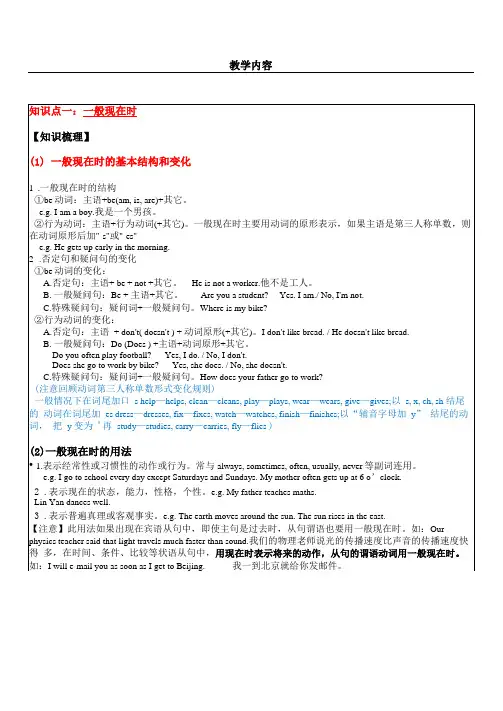
教学内容【例题精讲】例1.------ W ho is that lady?She's Miss Green. She us music, and she is so good.A. taughtB. teachesC. will teachD. is teaching 例 2. I think I'll take a bus to the meeting.A. do The bus? If you, you will be late.B. have doneC. will do例3. Unless the weather, we will have to cancel the picnic.A. improveB. improvesC. improvedD. will improve例4. We don't know if our friend .If he, we'll let you know.A. comes; comesB. comes; will come例5. Our geography teacher told us that the earth C. will come; comesthe sun.A. went aroundB. goes aroundC. is going aroundD. was going around【课堂练习】1.Look! A dog a blind man across the road.A. leadsB. leadC. is leadingD. led2.They usually TV in the evening.A. watchB. will watchC. are watchingD. watches3.He hardly up early.A. getsB. getC. doesn't getD. don't get4.John football.A. likes playingB. likes playC. like play5.Frank usually in touch with his primary school teachers by email.A. keepB. keepsC. keptD. will keep知识点二:一般过去时【知识梳理】(1)一般过去时的基本结构和变化1.定义:表示过去某时发生的动作或存在的状态。
简单的时态一般现在时一般过去时将来时现在进行时和过去进行时

简单的时态一般现在时一般过去时将来时现在进行时和过去进行时时态是语法中一个重要的概念,用以表达动作或状态发生的时间。
时态分为一般现在时、一般过去时、将来时、现在进行时和过去进行时。
下面将分别对这些时态进行解释和举例说明。
一、一般现在时(Simple Present Tense)一般现在时用于表达现在的习惯、真理、科学事实等。
示例:1. He usually goes to the gym in the morning.(他通常早上去健身房。
)2. Water boils at 100 degrees Celsius.(水在100摄氏度沸腾。
)二、一般过去时(Simple Past Tense)一般过去时用于表达过去某个具体时间发生的动作或状态。
示例:1. I watched a movie last night.(昨晚我看了一部电影。
)2. They lived in Paris for five years.(他们在巴黎住了五年。
)三、将来时(Future Tense)将来时用于表达将来要发生的动作或状态。
示例:1. We will have a meeting tomorrow.(我们明天要开会。
)2. She is going to travel to Japan next month.(她下个月将要去日本旅行。
)四、现在进行时(Present Continuous Tense)现在进行时用于表达正在进行的动作。
示例:1. They are watching TV at the moment.(他们此刻正在看电视。
)2. She is studying for her exam right now.(她正在复习考试。
)五、过去进行时(Past Continuous Tense)过去进行时用于表达过去某一时刻正在进行的动作。
示例:1. I was reading a book when she called.(她给我打电话的时候,我正在看书。
一般现在时,一般过去时,一般将来时及现在进行时

动词时态一(一般现在时,一般过去时,一般将来时及现在进行时)【用法讲解】考试要求:英语的动词的时态共有十六种,但是中考常考的主要有八种,一般现在时、一般过去时、一般将来时、现在进行时、现在完成时、过去进行时、过去将来时,过去完成时等时态的构成和用法。
本节先讲述一下一般现在时,一般过去时、一般将来时和现在进行时。
1. 一般现在时一般现在时的构成:一般现在时主要用动词原形表示,如果主语是第三人称单数,一般在动词原形后加-s或-es。
例如:I have breakfast at 7 every morning. 我每天早晨7点吃早餐。
He goes swimming on Sundays. 每周日他都去游泳。
一般现在时的用法:(1)表示经常发生的动作或者经常存在的状态。
经常和表示时间的状语often,always,usually,sometimes,every day等连用。
例如:My sister usually goes to school on foot.我姐姐经常步行去上学。
We often come to school at six in the morning.我们经常在早上六点到学校。
(2)表示某种习惯或者能力,也可以表示职业、特征等。
例如:My mother often gets up very early in the morning.我的妈妈经常在早上起床很早。
This kind of car runs very fast.这种小汽车跑得非常快。
(3)表示客观事实、客观规律或者客观真理。
例如:This kind of trees never grows in the desert.这种树从来不在沙漠里生长。
Do you know that knowledge is power?你知道知识就是力量吗?(4)在时间、条件、让步等状语从句中,表示将来的动作。
例如:They’ll be so happy when I tell them.我告诉他们时,他们会很高兴的。
一般现在时一般过去时一般将来时的句子结构

一般现在时、一般过去时、一般将来时是英语中最基本的三种时态。
它们分别用于描述现在、过去和将来发生的事情。
在句子结构上,它们有一些共同的特点,也有一些不同之处。
接下来将分别对这三种时态的句子结构进行阐述,并给出具体的例子。
一、一般现在时的句子结构一般现在时用来描述经常性或习惯性的动作,科学事实,普遍真理,以及口语中的将来计划等。
其句子结构为:主语 + 动词原形/动词第三人称单数形式 + 其他。
主语:指动作的执行者或者事物的所有者,可以是名词、代词或者某个词组。
动词原形/动词第三人称单数形式:动词根据主语的人称和数的不同,可以使用动词原形或者第三人称单数形式。
其他:可以是时间状语、地点状语、方式状语、目的状语、原因状语、结果状语等。
例句:1. I study English every day.(我每天学英语。
)2. He speaks Chinese fluently.(他讲中文流利。
)3. The sun rises in the east.(太阳从东方升起。
)二、一般过去时的句子结构一般过去时用来描述过去发生的事情或者已经完成的动作。
其句子结构为:主语 + 动词过去式 + 其他。
例句:1. I finished my homework yesterday.(我昨天完成了我的作业。
)2. She bought a new car last week.(她上周买了一辆新车。
)3. They visited the museum two days ago.(他们两天前参观了博物馆。
)三、一般将来时的句子结构一般将来时用来表示将来发生的动作或者情况。
其句子结构为:主语 + will/shall + 动词原形 + 其他。
例句:1. I will go to the cinema tomorrow.(我明天将去电影院。
)2. She shall help you with your project next week.(她下周将帮助你完成项目。
一般过去时,一般现在时和一般将来时
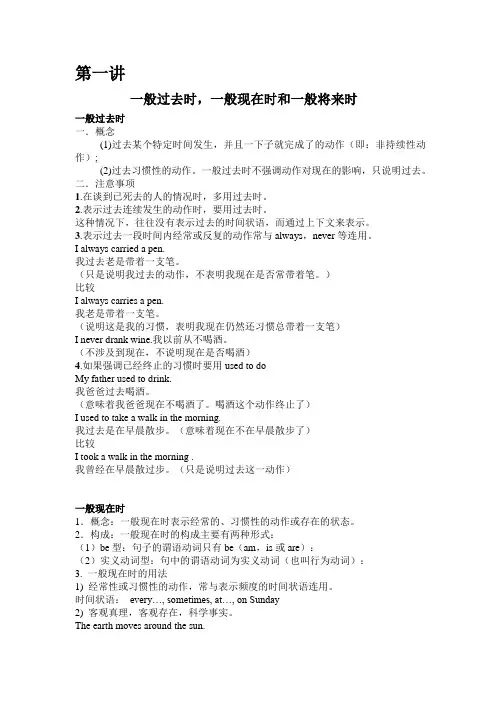
第一讲一般过去时,一般现在时和一般将来时一般过去时一.概念(1)过去某个特定时间发生,并且一下子就完成了的动作(即:非持续性动作);(2)过去习惯性的动作。
一般过去时不强调动作对现在的影响,只说明过去。
二.注意事项1.在谈到已死去的人的情况时,多用过去时。
2.表示过去连续发生的动作时,要用过去时。
这种情况下,往往没有表示过去的时间状语,而通过上下文来表示。
3.表示过去一段时间内经常或反复的动作常与always,never等连用。
I always carried a pen.我过去老是带着一支笔。
(只是说明我过去的动作,不表明我现在是否常带着笔。
)比较I always carries a pen.我老是带着一支笔。
(说明这是我的习惯,表明我现在仍然还习惯总带着一支笔)I never drank wine.我以前从不喝酒。
(不涉及到现在,不说明现在是否喝酒)4.如果强调已经终止的习惯时要用used to doMy father used to drink.我爸爸过去喝酒。
(意味着我爸爸现在不喝酒了。
喝酒这个动作终止了)I used to take a walk in the morning.我过去是在早晨散步。
(意味着现在不在早晨散步了)比较I took a walk in the morning .我曾经在早晨散过步。
(只是说明过去这一动作)一般现在时1.概念:一般现在时表示经常的、习惯性的动作或存在的状态。
2.构成:一般现在时的构成主要有两种形式:(1)be型:句子的谓语动词只有be(am,is或are):(2)实义动词型:句中的谓语动词为实义动词(也叫行为动词):3. 一般现在时的用法1) 经常性或习惯性的动作,常与表示频度的时间状语连用。
时间状语:every…, sometimes, at…, on Sunday2) 客观真理,客观存在,科学事实。
The earth moves around the sun.Shanghai lies in the east of China.3) 表示格言或警句中。
复习一般现在时,一般过去时,一般将来时,现在进行时
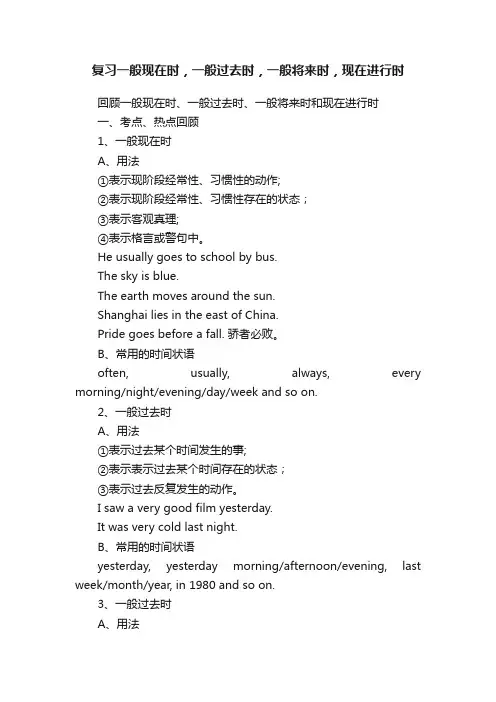
复习一般现在时,一般过去时,一般将来时,现在进行时回顾一般现在时、一般过去时、一般将来时和现在进行时一、考点、热点回顾1、一般现在时A、用法①表示现阶段经常性、习惯性的动作;②表示现阶段经常性、习惯性存在的状态;③表示客观真理;④表示格言或警句中。
He usually goes to school by bus.The sky is blue.The earth moves around the sun.Shanghai lies in the east of China.Pride goes before a fall. 骄者必败。
B、常用的时间状语often, usually, always, every morning/night/evening/day/week and so on.2、一般过去时A、用法①表示过去某个时间发生的事;②表示表示过去某个时间存在的状态;③表示过去反复发生的动作。
I saw a very good film yesterday.It was very cold last night.B、常用的时间状语yesterday, yesterday morning/afternoon/evening, last week/month/year, in 1980 and so on.3、一般过去时A、用法①表示在将来某个时间要发生的事;②表示表示在将来某个时间存在的状态;Mrs Wu will teach us English this term.I will go back to my hometown tomorrow.B、具体表现形式①助动词will+动词原形We won’t leave before eight.②be going to do sth.表示即将发生某事或打算、计划要做某事。
I’m going to do my homework this evening.③come, start,go ,move, leave, travel等动词常用进行时态表示按计划将要发生的事。
初中被动语态常考5种时态造句25个
初中常考词汇举例的被动语态句子,分为一般现在时、一般过去时、一般将来时、现在进行时和过去进行时五种时态:1.一般现在时:•English is taught in most schools around the world. → 英语在全世界大多数学校都有教学。
•Cars are driven on the right side of the road in the United States. → 在美国,车辆在马路的右侧行驶。
•The sun is shining brightly this morning. → 今天早晨,太阳在灿烂地照耀着。
•Coffee is served at breakfast time. → 在早餐时间提供咖啡。
•Many homes are heated with central air conditioning. → 许多家庭使用中央空调供暖。
1.一般过去时:•The house was built in 1980. → 这所房子在1980年建成。
•They were all tired after the long day at the office. → 在办公室度过了漫长的一天后,他们都感到疲惫。
•The homework was finished last night. → 家庭作业是昨晚完成的。
•The classrooms were decorated for the holidays. → 教室为假期进行了装饰。
•The email was sent before 5 PM. → 那封邮件在下午5点前发送了。
1.一般将来时:•The movie will be released next month. → 这部电影将在下个月上映。
•They will vi sit their grandparents next week. → 他们将在下周拜访他们的祖父母。
简单的时态一般现在时一般过去时和将来时
简单的时态一般现在时一般过去时和将来时时态是语法中的一个重要概念,它主要用来表示动作或状态发生的时间。
在英语中,时态分为一般现在时、一般过去时和将来时三种。
一、一般现在时一般现在时表示经常性的或习惯性的动作,或者表述普遍真理、自然规律等。
1.形式一般现在时的动词形式为原形动词。
例如:I eat an apple every day.He speaks English fluently.2.用法(1)表示日常习惯、常态或经常性的动作。
例如:She always brushes her teeth before going to bed.They usually go for a walk after dinner.(2)表示客观事实、普遍真理或自然规律。
例如:The sun rises in the east.Water boils at 100 degrees Celsius.(3)表示评论、观点或感受等。
例如:I think he is a talented musician.She looks beautiful in that dress.二、一般过去时一般过去时表示过去某个时间发生或完成的动作。
1.形式一般过去时的动词形式为动词的过去式。
例如:I studied English last night.He played basketball with his friends yesterday.2.用法(1)表示过去某个时间发生的动作。
例如:We visited the museum last week.She met her old friend at the party.(2)表示过去经常性的动作。
例如:He always ate breakfast at home when he was a child.(3)表示过去的习惯、惯常动作。
例如:Every morning, she woke up early and went jogging.三、将来时将来时表示将来某个时间发生或完成的动作。
完整版一般现在时一般过去时一般将来时现在进行时
初中语法般现在时、一般过去时、一般将来时、现在进行时四种时态的区别1、一般现在时——第三人称单数的动词变化规则:1)大多数动词在词尾加“ S'女口:stop—___ ; make— ______ read — _______ ; play—______2)以辅音字母加“ y”结尾的,要先将“ y”变为“ i”,然后在加“ es”女口:fly— ___ ; carry—_______ study—_______ ; worry—_______ 3)以“ s, x, ch, sh结尾的,在词尾加“ es”女口:teach — __ ; watch—_________4)以“ o”结尾的动词,加“ es”女口:go— __ do —________2、现在进行时——动词ing 形式的变化规则1. 一般动词直接在词尾+ing例:read—______ (读) talk—_______ (交谈) sinL ______ (唱歌) 2. 以不发音e 结尾的动词,先去e 再加ing例:like—_____ 喜欢write—______ 写skate—_______ (滑冰)3. 以重读闭音节结尾且末尾只有一个辅音字母的动词,双写末尾字母,再加ing 例:stop—_____ (停止) get—__________ (得到)4. 少数几个以ie 结尾的动词,变ie 为f 再加ing。
例:l i e —___ (躺、撒谎) t i e — ___ (系、捆绑)3、一般过去时——动词的变化规则(1) 一般在动词后加-ed。
如:play- _____ , offer- _____ , weigh- _____ , destroy- _____ , sign- _____(2) 在以字母e 结尾的动词后,只加-d。
如: like - ____ , provide-_____ , hate- _____ date- ________⑶在以“辅音字母+y”结尾的动词后,则改y为i,再加-ed。
初中语法总结一般现在时、一般过去时和一般将来时
初中语法总结一般现在时、一般过去时和一般将来时
一般现在时
一般现在时有三种形式
1.谓语是be(am/is/are)的一般现在时。
①肯定形式:主语+be+表语(形容词、名词充当表语)。
I am hungry.
You are beautiful.
He is a doctor.
②否定形式:主语+be+not+表语(形容词、名词充当表语)。
I am not hungry.
You aren't beautiful.
He isn't a doctor.
③一般疑问句形式:Be+主语+表语(形容词、名词充当表语)?
肯定回答:Yes,主语+be. 否定回答:No, 主语+ be+not.
—Are you hungry?
—Yes,I am./No,I'm not.
—Is he a doctor?
—Yes, he is./No, he isn,t.
④特殊疑问句形式:特殊疑问词+Be开头的一般疑问句?
—What is he?
—He is a doctor.
注意:be要随着主语变。
2.谓语动词是实义动词(及物动词或不及物动词)的一般现在时。
①肯定形式:“主语+及物动词+宾语”或“主语+不及物动词”。
She has a little brother.
她有一个弟弟。