
初中英语_九年级u6SectionA(3a教学设计学情分析教材分析课后反思
Ⅰ. Revision1. Check the homework.2. Introduce the zipper(设计意图:通过简单的介绍,巩固上节课知识,复习一下被动语态。
)Ⅱ. Lead-in一、播放图片《茶叶的起源》,让学生们了解中国的茶文化,及茶叶被发明的渊源,并了解其发展过程。
1. What are these pictures about?2. Do you like drinking tea?Ss try to answer the questions:It’s about the tea.Lu Yu.(设计意图:了解茶的悠久历史,对他们进行爱国教育,同时通过他们的个人修养。
还有引出本文。
)Ⅲ. Reading(一)Work on 3a:1. Tell Ss to read the article quickly and match each paragraph with its main idea. Lu Yu and his book Cha JingHow tea spread to other countriesHow tea was invented by accidentPara. 1Para. 2Para. 3Skimming方法指导:先阅读所给的三句话,然后快速阅读短文,抓住每一段的主题句,找到答案。
Students read the article quickly and match each paragraph with its main idea. (设计意图:通过小组讨论,复习以前学过的阅读策略,然后在用中学,达到巩固的目的)3. 学生们,按老师指导的方法进行阅读,并快速阅读三个段落。
4. 最后,学生先小组讨论,然后全班交流,校对答案。
Para. 1 How tea was invented by accidentPara. 2 Lu Yu and his book Cha JingPara. 3 How tea spread to other countriesPPT呈现答案。
(设计意图:利用多媒体,使教学简单,高效)(二)Work on 3b: scanning1. 告诉学生们再次阅读短文内容,并回答3b中的所有问题。
2. 学生们先阅读这些问题,理解它们的意思,然后带着相关问题仔细回读短文,并在短文的相关信息处划线。
3. 学生小组讨论,交流方法,然后交流答案,并校对答案。
① It was first drunk nearly 5, 000 years ago.② It was invented by accident.③ Lu Yu.④ It’s about how tea plants were grown and used to make tea.⑤ It is believed tea was brought to Korea and Japan during the 6th and 7th centuries. Tea didn’t appear until around 1660 in England.4. 让学生读一下自己的答案,并改正答案。
(三). Careful readingRead and fill the blanks.1.Fill the blanks according to the first paragraph.Tea (after water), the most popular drink in the world _______ (invent) by accident. It is believed that tea _______ (drink) 5,000 years ago. It ______ (say) that a Chinese ruler ______ (call) Shen Nong was the first ______ (discover) tea as a drink. One day Shen Nong _______ (boil) drinking water over an open fire. Some leaves from a tea plant ____ (fall) into the water and remained there for some time. It ________ (produce) a nice smell so he ______ (taste) the brown water. It was quite delicious, and so, one of the world’s favorite drinks _________ (invent).(设计意图:先给予方法指导,然后实践)2. Fill the blanks according to the last two paragraph.Lu Yu, “the saint of tea”, ______ (mention) Shen Nong in his book Cha Jing a fewthousand years later. The book describes how tea plants _______ and used to make tea. It also discusses where the finest tea leaves _______ (produce) and what kinds of water _______ (use).People believed that tea _______ (bring) to Korea and Japan during the 6th and 7th centuries. In England, tea ________ (not appear) until around 1660, but in less than 100 years, it had become the national drink. The tea trade from China to Western countries ______ (take) place in the 19th century.(四)Work on 3c. Complete the sentences with the correct forms of the verbs in the box.1. 告诉学生们本学习活动的要求:用所给单词的适当形式填空。
2. 让学生们读3c中的内容,理解每个句子的大体意思。
3. 学生们阅读句子内容,回想短文的内容,选择恰当的单词并用其恰当形式填空。
4. 如果不能直接填上,可以再去阅读短文,在相关的内容处,再仔细进行阅读,找到相关信息,并完成句子。
(设计意图:了解本文内容,掌握重点词汇句型))5. Check the answers。
( 1. invented 2. drunk 3. produced 4. brought 5. traded )6.Read again.IV ExerciseTranslate some important sentences.(ask a student to give )(设计意图:找一个优生出题,既训练他们的自学能力,又能检查听课效果。
)V.SummaryAsk them to talk about what they have learnt, then share them in class. VI.Homework1. Read the passage several times after school.2. Tell the story to each other , and ask somebody to introduce it next class.面对着升学的压力和任务,作为九年级的英语老师,我感到巨大的压力,为了帮助学生们在中考取得良好成绩,根据学科特点及学生特点研究各种教学模式,因材施教,促进学生英语的进步。
从本次期末的检测的成绩来看,学生英语水平普遍较差,成绩好的不多,部分学生已经对英语失去了信心,还有一部分学生觉得英语越来越难,渐渐力不从心了,不感兴趣了。
针对这种情况,教学的时候需要注意在备课中增加趣味性,以此来提高学生对英语学习的兴趣,同时注意在面对绝大多数学生时,注重打好基础,从最基本的东西抓起,避免拔苗助长。
1、由于初三英语教学的特殊性,我的讲解重点是以学生掌握语法知识,以中考应试教育为主,在课堂教学中,有时缺乏用心有效的师生互动,部分课时过于注重讲授,相对的开放型的、能激发学生想象力与创造力和发散学生思维的课堂比例就减小了。
2、课堂教学中没有很好地针对个体学生实际,缺乏“备学生”、这一必要环节;对教材的处理和把握没有进行有效地取舍、组合、拓展、加深;课堂教学没有做到对每个学生进行基础知识点、中考热点和中考难点的渗透,有一部分学生原有的知识不能得到及时、适时地活化;个别学生参与机会少;课堂留给学生自疑、自悟、自学、自练、自得的时间十分有限。
3、对中考的研究不够,对中考的考试范围、要求、形式、出题的特点及规律的了解不够深,在课堂教学中依靠于复习资料,只是对资料的选取与整合,忽视教师自身对知识框架的主动构建。
4、课堂设计缺乏适当适时的教学评价,不能及时获悉学生在课堂上有没有收获,有多大收获等学情;课前设计“想教学生什么”,课堂反馈“学生学到什么”和课后反思“学生还想学什么”三个环节没有得到最大程度上的统一。
1.新教材充分体现了新课标的“以人为本”教学理念。
达到“以人为本”全面发展的新型素质教育观,新教材突出了功能和结构的有机结合.新教材非常注重话题,每个单元都围绕一个具体的话题展开,突出了话题结构、功能、实际运用三个方面的结合。
让每个话题贴近学生生活实际,更便于学生灵活运用。
2、倡导“任务型”教学,强调课堂上师生互动。
本教材共14单元,分二个学期教学。
按要求,第一学期为1-10单元,第二学期为11-14单元。
课本增加了读写训练的比重,以便于听说读写的全面训练。
其内容主要反映了学生的日常学习和生活。
课本设计了中外学生同校学习的情景,便于介绍英语国家的风俗习惯和文化。
题材范围更广,除了学生的学校生活和家庭生活,还反映了学生的校外活动、劳动、卫生保健、体育运动、节日、尊师爱生、团结友爱、助人为乐的道德风尚。
Revision1.P_______ Hope has helped thousands of poor children in China in the past 27 years.2.I like the s_____ of the shoes , but its color is too dark.3.The offical ___________(网站) of our company has been in service for 15 years.4.She shouted,“Don't ________(提到) it.” I won't say it again.5.The nurses' _________(日常的)work is to look after the sick people.New words1.The police found the lost car ________ _________ (偶然的).2.______ _______(毫无疑问) this artical is the beat.3.The tiger is looked as the r________ of this forest.4.The dragon is treat as a n____________ symbol of the Chinese.5.Mother is _______(煮沸) the milk for the baby.Skim and match the main idea with each paragraph.Paragraph 1 Lu Yu and his book Cha JingParagraph 2 How tea spread to other countriesParagraph 3 How tea was invented by accidentRead the passage aloud and find out the sentences that are the past tense in the passive voice.(读课文找出一般过去时被动语态的句子)。
初中英语_九年级Unit6 When was it invented SectionA(3a教学设计学情分析教材分析课后反思
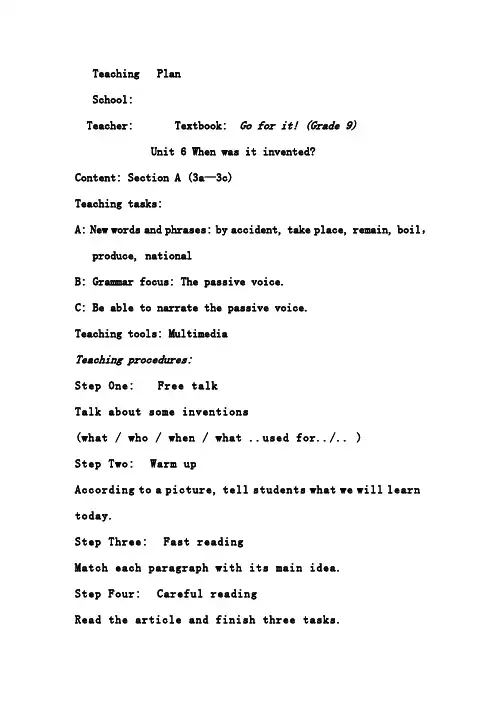
Teaching PlanSchool:Teacher: Textbook: Go for it! (Grade 9)Unit 6 When was it invented?Content: Section A (3a—3c)Teaching tasks:A: New words and phrases: by accident, take place, remain, boil,produce, nationalB: Grammar focus: The passive voice.C: Be able to narrate the passive voice.Teaching tools: MultimediaTeaching procedures:Step One: Free talkTalk about some inventions(what / who / when / what ed for../.. )Step Two: Warm upAccording to a picture, tell students what we will learn today.Step Three: Fast readingMatch each paragraph with its main idea.Step Four: Careful readingRead the article and finish three tasks.Task 1: Read part one and answer the questions.Task 2: Read part 2 carefully and finish the mind map. Task 3: Read part 3 and fill the chart.Step Five: Questions timeHelp students to solve the questions that they can’t understand.Step Six: Translate three sentencesStep Seven: ListeningTask 1: Read after the tape.Task 2: PK Time.Step Seven: RetellingRetell the textStep Eight: Know more about tea cultureStep Nine: Homework①Find out another invention --- coffee(who/ when/ how / where / what .used for …)②Recite the important points of this lesson .学情分析在前面的Unit 5学生已经学习了一般现在时的被动语态,学生对被动语态的概念、结构、运用已经有所掌握,但学生往往很难真正把握什么时候用被动语态,什么时候不用被动语态.此外,不规则动词过去分词的变化也往往是学生的学习难点。
人教版英语九年级全册Unit6SectionA3a4c教学设计
3.教师提出问题:“Do you know the origin of this festival? What are the differences between Chinese and Western festivals?”,引发学生对文化差异的思考。
2.针对文化差异和跨文化交际难点,采用以下教学方法:
(1)组织课堂讨论,让学生分享自己了解的节日习俗,增加对文化差异的认识。
(2)开展角色扮演活动,让学生模拟真实场景,进行跨文化交际实践。
(3)教师引导学生从不同文化角度看待问题一首与节日相关的英文歌曲,激发学生的兴趣,引出本节课的主题。
3.各小组整理讨论成果,准备进行课堂展示。
(四)课堂练习
1.教师设计填空、选择、句型转换等练习题,帮助学生巩固所学知识。
2.学生独立完成练习题,教师进行个别辅导。
3.教师选取部分练习题进行讲解,指出常见错误,引导学生避免类似错误。
4.学生进行角色扮演,模拟真实场景,运用所学知识进行口语交流。
(五)总结归纳
4.引出本节课的主题——Unit 6 Section A 3a-4c,探讨中西方节日的习俗和活动。
(二)讲授新知
1.教师呈现课文,引导学生学习词汇和短语,如:celebrate, traditional, festival, occasion, lunar, relative, gift, custom等。
二、学情分析
九年级的学生已经具备了一定的英语基础,他们对英语学习有较高的兴趣和热情。在此基础上,他们对本章节内容的学习有以下特点:
1.学生对节日的认知较为丰富,但对于节日的文化背景和具体习俗的了解尚浅,需要通过本节课的学习,拓宽知识视野。
人教版九年级英语Unit6SectionA(3a3c)说课稿

3.为下一节课的学习做好铺垫,提高课堂学习效果。
五、板书设计与教学反思
(一)板书设计
我的板书设计将采用清晰的布局、简洁的内容和直观的风格。板书左侧列出本节课的主要词汇,如音乐类型词汇;右侧则展示本节课的重要语法点,如一般现在时的句子结构。中间部分则用于记录听力材料的关键信息和课堂讨论的要点。
人教版九年级英语Unit6SectionA(3a3c)说课稿
一、教材分析
(一)内容概述
本节课为人教版九年级英语Unit 6 "Can you sing English songs?"的Section A(3a-3c)部分。在整个课程体系中,本单元主要围绕音乐这一主题展开,让学生在掌握相关英语表达的同时,培养他们对音乐的兴趣和爱好。本节课的内容旨在让学生通过听力、阅读和口语练习,掌握如何用英语谈论音乐类型、喜好以及简单的音乐活动。
(三)互动方式
为促进学生的参与和合作,我计划设计以下师生互动和生生互动环节:
1.师生互动:通过提问、示范、指导等方式,与学生进行互动,引导他们积极参与课堂活动。同时,关注学生的个体差异,给予个性化鼓励和指导。
2.生生互动:
a.小组讨论:让学生在小组内讨论音乐喜好、分享音乐故事,提高他们的口语表达能力。
2.结合真实语境,展示一般现在时在音乐活动中的运用,如句子:“He listens to jazz every day.”,引导学生理解并模仿。
3.播放听力材料,让学生完成相应的练习,提高听力技巧。
(三)巩固练习
为了帮助学生巩固所学知识并提升应用能力,我计划设计以下巩固练习或实践活动:
1.小组活动:让学生分组讨论,分享自己的音乐喜好,并用一般现在时进行表达。
人教版英语九年级全册Unit6SectionA(3a3c)教学设计
(一)教学重难点
1.重点:一般过去时的用法及其在句子中的变化,特别是第三人称单数的变化规则;本节课所学的词汇及其在语境中的应用。
2.难点:如何引导学生将一般过去时灵活运用于阅读理解、写作和口语表达中;如何帮助学生克服在描述过去事件时易犯的语法错误。
(二)教学设想
1.针对教学重点,采用以下设想:
3.教师根据新闻报道,引导学生关注一般过去时在叙述过去事件中的应用,为新课的学习做好铺垫。
(二)讲授新知,500字
1.教师结合课本3a部分的短文,引导学生学习一般过去时的用法,包括动词过去式的变化规则,特别是第三人称单数的变化。
2.通过示例句、填空、改错等形式,帮助学生掌握一般过去时的用法,并注意纠正学生在运用过程中的常见错误。
(1)利用多媒体教学资源,如动画、图片等,创设情境,让学生在情境中感知、理解一般过去时的用法。
(2)通过示例、练习、小组讨论等方式,帮助学生掌握一般过去时的变化规则,特别是第三人称单数的变化。
(3)设计丰富的词汇练习,如填空、造句、接龙等,让学生在实际运用中巩固所学词汇。
2.针对教学难点,采用以下设想:
5.阅读拓展:阅读一则英文新闻或故事,关注其中一般过去时的使用,并在阅读后进行简要分享,提高阅读理解能力。
6.小组讨论:分组讨论一般过去时的用法,每组总结出三个关键点,并在下节课进行分享。
作业要求:
1.学生需认真完成作业,确保作业质量,家长监督并签字确认。
2.教师将针对作业完成情况进行评价,给予反馈,鼓励学生持续进步。
3.能够通过阅读3a和3c部分的短文,理解并掌握一般过去时在叙述过去事件中的应用。
4.能够运用所学知识进行简单的英语写作,如编写一个小故事,描述过去发生的事情。
初中英语_九年级u6SectionA(3a教学设计学情分析教材分析课后反思

Ⅰ. Revision1. Check the homework.2. Introduce the zipper(设计意图:通过简单的介绍,巩固上节课知识,复习一下被动语态。
)Ⅱ. Lead-in一、播放图片《茶叶的起源》,让学生们了解中国的茶文化,及茶叶被发明的渊源,并了解其发展过程。
1. What are these pictures about?2. Do you like drinking tea?Ss try to answer the questions:It’s about the tea.Lu Yu.(设计意图:了解茶的悠久历史,对他们进行爱国教育,同时通过他们的个人修养。
还有引出本文。
)Ⅲ. Reading(一)Work on 3a:1. Tell Ss to read the article quickly and match each paragraph with its main idea. Lu Yu and his book Cha JingHow tea spread to other countriesHow tea was invented by accidentPara. 1Para. 2Para. 3Skimming方法指导:先阅读所给的三句话,然后快速阅读短文,抓住每一段的主题句,找到答案。
Students read the article quickly and match each paragraph with its main idea. (设计意图:通过小组讨论,复习以前学过的阅读策略,然后在用中学,达到巩固的目的)3. 学生们,按老师指导的方法进行阅读,并快速阅读三个段落。
4. 最后,学生先小组讨论,然后全班交流,校对答案。
Para. 1 How tea was invented by accidentPara. 2 Lu Yu and his book Cha JingPara. 3 How tea spread to other countriesPPT呈现答案。
初中英语_Unit6 SectionA(3a-3c)教学设计学情分析教材分析课后反思
Unit6 An old man tried to move the mountains.教学设计Section A 2 (3a-3c)一、教学目标:1. 语言知识目标:1) 学习掌握下列词汇:object, magic, stick, hide, tail, turn…into, excite, western2)阅读短文,能按要求找到相应的信息。
3)通过阅读提高学生们的阅读能力。
4) 了解《西游记》中美猴王这一人物的大体情况。
2. 情感态度价值观目标:1)多阅读中国传统文学名著,让学生们明白中国传统文化的博大、精深,并吸取中国传统文化中的精华。
2)从美猴王这一人物的大体情况中汲取积极的人生态度。
学习美猴王,要学习他“知难而上”的精神。
在我们生活工作中存在着很多的“山”。
在这些山的面前我们应该采取怎样的态度对待它?是通过西天取经的灾难来寻求帮助;还是像美猴王一样明知困难却迎难而上,凭借自己的力量勇敢的克服困难。
美猴王不畏艰险,不怕困难,勇敢面对的精神,正是值得我们所学习的。
学习愚公,要学习他不畏艰险,不怕困难,勇敢面对的精神和锲而不舍、持之以恒的决心和毅力。
二、教学目标1. 教学重点:1) 掌握本部分出现的生词和词组,达到熟练运用的目标。
2) 阅读短文,获得相关的信息。
通过阅读练习,来提高阅读能力。
2. 教学难点:1) 阅读短文,获得相关的信息的能力。
2) 理解并运用所学的词汇及表达方式。
三、教学过程:Step 1 RevisionShow some pictures to talk about Chinese stories.Step 3 Warming-up1. Watch a video about the Monkey King.2. Look at the pictures and answer the questions.1. Who are they?2. In which book are they the main characters?3. Which character do you like best?Step 4 Fast ReadingWork on 3a:1. Tell Ss to read the article in 3a quickly and try to find the answers to the questions① Which book is talked about?② Who is the main character?③ What is he like?Step 5 ListeningListen to the passage again and judge the sentences below True or False.1. Most pupils in England watch the TV program called Monkey in 1979 for the first time.2. Journey to the West is a new Chinese book. It’s new to Chinese children3. Monkey King can make 72 changes to his shape and size.4. The Monkey King uses a magic stick to fight the bad people.Step 6 Careful Reading1.Read the passage (paragraph 1)again to find the time, place, characters, and things in the same setting (场景)?2. Read the passage (paragraph 2) to finish 3b:What he can do:① He can make 72 changes to his shape and size, turning himself into different animals andobjects② He can make his magic stick small or large.What he can’t do:Unless he can hide his tail, he can’t turn himself into a person.3.Read the passage (paragraph3) to find the answers to the following question.Why do the children all over the world love the Monkey King?Step7 After Reading1.Work on 3c:2.Fill in the blanks.1. A neighbor ______ (call) Tony, helped me repair my fence yesterday.2. The Monkey King can make 72________ (change) to his shape and size.3. His uncle isn’t interested in _________ (play) chess at all.4. The two boys kept ________ (skate) for one hour.5. No one _______ (be) able to answer him at that time.Homework1.Read 3a tomorrow morningTry to repeat it with your own words.2.The Monkey King in my heart.(不少于10句话)Blackboard design:Unit6 An old man tried to move the mountains.Section A 2 (3a-3c)be able to make 72 changes turn intoso that come out keep doing sthbecome interested in四、教学反思:_______________________________________________________________________________ _______________________________________________________________________________ _______________________________________________________________________________ _______________________________________________________________________________ _______________________________________________________________________________ _______________________________________________________________________________ ______________________________________________________________________________学情分析:本课时是第六单元Section A的阅读教学部分,语篇介绍了《西游记》在西方国家受欢迎的情况,以及对书中主要角色孙悟空的介绍。
Unit6SectionA(3a3c)教学设计人教版英语九年级全册
(每个学习目标的达成需呈现学习目标、学习活动、评价标准、教师活动、目标达成情况五个方面)
一.Leadin
通过展示图片,利用学生熟悉的话题导入新课
Do you want to know more about tea culture?
Now let’s read the following passage and plete the tasks.
Who invented tea?
How was tea invented?
(2)Finish the mind map.
Read Paragaph 2
(1)answer these questions:
Who is Lu Yu?
What is Cha Jing about?
Fill in the blanks according to the pictures.
2.教材分析
本单元主要涉及到一般过去时的被动语态
3.学情分析
经过本单元一般过去时被动语态的学习,能了解并叙述茶叶被发明的渊源。
教材分析
本课时是新目标英语九年级第六单元的第二课时,继续围绕“发明”的话题进行阅读,让学生在活动中理解语言知识。
学情分析
通过上节课的学习,学生了解了过去式被动语态的构成,在本节课通过阅读帮助学生进一步感知被动语态的构成。
Read Paragaph 3
运用阅读技巧,根据关键词找出细节信息。
3.After Reading
(3C) plete the sentences with the correct forms of the verbs in the box.
作业/拓展
Retell the story of the invention of tea
初中英语_Unit6SectionA(3a-3c)教学设计学情分析教材分析课后反思
教学设计年级:九年级科目:英语内容:Unit 6 Section A(3a-3c)学生之前已经学习了Unit 5及Unit 6 第一课时,对一般现在时和一般过去时的被动语态有了一定的掌握,在此基础上再来学习本课时难度已经降低。
二教学内容分析本课时是九年级第六单元Unit 6 When was it invented?Section A部分3a-3c的阅读课,其中涉及一般过去时的被动语态这一重要语法,在整个英语的课程教材体系的学习中非常重要。
三学生情况分析一方面,学生对被动语态有一定的基础,另一反面,九年级的学生上课时不如低年级学生活跃。
四教学目标设计知识与能力1)Master the following words,phrases and sentences:by accident, ruler, boil, remain, smell,saint, national, takeplace, without doubt.Even though many people now know about tea culture,the Chineseare without doubt the ones who best understand the nature of tea.2) Read the passage, can find out the useful message.3) Improve the reading skills by reading.4) Learn about the history of tea and how tea is produced.情感态度与价值观Develop the sense of patriotic.五重点难点1.Teaching importance1) Master the important phrase,can use them freely2) Read the passage, can fiad out the useful message,by reading, improve their reading skills.2.Teaching difficulties1)The ability of getting useful message.2)The ability of understanding and using the phrases and expressions.六教学方法任务型教学法,情景教学法等。
Unit6SectionA(3a-3c)教学设计2023-2024学年人教新目标九年级英语全册
(4) 学生可以关注一些环保科技的发展,了解最新的环保科技成果,培养自己的科技素养和创新能力。
(5) 学生可以学习和借鉴一些环保人物的先进事迹,树立正确的价值观和人生观,激发自己的环保热情和社会责任感。
答案:
1. pollution
2. water
3. air
4. wildlife
5. habitats
例题2:
题目:根据文章内容,选择正确的句子。
A. We should plant more trees to protect the environment.
B. We should not use plastic bags to protect the environment.
例题5:
题目:根据文章内容,将句子补充完整。
S: Many animals are in danger.
S: Many animals are in danger because their habitats are being destroyed.
例题6:
题目:根据文章内容,选择正确的短语。
A. protect...from...
教学实施过程
1. 课前自主探索
教师活动:
- 发布预习任务:通过在线平台或班级微信群,发布预习资料(如PPT、视频、文档等),明确预习目标和要求。
- 设计预习问题:围绕“保护环境”的主题,设计一系列具有启发性和探究性的问题,引导学生自主思考。
- 监控预习进度:利用平台功能或学生反馈,监控学生的预习进度,确保预习效果。
(3)合作学习法:鼓励学生分组讨论,培养他们的团队协作能力和沟通能力。
人教版英语九年级全册Unit6SectionA(3a~3c)教学设计
-引导学生阅读3a~3c部分的短文,提高阅读速度和理解能力。
-播放相关听力材料,让学生在听的过程中获取关键信息,提高听力技巧。
6.课堂小结与作业布置
-通过提问、总结等方式,帮助学生巩固本节课所学知识。
-布置课后作业,如:写一篇关于自己兴趣爱好的短文,巩固课堂所学。
7.教学评价与反馈
(四)课堂练习,பைடு நூலகம்00字
1.教师设计填空、改错等练习,让学生在实际语境中运用一般现在时和一般过去时描述兴趣爱好和业余活动。
2.学生独立完成练习,巩固所学知识。
3.教师选取部分学生的练习进行展示和点评,指出优点和不足,提高学生的语言表达能力。
(五)总结归纳,500字
1.教师引导学生回顾本节课所学内容,总结一般现在时和一般过去时在描述兴趣爱好和业余活动中的运用。
-一般现在时:I like to read books in my free time.
-一般过去时:Yesterday I went shopping with my friends.
2.引导学生关注并学习与兴趣爱好和业余活动相关的词汇和短语,如:hobby, interest, spend time on, go shopping, play computer games等。
2.能够运用一般现在时和一般过去时描述自己的业余生活和兴趣爱好。
3.能够运用目标语言进行简单的调查活动,如:“What do you like to do in your free time?” “I like to read books.”
4.能够听懂并参与关于业余活动和兴趣爱好的讨论,提高听力理解能力。
- How do the people in the text spend their free time?