
仁爱版九年级英语教案
仁爱版九年级英语教案一、教学课题:Topic 1 There are many kinds of pollution around us.二、教学内容:1. New words and expressions:produce, chest, breathe, manage, waste, cancer, influence, look, several, secretary, relation, fisherman, president, dead, rabbit2. Learn the present perfect tense with for/since:3. Learn something about some kinds of pollution:(1)The large population has caused many problems.(2)Air pollution makes people sick.(3)Light pollution is harmful to our eyes.(4)Litter influences the look of our cities.三、教学目标:1. Learn the present perfect tense with since.2. Learn how to express complaint.3. Learn the present perfect tense with for and since四、教学难点:1. Learn the present perfect tense with since.2. Learn how to express complaint.3. Learn the present perfect tense with for.五、教学准备:课前让学生准备一些有关各种污染的一些图片。
六、教具:图片, 录音机, 多媒体.七、教学过程:Show some pictures to the students, then ask: Step 1 ReviewNow please look at these pictures. Would you like to say something about the environment around us? Please file:///C:/DOCUME~1/ADMINI~1/LOCALS~1/Temp/msohtml1/01/ clip_image002.gifanswer my questions.No.1. where do you live?No.2. Are there any changes in your village/town/city?What cha nges have taken place in your village…?No.3. How do you like living there? Why?(What problems do we have to face?)Step 2 PresentationShow some pictures about polluted water, ask the students to tell their partner what happened in the picture?Then teach the words:Chemical factory produce chest breatheGet the students to look at the pictures and then talk about why the air smells terrible.Listen to the tape again. Answer the following questions(1) Who are in the picture?(2) What are they talking about?(3) Is the chemical factory near Granny’s home?(4) Can we find fish in the river?(5) Is the sky blue?Step 3 Read and say.Get the students read 1a and answer the questions:1. What’s the matter with granny?2. Will she stay here?3. Does she have to see a doctor?And then call the students find out the sentences used by granny to express complaint. Then do 1b in the class.Step 4 PracticeGet the students Look at the pictures. Answer following questions.(1) Are there any chemical factories in your city?(2) Are they near your school?(3) What was your city like a few years ago?(4) Can you list some other kinds of pollution?Ask the students to think about how the pollution come into being and realize the harm of the pollution.Step 5 Work aloneGet the students define the following pollution with the phrases in 3a.Step 6 Make a surveyNow make a survey to study something around your home.Fill in the forms.( )1.—How long _____ you _____ here? 一、中考链接选择题—For about two years so far.A.have; studiedB.did; liveC.do; stayD.were; swimming( )2.We have known each other _____ ten years ago.A.forB.everC.aboutD.since( )3.There is _____ pollution in the world. We must stop it.A.much tooB.too muchC.many tooD.too many( )4.—Is the flower beautiful?—Yes, at _____ it’s _____ the one you bought for me.st; as bad asB.least; no better thanst; not betterD.least; no worsethan( )5.I can’t stand _____ for you so long.A.to waitB.waitingC.waitsD.waited( )6.The boss made child laborers _____ 12 hours every day.A.workingB.worksC.workD.to work( )7._____ the environment is important for human beings.A.Take care ofB.Taking care ofC.Took care ofD.Take the care of( )8.—Have you finished your homework?—Not _____. There are still some exercises to be done.A.alreadyB.yetC.justD.ever( )9.—It smells terrible. What has happened here?—Look, there is much waste gas _____ from the chemical factory.A.pourB.pouringC.pouredD.pours( )10.When I was walking in the street yesterday, I saw a UFO _____ over my head.A.flyingB.fliesC.flewD.to fly二、本话题作业单项选择( ) 1. —Don’t make any noise in the living room! My baby is sleeping.—A. Sorry, I won’t.B. It doesn’t matter.C. Excuse me, I’m wrong.D. Certainly, I won’t.( ) 2. —I asked her, “Do you study English here?”— I asked her she studied English there.A. thatB. whatC. ifD. how( ) 3. Thanks for giving me many presents. I haven’t never seen beautiful presentsin my life.A. so; suchB. such; soC. so; soD. such; such( ) 4. — How long has he this book?— For several days.A. borrowedB. boughtC. lentD. kept( ) 5. Maria’s learned Chinese in our school all the time, ?A. isn’t sheB. doesn’t sheC. didn’t sheD. hasn’t she( ) 6. The meat has been kept in the bag for several days without being frozen. It smellsnow.A. niceB. terribleC. wellD. badly( ) 7. What’s more, planes or machines produce noise.A. much tooB. many tooC. too muchD. too many( ) 8. She told me she to America next Thursday.A. goesB. wentC. goingD. would go( ) 9. There is a paper factory waste water into the river nearby.A. pouredB. pouringC. poursD. pour( ) 10. I can’t stand for you so long.A. to waitB. waitingC. waitsD. waitedⅡ.词汇(A) 根据句意,用所给单词的适当形式填空。
仁爱版初中英语九年级下全册教案
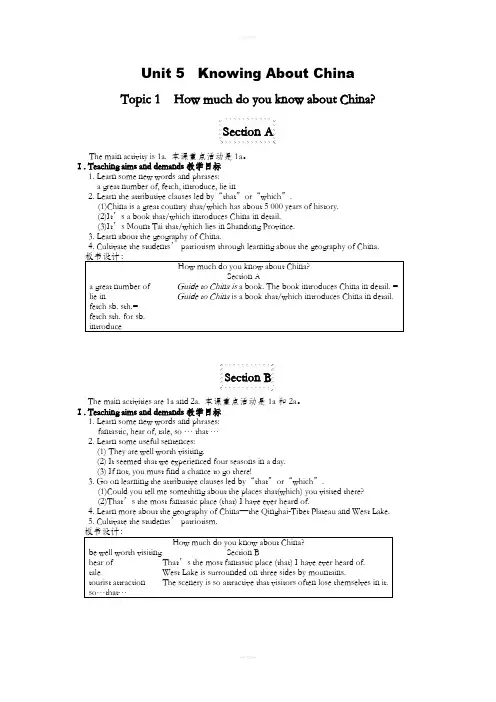
Unit 5 Knowing About ChinaTopic 1 How much do you know about China?Section AThe main activity is 1a. 本课重点活动是1a。
Ⅰ. Teaching aims and demands教学目标1. Learn some new words and phrases:a great number of, fetch, introduce, lie in2. Learn the attributive clauses led by“that”or“which”.(1)China is a great country that/which has about 5 000 years of history.(2)It’s a book that/which introduces China in detail.(3)It’s Mount Tai that/which lies in Shandong Province.3. Learn about the geography of China.4. Cultivate the students’ patriotism through learning about the geography of China.板书设计:How much do you know about China?Section Aa great number of Guide to China is a book. The book introduces China in detail. =lie in Guide to China is a book that/which introduces China in detail.fetch sb. sth.=fetch sth. for sb.introduceSection BThe main activities are 1a and 2a. 本课重点活动是1a和2a。
仁爱英语九年级上册教案
仁爱英语九年级上册教案第一单元《Unit 1 School Life》
Section A
课前预
- 了解课文标题和主题,预测词汇和短语
- 预并理解课文中的单词和句型
- 思考与课文主题有关的问题和话题
听力训练
- 听取录音,熟悉课文内容和结构
- 提高听力技巧和技能,学会提取有关的信息和思路语言训练
- 学会运用课文中的单词和短语
- 研究和运用课文中的语法和句型
- 培养表达和交流能力
阅读训练
- 带着问题和目的阅读课文
- 研究和应用相关的词汇和表达方式
- 提高理解能力和速度,发掘文本信息和意义
口语训练
- 学会流畅自然地表达和交流
- 练在不同情境和话题中表达自己的看法和意见- 提高语音语调和语言语法的正确性和准确性
Section B
课前预
- 基于课文主题和问题,了解背景知识和文化积累
- 预和掌握课文中的关键词语和短语
- 预测和推断课文中可能存在的问题和解决办法
听力训练
- 听取录音,熟悉和理解课文内容和结构
- 学会听懂和提取课文中的关键信息,筛选和转述有关的内容语言训练
- 学会运用课文中的单词和短语
- 学会运用和灵活掌握课文中的语法和句型
- 培养表达和交流能力,学会表达自己的看法和观点
阅读训练
- 带着问题和目的阅读课文,理解和概括文本意思和主旨
- 研究和应用相关的词汇和表达方式,提高辨析和推断能力- 提高阅读速度和效率,积累阅读和背景知识
口语训练
- 学会流畅自然地表达和交流,掌握一定的语言技巧和技能- 练在不同情境和话题中表达自己的看法和意见
- 提高语音语调和语言语法的正确和准确。
九年级上册仁爱版英语教案汇总5篇
九年级上册仁爱版英语教案汇总5篇九年级上册仁爱版英语教案篇1一、教材分析本单元要求学会谈论重要发明的历史及用途,然后针对各项发明的用处及特点,发表自己的看法,并说明理由。
话题一直是围绕着历史上和日常生活中的重要发明,通过使用“Passive Voice”(被动语态)形式的句型,循序渐进地展开讨论。
课本设计的活动情景能够自然地引发学生的好奇心,大家积极地投入到话题讨论中,寓教于乐,容易引起学生的兴趣;同时,它也有利于开阔学生的思路,培养创造精神,激励他们展开丰富的想象翅膀,人人都能成为“小发明家”。
二、教学目标语言目标重点词汇:salty, sweet, sour, crispy, pleasant, potato chips, slipper, leaf, fire, scoop, light bulb, microwave oven, abacus, camera, beverage, be invented by, be used for, by mistake, by accident重点句型:When was the telephone invented? I think it was invented in 1876.技能目标能够谈论发明的历史和用途能够对生活中的发明发表自己的看法能够解决生活问题,设计新发明情感目标充满想象力,善于观察事物面对难题,用积极的态度解决,发挥创造能力认识世界,改造世界三、重点难点重点讨论重要发明的时间、发明者和用途,学习使用句型“When was the telephone invented?”,“Who was it/were they invented by?”,“What is it/are they used for?”和答语。
难点如何描述一项新发明的来历和用途四、课前准备老师准备“大百宝箱”(由中等大小的盒子、彩纸等DIY而成),flashcards;a package of potato chips, some bars of chocolate.学生准备上课前引导学生使用互联网等工具查询1a图片中5项以及自己感兴趣的发明物的来历,然后在准备好的.卡片反面写上关于这项发明的日期、发明者和用途等信息(如果学生查到的信息是用中文描述的,要求简单地翻译成为英文信息),正面写上发明物的名称,存放在自己制作的“小百宝箱”里。
九年级英语仁爱版实用教案5篇
九年级英语仁爱版实用教案5篇九年级英语仁爱版实用教案篇1一、教学目标:1. 语言知识目标:1) 学习掌握下列词汇:France, no matter,local, brand, avoid, product,handbag,mobile, everyday九年级英语仁爱版实用教案篇2学习目标1.重点单词:expression,discover,secret,grammar2重点短语:an English movie called Toy Story,fall in love with,as well,look up3重点句式:The teacher spoke so quicklythat I did not understand her most of the time.I was afraid to ask questionsbecause of my poor pronunciation.I can find the meaningof new words by looking them up in a dictionary.学习重点1.重点短语和句型2.学习英语的方法学习难点学习英语的方法自主学习一、预习课本P3新单词并背诵,完成下面的汉译英。
1.表达_________2.发现________3.秘诀_______4.语法______二、认真预习P3找出下列短语和句型。
1.一部叫做Toy Story的电影2.喜欢上3.也4.老师说得如此的快以至于我大多数时间都不明白。
5.因为我的发音很差,我害怕问问题。
6.我通过在字典里查询找到新单词的意思。
课堂导学Step 1情景导入Teacher:Wei Fen really likes English and sheis a student who is good at English but she didnt use to like English.Do you knowwhat has changed her?Lets read the passageto find the answer.环节说明:由Wei Fen英语成绩的变化为话题,引起学生的好奇,同时又引出要学的内容。
仁爱版九年级英语上册Unit2Topic1SectionC教学设计
(一)导入新课
1.教学活动设计:教师通过展示一组关于环境问题的图片,如污染、资源浪费等,引发学生对环保话题的关注,激发学生的学习兴趣。
教学语言引导:“Look at these pictures, can you tell me what is happening to our environment? Do you think it is important to protect our environment? Why?”
3.培养学生积极向上的态度,鼓励学生面对困难和挑战时,保持乐观、勇敢面对。
4.借助本章节的学习,引导学生树立正确的人生观、价值观,使学生认识到人与自然的和谐共处的重要性。
二、学情分析ቤተ መጻሕፍቲ ባይዱ
九年级学生已具备一定的英语基础,但在语言运用、思维能力和情感态度方面仍有待提高。在本章节的学习中,他们对于环境问题有一定了解,但可能缺乏深入的认识和关注。在语言技能方面,学生的听、说、读、写能力发展不均衡,部分学生在口语表达和写作方面存在困难。
3.教师总结:教师针对学生的反思和分享进行总结,强调环保意识的重要性,鼓励学生在日常生活中采取行动,保护环境。
教学语言引导:“In conclusion, I hope you can remember what we have learned and apply it to your daily life. Remember that it’s time to take action to protect our environment!”
五、作业布置
为了巩固本章节所学知识,培养学生的实践能力和创新思维,特布置以下作业:
1.写作练习:请运用本节课所学的被动语态和重点词汇,写一篇关于环保的短文,内容可包括环保问题的描述、解决措施及个人观点。要求:80-100词,语言准确,表达清晰。
仁爱英语九年级上册教案

仁爱英语九年级上册教案
第一课:Unit 1 Friendship
教学目标:
1. 了解并掌握本单元的重点词汇和短语。
2. 能够运用所学词汇和短语描述友谊和友情。
3. 能够听懂并理解关于友谊的对话和短文。
4. 能够运用所学知识写一篇关于友谊的短文。
教学重点和难点:
1. 重点:掌握本单元的重点词汇和短语,能够描述友谊和友情。
2. 难点:能够听懂并理解关于友谊的对话和短文,运用所学知识写一篇关于友谊的短文。
教学过程:
1. 导入新课:通过展示一些关于友谊的图片或视频,引导学生谈论友谊的重要性。
2. 学习新词汇和短语:通过图片、例句等方式教授本单元的重点词汇和短语,帮助学生掌握。
3. 听力训练:播放有关友谊的对话和短文,让学生听懂并回答相关问题。
4. 口语练习:设计一些关于友谊的情景对话,让学生进行角色扮演,提高口语表达能力。
5. 书面表达:要求学生根据所学知识,写一篇关于友谊的短文,鼓励他们展示自己的想法和感受。
教学反思:
通过本节课的教学,学生能够充分了解友谊的重要性,掌握相关词汇和表达方式,提高听力和口语能力,同时培养学生的写作能力。
在教学过程中,要注重激发学生的兴趣,引导他们积极参与,提高课堂互动,让学生在轻松愉快的氛围中学习。
仁爱版九年级上册英语u1t1教案
仁爱版九年级上册英语u1t1教案教案标题:仁爱版九年级上册英语U1T1教案教案目标:1. 学生能够掌握并正确运用本单元的词汇和短语。
2. 学生能够理解并运用本单元的语法知识。
3. 学生能够通过听说读写的综合训练提高英语综合运用能力。
教材准备:1. 九年级上册英语教材《仁爱版》Unit 1,Text 1的教材和课件。
2. 多媒体设备和投影仪。
3. 学生练习册和笔记本。
教学流程:Step 1: 导入 (5分钟)使用多媒体设备播放一段关于国际友谊的视频,激发学生对主题的兴趣。
然后,通过提问学生的方式引入本单元的话题。
教师提问:- What do you think is important in a friendship?- Have you ever had a friend from another country? What did you learn from them?Step 2: 词汇和短语学习 (15分钟)教师通过展示词卡或课件,教授本单元的重点词汇和短语。
教师可以使用图片、示范和例句等方式帮助学生理解和记忆。
教师示范:- friendship: a relationship between friends- international: involving two or more countries- cultural exchange: the sharing of ideas, beliefs, and customs between different culturesStep 3: 听力训练 (20分钟)播放录音,让学生跟读并回答相关问题。
然后,再次播放录音,让学生填写相关信息。
教师指导:- 让学生先听一遍录音,不要求他们回答问题,只是让他们熟悉录音内容。
- 第二遍播放录音时,让学生回答问题或填写信息。
Step 4: 语法练习 (15分钟)教师通过讲解和练习,教授本单元的语法知识。
Unit 3 Topic1 SectionA 教案 仁爱版九年级英语上册
九年级上册Unit 3 Topic 1 English is widely spoken throughout the world.Section A【教学构思】一、教材分析:本课属于课标话题人与社会——“语言学习(Language learning)”中语言学习经历(Language learning experiences)项目,主要通过Kangkang,Li Xiang和Wang Junfeng的对话谈论王俊峰即将去迪士尼乐园,他将有一个好机会练习英语。
主要教学活动为1a,2a,2b和3,通过通过Kangkang,Li Xiang和Wang Junfeng的对话谈论王俊峰即将去迪士尼乐园,他将有一个好机会练习英语,学习被动语态am/is/are+past participle的用法以及谈论将来打算和表达愿望的表达法。
在2a和2b练习中,进一步训练被动语态am/is/are+past participle的用法。
在3听力活动中,训练学生通过听力获取细节信息的能力,培养学生“听”的语言能力。
二、设计说明:根据学情和本课的语法及话题,本节课的教学设计将听与说相结合,以1a为载体,立足话题,聚焦语法,通过听说练习内化知识;在语言生成阶段,循序渐进,帮助学生学以致用,并通过同伴合作完成学习任务。
本课在重、难点突破的方法上有所创新,教师在2a练习中巩固被动语态am/is/are+past participle的用法,在2b的活动中应用实践,让学生熟练运用被动语态am/is/are+past participle。
【教学目标】1. 通过听力活动和朗读对话,掌握对话大意和细节,培养“听”与“读”的语言能力;2. 在对话和练习中学习一般现在时被动语态的用法,准确理解一般现在时被动语态的意义并用于表达;3. 通过小组活动,运用本课所学语言知识,发展思维品质、自主学习能力和团队协作意识。
【教学重难点】1. 正确使用被动语态am/is/are+past participle;2. 做汇报展示小组活动成果。
九年级仁爱英语复习教案
九年级仁爱英语复习教案一、教学目标:1. 知识目标:通过复习,使学生掌握九年级仁爱英语课本中的重点单词、短语、句型和语法点。
2. 能力目标:提高学生的英语听说读写能力,使他们能够熟练运用所学知识进行日常交流。
3. 情感目标:激发学生学习英语的兴趣,培养他们的自信心和团队协作精神。
二、教学内容:1. 单词复习:列出九年级仁爱英语课本中的重点单词,让学生通过各种游戏和活动进行复习。
2. 短语复习:总结课本中的常用短语,通过例句和练习帮助学生掌握其用法。
3. 句型复习:分析课本中的重要句型,让学生通过模仿和练习学会正确运用。
4. 语法复习:回顾课本中的主要语法点,如时态、语态、被动语态等,通过练习巩固学生的掌握程度。
三、教学过程:1. 课堂导入:通过简单的英语对话或歌曲,激发学生的学习兴趣,引入当天的复习内容。
2. 新课内容:教师引导学生复习重点单词、短语、句型和语法点,通过例句和练习帮助学生理解和掌握。
3. 小组活动:学生分组进行互动,通过讨论、游戏和练习,巩固所学知识。
4. 课堂总结:教师对本节课的复习内容进行总结,强调重点和难点。
四、作业布置:1. 复习课堂所学内容,整理笔记。
2. 完成课后练习题,巩固所学知识。
3. 准备课堂展示,展示自己的英语能力。
五、教学评价:1. 课堂参与度:观察学生在课堂上的积极参与程度,评估他们的学习兴趣和动力。
2. 作业完成情况:检查学生作业的完成质量,评估他们对课堂所学知识的掌握程度。
3. 课堂展示:评价学生在课堂展示中的表现,考察他们的英语听说能力和自信心的培养。
六、教学策略:1. 多样化教学:运用图片、音频、视频等多种教学资源,丰富教学手段,提高学生的学习兴趣。
2. 任务型教学:设计各种实际的英语任务,让学生在完成任务的过程中运用所学知识,提高他们的实践能力。
3. 互动式教学:鼓励学生积极参与课堂互动,通过讨论、问答、游戏等活动,提高他们的英语听说能力。
七、教学资源:1. 课本:九年级仁爱英语课本,作为复习的主要依据。
Unit4Topic1SectionC教案2023-2024学年仁爱版九年级英语上册
3. He likes coffee.
4. She doesn't have a pet.
-答案:
1. I do not study English.
2. They do not play soccer.
3. He does not like coffee.
4. She does not have a pet.
4. He won't come to the party.他不会来参加派对。
5.一般现在时态疑问句和否定句的练习:
-练习题:根据下列句子,构造一般现在时态的疑问句和否定句。
1. I eat breakfast at 7:00 every morning.
2. She studies for the exam on weekends.
3. They play soccer in the park.
4. He doesn't watch TV in the evening.
教学反思与改进
首先,我觉得在课堂导入部分,虽然我试图通过提问和悬念来吸引学生的注意力,但效果似乎并不如我想象中的那样好。有些学生在导入阶段还没有完全进入学习状态,这可能会影响到他们对后续知识的理解和掌握。因此,我计划在未来的教学中,尝试使用更多样的导入方式,比如通过故事、游戏或者生活实例来引起学生的兴趣,从而更好地激发他们的学习动机。
在能力方面,学生的听力理解能力和口语表达能力有所提高,但仍有部分学生在表达时态混乱,不能准确运用疑问句和否定句进行沟通。此外,学生的阅读理解能力和写作能力也有待提高。
在素质方面,大部分学生具有较好的学习习惯和行为规范,但部分学生在课堂参与度上还不够高,需要教师引导和激发他们的学习兴趣。