
2019年春小学英语(外研版)四年级下册《Module 10Unit 1 I’ll send you a postcard.》word教案
外研版(一起)四年级英语下册教案
Module 10
Unit 1 I’ll send you a postcard.
一、教学分析
(一)教学内容分析
本课是新标准小学英语一年级起点第八册内容。
本节课主要是运用will和going to的一般将来时展开多种教学活动的,目的是让学生能正确表达即将做的事或计划做的事。
设计这节课旨在增加学生学习英语的兴趣,养成良好的语感和发音基础,发挥他们的想象力,能综合运用英语思维表达自己的情感。
(二)教学对象分析
四年级学生属于中段,处于一个承上启下的过渡阶段,孩子活泼可爱,敢想、敢说、敢做,求新求异的愿望非常强烈并且有一定的语言基础和语法功底,对多媒体环境下的学习和游戏比赛有极高的兴趣。
(三)教学环境分析
为了突破本堂课的重难点,我利用网络信息资源在多媒体教室为学生提供一个完全真实的语言环境,拓展学生学习和运用英语的渠道,使学生融入到一个多媒体的全英语的语言环境中,引发学生的创新思维,优化课堂教学,提高教学效果。
二、教学目标
(一)知识与技能
学会send, postcard, granddad这几个单词,运用一般将来时的will, going to 描述即将做的或打算做的事。
(二)过程和方法
在多媒体的互动游戏中提高听、说、读、交际及知识自学的综合能力。
(三)情感、态度与价值观
在轻松愉悦的学习氛围中,增强学英语的兴趣,养成良好的英语学习习惯。
三、教学重难点
(一)重点:熟练运用所学的will和going to 句型来描述即将做的事或打算做的事。
(二)难点:在实际生活中运用单词和句型进行一般将来时的表达。
四、教学过程
(一)教学流程
Start
Warm-up
说明: 开始与结束 学生活动 教师活动
(二)教学过程设计 Ⅰ. Warmer 1. Greeting.
2. Sing a song: Twinkle, twinkle, little star
(上课前唱首英语歌曲是为了调整一下学生的情绪,创造课堂气氛,培养学生学习英语的兴趣,同时使学生得到美的熏陶。
) Ⅱ. Task-presenting
1. Show the pictures and say where they are? (让学生欣赏课件上的美丽景点,使学生产
Greetings
Communications
Sing a song
Task-presenting Show pictures
Ask and answer: Where did you go before?
From Internet
Presentation and leading
Presentation and leading Read and choose Listen and circle
Listen and repeat
Task-fulfilling
CD-ROM
Guess and say Choose lucky numbers
Write your plan Summary Finish
生美的心理感受,从而导入新课。
)
S: Yes.
2. Ask students: Where did you go before?
3. Teacher talks about the plan this summer. And let the Ss guess. Who is right will get a postcard.
T: Summer holiday is coming; I’m going to go to a beautiful place. Can you guess where am
I going to go? If you are right, I’ll send you a postcard.
4.Learn the word“postcard”and“send”.(板书课题)
5.教师提问:This summer, where are you going to go?
S: I’m going to…同桌之间互相谈论一下,并倾听其他同学的计划。
T: What are you going to do there?
S: I’ll (visit my cousin…)
(指出I’ll的完整形式I will并板书,解释will和going to 都表示将来)
6. T: Do you want to know what our friends, Amy, Lingling and Daming are going to do this summer. Let’s listen and find.(提出疑问,让学生带着问题听录音,有目的地听,既能激起学生的兴趣,又可启迪学生的思维,使学生学习的主体作用得以充分发挥。
)Ⅲ. Presentation and leading
1. Lis ten and circle “will”“going to”
2. Listen again and then read and choose.
3. Learn granddad
4. Listen and repeat.
Ⅳ. Task-fulfilling 闯关游戏
1. Lucky numbers. Choose a golden egg number and do an exercise, and you will get a surprise point.
2. Play a guessing game.
3. Talk about your plan and write it down. 总结小组的得分情况。
Ⅴ. Summary
T: Children’s Day is coming. I hope your dream will come true. Happy Children’s Day!
板书:
Moudule10 Unit1 I’ll send you a postcard.
I’m goin g to go to…
多媒体技术运用
教学过程教学
内容
常规教学中存
在的困难
解决办法应用
媒体
媒体作用
导入英文
歌只有听觉效果用动画歌曲视频创设鲜活的音乐环
境吸引注意力
任务呈现呈现
操练
不易于学生理
解任务
用真实场景辅助理解图片激发学习兴趣
实践指导课文
学习
文本学习只限
于书本
用真实场景辅助理解光盘创设仿真的英语环
境帮助理解、运用
任务完成拓展
运用
受可用资源的
限制
用儿童喜欢的卡通人物
为主题设计猜谜闯关游
戏
图片挖掘生活中的资源
增大课堂容量。
外研版(一起)四年级英语下册教案教案Module10Unit1教案

外研版(一起)四年级英语下册教案教案Module10Unit1教案Module 10 Unit 1I’ll send you a postcard.教学模式介绍探究式教学模式是指在教学过程中,要求学生在教师指导下,通过以“自主、探究、合作”为特征的学习方式对当前教学内容中的主要知识点进行自主学习、深入探究并进行小组合作交流,从而较好地达到课程标准中关于认知目标与情感目标要求的一种教学模式。
其中认知目标涉及与学科相关知识、概念、原理与能力的掌握;情感目标则涉及思想感情与道德品质的培养。
探究式课堂教学模式的教学环节:创设情境——启发思考——自主(或小组)探究——协作交流——总结提高设计思路说明【创设情境】在这一部分里面,学生将会看到一段关于I send postcard 的视频。
这一视频旨在帮助学生快速进入本课的教学场景。
【启发思考】本部分中,老师和学生将一起讨论他们暑假要去哪里,导入be going to do这一句型表示将来的打算。
通过这一部分也可以帮助学生积累主要国家的名称。
【自主或小组探究】此部分将主要学习本课的对话,聚焦be going to do 表达已成型的将来打算。
在对话学习完成之后,学生将操练be going to do。
【协作交流】本部分中,学生将首先对对话进行角色扮演,继续熟悉并巩固已学的知识,然后小组合作调查成员在暑假的打算。
【总结提高】本部分的意义在于总结本课所学到的知识,补充学生需要的新知识。
就本课而言,主要是表达将来的几种句型。
教材分析本课是新标准小学英语一年级起点第八册的内容。
本节课主要是运用will和going to的一般将来时展开多种教学活动的,目的是让学生能正确表达即将做的事或计划做的事。
设计这节课旨在增加学生学习英语的兴趣,养成良好的语感和发音基础,发挥他们的想象力,能综合运用英语思维表达自己的情感。
教学目标【知识与能力目标】1.能够掌握单词及短语:postcard send a postcard go back to plan2.能够掌握句型:I will send you a postcard. I’m going to speak English every day.【能力目标】1.能够掌握will 在英语中的需用;并能与be going to 进行类比训练。
四年级英语下册 MODULE10 unit1教案 外研版
(外研版)四年级英语下册教案Module10Unit 1 Sam fell off his bike.Teaching aims:Sam and I went for a bike ride yesterday.and then...?Teaching importance:Describing an accidentTeaching difficulities:Using the simple past tense of irregular and regular verbs to talk about past activities.Teaching Tools:RecorderTeaching Steps:Step one : Warm upsing a song.Step two:listen and point1. Ask questions about the pictures in Chinese,e.g. What was Daming thinking about in Picture 1? What was he thinking about in picture2?What was Daming thinking about in picture3? How did Sam carry the watermelon in picture4? What happened to Daming in the last picture? What did the girls do in the last picture?2. Write the words'then','and' and'so'on the board.Explain that these words link sentences or clauses together.Say that 'so'indicates result,e.g. I went to bed at 11p.m., so I was late for school.Point out that 'and' means 'following this' Show the example in Pictures5and 6,i.e.Then Sam fell off his bike!And the watermelon bumped my head! The adverb'then'means'after that'.We often use 'then'when we are giving a sequence of instructions. Step three:Tell the story1)Write the following on the board:I ate ten nangoes,so...I didn't do my homework,so...I cleaned my teeth and then I...I fell over and...2)Have the students work in pairs and complete the sentences.Explain that there is no one correct answer for this exercise,however,the sentences must be grammatically corret and they must make sense.Example Answers:I ate ten mangoes, so I was sick/went to bed/went to the doctor.I didn't do my homework, so my mother was angry/the teacher was angry.I cleaned my teeth and then I went to bed/watched TV/read a book.I fell over and hurt my knee/I cried.Step four: HomeworkReview Module( Unit 1)Teaching aims:ReviewTeaching importance:ReviewTeaching difficulities:ReviewTeaching Tools:RecorderTeaching Steps:Step one : Warm upsing a song.Step two:Look at the map and say.1)Tell the students to imagine that the top of their desk (the flat part that they write on )is like a map with north at the top(this is the ide of the desk farthest away from the students),south at the bottom (this is the side closest to the students),west to the left and east to the right.2)Have the students get out their coloured pencils.3)Explain to the students that you are going to give instructions on where to place the pencils and they have to follow those instructions.e.g.put a red pencil in the south,please.Put a blue pencil in the north ,please.Do a lot of examples with the students.Step three:What will they do?1)Tell the students that you are going to choose a student and then say a day. The student has to say what he or she will do on that day.e.g.T:Sunday.S:I will visit my grandmother.T:Tuesday.S:I will play football.2)Do a lot of examples.Then have the students continue the activity in pairs. They should take turns to say the days.3)Point out that they can make up what they will do ; it doesn't have to be true.Step four: Homework。
外研版小学英语(一年级起点)四年级下册Module10 Unit1 课件
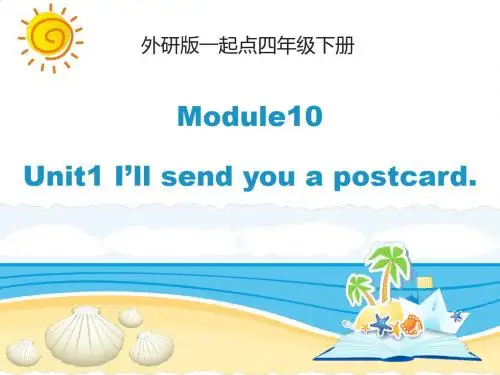
He’ll send them a postcard from China.
Warm-up
Listen, point and find “will, be going to”.
postcard
Warm-up
Read and answer
Listen, point and find “will, be going to”.
Daming: And I’ll send you a postcard from China.
Amy: Will you send us a postcard, too, Tweet-tweet?
All: Ha ha ...
I’ll = I will We’ll = We will
Warm-up
Have Daming got any plan now?
No, he hasn’t.
Maybe he’ll _vi_s_it_h_i_s_g_r_a_n_d_p_a_’s_f_a_rm__.
Warm-up
Read and circle
Listen, point and find “will, be going to”.
外研版一起点四年级下册
Module10 Unit1 I’ll send you a postcard.
Warm-up
Listen and chant.
Warm-up
Listen and chant.
She’s going to visit _A_u_s_tr_a_li_a.
She will see a k_a_n_g_a_r_o_o_.
答案
Warm-up
Listen and chant.
外研版四年级英语下册Module 10 Unit 1
(carry的过去式)拿,搬 (发生)
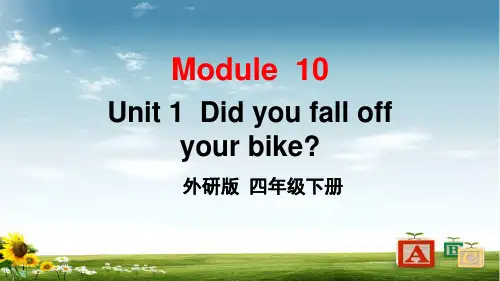
She fell off the bike and bumped her head.
掉下,落下;摔倒 fall的过去式 fall off 跌落 掉下,落下;摔倒 fall down 摔倒
撞伤
So she went to the hospital quickly. What a poor girl!
Module 10
Unit 1 Did you fall off your bike?
外研版 四年级下册
Read the story
One day, a little girl went to the town for a ride.
(城镇,市镇)
(骑车)
She felt thirsty and wanted a cup of water. But there was
bought a watermelon.
课堂小结
go for a bike ride 骑车 find – found 发现
fall – fell 跌倒
carry – carried 携带
fall off 摔跤
bump – bumped 撞
buy – bought 买
bump my head 撞到我的头
昨天他发生了交通事故。
A traffic accident happened to him yesterday.
Oh, Sam and I went for a bike ride yesterday.
“go for a+名词”意为“参加……(活动)”。 常用短语:go for a walk 去散步
happen(发生)多指事先无计划,偶然发生(的事情)。 当问某人或某人身体状态发生了什么事情时,常用此
外研版小学英语(一年级起点)四年级下册Module10 Unit1 课件
Lingling: We’ll send you a postcard from the UK.
Daming: And I’ll send you a postcard from China.
Amy: Will you send us a postcard, too, Tweet-tweet?
All: Ha ha ...
Daming: And I’ll send you a postcard from China.
Amy: Will you send us a postcard, too, Tweet-tweet?
All: Ha ha ...
I’ll = I will We’ll = We will
Warm-up
点击小喇叭或文本框都可以播放音频
Warm-up
Listen, point and find “will, be going to”.
Read it by yourselves for two minutes. 自己读对话两分钟。
Tips: 当你自己朗读时,遇到不会读或不明白 意思的单词或句子,可以把它圈起来, 请教同学或老师!
Amy will go back to the UK this summer.
Warm-up
Watch and answer
Listen, point and find “will, be going to”.
Who will go to the UK, too?
Lingling.
What is Lingling going to do in the UK every day? She’s going to speak English every day.
外研一起小学英语四年级下册教学课件Module 10 Unit 1 (第1课时)
Listen and repeat. (听并跟读) Read in groups. (小组读) Team show. (小组展示) Assessment. (评价)
I will send you a postcard.
1.What are you going to do this summer? I'm going to learn to swim.
2.Amy, what will you do tomorrow? I will visit my grandfather.
will be going to
I'm going to ... I'll ... ... What will you do?
send postcard grandfather
visit
send you a postcard go back to speak English be going to do
Let’s sing! Why Oh Why
What will they do tomorrow?
They/He/... will
will
be going to
Listen and match.听课文连线。
Amy
Linglid go back to England farm visit grandfather's farm
句子我最多 I'm going to ... 或者 I'll ... What will you do?
Module10Unit1I'llsendyouapostcard(课件)外研版(一起)英语四年级下
明信片
send
English postcard Chinese postcard
Listen and imitate.
Role play.
Let's practise.
Read and fill in
朗读P56 A2,并填空
Who
Amy Lingling Daming
Where
send a postcard to dad buy a present make a card write a message make a cake have a party tidy my room draw a picture for dad cook a dinner for dad… go swimming take photos go shopping have a big dinner see a film fly a kite draw a picture visit… have a picnic…
plan
计划
l an d d an ce fl an
Task:Share our summer holiday plan.
What is Amy going to do this summer?
What will Daming do?
farm
Will they send a postcard to Daming?
Think and say
想一想,说一说
What about Daming? He hasn't got any plan now.
Maybehe will visit his grandpa's farm.
Make a holiday plan
2018-2019年英语外研版小学四年级下册m10U1
(1)、复习上一课时所学内容。
(2)、展示Sam从自行车上摔倒的图片。
引出课题T: Today we’ll learn Module10 Unit 1“Did you fall off your bike?”(Ss read the sentence.)
(3)、T: Put your book on your arm∕head∕finger.What hened?请学生演示。
年级
四年级
备教者
教学内容
M10 Unit 1 Did you fall off your bike?(第一课时) (总37次)
教学目标
知识目标
能掌握运用单词fall of,fell,felldown,found, bumped,hened,thirsty,,bought,carried,then,watermelon.
(4)、T:The book fell off your arm∕head∕finger.教授单词hened,fell of
(5)、教师表现出口渴的样子:I want to eat a watermelon.(出示图片教学thirsty,watermelon.)
(6)、展示a ball,(边说边做动作)Look,I carried a ball.(情景教学carried,bumped)
(7)、同法教学其他单词。
(8)、多种形式朗读单词。
(9)、Listen to the tape and repeat.
Step 3、Practice
(1)、抽读卡片单词(分组比赛)
(2)、练习
备注
运用肢体语言、情景及图片展示进行教学,让学生通俗易懂,印象深刻。
新外研版英语四年级下册Module 10 Unit 1教案
Module 10Unit 1 Did you fall off your bike?一、教学目标:1.能够听、说、认读句子:What happened to ….. ? I went for a bike ride / were hungry and thirsty / bought a watermelon / fell off/ carried.2.能够听、说、认读以下单词和词组:happen, ride, thirsty, carry, bump, fell off二、教学重难点:教学重点: 使用句型What happened to …? We went for a bike ride / were hungry and thirsty / bought a watermelon / fell off/carried.教学难点: 较完整地叙述一件过去的事情。
三、教具准备:cards,recorder四、教学过程:Step 1: Warm up and lead-in1. Greetings.2. Let’s chantGo, went, went to school.Walk, walked, walked in the park.Talk, talked, talk to some friends.Help, helped, I helped Mum.Watch, watched, I watched TV.Step 2: Presentation1. 通过呈现西瓜图片引出watermelon , 通过变换西瓜球的位置引出fall off --fell off。
T: Look! What’s this?Ss: Watermelon.T: Where is the watermelon?S: …T: Now, where is it? (把西瓜球放在头顶,球不一心掉下来)Oh ,What happened?(引出fall off --fell off)通过师生互相传球的方式操练fall off ----fell off2.一个学生把球传给老师时,不小心把球砸到老师头上。
Module10完整(课件)英语四年级下册(1)
Presentation
Look and learn
found 发现;找到
Presentation
Watch and think
What happened to Daming
Presentation
Listen and answer
1. What happened to Daming Daming bumped his head. 2. Did Daming buy a watermelon Yes, he did. 3. Did Daming fall off his bike No, Sam fell off his bike.
Free talk
Warm-up
1. Did they go to the Great Wall 2. Did they have a nice holiday
Presentation
Look and think
What did Jack and Jill do
Presentation
Listen and chant
Module 10
Unit 1 Did you fall off your bike
Let’s sing
Warm-up
We visited England and we went to London zoo. We saw lots of people and some funny animals too. Oh, we love holidays, holidays, hooray! We want to visit China. We want to see Beijing. We’ll meet the Chinese children. We’ll talk and play and sing. Oh, we love holidays, holidays, hooray!