
【人教版八年级英语下册教案】Unit 2 Section A Grammar Focus~
Unit 2 I’ll help to clean up the city park.Section A (Grammar Focus~4c)教学目标【知识与技能】1. 学习掌握下列词汇:sign, sick, raise, alone2. 进行一步复习巩固学习Section A 部分所学的生词和词组。
3. 对动词不定式的用法进行归纳总结,掌握其规则。
4. 通过不同方式的练习,来熟练运用本单元出现的词组及动词不定式。
【情感、态度与价值观】使学生在谈论如何为别人提供帮助的对话中能意识到尽己所能,帮助他人,乐于奉献是一种良好的品德,培养学生为他人着想,热爱公益事业,乐于助人的优良品质。
教学重难点【教学重点】1. 复习巩固Section A 部分所学的生词和词组,达到熟练运用的目标。
2. 掌握和运用动词不定式的用法。
【教学难点】1. 掌握学过的后面跟不定式做宾语的动词。
2. 掌握动词不定式作不同的句子成份。
教学准备图片、视频、多媒体等教学过程Step 1 RevisionComplete the sentences.Mario and Mary ____ ___ several hours each week __ ____ others. Mario wants __ ___ an animal doctor. He _________ at an animal hospital. He wants __ _____ more about ____ __ care for animals.Mary is a book lover. She could read by herself __ ___ ____ of four. Last year, she decided __ ___ ___ for a volunteer after-school _______ program. Mary still works there once a week __ ____ kids _____ __ read. V olunteering here is a dream come true for her. She can what she _____ ___ ___and helps others at the same time.Can you tell something about Mary to us?Answers: give up, to help, to be, volunteers, to learn, how to, at the age, to try out, reading, to help, learn to, loves to doStep 2 Grammar focus1. 阅读Grammar Focus中的句子,然后做填空练习。
①我想去帮助无家可归的人。
I’d ____ ___ ______ homeless people.②你可以请求医院允许你探访儿童并让他们变得更高兴。
You could _____ hospital ___ ____ you visit the kids and cheer them up.③他自愿一周去那里一次去帮助孩子们学习读书She ________ there once a week ____ ______ kids learn to read.④他决定参加一个志愿者课后阅读节目的选拔。
She _______ ______ try out for a volunteer after-school reading program.⑤马里奥相信这会帮助他获得他的梦想工作。
Mario believes it can help him _____ _____ his future dream job.⑥我正在制作一些告示,并将它们张贴于学校里。
I’m making some sings _____ _____ _____ around the school.2. 学生们根据记忆,看大屏幕来完成填空练习。
3. 学生们完成填空试题后,可以打开课本检查答案,对错误的句子,单独进行强化记忆。
Step 3 New wordsLook at the big screen and learn the new words and expressions:1. raise v. 募集;征集e.g. They sold something to raise money. 他们卖掉一些东西来募集钱。
2. alone adj. adv. 独自;单独e.g. I don’t like to go out alone at night. 我不喜欢晚上独自一人外出。
辨析:lonely 与alonelonely 情感上的孤独,寂寞。
alone 独自一人(单不定感觉寂寞)。
e.g. Linda was alone in the house. 琳达独自一人呆在房子里。
She lives alone and often feels lonely. 她孑然一身,常感到寂寞。
Step 4 动词不定式用法小结:观察下列不定式在句中的作用。
1. To see is to believe.主语,表语2. Tom wants to see an alien.宾语3. My brother got up early to watch the final soccer game on TV.目的状语4. He was too excited to say a word.结果状语5. The sad movie made us cry.宾语补主语6. It is important for us to drink enough water.真正的主语1. 做动词宾语。
常见动词有would like, want, help, learn, hope, decide, volunteer。
e.g. We don’t want to spend too much money. 我们不想花费太多钱。
2. 作宾语补足语。
常见动词有ask, want, tell, invite, like, hate。
e.g. Mr. Li asked the students to copy the text. 李老师让学生们抄写课文。
3. 作目的状语。
e.g. Jack turned his head around to look at people. 杰克转过头看向人群。
4. 作后置定语。
e.g. Claire missed a great chance to make a lot of money.克莱尔错过了一个赚大钱的机会。
5. 动词help及一些役使动词后面常省略to。
e.g. My mother wouldn’t let me go to the movie. 妈妈不会让我去看电影的。
6. It做形式主语,真正的主语为后面的不定式。
e.g. It is important for us to protect the environment. 保护环境对我们来说很重要。
Step 5 Exercise:Ⅰ. 根据句意及括号内所给单词的提示填空。
1. Mr. Miller gave up his job ________(look) after his sick daughter.2. Kate would like ________(be) a teacher when she grows up.3. Mrs. Hand didn’t let me ________(give) out the newspapers.4. Every weekend Alice works in the club ________(help) kids read and write.5. Mom asks me not ________(spend) too much time on computer games.Answers: 1. to look 2. to be 3. give 4. to help 5. to spendⅡ. 完成句子.1. Who will _______________ (自愿读) these words for us?2. The girl often _____ her mother ______ the dishes (帮妈妈洗餐具) on weekends.3. We ______her ________ (邀请来) to our party.4. The old man had ______________ (无事可做) every day.Answers: volunteer to read, helps / do, asked / to come, nothing to doStep 6 Practice1. 4a: Fill in the blanks with the phrasal verbs in the box.1) Tell Ss to read the sentences in 4a and try to fill in the blanks with the phrasal verbs in the box.2) 方法指导:首先,先阅读所给的词组,明确每个词组的意思。
其次,通读全句,理解大意;然后,根据句意及句子中上下文意的提示来确定空格处的意思。
3) 同学们,按老师指导的方法进行阅读,并逐句推敲每空应填什么词组,在实际的运用中提高自己的阅读能力、分析能力及综合运用能力。
4) 最后,教师与同学们一起校对答案,并对学生们有疑问的地方进行解释,或作出合理的分析。
Answers: put off; call up; come up with; cheer up; put up; hand out; give out2. 4b: Fill in the blanks with the correct forms of the verbs in the box.1) 让学生们阅读表格中词语,明确每个单词的意思,为进行填词做好准备。
2) 通读全文,理解短文大意。
3) 逐句进行分析推敲,确定空格处的意思,并尝试用空格中的单词填空。
4) 最后,通读一遍短文,进行综合理解,看短文内容是否通顺,合理。
5) Check the answers with the Ss.Most people today are only worried about getting good jobs 1.____ lots of money. In their free time, they think about what 2. ____ for fun. However, few people think about what they can do 3. _____ others.There are many people who are less lucky than us. V olunteering our time to help these people is a good way 4. ______ our free time. For example, we can make plans 5.________ sick children in the hospital or raise money for homeless people. Some people even stop doing their jobs for a few months to a year 6. ________ to another country, like one of the countries in Africa, and help people there.Answers: 1: to make; 2: to do; 3: to help; 4: to spend; 5: to visit; 6: to move3. 4c: Complete the sentences with your own ideas. Use infinitives.1) 让一名学生读每个句子的内容。
人教版八年级英语下册教案:Unit 2 第2课时
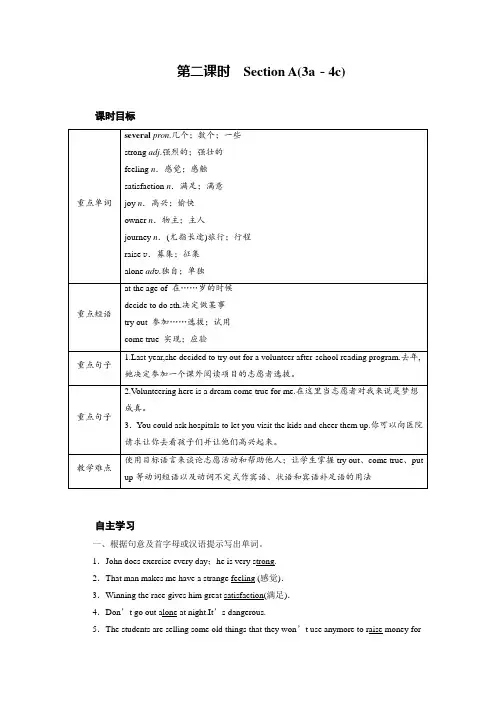
第二课时Section A(3a-4c)课时目标自主学习一、根据句意及首字母或汉语提示写出单词。
1.John does exercise every day;he is very strong.2.That man makes me have a strange feeling (感觉).3.Winning the race gives him great satisfaction(满足).4.Don’t go out alone at night.It’s dangerous.5.The students are selling some old things that they won’t use anymore to raise money forpoor children.二、写出下列画线短语的汉语意思。
1.She could read by herself at the age of four.在……岁的时候2.Mario loves animals and wants to be an animal doctor.兽医3.She decided to try out for a volunteer after-school reading program.参加……选拔;试用4.Volunteering here is a dream come true for me.实现5.I can do what I love to do and help others at the same time.同时教学过程环节1新课导入让学生听写以下短语,然后教师订正答案。
(教师可邀请两名学生到黑板前听写)打扫(或清除)干净________(使)变得高兴;振奋起来________分发;散发________想出;提出(注意、计划、回答等)________推迟________分发________打电话给(某人);征召________曾经……;过去……________照顾;非常喜欢________设计意图:温故知新,通过听写任务帮助学生记忆上堂课所学的短语,有利于知识间的衔接,便于老师循序渐进地开展教学。
人教版八年级英语下册 Unit 2 Section A 3a-4c 教案

Unit2I’ll help to clean up the city parks Section A3a-4c教案课题Section A3a-4c单元Unit2I’ll helpto clean up thecity parks学科英语年级八年级下册学习目标知识和能力1.单词:lonely,alone,help out,listen to,care for,used to,2、短语和句型:Train the students’reading,writing,speaking and listening skills with the target language.情感态度和价值观Try to be helpful to others.重点1.阅读短文找出Mario和Mary志愿去做什么2.能够学会对动词不定式的用法做总结。
难点熟练表达动词不定式的用法。
教学过程教学环节教师活动学生活动设计意图导入新课Step1:Enjoy a videoPlay a video and ask students to watch it carefully.Try to understand the meaning of thevideo.Step2:Free talk1.Show a picture of some boys who are in theanimal hospital.Ask students to sayWhere did they volunteer to work?They volunteered to work at an animal hospital.2.What did they do there?They want to learn more about how to care foranimals.3.What do you usually do on your free time?Watch thevideocarefully.Talk aboutthevolunteers结合本课主题,通过让学生观看视频并且自由讨论,自然地进入情境,开始本课时的学习。
人教版英语八年级上册 Unit 2 Section A (Grammar-3c)导学案

课题
Unit2 Section A (Grammar-3c)
课型
讲授课
主备
审核
学习
目标
1.复习巩固上节课所学的13个单词。
2.拼读并熟记单词表中P8的单词和短语
3.掌握名词的单复数和介绍他人。
学习
重
难点
掌握名词的单复数和介绍他人
预
习
案
(1) 帮助某人做某事 ______________ (2)看电视______________
一次once 两次 twice 特殊记,三次three times 有规律 基数词+times。
once a week 一个星期一次,表示动作的频率由 次数+a/an +时间段。
three times a day 一天三次 twice a year 一年两次,
对此类题常用how often 提问。
2.He hardly ever watches TV.他几乎不看电视。hardly 表示否定意义,是一个频率副词。hardly不是hard的副词形式,相当于almost not.
(3)读英语书______________ (4) 至少______________
(5)进行体育活动______________ (6)熬夜到很晚______________
(7)一周三次 ______________ (8)上网______________
行
课
案
合作探究
1.I go to the movies maybe once a week.我可能一个星期去看一次电影。
A. hardly B. greatly C. often D. seldom
2020年春人教新目标英语八年级下册Unit2全单元教案(无答案)

2020年春人教新目标英语八年级下册Unit2 I’ll help to clean up the city parks.第一课时(Section A 1a- 2c)课型:新授时间:主备人:审核人:审定人:组别:八年级英语组班级:姓名:[一.学习内容]:Unit2 I’ll help to clean up the city parks. (1a--2c)[二.学习目标]:1.能正确朗读并准确掌握本单元的生词及短语。
2.初步掌握向他人求助或提供帮助的句子。
[三.教学重点、难点]重点: 初步掌握向他人求助或提供帮助的句子。
难点:初步掌握向他人求助或提供帮助的句子。
1.预习P1-3的单词及短语2.熟悉相关教材内容并对不懂的地方进行标记。
一英汉互译:1.clean up the city parks2.visit Sick Children3.在医院4. 在外面工作5. 使他们高兴6。
分发食物7.在食品救济中心_____8.在课外学习活动小组教孩子9. 想出10清扫日______ 11离现在有两周_____12.推迟13制定计划__ ____ 14.做一些公告牌15.放学之后16.给某人打电话17.吃午餐二.请同学们认真阅读与本课时相关的句子和对话,并试着翻译下列的句子:1、这个女孩可以去医院探望生病孩子是他们高兴2、这个男孩可以在食品救济中心分发食物。
3、这个女孩可以志愿在课外学习活动小组教孩子。
4、这个男孩可以帮助打扫城市公园。
5、我们需要想出一个计划来告诉人们关于这个城市清扫日的事。
6、我们不能推迟制定计划了。
7、我们可以张贴标志牌。
三、请同学们认真朗读与本课时相关的对话并模仿该对话,根据自己实际情况写一个对话。
让学生小组回忆以前所学的有关于委婉(一)教学步骤1. 解读学习目标,学习新词汇2.教师通过玩游戏”Touch your ---”,然后引出询问向他人求助或提供帮助的句子:A: I like reading books.What could you do? B:You could volunteerin an after-school study program to teach kids. (选出写的好的小组进行加分)并核查预习案3.给学生5分钟的时间,让他们模仿1a中的短语进行相互问答练习并把他们编的对话写下来,听听力完成1 b,然后进行相互问答练习。
八年级英语下册Unit2 Section A教案人教版

八年级英语下册Unit2 Section A教案Topic: What’s the matter?Language goal: In this unit, students learn to talk about health and give advice.New language:1.The parts of the body.2. What’s the matter? I have aheadache/stomachache/toothache/sore throat. Teaching aid: Tape-recorder. New word card.Period: the first period.Teaching procedure:Step1: Presentation1.Say hello to the students. Then ask the students: Howmany parts of the body can you name? Help the students to answer by pointing to the head, the hand, the leg and the foot.ing the word cards to teach the new words, eg: Takeout the word card of “arm”. Point to my arm, and say: This is my arm. Then write the word on the blackboard and read them loudly.3.Get the students to read the words in pairs. Practicethe words like this:S1: (Point to his head) What’s this?S2: It’s your head. Where’s your ear?S1: It’s here. (Point to the ear)Step 2: 1a1.Ask students to look at the pictures of the studentsnumbered 1 through 5. Several body parts are marked with the letters a-m. Write the correct letter after the name of each body part on the list.2.Point out the sample answer “k”before the word“arm”.3.Ask students to complete the activity individually.4.Check the answers.e the word cards to consolidate the new words. Ask thestudents to read the words and point to the part of the body.Step3: Learn the illness.1.Act out an illness. For example:Hold the head and say: I have a headache. Get the students to repeat and explain the meaning of the word and sentence.2.Point to one of the people in the picture and ask:What’s the matter? Then answer: He has a stomachache.Get the students repeat. Then ask the other people and learn the illness such as: have a cold, have a toothache, have a sore throat, etc.Step4: 1b1.Ask the students to look and read the names in 1b.2.Say, you will hear 5 conversations. Look at the pictureand find the people that are being talked about. Write the number next to their name here.3.Play the recording twice and find the correct answers. Step5: 1c Pairwork.1.Point out the sample conversation in the box. Ask twostudents to read it to the class.2.Say, now work with a partner. Make your ownconversations about the pictures.3.As they talk, move around the room and monitoring theirwork.4.Ask several students to present their dialogues. Homework:write the new words.附:教案特色自我评价这是八年级英语下册第二单元《 What’s the matter 》Section A第一课时的一篇教案。
英语人教版八年级下册Unit 2 Section A Grammar Focus

Unit 2 I’ll help to clean up the city parks.Section A Grammar Focus—4cTeaching Aims1.Knowledge aims(1)Students can use the key structures:1) I’d like to help homeless people..2) She decided to try out for a volunteer after-school reading program.3) You could ask hospitals to let you visit the kids and cheer them up.4) Mario believes it can help him to get his future dream job.5) She volunteers there once a week to help kids learn to read.6) I’m making some signs to put up around the school(2)“could\ couldn’t” for suggestion.2. Ability Aims(1)Learn and master how to offer help by using the language chunks.(2)Can use infinitives.3 Moral Aims Educate students to care about and help some peopleTeaching Key PointsLearn and master how to offer help by using the language chunks and the usage of infinitives. Teaching Difficult PointsThe usage of infinitives.Teaching MethodsThe activity teaching method, the cooperative learning method, and the task-based language teaching method.Teaching AidsThe pictures about volunteering ;PPTTeaching Steps:Step1 Warming-upStep2 Grammar FocusShow students a video about “V olunteers Needed” and ask them to talk about their volunteering.1.Talk about how to offer help according to some pictures in class like this:1)A: I’d like __________homeless people. B:You could _________food at the food bank.2)A:I want _____________sick kids.B:You could ask hospital ___________you visit the kids and _____them______.3)She decided _______________for a volunteer after-school reading program.She believes it can help her ___________ my future dream job.She volunteers there once a week ____________kids learn ____________.4)I’m making some signs __________around the school.2.Have students to read and remember the sentences of Grammar Focus by themselves.Have them work in groups to sum up how to offer help .I’d like to......Plan I’m making ......Offer help I will......I hope/decide to ... ...Advice:You could /couldn’t ......4.Look through the sentences in Grammar Focus and let students sum up the characteristics of them.Step 3 Practice(4b)1 Group workStudents discuss the usage of infinitives in groups according to the sentences in Grammar Focus and then let them show the results. Teacher can give some help.动词不定式用法小结:1. 做动词宾语。
人教版小学英语八年级上册Unit2Section A (Grammar Focus-3c)教案及反思
3. ExplainGrammar Focus.
4.AskSs to read the sentences in this part and pay attention toW-andHow-questions.
5. Give some phrases and give a report according to the phrases.
6. Make an interview and report the information.
Who’s the best English student?
完成3c的表格并练习对话,列举一些关于英语学习的短语,并且做一个的报告,最后整理一篇报告。
反复读语法中的句子,概括这些句子的特点并讲解W-和How-构成的特殊疑问句。
Step 3
Practice
(PPT 14-16)
Work on 3a,3b.
1.Call students' attention to 3a.MakeSs scan the questions and answers first,then complete the task in 3a individually.
Then call some pairs to present in class.
设计这个游戏,图文并茂,引导学生复习句型。该活动旨在为语法讲解做铺垫,激发学生语法相关知识。
Step 2
Presentation
(PPT 5-13)
1. AskSs to read the sentences in Grammar Focus.
人教版八年级英语教案-Unit 2 How often do you exercise
Unit 2 How often do you exercise?Section A 1 (1a-2d)一、教學目標:1. 語言知識目標:1) 能掌握以下單詞: housework, hardly, ever, hardly ever, once, twice, Internet, program, full, swing, swing dance, maybe, least, at least能掌握以下句型:① —What does he do on weekends? —He usually watches TV.② —How often do you watch TV? —I watch TV every day.③ —Does he go shopping? —No, he never go shopping.2) 能瞭解以下語法:頻度副詞及一般現在時簡單談論週末活動情況。
2. 情感態度價值觀目標:通過本單元的學習,養成健康的飲食習慣,保證充足的睡眠時間,進行合理的運動鍛煉,以保持健康的體魄。
培養學生的邏輯表述能力,激發學生的積極思維,並使學生互相瞭解,增進友誼,加強人際交往,以形成良好的人際關係。
二、教學重難點1. 教學重點:1) 對6個頻度副詞細微差異的理解及使用。
2) 弄清一般現在時在不同人稱下動詞形式及提問的變化。
2. 教學難點:1) 第三人稱單數謂語動詞在此核心句型中的運用。
2) 談論課餘時間的各項活動,以及初步認識和使用頻率副詞。
三、教學過程Ⅰ. Lead inTalk about your last weekend’s activities.Ⅱ. Presentation(1) 教師問:“W hat do you usually do on weekends ? ” (並且板書)讓學生根據自己的實際回答I usually …… on weekends.(2) 教師出示動詞卡片 watch TV,read books,exercise,swimplay football、go shopping、 go to movies讓學生回答。
人教版英语八年级下册 Unit2_SectionB(2a-2e)教案
Unit2 SectionB(2a-2e)名师教案课型4 Reading and Learning (Section B 2a-2e )1.0Teaching Analysis教情分析1.1Teaching objectives 教学目标1.1.1Language targets 语言目标1.1.1.1Key Words and Chunks1.1.1.1.1For applying: letter, Miss, set up, disabled, make a difference to,blind, deaf, imagine, difficulty, open, door, carry, train, excited,training, kindness, clever, understand, change1.1.1.1.2For comprehending:1.1.1.2Sentence Structures1) I’d like to thank you for giving money to Animal Helpers.2) You helped to make it possible for me to have Lucky.3) What would it be like to be blind or deaf?4) Or imagine you can’t walk or use your hands easily.5) She talked to Animal Helpers about getting me a special trained dog.6) She also thought a dog might cheer me up.7) I love animals and I was excited about the idea of having a dog.8) In what other ways do you think dogs are able to help people?1.1.1.3Grammar Focus1) I’ll send you a photo of him if you like, and I could show you how hehelps me. (if you like是条件状语从句,意为“如果你喜欢”;how he helpsme是宾语从句,意为“他如何帮助我”)2) I’m su re you know that this group was set up to help disabled people likeme. (was set up是一般过去式的被动语态,一般过去时的被动语态的结构为“was/were+动词过去分词”)1.1.2Ability goals 能力目标1.1.2.1帮助学生通过单词的词性来帮助理解单词在句中的含义。
人教版八年级下册第二单元Grammarfocus说课课件
infinitives and send the link to me.
Contents
1 2 3 4 5 6
Blackboard Design
6: Blackboard Design
Phrasal verbs infinitives Competition G1 G2 G3 G4
PPT
Brainstorm
Contents
1 2 3 4 5 6
Teaching Methods Teaching Aids Teaching Procedures
Blackboard Design
Teaching Methods Direct instruction Task-based approach Communicative teaching
5 Sum up and homework
1
Purpose
Attract students’ interest
Make students have a relaxed mood
2 Phrasal verbs
Perform and guess Brainstorm
Chant
Exercise 4a using pads to photo and send me answers
趣配音 PPT
Multimedia
Contents
1 2 3 4 5 6
Teaching Procedures Blackboard Design
5: Teaching Procedures
1
Lead-in
2
Phrasal verbs