
加拿大政治体制概况
Canadian Political System Introduction:Canada is a constitutional monarchy with a federal system of parliamentary government and strong democratic traditions. Its political system under which modern Canada operates is known as the Westminster system. Since Canada’s political structure is modeled after those of Britain and the United States, it can be described as both a federation like the US and a constitutional monarchy like Britain.Westminster system:The Westminster system is a democratic parliamentary system of government modeled after the politics of the United Kingdom. This term comes from the Palace of Westminster, the seat of the Parliament of the United Kingdom.The essential features of the Westminster system are:∙The Government is chosen by the democratically elected lower house. The government requires the continuing support of amajority of members of that chamber to stay in office.∙The head of government is the Prime Minister, who leads a Cabinet which is responsible to the lower house.∙ A loyal Opposition exists, led by the leader of the party or parties with the second largest number of seats in the lower house.∙ A constitutional monarch, if one exists, who is “above politics” and acts on the advice of the prime minister.∙There is a career public service which impartially serves the government of the day.∙The armed services are outside of politics and act on the instructions of the government.∙The rule of law prevails, with an independent judiciary, subject to the Constitution.The Canadian government consists of three parts:ONE: The LegislatureThe Parliament of Canada: the House of Commons and the Senate.●The House of Commons:Each member chosen by a majority of eligible voters in each of the country's federal electoral districts, or ridings, via a plurality voting system. To run for one of the 308 seats in the House of Commons, an individual must be at least 18 years old, and on average, members of the House of Commons are elected for a maximum of five-year term.●The Senate:It is a group of 105 individuals appointed by the governor general on the advice of the prime minister; all those summoned to the Senate by the viceroy must be a minimum of 30 years old, and own property with a net worth of at least $4,000, in addition to owning landworth no less than $4,000 within the province he or she is to represent. Its main function is to accept or reject the suggestion of the House of Commons.●The Prime Minister is often the leader of the majority party in Parliament, and selects the ministers who make up the Cabinet, they exercise executive power as the “Government”, and are responsible only to the House of Commons.TWO: The Executive●The Governor General holds the highest position and is theoreticallythe source of executive power. In practice, however, the Governor General is only the symbolic executive who can act only on the advice of the Canadian Prime Minister and the Cabinet. Responsibilities:1) To summon the House of Common and the Senate;2)To give Royal Assent to all federal laws passed by the House ;3)To open and end session of Parliament;4)To dissolve Parliament before an election.●The Canadian government is divided into :The federal government: It shares many of the provincial government’s features. Besides, it has a second chamber equivalent to the Canadian Senate.The provincial government: A lieutenant Governor represents the King or Queen in each province; their duties are similar to those of the Governor General.Territorial government: Three territories have their own governments but with less power than those of the province.THREE: The JudiciaryThe courts in Canada are organized in four-level structure. Level 1: The Supreme Court.●It serves as the final court of appeals in Canada.●It hears both civil and criminal appeals from decision of the courts of appeals in all the provinces and territories.●It plays a special role as adviser to the federal government on questions concerning the Constitution and controversial complicated areas of private and public law.Level 2: The Federal Court of Appeal and the various provincial courts of appeals.Level 3: The Federal Court, The Tax Court of Canada, The provincial and the territorial superior courts of general jurisdiction.Level 4: Provincial courts.Political PartiesThere are three main political parties in Canada.●The Liberal Party: The most favored and influential political party in Canada, founded in 1867, and has often over the years held a majority in the Canadian House of Commons, and at other times still remained a substantial amount of seats. This party combines a liberal social policy with a moderate economic policy.●The Conservative Party:The right-wing political party in Canada was formed by the merger of the Canadian Alliance and the Progressive Conservative Party in December 2003. The Reform Party had been the chief political party to oppose the Liberal party for a number of years. In 2006, the party achieved a major victory with the election of its candidate for Prime minister, Stephen Harper.●The New Democratic Party:It is a social democratic party in Canada, founded in 1961, incorporating two other Canadian parties, the Cooperative Commonwealth Federation and the Canadian Labor Congress. The party represents the left-wing position and retains a small number of seats in the House of Commons.Election●Each province:Its own electoral system.The federal Parliament: A national electoral system.Different systems share many similarities as well as differences.●At the time of confederation, the right to vote was severely limited:★Only white men could vote and they had to meet certain property qualifications.★Women were given the right to vote in 1918;★Aboriginal Canada living on reserves in 1960;●Nowadays, citizens aged 18 or older have the right to vote.●Two citizens cannot vote:★The Chief Electoral Officer(总选举事务主任)★The Deputy Chief Electoral Officer(副首席选举事务主任)●Constitutionally, elections must be held every five years.By tradition, they are usually held at approximately four-year intervals.。
《加拿大》教案:了解加拿大的政治制度

《加拿大》教案:了解加拿大的政治制度第一章:引言1.1 课程目标:使学生了解加拿大的政治制度及其特点。
1.2 教学方法:采用讲授法,结合多媒体展示和小组讨论。
1.3 教学时间:45分钟第二章:加拿大的政治体制2.1 课程目标:使学生了解加拿大的政治体制,包括联邦制、君主立宪制等。
2.2 教学内容:2.2.1 加拿大的政治体制类型2.2.2 加拿大的宪法结构2.2.3 加拿大的政治组织机构2.3 教学方法:采用讲授法,结合案例分析和小组讨论。
2.4 教学时间:60分钟第三章:加拿大的选举制度3.1 课程目标:使学生了解加拿大的选举制度及其运作方式。
3.2 教学内容:3.2.1 加拿大的选举制度类型3.2.2 加拿大的选民资格3.2.3 加拿大的选举过程3.3 教学方法:采用讲授法,结合案例分析和小组讨论。
3.4 教学时间:45分钟第四章:加拿大的主要政治政党4.1 课程目标:使学生了解加拿大的主要政治政党及其政策。
4.2 教学内容:4.2.1 加拿大的主要政治政党4.2.2 各政治政党的政策特点4.2.3 加拿大的政党制度4.3 教学方法:采用讲授法,结合案例分析和小组讨论。
4.4 教学时间:60分钟第五章:加拿大的政治文化5.1 课程目标:使学生了解加拿大的政治文化特点及其对政治制度的影响。
5.2 教学内容:5.2.1 加拿大的政治文化特点5.2.2 加拿大的公民参与度5.2.3 加拿大的政治价值观5.3 教学方法:采用讲授法,结合案例分析和小组讨论。
5.4 教学时间:45分钟第六章:加拿大的法律体系6.1 课程目标:使学生了解加拿大的法律体系及其与政治制度的关系。
6.2 教学内容:6.2.1 加拿大的法律体系结构6.2.2 加拿大的司法独立6.2.3 加拿大的法律制定过程6.3 教学方法:采用讲授法,结合案例分析和小组讨论。
6.4 教学时间:60分钟第七章:加拿大的原住民政策7.1 课程目标:使学生了解加拿大原住民政策及其在政治制度中的地位。
加拿大的经济及政治(经济篇)

深受美国影响的加拿大经济
在二战期间,美加两国在军事生产等方面密切合作,使得加拿大同 美国一样成为同盟国军火库,工业突飞猛进。二战结束时,加拿大已 从一个农村经济国家转变成世界主要工业国。此后,加拿大和美国的 经济联系愈发紧密。
加拿大的经济、政治与外交
(经济篇)
整体框架
地理 影响 经济 决定 政治 决定 外交
枫叶之国
Байду номын сангаас
领土面积 最大城市 官方语言 人均GDP 国树 国家结构形式 政治体制
加拿大概况
998万平方公里
首都
多伦多
人口
英语、法语
GDP
52364美元(第10) 货币
枫树
国花
联邦制
国家政权
议会民主制
立国日期
渥太华
加拿大在有色冶金、信息通讯、运输设备、电力水利、纸浆造纸、微 电子软件、新能源新材料等产业方面拥有世界领先水平。
加拿大工业集团代表有庞巴迪公司、加拿大铝业、ATI、RIM等。
其他行业
服务业: 加拿大服务业在经济发展中占有重要地位。2010年,加服务业增加值
8902亿加元 ,占加GDP(10409)的72.2%;服务业从业人员1330万人, 占就业人口总数(1704万)的78.1%。 旅游业:
加拿大旅游业十分发达。据世界旅游组织统计,加在世界旅游组织收 入最高国家中排名第九。2005年,旅游收入256.49亿加元,占国内生产 总值的2.22%。接待外国游客3890.27万人。
加拿大的政治体制和社会制度研究

加拿大的政治体制和社会制度研究加拿大是一个民主、自治、联邦制的国家,其政治体制和社会制度因为其多元文化的特点而显得复杂和多样化,令人不得不加以研究。
政治体制加拿大采用的是议会制度,由联邦政府和10个省政府组成。
联邦政府(Canada government)分为三个分支:行政、立法和司法。
行政机构由总理和内阁组成。
总理是由国会议员选举产生的,由党派议会支持和建议选任内阁,内阁是总理选择的部长组成的。
这三个分支之间有权力的互相制约和平衡,实现了政治体制的稳定运行。
加拿大采用的是联邦制度,联邦政府和省政府在政治、经济、文化等领域都保持着一定的自治权。
联邦政府的事务涉及国家总体性问题,如国防、外交、移民等。
而省政府则承担地方性问题,如教育、医疗、社会福利等。
由于每个省的历史、文化、经济和人口等因素不同,因此各省之间的政治、经济、文化等差异也非常明显。
社会制度加拿大是一个多元文化的国家,其社会制度和生活方式也受到不同文化的影响。
加拿大是个福利国家,对病故、失业、老人、贫困和残疾人等方面都提供着社会保障。
而且,加拿大的医疗系统也是出了名的好,每个公民都可以享受到优质的医疗服务。
加拿大是一个民主国家,尊重言论自由和个人隐私,法律也保障公民的基本人权和自由。
此外,加拿大的教育也是著名的,经常在国际排名大赛中名列前茅。
加拿大有极高的教育水平,尤其是在艺术、文化、科学技术等领域。
同时,加拿大的社会各个阶层的关系也非常和谐,因为加拿大的历史和地理的原因产生的多民族、多文化的大熔炉,所以民族关系非常重要,这也使得加拿大的社会价值观强调多元化、包容性,人们习惯尊重多元文化。
结论加拿大的政治体制和社会制度在不断地发展和完善。
加拿大作为一个多元文化的国家,需要在政治、经济、文化、社会等方面不断进行改革,以适应国内外的新形势和新挑战,同时也需要在不断吸取国外发达民主国家的有益经验的前提下,建设一个更加繁荣、和谐和富有活力的社会和政治体制。
犀牛手札354:加拿大的三级政府+加拿大怎么这么慢?
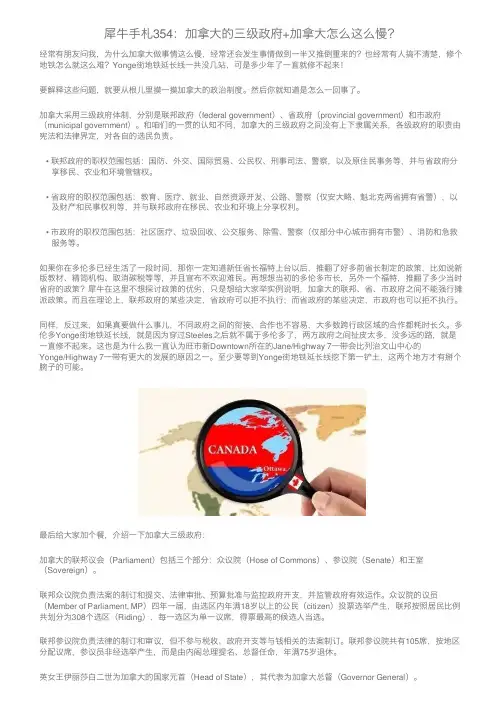
犀⽜⼿札354:加拿⼤的三级政府+加拿⼤怎么这么慢?经常有朋友问我,为什么加拿⼤做事情这么慢,经常还会发⽣事情做到⼀半⼜推倒重来的?也经常有⼈搞不清楚,修个地铁怎么就这么难?Yonge街地铁延长线⼀共没⼏站,可是多少年了⼀直就修不起来!要解释这些问题,就要从根⼉⾥摸⼀摸加拿⼤的政治制度。
然后你就知道是怎么⼀回事了。
加拿⼤采⽤三级政府体制,分别是联邦政府(federal government)、省政府(provincial government)和市政府(municipal government)。
和咱们的⼀贯的认知不同,加拿⼤的三级政府之间没有上下⾪属关系,各级政府的职责由宪法和法律界定,对各⾃的选民负责。
•联邦政府的职权范围包括:国防、外交、国际贸易、公民权、刑事司法、警察,以及原住民事务等,并与省政府分享移民、农业和环境管辖权。
•省政府的职权范围包括:教育、医疗、就业、⾃然资源开发、公路、警察(仅安⼤略、魁北克两省拥有省警),以及财产和民事权利等,并与联邦政府在移民、农业和环境上分享权利。
•市政府的职权范围包括:社区医疗、垃圾回收、公交服务、除雪、警察(仅部分中⼼城市拥有市警)、消防和急救服务等。
如果你在多伦多已经⽣活了⼀段时间,那你⼀定知道新任省长福特上台以后,推翻了好多前省长制定的政策,⽐如说新版教材、精简机构、取消碳税等等,并且宣布不欢迎难民。
再想想当初的多伦多市长,另外⼀个福特,推翻了多少当时省府的政策?犀⽜在这⾥不想探讨政策的优劣,只是想给⼤家举实例说明,加拿⼤的联邦、省、市政府之间不能强⾏摊派政策。
⽽且在理论上,联邦政府的某些决定,省政府可以拒不执⾏;⽽省政府的某些决定,市政府也可以拒不执⾏。
同样,反过来,如果真要做什么事⼉,不同政府之间的衔接、合作也不容易,⼤多数跨⾏政区域的合作都耗时长久。
多伦多Yonge街地铁延长线,就是因为穿过Steeles之后就不属于多伦多了,两⽅政府之间扯⽪太多,没多远的路,就是⼀直修不起来。
介绍加拿大议会制度和议员

-
介绍加拿大议会制度和议员
国会简介
国会是加拿大的最高 立法机构,由参议院 和众议院组成。它拥 有广泛的立法权力, 包括制定和修改法律 、批准国际条约等。 同时,国会还负责监 督行政和司法权力, 确保政府的行为符合 宪法和法律规定
介绍加拿大议ห้องสมุดไป่ตู้制度和议员
参议院简介
参议院是加拿大的上议院,由各 省和地区的议员组成。其主要职 责是审议和修改由众议院提交的 法律草案,并对政府政策进行评 估。参议院的议员通常较为资深 ,对政策的理解和判断能力较强 ,因此在政策制定过程中发挥着 重要作用
介绍加拿大议会制度和议员
众议院简介
众议院是加拿大的下议院,由各 省和地区的直接选举产生的议员 组成。其主要职责是提出和审议 各项法律草案,以及对政府政策 进行监督。众议院的议员更加贴 近选民,因此更加了解选民的需 求和意愿,在政策制定过程中起 着重要的桥梁作用
介绍加拿大议会制度和议员
国会议员职责
介绍加拿大议会制度和议员
议会的影响与未来发展
加拿大的议会制度在国内外都享有很高的声誉。作为一个民主制度,议会为公民提供了参 与政治决策的机会,保障了公民的基本权利。同时,议会制度也为政府提供了监督机制, 确保政府的行为符合法律和宪法规定。这种制度的存在为加拿大的稳定和发展提供了重要 保障
然而,随着社会的发展和变化,议会制度也面临着新的挑战和机遇。在未来的发展中,议 会需要更加注重公民的需求和意愿,更加积极地回应社会各界的关切。同时,议会还需要 加强透明度和问责制度,提高决策的质量和效率
介绍加拿大议会制度和议员
议员的选举与任命
在加拿大,议员是通过选举产生的。参议院和众议院的议员都是通过直接选举产生的。各 省和地区的选民直接投票选举他们的议员,这种选举方式确保了议员与选民之间的紧密联 系 参议院的议员通常由各省和地区的总督任命。总督在任命参议员时,会考虑候选人的 声誉、经验、专业知识和对社区的贡献等因素。参议员任期通常为六年,可以连任
加拿大政治体制概况--资料

Canadian Political SystemIntroduction:Canada is a constitutional monarchy with a federal system of parliamentary government and strong democratic traditions. Its political system under which modern Canada operates is known as the Westminster system. Since Canada’s political structure is modeled after those of Britain and the United States, it can be described as both a federation like the US and a constitutional monarchy like Britain.Westminster system:The Westminster system is a democratic parliamentary system of government modeled after the politics of the United Kingdom. This term comes from the Palace of Westminster, the seat of the Parliament of the United Kingdom.The essential features of the Westminster system are:•The Government is chosen by the democratically elected lower house. The government requires the continuing support of amajority of members of that chamber to stay in office.•The head of government is the Prime Minister, who leads a Cabinet which is responsible to the lower house.• A loyal Opposition exists, led by the leader of the party or parties with the second largest number of seats in the lower house.• A constitutional monarch, if one exists, who is “above politics” and acts on the advice of the prime minister.•There is a career public service which impartially serves the government of the day.•The armed services are outside of politics and act on the instructions of the government.•The rule of law prevails, with an independent judiciary, subject to the Constitution.The Canadian government consists of three parts:ONE: The Legislature 立法The Parliament of Canada: the House of Commons and the Senate.●The House of Commons:Each member chosen by a majority of eligible voters in each of the country's federal electoral districts, or ridings, via a plurality voting system. To run for one of the 308 seats in the House of Commons, an individual must be at least 18 years old, and on average, members of the House of Commons are elected for a maximum of five-year term.●The Senate:It is a group of 105 individuals appointed by the governor general on the advice of the prime minister; all those summoned to the Senate by the viceroy must be a minimum of 30 years old, and own property with a net worth of at least $4,000, in addition to owning landworth no less than $4,000 within the province he or she is to represent. Its main function is to accept or reject the suggestion of the House of Commons.●The Prime Minister is often the leader of the majority party in Parliament, and selects the ministers who make up the Cabinet, they exercise executive power as the “Government”, and are responsible only to the House of Commons.TWO: The Executive 执行●The Governor General holds the highest position and is theoreticallythe source of executive power. In practice, however, the Governor General is only the symbolic executive who can act only on the advice of the Canadian Prime Minister and the Cabinet. Responsibilities:1) To summon the House of Common and the Senate;2)To give Royal Assent to all federal laws passed by the House ;3)To open and end session of Parliament;4)To dissolve Parliament before an election.●The Canadian government is divided into :The federal government: It shares many of the provincial government’s features. Besides, it has a second chamber equivalent to the Canadian Senate.The provincial government: A lieutenant Governor represents the King or Queen in each province; their duties are similar to those of the Governor General.Territorial government: Three territories have their own governments but with less power than those of the province.THREE: The Judiciary 司法机构The courts in Canada are organized in four-level structure. Level 1: The Supreme Court.●It serves as the final court of appeals in Canada.●It hears both civil and criminal appeals from decision of the courts of appeals in all the provinces and territories.●It plays a special role as adviser to the federal government on questions concerning the Constitution and controversial complicated areas of private and public law.Level 2: The Federal Court of Appeal and the various provincial courts of appeals.Level 3: The Federal Court, The Tax Court of Canada, The provincial and the territorial superior courts of general jurisdiction.Level 4: Provincial courts.Political Parties 政党There are three main political parties in Canada.●The Liberal Party: The most favored and influential political party in Canada, founded in 1867, and has often over the years held a majority insubstantial amount of seats. This party combines a liberal social policy with a moderate economic policy.●The Conservative Party:The right-wing political party in Canada was formed by the merger of the Canadian Alliance and the Progressive Conservative Party in December 2003. The Reform Party had been the chief political party to oppose the Liberal party for a number of years. In 2006, the party achieved a major victory with the election of its candidate for Prime minister, Stephen Harper.●The New Democratic Party:It is a social democratic party in Canada, founded in 1961, incorporating two other Canadian parties, the Cooperative Commonwealth Federation and the Canadian Labor Congress. The party represents the left-wing position and retains a small number of seats in the House of Commons.Election 选举●Each province:Its own electoral system.The federal Parliament: A national electoral system.Different systems share many similarities as well as differences.●At the time of confederation, the right to vote was severely limited:★Only white men could vote and they had to meet certain property qualifications.★Women were given the right to vote in 1918;★Aboriginal Canada living on reserves in 1960;●Nowadays, citizens aged 18 or older have the right to vote.●Two citizens cannot vote:★The Chief Electoral Officer(总选举事务主任)★The Deputy Chief Electoral Officer(副首席选举事务主任)●Constitutionally, elections must be held every five years.By tradition, they are usually held at approximately four-year intervals.。
加拿大经济与政治(政治篇)
立法机构
加拿大议会由参议院和众 议院组成,参众两院通过的法 案由总督签署后成为法律。总 督有权“在总理的请求下”召 集和解散议会。 参议院的名额按各省人口 比例和历史惯例分配。参议员 由联邦总理提名,总督任命。 众议院的议员由按各省人 口比例划分的联邦选区直接选 举产生,任期4年。
参、众议院权利对比
加拿大政治体制的特点
加拿大是君主立宪制国家,这种政治体制与三权分立的美国总 统共和制有着很大的不同,是是象征性的没有行政实权,只 是履行礼仪性的职责且由总督代表其履行,真正的行政首脑是总理。
2)内阁与议会关系不同。加拿大总理通过议会选举产生,由众议院 中占多数席位的党派领袖当选总理,总理对议会负责;而美国的总 统则通过选举直接产生,总统不对议会负责。 3)三权并非完全分立。加拿大的立法、行政、司法并不是完全分立 的,三种权力有着千丝万缕的联系;而美国是典型的三权分立的国 家。
英联邦
该组织元首现为英国女 王伊丽莎白二世,同时身兼 英联邦王国内的16国的国家 元首。 英王是英联邦的名义元 首。随着英联邦内部联系越 来越不稳定,如今,英国也 不再是英联邦的主宰,只是 一个供各成员国进行政治、 经济磋商与合作的松散组织。
加拿大的政区
加拿大政治体制
加拿大是文化多元的联邦制国家。建制以来,加拿大形成了自己 独特的政治体制。
加拿大的政治
加拿大简史
加拿大于 16 世纪沦为法、英殖民地;1756—1763年,英、法爆发“七年战争”, 法国战败后,加拿大于1763 年正式成为英属殖民地;1867年,英国通过《英属北美法 案》将加拿大设为联邦,成为其自治领域;1926 年,英国议会通过《威斯敏斯特法 令》,承认加拿大的“平等地位”,加拿大开始获得外交独立权;1931年,其议会获 得同英议会平等的立法权,成为英联邦成员国;1982 年,加拿大国会通过自己的《宪 法法案》,加拿大获得完全独立。
加拿大政治体制概况
Canadian Political System Introduction:Canada is a constitutional monarchy with a federal system of parliamentary government and strong democratic traditions. Its political system under which modern Canada operates is known as the Westminster system. Since Canada’s political structure is modeled after those of Britain and the United States, it can be described as both a federation like the US and a constitutional monarchy like Britain.Westminster system:The Westminster system is a democratic parliamentary system of government modeled after the politics of the United Kingdom. This term comes from the Palace of Westminster, the seat of the Parliament of the United Kingdom.The essential features of the Westminster system are:The Government is chosen by the democratically elected lower house.The government requires the continuing support of a majority ofmembers of that chamber to stay in office.The head of government is the Prime Minister, who leads a Cabinetwhich is responsible to the lower house.A loyal Opposition exists, led by the leader of the party or parties withthe second largest number of seats in the lower house.A constitutional monarch, if one exists, who is “above politics” andacts on the advice of the prime minister.There is a career public service which impartially serves thegovernment of the day.The armed services are outside of politics and act on the instructions of the government.The rule of law prevails, with an independent judiciary, subject to the Constitution.The Canadian government consists of three parts:ONE: The LegislatureThe Parliament of Canada: the House of Commons and the Senate.●The House of Commons:Each member chosen by a majority of eligible voters in each of the country's federal electoral districts, or ridings, via a plurality voting system. To run for one of the 308 seats in the House of Commons, an individual must be at least 18 years old, and on average, members of the House of Commons are elected for a maximum of five-year term.●The Senate:It is a group of 105 individuals appointed by the governor general on the advice of the prime minister; all those summoned to the Senate by the viceroy must be a minimum of 30 years old, and own property with a net worth of at least $4,000, in addition to owning land worth no less than $4,000 within the province he or she is to represent. Its main function is to accept or reject the suggestion of the House of Commons.●The Prime Minister is often the leader of the majority party in Parliament,and selects the ministers who make up the Cabinet, they exercise executive power as the “Government”, and are responsible only to the House of Commons.TWO: The Executive●The Governor General holds the highest position and is theoretically the source of executive power. In practice, however, the Governor General is only the symbolic executive who can act only on the advice of the Canadian Prime Minister and the Cabinet.Responsibilities:1) To summon the House of Common and the Senate;2)To give Royal Assent to all federal laws passed by the House ;3)To open and end session of Parliament;4)To dissolve Parliament before an election.●The Canadian government is divided into :The federal government: It shares many of the provincial government’s features. Besides, it has a second chamber equivalent to the Canadian Senate.The provincial government: A lieutenant Governor represents the King or Queen in each province; their duties are similar to those of the Governor General.Territorial government: Three territories have their own governments but with less power than those of the province.THREE: The JudiciaryThe courts in Canada are organized in four-level structure.Level 1: The Supreme Court.●It serves as the final court of appeals in Canada.●It hears both civil and criminal appeals from decision of the courts of appeals in all the provinces and territories.●It plays a special role as adviser to the federal government on questions concerning the Constitution and controversial complicated areas of private and public law.Level 2: The Federal Court of Appeal and the various provincial courts of appeals.Level 3: The Federal Court, The Tax Court of Canada, The provincial and the territorial superior courts of general jurisdiction.Level 4: Provincial courts.Political PartiesThere are three main political parties in Canada.●The Liberal Party: The most favored and influential political party in Canada, founded in 1867, and has often over the years held a majority in the Canadian , and at other times still remained a substantial amount of seats.Conservative Party in December 2003. The Reform Party had been the chief political party to oppose the Liberal party for a number of years. In 2006, the party achieved a major victory with the election of its candidate for Prime minister, Stephen Harper.●The New Democratic Party:It is a social democratic party in Canada, founded in 1961, incorporating two other Canadian parties, the Cooperative Commonwealth Federation and the Canadian Labor Congress. The party represents the left-wing position and retains a small number of seats in the House of Commons.Election●Each province:Its own electoral system.The federal Parliament: A national electoral system.Different systems share many similarities as well as differences.●At the time of confederation, the right to vote was severely limited:★Only white men could vote and they had to meet certain property qualifications.★Women were given the right to vote in 1918;★Aboriginal Canada living on reserves in 1960;●Nowadays, citizens aged 18 or older have the right to vote.●Two citizens cannot vote:★The Chief Electoral Officer(总选举事务主任)★The Deputy Chief Electoral Officer(副首席选举事务主任)●Constitutionally, elections must be held every five years.By tradition, they are usually held at approximately four-year intervals.。
(整理)加拿大政治体制概况.
Canadian Political System Introduction:Canada is a constitutional monarchy with a federal system of parliamentary government and strong democratic traditions. Its political system under which modern Canada operates is known as the Westminster system. Since Canada’s political structure is modeled after those of Britain and the United States, it can be described as both a federation like the US and a constitutional monarchy like Britain.Westminster system:The Westminster system is a democratic parliamentary system of government modeled after the politics of the United Kingdom. This term comes from the Palace of Westminster, the seat of the Parliament of the United Kingdom.The essential features of the Westminster system are:∙The Government is chosen by the democratically elected lower house. The government requires the continuing support of amajority of members of that chamber to stay in office.∙The head of government is the Prime Minister, who leads a Cabinet which is responsible to the lower house.∙ A loyal Opposition exists, led by the leader of the party or parties with the second largest number of seats in the lower house.∙ A constitutional monarch, if one exists, who is “above politics” and acts on the advice of the prime minister.∙There is a career public service which impartially serves the government of the day.∙The armed services are outside of politics and act on the instructions of the government.∙The rule of law prevails, with an independent judiciary, subject to the Constitution.The Canadian government consists of three parts:ONE: The Legislature 立法The Parliament of Canada: the House of Commons and the Senate.●The House of Commons:Each member chosen by a majority of eligible voters in each of the country's federal electoral districts, or ridings, via a plurality voting system. To run for one of the 308 seats in the House of Commons, an individual must be at least 18 years old, and on average, members of the House of Commons are elected for a maximum of five-year term.●The Senate:It is a group of 105 individuals appointed by the governor general on the advice of the prime minister; all those summoned to the Senate by the viceroy must be a minimum of 30 years old, and own property with a net worth of at least $4,000, in addition to owning landworth no less than $4,000 within the province he or she is to represent. Its main function is to accept or reject the suggestion of the House of Commons.●The Prime Minister is often the leader of the majority party in Parliament, and selects the ministers who make up the Cabinet, they exercise executive power as the “Government”, and are responsible only to the House of Commons.TWO: The Executive 执行●The Governor General holds the highest position and is theoreticallythe source of executive power. In practice, however, the Governor General is only the symbolic executive who can act only on the advice of the Canadian Prime Minister and the Cabinet. Responsibilities:1) To summon the House of Common and the Senate;2)To give Royal Assent to all federal laws passed by the House ;3)To open and end session of Parliament;4)To dissolve Parliament before an election.●The Canadian government is divided into :The federal government: It shares many of the provincial government’s features. Besides, it has a second chamber equivalent to the Canadian Senate.The provincial government: A lieutenant Governor represents the King or Queen in each province; their duties are similar to those of the Governor General.Territorial government: Three territories have their own governments but with less power than those of the province.THREE: The Judiciary 司法机构The courts in Canada are organized in four-level structure. Level 1: The Supreme Court.●It serves as the final court of appeals in Canada.●It hears both civil and criminal appeals from decision of the courts of appeals in all the provinces and territories.●It plays a special role as adviser to the federal government on questions concerning the Constitution and controversial complicated areas of private and public law.Level 2: The Federal Court of Appeal and the various provincial courts of appeals.Level 3: The Federal Court, The Tax Court of Canada, The provincial and the territorial superior courts of general jurisdiction.Level 4: Provincial courts.Political Parties 政党There are three main political parties in Canada.●The Liberal Party: The most favored and influential political party in Canada, founded in 1867, and has often over the years held a majority in the Canadian House of Commons, and at other times still remained a substantial amount of seats. This party combines a liberal social policy with a moderate economic policy.●The Conservative Party:The right-wing political party in Canada was formed by the merger of the Canadian Alliance and the Progressive Conservative Party in December 2003. The Reform Party had been the chief political party to oppose the Liberal party for a number of years. In 2006, the party achieved a major victory with the election of its candidate for Prime minister, Stephen Harper.●The New Democratic Party:It is a social democratic party in Canada, founded in 1961, incorporating two other Canadian parties, the Cooperative Commonwealth Federation and the Canadian Labor Congress. The party represents the left-wing position and retains a smallnumber of seats in the House of Commons.Election 选举●Each province:Its own electoral system.The federal Parliament: A national electoral system.Different systems share many similarities as well as differences.●At the time of confederation, the right to vote was severely limited:★Only white men could vote and they had to meet certain property qualifications.★Women were given the right to vote in 1918;★Aboriginal Canada living on reserves in 1960;●Nowadays, citizens aged 18 or older have the right to vote.●Two citizens cannot vote:★The Chief Electoral Officer(总选举事务主任)★The Deputy Chief Electoral Officer(副首席选举事务主任)●Constitutionally, elections must be held every five years.By tradition, they are usually held at approximately four-year intervals.。
加拿大的经济与政治(经济篇)
加拿大工业集团代表有庞巴迪公司、加拿大铝业、ATI、RIM等。
其他行业
服务业: 加拿大服务业在经济发展中占有重要地位。2010年,加服务业增加
值8902亿加元 ,占加GDP(10409)的72.2%;服务业从业人员1330 万人,占就业人口总数(1704万)的78.1%。 旅游业:
主要资源 石油 铝 铁矿石 铀 金 镍
在世界的位次 储量世界第二 产量世界第三 出口世界第五 产量世界第二 产量世界第二 产量世界第一
工业
加拿大是西方七大工业国家之一。制造业和高科技产业较发达,资 源工业、初级制造业和农业亦是国民经济的主要支柱。2009年《福布斯》 全球上市公司2000强,加拿大有69家公司上榜,排名第五,次于法国。
以采矿业著称的加拿大工业
加拿大的工业生产主要由采 矿业、公共事业和制造业三大部 门构成。
加拿大矿产资源丰富,采矿 业发达,是世界第三矿业大国。 矿产品对加拿大的经济贡献率大, 矿产品占加铁路和其他陆路货物 运输量的60%。
加拿大是世界最大的矿产品 出口国,其80%的矿产品销往国 际市场,其中对美国出口最大。 2005年矿产品出口额达643亿加 元。
加拿大旅游业十分发达。据世界旅游组织统计,加在世界旅游组织 收入最高国家中排名第九。2005年,旅游收入256.49亿加元,占国内生 产总值的2.22%。接待外国游客3890.27万人。
加拿大经济特点
与许多发达国家一样,加拿大经济以服务业为主。然而与其它发 达国家不同的是,加拿大的第一产业占经济相当大的比重,农业与石 油工业同为加拿大经济中两项重要的行业。加拿大是世界上最大的农 产品出口国之一,是发达国家里极少数能源出口国之一,也是矿产资 源出口大国。加拿大制造业发达,尤其是南安大略和魁北克,汽车制 造和飞行器制造是最重要的两大行业。