
牛津上海版(深圳)英语六下Module 1 Unit 1《You and me》ppt课件1
Look and say
George
Joe
Look and say
How tall is Joe/George? Joe is 150 cm. George is 152 cm.
The smallest dog in the world only weighs about ( A ) kg. A 1 B 2 C 3 D 4
The biggest blue whale in the world weighs about (D ) kg. A 120,000 C 140,000 B 130,000 D 150,000
gram = g
1000 grams
Think and judge
A watermelon weighs about 4 grams. kilograms. ( ) A seven-year-old boy weighs about 2 23 kilograms. ( Eight eggs weigh about 500 grams. ( ) )
heavier one One kilogram of stone is as heavythan as one kilogram of wood. ( )
Think and choose The biggest and the smallest
The hummingbird is the smallest bird in the world. It only weighs ( B ) g. A 1 B 2 C 3 D 4
I am ... cm tall. ... is ... cm tall. ... is/am ... cm taller than ...
Ask and answer
Who is heavier?
George is 40 kilograms.
Joe is 47 kilograms.
kilogram = kg 1 kilogram
slim (kg)
34-39.5 34.6-40.1 35.2-40.9
normal (kg) 39.6-46.7 40.2-47.5 41-48.4
overweight (kg) 46.8-49.1 47.6-49.9 48.5-50.7
fat (kg)
≥49.2 ≥50 ≥50.8
Joe does not meet/meets the standard. He is …
Read and compare
The standard height and weight scale for Grade 6 boys.
Do Joe and George meet the standard?
height (cm) 150-150.9 151-151.9 152-152.9 too slim (kg) <34 <34.6 <35.2
Un it 1
You and me 课件 1
Think and guess
He/She is tall/thin/…
He She has …
He/She likes …
He/She often …
Who is he/she?
Read aloud
My friend and me
My friend is Mark. We are in the same school. We are tall and thin. We both have big eyes and round faces. We both like singing and dancing. We often go to school together. We are best friends.
The biggest kangaroo in the world weighs __ kg and the smallest weighs __ g. ( D ) A 10 ... 1 C 30 ... 3 B 20 ... 2 D 40 ... 4
The biggest and the smallest
Read and learn
Joe is 47 kilograms.
George is 40 kilograms. Joe is 7 kilograms heavier than George.
Compare your weights
— How much do you weigh? — I weigh ... kilograms. What about you? — I weigh ... kilograms. — Oh, ... are/am ... kilograms heavier than ...
cm = centimetre
1 metre = 100 centimetres 1 centimetre
1
metre
What do you use to measure things? tape ruler
set square
band tape
Ask and answer
How long is your...? My ... is ... centimetres long.
Think and say
My friend and me
My friend is .. often ... together. We are best friends.
Think and say
How are we different?
Ask and answer
How tall is ...? ... is ... centimetres tall.
Read and learn
Joe is 150 cm tall. George is 152 cm tall. George is 2 cm taller than Joe.
Compare your heights
牛津上海版(三起)英语六年级下册Module 1 Unit 2 单元测试卷 (含答案)
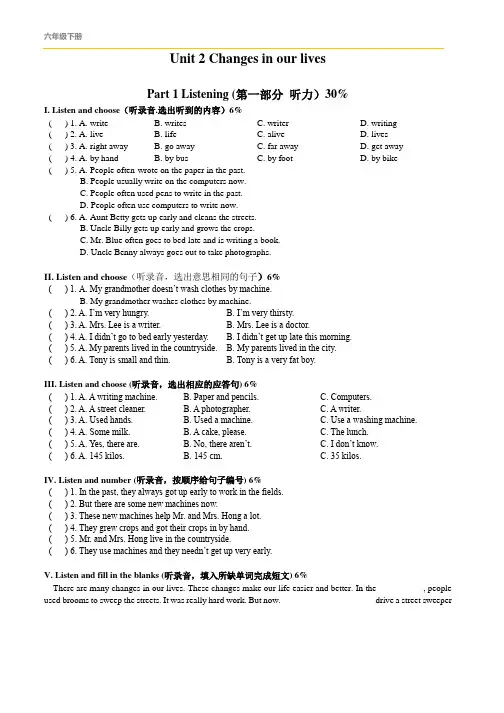
Unit 2 Changes in our livesPart 1 Listening (第一部分听力)30%I. Listen and choose(听录音.选出听到的内容)6%( ) 1. A. write B. writes C. writer D. writing( ) 2. A. live B. life C. alive D. lives( ) 3. A. right away B. go away C. far away D. get away( ) 4. A. by hand B. by bus C. by foot D. by bike( ) 5. A. People often wrote on the paper in the past.B. People usually write on the computers now.C. People often used pens to write in the past.D. People often use computers to write now.( ) 6. A. Aunt Betty gets up early and cleans the streets.B. Uncle Billy gets up early and grows the crops.C. Mr. Blue often goes to bed late and is writing a book.D. Uncle Benny always goes out to take photographs.II. Listen and choose(听录音,选出意思相同的句子)6%( ) 1. A. My grandmother doesn’t wash clothes by machine.B. My grandmother washes clothes by machine.( ) 2. A. I’m very hungry. B. I’m very thirsty.( ) 3. A. Mrs. Lee is a writer. B. Mrs. Lee is a doctor.( ) 4. A. I didn’t go to bed early yesterday. B. I didn’t get up late this morning.( ) 5. A. My parents lived in the countryside. B. My parents lived in the city.( ) 6. A. Tony is small and thin. B. Tony is a very fat boy.III. Listen and choose (听录音,选出相应的应答句) 6%( ) 1. A. A writing machine. B. Paper and pencils. C. Computers.( ) 2. A. A street cleaner. B. A photographer. C. A writer.( ) 3. A. Used hands. B. Used a machine. C. Use a washing machine.( ) 4. A. Some milk. B. A cake, please. C. The lunch.( ) 5. A. Yes, there are. B. No, there aren’t. C. I don’t know.( ) 6. A. 145 kilos. B. 145 cm. C. 35 kilos.IV. Listen and number (听录音,按顺序给句子编号) 6%( ) 1. In the past, they always got up early to work in the fields.( ) 2. But there are some new machines now.( ) 3. These new machines help Mr. and Mrs. Hong a lot.( ) 4. They grew crops and got their crops in by hand.( ) 5. Mr. and Mrs. Hong live in the countryside.( ) 6. They use machines and they needn’t get up very early.V. Listen and fill in the blanks (听录音,填入所缺单词完成短文) 6%There are many changes in our lives. These changes make our life easier and better. In the __________, people used brooms to sweep the streets. It was really hard work. But now. __________ __________ drive a street sweeperto clean the streets. I usually watched programs on TV, but now I never watch them on TV, because I can __________different programs on my __________. I’m a writer. I also write my books on it. Computers make my life fantastic. I __________in the future there will be more new things and t hey’ll help people a lot.Part 2 Reading and Writing (第二部分读写)60%I. Read and judge (判断下列各组单词划线部分的发音是否相同,相同的打“√”,不同的打“×”) 6%1. blow coat ( )2. house flower ( )3. hole crop ( )4. new grow ( )5. digital green ( )6. machine chair ( )II. Look and write (根据图意,填上适当的单词完成句子) 61. Little Match Girl is a p_____ girl. She has nothing to eat.2. The s_____ are very quiet in the early morning.3. Snow White and the seven dwarfs (矮人) had a happy 1_____4. I really like tennis. I am a tennis f_____.5. Do you want to go to the t_____ w ith me?6. My uncle d_____ a bus every day.III. Read and write (用所给单词的适当形式填空) 8%1. In the past, there __________ (be) a river near my home. Now there __________ (be) some tall buildings.2. __________ you __________ (sweep) the floor yesterday?3. __________ (farm) Wang grows vegetables.4. I’m tired. I would like to __________ (take) a rest.5. Don’t use that cup. It’s __________ (my).6. Sam usually __________ (go) to bed early, but yesterday he__________ (go) to sleep late.IV. Read and choose (选择填空) 10%( ) 1. The machine is helpful. It can clean the floor______.A. in the pastB. in a short timeC. in a long time( ) 2. I don’t like machines. I always do the washing ______.A. every dayB. by handC. by machine( ) 3. Long long ago, there ______ a lot of wild birds here.A. areB. wereC. is( ) 4. — How much do you weigh? —______A. 5 kilos.B. 500 kilos.C. 50 kilos.( ) 5. In the story, a fairy is ______.A. a beautiful ladyB. an ugly womanC. a handsome man( ) 6. — Helen, this new computer is for you. — ______A. How fun!B. How fantastic!C. How exciting( ) 7. I can’t find my broom, but it ______ here.A. wereB. wasC. is( ) 8. —How do you go to work every day? —______A. Take a bus.B. In the morning.C. On a bus.( ) 9. What do you usually do ______?A. nowB. after workC. yesterday( ) 10. I like using the digital camera, because______.A. it can take photosB. I can see the photos right awayC. it’s a good oneⅤ. Read and write(用适当的介词填空)6%1. Please take the photos ______ your new camera.2. My parents smiled ______ each other.3. I like washing my clothes ______ hand.4. We always enjoy ourselves ______ the weekend.5. My friend Peter has a house ______ a swimming pool.6. Would you like to go there ______ foot?Ⅵ. Rewrite the sentences (按要求改写下列句子) 7%1.People wrote letters on paper in the past. (改成一般疑问句)___________________________________________________________________________________________________ 2. Mr. White is a photographer. (对划线部分提问)___________________________________________________________________________________________________ 3. I was 100 days old in this photo. (对划线部分提问)___________________________________________________________________________________________________ 4. There was a lake in the village before. (对划线部分提问)___________________________________________________________________________________________________ 5. A street sweeper can clean the streets quickly. (对划线部分提问)___________________________________________________________________________________________________ 6. I would like to see a film. (另写一句,但意思不变)___________________________________________________________________________________________________ 7. Mr, apples, Lee, a, to, knife, cut, use, the (连词成句)___________________________________________________________________________________________________ VII. Read and match (读一读,把问答句配对) 6%( ) 1. Does your mother wash clothes by hand? A. I don’t know. But maybe they use a machine.( ) 2. You can make a wish on your birthday day. B. Yes. And I also take photos with my mobile (手机). ( ) 3. How does a farmer plant and get in crops? C. No. But there was a nice river outside the city.( ) 4. Was there a beautiful lake in the city? D. I don’t need any wishes, but thank you anyway.( ) 5. Do you take photographs with a camera? E. Usually. I rarely use pens and paper now.( ) 6. So you write on your computer? F. Oh, no. She used hands to wash clothes in the past. VIII. Read and choose (读一读,选择适当的句子完成对话) 5%Sam: Hi, Peter. ___1___Peter: Yes, it was a wonderful film.Sam: Really? What is the film about?Peter: ___2___Sam: Sounds interesting! So what changes did the film tell?Peter: A lot. For example, people rode horses or walked to a far place.Sam: ___3___Peter: Yes. There weren’t any mobile phones before.Sam: But now we can talk, read and watch TV on a mobile phone.Peter: ___4___ Inventions change our life.Sam: And make our life better! I want to see the film too!Peter: ___5___Sam: I think so.IX. Writing (请你写一写生活中,过去和现在有什么不一样,不少写六句) 6%In the past, people watched black and white TV. Now people watch color TV._______________________________ ___________________________________________________________________________________________________ ___________________________________________________________________________________________________ ___________________________________________________________________________________________________ ___________________________________________________________________________________________________ ___________________________________________________________________________________________________Part 3 Speaking (第三部分口语)10%I. Read aloud (朗读下列句子) 5%1. A photographer takes photos with digital cameras now.2. Fred and Doris smiled at each other and went away.3. I wish you a happy Spring Festival.4. There’s a poor farmer called Henry.5. Mrs. Hong got her crops in by hand in the past.II. Answer the question (回答问题) 5%1. Were you thin in the past?2. Do you live in the city or in the countryside?3. How does your mother wash dishes?4. What does a photographer do?5. What did people use to write in the past?Unit2 Changes in our livesPart 1 Listening (第一部分听力)I. Listen and choose (听录音, 选出听到的内容)1. In the future, I want to be a write. (C)2. There are a lot of changes and the life is better. (B)3. I will give you the book right away. (A)4. In the past, people usually went to work by bike. (D)5. People often use computers to write now. (D)6. Mr Blue often goes to bed late and is writing a book. (C)II. Listen and choose (听音,选出意思相同的句子)1. My grandmother likes washing clothes by hand. (A)2. I would like a glass of water. (B)3. Mrs Lee writes stories for children. (A)4. I went to bed very late last night. (A)5. My parents liked their old home. There were rivers and hills nearby. (A)6. Tony is 145 cm tall and weighs 60 kg. (B)III. Listen and choose (听录音,选出相应的应答)1. What did people use to write in the past? (B)2. Mr Wang drives a street sweeper. What’s his job? (A)3. How does your mother wash clothes? (C)4. What would you like to eat? (B)5. Are there many changes in our lives? (A)6. Alice is 10 years old. How much does Alice weigh? (C)IV. Listen and number (听录音,按顺序给句子编号)Mr and Mrs Hong live in the countryside. In the past, they always got up early to work in the fields. They grew crops and got their crops in by hand. But there are some new machines now. These new machines help Mr and Mrs Hong a lot. They use machines and they needn’t get up very early.(2,4,5,3,1,6)V. Listen and fill in the blanks (听录音,填入所缺单词完成短文)There are many changes in our lives. These changes make our life easier and better. In the past, people used brooms to sweep the streets. It was really hard work. But now, street cleaners drive a street sweeper to clean the streets. I usually watched programs on TV, but now I never watch them on TV, because I can watch different programs on my computer. I’m a writer.I also write my books on it. Computers make my life fantastic. I wish in the future there will be more new things and they’ll help people a lot.Part 2 Reading and writing (第二部分读写)I. 1. ✓ 2. ✓ 3. ✕ 4.✕ 5.✕ 6.✕II. 1. poor 2. streets 3. life 4. fan 5. theatre 6. drives III. 1. was, are 2. Did, sweep 3. Famer 4. take 5. mine 6. goes, went IV. 1. B 2. B 3. B 4. C 5. A 6. B7. B 8. A 9. B 10. BV. 1. with 2. at 3. by 4. at 5. with 6. onVI. 1.Did people write letters on paper in the past?2. What is Mr White?/What does Mr White do?/What is Mr White’s job?3. How old were you in this photo?4. How many lakes were there in the village before?5. What can a street sweeper do?6. I want to see a film.7. Mr Lee uses a knife to cut the apples.VII. 1. F 2. D 3. A 4. C 5. B 6. EVIII 1. E 2. A 3. D 4. B 5. C六年级下册。
沪教牛津小学英语六年级下册Unit 1 You and me 课件
沪教牛津小学英语六年级下册Unit 1 You and me 课件介绍本文档是沪教牛津小学英语六年级下册Unit 1的课件,主题为“You and me”。
本课件旨在帮助学生学习和掌握与“我”和“你”相关的英语表达方式,包括人称代词和相关的句型。
1. 课程目标本节课的目标是让学生了解并能正确使用人称代词me和you,并掌握相关的句型结构。
2. 课程内容2.1. 人称代词me和you•me: 表示“我”,常用于作为宾语。
•you: 表示“你”,可用作主语和宾语。
2.2. 句型本节课将学习以下两种句型: 1. I help you. 2. You help me.2.3. 课堂互动通过配对练习和角色扮演,让学生在实际交流中练习使用新学到的句型和人称代词。
3. 课程步骤3.1. 导入新知识•利用图片或实物引导学生讨论“me”和“you”的含义。
•通过示例句子展示人称代词的用法。
3.2. 学习新知识•介绍“I help you.”和“You help me.”两个句型,让学生理解句子的含义和结构。
•引导学生朗读示例句子,并模仿朗读。
3.3. 练习活动•学生分为小组,进行配对练习,用“I help you.”和“You help me.”造句。
•随机抽取学生上台展示造句,让其他学生评判句子的正确性。
3.4. 角色扮演•学生分成小组,演示日常生活中使用新句型和人称代词的情境,如互相帮助做作业、一起打扫教室等。
3.5. 总结和评价•总结本节课学到的新句型和人称代词,让学生给自己打分评价。
•提问学生在日常生活中如何使用新句型和人称代词。
4. 课后练习4.1. 书面练习•在作业本上完成填空练习,补充句子中适当的人称代词me或you。
•写出五个句子,使用新学的句型“I help you.”或“You help me.”。
4.2. 口头练习•学生自行组织小组活动,进行对话练习,使用新学的句型和人称代词。
5. 总结通过本课件的学习,学生了解和掌握了人称代词me和you 的用法,并能正确运用在句子中。
牛津上海版(深圳)英语六下Module 1 Unit 1《You and me》课件1
Think and say
What do you know about your friend?
appearance abilities interests hobbies …
Read aloud
Joe is visiting his cousin George in the countryside.
Ask and answer
1. What does George usually do after school? He usually plays basketball and table tennis after school. 2. What does Joe usually do after school? He usually plays football after school. 3. What does George sometimes do? He sometimes goes fishing with his grandpa. 4. Does Joe often go fishing? Why or why not? No, he doesn't go fishing often because there’s no river near his home.
Joe: George, how tall are you? George: I’m 152 cm tall. What about you? Joe: I’m 150 cm tall. George: Oh, I’m 2 cm taller than you.
How much do you weigh? Joe: I weigh 47 kg. What about you? George: I weigh 40 kg. Joe: Oh, I’m 7 kg heavier than you. George: Do you meet the standard? Joe : No, I don't. I’m a little overweight.
牛津上海版英语(深圳用)六年级下册Module 1 Unit 1 You and me Period 1课件
>>Practice say
George: Sometimes I go fishing with my grandpa. Joe: How exciting! I don't go fishing often. There's no river
near my home. George: But you can go to museums. That's fantastic!
George
Joe
>>Presentation Look and learn
How tall is Joe/George? Joe is 150 cm. George is 152 cm.
cm = centimetre
>>Presentation Look and learn 1 centimetre
Make and say
>>Practice
Name: ___________________ Age: ____________________ Height(cm): _______________ Weight(kg): _______________ Hobbies: _________________
1 metre 1 metre = 100 centimetres
>>Practice Ask and answer
A: How long is your...? B: My ... is ... centimetres long.
>>Presentation Look and learn
kilogram= kg
>>Summary
(完整版)上海版牛津英语六年级下册6B重点知识点复习整理(最新整理)

(完整版)上海版牛津英语六年级下册6B重点知识点复习整理(最新整理)上海版牛津英语六年级下册6B重点知识点复习整理Module 1 City LifeUnit 1 Great cities in Asia【知识点梳理】1.方位词:east / west / north / south / north-east / north-west / south-east / south-west用法:a. 两地不相邻: e.g. A is north B. (= to the south of)b. 两地接壤: e.g. A is on the north of B.c. 所属关系,A包含B, B属于A: e.g. B is in the north of A.2. by + 交通工具表示“乘……交通工具”, 用how进行提问e.g. by bus / ferry / train / ship / underground… by plane = by air, by ship = by sea3. How far…多远(询问距离的远近,路程的长短)e.g. Hoe far is it from your home to school? 从你家到学校有多远?4. How long…多长,多久(询问时间的长短,提问一段时间)e.g. How long does it take to travel from Shanghai to Beijing by train? 坐火车从上海到北京要花多长时间?5. It takes (sb.) some time to do sth. 做某事需要花费多少时间e.g. It takes me five hours to make this modal plane. 做这个模型飞机花了我5个小时。
6. like / love / enjoy doing sth. 喜欢做某事e.g. The people in Bangkok like / love / enjoy eating spicy food. 曼谷人喜欢吃辛辣食物。
牛津上海版英语六年级上学期Module 1 Family and friends Uni

• Before going on a trip with your family or friends, what do you need to think about first?
• When? • What time? • Which place? • How to get there? • How much?
How are we going to get there?
Let’s go by ; v.原形…
How much does it cost? 将要做…
taking a bus to Ocean Park
When are we going to come back?
10:00 = 10 a.m. = 10 o’clock in the morning
Listening and speaking: Planning a visit
Unit 3 Spending a day out together
• Have you been on a one-day trip (旅行) with your • Wfamheilrye?do you usually go on a trip with your family? • Where do you usually go on a trip with your friends?
Plan (计划) a trip !
• date • time • place • way • cost
/kɒst/ v. 花费 n. 花费
• What do they talk about?
• When? • What time? • Which place? • How to get there?
沪教牛津版深圳小学英语六年级下册-M1U1《You-and-me》ppt课件第二课时
They like to walk or ride their bikes.
4.What do farmers do in the countryside?
They plant crops in spring. Then in autumn, they get the crops in.
April … name …
…
11
Sounds
12
Culture corner
I’m from South America.
I’m from Europe.
I’m from Asia.
I’m from Africa.
I’m from North America.
13
Homework
Finish the chart.
What’s in the city or countryside?
City
Countryside
14
15
4
Read and repeat
Welcome to my hometown!
5
Read and answer
1.Where does Joe live?
He lives in the city.
2.What’s in the city?
There are a lot of tall buildings. There are a lot of shops and restaurants too.
3.How do people go to work?
They go to work by car, bus or underground.
牛津上海(上海本地版)六年级上册Module 1 Family and friendsunit 1 Family and relatives教案
6A Module 1 Family and friendsUnit 1Family and relativesFirst PeriodLanguage Targets : 1. Vocabulary: granddaughter, grandson, cousin2. Function:Using demonstratives to refer to peoplee.g., These are my family and relatives. This is mygrandfather.3. Talking about one’s family and relatives.Ability Targets: Students should respect their and love their family members and relatives.Listening: Listen for specific information.Reading: Identify details that support a main idea.Writing: Write out a piece of work by presenting writing using appropriate layout and visual support including charts.Emotion Targets:Language focus: Using demonstratives to refer to peoplee.g., These are my family and relatives. This is mygrandfather.Materials: 1. Cassette 6A and a cassette player.2. Workbook 6A pages 1 and 2.3. Students’ Book 6A page 2Second PeriodLanguage Targets: 1. Vocabulary: present, only, member,2. Function:1) Using demonstratives to refer to peoplee.g., This is my grandfather. These are my uncles.2) Asking How questions to find out quantitye.g., How many uncles do you have?3. Writing greetings cards.Ability Targets:Listening: Listen for specific information.Speaking: Maintain an interaction by replying and asking questions. Reading: Read written language in meaningful chunks.Writing: Gather and share information by using strategies such as questioning and interviewing.Emotion Targets:Students should respect their and love their family members and relatives.Language focus: 1) Using demonstratives to refer to peoplee.g., This is my grandfather. These are my uncles.2) Asking How questions to find out quantitye.g., How many uncles do you have?Materials: 1. Cassette 6A and a cassette player.2. Workbook 6A pages 3 and 5.3. Students’ Book 6A page 4Third PeriodLanguage Targets: 1. Vocabulary: else, play badminton ,always, usually, sometimes2. Function:1) Using adverbs of frequencye.g., I usually go shopping with my aunt.2) Using the simple present tense to describe habitual actions.e.g., I sometimes play badminton with her.3) Using pronouns to identify people.e.g., What else do you do with her?3. Talking about family leisure activities and frequency.Ability Targets:Listening: Listen for specific information.Speaking: Maintain an interaction by replying and asking questions.Reading: Identify derails that support a main idea.Emotion Targets: Students can realize how to deal with each other well and get on well with each other.Language focus: 1) Using adverbs of frequencye.g., I usually go shopping with my aunt.2) Using the simple present tense to describe habitual actions.e.g., I sometimes play badminton with her.3) Using pronouns to identify people.e.g., What else do you do with her?Materials: 1. Cassette 6A and a cassette player.2. Workbook 6A pages 43. Students’ Book 6A page 5Teaching steps:Fourth PeriodLanguage Targets: 1. Using demonstratives to refer to peoplee.g., This is my grandfather.2. Using adverbs of frequency.e.g., I always …with….3. Writing something about your family and relatives. Ability Targets:Listening: Listen for specific information.Speaking: Maintain an interaction by replying and asking questions.Writing: Write a piece of work using appropriate layout and visual support including photos.Language focus: 1. Using demonstratives to refer to peoplee.g., This is my grandfather.2. Using adverbs of frequency.e.g., I always …with….Materials: 1. Cassette 6A and a cassette player.2. Workbook 6A pages 6 and 7.3. Students’ Book 6A page 6。
六年级下册英语一课一练-Module 1 Unit 2 At the airport同步练习1 牛津上海版一起含解析
牛津上海版(试用本)2018-2019学年小学英语六年级下册Module 1 Unit 2 Atthe airport同步练习1一、Translate the following phrases into English (将下列词组翻译成英语)1.将下列词组翻译成英语(1)大量的空间________(2)足够的空间________(3)打包行李________(4)几条真丝围巾________(5)一次去洛杉矶的旅行________(6)机票________(7)很多T恤衫________(8)计划待在那里________二、Choose the best answer (选择最恰当的答案)2.Do you know there is airport in Pu dong New Area?A.aB.anC.theD./3.— Have you packed your suitcase ?— Yes, I have.A.alreadyB.everC.justD.yet4.Mum, you can put your things in this bag. There is space in it.A.littleB.muchC.manyD.a few5.—Have you read today's newspaper?— There is in it.A.something importantB.important somethingC.important anythingD.anything important6.Mr. and Mrs. Brown in England for three years.A.liveB.livedC.has livedD.have lived7.His plane will arrive at the Pudong Airport in two hours. The underlined part means " ".A.reachB.getC.arrive inD.get in8.The blue T-shirt is expensive, but that yellow is cheap.A.onesB.itC.oneD.T-shirts9.My home is far from school, so I often my bicycle to school.A.getB.takeC.rideD.by10.In the past, people information on the Internet.A.travelC.travelledD.travelling11.— Would you like something to eat?—I want to eat some apple pies.A.Yes, please.B.Yes, I would.C.Yes, thanks.D.Yes, give me.三、Complete the sentences with the given words in their proper forms (用括号中所给单词的适当形式完成下列句子。
六年级下册英语Module 1 Unit 3 Our school in the future 牛津上海版(三起)
(1)I got up at about 6 in the morning last Saturday. ( F ) (2)I did some exercise last Sunday. ( F ) (3)I made some egg pies by myself. ( T ) (4)We played cards last Sunday. ( T ) (5)Mike was so sad. (T )
Sally's school is big. The playground is big. Students can run and play there. The library is big and new. Students can read all kinds of books in it. There is a garden. But it is very small.
A. will gives
B. will give
C. gives
5. In the future, school will __C__ different.
A. is
B. are
C. be
6. Robot will help us __A__ books in the library.
A. find
wing
6. bank
back
7. in
ink
8. seem
sing
Play a game
watch TV
go shopping
sing songs
take photos
every day yesterday next week now
I
they
he