
译林版英语四年级《Unit4 I can play basketball》
• 58•课例•评点译林版英语四年级《Unit4I canplay basketball》江苏省盐城市实验小学丁莹执教江苏省盐城市第一小学教育集团邰霞评析教材简析本单元主要学习如何询问他人是否会做某项运动,要求学生会说一些体育运动basketball,football及一些表示动作的单词 jump,skate,swim 等。
本课通过 Mike,Wang Bing,Liu Tao在学校篮球场上的活动及对话要求学生能够运用句型Can you... ?和答句 Yes,I can.No,I can’t,并理解11^狂- bout you? Have a try.I can play basketball well。
能够运用各种不同的表达如Nice,Cool,Great等来进行赞美。
目标预设1.能够通过对课文情节的梳理,让学生记住故事内容,并 能正确朗读。
2.能听懂、会说、会读单词basketball,football,jump,swim,well,have a try。
3.初步理解、会说、会读句型。
Can you...Yes,I can.No,I can’t.Can Mike play basketball?Yes,he can.He can play basketball very well.4.能够知道如何用Nice,Cool,Great来表达自己的赞美,同时也要知道如何回应赞美;能够通过图片记忆Stoy time的故事情节,并最终明白就是“eeryne”。
5.引导学生使用礼貌用语。
教学重点1.能够通过图片记忆Story time的故事情节,并能复述故事。
2.能听懂、会说、会读句型。
1)告诉别人会做某事的句型:c n...2)询问对方或他人是否会做某事的句型及其答语。
C a you... ? Yes,I can.No,I can’.教学难点1.能听懂、会说、会读表示称赞或者欢呼的句子。
Nice!Very well!Cool!Great!Yeah!2.当你想让别人尝试一下时会说:Have a try.设计理念在教学中,教师主要采用任务型教学和情景式教学相结合的教学方式。
将本课的教学目标分配到多个具体的活动任务当中,使学生在使用英语完成任务的同时,在不知不觉中学会英语,更主要的是培养学生在完成任务的过程中提高运用英语的学习紧迫感。
另外,教师要为学生创设较为真实的语言情景让学生运用所学的知识,使学生感受到如临其境,触景生情。
设计思路教学开始教师通过与学生的交流引出baketball从而揭题,并创设篮球场的场景,通过数次不同形式的阅读引导帮助学生完成课文的学习。
教学过程课前,Let’s enjoy!播放歌曲《I can skate and I can jump》Stepl.Warming up1.Greetings.2. Free talk.A.Nice to meet you,class.Hello/Hi/Good morning/Tm veryhappy to be your new teacher today.Are you happy too?B.Brain storming.T:Look at these pictures (课件出示 run,eat,sleep,openthe door...等单词),do you remember? Try to say some words.(播放课件)T:Now,I can say “drink”“open the books”. other ones?(课件出示“p o t a d activities”,教师的表扬语尽可能用上 Nice!Cool!Great!Wonderful!并适时板书。
)Step2. Presentation1.呈现新单词 jum p,swim,play football,play basketball.Let’s share the video!Can you say some sports names?教师播放里约奥运会的一些精彩的片段,并问:What c nthey do?(看到了哪些“运动名称”?)并板书新单词。
2.教授单词 jump,swim,play football,play basketball。
老师用简笔画呈现单词,领读并请几位同学试着做出对应的动作。
Jump:两人一组以开火车的形式读;Swim:男生女生读;Football:组内齐读;Basketball:全班跟读;3.揭题。
T:手持一■个小篮球,Look,It’s a toy basketball.I can play basketball.(朝篮筐里投篮)Today,We’ll learn Unit4 I can play basketball.(领读)Step3.Reading1. 看课题,思考。
T:手指课题中T,并问:Who am “I”?S进行猜测。
2. 看图片,获取信息。
课件出示(出示书上的一幅图片)。
(1) Who are they?学生回答。
教师在黑板上适时贴上•59 •Wang Bing,Liu Tao,Mike 等的头饰。
(2) Where ?(3) What else can you see ?3. Watch and say .T : Can they play basketball ? S :...T : Are you right ? Let’s watch !(播放课文的动画)4. 处理第一幅图片。
学牛更好地理解)Let’s open your books and read Pic 3 and Pic 4by yourselves .S :自读课文。
T : Howdo you know ? Please underline the sentences .课件第三、四幅图,画出答案并请1 ~2位学生说一说句子。
(2)处理 Have a try !T :(手指第三幅图)Look,Can he play basketball ?(1) Read and underline .S : No .T : First , Can W . B play basketball ? S :...T : How do you know ? Please underline the sentences . How to ask and answer ?(课件第一幅图,画出答案)S :...(教师贴笑脸 So ,W . Bean play basketball .)教师问学生:Can you play basketball ?S : Yes ,I can . No ,I can’t .(领读,板书)(2)利用不同的方式操练句型。
T : Is he happy ?S : No .教师贴哭脸。
T : Who can read the sentence “No,I can ’t . ” 请几位学生有 感情地读一读。
T : LT is not happy ! How do WB and Mike encourage him ? S : ...T :领读 Have a try ! I you were Mike and L T ,What should A . Boys : Can you play basketball ?Girls : Yes , I can .S : Can you play basketball ?T : No,I can ’t .c .学生开火车逐一问答。
(用小篮球互动,教师适时用赞美的词表扬)(3)学会礼貌用语并补充第一幅图。
T : look at this dialogue . Do you want to be polite children ?Please make some sentences .S :Good morning,Good afternoon ,Hi,Hello ...5.处理第二幅图。
you do ?(3)情感升华。
T : Thank you . At last,LT can play basketball .T : Is he happy now ?S : Yes .(教师板书变哭脸为笑脸)T:So we should believe ourselves . I believe,I can .()跟读并表演第三、四幅图。
A . Let’s follow the tape .在跟读的过程中,教师特别是表达人物情感的句子,采用齐读、单个读、开火车读等方式,教师并 适时对学生进行表扬。
B . Can you act in roles ?学生表演,教师适时进行鼓励。
(1) Read and underlineT : Can Mike play basketball ? (Mike 的头饰移到板书的句型中,让学生更好地理解)S : ...T : How do you know ? Please underline the sentences .课件第2幅图,画出答案,并请1 ~2位学生读一读句子。
Step . Read the whole story 1. Read together .2. Dub .教师分配好角色,学生配音。
Redy ? Let ’go ! Step 5. Consolidations1.示范。
(2)处理 wellT : You did very well in the story time .老师手指黑板:To -T : How does Mike play ? He can play basketball very well . Well means “great ” /‘wonderful ’’ !day,we learn some new sentences and words . Let’suseour lives ? Look , Here are 4 scenes .课件出示场景 1,2,Can you make a sentence to use “ well ” ? ________ can ________well .T :So , Mike can play basketball .并贴上笑脸。
(3)跟读并表演一、二两幅图。
A . 跟读Let ’ follwthe tape .在跟读的过程中,教师特别 要注意人物的情感。
采用齐读、单个读、开火车读等方式,教师并适时对学生进行表扬。
B . 表演 Can you act in roles ? Don’t forget to be a politechid .学生表演,教师进行评价。
四年级上册英语教案 -Unit4 I can play basketball 译林版(三起)

四年级上册英语教案 - Unit4 I can play basketball一、教学目标1.听、说、读、写本单元的重点单词和句子。
2.能够简单地介绍运动员的运动项目。
3.了解体育运动对健康的重要意义。
二、教学重点1.掌握本单元的生词和句式。
2.学会描述运动员的运动项目。
3.理解运动对健康的积极影响。
三、教学难点1.有意识地运用本单元的词汇和句式描述运动员的运动项目。
2.理解体育运动对身体健康的作用。
四、教学准备1.教师准备:–课件、投影仪;–电子白板、PPT或黑板等;–课件屏幕上显示课文图片和相关单词;–拥有一些关于运动员的PPT或视频资料。
2.学生准备:–学生预先准备好笔、文具等。
–熟悉本单元的生词和句式。
五、教学过程1. 教学引入用本单元的生词和图片,让学生们猜测运动会的题目。
例如:basketball、swimming等,并让学生说出自己喜欢的运动项目。
然后介绍本单元的课文主题。
2. 新学内容1.听课文教师播放课文音频,并指导学生重点听词句,注意语音语调。
之后就可以请学生跟读课文并讨论其中的生词和句子。
2.完成课文填空活动让学生阅读课文并用合适的词填空。
3.学习重点单词及句式在本单元中,我们学习表示运动员运动项目的单词和短语,如play basketball、swim、run等。
同时要学会句式“I can play…”和“Can you play…” 的用法。
4.观看运动员赛场视频播放关于运动员的视频让学生了解各种不同的运动项目以及运动员之间的友谊比赛。
3. 学习活动1.小组讨论请学生分组讨论自己喜欢的运动和运动员。
让学生彼此相互分享自己的想法。
2.语言学习活动让学生根据给出的单词或句型描述一个运动员的运动项目,还可要求学生以句子形式进行发言。
4. 课堂巩固1.游戏掌握课文句子顺序教师把故事中的句子分成若干小组并打乱序列,然后让学生将其重新排序。
2.判断正确或错误给出一些运动员的图片和运动项目,让学生判断该运动是否属于该运动员,并对正确或错误表示。
译林版四年级上Unit 4 I can play basketball
Unit 4 I can play basketball夯实基础一、掌握词汇:1. basketbal篮球2.well好3.yeah是的,对的4. football足球5. jump跳6.skate溜冰;滑冰7.swim游泳8. quack(鸭子的)呱呱声9. tweet(小鸟的)叽喳声10.fy飞11.ouch哎呦12.sad难过的,伤心的13. either也二、掌握词组:1. play basketball打篮球2. very well 很好,非常好3. have a try试一试4. play football踢足球5. look at me看我6. can’t fly不会飞7. be sad伤心8. five funny boys五个有趣的男孩9. five footballs五个足球三、掌握重点句型:1. Can you play basketball? Yes, I can./No, I can’t.你会打篮球吗?是的,我会。
/不,我不会。
2. I can play football. I can’t play basketball.我会踢足球。
我不会打篮球。
3. She can skate. She can’t swim.她会滑冰。
她不会游泳。
4. He can run and swim. He can’t play football.他会跑步和游泳。
他不会踢足球。
5. He can play basketball very well. 他能打篮球打得非常好。
6. Can Tom play football? Yes, he can./No, he can’t.汤姆会踢足球吗?是的,他会。
/不,他不会。
7.Can Lucy swim? Yes, she can./No, she can’t.露西会游泳吗?是的,她会。
/不,她不会。
8. Have a try. 试一试。
9. I’m eleven years old. 我十一岁。
译林版(三起)四年级上册英语教案:Unit 4 I can play basketball
译林版(三起)四年级上册英语教案:Unit 4 I can playbasketball教材分析教材内容本单元主要包含以下的内容:1.新词汇:basketball, soccer, baseball, volleyball, ping-pong, tennis, badminton。
2.语言目标:掌握表示运动的动词短语“playbasketball/soccer/baseball/volleyball/ping-pong/tennis/badminton”;掌握动词短语与“I can”结合使用的句子结构。
3.语音特点:介绍选手罗纳尔多,学习用他的口音读单词soccer。
4.语言功能:了解不同的运动项目,询问和回答自己会打哪些球类运动。
教学目标通过本单元的学习,使学生掌握以下几个方面的知识和能力:1.掌握表示运动的动词短语“playbasketball/soccer/baseball/volleyball/ping-pong/tennis/badminton”。
2.掌握动词短语与“I can”结合使用的句子结构。
3.能够用英语简单介绍罗纳尔多和用他的口音读单词soccer。
4.了解不同的运动项目,并能够询问和回答自己会打哪些球类运动。
教学准备1.教材:译林版(三起)四年级上册英语教材。
2.教具:录音机、幻灯片、单词卡片、体育用品图片等。
3.环境:教室。
教学过程Step 1 Warm-up1.Greetings and self-introduction.2.Listen to and sing the “Hello” song.3.Look at the teacher’s picture of Ronnie and learn how to pronounce “soccer” like him.4.Review the names of some ball games and learn some new ones.Step 2 Presentation1.Listen to the teacher’s introduction of Ronnie and soccer.2.Look at the picture on the textbook of Ronnie and soccer.3.Listen to the teacher’s explanations of different ball gam es.4.Learn the new words and phrases: basketball, soccer, baseball, volleyball, ping-pong, tennis, badminton.Step 3 Practice1.Play the “What’s missing?” game: Put some sports equipment on the table and ask the students to close their eyes. Remove one item and get them to guess which item is missing.2.Play the “What’s this?” game: Show pictures of different ball games and ask the students to guess which game it is.3.Play the “Matching game”: Match the words with the pictures on the board.4.Play the “Teacher says” game: The teacher says “Play soccer” and the students have to play soccer; if the teacher says “Play basketball”, the students have to play basketball.Step 4 Production1.Ask the students to work in pairs and take turns to ask and answer which sports they can play.2.Ask some students to share their conversations with the class.Step 5 Feedback1.Review the new words and phrases.2.Review the sentence structure of “I can play…”.3.Review the names of different ball games.教学扩展1.Sing the “Let’s Go” song to learn some action verbs.2.Watch and discuss a video of a ball game, and describe the game in English.3.Research and learn about some famous sports stars from different countries and write about them in English.总结本单元教学主要围绕运动球类和动词短语“playbasketball/soccer/baseball/volleyball/ping-pong/tennis/badminton”展开,通过多种方式让学生学习、掌握相关知识。
小学英语四年级上册知识梳理Unit 4I can play basketball(译林版三起含答案)
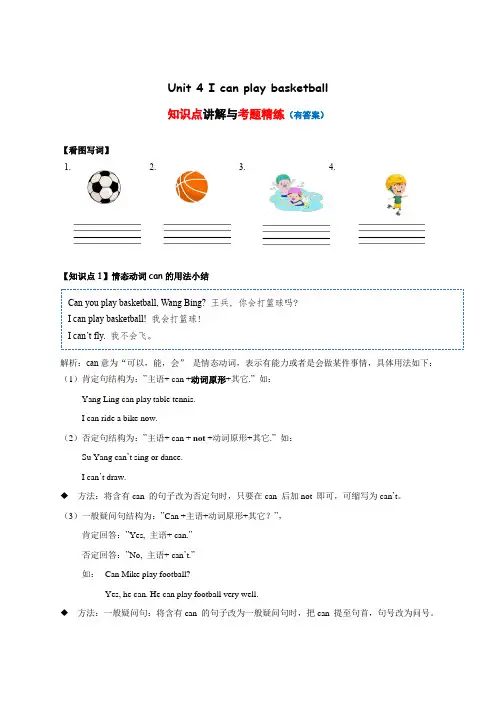
Unit 4 I can play basketball知识点讲解与考题精练(有答案)【看图写词】1. 2. 3. 4.【知识点1】情态动词can的用法小结Can you play basketball, Wang Bing? 王兵, 你会打篮球吗?I can play basketball! 我会打篮球!I can’t fly. 我不会飞。
解析:can意为“可以,能,会”是情态动词,表示有能力或者是会做某件事情,具体用法如下:(1)肯定句结构为:”主语+ can +动词原形+其它.”如:Yang Ling can play table tennis.I can ride a bike now.(2)否定句结构为:”主语+ can + not +动词原形+其它.”如:Su Yang can’t sing or dance.I can’t draw.◆方法:将含有can 的句子改为否定句时,只要在can 后加not 即可,可缩写为can’t。
(3)一般疑问句结构为:”Can +主语+动词原形+其它?”,肯定回答:”Yes, 主语+ can.”否定回答:”No, 主语+ can’t.”如:--Can Mike play football?--Yes, he can. He can play football very well.◆方法:一般疑问句:将含有can 的句子改为一般疑问句时,把can 提至句首,句号改为问号。
(4)特殊疑问句结构为:“特殊疑问词+ can引导的一般疑问句?”。
如:What can your brother do?Who can open the door?·易错点提醒:can后接动词原形,不随主语人称或数的变化而变化。
【考题精练1】一、单项选择。
( ) 1. —________ play football? —No, he can’t.A. Can JackB. Can youC. Does Mike( ) 2. —Can you run fast? —________A. Yes, I can’t.B. No, I can.C. Yes, I can.( ) 3. Ducks can ________.A. to swimB. swimC. swims( ) 4. I can ________, but my sister _________.A. skate; doesn’tB. skate; can’tC. to skate; can ( )5. --skate? --Yes, she can.A.Can sheB.She canC.Can Wang Bing ( )6. ----They can play football.A.What can the girl do?B.What can he do?C.What can they do?二、按要求完成句子。
译林版4A_unit4_I_can_play_basketball_story_time_教案

Unit 4 I can play basketballStory time教学目标:1、能用I can …这一句型表达自己能做某事2、能够听懂、会读、会说、会读并能熟练使用Can you …?句型来询问他人是否会做某事,且能用Yes, I can/No, I can’t.来回答。
3、能够正确使用句子:Can he/she…? Yes, he/she can. No, he/she can’t.4、能够理解并正确使用can 和can’t5、能够使用Have a try来鼓励他人。
6、能听懂、会读、会说单词can,can’t ,basketball, football,7、能用nice,cool,great表达自己的感受重点难点:1、能用I can …这一句型表达自己能做某事2、能够听懂、会读、会说、会读并能熟练使用Can you …?句型来询问他人是否会做某事,且能用Yes, I can/No, I can’t.来回答。
3、能够理解并正确使用can 和can’t4、能够正确使用句子:Can he/she…? Yes, he/she can. No, he/she can’t. 教学准备:PPT 单词卡片小图片(多准备几张用来奖励学生)彩色粉笔提前写好课题教学设计:一、GreetingT: Hello, everyone, I’m your English teacher this class. You can call me ‘Miss Dai’. Good morning boys and girls!S: Good morning Miss Dai!T: Thank you. Sit down, please.二、Warming upT: let’s listen to a song. If you remember, please sing together.播放歌曲‘Don’t talk, Tom!’(鼓励学生一起唱)T: Do you remember anything else? (帮助学生回忆run,eat, drink, sleep,shout, 如果学生想起来了,就把单词卡贴在黑板上,没有想起来的,老师做动作引导学生回答)Learn tips: 1这些都是动词。
Unit4 I can play basketball (教学设计)译林版(三起)英语四年级上册

Unit4 I can play basketball (教学设计)一、教学目标1.掌握运动词汇play basketball,了解相关的词汇和口语表达方式。
2.培养学生运动的兴趣和能力,提高团队合作意识。
3.帮助学生学会询问他人是否会打篮球以及询问他人是否愿意一起运动的表达方式。
二、教学准备教材《译林版(三起)英语四年级上册》Unit 4 I can play basketball部分内容、电子白板、PPT课件、篮球等相关道具。
三、教学过程活动1:导入新课1.教师用PPT或电子白板展示篮球图片,以引起学生的兴趣。
2.教师鼓励学生谈论球,鼓励学生分享自己打球的经历。
3.教师根据学生的回答形成课堂情景,进一步引入新课的内容。
活动2:讲解重点词汇1.教师在黑板上列出相关词汇play basketball、basketball、team等,学生跟读并模仿发音。
2.教师解释这些词的含义,并呈现一些相关图片或视频,以增强学生的理解和记忆。
活动3:学习短语表达1.教师将短语can play basketball或I can play basketball写在黑板上,鼓励学生跟读并模仿。
2.教师演示如何使用这些句子询问他人的能力。
3.学生进行模拟对话练习,加强口语表达能力。
活动4:练习运动技能1.教师在教室或操场上组织学生分组进行篮球比赛。
2.教师鼓励学生认真观察比赛,学习防守、进攻等基本技巧。
3.教师引导学生思考合理的战术和团队合作方式。
活动5:总结与归纳1.教师请学生总结一下今天学到的知识,将之前学习重点词汇和短语表达写在黑板上,让学生逐个回忆并总结。
2.学生进行小组讨论,将篮球比赛过程中学到的东西进行归纳整理。
3.小组代表向全班汇报讨论结果,加深学生对知识的理解和记忆。
四、教学评价通过以上课程,学生将能掌握运动相关的基本词汇和短语表达方式,了解篮球基本规则和技巧,以及培养团队合作精神和体育兴趣。
通过对学生的表现、回答情况和练习的水平进行教学评价,以便调整教学策略,并加强学生的实际应用能力。
牛津译林版英语四年级上册 (I can play basketball)新课件
3.It's cute. 它很可爱。
重点句型
4.—Do you like dogs? 你喜欢狗吗? —No, I don't. 不,我不喜欢。
5.Do you like it? 你喜欢它吗? 6.They're cute and fat. 它们又可爱又胖。
Unit 4 I can play basketball
重点单词
1.basketball 篮球 2.football 足球 3.jump 跳 4.skate 溜冰;滑冰 5.swim 游泳
重点单词
6.sad 难过的,伤心的 7.fly 飞 8.well 好 9.can't=cannot 10.yeah 是的,对的
重点句型
4.—Can Tom play football? 汤姆会踢足球吗? —Yes, he can./ No, he can't. 是的,他会。/ 不,他不会。
5.Don't be sad, Bobby.不要伤心,波比。 6.I can't fly either.我也不会飞。
Unit 1
I like dogs
重点单词
1.like 喜欢 2.dog 狗 3.cat 猫 4.panda 熊猫 5.horse 马 6.tiger 老虎
重点单词
7.animal 动物 8.cute 可爱的 9.fat 胖的 10.elephant 大象 11.lion 狮子 12.monkey 猴子 13.have 有
重点短语
重点句型
1.He can play basketball well.他篮球打得好。 2.—Can you play basketball? 你会打篮球吗?
四年级上册英语-Unit 4 I can play basketball 译林版PPT课件
name jump skate swim
Helen
√
play football
play table tennis
play basketball
A: Hello, XXX. Can you …?
B: Yes, I can. / No, I can’t.
Today’s Homework
Read correctly and act the dialogue . 正确朗读并且表演对话。
A.He thinks(认为) he can . B.He doesn‘t think(不认为) he can .
A 2. Can Liu Tao play basketball at last(最后)?(
)
A. Yes, he can.
B. No, he can’t.
Let’s read
Let’s read
One student: Look at the students' actions
and guess the words. 看全班动作,猜出单词
本次习作没有规定特别具体的内容,更没有限定形式,完全由学生自己决定,写想写的内容。目的是给学生更自由的习作空间,更宽 泛的习作内容。教学时要注意到这一点,但并不是不进行习作兴趣的激发和习作指导。 6、培养带工具书阅读的习惯。 按方位的变化写景
You can stand up and say “Yes, I …”
3. If you answer : “No, I … ”. You can sit and say : “ No , I …”
Play a guessing game
Rules(规则):
All the students: Look at the pictures and act. 看屏幕上图片,演一演动作
译林版(三起)英语四年级上册Unit 4 I can play basketball单词讲解课件
图片记忆
n.(名词)(鸭子的)呱呱声
例句 联想
The duck says “Quack, quack!” 鸭子说:“呱呱,呱呱!”
duck 鸭子
n.(名词)(小鸟的)叽喳声
形近词 sweet 糖果 例 句 Can you hear a tweet? 你能听见叽喳声吗? 联 想 bird 鸟
第三人称单数形式 flies
试一试
用法 例句 拓展
常用于鼓励别人做某事。
—Sorry, I can’t do this. 对不起,我不会做这个。 — Have a try, Bob. 试一试,鲍勃。
“have a+名词”表示名词对应的动作,如have a look(看一看),have a swim(游泳)。
形近词 year 年
v.(动词)飞
例 句 The bird can fly. 鸟会飞。
拓 展 fly还可以意为“放飞”,如fly a kite(放风筝)。
interj.(感叹词)哎呦
用法 例句
ouch通常表示突然疼痛时发出的叫声。
— Have a try, Ben. 试一试,本。 — Ouch! I can’t swim. 哎呦!我不会游泳。
adv.(副词)好
短语 例句 联想
sleep well 睡得好
I can play table tennis well. 我能打乒乓球打得好。 good (形容词)好的
用 法 can’t(cannot)是can的否定形式,其后接动词原形。
例 句 Susan can’t make apple pies. 苏珊不会做苹果馅饼。
Unit 4
I can play bБайду номын сангаасsketball
新江苏译林版四年级上册《unit 4 i can play basketball》优秀教案(重点资料).doc
Unit4 I can play basketball第一课时教学目标:1.能初步听懂、会读、会拼写basketball, football, jump,skate, swim2.能初步听懂、会读、会说very well和have a try3.能熟练地听懂、会说、会读、会运用本单元句型:Can you/…?并且会用Yes,…can./No,…can’t来回答。
4.培养学生运动的意识,明白:生命在于运动5.培养学生自信并且勇于尝试的精神教学重难点:1.能初步听懂、会读、会拼写basketball, football, jump,skate, swim2.能初步听懂、会读、会说very well和have a try3.能熟练地听懂、会说、会读、会运用本单元句型:Can you/…?并且会用Yes,…can./No,…can’t来回答。
4.培养学生运动的意识,明白:生命在于运动5.培养学生自信并且勇于尝试的精神教学准备:挂图,卡片,多媒体(PPT)教学过程:Step 1 Greeting and free talkGreetingT: Good morning/afternoon, boys and girls.S: Good morning/afternoon, Miss Wu.Step 2 Presentation学生活动设计(或修改反思)Play a game----Fast respondT:I have some pictures here. Try to tell me.T:I like…What do you like?Do you like…?S:…T: I can…What can you do?Can you …?板书并且出示中文意思Can you /×××…? S:…板书并且出示中文意思:Yes, I/ he/she can.No, I/he/she can’t.教授单词:swim, skate, play football ,jump…教授单词basketball,并且板书组句读:I can play basketball.It’s my basketball…导题:Today we’ll learn Unit 4 I can play basketball 出示课题,全班读课题。