
解读剑桥雅思8阅读真题1
解读剑桥雅思8阅读真题TEST 1READING PASSAGE 1You should spend about 20 minutes on Questions 1-13, which are based on Reading Passage 1 below.A Chronicle of TimekeepingOur conception of time depends on the way we measure it.A According to archaeological evidence, at least 5, 000 years ago, and long before the advent of the Roman Empire, the Babylonians began to measure time, introducing calendars to co-ordinate communal activities, to plan the shipment of goods and, in particular, to regulate planting and harvesting. They based their calendars on three natural cycles: the solar day, marked by the successive periods of light and darkness as the earth rotates on its axis; the lunar month, following the phases of the moon as it orbits the earth; and the solar year, defined by the changing seasons that accompany our planet's revolution around the sun.B Before the invention of artificial light, the moon had greater social impact. And, for those living near the equator in particular, its waxing and waning was more conspicuous than the passing of the seasons. Hence, the calendars that were developed at the lower latitudes were influenced more by the lunar cycle than by the solar year. In more northern climes, however, where seasonal agriculture was practised, the solar year became more crucial. As the Roman Empire expanded northward, it organised its activity chart for the most part around the solar year.C Centuries before the Roman Empire, the Egyptianshad formulated a municipal calendar having 12 months of 30 days, with five days added to approximate the solar year. Each period of ten days was marked by the appearance of special groups of stars called decans. At the rise of the star Sirius just before sunrise, which occurred around the all-important annual flooding of the Nile, 12 decans could be seen spanning the heavens. The cosmic significance the Egyptians placed in the 12 decans led them to develop a system in which each interval of darkness (and later, each interval of daylight) was divided into a dozen equal parts. These periods became known as temporal hours because their duration varied according to the changing length of days and nights with the passing of the seasons. Summer hours were long, winter ones short; only at the spring and autumn equinoxes were the hours of daylight and darkness equal. Temporal hours, which were first adopted by the Greeks and then the Romans, who disseminated them through Europe, remained in use for more than 2, 500 years.D In order to track temporal hours during the day, inventors created sundials, which indicate time by the length or direction of the sun's shadow. The sundial's counterpart, the water clock, was designed to measure temporal hours at night. One of the first water clocks was a basin with a small hole near the bottom through which the water dripped out. The falling water level denoted the passing hour as it dipped below hour lines inscribed on the inner surface. Although these devices performed satisfactorily around the Mediterranean, they could not always be depended on in the cloudy and often freezing weather of northern Europe.E The advent of the mechanical clock meant that although it could be adjusted to maintain temporal hours, it was naturally suited to keeping equal ones. With these, however, arose the question of when to begin counting, and so, in the early 14th century, a number of systems evolved. The schemes that divided the day into 24 equal parts varied according to the start of the count: Italianhours began at sunset, Babylonian hours at sunrise, astronomical hours at midday and 'great clock' hours, used for some large public clocks in Germany, at midnight. Eventually these were superseded by 'small clock', or Frenchhours, which split the day into two 12-hour periods commencing at midnight.F The earliest recorded weight-driven mechanical clock was built in 1283 in Bedfordshire in England.The revolutionary aspect of this new timekeeper was neither the descending weight that provided its motive force nor the gear wheels (which had been around for at least 1, 300 years) that transferred the power; it was the part called the escapement. In the early 1400s came the invention of the coiled spring or fusee which maintained constant force to the gear wheels of the timekeeper despite the changing tension of its mainspring. By the 16th century, a pendulum clock had been devised, but the pendulum swung in a large arc and thus was not very efficient.G To address this, a variation on the original escapement was invented in 1670, in England. It was called the anchor escapement, which was a lever-based device shaped like a ship's anchor. The motion of a pendulum rocks this device so that it catches and then releases each tooth of the escape wheel, in turn allowing it to turn a precise amount. Unlike the original form used in early pendulum clocks, the anchor escapement permitted the pendulum to travel in a very small arc. Moreover, this invention allowed the use of a long pendulum which could beat once a second and thus led to the development of a new floor-standing case design, which became known as the grandfather clock.H Today, highly accurate timekeeping instruments set the beat for most electronic devices. Nearly all computers contain a quartz-crystal clock to regulate their operation. Moreover, not only do time signals beamed down from Global Positioning System satellites calibrate the functions of preciseon navigation equipment, they do so as well for mobile phones, instant stock-trading systems and nationwide power-distribution grids. So integral have these time-based technologies become to day-to-day existence that our dependency on them is recognised only when they fail to work.Questions 1-4Reading Passage 1 has eight paragraphs, A-H.Which paragraph contains the following information?Write the correct letter, A-H, in boxes 1-4 on your answer sheet.1 a description of an early timekeeping invention affected by cold temperatures本题要求找出相关描述。
雅思剑8-阅读文本
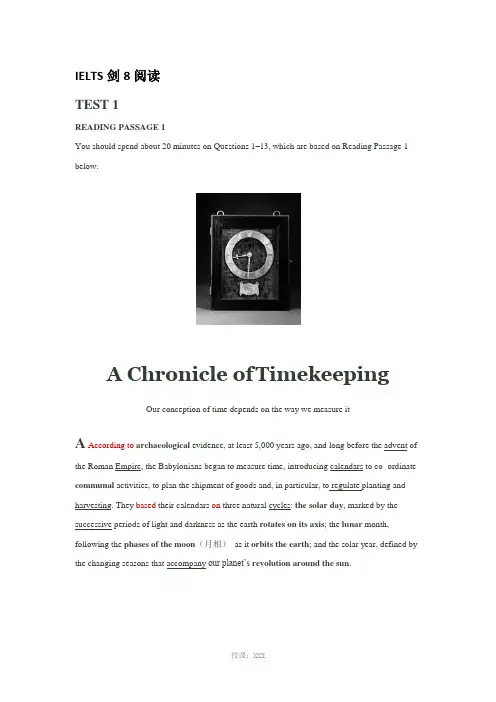
IELTS剑8阅读TEST 1READING PASSAGE 1You should spend about 20 minutes on Questions 1–13, which are based on Reading Passage 1 below.A Chronicle of TimekeepingOur conception of time depends on the way we measure itA According to archaeological evidence, at least 5,000 years ago, and long before the advent of the Roman Empire, the Babylonians began to measure time, introducing calendars to co- ordinate communal activities, to plan the shipment of goods and, in particular, to regulate planting and harvesting. They based their calendars on three natural cycles: the solar day, marked by the successive periods of light and darkness as the earth rotates on its axis; the lunar month, following the phases of the moon(月相)as it orbits the earth; and the solar year, defined by the changing seasons that accompany our planet’s revolution around the sun.B Before the invention of artificial light, the moon had greater social impact. And, for those living near the equator in particular, its waxing and waning(月圆月缺)was more conspicuous than the passing of the seasons. Hence, the calendars that were developed at the lower latitudes were influenced more by the lunar cycle than by the solar year. In more northern climes, however, where seasonal agriculture was practised, the solar year became more crucial. As the Roman Empire expanded northward, it organised its activity chart for the most part around the solar year.C Centuries before the Roman Empire, the Egyptians had formulated a municipal calendar having 12 months of 30 days, with five days added to approximate the solar year. Each period of ten days was marked by the appearance of special groups of stars called decans(黄道十度分度). At the rise of the star Sirius(天狼星)just before sunrise, which occurred around the all- important annual flooding of the Nile, 12 decans could be seen spanning the heavens. The cosmic significance the Egyptians placed in the 12 decans led them to develop a system in which each interval of darkness (and later, each interval of daylight) was divided into a dozen equal parts. These periods became known as temporal hours(日光时—古罗马和奥斯曼帝国将白昼等分成小时而成的一种时间单位)because their duration varied according to the changing length of days and nights with the passing of the seasons. Summer hours were long, winter ones short; only at the spring and autumn equinoxes(秋分)were the hours of daylight and darkness equal. Temporal hours, which were first adopted by the Greeks and then the Romans, who disseminated (散播)them through Europe, remained in use for more than 2,500 years.D In order to track temporal hours during the day, inventors created sundials(日晷), which indicate time by the length or direction of the sun’s shadow. The sundial’s counterpart, the water clock, was designed to measure temporal hours at night. One of the first water clocks was a basin with a small hole near the bottom through which the water dripped out. The falling water level denoted the passing hour as it dipped below hour lines inscribed on the inner surface. Although these devices performed satisfactorily around the Mediterranean, they could not always be depended on in the cloudy and often freezing weather of northern Europe.E The advent of the mechanical clock meant that although it could be adjusted to maintain temporal hours, it was naturally suited to keeping equal ones. With these, however, arose the question of when to begin counting, and so, in the early 14th century, a number of systems evolved. The schemes that divided the day into 24 equal parts varied according to the start of the count: Italian hours began at sunset, Babylonian hours at sunrise, astronomical hours at midday and ‘great clock’ hours, used for some large public clocks in Germany, at midnight. Eventually these were superseded by(可以和sub constitute一起讲)‘small clock’, or French, hours, which split the day into two 12- hour periods commencing at midnight.F The earliest recorded weight - driven mechanical clock was built in 1283 in Bedfordshire in England. The revolutionary aspect of this new timekeeper was neither the descending weight that provided its motive force nor the gear wheels (齿轮,which had been around for at least 1,300 years) that transferred the power; it was the part called the escapement(擒纵机构). In the early 1400s came the invention of the coiled spring(螺旋弹簧)or fusee which maintained constant force to the gear wheels of the timekeeper despite the changing tension of its mainspring.By the 16th century, a pendulum clock(摆钟)had been devised, but the pendulum swung in a large arc and thus was not very efficient.G To address this, a variation on the original escapement was invented in 1670, in England. It was called the anchor escapement(锚式擒纵机构), which was a lever-based device shaped like a ship’s anchor. The motion of a pendulum rocks this device so that it catches and then releases each tooth of the escape wheel, in turn allowing it to turn a precise amount. Unlike the original form used in early pendulum clocks, the anchor escapement permitted the pendulum to travel in a very small arc. Moreover, this invention allowed the use of a long pendulum which could beat once a second and thus led to the development of a new floorstanding case design, which became known as the grandfather clock(落地式大摆钟).H Today, highly accurate timekeeping instruments set the beat for most electronic devices. Nearly all computers contain a quartz- crystal clock to regulate their operation. Moreover, not only do time signals beamed down from Global Positioning System satellites calibrate(校准)the functions of precision navigation equipment, they do so as well for mobile phones, instant stock- trading systems and nationwide power- distribution grids. So integral have these time- based technologies become to day- to- day existence that our dependency on them is recognised only when they fail to work.READING PASSAGE 2AIR TRAFFIC CONTROL IN THE USAA An accident that occurred in the skies over the Grand Canyon in 1956 resulted in the establishment of the Federal Aviation Administration (FAA) to regulate and oversee the operation of aircraft in the skies over the Unite States, which were becoming quite congested. The resulting structure of air traffic control has greatly increased the safety of flight in the United States, and similar air traffic control procedures are also in place over much of the rest of the world.B Rudimentary air traffic control (ATC) existed well before the Grand Canyon disaster. As early as the 1920s, the earliest air traffic controls manually guided aircraft in the vicinity of the airports, using lights and flags, while beacons and flashing lights were placed along cross-county routes to establish the earliest airways. However, this purely visual system was useless in bad weather, and, by the 1930s, radio communication was coming into use for ATC. The first region to have something approximating today’s ATC was New York City, with other major metropolitan areas following soon after.C In the 1940s, ATC centres could and did take advantage of the newly developed radar and improved radio communication brought about by the Second World War, but the system remained rudimentary. It was only after the creation of the FAA that full-scale regulation of America’s airspace took place, and this was fortuitous (偶然的,意外的), for the advent of the jet engine suddenly resulted in a large number of every fast planes, reducing pilots’ margin of error and practically demanding some set of rules to keep everyone well separated and operating safely in the air.D Many people think that ATC consists of a row of controllers sitting in front of their radar screens at the nation’s airport, telling arriving and departing traffic what to do. This is a very incomplete part of the picture. The FAA realised that the airspace over the United States would at any time have many different kinds of planes, flying for many different purposes, in a variety of weather conditions, and the same kind of structure was needed to accommodate all of them.E To meet this challenge, the following elements were put into effect. First, ATC extends over virtually the entire United States. In general, from 365m above the ground and higher, the entire country is blanketed by controlled airspace. In certain areas, mainly near airports, controlled airspace extends down to 215m above the ground and, in the immediate vicinity1of an airport, all the way down to the surface. Controlled airspace is that airspace in which FAA regulations apply. Elsewhere, in uncontrolled airspace, pilots are bound by fewer regulations. In this way, the recreational pilot who simply wishes to go flying for a while without all the restrictions imposed by the FAA has only to stay in uncontrolled airspace, below 365, while the pilot who does want the protection afforded by ATC can easily enter the controlled airspace.F The FAA then recognised two types of operating environments. In good meteorological conditions, flying would be permitted under Visual Flight Rules (VFR), which suggests a strong reliance on visual cues to maintain an acceptable level of safety. Poor visibility necessitated a set of Instrumental Flight Rules (IFR), under which the pilot relied on altitude and navigational information provided by the plane’s instrument panel to fly safely. On a clear day, a pilot in controlled airspace can choose a VFR or IFR flight plan, and the FAA regulations were devised in a way which accommodates both VFR and IFR operations in the same airspace. However, a pilot can only choose to fly IFR if they possess an instrument rating which is above and beyong the basic pilot s’ license that must also be held.1vicinity:1.in the vicinity (of something): in the area around a particular place:例:The stolen car was found in the vicinity of the station. There used to be a mill in the vicinity.2.in the vicinity of £3 million/$1,500/2 billion years etc:close to a particular amount or measurement:例:All meteorites are of the same age, somewhere in the vicinity of 4.5 billion years old.G Controlled airspace is divided into several different types, designated by letters of the alphabet. Uncontrolled airspace is designated Class F, while controlled airspace below 5,490m above sea level and not in the vicinity of an airport is Class E. All airspace above 5,490m is designated Class A. The reason for the division of Class E and Class A airspace stems from the type of planes operating in them. Generally, Class E airspace is where on finds general aviation aircraft (few of which can climb above 5,490m anyway), and commercial turboprop aircraft. Above 5,490 is the realm of the heavy jets, since jet engines operate more efficiently at higher altitudes. The difference between Class E and A airspace is that in Class A, all operations are IFR, and pilots must be instrument-rated, that is, skilled and licensed in aircraft instrumentation. This is because ATC control of the entire space is essential. Three other types of airspace, Classes D, C and B, govern the vicinity of airports. There correspond roughly to small municipal, medium-sized metropolitan and major metropolitan airports respectively, and encompass an increasingly rigorous set of regulations. For example, all a VFR pilot has to do to enter Class C airspace is establish two-way radio contact with ATC. No explicit permission from ATC to enter is needed, although the pilot must continue to obey all regulations governing VFR flight. To enter Class B airspace, such as on approach to a major metropolitan airport, an explicit ATC clearance is required. The private pilot who cruises without permission into this airspace risks losing their license.TELEPATHYCan human beings communicate by thought alone? For more than a century the issue of telepathy has divided the scientific community, and even today is still sparks bitter controversy among top academics.Since the 1970s, parapsychologists at leading universities and research institutes around the world have risk the derision of sceptical colleagues by putting the various claims for telepathy to the test in dozens of rigorous scientific studies. The results and their implications are dividing even the researchers who uncovered them.Some researchers say the results constitute compelling evidence that telepathy is genuine. Other parapsychologists believe the field is on the brink of collapse, having tried to produce definitive scientific proof and failed. Sceptics and advocates alike do concur on one issue, however: that the most impressive evidence so far has come from the so-called ‘ganzfeld’ experiments, a German term that means ‘whole field’. Reports of telepathic experiences had by people during meditation led parapsychologists to suspect that telepathy might involve ‘signals’ passing between people that were so faint that they were usually swamped by normal brain activity. In this case, such signals might be more easily detected by those experiencing meditation-like tranquility in a relaxing ‘whole field’ of light, sound and warmth.The ganzfeld experiment tries to recreate these conditions with participants sitting in soft reclining chairs in a sealed room, listening to relaxing sounds while their eyes are covered with special filters letting in only pink light. In early ganzfeld experiments, the telepathy test involved identification of a picture chosen from a random selection of four taken from a large image bank. The idea was that a person acting as a ‘sender’ would attempt to beam the image over to the ‘receiver’ relaxing in the sealed room. Once the session was over, this person was asked to identify which of the four images had been used. Random guessing would give a hit-rate of 25 per cent; if telepathy is real, however, the hit-rate would be higher. In 1982, the results from the first ganzfeld studies were analysed by one of its pioneers, the American parapsychologist Charles Honorton. They pointed to typicalhit-rates of better than 30 per cent – a small effect, but one which statistical tests suggested could not be put down to chance.The implication was that the ganzfeld method had revealed real evidence for telepathy. But there was a crucial flaw in this argument- one routinely overlooked in more conventional areas of science. Just because chance had been ruled out as an explanation did not prove telepathy must exist; there were many other ways of getting positive results. These ranged from ‘sensory leakage’—where clues about the pictures accidentally reach the receiver – to outright fraud. In response, the researchers issued a review of all the ganzfeld studies done up to 1985 to show that 80 per cent had found statistically significant evidence. However, they also agreed that there were still too many problems in the experiments which could lead to positive results, and that drew up a list demanding new standards for future research.After this, many researchers switched to autoganzfeld tests – an automated variant of the technique which used computers to perform many of the key tasks such as the random selection of images. By minimising human involvement, the idea was to minimise the risk of flawed results. In 1987, results from hundreds of autoganzfeld tests were studied by Honorton in a ‘meta-analysis’, a statistical technique for finding the overall results from a set of studies. Though less compelling than before, the outcome was still impressive.Yet some parapsychologists remain disturbed by the lack of consistency between individual ganzfeld studies. Defenders of telepathy point out that demanding impressive evidence from every study ignores one basic statistical fact: it takes large samples to detect small effects. If, as current results suggest, telepathy produces hit-rates only marginally above the 25 per cent expected by chance, it’s unlikely to be detected by a typical ganzfeld study involving around 40 people: the group is just not big enough. Only when many studies are combined in a meta-analysis will the faint signal of telepathy really become apparent. And that is what researchers do seem to be finding.What they are certainly not finding, however, is any change in attitude of mainstream scientists: most still totally reject the very idea of telepathy. The problem stems at least in part from the lack of any plausible mechanism for telepathy.Various theories have been put forward, many focusing on esoteric ideas from theoretical physics. They include ‘quantum entanglement’, in which events affecting one group of atoms instantly affect another group, no matter how far apart they may be. Whilephysicists have demonstrated entanglement with specially prepared atoms, no-one knows if it also exists between atoms making up human minds. Answering such questions would transform parapsychology. This has promoted some researchers to argue that the future lies not in collecting more evidence for telepathy, but in probing possible mechanisms. Some work has begun already, with researchers trying to identify people who are particularly successful in autoganzfeld trials. Early results show that creative and artistic people do much better than average: in one study at the University of Edinburgh, musicians achieved a hit-rate of 56 per cent. Perhaps more tests like these will eventually give the researchers the evidence they are seeking and strengthen the case for the existence of telepathy.TEST 2Sheet glass manufacture: the float process Glass, which has been made since the time of the Mesopotamians and Egyptians, is little more than a mixture of sand, soda ash and lime. When heated to about 1500 degrees Celsius (℃)this becomes a molten mass that hardens when slowly cooled. The first successful method for making clear, flat glass involved spinning. This method was very effective as the glass had not touched any surfaces between being soft and becoming hard, so it stayed perfectly unblemished, with a 'fire finish'. However, the process took a long time and was labour intensive.Nevertheless, demand for flat glass was very high and glassmakers across the world were looking for a method of making it continuously. The first continuous ribbon process involved squeezing molten glass through two hot rollers, similar to an old mangle. This allowed glass of virtually any thickness to be made non-stop, but the rollers would leave both sides of the glass marked, and these would then need to be ground and polished. This part of the process rubbed away around 20 per cent of the glass, and the machines were very expensive.The float process for making flat glass was invented by Alistair Pilkington. This process allows the manufacture of clear, tinted and coated glass for buildings, and clear and tinted glass for vehicles. Pilkington had been experimenting with improving the melting process, and in 1952 he had the idea of using a bed of molten metal to form the flat glass, eliminating altogether the need for rollers within the float bath. The metal had to melt at a temperature less than the hardening point of glass (about 600~C), but could not boil at a temperature below the temperature of the molten glass (about 1500~C). The best metal for the job was tin.The rest of the concept relied on gravity, which guaranteed that the surface of the molten metal was perfectly flat and horizontal. Consequently,when pouring molten glass onto the molten tin, the underside of the glass would also be perfectly flat. If the glass were kept hot enough, it would flow over the molten tin until the top surface was also flat, horizontal and perfectly parallel to the bottom surface. Once the glass cooled to 604~C or less it was too hard to mark and could be transported out of the cooling zone by rollers~, The glass settled to a thickness of six millimetres because of surface tension interactions between the glass and the tin. By fortunate coincidence, 60 per cent of the flat glass market at that time was for six millimetre glass.Pilkington built a pilot plant in 1953 and by 1955 he had convinced his company to build a full-scale plant. However, it took 14 months of non-stop production, costing the company £100, 000 a month, before the plant produced any usable glass. Furthermore, once they succeeded in making marketable flat glass, the machine was turned off for a service to prepare it for years of continuous production. When it started up again it took another four months to get the process right again. They finally succeeded in 1959 and there are now float plants all over the world, with each able to produce around 1000 tons of glass every day, non-stop for around 15 years.Float plants today make glass of near optical quality. Several processes - melting, refining, homogenising - take place simultaneously in the 2000 tonnes of molten glass in the furnace. They occur in separate zones in a complex glass flow driven by high temperatures. It adds up to a continuous melting process, lasting as long as 50 hours, that delivers glass smoothly and continuously to the float bath, and from there to a coating zone and finally a heat treatment zone, where stresses formed during cooling are relieved.The principle of float glass is unchanged since the 1950s. However, the product has changed dramatically, from a single thickness of 6. 8 mm to a range from sub-millimetre to 25 mm, from a ribbon frequently marred by inclusions and bubbles to almost optical perfection. To ensure the highest quality, inspection takes place at every stage. Occasionally, a bubble is not removed during refining, a sand grain refuses to melt, a tremor in the tin putsripples into the glass ribbon. Automated on-line inspection does two things. Firstly, it reveals process faults upstream that can be corrected. Inspection technology allows more than 100 million measurements a second to be made across the ribbon, locating flaws the unaided eye would be unable to see. Secondly, it enables computers downstream to steer cutters around flaws.Float glass is sold by the square metre, and at the final stage computers translate customer requirements into patterns of cuts designed to minimise waste.Questions 1-8Complete the table and diagram below.Choose NO MORE THAN TWO WORDS from the passage for each answer.Write your answers in boxes 1-8 on your answer sheet.Early methods of producing flat glassPilkington's float processQuestions 9-13Do the following statements agree with the information given in Reading Passage 1?In boxes 9-13 on your answer sheet, writeTRUE if the statement agrees with the informationFALSE if the statement contradicts the informationNOT GIVEN if there is no information on this9 The metal used in the float process had to have specific properties.18 Pilkington invested some of his own money in his float plant.11 Pilkington's first full-scale plant was an instant commercial success.12 The process invented by Pilkington has now been improved.13 Computers are better than humans at detecting faults in glass.THE LITTLE ICE AGEREADING PASSAGE 2You should spend about 20 minutes on Questions 14-26, which are based on Reading Passage 2 on the following pages.Questions 14-17Reading Passage 2 has six paragraphs, A-F.Choose the correct heading for paragraphs B and D-F from the fist of headings below.14 Paragraph B15 Paragraph D16 Paragraph E17 Paragraph FTHE LITTLE ICE AGEA This book will provide a detailed examination of the Little Ice Age and otherclimatic shifts, but, before I embark on that, let me provide a historical context.We tend to think of climate - as opposed to weather - as somethingunchanging, yet humanity has been at the mercy of climate change for its entire existence, with at least eight glacial episodes in the past 730, 000 years. Our ancestors adapted to the universal but irregular global warming since the end of the last great Ice Age, around 10, 000years ago, with dazzling opportunism. They developed strategies for surviving harsh drought cycles, decades of heavy rainfall or unaccustomed cold; adopted agriculture and stock-raising, whichrevolutionised human life; and founded the world's first pre-industrial civilisations in Egypt, Mesopotamia and the Americas. But the price of sudden climate change, in famine, disease and suffering, was often high.B The Little Ice Age lasted from roughly 1300 until the middle of the nineteenth century. Only two centuries ago, Europe experienced a cycle of bitterly cold winters; mountain glaciers in the Swiss Alps were the lowest in recorded memory, and pack ice surrounded Iceland for much of the year. The climatic events of the Little Ice Age did more than help shape the modern world. They are the deeply important context for the current unprecedented global warming. The Little Ice Age was far from a deep freeze, however; rather an irregular seesaw of rapid climatic shifts, few lasting more than a quarter-century, driven by complex and still little understood interactions between the atmosphere and the ocean. The seesaw brought cycles of intensely cold winters and easterly winds, then switched abruptly to years of heavy spring and early summer rains, mild winters, and frequent Atlantic storms, or to periods of droughts, light northeasterly winds, and summer heat waves.C Reconstructing the climate changes of the past is extremely difficult, because systematic weather observations began only a few centuries ago, in Europe and North America. Records from India and tropical Africa are even more recent. For the time before records began, we have only 'proxy records' reconstructed largely from tree rings and ice cores, supplemented by a few incomplete written accounts. We now have hundreds of tree-ring records from throughout the northern hemisphere, and many from south of the equator, too, amplified with a growing body of temperature data from ice cores drilled in Antarctica, Greenland, the Peruvian Andes, and other locations. We are close toa knowledge of annual summer and winter temperature variations over much of the northern hemisphere going back 600 years.D This book is a narrative history of climatic shifts during the past ten centuries, and some of the ways in which people in Europe adapted to them. Part One describes the Medieval Warm Period, roughly 900 to 1200. During these three centuries, Norse voyagers from Northern Europe explored northern seas, settled Greenland, and visited North America. It was not a time of uniform warmth, for then, as always since the Great Ice Age, there were constant shifts in rainfall and temperature. Mean European temperatures were about the same as today, perhaps slightly cooler.E It is known that the Little Ice Age cooling began in Greenland and the Arctic in about 1200. As the Arctic ice pack spread southward, Norse voyages to the west were rerouted into the open Atlantic, then ended altogether. Storminess increased in the North Atlantic and North Sea. Colder, much wetter weather descended on Europe between 1315 and 1319, when thousands perished in a continent-wide famine. By 1400, the weather had become decidedly more unpredictable and stormier, with sudden shifts and lower temperatures that culminated in the cold decades of the late sixteenth century. Fish were a vital commodity in growing towns and cities, where food supplies were a constant concern. Dried cod and herring were already the staples of the European fish trade, but changes in water temperatures forced fishing fleets to work further offshore. The Basques, Dutch, and English developed the first offshore fishing boats adapted to a colder and stormier Atlantic. A gradual agricultural revolution in northern Europe stemmed from concerns over food supplies at a time of rising populations. The revolution involved intensive commercial farming and the growing of animal fodder on land not previously used for crops. The increased productivity from farmland made some countries self-sufficient in grain and livestock and offered effective protection against famine.。
雅思阅读:例题详解--剑八T1P1为例
雅思阅读:例题详解--剑八T1P1为例下面为大家整理了雅思阅读例题详析,供考生们参考,以下是详细内容。
今天详细讲解突破雅思剑8之Test1之Passage1。
翻开雅思剑桥系列,首先浏览题目,留下总体印象是:一共有三种题型,前两个题型是Matching题,而最后一个是填图题。
然后进行分析,最后的填图题型,应该可以一眼判断是小段落的信息填空,不需要畏惧,顺着文章读下去,水到自然会渠成。
而比较棘手的是前两个Matching题型,1-4题是InformationContained题,而5-8题则属于TraditionalMatching题(也就是变形的人名与理论搭配题),二者都是乱序的。
再次确定和辨析完Matching题目的属性后,大家不禁心里多少会有些紧张吧。
因为这类乱序的题目的确是比较棘手。
但无论形式如何复杂,只要一步步按部就班的划出KeyWords,再回原文定位,一切题目都是可以解决的。
小贴士:所谓划出KeyWords,就是找出雅思阅读原文中的重要信息点(通常也为考点所在),使题干一目了然,最重要的还是确定了KeyWords之后,能够顺利地返回原文进行定位,从而顺利解题。
在此,小编就拙劣地给出一些自己的解题思路吧:1.KWs:coldtemperature;与第4段中的freezingweather信息点相对应2.KWs:farmingcommunities;与第2段中的agriculture信息点相对应。
小编在此还要罗嗦几句。
这题,小编自己也做错了,错误地定位到了第1段中的regulateplantingandharvesting。
所以,题目在这里还有一个重要的KWs一开始容易被忽略,那就是theimportanceof,与第2段中的crucial一词相呼应。
如果两个KWs和相对应原文中的信息点都找对的话,这题就一定不会出错的~3.KWs:originsofthependulum;与第6段末尾处中的apendulumclockhadbeendevised 相对应。
剑桥雅思八阅读详解TEST1234整合原创版

剑桥雅思八阅读详解TEST1READING PASSAGE 1 计时器发展史段落配对题1, 排除全文都含有的关键词“TIME KEEPING”哪里都有就不是关键词“cold temperature”回答原文中找答案。
D段结尾”often freezing weather of”同义重现。
2,如果题目中定语和修饰成分太长,则把关键词落在靠后的位置,做题就比较有效。
关键词“Calendar, farming” B段出现了两个原形重现,很容易选出。
3,关键词pendulum(clock),origin’s段倒数第2行”a pendulum clock had been devised”.发明制造出来。
4,”(calculate) uniform hours”. E段第2行”to keeping equal ones”上半句提到了”one”指的就是”hours””;”equal”的意思就是uniform”.5,答案B。
原文分为两大部分ABC第一部分讨论的是”calendar”一年之内的计时器,DEFGH第二部分讨论的是一天之内计时器clock。
所以第五第八题三选二,很好做。
6,答案E。
“two equal hakves” 原文在本段最后一句7,答案G. 关键词”new shape”原文第二行” was a lever based devise shaped like a ship’s anchor.”8,答案A。
关键词”organize-event-schedule”原文第三行”co-ordinate activities…plant-regulate.”9-13题。
该题型为100%集中在了某一段找答案;图上有标题“1670”就是关键词。
很快即可定义在G段。
注意:答案小于等于2个词9,resembling好像…一样shape like答案:ship’s anchor(第二行)10,escape wheel11,tooth 第四行12,long pendulum13, second倒数第二行。
剑桥雅思8阅读解析【答案;范文】
我的托福雅思必过
剑桥雅思8阅读解析【答案范文】
剑桥雅思8阅读解析包括了详细的答案及范文,剑桥雅思是官方指定的复习资料,深受中国考生的欢送。
今天为大家收集了剑桥雅思阅读8解析的详细内容,同学们可以适当的参考一下!
剑桥雅思8阅读解析包括test1、2、3个局部,每个局部都做了详细的解答,感兴趣的同学记得耐着性子看完。
〔此内容来源互联网如有问题请及时跟我们联系〕剑桥雅思8阅读解析Test1Passage1
体裁
主要内容:
由古及今介绍计时的历史。
说明文
A 段:介绍古巴比伦人的计时方法。
B 段:月亮对于历法计时的社会重要性。
C 段:介绍古埃及人的计时方法。
结构D 段:形形色色的计时器陆续出现,尽管并不完美。
E 段:机械计时器引发各国最终统一校准开始时间。
F 段:介绍最早的重力驱动机械钟。
G 段:机械钟的进一步改进,并成为最早的座钟。
H 段:今天的计时器。
解析:
Questions 1-4
● 题型归类:Matching 此题解题时可先划出题目中的关键词,然后迅速回到文章寻找其同义替换后的对应词。
其间可大致通过题目中的关键词猜想其在文章的位置与段落特点。
Questions 5-8
● 题型归类:Matching 此题为两局部匹配题。
可先划出句子中关键词,然后根据题目中需进行匹配的第二局部所出现的国家名称,在其周围寻找所划关键词的同义替换。
剑桥雅思阅读8(test1)答案分析
剑桥雅思阅读8(test1)答案分析为了帮助大家更好地备考雅思阅读,下面小编给大家分享剑桥雅思阅读8原文翻译及答案解析(test1),希望对你们有用。
剑桥雅思阅读8原文(test1)READING PASSAGE 1You should spend about 20 minutes on Questions 1-13, which are based on Reading Passage 1 below.A Chronicle of TimekeepingOur conception of time depends on the way we measure itA According to archaeological evidence, at least 5,000 years ago, and long before the advent of the Roman Empire, the Babylonians began to measure time, introducing calendars to co-ordinate communal activities, to plan the shipment of goods and, in particular, to regulate planting and harvesting. They based their calendars on three natural cycles: the solar day, marked by the successive periods of light and darkness as the earth rotates on its axis; the lunar month, following the phases of the moon as it orbits the earth; and the solar year, defined by the changing seasons that accompany our planet's revolution around the sun.B Before the invention of artificial light, the moon had greater social impact. And, for those living near the equator in particular, its waxing and waning was more conspicuous than the passing of the seasons. Hence, the calendars that were developed at the lower latitudes were influenced more by the lunar cycle than by the solar year. In more northern climes, however, where seasonal agriculture was practised, the solar year became more crucial. As the Roman Empire expanded northward, it organised its activity chart for the most part around the solar year.C Centuries before the Roman Empire, the Egyptians hadformulated a municipal calendar having 12 months of 30 days, with five days added to approximate the solar year. Each period of ten days was marked by the appearance of special groups of stars called decans. At the rise of the star Sirius just before sunrise, which occurred around the all-important annual flooding of the Nile, 12 decans could be seen spanning the heavens. The cosmic significance the Egyptians placed in the 12 decans led them to develop a system in which each interval of darkness (and later, each interval of daylight) was divided into a dozen equal parts. These periods became known as temporal hours because their duration varied according to the changing length of days and nights with the passing of the seasons. Summer hours were long, winter ones short; only at the spring and autumn equinoxes were the hours of daylight and darkness equal. Temporal hours, which were first adopted by the Greeks and then the Romans, who disseminated them through Europe, remained in use for more than 2,500 years.D In order to track temporal hours during the day, inventors created sundials, which indicate time by the length or direction of the sun's shadow. The sundial's counterpart, the water clock, was designed to measure temporal hours at night. One of the first water clocks was a basin with a small hole near the bottom through which the water dripped out. The falling water level denoted the passing hour as it dipped below hour lines inscribed on the inner surface. Although these devices performed satisfactorily around the Mediterranean, they could not always be depended on in the cloudy and often freezing weather of northern Europe.E The advent of the mechanical clock meant that although it could be adjusted to maintain temporal hours, it was naturallysuited to keeping equal ones. With these, however, arose the question of when to begin counting, and so, in the early 14th century, a number of systems evolved. The schemes that divided the day into 24 equal parts varied according to the start of the count: Italian hours began at sunset, Babylonian hours at sunrise, astronomical hours at midday and 'great clock' hours, used for some large public clocks in Germany, at midnight. Eventually these were superseded by 'small clock', or French, hours, which split the day into two 12-hour periods commencing at midnight.F The earliest recorded weight-driven mechanical clock was built in 1283 in Bedfordshire in England. The revolutionary aspect of this new timekeeper was neither the descending weight that provided its motive force nor the gear wheels (which had been around for at least 1,300 years) that transferred the power; it was the part called the escapement. In the early 1400s came the invention of the coiled spring or fusee which maintained constant force to the gear wheels of the timekeeper despite the changing tension of its mainspring. By the 16th century, a pendulum clock had been devised, but the pendulum swung in a large arc and thus was not very efficient.G To address this, a variation on the original escapement was invented in 1670, in England. It was called the anchor escapement, which was a lever-based device shaped like a ship's anchor. The motion of a pendulum rocks this device so that it catches and then releases each tooth of the escape wheel, in turn allowing it to turn a precise amount. Unlike the original form used in early pendulum clocks, the anchor escapement permitted the pendulum to travel in a very small arc. Moreover, this invention allowed the use of a long pendulum which could beat once a second and thus led to the development of a new floor-standingcase design, which became known as the grandfather clock.H Today, highly accurate timekeeping instruments set the beat for most electronic devices. Nearly all computers contain a quartz-crystal clock to regulate their operation. Moreover, not only do time signals beamed down from Global Positioning System satellites calibrate the functions of precision navigation equipment, they do so as well for mobile phones, instant stock-trading systems and nationwide power-distribution grids. So integral have these time-based technologies become to day-to-day existence that our dependency on them is recognised only when they fail to work.Questions 1-4Reading Passage 1 has eight paragraphs, A-H.Which paragraph contains the following information?Write the correct letter, A-H, in boxes 1-4 on your answer sheet.1 a description of an early timekeeping invention affected by cold temperatures2 an explanation of the importance of geography in the development of the calendarin farming communities3 a description of the origins of the pendulum clock4 details of the simultaneous efforts of different societies to calculate time usinguniform hoursQuestions 5-8Look at the following events (Questions 5-8) and the list of nationalities below.Match each event with the correct nationality, A-F.Write the correct letter, A-F, in boxes 5-8 on your answer5 They devised a civil calendar in which the months were equal in length.6 They divided the day into two equal halves.7 They developed a new cabinet shape for a type of timekeeper.8 They created a calendar to organise public events and work schedules.List of NationalitiesA BabyloniansB EgyptiansC GreeksD EnglishE GermansF FrenchQuestions 9-13Label the diagram below.Choose NO MORE THAN TWO WORDS from the passage for each answer.Write your answers in boxes 9-13 on your answer sheet.图片10READING PASSAGE 2You should spend about 20 minutes on Questions 14-26, which are based on ReadingPassage 2 on the following pages.Questions 14-19Reading Passage 2 has seven paragraphs, A-G.Choose the correct heading for paragraphs A and C-G from the list below.Write the correct number, i-x, in boxes 14-19 on your answerList of Headingsi Disobeying FAA regulationsii Aviation disaster prompts actioniii Two coincidental developmentsiv Setting altitude zonesv An oversimplified viewvi Controlling pilots’ licencesvii Defining airspace categoriesviii Setting rules to weather conditionsix Taking off safelyx First steps towards ATC14 Paragraph AExample AnswerParagraph B x15 Paragraph C16 Paragraph D17 Paragraph E18 Paragraph F19 Paragraph GAIR TRAFFIC CONTROLIN THE USAA An accident that occurred in the skies over the Grand Canyon in 1956 resulted in the establishment of the Federal Aviation Administration (FAA) to regulate and oversee the operation of aircraft in the skies over the United States, which were becoming quite congested. The resulting structure of air traffic control has greatly increased the safety of flight in the United States, and similar air traffic control procedures are also in place over much of the rest of the world.B Rudimentary air traffic control (ATC) existed well before the Grand Canyon disaster. As early as the 1920s, the earliest air traffic controllers manually guided aircraft in the vicinity of the airports, using lights and flags, while beacons and flashing lights were placed along cross-country routes to establish the earliest airways. However, this purely visual system was useless in bad weather, and, by the 1930s, radio communication was coming into use for ATC. The first region to have something approximating today's ATC was New York City, with other major metropolitan areas following soon after.C In the 1940s, ATC centres could and did take advantage of the newly developed radar and improved radio communication brought about by the Second World War, but the system remained rudimentary. It was only after the creation of the FAA that full-scale regulation of America's airspace took place, and this was fortuitous, for the advent of the jet engine suddenly resulted in a large number of very fast planes, reducing pilots' margin of error and practically demanding some set of rules to keep everyone well separated and operating safely in the air.D Many people think that ATC consists of a row of controllers sitting in front of their radar screens at the nation's airports, telling arriving and departing traffic what to do. This is a very incomplete part of the picture. The FAA realised that the airspace over the United States would at any time have many different kinds of planes, flying for many different purposes, in a variety of weather conditions, and the same kind of structure was needed to accommodate all of them.E To meet this challenge, the following elements were put into effect. First, ATC extends over virtually the entire United States. In general, from 365m above the ground and higher, theentire country is blanketed by controlled airspace. In certain areas, mainly near airports, controlled airspace extends down to 215m above the ground, and, in the immediate vicinity of an airport, all the way down to the surface. Controlled airspace is that airspace in which FAA regulations apply. Elsewhere, in uncontrolled airspace, pilots are bound by fewer regulations. In this way, the recreational pilot who simply wishes to go flying for a while without all the restrictions imposed by the FAA has only to stay in uncontrolled airspace, below 365m, while the pilot who does want the protection afforded by ATC can easily enter the controlled airspace.F The FAA then recognised two types of operating environments. In good meteorological conditions, flying would be permitted under Visual Flight Rules (VFR), which suggests a strong reliance on visual cues to maintain an acceptable level of safety. Poor visibility necessitated a set of Instrumental Flight Rules (IFR), under which the pilot relied on altitude and navigational information provided by the plane's instrument panel to fly safely. On a clear day, a pilot in controlled airspace can choose a VFR or IFR flight plan, and the FAA regulations were devised in a way which accommodates both VFR and IFR operations in the same airspace. However, a pilot can only choose to fly IFR if they possess an instrument rating which is above and beyond the basic pilot's license that must also be held.G Controlled airspace is divided into several different types, designated by letters of the alphabet. Uncontrolled airspace is designated Class F, while controlled airspace below 5,490m above sea level and not in the vicinity of an airport is Class E. All airspace above 5,490m is designated Class A. The reason for the division of Class E and Class A airspace stems from the type ofplanes operating in them. Generally, Class E airspace is where one finds general aviation aircraft (few of which can climb above 5,490m anyway), and commercial turboprop aircraft. Above 5,490m is the realm of the heavy jets, since jet engines operate more efficiently at higher altitudes. The difference between Class E and A airspace is that in Class A, all operations are IFR, and pilots must be instrument-rated, that is, skilled and licensed in aircraft instrumentation. This is because ATC control of the entire space is essential. Three other types of airspace, Classes D, C and B, govern the vicinity of airports. These correspond roughly to small municipal, medium-sized metropolitan and major metropolitan airports respectively, and encompass an increasingly rigorous set of regulations. For example, all a VFR pilot has to do to enter Class C airspace is establish two-way radio contact with ATC. No explicit permission from ATC to enter is needed, although the pilot must continue to obey all regulations governing VFR flight. To enter Class B airspace, such as on approach to a major metropolitan airport, an explicit ATC clearance is required. The private pilot who cruises without permission into this airspace risks losing their license.Questions 20-26Do the following statements agree with the information given in Reading Passage 2?In boxes 20-26 on your answer sheet, writeTRUE if the statement agrees with the informationFALSE if the statement contradicts the informationNOT GIVEN if there is no information on this20 The FAA was created as a result of the introduction of the jet engine.21 Air Traffic Control started after the Grand Canyon crash in1956.22 Beacons and flashing lights are still used by ATC today.23 Some improvements were made in radio communication during World War II.24 Class F airspace is airspace which is below 365m and not near airports.25 All aircraft in Class E airspace must use IFR.26 A pilot entering Class C airspace is flying over an average-sized city.READING PASSAGE 3You should spend about 20 minutes on Questions 27-40, which are based on Reading Passage 3 below.TELEPATHYCan human beings communicate by thought alone? For more than a century the issue of telepathy has divided the scientific community, and even today it still sparks bitter controversy among top academicsSince the 1970s, parapsychologists at leading universities and research institutes around the world have risked the derision of sceptical colleagues by putting the various claims for telepathy to the test in dozens of rigorous scientific studies. The results and their implications are dividing even the researchers who uncovered them.Some researchers say the results constitute compelling evidence that telepathy is genuine. Other parapsychologists believe the field is on the brink of collapse, having tried to produce definitive scientific proof and failed. Sceptics and advocates alike do concur on one issue, however: that the most impressive evidence so far has come from the so-called 'ganzfeld' experiments, a German term that means 'whole field'. Reports oftelepathic experiences had by people during meditation led parapsychologists to suspect that telepathy might involve 'signals' passing between people that were so faint that they were usually swamped by normal brain activity. In this case, such signals might be more easily detected by those experiencing meditation — like tranquillity in a relaxing 'whole field' of light, sound and warmth.The ganzfeld experiment tries to recreate these conditions with participants sitting in soft reclining chairs in a sealed room, listening to relaxing sounds while their eyes are covered with special filters letting in only soft pink light. In early ganzfeld experiments, the telepathy test involved identification of a picture chosen from a random selection of four taken from a large image bank. The idea was that a person acting as a 'sender' would attempt to beam the image over to the 'receiver' relaxing in the sealed room. Once the session was over, this person was asked to identify which of the four images had been used. Random guessing would give a hit-rate of 25 per cent; if telepathy is real, however, the hit-rate would be higher. In 1982, the results from the first ganzfeld studies were analysed by one of its pioneers, the American parapsychologist Charles Honorton. They pointed to typical hit-rates of better than 30 per cent — a small effect, but one which statistical tests suggested could not be put down to chance.The implication was that the ganzfeld method had revealed real evidence for telepathy. But there was a crucial flaw in this argument —one routinely overlooked in more conventional areas of science. Just because chance had been ruled out as an explanation did not prove telepathy must exist; there were many other ways of getting positive results. These ranged from'sensory leakage' — where clues about the pictures accidentally reach the receiver —to outright fraud. In response, the researchers issued a review of all the ganzfeld studies done up to 1985 to show that 80 per cent had found statistically significant evidence. However, they also agreed that there were still too many problems in the experiments which could lead to positive results, and they drew up a list demanding new standards for future research.After this, many researchers switched to autoganzfeld tests — an automated variant of the technique which used computers to perform many of the key tasks such as the random selection of images. By minimising human involvement, the idea was to minimise the risk of flawed results. In 1987, results from hundreds of autoganzfeld tests were studied by Honorton in a 'meta-analysis', a statistical technique for finding the overall results from a set of studies. Though less compelling than before, the outcome was still impressive.Yet some parapsychologists remain disturbed by the lack of consistency between individual ganzfeld studies. Defenders of telepathy point out that demanding impressive evidence from every study ignores one basic statistical fact: it takes large samples to detect small effects. If, as current results suggest, telepathy produces hit-rates only marginally above the 25 per cent expected by chance, it's unlikely to be detected by a typical ganzfeld study involving around 40 people: the group is just not big enough. Only when many studies are combined in a meta-analysis will the faint signal of telepathy really become apparent. And that is what researchers do seem to be finding.What they are certainly not finding, however, is any change in attitude of mainstream scientists: most still totally reject thevery idea of telepathy. The problem stems at least in part from the lack of any plausible mechanism for telepathy.Various theories have been put forward, many focusing on esoteric ideas from theoretical physics. They include 'quantum entanglement', in which events affecting one group of atoms instantly affect another group, no matter how far apart they may be. While physicists have demonstrated entanglement with specially prepared atoms, no-one knows if it also exists between atoms making up human minds. Answering such questions would transform parapsychology. This has prompted some researchers to argue that the future lies not in collecting more evidence for telepathy, but in probing possible mechanisms. Some work has begun already, with researchers trying to identify people who are particularly successful in autoganzfeld trials. Early results show that creative and artistic people do much better than average: in one study at the University of Edinburgh, musicians achieved a hit-rate of 56 per cent. Perhaps more tests like these will eventually give the researchers the evidence they are seeking and strengthen the case for the existence of telepathy.Questions 27-30Complete each sentence with the correct ending, A-G, below.Write the correct letter, A-G, in boxes 27-30 on your answer sheet.27 Researchers with differing attitudes towards telepathy agree on28 Reports of experiences during meditation indicated29 Attitudes to parapsychology would alter drastically with30 Recent autoganzfeld trials suggest that success rates will improve withA the discovery of a mechanism for telepathyB the need to create a suitable environment for telepathy.C their claims of a high success rate.D a solution to the problem posed by random guessing.E the significance of the ganzfeld experiments.F a more careful selection of subjects.G a need to keep altering conditions.Questions 31-40Complete the table below.Choose NO MORE THAN THREE WORDS from the passage for each answer.Write your answers in boxes 31-40 on your answer sheet.Telepathy ExperimentsName/DateDescription Result FlawGanzfeldStudies1982 Involved a personacting as a31..............who picked out one32............froma random selectionof four, and a33..............,who then tried toidentify it. Hit-rates werehigher than withrandom guessing. Positive resultscould be producedby factors such as34..............or35.............. .Autoganzfeldstudies1987 36.............were used for keytasks to limit theamount of37..............in carrying out thetest. The results werethen subjected toa 38............. The 39..........between differenttest results wasput down to thefact that samplegroups were not40...................(aswith most ganzfeldStudies).剑桥雅思阅读8原文参考译文(test1)PASSAGE 1参考译文:时间记录的历史我们对时间的概念取决于我们测量时间的方式有考古证据表明,至少5000年前,早在罗马帝国尚未出现之时,巴比伦人就开始测量时间,他们引进日历来统筹公共活动,计划货物装运,特别是管控作物种植和收割。
剑桥雅思8阅读解析test1精编版

Passage1Question 1答案: D关键词: early timekeeping invention, cold temperatures定位原文: D段最后1句“Although these devices performed…”解题思路: 全文只有该句中提及寒冷气温。
该句含义为“尽管这些装置在地中海地区十分好用,但在多云并常有严寒天气的欧洲北部却不能一直使用。
”与题干中描述的内容相符。
Question 2答案: B关键词: geography, development of the calendar, farming communities定位原文: B段内容解题思路:该段一共五句话,从第二句开始每一句话都介绍了一个地理位置的变化对calendar的影响。
分别是:And, for those living near the equator in particular,...Hence, the calendars that were developed at the lower latitudes,...In more northern climes, however,...As the Roman Empire expanded northward, ...Question 3答案: F关键词: pendulum clock, origins定位原文: F段最后1句“By the 16th century…”解题思路:含义为“到了 16世纪,人们发明了摆钟。
但由于钟摆摆动弧度很大,因此并不十分有效”。
此句中devised意为“发明”,与题干中的origins对应。
Question 4答案: E关键词: simultaneous efforts, different societies, uniform hours对应原文: E段第3句“The schemes…”解题思路:含义为“人们计划将一天分为24个等份,而这些计划因为计时起点的不同而不同:意大利时间从日落开始算起,巴比伦时间从日出开始,天文学时间从中午开始,而德国一些大型公共时钟使用的‘大钟’时间从午夜开始算起”。
剑8 land of the rising sum雅思阅读解析
剑8 land of the rising sum雅思阅读解析全文共四篇示例,供读者参考第一篇示例:《剑桥雅思8》作为备考雅思阅读的重要教材之一,其中的每篇阅读文章都是备考雅思阅读的必备材料。
其中有一篇名为“Land of the Rising Sun”,讲述了日本这个古老国家的一些历史和文化背景。
接下来我们将对该文章进行详细解析。
这篇文章首先介绍了日本的地理位置和一些历史背景,包括日本是一个由四个主要岛屿组成的群岛国家,位于太平洋地区的东部。
文章还提到了日本的地震和火山活动频繁,因此该国的人口大多聚居在海岸线附近。
接着,文章讨论了日本的历史背景,包括日本在19世纪的现代化进程以及二战后的重建过程。
文章指出,日本在20世纪中叶成为了一个经济强国,但同时也面临着一些社会问题,例如老龄化和环境污染等。
文章还介绍了日本的文化,包括日本传统艺术、建筑和食物等。
文章指出,日本人重视传统文化和道德价值观,同时也展示了他们对创新和现代科技的敏锐兴趣。
在阅读这篇文章时,雅思考生需要注意以下几点:要熟悉日本的地理位置和历史背景,了解该国的基本情况。
这有助于更好地理解文章内容。
要关注文章中提到的日本社会问题,例如老龄化和环境污染等。
这些问题可能会成为雅思阅读考试的话题之一。
要留意文章中提到的日本文化和传统价值观。
这些内容可能会涉及到雅思口语和写作考试中的话题。
要注意文章中的主题和作者观点,分析文章的结构以及作者的意图。
这有助于帮助考生更好地理解文章,并在考试中更好地回答问题。
《剑8 Land of the Rising Sun》这篇文章无论是从地理、历史还是文化方面都是备考雅思阅读的重要材料。
考生可以通过阅读和解析这篇文章,提高自己的阅读能力和应对考试的能力。
希望考生们能够在备考雅思阅读时充分利用这个资源,取得满意的成绩。
第二篇示例:雅思阅读是备考雅思考生们最头疼的部分之一,尤其是对于英语能力稍显一般的考生来说,想要在阅读部分取得一个好成绩,就需要花费更多的时间和精力去准备。
剑桥雅思8阅读Test1Pessage2译文
英语为各位考生推荐雅思真题-剑桥雅思8阅读Test1Pessage2阅读译文-美国航空交通管制。
想了解更多有关雅思解析8译文,请点击:剑桥雅思8阅读解析。
真题下载,请点击:美国航空交通管制A. 1956年美国大峡谷上空发生的一起事故促成了联邦航空局(FAA)的成立。
该局负责管理和监督美国越来越拥挤的天空。
由此形成的空中交通管制结构大大增加了飞机在美国的飞行安全,世界其他很多地方也采取了类似的空中交通管制程序。
B.早在大峡谷灾难发生之前就存在雏形的航空交通管制(ATC)。
早在20世纪20年代初,最早的空中交通管制员在机场附近用灯和标志旗手动引导飞机。
当时,灯标和闪光灯沿着越野路线放置以建立最早的航线。
然而,这种纯粹的视觉系统在恶劣天气情况下是无用的。
到20世纪30年代,航空交通管制开始使用无线电通讯。
首个采用类似于今天的航空交通管制的地方是纽约市,其他主要的大都市紧随其后。
C.20世纪40年代,航空交通管制中心利用了第二次世界大战催生出的新研制的雷达和改进后的无线电通讯技术,但管制系统仍然很不成熟。
直到联邦航空局分创建以后,美国才开始进行全面的领空管制。
而这一事件却是偶然的,因为喷气式发动机的产生突然导致大批快速飞机的出现。
这些飞机减少了飞行员的误差幅度,并且需要实际的整套规则以使飞机之间保持良好的分离状态,在空中安全行驶。
D.很多人认为,航空交通管制就是一排管理人员坐在国家机场的雷达屏幕前指挥着抵港及离港的交通。
这只是整个场景中的一部分。
美国联邦航空局认识到每时每刻都会有许多不同种类的飞机,为了这样那样的目的,在各种各样的天气情况下飞行在美国的空中。
因此,急需一个能够容纳所有情况的同一体系。
E.为了迎接这一挑战,美国联邦航天局实施了以下重要措施。
首先,让航空交通管制几乎遍及整个美国。
一般来说,离地面365米以及更高的地方,整个国家都被管制空域覆盖。
在某些地区,主要是靠近机场的地带,管制空域扩大到自地面215米以上的范围,而在紧邻机场的区域,管制空域包括地面以上所有区域。
【参考文档】剑桥八阅读答案-优秀word范文 (11页)
本文部分内容来自网络整理,本司不为其真实性负责,如有异议或侵权请及时联系,本司将立即删除!== 本文为word格式,下载后可方便编辑和修改! ==剑桥八阅读答案篇一:剑桥雅思8真题及解析Test1阅读目录剑桥雅思8阅读解析Test1Passage1 ....................................................... .. (2)剑桥雅思8阅读解析Test1Passage2 ....................................................... .. (7)剑桥雅思8阅读解析Test1Passage3 ....................................................... (12)剑桥雅思8阅读解析Test1Passage1体裁主要内容:由古及今介绍计时的历史。
说明文A 段 :介绍古巴比伦人的计时方法。
B 段 :月亮对于历法计时的社会重要性。
C 段 :介绍古埃及人的计时方法。
结构D 段 :形形色色的计时器陆续出现,尽管并不完美。
E 段 :机械计时器引发各国最终统一校准开始时间。
F 段 :介绍最早的重力驱动机械钟。
G 段 :机械钟的进一步改良,并成为最早的座钟。
H 段 :今天的计时器。
名师点题剑桥雅思8阅读:Questions 1-4● 题型归类 :Matching 本题解题时可先划出题目中的关键词,然后迅速回到文章寻找其同义替换后的对应词。
其间可大致通过题目中的关键词猜测其在文章的位置与段落特点。
名师点题剑桥雅思8阅读:Questions 5-8● 题型归类 :Matching 本题为两部分匹配题。
可先划出句子中关键词,然后根据题目中需名师点题剑桥雅思8阅读:Questions 9-13?● 题型归类 :Diagram通过题目中的时间标志(1670 年)可迅速定位到文章 G 段。
剑桥雅思8阅读Test1Passage3
Reading Passage 3篇章结构解题地图难度系数:★★★解题顺序:TABLE COMPLETION→SENIENCE COMPLETION友情提示:大部分TABLE COMPLETION的题目都比较容易,尽量先将其解决。
通过题干粗略定位,发现此SENTENCE COMPLETION为全文考查型,所以一定要最后再做。
必背词汇1. constitute v. 组成,构成Female workers constitute the majority of the labour force. 女性职员构成了劳动力的大半。
The rise in crime constitutes a threat to society. 犯罪率上升对社会构成了威胁。
2. genuine adj. 真的;真诚的We need laws that will protect genuine refugees. 我们需要能够保护真正难民的法律。
The reforms are motivated bv a genuine concern for the disabled.这些改革的动机是出于对残疾人真正的关心。
3. suspect v. 猜想,怀疑I suspected that there was something wrong with the engine. 我怀疑发动机出了问题。
The drug is suspected of causing over 200 deaths. 这种药物被怀疑造成了200多人死亡。
4. seal v. 封闭,密封The organs are kept in sealed plastic bags. 这些器官被保存在密封的塑料袋中。
He wrote the address and sealed the envelope. 他写好地址并封好信封。
5. reveal v. 展现,揭露Details of the murder were revealed by the local paper. 谋杀的细节被当地报纸披露出来。