
人教版英语八年级下册试题第一单元知识点
第一单元知识点
一对话
1Sarah ______(not look) ______(good\well) now , becaust he was______ (play) with his friends ______ the park yesterday. Then it _____(get ) _______(wind), but he _____(not put) on his jacket .Now he _____(have) a cold .
2Jim can”t _____(move ) now, He _____(hurt ) ______ (he) when he was ______(play) soccer the other day . It _____(seem) OK at _____, but now he _____(have) a really sore back .
3 It is very difficult for Judy _____(talk),becaust she _____ (talk) too much and didn”t drind e_____ water.He ____(have ) a sore throat now .
4 There was s______ wrong with ______( Jim) tooth ,he should go to see a d_______, If he doesn’t go ,it _____(hurt) even ______(much) later.
5 I was__(cook) dinner just now and cut ______ (I) ____ accident .It looks s_______ .I must p___ some medicine on it .
6Tom _____(eat) too much a___ dinner yesterday ,now he _____(look) t______. He s_____ lie down and take a b______.
二词法
1good \ well
Tat sounds ______. \ I don’t feel _____. \ He sleeps ______ every day .
2`跟动词—in的一些情况
(1)--He ofern practices ____(speak ). \ They enjoyed _______ (compete) each other .
(2) Finally , he finished _____(read) the book 。
(3)They used to ______(play) basketball in the morning .
(4)She is good at _____(sing) .
(5) We is used to ______( get ) up early .
(6)They have to give up _______(take) a risk.
(7)The nurse always thinks about _____(save) others’ lives .
(8)He had problems______(finish) the work in two hours .
(9)They keep on _______(climb) mountains after this experience .
(10) The doctor doesn’t mind her ______(open) the window.
3 He ______(不应该) play soccer im the street .
4 He a_____ lost his life because of his cough .
5 mean\ meaning decide\ decision die\death we \ourseves important \importance
(1)Do you know the _____(mean) of the learning English ?
(2)We are able to take care of _______( us) .
(3) He hurt ______(him) in PE class .
(4) Jim made a _____(decide) to study hard .= Jim _____(decide) to study hard.
(5)What does this word _____(mean) ? ---Sorry , I don’t know its ______(mean) .
(6)His ______(die) is weighter(重) than Muont Tai .\ Please come quickly, he is____(die).
6 so---that\ so that too---to
He was _____ tired ____work .\ He was ____ tired _____he _____work . They get up early _______they could catch the early bus .
7 because\ because of
The boy couldn’t go to school ________ his illness . \He couldn’t go to school _____ he was ill .
8 keep\keep on。
人教版八年级英语下册 Unit 1 What’s the matter?知识点复习
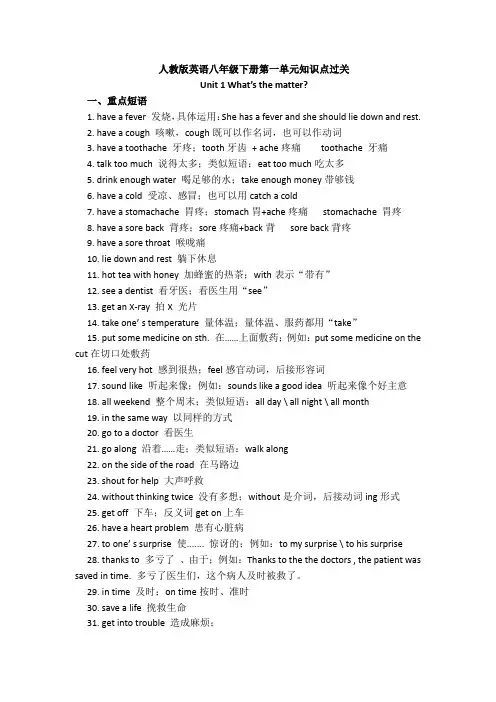
人教版英语八年级下册第一单元知识点过关Unit 1 What’s the matter?一、重点短语1. have a fever 发烧,具体运用:She has a fever and she should lie down and rest.2. have a cough 咳嗽,cough既可以作名词,也可以作动词3. have a toothache 牙疼;tooth牙齿+ ache疼痛toothache 牙痛4. talk too much 说得太多;类似短语:eat too much吃太多5. drink enough water 喝足够的水;take enough money带够钱6. have a cold 受凉、感冒;也可以用catch a cold7. have a stomachache 胃疼;stomach胃+ache疼痛stomachache 胃疼8. have a sore back 背疼;sore疼痛+back背sore back背疼9. have a sore throat 喉咙痛10. lie down and rest 躺下休息11. hot tea with honey 加蜂蜜的热茶;with表示“带有”12. see a dentist 看牙医;看医生用“see”13. get an X-ray 拍X 光片14. take one’ s temperature 量体温;量体温、服药都用“take”15. put some medicine on sth. 在……上面敷药;例如:put some medicine on the cut在切口处敷药16. feel very hot 感到很热;feel感官动词,后接形容词17. sound like 听起来像;例如:sounds like a good idea 听起来像个好主意18. all weekend 整个周末;类似短语:all day \ all night \ all month19. in the same way 以同样的方式20. go to a doctor 看医生21. go along 沿着……走;类似短语:walk along22. on the side of the road 在马路边23. shout for help 大声呼救24. without thinking twice 没有多想;without是介词,后接动词ing形式25. get off 下车;反义词get on上车26. have a heart problem 患有心脏病27. to one’ s surprise 使....... 惊讶的;例如:to my surprise \ to his surprise28. thanks to 多亏了、由于;例如:Thanks to the the doctors , the patient was saved in time. 多亏了医生们,这个病人及时被救了。
最全面人教版八年级下册英语第一单元知识点归纳总结
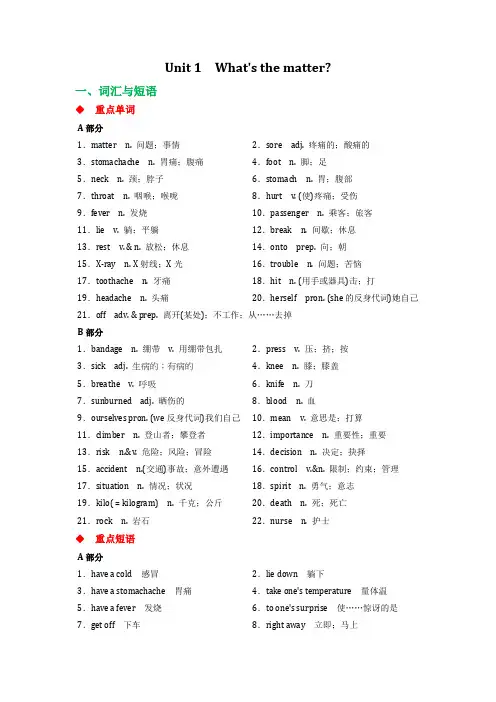
Unit 1 What's the matter?一、词汇与短语◆重点单词A部分1.matter n. 问题;事情2.sore adj. 疼痛的;酸痛的3.stomachache n. 胃痛;腹痛4.foot n. 脚;足5.neck n. 颈;脖子6.stomach n. 胃;腹部7.throat n. 咽喉;喉咙8.hurt v. (使)疼痛;受伤9.fever n. 发烧10.passenger n. 乘客;旅客11.lie v. 躺;平躺12.break n. 间歇;休息13.rest v. &n. 放松;休息14.onto prep. 向;朝15.X-ray n. X射线;X光16.trouble n. 问题;苦恼17.toothache n. 牙痛18.hit n. (用手或器具)击;打19.headache n. 头痛20.herself pron. (she的反身代词)她自己21.off adv. & prep. 离开(某处);不工作;从……去掉B部分1.bandage n. 绷带v. 用绷带包扎2.press v. 压;挤;按3.sick adj. 生病的;有病的4.knee n. 膝;膝盖5.breathe v. 呼吸6.knife n. 刀7.sunburned adj. 晒伤的8.blood n. 血9.ourselves pron. (we反身代词)我们自己10.mean v. 意思是;打算11.climber n. 登山者;攀登者12.importance n. 重要性;重要13.risk n.&v. 危险;风险;冒险14.decision n. 决定;抉择15.accident n.(交通)事故;意外遭遇16.control v.&n. 限制;约束;管理17.situation n. 情况;状况18.spirit n. 勇气;意志19.kilo( = kilogram) n. 千克;公斤20.death n. 死;死亡21.rock n. 岩石22.nurse n. 护士◆重点短语A部分1.have a cold 感冒2.lie down 躺下3.have a stomachache 胃痛4.take one's temperature 量体温5.have a fever 发烧6.to one's surprise 使……惊讶的是7.get off 下车8.right away 立即;马上9.take breaks (take a break) 休息10.talk too much 说得太多11.drink enough water 喝足够的水12.have a very sore throat 嗓子非常疼13.get an X-ray 拍X光片14.see a dentist 看牙医15.drink some hot tea with honey 喝一些加蜂蜜的热茶16.put some medicine on sth.在……上面敷一些药17.feel very hot 感到很热18.sound like 听起来像19.all weekend 整个周末20.in the same way 以同样的方式21.go to a doctor 看医生22.go along 沿着……走23.on the side of the road 在马路边24.shout for help 大声呼救25.without thinking twice 没有多想26.have a heart problem 有心脏病27.thanks to 多亏了;由于28.in time 及时29.save a life 挽救生命30.get into trouble 陷入麻烦31.hurt oneself 受伤32.fall down落下;摔倒B部分1.be used to 习惯于……;适应于……2.in a difficult situation 在困境中3.take risks (take a risk) 冒险4.keep on doing sth. 继续(或坚持)做某事5.run out (of) 用尽;耗尽6.make a decision 作出决定7.cut off 切除8.get hit on the head 撞到头部9.get out of 离开;从……岀来10.be interested in 对……感兴趣11.give up 放弃12.mean doing sth. 意味着做某事13.put a bandage on sth. 用绷带包扎…14.lose one's life 失去生命15.feel sick 感到恶心16.mountain climbing 登山运动17.have problems breathing 呼吸困难18.be in control of 掌管;管理◆重点句子A部分1.What's the matter with you?=What's the trouble with you?=What's wrong with you?你怎么了?2.What should she do? 她该怎么办呢?3.Did you fall down? 你跌倒了吗?4.Should I take my temperature? 我应该量一下体温吗?5.I think I sat in the same way for too long without moving.我想我以同样的姿势一动不动地坐得太久了。
最新人教版八年级英语下册第一单元知识点汇总
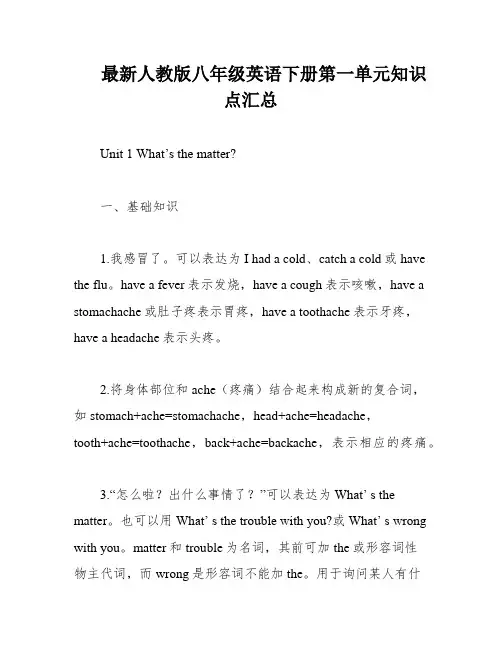
最新人教版八年级英语下册第一单元知识点汇总Unit 1 What’s the matter?一、基础知识1.我感冒了。
可以表达为I had a cold、catch a cold或have the flu。
have a fever表示发烧,have a cough表示咳嗽,have a stomachache或肚子疼表示胃疼,have a toothache表示牙疼,have a headache表示头疼。
2.将身体部位和ache(疼痛)结合起来构成新的复合词,如stomach+ache=stomachache,head+ache=headache,tooth+ache=toothache,back+ache=backache,表示相应的疼痛。
3.“怎么啦?出什么事情了?”可以表达为What’ s the matter。
也可以用What’ s the trouble with you?或What’ s wrong with you。
matter和trouble为名词,其前可加the或形容词性物主代词,而wrong是形容词不能加the。
用于询问某人有什么病或遇到什么麻烦、问题,其后跟询问对象时,与介词with连用,如What’s the matter with sb。
= What’s your trouble?= What’s up?= What happens to sb。
举例来说,当问到“What’s the matter with you?”时,回答可以是“I have a bad cold.”4.maybe表示“或许”,常用于句首,表示可能性,后加句子。
例如Maybe you are right。
may be是情态动词+be的结构,意为“可能,也许”,后加名词、代词或形容词。
例如He maybe angry。
sound like可以和名词、代词以及从句结合使用,如It sounds like you don’t know the truth.It sounds like a good idea。
新人教版八年级英语下册第一单元知识点
新人教版八年级英语下册第一单元知识点
第一单元主要介绍了动词的时态、情态动词以及一般现在时态和现在进行时态的用法。
1. 动词的时态:
- 一般现在时:表示经常性或普遍性的动作或状态。
- 一般过去时:表示过去某个时间发生的动作或状态。
- 一般将来时:表示将要发生的动作或状态。
- 现在进行时:表示现在正在进行的动作。
- 过去进行时:表示过去某个时间正在进行的动作。
- 现在完成时:表示过去的某个时间开始,并持续到现在的动作或状态。
- 过去完成时:表示过去的某个时间前完成的动作或状态。
2. 情态动词:
- can/could:表示能力或许可。
- may/might:表示可能性、许可或请求。
- must:表示必须。
- should:表示建议或义务。
- will/would:表示意愿、习惯或请求。
3. 一般现在时的用法:
- 表示经常性或习惯性的动作或状态,常与频率副词连用(如always, often, sometimes等)。
- 表示客观事实或真理,常用于科学、历史等领域。
- 表示现在的状态、感觉或所属关系。
4. 现在进行时的用法:
- 表示现阶段正在进行的动作或临时状态。
- 表示计划或安排的未来动作。
- 与always或often连用,表示经常性的不满或抱怨。
以上是第一单元的知识点,希望对你有帮助。
最新人教版八年级下册英语第一单元知识点
人教版英语八年级下Unit 1 What’s the matter一、重点单词及用法1.foot-feet 单复数的考察常用复数同:tooth-teetheg:Look,my f_____ are very big,but the new shoes are so small.2.stomach 变复数词尾直接+s stomachseg:The children can’t eat too much ice-cream because it’s bad for their s_______.3.X-ray 冠词考察无特指情况下用an X-ray4.lie躺-lay(过去式)-lying(现在分词)躺lie down 躺下eg:They are _______(lie)on the beach and having a good time5.passenger 乘客复数passengerseg:There were ten __________ on the bus at that time.6.bandage n.绷带v.用绷带包扎eg:Can you put the bandage on the cut(改为同义句)Can you _________ yourself7.Kilo 复数kiloseg:How many ______ of tomatoes do you want8.knife 复数kniveseg:Don’t play with may cut your fingers.9.death n.死亡die v.死亡-died(过去式)-dying(现在分词)dead (形容词死亡的)eg:The dog’s ______ made him very sad.10.s ick 生病的既可以作表语又可以做定语be sick =be illeg:We are going to visit _______ children in hospital.二、重点短语have a cold =catch a cold =have the flu 感冒cough 咳嗽lie down 躺下take one’s temperature 量体温have a fever 发烧take/have breaks/a break 休息=take/have a rest get off 下车-get on上车to one’s surprise 令某人惊讶的是right away 立刻马上=right now get into (trouble)陷入(麻烦)get sunburned 被晒伤be used to (doing)习惯于适应于...... take risks/a risk 去冒险run out (of)用完用尽cut off 切除get out of 离开从......出来be in control of 掌管管理give up (doing)放弃(做)某事have a stomachache 胃痛get an X-ray 做一个X射线检查thanks to......由于多亏in time 及时on time 准时think about 考虑think of认为fall down 摔倒make a decision 作决定put......on......把....放在...上be interested in 对...感兴趣三、用法总结1.need to do sth需要做某事eg: The teacher needs_____(rest) for a few minutes.like 意为“听起来像”后接n./adj./句子eg: It sounds like a good idea.类似的感官动词+like:feel like/smell like/ look like/taste like/seem likesound+adj. 结构中,sound 是系动词意为“听起来是”后接形容词eg:That sounds great.+n./doing(v.现在分词)He went to school without having breakfast. eg:He left the classroom without ________ anythingv.同意,赞成agree with sb/某人的意见看法Does she agree with usagree to do sth 同意做某事They agreed to solve the problem. problems (in) doing sth做某事有困难=have trouble/difficulty (in) doinghave problems with sth =have trouble/difficulty with sth 在某方面有困难eg:One of my good friends said he had problems__________(learn) English.get used to doing sth 习惯于做某事eg:He used to get up late,but now he is used to getting up early.used to do sth 过去常常做某事(现在不做了)eg:He used to read English in the evening.use sth to do sth 使用用某物做某事eg:So he used knife to cut off his arm.be used to do sth 被动被用于做某事eg:These new pens are used to paint the wall.one’s life 丧失生命save one’s life 挽救某人的生命eg:He lost his life in the car accident.adj.足够的充足的后接名词n. enough moneyadv.足够地修饰形容词/副词enough要后置eg:The book is_______,but I don’t have enough money ______it.interesting; to buy enough; to buyenough; buying interesting; buying9. the importance of (doing)sth (做)某事的重要性important adj.重要的unimportant adj.不重要的importance n.重要性eg:We students should know the importance of (learning)English.n.决定make a decision (to do sth)decide to do sth 决定做某事decide not to do sth 决定不做某事eg:Tom made a decision to study English well.up 放弃give up 是动词+副词结构接代词作宾语时代词放中间eg:The problem is so difficult for you,but don’t _______A.give it up it out up it out itgive up doing sth 放弃做某事eg:You will be very sad if you give up______(sing).用法keep on doing sth 继续做某事(中间有间隔强调重复性)eg:He kept on studying though he was very tired.keep doing sth 继续不停地做某事(不间断连续性)eg:Keep walking until you reach the end of the road.keep sb doing 让某人一直做某事eg:Don’t keep the other students waiting.keep sb from doing sth 阻止某人做某事eg:We should keep the little boy from stepping on the grass.用法find找到,强调寻找的结果look for强调寻找过程find out找出查明eg:I was looking for my watch,but I didn’t find it.find sb doing sth 发现某人正在做某事eg:When I walked along the road,I found an old man shouting for help.find it +adj形容词+to do sth 发现做某事是...的eg:She found it hard to finish the work by herself.risks=take a risk 冒险He likes taking risks.risk one’s life to do 冒着生命危险去做某事eg:He risked his life to save the child.risk doing stheg: The man called Tom often risks flying over the sea.四、短语辨析1.see sb doing sth 看见某人正在做某事(动作正在发生)see sb do sth 看见某人做某事(看到动作全过程或者经常看到动作发生)eg:I saw the boy crying when I passed by(路过).类似的hear/watch/notice/find+sb do/doing sththanks to 多亏... 由于....=with the help of/with one’s help=because ofthanks for 因.......而感谢强调感谢的原因eg:Thanks to my teacher ,I passed the exam.Thanks for your help .Thanks for inviting me.2.in time 及时表示动作在规定时间内或比规定时间提前发生on time 准时按时指正好在规定时间内eg:Thanks for coming here to help me in time.The train arrived into the station on time.火车准时进站了。
人教版八年级英语下册各单元知识点总结完整版
Unit 1 What’s the matter?一、重点短语1. have a fever 发烧2. have a cough 咳嗽3. have a toothache 牙疼4. talk too much 说得太多5. drink enough water 喝足够的水6. have a cold 受凉;感冒7. have a stomachache 胃疼8. have a sore back 背疼9. have a sore throat 喉咙痛10. lie down and rest躺下来休息11. hot tea with honey加蜂蜜的热茶12. see a dentist看牙医13. get an X-ray拍X光片14. take one’ s temperature量体温15. put some medicine on sth在……上面敷药16. feel very hot 感到很热17. sound like 听起来像18. all weekend 整个周末19. in the same way以同样的方式20. go to a doctor 看医生21. go along 沿着……走22. on the side of the road 在马路边23. shout for help 大声呼救24. without thinking twice 没有多想25. get off 下车26. have a heart problem 有心脏病27. to one’ s surprise 使……惊讶的28. thanks to 多亏了;由于29. in time及时30. save a life 挽救生命31. get into trouble 造成麻烦32. right away 立刻;马上33. because of 由于34. get out of 离开35. hurt oneself 受伤36. put a bandage on sth. 用绷带包扎37. fall down 摔倒38. feel sick 感到恶心39. have a nosebleed 流鼻血40. cut his knee割伤他的膝盖41. put her head back 把她的头向后仰42.have problems breathing呼吸困难43. mountain climbing登山运动44. be used to doing sth. 习惯做某事45. run out (of) 用完;用尽46. so that 以便47. so…that 如此……以至于……48. be in control of 掌管;管理49. in a difficult situation 在逆境屮50. keep on doing sth.坚持做某事51. make a decision做出决定52. take risks 冒险53. give up 放弃二、知识点解析1. What’s the matter? 怎么了?若是询问“某人怎么了?”要用“What’s the matter with sb.?”拓展:What’s the matter with sb.? 的同义句:What’s wrong with sb.? / What’s the trouble with sb.?2.疾病类短语:have a +疾病. e.g. :have a fever 发烧have a cold 感冒have a cough 咳嗽.have a +身体部位-ache. e.g.: have a headache 头痛have a toothache 牙痛.have a sore+身体部位. e.g.: have a sore throat咽喉痛have a sore back背痛例题:Mom, I____________.I’m sorry to hear that, dear. We must go to see the dentist right away.A. have a headacheB. have a stomachacheC. have a toothacheD. have a fever3. lie down 躺下V. 躺,平躺。
人教版英语八年级下册 Unit 1 单元话题重点知识点精讲精练
八年级人教版 Unit 1 What’s the matter单元话题重点知识点精讲精练1. talk about health problems and accidents(谈论健康问题及意外事故)—What's the matter (with you)?①—I _________________________________(患感冒/发烧/咳嗽/流鼻血/流鼻涕).①—I _________________________________(喉咙痛/背痛/脖子痛). ①—I _________________________________(头痛/牙齿痛/胃痛)2.give advice(给建议)①—I have a stomachache. What should I do? —You should _________________________________(躺下休息).①—I cough badly and have a sore throat now. What should I do? —You should _________________________________(喝热蜂蜜茶).①—I have a toothache. What should I do? —You should _________________________________(看牙医并拍X 光片).①—I have a fever. What should I do? —You should _________________________________(量体温).①—I cut myself by accident. What should I do? —You should _________________________________(敷药). 给建议句型___________________________________________________________ _______________________________________重点知识点:①matter n.问题;事情What's the matter ___________ you?(matter 可换成___________)What's ___________ with you? What happened ___________ you?matter v.要紧;有重大影响;事关紧要It doesn't matter.没关系The only thing that really matters is what the wall looks like when we are done and how much fun we have painting it.唯一重要的事情是当我们结束时墙的样子以及我们在刷墙过程中得到多少快乐。
八年级人教版英语下册unit1知识点总结
八年级人教版英语下册unit1知识点总结Unit1是八年级英语下册的第一单元,主要围绕“the sentence”这一主题展开。
在学习中,我们需要掌握一些重要的知识点,本文将对这些知识点进行总结。
一、句子的构成句子是表达完整意义的语言单位,主要由主语、谓语和宾语三部分构成。
其中,主语是句子的主要话题或动作的执行者,通常位于句子的最前面;谓语是句子的核心,描述主语的动作或状态;宾语是句子的补充说明,通常位于谓语之后。
句子的构成还包括句子成分和句子成分的分类。
句子成分包括主语、谓语、宾语、表语、定语和状语等。
句子成分的分类主要有三种,即主谓结构、主、谓、宾结构和主系表结构。
二、句子的种类英语中根据句子的用途和表达方式,可以分为陈述句、疑问句、祈使句和感叹句四种。
其中,陈述句用来陈述事实、肯定或否定某种情况,一般语序为主谓宾,常以句号结尾;疑问句用来询问问题,通常以问号结尾;祈使句用来表达请求、命令或建议等语气,通常省略主语,以动词原形开头;感叹句用来表达强烈的情感,常以感叹词或how引导。
三、句子的语态和时态英语中的语态有两种,即主动语态和被动语态。
主动语态表示主语执行动作,而被动语态则表示主语受到动作的影响。
时态是句子非常重要的一部分,用来表示动作发生的时间。
英语中时态主要有现在时、过去时和将来时三种。
其中,现在时表示现在或经常性的动作;过去时表示过去发生的动作;将来时表示将来要发生的动作。
四、句子的修辞手法修辞手法是指用以增强语言表现力的一些技巧或方法,英语中常见的修辞手法包括比喻、拟人、排比、反问、设问、修饰语等。
其中,比喻是常用的一种修辞手法,用来通过两个事物之间的共性来形象地说明某一现象或情况,增强语言的表现力。
拟人则是将非人事物或抽象物质化为人来进行描述,以增强表达的感染力。
以上是八年级人教版英语下册Unit1的知识点总结,希望能够对大家在学习中有所帮助。
人教版英语八年级下册unit1单元知识点归纳总结
人教版英语八年级下册Unit1 What’s the matter?重点短语1.have a fever 发烧2. have a cough 咳嗽3. have a toothache 牙疼4. talk too much 说得太多5. drink enough water 喝足够的水6. have a cold 受凉;感冒7. have a stomachache 胃疼8. have a sore back 背疼9. have a sore throat 喉咙痛10. lie down and rest 躺下来休息11. hot tea with honey 加蜂蜜的热茶12. see a dentist 看牙医13. get an X-ray 拍X 光片14. take one’ s temperature 量体温15. put some medicine on sth. 在……上面敷药16. feel very hot 感到很热17. sound like 听起来像18. all weekend 整个周末19. in the same way 以同样的方式20. go to a doctor 看医生21. go along 沿着……走22. on the side of the road 在马路边23. shout for help 大声呼救24. without thinking twice 没有多想25. get off 下车26. have a heart problem 有心脏病27. to one’ s surprise 使....... 惊讶的28. thanks to 多亏了;由于29. in time 及时30. save a life 挽救生命31. get into trouble 造成麻烦32. right away 立刻;马上33. because of 由于34. get out of 离开;从……出萍35. hurt oneself 受伤36. put a bandage on sth. 用绷带包扎37. fa ll down 摔倒38. feel sick 感到恶心39. have a nosebleed 流鼻血40. cut his knee 割伤他的膝盖41. put her head back 把她的头向后仰42. have problems breathing 呼吸困难43. mountain climbing 登山运动44. be used to doing sth. 习惯做某事45. run out (of) 用完;用尽46. so that 以便47. so. . . that 如此… …以至于…48. be in control of 掌管;管理49. in a difficult situation 在闲境中50. keep on doing sth. 继续或坚持做某事51. make a decision 做出决定52. take risks 冒险53. give up 放弃Section A1. What’ s the matter? 怎么啦?出什么事情了?【解析】matter/ ' mætə(r)) /n.问题;事情What’ s the matter with you?= What’s the trouble with you?= What’ s wrong with you?你怎么了?【注】:matter 和trouble 为名词,其前可加the 或形容词性物主代词,wrong 是adj.不能加the 【用法】用于询问某人有什么病或某人遇到什么麻烦、问题其后跟询问对象时,与介词with连用。
人教版英语八年级下册单元Unit 1 知识点+测试卷+思维导图
Unit 1 What’s the matter?1.重点词汇:foot, knee, neck, stomach, throat, matter, cough, fever, headache, stomachache, toothache, nurse, blood, rest, X-ray, situation, spirit, trouble, death, hit, hurt, lie ...2. 短语归纳:1. have a cold 感冒2. have a stomachache 胃痛3. lie down 躺下4. take one’s temperature 量体温5. have a fever 发烧6. take breaks (take a break) 休息7. get off 下车8. to one’s surprise 使……惊讶的;出乎……意料9. right away 立即,马上10. get into陷入;参加11. be used to习惯于……;适应于……12. take risks (take a risk) 冒险13. run out (of) 用尽,耗尽14. get out of离开;从……出来15. be in control of 掌管;管理16. give up放弃3. 必背典句:1. -What’s the matter? -I have a stomachache.-你怎么了?-我胃痛。
2. -What’s the matter with Ben? -He hurt himself.-本怎么了?-他弄伤了自己。
3. -Does he have a toothache? -Yes, he does.-他牙疼吗?-是的,他牙疼。
4. -What should she do? -She should take her temperature.-她应该做什么?-她应该量体温。