
外研版高中英语必修一 Module 5 教学设计
Module 5 A lesson in a labThis module mainly introduces scientific knowledge and the operation and report of basic experiments to students. Questions can often lead to inquiry and phenomenon usually makes people think deeply. Thus, students can voluntarily practice and seek the truth on their own. In this module, we are going to learn some commonly used vocabulary and sentence patterns about scientific experiments. In terms of grammar, we’re going to learn the expressing ways of Degrees of Comparison. Besides, students should also learn to use the forms of modifier of Degrees of Comparison. In pronunciation, students are asked to learn the intonation of general questions and special questions. At the same time, after learning this module, students are required to improve their abilities of listening, speaking, reading and writing as well as some strategies of learning.【知识与能力目标】1.掌握并记忆本课的重点词汇和短语2.培养学生的阅读能力,训练学生阅读速度,查读的阅读技巧;训练学生学会找主题句,归纳文章主旨,运用想象,联想,学会用英语思考的能力3.让学生复习倍数比较和形容词比较级,并掌握这些用法。
【过程与方法目标】1.通过让学生观看图片来让学生对世界上著名科学家有所了解并了解一些化学材料和实验的英语表达。
2.通过朗读指导,自主探究,小组活动等方面来引导学生掌握这个单元的单词,文章和知识点。
【情感态度价值观目标】通过两个实验来连接起英语和化学方面的知识【教学重点】1.学习和掌握本课生词2.让学生掌握并灵活运用倍数比较和形容词比较级的用法。
【教学难点】1.多层次的训练阅读能力,提高阅读水平怎样让学生灵活使用词汇、短语和句型来做题。
Step one: Introduction and VocabularyThe teacher uses some pictures to introduce some famous scientists at home and abroad and then do a match game to have a better understanding of them.Do a listening to introduce some new words in this module.1. (a) Water exists as a solid, a liquid and a gas. (b) Water exists as a solid and a liquid only.2. (a) When you heat a metal, it expands. (b) When you heat a metal, it contracts.3. (a) Steel is a mixture of iron and other substances. (b) Steel is a mixture of iron and oxygen.4. (a) Two-thirds of the earth’s surface is water. (b) 50% of the earth’s surface is water.5. (a) The distance of the sun from the earth is 25.500 kms.(b) The distance of the sun from the earth is 150,500,500 kms.6. (a) The earth is 4.6 million years old. (b) The earth is 4.6 billion years old.7. (a) The earth is twice as large as the moon. (b) The earth is forty-nine times larger than the moon.Do some matching exercises to review some new words and inform Ss some English expressions of metals.How to say the cardinal numbers, the ordinal numbers, fraction, decimals and percent.(英语中基数词、序数词、分数、小数和百分数的读法)1. 基数词的读法A. 先说“几十”,再说“几”,中间用连字符。
B. 先说“几百”,再加and,再加末两位数(或末位数)C. 1000以上的数先从后向前数,每三位数加一“,”(千分位);第一个“,”号前为thousand; 第二个“,”号前为million;第三个“,”号前为billion。
2. 序数词的读法序数词一般以与之相应的基数词加词尾-th构成,如:tenth(第十),但下面这些基数词在变序数词时,有特别的地方。
3. Fraction分数表达法式:分子要用基数词,分母用序数词,如果分子大于一,分母必须用复数形式1/5 one fifth2/3 two thirds3/7 three sevenths4. Decimals小数表达法式:小数点以前按基数词读出,若整数部分为0可读作zero或nought,也可以不读;小数点读作point;小数点后按基数词分别单个读出。
小数点后的0通常读字母O的音。
4.Percent百分数百分数表达方式:%前是什么就读什么,读了之后加上百分号(%)percent就可了。
Step two: Reading & vocabularyLet Ss look at the some pictures and ask them whether they know the names of the equipment. Ask Ss whether they know how we can carry out an experiment successfully.What is the correct order to describe the stages of a scientific experiment?aim method result conclusionPassage Aelectrical adj. 用电的,与电有关的electricity n. 电equipment n. 设备,装备react vi. (化学)反应reaction n. 反应oxide n. 氧化物steam n. 蒸汽,水气Read the passage as quickly as you can and choose the best title for it.The Different Uses of MetalsThe Reaction of MetalsThe Reaction of Metals with OxygenRead the passage again and answer the following questions:1.Which of the metals in the table reacts the most with oxygen and water?2.potassium, calcium and sodium2. What happens when you heat calcium in oxygen?It begins to form an oxide.Passage BPre-reading:What’s happening to the nail in the pictures?Read the passage and complete the table.1. In the first part of the experiment, the __ is dry, not wet.2. It shows that iron ___________ when the air is dry.3. In the second part of the experiment, you must ___ the water to make sure there is no __ in it.4. You add _______ to the water because this keeps __ out of it.5. It shows that ___ does not rust in water that has no __ in it.Complete the passage with proper words according to passage A and BIt is hard to think of a world without metals. Different metals have different metals have different uses, for example, iron can be used in ________ equipment. But above all we should know whether it will ____ under different conditions otherwise it will keep the equipment from working well. As we all know, if iron is heated in oxygen, it will react slowly but will not form an _____. On the other hand, if it is put together with water or _____, there will a ______ reaction. Next let’s do an __________ to support the above. First, get a test tube filled with water and put it over the _____________ to ___ for three minutes.Then put three or four clean nails in the water with some oil added to it and leave the tube for one week. What happens? The iron does not ____ in air-free water. Another experiment, if you put the nails in the tube with the air in it for one week, then what happens? Iron rusts in _______ water. Step three: Grammar倍数表达1.The earth is 49 times larger than the moon.=The earth is 49 times as large as the moon.=The earth is 49 times the size of the moon.用times表示倍数,一般只限于表示3倍或3倍以上的数表示两倍可以用twice Conclusion:1. A + be+倍数+as +形容词原级+as +B2. A + be + 倍数+ 形容词比较级+ than + B3. A+be +倍数+the + (size, height, length, weight, width, depth, age)+of +B Example: A: The Yangtze River is about three times as long as the Songhua River.B: The Yangtze River is about three times longer than the Songhua River.C: The Yangtze River is about three times the length of the Songhua River. Step four: Cultural cornerDiscussion1.What subjects are you interested in?2. Are you always interested in it/them?3. Why are you interested in it/them?4. What do you think of science?Ask Ss why Mark has become more interested in science.Language points1. 辨析:used to do sth 表示过去常常做某事(但现在不做了)be used to (doing) sth 习惯于(to为介词)be used to do sth 被用来做某事(被动语态)2. The science facilities are very good, with laboratories that have all the latest equipment.这些科研设备非常好,实验室配有最新的设备。
外研社高中英语选择性必修一Unit5RevealingnaturePresentingIdeas教案

新外研社版高中英语选择性必修一Unit5 Revealing naturePresenting Ideas教学设计教学目标:By the end of this period, students will be able to:1.Understand the nature from a variety of perspectives;2.Recommend an excellent documentary related to the theme of the unit;3.Have a deeper understanding of the relationship between human and nature.教学重难点:1.Think deeply about the way of protecting nature through the completion of the comprehensive activity.2.Deepen students’ understanding of the theme of “nature”, and cultivate students’ correct outlook on life and values.教学方法:Task-based teaching method教学资源:教材、教具、多媒体课件、学案、黑板和粉笔。
教学设计:Step ⅠLead-inLook at the information about the nature documentaries and answer the questions.Questions:1.Can you guess what secrets of nature are revealed in these documentaries?2.What other nature documentaries have you watched? Which one do you likemost?Give your reasons.Suggested answers:Students’ own answers.Step ⅠThink and definitionActivity1Take notesChoose one nature documentary you like and complete the notes.Title:_____________________Main theme:______________________Reasons you recommend it:___________________Activity2Group discussionWork in groups.Talk about one nature documentary you like.Use the mind map to express yourselves with logic and finally choose “the best candidate” based on the evaluation table.Step ⅠPresentationPrepare a short presentation.Consider the following:1.the structure of your presentationeful words,expressions and structuresGive your presentation to the class.V ote for the best presentation.Step ⅠReflectionWrite a reflection after completing this unit.Consider the following:教学反思:本节课让学生介绍一部揭示自然奥秘的纪录片,回顾纪录片的主要内容并说出推荐理由。
基于主题语境的高中英语单元整体教学设计例析——以外研版必修一Unit5_为例
课改论坛二、单元主题与主要内容分析Into the wild这个单元属于“人与自然”主题语境下的“自然生态”与“环境保护”主题群,子主题语境是“人与动物”。
该单元共由六个模块、十个语篇组成,内容包括:日常生活中人与宠物的关系、动物的迁徙、人类行为对动物生存的影响、与动物有关的习语、能否在动物园饲养野生动物、摄影师偶遇野生熊、动物档案、与动物有关的影视和书籍、濒危动物海报制作等。
十个语篇涵盖听、说、读、写、看五项语言技能训练和语言知识学习。
整个单元以“人与动物”的主题为引领,以十个语篇为载体,以各种活动为路径,糅合主题语境、语篇类型、语言知识、文化知识、语言技能和学习策略等六大要素,循序渐进,相互强化。
下面,笔者对六个模块进行分析。
1.Starting out部分:这部分语篇属于说明文,呈现的是一段与动物主题相关的视频,介绍了英国人饲养宠物的情况,目的在于激发学生对本单元的学习兴趣。
2.Understanding ideas部分:The Monarch’s Jour⁃ney是一篇反映单元主题的课文,语篇类型为科普类说明文。
该语篇介绍了黑脉金斑蝶迁徙的相关知识,以及人类行为对黑脉金斑蝶生存的影响。
读前的导入活动用图片的形式展示了一些动物,让学生判断哪些动物有迁徙的行为,并让学生发表对迁徙动物的认识,这有助于学生提前熟悉课文话题,为课文学习做铺垫;读中活动考查学生对课文具体内容的理解;读后活动则是通过选择题、填空题、思维导图的形式对文章出处、主旨大意、细节理解和开放性问题等进行检测,启发学生深入思考人类行为对动物的影响。
ing language部分:Attributive clauses部分包括两个语篇,第一个语篇用报道的形式展现了中国大熊猫到达荷兰后的情况。
第二个语篇是一封电子邮件,介绍南非之行所见所思。
Vocabulary部分的语篇是一篇说明文,主要介绍一些与动物相关的英语习语的用法,旨在帮助学生了解英语习语的用法。
外研版必修一英语module_5_教学设计
Module 5 A lesson in labPart One: Teaching Design第一部分教学设计Teaching aims and requirements of the unit●To learn about some vocabulary and knowledge related to science and experiments●To know about some metals and get to know their main uses in our lives●To make the students know how to do a simple experiment and write the report about it inEnglish●To deal with all the activities 1-6 about passage A and passage B on page 44-45●To develop students’ expression ability as well as reading ability by practicin g these two passages ●To raise students’ interests in science and form the rigorous scientific attitude.Teaching pointHow iron reacts with air and with water?Teaching proceduresPeriod 1: Introduction and readingStep1: Warming up1.Warming up by discussingGood morning, class. Today we are going to to read about A SIMPLE SCIENTIFIC EXPERIMENT. But first I’d like to show you something. See what’s in my hand? A rusted knife and rusted nail. How does this happen? Please discuss this with your partner.2.Warming up by learning vocabularyTurn to page115, and go over the vocabulary list for Unit 53.Warming up by daily talkT: Now you learn several subjects at school, such as, maths, Chinese, English,physics, chemistry and so on. Which do you like best? Why ? Any volunteers?S1: I like English. My wish is to go abroad some day so I like English and I want to learn it well.S2: I like biology. I want to become a scientist to explore the secrets of life.S3: I like physics. I’m interested in electricity. I want to know more about it and make more use of it to make our life better and better.S4:… ... ... ...T: When I was at your age, I often did experiments at school.(Teacher writes the word “experiment” on the blackboard.) Do you know the meaning of the word “experiment”? It means “trial made in order to prove the truth of an idea”. For example, I hope to find the answer to this problem by experiment. Do you often do experiment?S5: Yes. We often do experiment in physics, chemistry and biology in the labs or in the classroom. T: So today we are going to learn an experiment.Step2: Pre-reading1.Work in pairs, and discuss why an iron knife and nail rust.( the students may say it’s because ofwater and oxygen.) How can you prove that? (to conduct an experiment).1.Leading-inWe know the experiment you did just now tell us a truth that metal may react with different substances in a certain si tuation. Now, we’re going to learn something about an experiment. Skim the text to get a general understanding2.Fast reading: Read Passage A and choose the best title for it.A. The Different Uses of MetalsB. The Reaction of MetalsC. The Reaction of Metals with Oxygen( Key: B )3.Careful reading: Read passage A again and answer these questions.1) Which of the metals in the table reacts the most with oxygen and water?( Key: Potassium )2) What happens when you heat calcium in oxygen?( Key: It will burn to form an oxide )3) Which metals react with steam?( Key: Magnesium, Alumminium and Zinc )4) Does iron have a slow or fast reaction with steam?( Key: It reacts slowly.)5) Does copper react with water?( Key: No )4.Read passage B and fill in the table.(on page 44)pare the 5 sentences and find the different usage of the word leave1) Leave the tube for one week. (使… 处于某种状态)2) I’m leaving Changchun for Beijing tomorrow. (离开)3) There are five minutes left. (剩下)4) Leave it to me. (交给)5) He said that he had left his book in the classroom. (落在某地方)Step 4: Post-readingIn our daily life maybe you always see something rusted, it is not good. How can you solve this problem?Step 5: Discussion1.Do you think it is easy or difficult for you to carry out a scientific experiment well? And canyou describe how to do it successfully in simple words?2.If you want to learn science subjects well, what qualities do you think you should have?(Possible answer: We should be careful / serious / diligent / patient / thoughtful /etc.)Step 6: Reading practiceRead the following passage within 5 minutes and make a proper choice to each problem.During the 19th century scientists found that when certain parts of the brain of a man were injured, he would lose the power to do something. And so people thought that each part of the brain did a different job. But modern research has found out that this is not so, for it is not easy to say exactly what each part of the brain does.In the past fifty years, there has been a great increase in the amount of research done on the brain. Chemists and biologists have discovered that the way the brain works is not so simple as people in general may think. Chemists tell us that 1,000,000 chemical changes take place in the brain every second. Some recent researches also suggest that we can remember everything that happens to us. We may not be able to recall the things we’ve heard and seen, but it is all kept there in the storehouse of the mind.Earlier scientists thought that the power of one’s brain got weaker and weaker as one grew older. But it is now thought that it is not true. As long as the brain is given plenty of exercise, it keeps its power.*It has been established that an old person who has always been active in the mind has a quicker mind than a young man, who has done some physical work without using much of his brain.* The more work we give our brains, the more work they are able to do.1. At present, the scientists have found out that___.A. a certain part of a man’s brain does a certain jobB. if a man’s brain is injured, he can’t do anythingC. it’s difficult to conclude what each part of a man’s brain doesD. the brain is more powerful than any other parts of a man’s body2. Which of the following is TRUE according to the text?A. Less researches have been done on the brain in the past fifty years.B. Most people think that the way the brain works is simple.C. 1,000,000 chemical changes take place in the brain every minute.D. We can’t recall all that we’ve heard and seen because what we can remember is limited.3. The main idea of the last paragraph is that____.A. One’s brain gets weaker and weaker as he grows olderB. One’s brain grows stron ger as he grows olderC. One’s mind becomes quicker as he keeps active in thinkingD. We’d better do less physical work, for it is not good for our mental health4. The purpose of writing this text is to ____.A. tell us some new findings about manB. criticize the scientists of the 19th centuryC. encourage further study in the brainD. correct some misunderstanding about the brain( Key: CBCD )Step 5: Homework1. Conduct an experiment about something you see in your daily life.2. Try to repeat the text freely yourself.3. Learn the new words again, using the dictionary If necessary.Module 5 A lesson in labPart One: Teaching Design第一部分教学设计Teaching aims and requirements of the unit●To learn about some vocabulary and knowledge related to science and experiments●To know about some metals and get to know their main uses in our lives●To make the students know how to do a simple experiment and write the report about it inEnglish●To deal with all the activities 1-6 about passage A and passage B on page 44-45●To develop students’ expression ability as well as reading ability by practicing these twopassages●To raise students’ interests in science and form the rigorous scientific attitude.Teaching pointHow iron reacts with air and with water?Teaching proceduresPeriod Two: Grammar and usageStep 1: General introduction1. Structures of comparison structures ( 形容词或副词各级别句式)1). as + adj./ adv. + as.The layout of Class One’s wall newspaper is as beautiful as that of Class Three’s.as + adj. + a + n. + asThis is as good a dormitory building as the other.as + many / much + n. + asI have as much experience as you in doing the work.2). not as/so + adj./ adv. +asThe bedroom is not as big as the sitting room,3). the -er form + thanMost people think detective stories are more interesting than science fiction.4). the + -est formThis is the largest supermarket in our neighborhood.2. Some other structures1) -er form + and + -er formOur city is becoming more and more prosperous with the development of industry.2) the + -er form, the + -er form,The higher the plane flies, the smaller it will look.3) This bridge is three times longer than that one.This bridge is four times the length of that one.This bridge is four times as long as that one.Step 2: Test to the grammar1 After the new technique was introduced, the factory produced________ tractors in 1988 as the year before.A. as twice manyB. as many twiceC. twice as manyD. twice many as2 How beautifully she sings! I’ve never heard_________.A. the better voiceB. a good voiceC. the best voiceD. a better voice3 If the manager had to choose between the two, he would say John was _______choice.A. goodB. the bestC. betterD. the better4 "Are you satisfied with her answer? " "Not at all. It couldn’t have been______".A. worseB. so badC. betterD. the worst5 Paper produced every year is______ the world’s production of vehicles.A. the three times weightB. three times the weight ofC. as three times heavy asD. three times as heavier as6 We advertised for pupils last autumn, and got_______60.A. more thanB. more ofC. as much asD. so many as7 Professor White has written some stories, but he is _____known for his plays.A. the bestB. moreC. betterD. the most8 It is generally believed that teaching is ____it is a science.A. an art much asB. much an art asC. as an art much asD. as much an art as9 In recent years travel companies have succeeded in selling us the idea that the further we go, _____.A. our holiday the will be betterB. our holiday the will be the betterC. the better our holiday will beD. the better will our holiday be10. I’m _____ at sums than Jean, but better at history.A. moreB. lessC. worseD. cleverer11. We couldn’t have picked ______ day for the picnic because it rained nonstop.A. a worseB. a worstC. the worseD. the worst12. This bird is really lovely, and I’ve never seen _____ one.A. a finerB. a finestC. the finer oneD. the finest13. His pronunciation is bad, but mine is _____.A. no betterB. no moreC. even betterD. even more14. Holiday flights are getting ______ expensive, and we can go by plane.A. more and moreB. less and lessC. by farD. so much15. Generally speaking, the younger you are, _____ to learn.A. it is easierB. the easier it isC. it is easy D it is easier16. We were very tired, for we walked _______ 20 miles that day.A. less thanB. no less thanC. no more thanD. only17. You are ______ careful than your brot her. you two can’t do the work that needs care and skill.A. not moreB. no moreC. not lessD. no less18. “Oh, how fat he is!” “ But I think he is ______ than fat”A. shortB. shorterC. more shortD. shortest19. In my apartment there are two rooms,____ is used as a living room.A. larger oneB. the larger of whichC. the largest oneD. the largest of which20. “Would you like a cup of coffee or a glass of beer?” “_______ will do, but milk is ______ popular with me.”A. Neither, notB. Both, moreC. Either, the mostD. All, the most(Keys: 1-5 CDDAB 6-10 ACDCC 11-15 AAABB 16-20 BBCBC)Module 5 A lesson in labPart One: Teaching Design第一部分教学设计Teaching aims and requirements of the unit●To learn about some vocabulary and knowledge related to science and experiments●To know about some metals and get to know their main uses in our lives●To make the students know how to do a simple experiment and write the report about it inEnglish●To deal with all the activities 1-6 about passage A and passage B on page 44-45●To develop students’ expression ability as well as reading ability by practicing these twopassages●To raise students’ interests in science and form the rigorous scientific attitude.Teaching pointHow iron reacts with air and with water?Teaching proceduresPeriod Three: Self-assessmentStep 1: Listening and speaking in everyday English given in this unitListen to the dialogues and answer the True or False questions.A dialogue.Susan (a girl) meets Peter (a boy) in the schoolyard and they begin a chat about how to study Module 5 better. Mr. Smith is their teacher of English.(Su = Susan; Pt = Peter; Sm = Mr. Smith)Pt: Hi, Susan.Su: Hello, Peter.Pt: You look worried, anything the matter?Su: Oh…My English study.Pt: But you do quite well in English?Su: Thank you. Now some students are saying that this module is the most difficult that we have ever had.Don't you think so?Pt: Not that hard, I think.Su: But it's really too much for me, especially those dull words. They have been driven me mad.Pt: Well, I have made some English labels with them, and Mr. Smith has managed to persuade the school committee to allow us to put the labels along with those in Chinese in the lab and on the equipment, as long as it's safe to have a label on it.Su: Do you think it will help?Pt: Sure, in this way, any time we go to do experiments, we can see the labels in English and it will absolutely help us remember them.Su: Maybe it will work. But how about the experiment report . It appears easy, but it's really hard to be perfect work.Pt: I feel the same way. But don't worry, I just said goodbye to Mr. Smith in the lab.Let turn to him for some advice.Su: OK.(Narrator): Then they go to the lab and Mr. Smith's still there.SM: Hello, Peter and Susan, anything I can do for you.Pt: Susan is worrying about her study of this module.SM: You see, I have finished these labels. They will help you remember the new words.Su: But how about the experiment report? It's really hard to do it well.SM: But it's not so hard? Oh. I see. You've got nothing hard in your English, but in your concept. Pt and Su: Concept, what do you mean by saying so?SM: Let me explain it to you. You think it hard to write an experiment report in English. But the difficulty lies not in your English, but in your concept, as you have never thought you can do an experiment report in English.You are frightened.Su: Maybe so, I have not had the heart to start it, just because I don't think I can do it.Pt: Me too.SM: But you have done well in both chemistry and physics. You should be sure that you can do an experiment well not because it is in Chinese, but because you are able to do it well. So remember, you'll never know if you can do something unless you have the heart to have a try. You've got it?Su and Pt: Yeah, that's the very point. We'll go back and do it right now. Thank you very much, Mr. Smith.SM: I'm sure you can do it very well. Good luck.Su and Pt: Bye.SM: Bye.True or false questions:1.Susan doesn't do well in her English.2.Concept is important.3.Peter is more serious with his study than Susan.4.Mr. Smith went to the lab to do an experiment.5.It's really different between writing an experiment report in English and one in Chinese.( Key:F T F F F )Open discussion:What can you learn from the case of Susan?Possible answer: We can only do something well when we are sure that we can do it well. So, we should learn to believe in ourselves.Step2: Make multiple choices according to the language points we study in this unit.1. You can look for new coins to add___ your collection.A. upB. toC. upD. /2. The anti-Japanese war______ in 1945.A. concludedB. endedC. finishedD. completed3. He ____ his letter with good wishes to the family.A. finished writingB. endedC. finishedD. concluded4. His method ______ English is very good.A. to studyB. for studyingC. of studyingD. in studying5. Mary ____ some sugar in her cup of coffee.A. meltedB. dissolutionC. disposedD. dissolved6. It’s dangerous to touch _______ wires.A. electrifiedB. electricC. electricalD. electricity7. They have already _____ themselves for the travel.A. supportedB. suppliedC. providedD. equipped8.---- Good morning, Grand Hotel.----Hello, I’d like to book a room for the nights of the 18th and 19th.----______A.What can I do for you?B. Just a minute, please.C. What’s the matter?D. At your service9. The visiting guests expressed their satisfaction with the talks, _____ that they had enjoyed their stay here.A. having addedB. to addC. addingD. added10.--- Will you go and have a picnic in the park with us tomorrow?---- I’ll try, but _______.A. this dependsB. it all depends onC. that dependsD. that depends on11.I owe my success to my father. Whenever I was not sure of going on, he always encouraged me to ________.A. get aheadB. go aheadC. take aheadD. be ahead12.The students ________ a line on the play ground, getting ready for their P.H.A. FormedB. stoodC. rowedD. got13.His success _______ his hard work.A. resultedB. resulted inC. resulted fromD. caused14.The water had boiled _______ and the kettle was empty.A. awayB. overC. downD. /15.he worked hard, _____ he passed the exam.A. in a resultB. as resultC. as a resultD. for a result16.---- No, I’m afraid he isn’t in. This is his secretary speaking. Can I help you?A. Oh, you willB. Oh, that’s a pityC. I should think soD. Well, I look forward to hearing from you17. --- Would you please come to help me with my homework tomorrow?A. My pleasureB. It dependsC. You’re welcomeD. I’m glad to hear that18. ______ in a white uniform, he looks more like cook than a doctor.A. DressedB. To dressC. DressingD. Having dressed19. You are standing too near the camera. Can you move _______?A. a bit farB. a little fartherC. a bit of fartherD. a little far20.---Let’s go swimming, shall we?---________.A. It’s my pleasureB. It doesn’t matterC. Yes , let’s goD. I agree with you(keys: 1-5 BDACD 6-10 ADBCC 11-15BACAC 16-20 CBABC)Step 3: A close testRead the following story and choose a proper word to each blank in the story from the given words in every group and make the story complete both in meaning and structure.I was 15 when I walked into McCauley’s Bookstore in Ashland. As I was looking at titles(标题) on the shelves, the man behind the counter, 1 , asked if I’d like 2 . I needed to start 3 for college, so I said yes. I 4 after school and during summers for the lowest wages, and the job helped 5 my freshman (or first) year of college. I would work many other jobs: I made coffee in the Students’ Union during college, I was a hotel maid (or waitress) and 6 made maps for the U.S. Forest Service. But selling books was one of the most satisfying.One day a woman asked me for books on cancer. She seemed fearful (or much afraid). I showed her almost 7 we had at that time in store and found other books we could order. She left the store less 8 . I have always remembered the 9 I felt in having helped her.Years later, as a 10 in Los Angeles, I heard about an immigrant (移民) child who was born 11 his fingers connected (or joined together), web-like. His family could not afford (or pay for) a corrective(矫正;整形) operation, and the boy lived in 12 , hiding his hand in his pocket.I 13 my boss to let me do the story. After my story was broadcast, a doctor and a nurse called, offering to perform the 14 for free.I visited the boy in the recovery(康复) room soon after the operation. The first thing he did was to hold up his 15 hand and say, “Thank you.” I felt a sense of 16 .In the past, while I was 17 , I always sensed (or felt) I was working for the customer, not the store. Today it’s the 18 . NBC News pays my salary(工资), 19 I feel as if I work for the 20 , helping them make sense of (or find the meaning of) the world.1. A.the reader B.the college studentC.the shop owner D.the customer2. A.a book B.a job C.some tea D.any help3. A.planning B.saving C.preparing D.studying4. A.read B.studied C.cooked D.worked5. A.pay for B.fit for C.run for D.enter for6. A.so B.yet C.even D.still7. A.anything B.something C.nothing D.everything8. A.worried B.satisfied C.excited D.puzzled9. A.pride B.failure C.sadness D.surprise10. A.doctor B.store owner C.bookseller D.TV reporter11. A.in B.with C.by D.for12. A.shame B.honor C.terror(恐怖) D.danger13. A.advised B.forced C.persuaded D.allowed14. A.action B.program C.treatment D.operation15. A.repaired B.connected C.hurt D.improved16. A.pleasure B.sadness C.interest D.disappointment(失望)17. A.at the TV station B.in the Students’ UnionC.at the U.S. Forest Service D.at McCauley’s Bookstore18. A.difference B.same C.usual D.request19. A.so B.and C.but D.because20. A.readers B.viewers C.customers D.passengers(Keys:1-5 CBBDA 6-10CDAAD 11-15 BACDA 16-20 ADBCB)Step 4: Translate the following into English paying attention to the bold words or phrases1.眼睛对光有反应。
外研版高中英语必修一Module 5A Lesson in a LabFunction,Everyday English and教案2
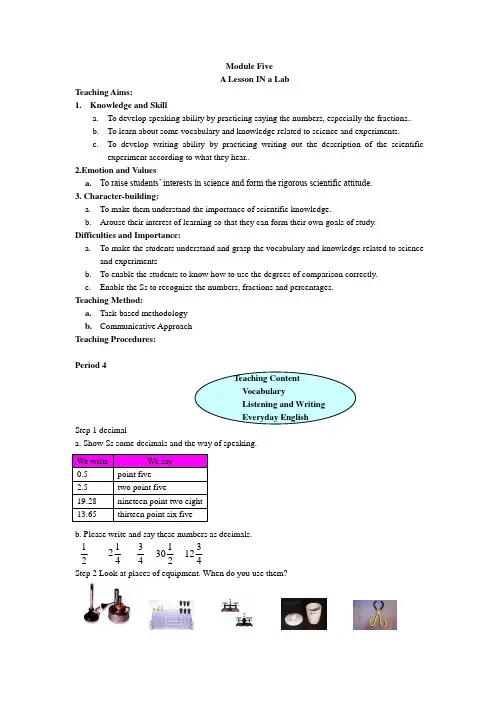
Module FiveA Lesson IN a LabTeaching Aims:1.Knowledge and Skilla.To develop speaking ability by practicing saying the numbers, especially the fractions..b.To learn about some vocabulary and knowledge related to science and experiments.c.To develop writing ability by practicing writing out the description of the scientificexperiment according to what they hear..2.Emotion and Valuesa.To raise students’ interests in science and form the rigorous scientific attitude.3. Character-building:a.To make them understand the importance of scientific knowledge.b.Arouse their interest of learning so that they can form their own goals of study. Difficulties and Importance:a.To make the students understand and grasp the vocabulary and knowledge related to scienceand experimentsb.To enable the students to know how to use the degrees of comparison correctly.c.Enable the Ss to recognize the numbers, fractions and percentages.Teaching Method:a.Task-based methodologymunicative ApproachTeaching Procedures:Period 4Teaching ContentVocabularyListening and WritingEveryday EnglishStep 1 decimala. Show Ss some decimals and the way of speaking.b. Please write and say these numbers as decimals.214124321304312Step 2 Look at places of equipment. When do you use them? We write We say0.5 point five2.5 two point five19.28 nineteen point two eight13.65 thirteen point six fiveBunsen burner test tube balance crucible tongsStep 3 Listening and writinga.We are going to listen to a dialogue that takes place in a lab. A teacher helps a student do anexperiment. In this experiment, the metal magnesium burns in air. Is there a change in weight when this metal burns in air? Let’s guess / predict.Aim: To find out if there is a change in weight when the metal magnesium burns in air.Result:________________________________________________________.b.Now let’s listen to the dialogue. Try to find out whether there is a change in weight when themetal magnesium burns in air. At the same time, pay attention to the information related to theSuggested answers:Aim: to find out if there’s a change in weight when magnesium burns in air.Apparatus: Magnesium, Bunsen burner, a balance, a crucible.Method: First, put the magnesium in the crucible. Then put the crucible on the balance and weigh it. Next, heat the magnesium. Light the Bunsen burner and hold the crucible over it. Finally, weigh the magnesium again.Result: It weighs a little more than before.Conclusion: There is a change in weight when magnesium burns in air.Step 4 Everyday EnglishChoose the correct meaning. Then check your answers with your partner.1.Where do we go from here? Means________.A. What shall we do next?B. Is this the right way?2.Keep the noise down means _______.A. Don’t talkB. Talk quietly3.You’ve got it! means ______A. You’ve understoodB. You have something4.Go ahead means_________A. Go awayB. Begin5. It’s your turn means________.A. You’re nextB. turn aroundSuggested answers:A;B;A;B;AHomework:Finish Exercise 13 on page 95。
高中英语 外研版高一必修一Unit5 教学设计

To help Ss ratetheirperformance, review the unit, anmprove.
3.T asksSsto votefor the best story.
1. Ss make criteria for a good story.
2. Ss present their stories to the class.
3. Ss vote for the best story.
To encourage Ss to present their stories and assess other Ss’ presentation.
To help Ss make full preparationsfor their presentation.
Activity 3
1. T guides Ss to make criteria for a good story.
2. T asks Ss to tell the storiesto the class.
Part 2
Procedures
Purposes
Teacher’s activity
Students’ activity
Investigate
1. T asks Ss to look at the pictures and think about other endangered animals and choose an animal to make a poster.
2. Tasks Ss to complete the notes.
外研版必修一unit5整体单元设计
外研版必修一unit5整体单元设计一、教学目标本单元的教学目标主要包括以下几个方面:1. 知识目标:学生能够掌握和运用关于文化和交际的相关词汇和语法知识,理解相关课文内容;2. 能力目标:培养学生的阅读理解、口语表达和写作能力,提高学生的跨文化交际能力;3. 情感目标:培养学生对多元文化的尊重和包容,提高学生的国际交往和合作意识。
二、教材分析本单元的教材主要包括以下几个部分:1. 课文阅读:学生将会学习并理解与多元文化有关的课文内容,包括文化差异和交际技巧等方面的内容;2. 语法知识:学生将学习相关的语法知识,如虚拟语气、情态动词的用法等;3. 词汇积累:学生将学习相关的文化和交际词汇,了解其用法和搭配;4. 阅读素材:学生将接触与多元文化相关的阅读素材,拓展对不同文化的了解。
三、教学重点和难点1. 教学重点:重点在于教授和理解关于文化和交际的相关词汇和语法知识,以及通过课文和阅读素材拓展对多元文化的认识;2. 教学难点:难点在于学生如何理解和运用季刊文化和交际的相关知识,并且如何进行对比和交际实践。
四、教学策略1. 任务型教学:通过多种任务型教学活动,培养学生的合作精神和实际应用能力;2. 多媒体辅助教学:利用多媒体设备,向学生展示不同国家和地区的文化风情,激发学生的学习兴趣;3. 体验式教学:通过实地走访或互联网搜索,使学生更好地了解和体验不同文化;4. 交际式教学:鼓励学生参与课堂交流,增加语言表达机会,提高交际能力。
五、教学内容安排1. 第一课时:导入多元文化概念,介绍不同国家和地区的文化特点,培养学生对多元文化的兴趣;2. 第二课时:教授文化和交际的相关词汇,包括礼仪、传统节日、日常用语等;3. 第三课时:讲解并练习相关的语法知识,如虚拟语气和情态动词的用法;4. 第四课时:阅读相关的素材,包括文化差异的案例和多元文化交际技巧;5. 第五课时:组织学生展示和交流,让学生运用所学知识进行对比和交际实践。
新外研社(19)高中英语必修一Unit5Into the wild-Using Language教案
新外研社(19)高中英语必修一Unit 5 Into the wild-Using Language教案Teaching objectives:1.Enable the students to learn more about the structures and functions of the attributive clauses and master the usage of relative adverbs as well as their applications in real contexts.2.Guide the students to deepen the understanding of English and stimulate their interest in learning English.Meanwhile,they will learn to observe,research and summarize in English thinking models.3.Lead the students to learn more about the attributive clauses by observing,analyzing and illustrating.Thus,they will deepen their own understanding of the attributive clauses.4.Help the students to explore more usage of the attributive clauses,especially that of the relative adverbs through self-study and cooperation.Evaluation objectives:1.Ask the students whether they could recognize the attributive clauses and whether they have mastered the usage of relative adverbs as well as their applications in real contexts.2.Ask the students whether they could properly use the idioms related to animals and whether they know some other common idioms.3.Check students’ ability to understand the conversations about animals and let them debate on the topics about protecting animals and express their opinions.Teaching key and difficult points:1.Enable the students learn more about the structures and functions of the attributive clauses and master the usage of relative adverbs as well as their applications in real contexts.2.Help the students master and properly use the idioms related to animals, and learn the meanings of some common idioms.3.Improve students’ ability to understand the conversations about animalsand encourage them to debate on the topics and express their agreements and disagreements.4.Lead the students to think about the relationship between human beings and animals, realize the importance of harmony between us and set up the ecological view of sustainable development.Teaching methods:Task-based Approach; Cooperative Teaching MethodTeaching procedures:Step1: Lead-inThe teacher leads the students to review the reading passage on Page50-51 and underline all the attributive clauses in the passage. Then, the teacher will introduce the main topic of this class.(Intention:Introduce the grammar item of this class; the attributive clauses introduced by relative adverbs)Step2: Teach a new class1.Autonomic LearningThe teacher requires the students to discuss the similarities of the underlined attributive clauses in the passage and then summarize the law of the application of their conjunctions, such as where, when and why.(Intention:Summarize the usage of the relative adverbs in the attributive clauses)2.Achievement displayWhen the relative words function as adverbials of time, place and reason in the attributive clauses, we should use relative adverbs, such as when, where and why.(Intention:It will be much more effective to let the students summarize the law of application of the relative adverbs on their own.)3.Cooperative researchStudents are required to discuss why the author uses the attributive clauses rather than two simple sentences in the passage and then they should complete the Activities 1,2 and 3 on Page 53.(Intention:Let students realize the importance of the attributive clauses in the composition and lead the students to try to use the attributive clauses in their following writing.)4.Break through the difficulties(1)Students are required to analyze the usage of relative adverbs again and compare their usage with those of relative pronouns.①The usage of the relative adverb:whenWhen the antecedents are nouns representing time, such as time, day, year, month, week etc. And the relative words function as an adverb of time in the attributive clauses, we will use“when”to introduce the attributive clauses.Eg. I still remember the time when I was in college.I have forgotten the exact date when this country became independent.②The usage of the relative adverb:whereWhen the antecedents are nouns representing place, such as place, room, mountain, airport, etc. and the relative words function as an adverb of place in the attributive clauses, we will use“where”to introduce the attributive clause.Eg. This is the hotel where they stayed.When the antecedents are nouns, such as situation, case, stage, point etc. And meanwhile the relative words function as an adverb of place in the attributive clauses, we will use“where”to introduce the attributive clauses, too.Eg. They have reached the point where they have to separate with each other.③The usage of the relative adverb:whyWhen the antecedent are nouns representing reason, such as reason, and the relative words function as an adverb of reason in the attributive clauses, we will use“why”to introduce the attributive clauses.Eg. This is the reason why he left in a hurry.(Intention:Let the students learn more about the usage of relative adverbs by showing them some typical sentences.)Step3:Explanation当关系词在定语从句中作时间、地点、原因状语时,应使用关系副词,,。
外研版高中英语必修一Module5A Lessen in a Lab教学设计教案
Word-
study
1 Review the words listed on thetableand get to know more usages about these new words by using CD-ROM
设计说明;词汇学习把相关的内容联系在一起,方便学生记忆,同时扫除新课中可能的障碍并使学生自然进入主题。
Activity1
Lead-in
1 Ask students to read the offered words in Activity 1 by themselves , trying to work out the correct order of these
Words describing the stages of an experiment according to what they have reported
教学
目标
题材
目标
本课时简单介绍了金属氧化反应并列出了显示金属活动性能的表格。使学生了解和学会使用科技,实验有关的词汇和知识。培养学生用英语思考和表达的基本技能,增加语言运用的真实感,使学生体验到语言的工具性使用。
语
言
知
识
目
标
Teaching Points (教学重点)
1.Encourage the students to talk about science as well as science subject .
3.Ask them to answer in groups and call back the answers
Dissolve
form
3 Ask students to check these answers andtogetherwith them complete the table below
高中英语新课标外研版必修1教案(Module 5 1st period)
Module 5 A Lesson in a LabⅠ.The General Idea of This ModuleThis module mainly introduces scientific knowledge and the operation and report of basic experiments to students. Questions can often lead to inquiry and phenomenon usually makes people think deeply. Thus, students can voluntarily practice and seek the truth on their own. In this module, we are going to learn some commonly used vocabulary and sentence patterns about scientific experiments. In terms of grammar, we’re going to learn the expressing ways of Degrees of Comparison. Besides, students should also learn to use the forms of modifier of Degrees of Comparison. In pronunciation, students are asked to learn the intonation of general questions and special questions. At the same time, after learning this module, students are required to improve their abilities of listening, speaking, reading and writing as well as some strategies of learning.INTRODUCTIONSome vocabulary on science and technology,experiments are enumerated(列举> in this section.Three activities have been designed. Students ought to get familiar with the meanings of the useful words and expressions so that they can get ready for the study activities.VOCABULARY AND SPEAKINGThis part introduces vocabulary of numerals.Besides,five activities have been designed here for the students to distinguish and calculate the numbers and percentage.GRAMMAR 1In this part,we will learn degrees of comparison of the adjectives. It mainly deals with the expressing ways of multiple.READING AND VOCABULARYThis section leads to some words and useful expressions concerning the topic of this module.It also introduces oxide reaction of metals. The exercises designed according to the reading text enable the students to learn to use the relevant vocabulary by doing the exercises. VOCABULARYThis section supplies vocabulary on experimental apparatus and gives us the reading method of fractions.It also supplies us some relevant activities.LISTENING AND WRITINGThe listening material is a dialogue of teachers and students who are doing an experiment.It gives us the activity on relevant experiment as well.GRAMMAR 2This section mainly introduces three kinds of usage of degrees of comparison of the adjectives.PRONUNCIATIONIn this part,the students are required to master the intonation of general questions and special questions.EVERYDAY ENGLISHIn this part,the students shall learn several useful expressions of daily English.That is:“Where do we go from here?”“Keep the noi se down.”“You’ve got it.”“It’s your turn.”“Go ahead!”FUNCTIONIn writing,the students are asked to grasp the use of first,next, after that,lastly and so on in a paragraph.They are also required to learn the usage of comma.CULTURAL CORNERThe students must learn the teaching conditions of senior high school education of Canada by reading this passage.TASKIt requires students to work in pairs.Furthermore,the students are asked to write an experimental report by recalling the experiments carried out in class and going over the content of reading. MODULE FILEThis section summarizes the words and expressions,grammar, pronunciation and everyday Egnlish learnt in this module.Ⅱ.Three-Dimensional Goals1.Knowledge and skills(1>Be able to master the key vocabulary and read the text fluently. Get to know something about science and technology,experimental reports.(2>The students are required to understand and master the usage of tractions and degrees of comparison of adverbs.2.Process and methods(1>Learn independently,under the teacher’s guidance.Try to get to know knowledge concerning experiments on science and technology.(2>Inquiry and activity.Students are required to understand its importance of scientific knowledge.The students will be aroused the enthusiasm for observing and analyzing problems.3.Emotion and valuesThe materials in this part can help students change their attitude towards study and arouse their interest of learning so that they can form their own goals of study.Ⅲ.Teaching Important PointsStudents should get to know some scientific knowledge and draw a conclusion by doing some experiments.Master relevant vocabulary and phrases and improve the students’abilities of listening,speaking,reading and writing.Ⅳ.Teaching Difficult PointHow to improve the students’ ability of writing effectively.Ⅴ.Preparation of Teaching Aidsa tape recorder,multimedia, a computer and a slide projectorⅥ.Teaching Timefive periodsThe first period:Introduction,V ocabulary and SpeakingThe second and the third period:Reading and V ocabularyThe fourth period:V ocabulary,Listening and Writing, Grammar 1-2The fifth period:Pronunciation Everyday English,Function and Cultural CornerThe First PeriodThe General Idea of This PeriodIn this period,we are going to learn to say some large numbers quickly and correctly. And we will learn to use some new words.Teaching Aims1.Learn and master the following:Learn the meaning of the following words:liquid,expand, contract,substance,mixture,oxygen,electricity.Learn to say the large numbers in English.2.Develop the students’speaking ability by listening andspeaking.Teaching Important Points1.Train the students’ abilities of listening and speaking.2.Enable the Ss to recognize the numbers,fractions and percentages.Teaching Difficult PointHow to improve the students’ speaking ability.Teaching MethodsIndividual and pair work.Teaching Aids1. a computer2. a projector3.the blackboardTeaching ProceduresStep 1 Greetings and Lead-inT:Hello,everyone.Ss:Hello,Mr Li.T:Sit down,please. Now in this unit we are going to learn something about general science and learn how to express the numbers. First of all,let’s learn the new words. (Show the new words on the screen.>liquid 液体expand 膨胀contract 收缩substance 物质mixture 混合物oxygen 氧气electricity 电T:OK. Please read the new words and find the Chinese meaning for each worD.(The Ss read and look up the words in the vocabulary individually.Teacher makes sure the Ss know the new words. Read the words after you.>Step 2 Choose the correct answers to the quiz.Teacher asks the Ss to look through Part one and judge which statements are true.The Ss read and tick the possible right sentences.T:Now listen and check your answers.The Ss check the answers in pairs.1.a2.a3.a4.a5.b6.b7.bT:Now listen again and check your answers.Step 3 PracticeT:Put the words in pairs or groups individually.(The Ss work on their own.>T:Compare the answers in pairs.1.air—oxygen2.contract—expand3.earth—sun—moon4.gas—liquid—solidStep 4 PracticeTeacher shows the words on the screen. Have the class repeat them. electricity iron metal steel air glassT:Can you find these things in our classroom?(Further questions for them to answer>Which of the above are natural?Which are man-made?Which can be both?T:Work in pairs or groups.(Call back the answers from the class.>1.Electricity,iron,some metals and air are natural.2.Steel,some metals and glass are man-made.3.Electricity and some metals (alloys for example> can be man-made and naturally.Step 5 V ocabulary and speaking1.Look at the numbers.(Show these numbers on the screen. Ask them to say the numbers. The English expression will be given when a student makes the answer.>76seventy-six876eight hundred and seventy-six2876two thousand,eight hundred and seventy-six32 876thirty-two thousand,eight hundred and seventy-six432 876four hundred and thirty-two thousand,eight hundred and seventy-six2.Look and learn SB P42 Part 1By this time,the Ss should know the meaning of “million”.T:Read the numbers. And find the two mistakes.This is a good time the Ss learn how to say the large numbers. Theteacher walks around the class and offers help when necessary.S:I’ve found the errors. The first two numbers are misread.T:You’re right. But how can you say the numbers?S:The first one should be fifty-two million,four hundred and seventy thousand,three hundred and eighty-three.T:Great! What about the second?S:It’s one hundred million.T:Good job!3.Look and sayLook at the following big numbers and say them in English quickly.55 555655 5557 555 50587 555 500987 555 5001 000 000 0004.Listen and writeT:Listen to the following numbers in English and write them down.three thousand,five hundred and forty-sixthirty-three thousand,seven hundred and ninety-sixfive hundred and twenty-two thousand,four hundred and eighty -fivethree million,two hundred and thirty-five thousandThe Ss write in the Arab letter.The teacher collects some of their work and shows it on the real object objector.5.Look at these fractions SB,P42 Part 2T:Now please say these fractions in English.S:Two fifth.T:Is it right?S:No,it’s two fifths.T:Good! Next?S:Five eighths.S:Nine tenths.S:Three eighths.S:Five sixths.T:Who can describe the fractions in Activity 2 as percentages?S:I’ll try. One third is the same as 33.33%.S:Four-fifths is the same as 80%.S:One-tenth is the same as 10%.S:Three-quarters is the same as 75%.S:One half is the same as 50%.S:Two-thirds is the same as 66.66%.S:Two-fifths is the same as 40%.S:Five-eighths is the same as 62.5%.S:Nine-tenths is the same as 90%.S:Three-eighths is the same as 37.5%.S:Five-sixths is the same as 83.33%.T:Good! Your mathematics is excellent!6.PracticeT:Let’s turn to P43, Part 4Read these questions aloud and say the numbers.(Put the Ss into pairs to take turns asking and answering the questions.Circulate,monitor and help where necessary. Call back the answers from the class.>(1>3 000 000(2>48 046 000(3>50 000 000 (4>265 693 096(5>750 375 000 (6>80 000 000Step 6 PracticeT:Work in pairs. Give your partner five sums. Use numbers over a million. Your partner must find the answers. Work out the answers and then say them in words.Step 7 Assignment1.Master the new words we have learned in this class.2.Work in pairs. Look,listen,speak and write the larger numbers,fractions and percentages.Step 8 The design of the writing on the blackboardModule 5 A Lesson in a LabThe First Periodliquid55 555expand655 555 contract7 555 505substance87 555 500mixture987 555 500 oxygen 1 000 000 000electricity Step 9 Activity and InquirySteps Students’ Acting Teacher’s Organizing1 The students are asked to use amixture ofpercentages,additions and fractions,as in the previous activity.Thenwork outthe questions on their own first,butleavethe answers off the paper they writethe questions on. Ask the students to work out the answers independently.2 The students should exchangequestions and writethe answers out on paper as theywould say them(i.e. in words,not just in figures>. The teacher looks around the class, inspecting the students’ activity.3 Take it in turns to ask and answer eachother’s question. Ask the students to carry out the activity seriously.申明:所有资料为本人收集整理,仅限个人学习使用,勿做商业用途。
外研版高中英语必修1M5教学设计
3. Surf the Internet for informationabout scientific experiment to prepare for your report.
speaking:能熟练的说出含有“科学与实验”的相关词汇和短语的句子或语段
listening:能够在听的过程中抓住对话的主题
能听懂和辨别并获取数字相关信息
writing:能熟练写出含有形容词和副词的比较级用法的句子或语段。
语言运用
能以“科学与实验”为主题进行交谈,并在交谈中准确使用相关词汇。
文化意识
1. Try to understand the form of comparison in the Introduction part
2. Use comparison to paraphrase the sentences
初步了解比较级基本形式并学会运用,为本模块语法项目做好铺垫。
对照分析以及讨论分享中帮助理解、学会运用。
数字表达以及不同形式数字信息的提炼与获取。
通过生动的形式,加深学生对于数字信息的掌握。
第
41-44
分钟
回顾所学
师生合作根据本节课内容完善本节课所学重要信息点(实验报告相关词汇part 1),并将这些信息点总结到实验报告写作相关专题处,P50。
回顾本节课所学知识,为写作任务做准备。
第
45
分钟
布置作业