
(完整版)人教版六年级英语下册Unit2知识点汇总
Unit2 Last weekend 知识点整理
△话题:初识一般过去时(动词的过去式),询问某人周末过得怎么样?以及在过去的时间里做了什么,是否做了某事。
1.动词过去式的规则变化
词尾的读音
在浊辅音和元音后面读/d/ 在清辅音后面读/t/
在/t/、/d/音后面读/id/
2.不规则动词过去式
do/does did am/is was are were have/has had see saw drink drank go went sleep slept make made get got read read
3.动词短语
cleaned my room washed my clothes stayed at home watched TV did my homework drank tea(喝茶) read a book saw a film(看电影) had a cold(感冒) went boating(划船) listened to music made the bed(整理床铺) 4.时间短语
last night(昨晚)last Monday(上周一) last weekend(上个周末) yesterday(昨天) the day before yesterday(前天)
△句型:
①询问对方周末过得怎么样
How was your weekend?
—— It was fine/good/great,thank you.
②询问某人在过去的时间里做了什么
What did+主语+do(+过去时间)?
——主语+动词过去式+其他。
例句:What did you do last weekend?
—— I stay ed at home and watch ed TV.
③询问对方在过去的时间里是否做了某事
Did +主语+动词原形+其他?
—— Yes,主语 did. / No, 主语 didn’t.
例句:Did he have a cold yesterday?
—— Yes,he did. / No,he didn’t.
Did you see a film (last night)?
—— Yes,I did. / No,I didn’t.
④询问电影是否有趣
Was it interesting?
—— Yes,it was. / No, it wasn’t.
△知识点:
1:否定(缩写)形式:直接+
not did didn’t
was wasn’t were weren’t
2:想要做某事:want + to +动词原形
3:than+动词ing 例:It’s faster than walking.
4:enjoy(享受)+动词ing I enjoy playing computer games. 5: too 用于肯定句
either 用于否定句
6: 句型的转换
①He read a book yesterday afternoon.(对划线部分提问)
What did he do yesterday afternoon ?
②I washed my clothes last morning.(改为一般疑问句)
Did you wash your clothes last morning?
也
③I went shopping last night. (改为否定句)
I didn’t go shopping last weekend.
④Did you do your homework last night. (否定回答)
No,I didn’t.
⑤My weekend was bad . (就划线部分提问)
How was your weekend ?
易错题
❖ She usually clean s her room on the weekend.
❖ She clean ed her room last weekend.
❖ I like watch ing TV. I watch ed TV yesterday.
❖ I am going to see a film next Friday. I saw a film last Friday. ❖ We didn’t go boating the day before yesterday.。
六年级下英语知识点归纳Unit 2 What’s the matter Mike_人教PEP

Unit 2 What’s the matter, Mike?必背词汇:have a fe ver (发烧)tired (疲劳的)have a cold (感冒)excited(兴奋得)have a sore throat (喉咙痛)angry(生气的)表示身体have a toothache (牙痛)表示情绪sad (悲伤的)不适的have a headache (头痛)心情happy (高兴得)hurt (疼痛)bored (无聊的)sore (疼得)其他:feel(感觉)sick(有病的)nose(鼻子)know(知道)worry (担心)medicine (药)drink (喝)stay (在,逗留)better(更好的)soon (立刻,不久)trip (旅行)fail (失败)pass(传递)重点句型:1.A:What’s the matter? 你怎么啦?B: I have a toothache. 我牙痛。
2.A: How do you feel ? 你感觉怎样?B:I feel sick. 我觉得不舒服。
3.A:How does she/he feel? 她/他感觉如何?B:She/ He is tired. 她/他累了。
4.You look so happy. 你看起来如此高兴。
5.A:I failed the math test. 我数学考试失败了。
B:I’m sorry to hear that. 听到这个消息我很难过。
6.How are you ? You look so excited. 你怎么了?你看起来很兴奋。
7.If you have a fever ,you might have athe flu.如果你发烧,你可能得了流感。
8.Don’t worry! If you are sick,see the doctor.不要担心!如果你病了,去看医生。
9.Take some medicine and drink hot drinks.吃些药和热饮料。
人教版英语六年级下册第二单元知识点归纳总结复习
人教版英语六年级下册第二单元知识点归纳总结复习本文旨在对人教版英语六年级下册第二单元的知识点进行归纳总结和复,以便同学们更好地掌握和运用英语知识。
一、语音单词发音:1. 内含元音字母e的单词,重读部分字母e发[i:](如w i pe,pre fer,t e n),非重读部分字母e发[ə](如op e n,nic e )。
2. 内含元音字母a的单词,底音发[æ](如c a t,a pple,b a g),有些单词在意大利语中,底音是开音[a](如p a sta)。
3. 内含元音字母o的单词,重读部分发[əʊ](如bl ow ,gr ow ),非重读部分发[ə](如ph ot o),内含元音字母o和e的单词,重读部分发[əʊ](如sh ow er),非重读部分发[ɪ](如w om e n)。
4. 指在a, o, u三个元音字母后的r的发音,在美式英语中基本不发音,而在英式英语中喜欢将发音弱化,只用[r]表示(如st a r,b o th,p u rple)。
二、语法1. 本单元主要研究there be句型, 即“有”句型。
构成方式为:there + be动词(am, is, are)+ 名词或代词。
2. 动词的第三人称单数的构成方式:一般情况下在动词后直接加s。
但以下几类动词除外:(1)以s, x, ch, sh结尾的动词,直接加es(如watch → watches,fix → fixes,pass → passes,brush → brushes)。
(2)以辅音字母+y结尾的动词,改y为i再加es(如carry → carries,study → studies)。
(3)以o结尾的动词,有的在词尾直接加s(如go → goes),有的加es(如do → does),还有的变成es(如potato → potatoes)。
三、词汇2. 这些单词需要同学们反复背诵和使用,以便记忆更加深刻。
人教版六年级下册英语第二单元知识点
人教版六年级下册英语第二单元知识点本文档将介绍人教版六年级下册英语第二单元的知识点。
第二单元主要涉及人物的描述、问候和日常交流等方面。
1. 人物描述在第二单元中,我们将研究如何描述人物的外貌特征和性格特点。
以下是一些常用的描述词汇:- 外貌特征:tall(高)、short(矮)、thin(瘦)、fat(胖)、beautiful(漂亮)、handsome(帅气)等。
- 性格特点:kind(友善的)、friendly(友好的)、hardworking(努力的)、smart(聪明的)、funny(有趣的)等。
2. 问候和日常交流在日常生活中,我们经常需要进行问候和交流。
以下是几个常见的问候和交流方式:- 问候语:Hello!(你好!)、Good morning!(早上好!)、How are you?(你好吗?)等。
- 介绍自己:My name is...(我叫...)、I am...(我是...)等。
- 询问对方:What's your name?(你叫什么名字?)、How old are you?(你多大了?)、Where are you from?(你来自哪里?)等。
3. 相关词汇和句子接下来是一些与第二单元相关的常用词汇和句子:- 名词:student(学生)、teacher(老师)、classroom(教室)、school(学校)等。
- 动词:study(研究)、read(读)、write(写)、listen(听)等。
- 句子:I am a student.(我是学生。
)、She is my teacher.(她是我的老师。
)、Where is the classroom?(教室在哪里?)等。
总结人教版六年级下册英语第二单元主要涉及人物的描述、问候和日常交流。
通过掌握描述词汇、常用句子和问候方式,我们能够更好地与他人交流和表达自己。
希望这些知识点能帮助你更好地研究和使用英语。
以上就是本文对人教版六年级下册英语第二单元的知识点的介绍。
(完整版)人教版六年级英语下册Unit2知识点汇总
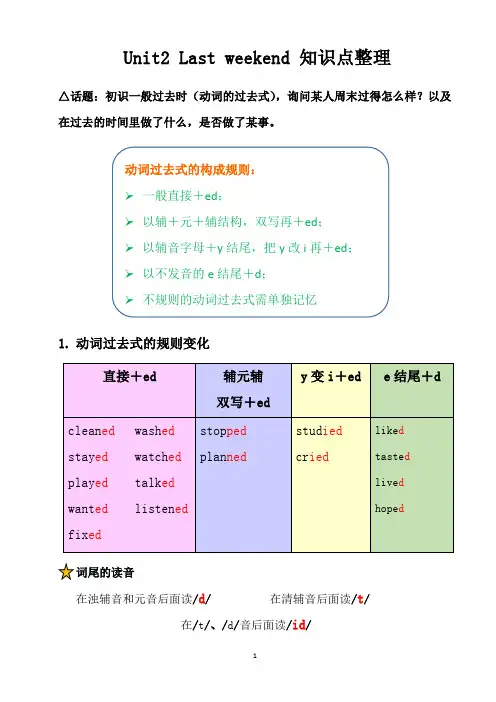
Unit2 Last weekend 知识点整理△话题:初识一般过去时(动词的过去式),询问某人周末过得怎么样?以及在过去的时间里做了什么,是否做了某事。
1.动词过去式的规则变化词尾的读音在浊辅音和元音后面读/d/ 在清辅音后面读/t/在/t/、/d/音后面读/id/2.不规则动词过去式do/does did am/is was are were have/has had see saw drink drank go went sleep slept make made get got read read3.动词短语cleaned my room washed my clothes stayed at home watched TV did my homework drank tea(喝茶) read a book saw a film(看电影) had a cold(感冒) went boating(划船) listened to music made the bed(整理床铺) 4.时间短语last night(昨晚)last Monday(上周一) last weekend(上个周末) yesterday(昨天) the day before yesterday(前天)△句型:①询问对方周末过得怎么样How was your weekend?—— It was fine/good/great,thank you.②询问某人在过去的时间里做了什么What did+主语+do(+过去时间)?——主语+动词过去式+其他。
例句:What did you do last weekend?—— I stay ed at home and watch ed TV.③询问对方在过去的时间里是否做了某事Did +主语+动词原形+其他?—— Yes,主语 did. / No, 主语 didn’t.例句:Did he have a cold yesterday?—— Yes,he did. / No,he didn’t.Did you see a film (last night)?—— Yes,I did. / No,I didn’t.④询问电影是否有趣Was it interesting?—— Yes,it was. / No, it wasn’t.△知识点:1:否定(缩写)形式:直接+not did didn’twas wasn’t were weren’t2:想要做某事:want + to +动词原形3:than+动词ing 例:It’s faster than walking.4:enjoy(享受)+动词ing I enjoy playing computer games. 5: too 用于肯定句either 用于否定句6: 句型的转换①He read a book yesterday afternoon.(对划线部分提问)What did he do yesterday afternoon ?②I washed my clothes last morning.(改为一般疑问句)Did you wash your clothes last morning?也③I went shopping last night. (改为否定句)I didn’t go shopping last weekend.④Did you do your homework last night. (否定回答)No,I didn’t.⑤My weekend was bad . (就划线部分提问)How was your weekend ?易错题❖ She usually clean s her room on the weekend.❖ She clean ed her room last weekend.❖ I like watch ing TV. I watch ed TV yesterday.❖ I am going to see a film next Friday. I saw a film last Friday. ❖ We didn’t go boating the day before yesterday.。
Unit 2 Last weekend 知识点(知识清单)人教PEP版英语六年级下册
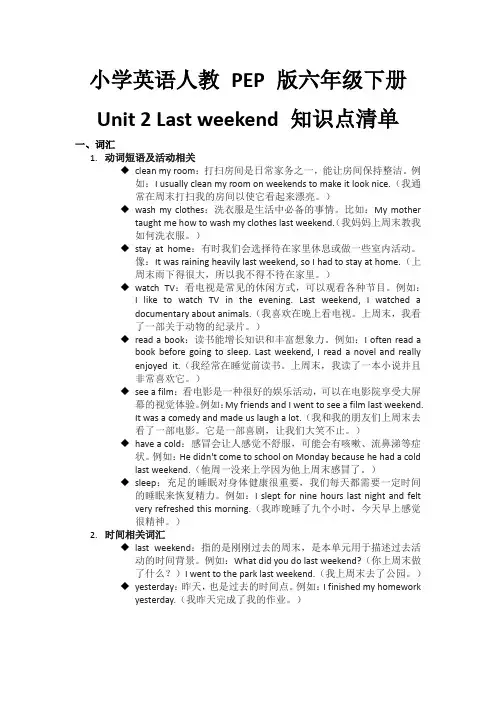
小学英语人教PEP 版六年级下册Unit 2 Last weekend 知识点清单一、词汇1.动词短语及活动相关◆clean my room:打扫房间是日常家务之一,能让房间保持整洁。
例如:I usually clean my room on weekends to make it look nice.(我通常在周末打扫我的房间以使它看起来漂亮。
)◆wash my clothes:洗衣服是生活中必备的事情。
比如:My mothertaught me how to wash my clothes last weekend.(我妈妈上周末教我如何洗衣服。
)◆stay at home:有时我们会选择待在家里休息或做一些室内活动。
像:It was raining heavily last weekend, so I had to stay at home.(上周末雨下得很大,所以我不得不待在家里。
)◆watch TV:看电视是常见的休闲方式,可以观看各种节目。
例如:I like to watch TV in the evening. Last weekend, I watched adocumentary about animals.(我喜欢在晚上看电视。
上周末,我看了一部关于动物的纪录片。
)◆read a book:读书能增长知识和丰富想象力。
例如:I often read abook before going to sleep. Last weekend, I read a novel and reallyenjoyed it.(我经常在睡觉前读书。
上周末,我读了一本小说并且非常喜欢它。
)◆see a film:看电影是一种很好的娱乐活动,可以在电影院享受大屏幕的视觉体验。
例如:My friends and I went to see a film last weekend.It was a comedy and made us laugh a lot.(我和我的朋友们上周末去看了一部电影。
人教版六年级下unit 2知识点总结

Unit 2 Last weekend.知识点总结一必背单词cleaned( clean的过去式)打扫stayed(stay的过去式)停留washed(wash的过去式)洗watched( watch的过去式)看had(have的过去式)患病;得病slept(sleep的过去式)睡觉read(read的过去式)读saw(see的过去式)看见last最近的;上一个的yesterday昨天before在…之前had a cold感冒二必背词组动词短语talked about谈论(过去式) stayed at home待在家里(过去式) drank tea 喝茶(过去式)watched TV看电视(过去式) watched some children`s shows看一些儿童节目(过去式)did something else做其他事情(过去式)cleaned my room打扫房间(过去式) washed clothes洗衣服(过去式) read a new film magazine 看一部新的电影杂质(过去式)buy the new film magazine 买新一期的电影杂质had a cold 感冒(过去式)cooked the food 烹饪食物(过去式) read a book 读书(过去式)did my homework做家庭作业(过去式went fishing去钓鱼(过去式) played football 踢足球(过去式) saw a film看电影(过去式)时间短语last weekend上周末Last night昨晚all weekend整个周末all night整晚the day before yesterday 前天on Saturday morning / afternoon 在星期六上午/下午三重点句型1.How was….用来询间对方过去的某个时过得如何句式结构:How+was+时间名词(短语)?回答:主语+was+形容词。
人教版六年级下册英语第二单元知识点
人教版六年级下册英语第二单元知识点Title: Unit 2 Knowledge Points of Grade 6 in People's Education Press EditionIntroduction:The Unit 2 of Grade 6 in People's Education Press Edition mainly talks about numbers and time. Here are some important knowledge points that students should master.1. Numbers:In this unit, students will learn cardinal numbers and ordinal numbers. Cardinal numbers are used for counting objects, while ordinal numbers are used to indicate the position of an object in a sequence. For example, "one, two, three" are cardinal numbers, and "first, second, third" are ordinal numbers. Students should also learn how to write numbers in words and figures.2. Time:In this unit, students will learn how to tell the time in both the 12-hour and 24-hour clock systems. They should also know how to use "to" and "past" to indicate the minutes, such as "it's ten to six" or "it's twenty past nine". Students should also learn the words related to time, such as "hour, minute, second, o'clock, half past, quarter to/past".3. Units of measurement:In this unit, students will learn some common units of measurement, such as centimeter, meter, kilogram, and gram. They should know how to convert one unit to another, such as how many centimeters in a meter or how many grams in a kilogram. This will help them in their future studies of science and math.4. Money:In this unit, students will learn the basic concepts of money, such as coins, bills, and currency. They should know how to count money, such as "one dollar, two dollars, fifty cents". They should also learn the currency symbols and exchange rates of some common currencies, such as US dollars, euros, and yen.Conclusion:In conclusion, the Unit 2 of Grade 6 in People's Education Press Edition covers some basic but important knowledge points about numbers and time. Mastering these knowledge points will help students build a solid foundation for future studies of science, math, and other subjects.。
人教新起点英语六年级下册Unit 2 All Around Me知识点汇总
Unit 2 All Around Me(我的周围)一、单元词汇show... around 带领……参观Queen s Park 女王公园art gallery 艺术馆public library 公共图书馆downtown 闹市区;市中心Lake Ontario 安大略湖stadium(露天)体育场二、单元句型(一)位置Next to the bookshop is a cinema, and there is a bank next to the cinema. 书店旁边是一个电影院,电影院旁边有一个银行。
Across from the cinema there is a library.电影院对面有一个图书馆。
The CN Tower is near the stadium. CN塔在体育场的旁边。
It s near the park, next to the subway station.它离公园很近,在地铁站的旁边。
(二)那儿有......There are many beautiful buildings in downtown Toronto.在多伦多市中心有许多美丽的建筑物。
There are a lot of shops on this street. 这条街上有很多商店。
There is a big lake in Toronto called Lake Ontario. 有一个大的湖在多伦多叫做安大略湖。
There is a famous restaurant next to the stadium.体育场旁边有一家很有名的餐厅。
(三)科目My favourite class is PE. 我最喜欢的课是体育课。
We study English and maths every day.我们每天学习英语和数学。
We have PE class on Tuesday and Thursday afternoons. 我们的体育课在星期二和星期四的下午。
pep(人教版)六年级英语下册 Unit 2 (2) 单元知识点梳理.doc
第二单元知识点梳理一.必背词汇:clean---cleaned my room 打扫我的房间last weekend 上个周末wash ---washed my clothes 洗我的衣服last Monday上个星期一stay---stayed at home 待在家里last night昨晚watch---watched TV 看电视yesterday evening昨天晚上(词组的过去式)drink---drank tea 喝茶yesterday昨天have---had a cold 感冒the day before yesterday前天see---saw a film 看电影read---read a book 看书sleep---slept 睡觉其它:cook--cooked the food visit--visited my grandparentsplay--played footballstudy--studied English do ---did something else go---wentboating make---made the bedsshow演出magazine 杂志better更好的(good,well的比较级)faster(更快的)hotel(旅馆)fixed(修理)broken(破损的)lamp (台灯)loud(喧闹的,大声的)enjoy(享受…乐趣,喜爱)stay (暂住,逗留)二.语法知识:1. 动词的过去式构成规则:发音规则:1 一般动词在词尾加上ed 。
如:worked , washed played2 以e 结尾的动词在词尾加上d. 如:used, lived3 以辅音字母和y结尾的动词改y为i ,再加上ed . 如:studied , emptied4 末尾只有一个辅音字母的重读闭音节词,双写最后的辅音字母,再加ed 如:stopped ①在浊辅音和元音后面读/d/②在清辅音后面读/t/③在/t/和/d/后面读/id/2.句型:询问在过去的某一个时间做了什么,借助助动词did特殊疑问句——What did you do yesterday / last weekend ? —— I did my homework .一般疑问句,把did提前——Did you help your parents clean the room ? ( 当句子变为一般疑问句,动词应还原成动词原形)——Yes , I did ./No, I didn’t .三.重点句型:1. ---How was your weekend? ---It was good, thank you. 你周末过得怎么样?很好,谢谢。
人教版小学英语六年级下册精品教学课件 Unit 2 单元总结
疑点指津
3.规则动词过去式的构成:
构成规则
原形
一般在词尾加-ed
look play
以不发音的字母e结尾的动 词在词尾加-d
live
hope
结尾是“辅音字母+y”的动 词, 变“y”为“i”再加-ed
study carry cry
以重读闭音节结尾, 末尾
只有一个辅音字母的动词, stop
先双写这个辅音字母, 再 plan
语法: 一般过去时的含义和用法, 包括动词过去式的变化规则和读音规则。
能力 1.能够用一般过去时描述自己在过去的时间里所做的事情。 2.能够用一般过去时对过去所做的事情进行问答。
疑点指津
1.一般过去时的含义: 表示过去某个时间或某一段时间内发生的动作或存在的状态, 常 和yesterday, last weekend, last Saturday等表示过去的时间状语连用; 也表示过去经常发生或反复发生的动作, 常和often, always等表示 频度的词连用。 2.动词过去式构成口诀: 过去式用于过去时, 表示过去发生事。 过去式构成有规律, 一般词尾加-ed。 如果词尾有个e, 直接加上字母-d。 结尾若是“辅音+y”, 变y为i加-ed。 “一辅重闭”作尾巴, 双写之后加-ed。
加-ed
过去式 looked played
lived hoped
studied arried cried
stopped planned
单元总结
学海指南
四会: cleaned (clean 的过去式), stayed (stay 的过去式),
washed (wash 的过去式), watched (watch 的过去式),