
牛津译林版八年级上册Unit 8《Natural disasters》(Grammar 2)课件
去年夏天的这个时候我正在英国度
假。
6. Mary ___________ was dancing while Peter was playing ___________the piano. Mary在跳舞,而Peter在弹钢琴。
7. They _____________the newspaper were reading
clean, play, hold, watch, teach, read, study,
each, eat, drink, write, dance, sing, smoke
等
巩固练习 1.My wallet dropped on the ground _______ while I was running. 2. __________ I was falling asleep, there was When a loud knock on the door. 3. __________ he was reading, an While earthquake started. 4. Were the students listening to the teacher while carefully __________ the teacher was giving a lesson? When 5. __________ the telephone rang, I became nervous.
when I went ________ into the room.
我走进屋子时他们正在看报纸。
doing at five 8. What _____ were you _______
yesterday afternoon? 昨天下午5点你在做什么?
9. The students ______________for their were preparing lessons when Mr Black entered the classroom. Black先生走进教室的时候学生们正在 准备功课。 talking some 10.The teacher was __________to parents when I saw her.
when 后通常加短暂性动词,如:arrive, come in,
get up, open, close, finish, begin, come, go,
arrive, reach, get to, leave, move, borrow, buy, die, knock 等
While后通常加延续性动词, 如:live, run, stay,
Unit 8
Grammar B
What were you doing when the teacher came into the classroom just now?
do homework clean the desk talk with my desk mate prepare for the next lesson look for the book read English books have breakቤተ መጻሕፍቲ ባይዱast
when ,while 的区别
I was reading when you came in. I was reading when you were sleeping.
When引导的时间状语从句,谓语是延续性的,或 者短暂性的。通常用一般过去时,也可以用进行时。
when while 的区别
My mother was watching TV while I was doing my homework.
when
I
was doing homework I was cleaning the desk I was talking with my deskmate I was preparing for the next lesson
I was looking for the book I was having breakfast
When the teacher came in.
What was A doing while B was doing sth?
…was running while …was walking. …was playing basketball while …was playing football. …was reading books while …was playing computer games. …was singing while …was doing his homework
He was taking a shower while his wife was talking on the phone.
while引导的时间状语从句,谓语动词只能是 延续性的,通常用进行时。 while students were The teacher came in ____ talking noisily. =The students were talking noisily when ___ the teacher came in.
________ knocked at the door? 我敲门的时候你在干什么?
4. She wasn’t ______________the room when I cleaning ____ to see her. went 我去看她的时候她不是在打扫房间。 was spending 5. I _____________my vocation England this time last summer.
1. I _________ was doing my homework when Mike _____ came last night. 昨天晚上迈克来的时候我正在写作业。 2. While Ann was ____________TV, her watching got home. father ___ 安正在看电视时,她父亲回来了。 3. What were you doing when I
译林版初中英语八年级上册Unit8Natural disasters知识点归纳及巩固练习题、参考答案
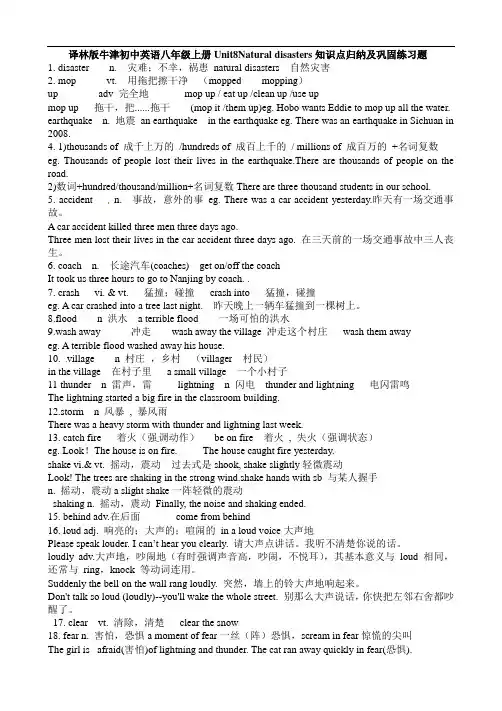
译林版牛津初中英语八年级上册Unit8Natural disasters知识点归纳及巩固练习题1. disaster n. 灾难;不幸,祸患natural disasters 自然灾害2. mop vt. 用拖把擦干净(mopped mopping)up adv 完全地mop up / eat up /clean up /use upmop up 拖干,把......拖干(mop it /them up)eg. Hobo wants Eddie to mop up all the water. earthquake n. 地震an earthquake in the earthquake eg. There was an earthquake in Sichuan in 2008.4. 1)thousands of 成千上万的/hundreds of 成百上千的/ millions of 成百万的+名词复数eg. Thousands of people lost their lives in the earthquake.There are thousands of people on the road.2)数词+hundred/thousand/million+名词复数There are three thousand students in our school.5. accident n. 事故,意外的事eg. There was a car accident yesterday.昨天有一场交通事故。
A car accident killed three men three days ago.Three men lost their lives in the car accident three days ago. 在三天前的一场交通事故中三人丧生。
6. coach n. 长途汽车(coaches) get on/off the coachIt took us three hours to go to Nanjing by coach. .7. crash vi. & vt. 猛撞;碰撞crash into 猛撞,碰撞eg. A car crashed into a tree last night. 昨天晚上一辆车猛撞到一棵树上。
译林牛津版8A Unit 8 Natural disasters Grammar 教学课件 (共17张PPT)
now
• What were you doing when the phone rang?
(background description – I was watching T.V.)
• What happened when you were watching T.V.?
3
PAST CONTINUOUS TENSE
• The Past Continuous describes an action that was already happening at a time in the past and was not finished at the time.
• It means that the action was in progress at a certain time in the past. Example: At 5 o´clock Mark was playing football with his friends.
Key word: when
Past Continuous
1. To say that something was in progress at a certain time in the past
2. To describe a background situation (was / were + ING)
•I was watching T.V. at 8.30 pm last night. (I started at 8.00 pm
and was still watching T.V. at 8.30 pm).
牛津译林版八年级上册Unit 8《Natural disasters》(Grammar)随堂练习
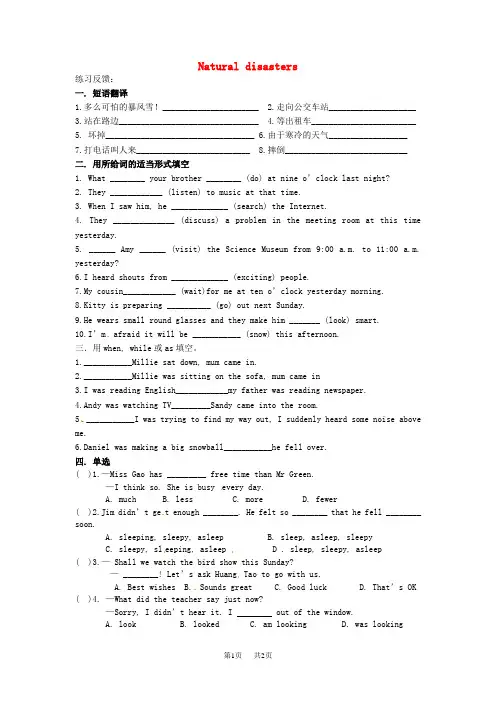
Natural disasters练习反馈:一. 短语翻译1.多么可怕的暴风雪!______________________2.走向公交车站____________________3.站在路边________________________________4.等出租车________________________5. 坏掉__________________________________6.由于寒冷的天气__________________7.打电话叫人来__________________________ 8.摔倒____________________________二. 用所给词的适当形式填空1. What ________ your brother ________ (do) at nine o’clock last night?2. They ____________ (listen) to music at that time.3. When I saw him, he _____________ (search) the Internet.4. They ______________ (discuss) a problem in the meeting room at this time yesterday.5. ______ Amy ______ (visit) the Science Museum from 9:00 a.m. to 11:00 a.m. yesterday?6.I heard shouts from _____________ (exciting) people.7.My cousin____________ (wait)for me at ten o’clock yesterday morning.8.Kitty is preparing __________ (go) out next Sunday.9.He wears small round glasses and they make him _______ (look) smart.10.I’m afraid it will be ___________ (snow) this afternoon.三.用when, while或as填空。
牛津译林版八年级上册Unit8《Naturaldisasters》(Grammar)说课稿
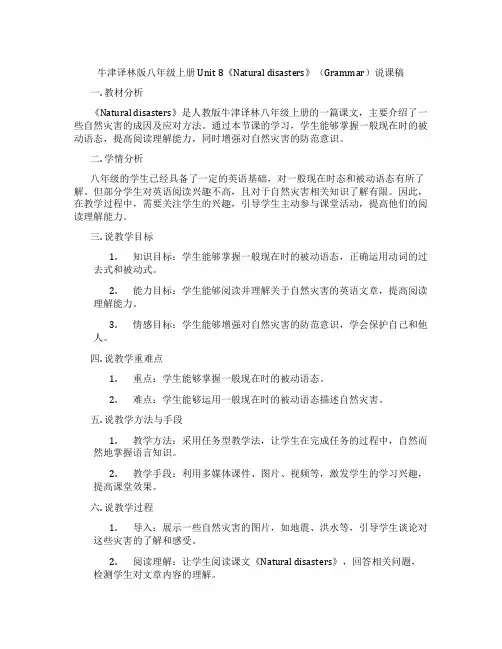
牛津译林版八年级上册Unit 8《Natural disasters》(Grammar)说课稿一. 教材分析《Natural disasters》是人教版牛津译林八年级上册的一篇课文,主要介绍了一些自然灾害的成因及应对方法。
通过本节课的学习,学生能够掌握一般现在时的被动语态,提高阅读理解能力,同时增强对自然灾害的防范意识。
二. 学情分析八年级的学生已经具备了一定的英语基础,对一般现在时态和被动语态有所了解。
但部分学生对英语阅读兴趣不高,且对于自然灾害相关知识了解有限。
因此,在教学过程中,需要关注学生的兴趣,引导学生主动参与课堂活动,提高他们的阅读理解能力。
三. 说教学目标1.知识目标:学生能够掌握一般现在时的被动语态,正确运用动词的过去式和被动式。
2.能力目标:学生能够阅读并理解关于自然灾害的英语文章,提高阅读理解能力。
3.情感目标:学生能够增强对自然灾害的防范意识,学会保护自己和他人。
四. 说教学重难点1.重点:学生能够掌握一般现在时的被动语态。
2.难点:学生能够运用一般现在时的被动语态描述自然灾害。
五. 说教学方法与手段1.教学方法:采用任务型教学法,让学生在完成任务的过程中,自然而然地掌握语言知识。
2.教学手段:利用多媒体课件、图片、视频等,激发学生的学习兴趣,提高课堂效果。
六. 说教学过程1.导入:展示一些自然灾害的图片,如地震、洪水等,引导学生谈论对这些灾害的了解和感受。
2.阅读理解:让学生阅读课文《Natural disasters》,回答相关问题,检测学生对文章内容的理解。
3.语法讲解:讲解一般现在时的被动语态,让学生通过例句和实践,掌握这一语法知识。
4.小组讨论:学生分成小组,讨论如何用英语描述一种自然灾害,以及如何防范。
5.展示与评价:每个小组选择一名代表,展示他们的讨论成果,其他同学和老师进行评价。
6.总结与反思:教师引导学生总结课堂所学,让学生反思自己在课堂上的表现,以及如何提高。
牛津译林版八年级上册英语《Natural disasters》PPT习题课件
可数名词。catch fire意为“着火”,强调动作,其同义短语为
__b_e_o_n_f_ir_e____,强调_状_态______。 [搭配] ___p_ut_o_u_t_th_e__fir_e____ 灭火 __m__ak_e_a__fir_e_______ 生火
知识点 2 thousands of... 成千上万的......
eg: Thousands of people are planting trees on the hill. 成千上万的人正在山上种树。
考向【重点】 它已经不是确切地要表示“千”的意思了, 如thousand前有具体的数字修饰时,则 thousand后就不加s。 如:two thousand 两千
[拓展]类似用法的单词还有hundred, million, billion。
[注意]英语中新闻标题有一套独特的语法体系。一方面,常省 略冠词、系动词等,以节省版面;另一方面,常采用一般现在 时,以突出其新奇感觉
活学活用
2.(1)Every year, __C______ books are donated to the children in poor areas. lion lions lions of lion of
活学活用
3.Last Saturday a car __c_r_as_h_e_d_________(撞到) a big
tree.
into
4 Flood washes away village. 洪水冲走村庄。 [探究] wash意为“冲掉,冲走”,常与__a_w_ay____连用。如果 ___代_词____作宾语,必须放在wash和away中间。 [拓展] wash还可译为“洗,洗涤”。
牛津译林版初中八年级英语上册 《Natural disasters》PPT习题课件
3.LastSaturdayacar_c_r_as_h_e_d_i _________(撞到)
abigtree.
nto
4 Floodwashesawayvillage. 洪水冲走村庄。 [探究] wash意为“冲掉,冲走a”wa,y 常与 __代__词____连用。如果________作宾语,必须放 在[拓w展as]hw和asahw还ay可中译间为。“洗,洗涤”。
Unit8 Naturaldisasters
Welcometotheunit
1.upadv.________ 2.earthquaken.________
课前自主预习
1.up adv完._全__地_____
2.earthquake n地.震________
单
3.coach n.长途__汽_车_____
7.小男孩
Who will ________从__树_上__摔___ the water if I go home without you?下伤来了,腿弄。
4.地震使成千上万的人丧生。
thousand
Earthquake killsso_f ____5.长途汽车撞到树上。
3 Coachcrashesintotree. 长途汽车撞到树上。 [探究] crash为不_及_物______动词,意为“猛撞;碰 撞c”ras。hin常to 用短语为____________,意为“撞 到[拓”展。] crash也可以用及作物________动词,意为 “撞击;砸碎”。
活学活用
句 型
Coach _ct_or_as_h_e_si_n_________ tree.
6.洪水冲走村庄。
在
Flood _w_a_s_h_e_sa_w_a_y_______ village.
牛津译林版八年级上Unit8 Natural disasters Grammar课件
She was drinking milk at this time yesterday.
She was playing computer games at that time.
He was reading newspaper from 10 to 11 yesterday morning.
Can you work out the rule?
3) 否定句:was/were not + Ving was not = wasn’t
were not = weren’t
4) 疑问句:将 was/were 移到主语前
5) 特殊疑问句:疑问词 + was/were +
主语 + Ving …?
Was she talking at that time? No, she was not talking at that time.
What is Tom doing? Tom is playing football. What is Lucy doing? Lucy is read ing a book.
Present continuous tense be (am/is/are) + verb-ing
What was Tom doing at that moment?
• read books • practise swimming • watch the parade 5. from 9 to 10 last night • make cakes
牛津译林版八年级上册英语《Natural disasters》PPT课件(第2课时)
in danger处于危险中,in a hurry匆忙地
知识点 3 in all directions 朝各个方向;四面八方
eg: The birds are flying in all directions. 鸟儿们正朝四面八方飞去。 归纳:in the direction of向……方向,朝……方向 eg: She drove her car in the direction of Shanghai.
right. Write the correct letters in the blanks.
1 shake(lind 5)
__e____ a finally
2 scream (line 5) __c____
3 come down (line 8) __b____
4 silent (line 9)
___f ___
9.Their football team was ___B_____ in that important game. A.won B.beaten C.failed(威海)
10.____A____ the traffic was heavy yesterday, we got to the bus station on time.(菏泽) A.Although B.Unless C.Since
I heard a loud noise like thunder. Soon the real noise came, like bombs under the ground. The earth started to shake. People screamed in fear. Some ran out of the building. I tried my best to run out too, but I could not.
牛津译林版八年级上册Unit8《Naturaldisasters》(Studyskills)说课稿
牛津译林版八年级上册Unit 8《Natural disasters》(Study skills)说课稿一. 教材分析《牛津译林版八年级上册Unit 8 Natural disasters》是一篇关于自然灾害的文章,通过介绍地震、台风、洪水等自然灾害,让学生了解自然灾害的特点以及如何应对。
本课内容与学生的生活息息相关,能够激发学生的学习兴趣。
文章语言简练,图文并茂,有助于学生理解和掌握知识。
二. 学情分析八年级的学生已经具备了一定的英语基础,能够进行简单的阅读和交流。
但学生在阅读长篇文章时,可能会遇到生词和语法障碍,影响阅读理解。
因此,在教学过程中,教师需要帮助学生克服这些困难,提高阅读理解能力。
三. 说教学目标1.知识目标:让学生掌握与自然灾害相关的词汇和表达方式,如earthquake、typhoon、flood等。
2.能力目标:培养学生阅读长篇文章的能力,提高学生的阅读理解水平。
3.情感目标:培养学生关爱生命,关注自然的意识,增强学生应对自然灾害的能力。
四. 说教学重难点1.重点:让学生掌握与自然灾害相关的词汇和表达方式。
2.难点:理解文章中涉及的复杂句子结构和语法现象。
五. 说教学方法与手段1.教学方法:采用任务型教学法,让学生在完成任务的过程中,掌握知识,提高能力。
2.教学手段:利用多媒体课件、图片、视频等辅助教学,增强学生的学习兴趣。
六. 说教学过程1.导入:通过展示自然灾害的图片,引导学生谈论自然灾害,激发学生的学习兴趣。
2.阅读理解:让学生阅读文章,回答相关问题,提高学生的阅读理解能力。
3.词汇学习:讲解文章中出现的生词和短语,让学生掌握与自然灾害相关的词汇。
4.语法讲解:分析文章中的复杂句子结构和语法现象,帮助学生理解。
5.小组讨论:让学生分小组讨论如何应对自然灾害,培养学生的合作意识。
6.总结:对本节课的内容进行总结,强化学生的记忆。
7.作业布置:让学生课后写一篇关于自然灾害的短文,提高学生的写作能力。
牛津译林版八年级上册Unit 8《Natural disasters》(Task)说课稿
牛津译林版八年级上册Unit 8《Natural disasters》(Task)说课稿一. 教材分析《牛津译林版八年级上册Unit 8 Natural disasters》是围绕自然灾害展开的一篇文章。
本节课的主要内容是让学生通过阅读文章,了解自然灾害对人类生活的影响以及如何在自然灾害面前保护自己。
教材内容丰富,插图生动,激发了学生学习兴趣。
同时,本节课还设计了丰富的口语、写作和听力活动,帮助学生全面提高英语能力。
二. 学情分析八年级的学生已经具备了一定的英语基础,对于一些简单的自然灾害词汇和表达方式有所了解。
但他们在阅读长篇文章、理解复杂信息方面还存在一定的困难。
因此,在教学过程中,我需要关注学生的个体差异,调整教学策略,确保每个学生都能参与到课堂活动中来。
三. 说教学目标1.知识目标:学生能够掌握与自然灾害相关的词汇和表达方式,如earthquake、tsunami、hurricane等。
2.能力目标:学生能够通过阅读文章,理解自然灾害对人类生活的影响,提高阅读理解能力。
3.情感目标:培养学生关爱生命、珍惜生命的意识,以及面对自然灾害时的自我保护能力。
四. 说教学重难点1.重点:学生能够掌握与自然灾害相关的词汇和表达方式,理解文章内容。
2.难点:学生能够运用所学知识,就自然灾害话题进行口语交流和写作表达。
五. 说教学方法与手段1.任务型教学法:通过完成各种任务,激发学生的学习兴趣,提高学生的参与度。
2.情境教学法:创设生动的情境,让学生在真实的环境中学习英语。
3.交际式教学法:鼓励学生积极参与课堂交流,提高口语表达能力。
4.利用多媒体教学手段:通过播放视频、图片等,丰富教学内容,提高学生的学习兴趣。
六. 说教学过程1.导入:以一段关于自然灾害的视频导入,激发学生的学习兴趣。
2.阅读理解:学生阅读文章,回答相关问题,了解自然灾害对人类生活的影响。
3.词汇学习:学生通过小组合作,归纳总结文章中出现的自然灾害词汇。