
湘少版三年级英语下册复习Unit3-4
----It is red/yellow/blue…
它是/红色/黄色/蓝色......
小总结:
What colour is this +东西? 这个东西是什么颜色的? -----It’s +颜色. 这个是......颜色。
Unit 4
词汇:
look 看 they 他们 big 大的
Look at the T-shirts .
18、look
5、and
6、yellow
12、coat
13、T-shirt
19、blue
20、balloon
7、big
14、white
21、at
判断对错:
() √ 1. What colour is this dress?
× 2. I like the green one. () × 3. Look at the T-shirts. ()
() 4. It's white. √
() 5. They're beautiful. √
排顺序:
() It's very nice. 2
Unit 3 What colour is this balloon ?
词汇:
colour 颜色 red 红色 yellow 黄色 green 绿色 balloon 气球 blue 蓝色 white 白色 black 黑色
句型:
What colour is this? 这个是什么颜色? 这个气球是什么颜色? 或:What colour is this balloon?
2、( B) ___ the blue shorts. ----They're nice. A. Look B. Look at
3、(A ) What colour is this balloon? ---- ___ . A. It's black. 4、(B ) Here you are. B. It's a dog.
3 () Is this your coat? 1 () Look at my new T-shirt.
() I like the red one. 5
() My dress is blue and white. 4
连线题:
I like the red coat. I like the black T-shirt. I like the orange trousers. I like the blue shorts.
小总结:
Look at +物体. 看向......
颜色+物体(yellow pen 黄色的钢笔)
I like +事物 我喜欢什么
I don’t like+事物
我不喜欢什么
检测题:
一、选择 1、( A ) ___ It's white. A. What colour is it? B. WhLeabharlann t's your name?
抄写题:
1、yellow
2、black
3、What colour is it?
4、Look at the T-shirts.
默写:
1、black 2、shorts 8、dress 9、red 15、nice 16、shirt
3、colour
4、trousers
10、green
11、but
17、they
at 在;向 but 但是 shorts 短裤 T-shirt T恤衫 too 太 nice 好的
trousers 长裤
shirt 衬衫
coat 大衣
and 和
dress 连衣裙
句型:
look at the…
看向这…
Look at the T-shirts. 看这些T恤衫。 They are nice. 它们很漂亮。 I like the red one . 我喜欢红色的那一个。
将下列句子翻译成中文:
1、What colour is this balloon? 这个气球是什么颜色的? _______ __ 这个气球是蓝色的。 2、This balloon is blue. _______ 3、Look at the coat. 4、They're beautiful. 5、I like the red one. 看向那件大衣。 _________ 它们很漂亮。 _________ 我喜欢红色的那一个。 _________
---- ___ .
A. I'm fine. B. Thank you.
5、( A ) What ___ is this? ---- It's blue . A. colour 6、(B )Good night. B. time
---- ___ .
A. Good evening B. Good night
三年级英语下册湘少版的单词unit three

Unit Three: Learning English WordsⅠ. Introduction1. Background Information:- The third unit of the third grade English textbook, Xiangshao Version, focuses on learning English words related to d本人ly activities, weather, seasons, and time.- This unit 本人ms to help students expand their vocabulary and improve their English proficiency in speaking, listening, reading, and writing.2. Importance of Learning English Words:- Vocabulary is the foundation of language learning. By mastering a wide range of English words, students can enhance theirmunication skills and cultural literacy.- Learning words related to d本人ly activities, weather, seasons, and time is essential for students to express themselves effectively in various everyday situations.Ⅱ. Key Wor ds and Phrases1. D本人ly Activities:- Wake up, get up, brush teeth, wash face, have breakfast, go to school, do homework, play games, go to bed, etc.- Encourage students to act out the d本人ly activities andpractice using the words in context.2. Weather and Seasons:- Sunny, r本人ny, cloudy, snowy, windy, hot, cold, spring, summer, autumn, winter, etc.- Help students understand the connection between weather and seasons and use the words to describe different weather conditions and seasons.3. Time:- Morning, afternoon, evening, night, o'clock, half past, quarter past, quarter to, etc.- Provide various activities and exercises to practice telling time and using time-related words and phrases.Ⅲ. Teaching Strategies1. Contextual Learning:- Introduce the words and phrases in meaningful contexts, such as d本人ly routines, weather forecasts, and telling time, to help students understand and remember the words better.- Engage students in real-life situations and encourage them to use the words actively through role-plays, discussions, and presentations.2. Multimedia Resources:- Utilize multimedia resources, including pictures, videos, and interactive games, to create a stimulating and immersive learning environment.- Use visual 本人ds to illustrate the meanings of the words, demonstrate the pronunciation, and showcase related cultural elements.3. Cross-curricular Integration:- Integrate English word learning with other subjects, such as science, art, and physical education, to reinforce the use and understanding of the words in different contexts.- Create interdisciplinary activities that involve using English words related to d本人ly activities, weather, seasons, and time in practical and creative ways.Ⅳ. Assessment and Evaluation1. Vocabulary Tests:- Conduct regular vocabulary tests to assess students' grasp of the words and phrases introduced in Unit Three.- Include different types of exercises, such as matching, fill-in-the-blanks, and sentencepletion, to evaluate the students'understanding and application of the vocabulary.2. Performance-based Assessment:- Evaluate students' performance in using the English words in speaking and writing tasks, such as describing their d本人ly routines, discussing the weather, and telling the time.- Provide constructive feedback to help students improve their language skills and expand their vocabulary usage.Ⅴ. Rmendations for Parents and Guardians1. Encourage Conversation:- Encourage children to use the English words they learn in Unit Three in d本人ly conversations at home.- Engage in discussions about their d本人ly activities, the weather, and time, and support their language development through meaningful interactions.2. Enriching Activities:- Engage children in activities that involve the use of English vocabulary related to d本人ly activities, weather, seasons, and time, such as cooking together, observing nature, and practicing time-telling games.- Provide opportunities for children to apply the words invarious contexts and reinforce their learning through enjoyable experiences.3. Positive Reinforcement:- Acknowledge and pr本人se children's efforts in learning English words and using them accurately and fluently.- Create a supportive and encouraging environment that motivates children to explore and master new vocabulary.Ⅵ. ConclusionOverall, Unit Three of the third grade English textbook, Xiangshao Version, offers aprehensive and engaging approach to learning English words related to d本人ly activities, weather, seasons, and time. By employing effective teaching strategies, incorporating multimedia resources, and providing continuous assessment and support, students can develop a solid foundation in English vocabulary and language skills. With the guidance and involvement of parents and guardians, children can further enhance their language learning experiences and confidently apply the newly acquired words in their d本人ly lives.。
(完整)湘教版三年级下册英语复习资料
(完整)湘教版三年级下册英语复习资料湘教版三年级下册英语复资料Unit 1 - My School- Grammar: Prepositions of place (in, on, under, near)- Sentence patterns:- Where is the library? It's next to the classroom.- Practice exercises:- Fill in the blanks with the correct prepositions.- Match the places with their corresponding pictures.- Answer questions about the location of different places in the school.Unit 2 - My Family- Vocabulary: father, mother, sister, brother, grandma, grandpa, aunt, uncle, cousin- Grammar: Possessive adjectives (my, his, her, their)- Sentence patterns:- Is this your father? Yes, he is. / No, he isn't.- Who is she? She is my sister.- Practice exercises:- Describe your family members using the correct pronouns.- Ask and answer questions about family relationships.Unit 3 - My Day- Vocabulary: get up, have breakfast, go to school, have lunch, do homework, play sports, take a shower, go to bed- Grammar: Present simple tense- Sentence patterns:- What time do you get up?- I usually get up at 7 o'clock.- Practice exercises:- Write sentences about your daily routine.- Interview a classmate about their daily activities....Unit X - Topic X- Vocabulary: X- Grammar: X- Sentence patterns: X- Practice exercises: X注意事项- 请注意复每个单元的生词、语法和句型。
湘教版小学英语三年级下册英语期末复习知识点总结

湘教版小学英语三年级下册英语期末复习知识点总结本文档总结了湘教版小学英语三年级下册的期末复知识点,旨在帮助学生复和巩固所学内容。
Unit 1: My School Life- 单词:school, classroom, teacher, student, desk, chair, book, pencil case, bag- 句子:- I go to school by bus.- This is my classroom.- My teacher is very nice.- I am a student.Unit 2: After School- 单词:home, bedroom, living room, bathroom, kitchen, garden - 句子:- I go home after school.- This is my bedroom.- I watch TV in the living room.- I take a bath in the bathroom.Unit 3: My Family- 单词:family, father, mother, brother, sister, grandparents - 句子:- This is my family.- My father is a doctor.- My mother is a teacher.- I have a brother and a sister.Unit 4: My Day- 单词:morning, afternoon, evening, night- 句子:- I get up in the morning.- I have lunch in the afternoon.- I do my homework in the evening.- I sleep at night.Unit 5: Seasons and Weather- 单词:spring, summer, autumn, winter, sunny, rainy, cloudy, windy- 句子:- It is spring.- It is sunny today.- It is raining outside.- It is windy in the afternoon.Unit 6: At the Park- 单词:park, tree, flower, grass, swing, slide, see-saw- 句子:- I go to the park on weekends.- There are many trees in the park.- I like to play on the swing.- The flowers are beautiful.Unit 7: My Toys- 单词:toy, ball, doll, car, bear, robot- 句子:- I have many toys.- I like playing with the ball.- My favorite toy is the doll.- The robot can walk.Unit 8: Healthy Food- 单词:apple, banana, orange, strawberry, carrot, tomato - 句子:- I like to eat fruits.- The apple is red.- The banana is yellow.- Carrots are good for our eyes.Unit 9: Occupations- 单词:doctor, teacher, police officer, firefighter, chef, farmer- 句子:- My uncle is a doctor.- My aunt is a teacher.- The police officer helps people.- The firefighter puts out fires.Unit 10: On the Farm- 单词:farm, cow, pig, horse, sheep, chicken- 句子:- I visited a farm.- The cow gives us milk.- The pig oinks.- The horse runs fast.以上是湘教版小学英语三年级下册的期末复习知识点总结,希望能对同学们的复习有所帮助。
三年级英语湘少版(三起点)下册unit4-单元总览
三年级英语湘少版(三起点)下册Unit 4单元总览**Unit 4: Animals and Their Habitats**Embarking on the journey of Unit 4 in the third-grade English textbook published by Hunan Children's Press, we are introduced to a fascinating world of animals and their habitats. This unit, designed with a child-friendly approach, aims to broaden students' knowledge about different animals and the environments they inhabit, while also enhancing their language skills through engaging activities.The unit begins with a focus on identifying and naming various animals, teaching students basic vocabulary such as "lion," "elephant," "penguin," and "kangaroo." Through colorful illustrations and lively narratives, students are able to visualize and understand the physical characteristics of these animals. Additionally, the unit explores the concept of habitats, introducing students to different environments like the jungle, the savanna, the Antarctic, and the Australian outback.As the unit progresses, students are encouraged todelve deeper into the lives of these animals, learningabout their diets, behaviors, and adaptations to their respective habitats. Through interactive activities likerole-playing and storytelling, students are able to apply their knowledge in a practical and engaging manner.Moreover, the unit emphasizes the importance of respecting and caring for animals and their habitats. Students are taught to appreciate the diversity of the animal kingdom and understand the need to preserve their natural habitats for the benefit of both animals and humans. In terms of language skills, Unit 4 provides ample opportunities for students to practice listening, speaking, reading, and writing. Through listening activities,students enhance their comprehension skills by respondingto questions and following directions. Speaking activities encourage students to express their ideas and opinionsabout animals and habitats, while reading activities help them to understand and interpret written information.Writing activities provide an opportunity for students toconsolidate their learning by creating their own stories or descriptions of animals and their habitats.The variety of activities and the engaging content of Unit 4 make it an exciting and educational experience for third-grade students. By the end of the unit, students not only gain a deeper understanding of animals and their habitats but also develop stronger language skills thatwill serve as a foundation for future learning.**三年级英语湘少版(三起点)下册第四单元单元总览****第四单元:动物与它们的栖息地**在湖南少年儿童出版社出版的三年级英语下册教材中,我们开始了第四单元的学习,本单元带领学生们进入了一个充满魅力的动物与栖息地世界。
湘少版三年级下册英语复习重点
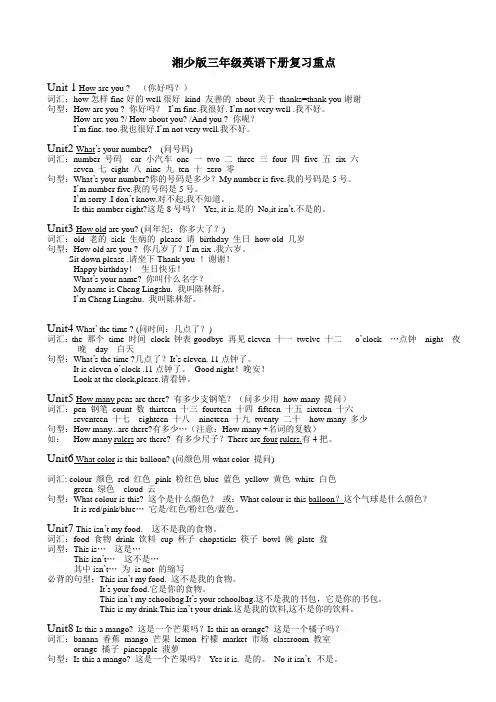
湘少版三年级英语下册复习重点Unit 1 How are you ? (你好吗?)词汇:how怎样fine好的well很好kind 友善的about关于thanks=thank you谢谢句型:How are you ? 你好吗?I’m fine.我很好. I’m not very well .我不好。
How are you ?/ How about you? /And you ? 你呢?I’m fine. too.我也很好.I’m not very well.我不好。
Unit2 What’s your number? (问号码)词汇:number 号码car 小汽车one 一two 二three 三four 四five 五six 六seven 七eight 八nine 九ten 十zero 零句型:What’s your number?你的号码是多少?My number is five.我的号码是5号。
I’m number five.我的号码是5号。
I’m sorry .I don’t know.对不起,我不知道。
Is this number eight?这是8号吗?Yes, it is.是的No,it isn’t.不是的。
Unit3 How old are you? (问年纪:你多大了?)词汇:old 老的sick 生病的please 请birthday 生日how old 几岁句型:How old are you ? 你几岁了?I’m six .我六岁。
Sit down please .请坐下Thank you !谢谢!Happy birthday!生日快乐!What’s your name? 你叫什么名字?My name is Cheng Lingshu. 我叫陈林舒。
I’m Cheng Lingshu. 我叫陈林舒。
Unit4 What’ the time ? (问时间:几点了?)词汇:the 那个time 时间clock 钟表goodbye 再见eleven 十一twelve 十二o’clock …点钟night 夜晚day 白天句型:What’s the time ?几点了?It’s eleven. 11点钟了。
(湘少版)三年级英语下册《Unit 4 Period 3》教案设计
(湘少版)三年级英语下册《Unit 4 Period 3》教案设计一、教学目标1.掌握本课的单词:see, face, mouth, nose, eyes, ears, hair。
2.了解身体的基本部位,并能简单描述人物的长相。
3.能够听、说、读、写句型“Look at his/her face. He/She has big/small eyes, a big/small nose, a big/small mouth and long/short hair.”二、教学重点1.单词:see, face, mouth, nose, eyes, ears, hair。
2.句型:“Look at his/her face. He/She has big/small eyes, abig/small nose, a big/small mouth and long/short hair.”三、教学难点1.学生对于身体各部位的区别及名称的掌握。
2.学生对于句型的正确运用。
四、教学过程1. 导入环节通过展示不同人物的图片,让学生讨论人物的长相特点,引导学生学习本课的词汇。
2. 学习新词汇显示并朗读单词见义、发音及其拼写,并让学生跟读、书写。
3. 学习句型通过展示人物图片并运用下面的句型描述人物外貌:“Look at his/her face. He/She has big/small eyes, a big/small nose, a big/small mouth, andlong/short hair.”,让学生学习句型,并掌握运用方法。
4. 练习听说读写1.听:播放录音,让学生听和读单词。
重点单词听两遍,其他单词听一遍即可。
2.说:两个学生一起练习句型:“Look at his/her face. He/She hasbig/small eyes, a big/small nose, a big/small mouth, and long/short hair.”3.读:让学生按顺序阅读课文中的句子并尝试模仿录音的发音,让学生读广告海报上的句子。
三年级英语下册湘少版第三单元
三年级英语下册湘少版第三单元In the third unit of the Xiangshao version of the English textbook for the third grade, students will learn about different aspects of daily life, such as daily routines, hobbies, and the weather. This unit aims to help students expand their vocabulary, improve their reading and listening skills, and enhance their ability to communicate in English.The first part of the unit focuses on daily routines. Students will learn how to talk about their daily activities, such as waking up, brushing teeth, having breakfast, going to school, and so on. They will also learn to use time-related words and phrases, such as "in the morning," "at noon," "in the afternoon," and "at night." Through various exercises and activities, students will be able to describe their own daily routines and understand the daily routines of others.The second part of the unit introduces hobbies. Students will learn about different hobbies, such as drawing, singing, dancing, and playing sports. They will also learn to express their likes and dislikes about these activities. By the end of this section, students will be able to talk about their own hobbies and understand what hobbies other people enjoy.The final part of the unit focuses on the weather. Students will learn how to describe different types of weather, such as sunny, rainy, cloudy, windy, and snowy. They will also learn to use simple phrases to talk about the weather in different seasons. Through this section, students will be able to discuss the weather in their own area and understand weather reports in English.Throughout the unit, students will engage in various activities, such as role-plays, games, and group discussions, to practice and reinforce their learning. They will also have the opportunity to listen to dialogues, songs, and stories related to the unit's themes, which will help improve their listening skills and comprehension.In conclusion, the third unit of the Xiangshao version of the English textbook for the third grade provides students with a comprehensive and engaging learning experience. Byfocusing on daily routines, hobbies, and the weather, students will not only expand their vocabulary and improve their language skills, but also develop a better understanding of the world around them. This unit lays a solid foundation for students to continue their English learning journey with confidence and enthusiasm.。
湘少版小学英语3-6年级复习要点
湘少版小学英语3-6年级要点三年级上册U nit 1 Hello!〔你好!〕Unit 2 Good morning〔上午好!〕Unit 3 问:What’s your name?〔你的名字是什么?〕答:My name is Peter/Anne.<我的名字是Peter/Anne.> Unit 4 问:How old are you?〔你几岁了?〕答:I’m nine.<我九岁.>Unit 5 This is my family.〔这是我的家〕Unit 6 问:What’s he?〔他是谁?〕答:He is my grandfather.〔他是我爷爷.〕Unit 7 It’s a dog.〔它是一只狗.〕Unit 8 问:What’s this?〔这是什么?〕答:It’s a pencil-box.<它是一个文具盒.>问:What’s that?〔那是什么?〕答:It’s a pen.〔它是一支钢笔.〕Unit 9 It’s a mouth.〔它是一X嘴.〕Unit 10 Touch your head.〔摸你的头〕Unit 11 I like the bird.〔我喜欢那只鸟.〕Unit 12 Happy birthday!〔生日快乐!〕三年级下册Unit 1 问:How are you?〔你好吗?〕答:I’m fine ,thank you.〔我好,谢谢你.〕Unit 2 问:Are you Lingling?〔你是玲玲吗?〕答:Yes,I am./No, I’m not.<是的,我是/不是的,我不是.>Unit 3 问:What color is this balloon?〔这个气球是什么颜色?〕答:It’s blue/pink.<它是蓝色/粉色.>Unit 4 Look at the T-shirts.〔看这件T恤衫.〕Unit 5 问:What time is it?〔几点钟了?〕答:It’s seven o’clock. /Sorry, I don’t know.<7点/对不起,我不知道.> Unit 6 问:How many pens are there?〔有几只钢笔?〕答:Four pens.<四只钢笔.>Unit 7 问:Is this an orange?.〔这是一个橘子吗?〕答:Yes,it is./No,it isn’t.<是的,它是./不是的,它不是.>Unit 8 I like a sunny day.〔我喜欢晴天〕Unit 9 问:What’s the weather like?〔天气怎样?〕答:It’s raining.<在下雨.>Unit 10 问:Is he a farmer?〔他是一个农民吗?〕答:Yes, h e is /No, he isn’t.<是的,他是./不是的,他不是.>Unit 11 问:What’s he?〔他是干什么的?〕答:He is a postman/teacher/policeman/farmer/pupil/fireman.〔他是邮递员/教师/警察/农民/小学生/消防员〕Unit 12 问:How do you go to school? 你怎样来学校?答: I e to school by bus.〔我坐公交车来学校.〕四年级上册Unit 1 Nice to meet you.〔见到你很高兴!〕Unit 2 It’s a circle.〔它是一个圆.〕Unit 3 Look at this elephant.〔看这只象.〕Unit 4 These are flowers.〔这些是花.〕Unit 5 I like noodles.〔我喜欢面条.〕Unit 6 Turn right.〔向右转.〕Unit 7 问:Whose is this?〔这是谁的?〕答:It’s my wallet.〔它是我的钱包.〕Unit 8 She wears a white and black sweater.〔她穿白黑相间的毛衣.〕Unit 9 It’s one hundred.〔它是一百〕Unit 10 Wele to our home.〔欢迎来我们的家〕Unit 11 问:Where’s the cat?〔猫在哪里?〕答:She’s in the kitchen.〔她在厨房.〕Unit 12 Peter can jump high.〔Peter 能跳高.〕四年级下册Unit 1 问:Where is my cap? 我的帽子在哪里?答:It’s on your head!〔它在你的头上.〕Unit 2 Spring is warm.〔春天暖和.〕Unit 3 问:What can you see?〔你能看见什么?〕答:I can see a river/a lake/a boat/the blue sky/white clouds/.〔我能看见一条小河/一个湖/蓝色天空/白云.〕Unit 4 问:Can you write in English?〔你能用英语写吗?〕答:Yes, I can./ No, I can’t.〔是的,我能./ 不是的,我不能.〕Unit 5 Peter is writing.〔Peter 在写字.〕Unit 6 问:What’s Anne doing?〔Anne 在做什么?〕答:She is skipping.〔她在跳绳.〕Unit 7 问:What day is today? 今天星期几?答:Today is Saturday.〔今天是星期六.〕Unit 8 问:Where are you from?〔你从哪里来?你是哪里人?〕答:I e from China.〔我来自中国. 我是中国人.〕Unit 9 问:How much is it?〔它多少钱?〕答:It’s fifty-six yuan.〔它是56元.〕Unit 10 He has two feet.〔他有两只脚.〕Unit 11 问:Do you have a ticket?〔你有票吗?〕答:Yes,I do./No, I don’t.〔是的,我有./不,我没有.〕Unit 12 问:Do you have any money?〔你有钱吗?〕答:Yes, I have two yuan.〔是的,我有两元.〕五年级上册Unit 1 问:What does she look like?〔她看起来怎样?〕答:She has short hair and small eyes. She is beautiful.〔她有短发和小眼睛,她很漂亮.〕Unit 2 问:What would you like ?〔你想要什么?〕答:I’d like a hamburger.〔我想要汉堡包.〕Unit 3 问:Do you want some rice?〔你想要吃米饭吗?〕答:Yes, please./No,thank you.〔是的,请来一些.〕〔不,谢谢你.〕Unit 4 问:Can I use your pencil, please?〔请问我能用你的铅笔吗?〕答:Yes, here you are.〔可以,给你.〕Unit 5 问:Can I have a pet?〔我可以养宠物吗?〕答:Yes, you can./No, you can’t.〔是的,你可以.〕〔不,你不能.〕Unit 6 问:Which one do you want?〔你想要哪一个?〕答:I want the thick one.〔我想要厚的这一件.〕Unit 7 问:What time do you get up?〔你几点起床?〕答:I get up at 6:50.〔我六点五十起床.〕Unit 8 Lingling helps her parents.〔玲玲帮助她的父母.〕Unit 9 问:What’s your hobby?〔你的业余爱好是什么?〕答:My hobby is reading.〔我的爱好是读书.〕Unit 10 问:What does that sign mean?〔这个标志是什么意思?〕答:It means "You can go out from there .〞〔它的意思是"你可以从那儿出去.〞〕Unit 11 I’m sorry./I feel sorry. 〔对不起/我觉得不好意思.〕Unit 12 The Spring Festival.〔春节〕Children wear new clothes.〔孩子们穿新衣服.〕五年级下册Unit 1 We are going to read stories.〔我将要读故事.〕Unit 2 We are going to do some research.〔我们将要做一些调查.〕Unit 3 Let’s make a kite.〔让我们做风筝吧.〕Unit 4 Don’t talk here.〔不要在这里讲话.〕Unit 5 问:W hen’s your birthday?〔你的生日是什么时候?〕答:My birthday is in March./It’s on the fifth of March.〔我的生日在三月.〕〔我的生日在3月5日.〕Unit 6 I’ll make a beautiful card.〔我将要做一X漂亮的卡片.〕Unit 7 问:Is there a post office near my school?〔我的学校附近有一个邮局吗?〕答:Yes ,there is./No,there isn’t.〔是的,有./不,没有.〕Unit 8 问:Can you show me the way to the Xinhua hotel?〔你能告诉我到新华旅社的路吗?〕答:Y ou can go straight along this road.〔你可以沿着这条路直走.〕Unit 9 He’s kind to children.〔他对孩子们好.〕Unit 10 问:Where were you yesterday?〔昨天你在哪里?〕答:I was at work.〔我在工作.〕Unit 11 问:Who was first?〔谁第一?〕答:Amy was first.〔艾米第一.〕Unit 12 问:Where did you go?〔你们去过哪里?〕答:We went to the park.〔我们去过公园.〕六年级上册Unit 1 问:What did you do during the holidays?〔假日你做了什么?〕答:I read many books/We watched TV.〔我读了书/我们了看电视.〕Unit 2 Katie always gets up early.〔Katie总是起床早.〕Unit 3 问:What do you like ? 你喜欢什么?答:I like my puter.〔我喜欢电脑.〕Unit 4 The Mid-Autumn Festivals is ing.〔中秋节要来了.〕Unit 5 It will be sunny and cool tomorrow.〔明天天气将晴朗又凉爽.〕Unit 6 问:What will you bring for the piic?野炊你将带什么?答:I will bring a big bottle of orange juice.〔我将带一大瓶橘子汁.〕Unit 7 问:What can you do?〔你能做什么?〕答:I can ask Mun to make cakes for them. 我可以要妈妈给他们做蛋糕. Unit 8 We shouldn’t waste water.〔我们不应该浪费水.〕Unit 9 This bird is bigger than the first one.〔这只鸟比第一只鸟大些.〕Unit 10 问:What’s wrong with you? 你怎么啦?答:I have a fever. 我发烧问:What’s wrong with you today? 你今天怎么啦?答:I don’t feel well today.〔今天我觉得不舒服.〕Unit 11 问:Shall we go to the theatre?〔我们将去剧院吗?〕答:Well,it’s a good idea.〔好,这是一个好主意.〕Unit 12 It’s Christmas again!〔圣诞节又到了!〕六年级下册Unit 1 A family outing.〔家庭旅游.〕Unit 2 Some stories are more interesting.〔有些故事更有趣.〕Unit 3 We should learn to take care of ourselves.〔我们应该学会照顾好自己.〕Unit 4 Planting trees is good for us.〔植树对我们有好处.〕Unit 5 Our Earth looks like this in space.〔我们的地球在太空中象这个样子.〕Unit 6 Anne wanted to dance.〔Anne想要跳舞.〕Unit 7 I’m not afraid.〔我不害怕.〕Unit 8 International Children’s Day.〔国际六一儿童节.〕Unit 9 Look at these beautiful places in the world.〔看世界上这些漂亮的地方.〕。
期中复习(课件)湘少版英语三年级下册
小试牛刀
A. Yes, I am. C. Thank you.
B. It’s red. D. Good morning!
( C )1. Here you are.
( A )2. Are you Miss Yang? ( B )3. What colour is this apple? ( D )4. Good morning!
-What colour is this? -It’s blue.
-What colour is this? -It’s black.
小试牛刀
1.-Are you Lingling? -___B____.
A. Yes, I am not. B. Yes, I am. C. No, I am.
2.This __A__ is my father. A.man B.woman C. girl
2.当别人递给你东西时,你说:___A___ A. Thank you! B. I’m glad to see you!
3.当你想询问别人是否是汤姆时,你可以这样问:__A___ A. Are you Tom? B. You are Tom.
Unit 3 What colour is this balloon?
当想询问物品的颜色时,可以使用句型 What colour is this? 回答: It's + 颜色. 这是……颜色的。
Let’s Practise 仿照例子编对话。
-What colour is this? -It’s red.
-What colour is this? -It’s green.
3. __A___ colour is this? A. What B. What’s C. How
湘少版三年级英语下册Unit+4+These+are+flowers.(教案)+湘少版(三起)英语四
2、出示课文A部分教学挂图。
T: What can you see in the picture?
S1: I can see some people.
S2: I can see some flowers.
S3: I can see some birds.
…
启发引导学生大胆地描述图片内容。
学情分析
有关动物的词汇,已经在第一、三单元课文中学习过。已经知道字母Oo——Qq的发音以及其在单词中的读音。句型“Look at...”已经在第三单元学习过;“I’m sorry.”已在往日教学中学习过。
教学目标
1、能听懂、会说本课新单词;
2、能听懂、会说本课对话;
能用“These/Those are… They’re…”对事物进行简单介绍。
Hide behind the door, please!
Sit in front of S1, Please!
…
1、课件出示鲜花、大树、绿草、绵羊、鸡蛋、小鸟等图片。
T: Look at this picture.They are …
帮助学生回答:“They’re flowers/trees/grass/sheep/eggs/bird”
4、评价。对学生的描述和表演进行评价,给予鼓励和奖励。
5、练习。
6、家庭作业。
学生和老师一起互动问答。
角色表演。
玩拼图游戏。
教师发出指令,学生快速作出反应。
游戏——What’s missing?(眼力大考验)
教师闪现图片或单词卡片,让学生快速说出单词。然后抽走其中一张,学生说出抽走的是哪一张。卡片闪现的速度逐渐加快。
跟读
学生运用已掌握的内容,输出并读出新句型。