
九年级英语全册Unit 10 You're supposed to shake hands同步练习 新版人教新目标版
Unit10 You're supposed to shake hands一、单项选择(共20小题;共20分)1. You're supposed your room up before you go out.A. to cleanB. cleanC. cleaning2. Listening to the music always makes me .A. relaxed; relaxingB. relaxed; relaxedC. relaxing; relaxingD. relaxing; relaxed3. My parents and teachersalways me progress. So I have to work hard.A. hope; to makeB. wish; makeC. expect; makeD. expect; to make4. It's fun a birthday card for your friend.A. makesB. makeC. to makeD. to making5. It's possible for ordinary people on the moon in the nearfuture.A. walkB. to walkC. walkingD. will walk6. --- I am sorry I didn't do a good job.--- Never mind. , you have tried your best.A. Above allB. In allC. At allD. After all7. Hong Kong Disneyland is well worth .A. to visitB. visitingC. visitD. visited8. I used to eat a lot in the morning. However, I used toeating anything now because I always sleep late.A. don'tB. didn'tC. haven'tD. am not9. You can come to visit me every day Tuesday. I will go outfor dinner that day.A. exceptB. expectC. besidesD. beside10. China is making great efforts the traditional culture.A. to developB. developingC. developedD. develop11. --- Oh, my god! I'm late for school.--- You get up at six.A. supposedB. supposed toC. were supposed toD. were supposed12. --- Did you enjoy the concert last night?--- Not very much. The soft music made me . I soon fell asleep.A. excitedB. relaxedC. surprisedD. interested13. What present do you expect your father for you?A. buyB. is buyingC. buyingD. to buy14. It's dangerous a close look at the tiger in the zoo.A. for us takingB. of us to takeC. of us takingD. for us to take15. It is a shame such a mistake.A. makeB. to makeC. makingD. made16. You should praise your son. , he works harder than before.A. After allB. Above allC. As a resultD. First of all17. The shoes were worn out, what's more, they aren't worth .A. to mendB. mendingC. mendedD. for mending18. Mary is used to a T-shirt and jeans.A. wearB. put onC. wearingD. putting on19. This is a good composition several grammar mistakes.A. exceptB. except forC. besidesD. beside20. --- Many people are worried that so many college graduates each year can'tfind a job.--- There is no need to worry about it as the government is now making every to provide more jobs.A. effortB. effectC. measureD. action二、单词拼写(单句首字母填空)(共10小题;共10分)21. Walking on the beach makes you feel r .22. When you g someone, you say "Hello" or shake hands with them.23. The dictionary that my father bought for me many years ago is still of great v .24. It's bad m to interrupt other people while they are talking.25. She wanted to e the blouse, because it didn't fit.26. As a gentleman, you should learn how to b at the dinner table.27. --- Can you give me some s on learning English?---Yes. Read English magazines, and...28. Listening, speaking, reading and writing are four b skills of English learning.29. He goes to work every day e Monday.30. In 1938, Bethune went to n China, as he knew many people were dying in the war.三、单词拼写(根据中文提示拼写单词)(共10小题;共10分)31. There are some (交换) students from Beijing Sunshine Secondary School in our school this term.32. I like soft music. It always makes me (轻松的).33. Why didn't you (敲) at the door before you came in?34. You must take your (护照) when you go abroad.35. He is from (东部的) Africa.36. Different people from different places have different (风俗习惯).37. The (用途) of regular exercise should not be underestimated(低估).38. She (表现) very badly at the party last night.39. He sometimes makes a helpful (建议).40. You should make your dream come true through your own (努力).四、翻译(根据中文提示完成句子)(共10小题;共20分)41. 我们理应彼此帮助。
We each other.42. 即使你和朋友在一起,在公共场合最好也要控制你的音量。
(keep)(词数不限)Even if you are with your friends, it is better in public places.43. 他正在努力学习数学。
He is to study math.44. She very me when I was late. (对我大发脾气。
)45. I am gradually (习惯于吃) with chopsticks and spoon.46. 他总是不怕麻烦地帮我摆脱困境。
(词数不限)He always his way to help me out.47. The story book is (值得看).48. 当你去拜访朋友,进入他家之前,你应该先脱鞋。
When you visit a friend, you should your shoes before entering his home.49. 你应该找份兼职以多赚点钱。
(词数不限)You to find a part-time job to earn more money.50. 在考试中关注细节,我们取得好成绩并非难事。
It's not difficult for us in the test paying attention to the details.五、完形填空(共10小题;共15分)When in Rome, do as the Romans do. Before going to a new place, learn its manners and 51 there. In this way, we won't be 52 . But good manners are different in different places. In Japan, it's polite to take off shoes before 53 houses. In France, however, it's not 54 even if your shoes are dirty. 55 in Malaysia don't finish their drink. Instead, they leave a little to show the hosts that he has enough. When greeting others, peoplein England 56 expressions like "Hello!" or "Fine weather!". But people in China usually 57 "Have you eaten?" or "Where are you going?" You know, we 58 are always considered to be warm-hearted and care a lot about others.People all over the world 59 that a person with good manners is kind and helpful to others. We will not behave badly 60 we can understandand remember all these. Polite people are welcomed wherever they go.51. A. customs B. signs C. activities D. languages52. A. lazy B. lost C. rude D. lucky53. A. buying B. entering C. renting D. sweeping54. A. natural B. perfect C. obvious D. necessary55. A. Guests B. Drivers C. Patients D. Friends56. A. tell B. say C. set D. use57. A. act B. ask C. show D. think58. A. Chinese B. Japanese C. Frenchmen D. Englishmen59. A. reply B. argue C. agree D. wonder60. A. if B. so C. unless D. because六、阅读理解(共16小题;共32分)AWe saw an interesting documentary some days ago. It tells that before yougo to another country, it is a great help if you know the language and some of the customs(习俗) of the country.When people meet each other for the first time in Britain, they say “Ho wdo you do?” and snake hands. Usually they do not shake hands after they haven'tmet for a long time or when then they will be away from each other for a long time. Last year a group of German students went to England for a holiday. Their teacher told them that the English people hardly shake hands. So when they met their English people hardly shake hands, so when they met their English friends at the station, they kept their hands behind their backs. The English students had learned that the Germans shake hands as often as possible, so they put their hands in front and got ready to shake hands with them. It made both of them laugh.61. It is if you know the language and some customs of the country you want to go to.A. not usefulB. not helpfulC. very helpfulD. very sad62. English people usually shake hands when they .A. meet every timeB. meet for the first timeC. say goodbye to each otherD. say hello to each other63. Usually English people don't shake hands .A. when they won't be away for a long timeB. when they say “How do you do?”C. when they meet each other for the first timeD. after they haven't met for a long time64. Which is RIGHT?A. German people shake hands as often as possible.B. English people like shaking hands very much.C. German people hardly shake hands.D. Neither English people nor Germans like shaking hands.65. This passage is about .A. shaking handsB. languagesC. customsD. languages and customsBIf you are in America or go to American families to have meals, you should learn some table manners. Here are some tips:Don't circle your plate with your arms. If you do so, you will become the focus(焦点) of the table. Everyone would wonder, "Is there anything wrong with the food?" This may give a wrong message that you don't like the food or something like that.Don't push the plate back when finished, leave it where it was. Do you want to let the hostess know that you've just done a labor?Don't lean(倚靠) back and say "I'm through" or "I'm full". Just put the fork and knife across the plate. That's all.Don't cut up everything before you start to eat. Cut only one or two bites(块) at a time.Never take a huge mouthful of anything. Do you want to show how hungry you are? Don't do that. It's not so good.It's never good to reach across the table for anything. If the thing you want is not at hand, simply ask the nearest person for help, like "Mrs. Smith, could you pass me the dish?"66. According to the passage, which of the following is WRONG?A. Leave the plate where it was when finished.B. Cut up one or two bites before you start to eat.C. Push the plate back where it was.D. Don't take a huge mouthful of anything.67. After finishing dinner, you should .A. put the fork and knife across the plateB. stand up and leave the tableC. say "I'm full"D. say "Thank you"68. If you want a dish far from you at table, you should .A. ask the nearest person for helpB. leave your seat to get itC. sit there until others help youD. stand up and reach across the table for it69. If you are at table and circle your plate with your arms, other people will think .A. you don't like the foodB. the food isn't good for youC. there is something wrong with the foodD. all above70. Which can be the best title for this passage?A. How to Behave in America?B. Table Manners in AmericaC. What you Can Do in America?D. Table MannersCKnowing how to ask for information and help politely is important.In English, "Where are the restrooms?" and "Could you please tell me where the restrooms are?" are similar requests(请求) —both are correct English, but the first could sound rude. It's important to use correct language, but sometimes this alone is not enough—we need to learn how to be polite when we make requests.In English, just like in Chinese, we change the way we speak when talking with different people. The expressions you use might depend on whom you are speaking to or how well you know them. If you say to your teacher, "Where is my book?" this will sound rude. But if you say "Excuse me, Mr. West. Do you know where my book is?", your question will sound much more polite. On the other hand, it might be alright to say "Where is my book?" to the people you know well.And you would not usually say "Peter, lend me your pen.". A very direct order like this can sound rude in English. Usually in English polite questions are longer and include extra(附加的) language, such as "Could you please...?" or "Can I ask...?". It sounds more polite to say "Peter, could you please lend me your pen?". If you stop a stranger in the street, we might first say "Excuse me. I wonder if you can help me." or "I'm sorry to trouble you but…" before asking him for help.It might seem that speaking politely is more difficult than being direct, and in a way this may be true.71. When we make requests, we need to speak in a way.A. politeB. carefulC. differentD. direct72. You should say " " when you ask a stranger for a way.A. Which is the way to the zoo?B. How can I get to the zoo?C. Do you know the way to the zoo?D. Excuse me. Can you tell me the way to the zoo?73. Which of the following is true according to the passage?A. We should use long sentences when we ask for information and help.B. When we ask for help from others, polite language must be used.C. The way of speaking is important when we ask different people for help.D. In English, polite questions are as necessary as rude and direct ones.DSpending two or three hours playing outdoors each day can reduce a child's chance of becoming short-sighted, a research shows. It challenges(挑战) the belief that short-sightedness is caused by computer use, watching TV or reading in weak light.The Australian government researchers believe that sunlight is good for people's eyes. They compared the vision(视力) and habits of 100 seven-year-old children in Singapore and Australia. In all, 30% of the Singaporean children were short-sighted—this rate(比率) was ten times higher than Australian children.Both groups spent a similar amount of time reading, watching television and playing computer games. However, the Australian children spent an average(平均) of two hours a day outdoors—90 minutes more than the Singaporean children.Professor(教授) Ian Morgan, from the Australian Research Council's Vision Centre, said, "Humans are naturally long-sighted, but when people begin to go to school and spend little or no time outdoors, the number of short-sighted people gets larger. We're also seeing more and more short-sighted children in cities all around the world—and the main reason may be that city children spend less time outdoors."Daylight can be hundreds of times brighter than indoor light. But why does playing outside prevent us from becoming short-sighted? Scientists believe that natural light has a special chemical(化学物质) which stops the eyeball from growing out of shape and prevents people becoming short-sighted.So be outdoors. It doesn't matter if that time is spent having a picnic or playing sports.74. How much time did the Singaporean children spend outdoors on average every day in the research?A. 2 hours.B. 90 minutes.C. 1 hour.D. 30 minutes.75. What is the fifth paragraph mainly about?A. Why people become short-sighted.B. Why natural light has a special chemical.C. Why playing outside is good for one's eyesight.D. Why daylight is much brighter than indoor light.76. Which of the following is true according to the passage?A. People will all become short-sighted after they begin to go to school.B. Playing outdoors for 2 or 3 hours every day can help protect your eyesight.C. Children in Australia are more likely to get short-sighted than those in Singapore.D. If you spend two or three hours playing outside each day, you won't getshort-sighted.七、短文7选5(5选5等)(共5小题;共10分)The Secrets of Happiness77. Money and success alone do not bring lasting(长久的) happiness. Happiness depends on ourselves. In other words, we make our own happiness. Here are a few suggestions to help you be happier.78. Too often, we spend so much time thinking about the future for example, getting into college or getting a good job—that we fail to enjoy the present(现在). You should enjoy life's simple pleasures, such as readinga good book, listening to your favorite music, or spending time with close friends.79.Another secret to leading a happy life is to be active, and have hobbies where you forget your problems. Many people experience this dancing, or playing a sport, such as skating or soccer. 80.Finally, many people find happiness in helping others. According to studies, people feel good when they volunteer their time to help others.81. You can help a friend with his or her lessons, go shopping to buy food for your family members, or simply help out around the house by washing the dishes.A. The second secret of happiness is to do more exercise.B. If you want to feel happier, do something nice for someone.C. People who have brothers and sisters are happier than others.D. The first secret of happiness is to enjoy the simple things in life.E. Most people want to be happy, but few know how to find happiness.F. People who have several close friends live happier and healthier lives.G. You can forget about your problems, and only think about the activity.八、阅读与表达(问答式)(共5小题;共10分)Ma Hua graduated from Fudan University. He had a good career in IT and a great life in Shanghai, but he felt there was something missing from his life. He wanted to help others to improve their lives, so in March 2003 he gave up his job. Then he moved to south-west China to do voluntary work in a village primary school. He soon became an important member of the local people. In his class, he painted pictures on the walls to help students remember English words. He also spent his money building a playground for the children.Ma Hua quickly got used to his new life. He got great satisfaction from his work and felt very happy, even though life there was hard—he had to melt(融化) ice for water and grow vegetables for food. When he was free, he wrote poems describing the peace and beauty around him. Sometimes he would go walking in the mountains and enjoy the beautiful view.Sadly Ma Hua was killed in a car accident in July 2004 at the age of 31. His death was a great loss to all those who knew him, but it is a comfort to know that he lived happily, doing what he loved and enriching the lives of others.82. When did Ma Hua give up his job in Shanghai?83. What did Ma Hua build for the primary school children?84. Did Ma Hua enjoy his life in the village?85. What did Ma Hua do in his free time? Give ONE example.86. What can we learn from Ma Hua?答案一、单项选择1. A2. D3. D4. C5. B6. D7. B8. D9. A 10. A11. C 12. B 13. D 14. D 15. B16. A 17. B 18. C 19. B 20. A二、单词拼写(单句首字母填空)21. relaxed22. greet23. value24. manners25. exchange26. behave27. suggestions28. basic29. except30. northern三、单词拼写(根据中文提示拼写单词)31. exchange32. relaxed33. knock34. passport35. eastern36. customs37. value38. behaved39. suggestion40. effort四、翻译(根据中文提示完成句子)41. are supposed to help42. to keep your voice down/to keep down your voice43. making an effort44. got; mad at45. used to eating46. goes out of47. worth reading48. take; off49. are supposed50. to make good grades; after五、完形填空51. A 52. C 53. B 54. D 55. A56. D 57. B 58. A 59. C 60. A六、阅读理解61. C 62. B 63. D 64. A 65. C66. C 67. A 68. A 69. D 70. B71. A 72. D 73. C 74. D 75. C76. B七、短文7选5(5选5等)77. E 78. D 79. F 80. G81. B八、阅读与表达(问答式)82. In March 2003.83. He built a playground for the primary school children.84. Yes, he did./Yes.85. He wrote poems describing the peace and the beauty around him. / He would go walking in the mountains and enjoy the beautiful view.86. We should try to help others like him.。
人教版英语九年级全册单元unit 10 知识点+测试卷+思维导图
Unit 10 You’re supposed to shake hands.1.重点词汇:capital, noon, passport, chalk, blackboard, coast, season, manner, suggestion, kiss, greet, value, knock, exchange, behave, worth, empty...2. 短语归纳:1. be supposed to 应该2. shake hands 握手3. the welcome party 欢迎会4. make friends 交朋友5. as soon as 一……就……6. to one’s surprise 使某人惊讶的是7. everyday lives 日常生活8. drop by 顺便访问;随便进入9. after all 毕竟;终究10. make an effort 付出努力11. at the table 在桌旁12. make...feel at home 使(某人)感到宾至如归13. be/get used to (doing) sth 习惯于做某事14. look forward to doing sth 期盼着做某事15. show up 出现3. 必背典句:1. -What are you supposed to do when you meet someone for the first time? 当你第一次见某人时,你应该做什么?-You’re supposed to shake hands. 你应该握手。
2. -Am I supposed to wear jeans? 我应该穿牛仔裤吗?-No, you’re expected to wear a suit and tie. 不,你应该穿西装打领带。
3. -Is it important to be on time? 准时很重要吗?-Yes, it’s important to be on time. 是的,准时很重要。
九年级英语全册 Unit 10 You are supposed to shake hands Se
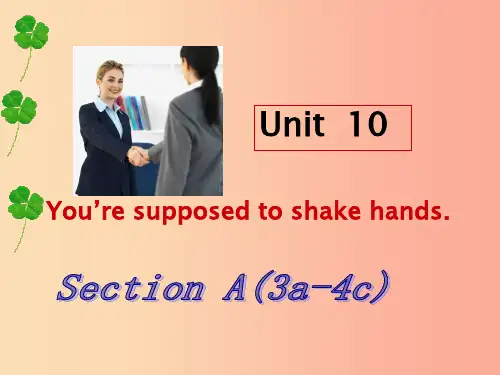
Read the passage again and plete the chart. Ideas and customs about ... Colombia Switzerland being on time visiting a friend’s house making plans with friends
You are supposed to help to keep the street clean.
What are you supposed to do when someone asks you the way?
You are supposed to show the way politely.
1. In which country is it OK to be 15 minutes late for dinner? In Colombia.
2. Where is Teresa Lopez from? She is from Cali, Colombia.
3. Do people often drop by friends’ homes in Colombia? Yes, they do.
be supposed to 表示 “被期望(做)或要 求应该”, 后须接动词原形.
be supposed + to do 动词不定式
= be expected to do/ should do
eg. You are supposed to arrive on time.
精编版九年级Unit-10-You-are-supposed-to-shake-hands知识点和练

九年级U n i t-10-Y o u-a r e-s u p p o s e d-t o-s h a k e-h a n d s知识点和练习Unit 10 You are supposed to shake hands一.短语归纳1. be supposed to do sth 应该做…2. be expected to do sth. 应该/被期望做…3. shake hands (with…) (和…) 握手4. bow to sb. 向某人鞠躬5. for the first time 首次,第一次6. people in Korea 韩国的人们7. greet sb.( in) the wrong way以错误的方式问候某人8. be invited to sw. 被邀请去…9. be invited to do sth. 被邀请做… 10.welcome party 欢迎会11. as soon as 一… 就…(引导时间状从) 12. as soon as sb can 尽可能快的。
13.hold out (my hands) 伸出(我的手) 14. on both sides of my face在我的两个脸颊上15. be from= come from 来自 16. be relaxed about 对…放松/随意17. a bit/ little late 晚一点 18. value the time we spend with sb珍惜我们与某人度过的时间19.in our everyday lives 在我们的日常生活中 20. drop by 顺便拜访,随便进入21. make plans ( to do sth.) 计划做某事 22. plan to do sth.计划做某事23. on the side of the face在脸的一侧 24. the town center 在城镇中心25. as many as sb can = as many as possible 尽可能多的…26. be on time 守时 27. the capital of clocks and watches钟表之都28. after all 毕竟,终归 29. at noon 在中午30. 15 minutes late 迟到15分钟 31. get / be mad (at sb) 生气,气愤32.make an effort (to do sth) 努力做…33.avoid heavy traffic 避免交通拥挤34.keep sb waiting让某人一直等候 35.without calling first 没有事先打电话36.go abroad 出国 at home 在国内 37. be important to 对…是重要的38. bring your passport 带护照39.clean … off 把…擦掉40 clean the chalk off the blackboard 把黑板上的粉笔字擦掉41.the northern coast of Norway 挪威的北海岸42. during the winter season 在冬季 43. knock at/ on 敲(门,窗…)44. take off 脱下,起飞 45. be worth doing sth. 值得做…46. table manners 餐桌礼仪 47. mind your manners 注意你的礼仪48. stick …into… 把... 插进… 49.hit an empty bowl 敲空碗50. point at指着, point to指向(侧重方向) 51. at the table 在餐桌旁52 at table 在吃饭 53.basic table manners 基本的餐桌礼仪54. my biggest challenge 我最大的挑战55. on my student exchange program 在我的交换生生56.there is no reason to do sth.没原因做57. go out of one’s way (to do sth.)特地做某事…, 格外努力做…58.make sb feel at home 使某人感到宾至如归59. a teenage granddaughter 一个十几岁的(外)孙女60. talk to sb in French用法语和…交谈 61.be comfortable doing 舒服/轻松做某事62.behave well/ badly/ politely举止好 63. behave oneself 举止规矩64. as you can imagine 正如你想象的那样 65. be different from 与…不同66.be / get used to sth 习惯于某事 be / get used to doing sth.习惯于做某事67. gradually get used to sth逐渐习惯某事 68. cut it up 把它切开69. eat it with a fork 用叉子吃它70.put your elbows on the table 把肘部放在桌子上71. have a safe trip 一路平安,旅途愉快 72. show up 出席,露面,到场,二.用法集萃1. (1)suppose:猜想;假设 suppose that表示“猜测;假设”,that 可省例:I suppose he is a student.(2)be supposed to do sth被期望做某事,应该做某事。
九年级英语上册unit10知识要点
九年级英语上册Unit10You’resupposed to shake hands一、课文知识要点:1、You’re supposed toshake hands.你应该握手。
①besupposedto do sth.是“应该……”,与should用法相似。
否定形式是benot supposed to do sth,意为“不应该……”。
Youaresupposedtostudy harder.你应该更努力学习。
Youare notsupposedtoeatso much.你不应该吃这么多。
Drivers are supposedto wear the seatbeltwhen driving.司机开车的时候应当系好安全带。
②shake“摇动、抖动”shake→ shook →shakenshake hands 握手;shakehands with sb./shakeone's hands 与某人握手Atlast,he shook hishead andrefused.最后,他摇摇头拒绝了。
2、IntheUnited States,they’re expected toshakehands.在美国他们要握手。
expect“期望;指望;认为;预料”;expectto do sth.期望/期待做某事expectsb tosth. 期待某人做某事beexpectedto sth被期待/要求做某事She expects to go abroad.她期待着出国。
I expected mysonto passthe exam.期望我的儿子通过考试。
You can't expect me tofinish the work in just twodays.你不能期望我仅在两天之内完成这项工作。
Sheisexpected to bea good doctor.有人期望她成为一名好医生。
Thevisitors are expected toarrive in half an hour.参观者要在半小时后到达。
九年级英语全册 Unit 10 You're supposed to shake hands单元分析
Unit 10 You're supposed to shake hands.Language Goal【语言目标】Talk about customs and what you're supposed to do Knowledge Goals【知识目标】Key Words custom,kiss,greet,relaxed,value,capital,noon,mad,passport,chalk,blackboard,northern,coast,season,knock,eastern,worth,manner,empty,basic,exchange,granddaughter,behave,except,suggestionKey Phrasesdrop by,after all,get mad,make an effort,clean…off,take off,go out of one's way,make…feelat home,get used toKey Sentences 1.—What are you supposed to do when you meetsomeone for the first time?—You're supposed to shake hands.2.—Am I supposed to wear jeans? —No,you're expected to wear a suit and tie.3.—Is it important to be on time?—Yes,it's important to be on time.Key Grammar Learn to use “be supposed/expecte d to+infinitive”;Learn to use “It is+adj.+to do sth.”Ability Goals 【能力目标】1.Develop listening,speaking,reading and writingskills by using the target languages. 2.Learn to talk about what you're supposed to doand what you're expected to do.Tell others it's important/polite/impolite/…to do sth.Moral Goals 【情感目标】1.With the help of this unit's study,students can use the structures to talk about customs and whatyou're supposed to do.2.Learn something about cultures in other countries.And know how to perform in differentcultures.Teaching Time【课时】Five periodsPeriod 1 Section A(1a-2d)Period 2 Section A(3a-4c)Period 3 Section B(1a-1d)Period 4 Section B(2a-2e)Period 5 Section B(3a-3b) & Self Check本单元围绕世界各国的礼仪和习俗,要求学生了解各国文化背景、礼仪习俗,学会在不同场合的恰当表现,提升跨文化意识。
九年级英语全册Unit10You’resupposedtoshakehands重点总结短语+句型+作文素材新版人教新目标版

Unit 10 You are supposed to shake hands.一.重点词组1. be supposed to do sth=be expected to do sth=should do sth被期望/要求做某事;应该2. shake hands 握手3. drop by 顺便拜访knock on/at a door敲门4. after all毕竟;终归5. pick up 拾起;捡起接某人6. make a noise 发出噪音7. table manners 餐桌礼仪8. get used to (doing)sth习惯于9. be relaxed about对…随意/放松10. get mad/angry大动肝火;气愤11.clean…off把…擦掉12.take off脱下(衣服);(飞机等)起飞13.make an effort(to do)作出努力=try to do14.make sb feel at home使某人感到宾至如归15.cut up切开; 切碎16.be (well) worth (doing) (很)值得做…17.make friends with与…交朋友18.as soon as一…就…19. greet sb=say hello to sb20. be different from 与…不同21.on time 按时in time及时22. go out of one‟s way (to do) 特地;格外努力clean…off把……擦掉23. as…as sb. can / could= as…as possible尽可以地be worth doing sth. 值得做某事24. table manners/ good/bad manners cost/ be worth suggest/ suggestion(C) /ad vice(U)except/besides behave/ behavior Brazil/ Brazilian empty/ full/ fill二.重点语法1. (1)suppose:猜想;假设suppose that表示“猜测;假设”,that可省例:I suppose he is a student.(2)be supposed to do sth=be expected to do sth被期望做某事,应该做某事。
九年级英语全册 Unit 10 You’re supposed to shake hands Sec
Unit 10 You’re supposed to shake hands. Section B1. It’s impolite to point at anyone with your chopsticks.用筷子指着别人是不礼貌的。
该句句式为:It’s+adj.+to do...结构,意为“做某事怎么样”,是主系表结构,it为形式主语,真正的主语是后面的动词不定式。
句中的point意为“指,指向”,常构成短语point at,point to和point out。
例如:It’s impolite to point your fingers at others.用手指指人是很不礼貌的。
Don’t point at anyone with your chopsticks. It’s not polite.不要用你的筷子指着任何人,那是不礼貌的。
辨析:point at,point to与point outpoint at,point to和point out的意思都与“指”有关,但还是有一定区别的。
①point at习惯上表示指向离说话人较近的事物,意为“指着”,at是介词,着重于指的对象。
例如:Don’t point at the words while you are reading.读书时不要用手指着字。
②point to多用来表示指向离说话人较远的事物,意为“指向”,to也是介词,着重于指的方向。
例如:As he started the operation,the hour hand of the clock pointed to 9.他开始手术时,时针指着九点。
③point out表示的是给某人指示方向、要点或错误等,意为“指出”,out是副词。
例如:The teacher pointed out many mistakes in my homework.老师指出我作业里的许多错误。
2. They go out of their way to make me feel at home.他们特意让我感觉像在家一样。
人教版英语九年级全一册Unit10听力原文及翻译
人教版英语九年级全一册Unit10听力原文及翻译Unit 10 You’re supposed to shake hands.Section A, 1bYoshi:What are people supposed to do when they meet in your country, Rodrigo?罗德里戈,在你们国家人们见面的时候应该怎么做?Rodrigo:Do you mean when people meet for the first time?你是说人们第一次见面的时候吗?Yoshi:Yeah.是的。
Rodrigo:In Mexico, we shake hands.在墨西哥,我们握手。
Yoshi:What about in Brazil, Celia?西莉亚,在巴西呢?Celia:Well, in Brazil, people sometimes kiss. How about in Japan, Yoshi? What are people expected to do when they meet for the first time?在巴西,人们有时候会亲吻。
吉,在日本呢?人们第一次见面的时候会做什么?Yoshi:We bow.我们鞠躬。
Kim:And in Korea we also bow.在韩国我们也是鞠躬。
Mike:Well, I guess in most Western countries we shake hands我想在大多数西方国家,我们都会握手。
Section A, 2a, 2bDaisy:Hi, Maria. How was Paul’s party?你好,玛利亚。
保罗的聚会怎么样啊?Maria:Oh, Daisy, it was terrible.哦,黛西,太糟糕了。
Daisy:It was?是吗?Maria:Uh-huh.是的。
Daisy:What happened?发生什么了?Maria:Well, I was supposed to arrive at 7:00, but I arrived at 8:00.我原本应在7点到,但我八点才到的。
九年级英语Unit10-You're-supposed-to-shake-hands.课文重难点知识点详细讲解
Unit10 You’re supposed to shake hands.课文重难点知识点详细讲解1.be supposed to 的用法用法一:be supposed to... 其中to是动词不定式符号,不是介词,其后要跟动词原形。
当be supposed to... 的主语是“人”时,意为“应该……”;“被期望……”,它可以用来表示劝告、建议、义务、责任等,相当于情态动词should。
如:Everyone is supposed to wear a seat-belt in the car.每个人在汽车里都应该系安全带。
Teachers are supposed to treat all the students alike.老师应该对所有的学生一视同仁。
用法二:当be supposed to... 的主语是“物”时,它表示“本应;本该”,用于表示“某事本应该发生而没有发生”。
如:The new laws are supposed to prevent crime.这些新法令本应该起到防止犯罪的作用。
The train was supposed to arrive half an hour ago. 火车本应在半小时之前到达。
用法三: be supposed to后面接“have + 过去分词”时,表示“本应该做某事而没做”。
如:You are supposed to have handed in your homework by now.现在你应该已经把作业交上来了。
He is supposed to have arrived an hour ago. 他应该一小时前就到了。
用法四: be supposed to... 的否定结构为be not supposed to...,它常用于口语中,意为“不被许可;不应当”。
如:She was not supposed to be angry about that. 她本不该为那件事而生气的。