
初一英语语法及主要知识点归纳总结
初一英语知识点归纳总结分类:英语学习Unit 1 Where’s your pen pal from?一.短语:1 .be from = come from 来自于----2.live in 居住在---3.on weekends 在周末4 .write to sb = write a letter to sb 给某人写信;写信给某人5 .in the world 在世界上in China 在中国6.pen pal 笔友14 years old 14岁favorite subject 最喜欢的科目7.the United States 美国the United Kingdom 英国New York 纽约8.speak English 讲英语like and dislike 爱憎9.go to the movies 去看电影play sports 做运动二.重点句式:1 Where’s your pen pal from? = Where does your pen pal from/2 Where does he live?3 What language(s) does he speak?4 I want a pen pal in China.5 I can speak English and a little French.6 Please write and tell me about yourself.7 Can you write to me soon?8 I like going to the movies with my friends and playing sports. 三.本单元的国家,人民、语言对应。
1 Canada---- Canadian---- English / French2 France------ French------French3 Japan------Japanese----Japanese4 Australia----Australian----- English5 the United States------ American---- English6 the United Kingdom---British----- EnghishUnit 2 Where’s the post office?一.Asking ways: (问路)1.Where is (the nearest) ……?(最近的)……在哪里?2.Can you tell me the way to ……?你能告诉我去……的路吗?3.How can I get to ……?我怎样到达……呢?4.Is there …… near here / in the neighborhood? 附近有……吗?5.Which is the way to ……?哪条是去……的路?二.Showing the ways: (指路)1. Go straight down / along this street. 沿着这条街一直走。
2. Turn left at the second turning. 在第二个路口向左转。
3. You will find it on your right. 你会在你右手边发现它。
4. It is about one hundred metres from here. 离这里大约一百米远。
5. You’d better take a bus. 你最好坐公交车去。
(You’d better+动词原形)三.词组1. across from …… 在……的对面across from the bank 在银行的对面2. next to…… 紧靠…… next to the supermarket 紧靠超市3. between……and…… 在……和……之间between the park and the zoo 在公园和动物园之间among 表示位于三者或三者以上之间4. in front of…… 在……前面There is a tree in front of the classroom.课室前面有棵树。
in the front of…… 在……(内)的前部There is a desk in the front of the classroom.课室内的前部有张桌子。
5. behind…… 在……后面behind my house 在我家后面6. turn left/ right 向左/右拐on the left/right of…… 在某物的左/右边on the left of our school 在我们学校的左边on one’s left/right 在某人的左/右边on my left 在我左边7. go straight 一直走8. down /along…… 沿着……(街道)down/along Center Street 沿着中央街9. in the neighborhood=near here 在附近10 welcome to…… 欢迎来到……11. take /have a walk 散步12. the beginning of…… ……的开始,前端at the beginning of…… 在……的开始,前端in the beginning 起初,一开始13. have fun=have a good time=enjoy oneself 玩得开心,过得愉快我昨天玩得很开心。
I had fun yesterday.I had a good time yesterday.I enjoyed myself yesterday.14. have a good trip 旅途愉快15. take a taxi 坐出租车16. 到达:get to +地方get here/ there/ home 到这/那/家arrive in +大地方I arrive in Beijing.arrive at +小地方I arrive at the bank.reach +地方17.go across 从物体表面横过go across the street 横过马路go through 从空间穿过go through the forest 穿过树林18.on + 街道的名称。
Eg: on Center Streetat + 具体门牌号+街道的名称Eg: at 6 Center Street三.重难点解析1.enjoy doing sth 享受做某事的乐趣,喜爱做某事I enjoy reading. 我喜爱读书。
到目前为止,我们学了两个特殊的动词finish和enjoy,都是要带doing.I finish cleaning the room. 我扫完了这间屋子。
2.hope to do sth 希望做某事I hope to pass this exam. 我希望通过这次考试。
hope +从句I hope tomorrow will be fine. 我希望明天将会晴朗。
(从句即是一个小句子,这个小句子又放在大句子中,从属于大句子,所以叫从句。
如tomorrow will be fine是一个从句,它又放在I hope 的后面,形成句中有句。
)3. if 引导一个表示假设的句子。
If I have much money, I will go to the moon. 如果我有许多钱,我就会去月球。
If you are hungry, you can buy some food in the supermarket.如果你饿了的话,你可以在超市买一些食物。
四.本单元的反义词、近义词配对1new—old 2 quiet--- busy 3 dirty--- clean 4 big---- smallUnit 3 Why do you like koala bears?一.重点词组eat grass eat leaves be quiet very shy very smart very cuteplay with her friends kind of South Africa other animalsat night in the day every day during the day二. 交际用语1. Why do you like pandas? Because they’re very clever.2. Why does he like koalas? Because they’re kind of interesting.3. Where are lions from? They are from South Africa.4. What other animals do you like?I like dogs, too.Why?Because they’re friendly and clever.5. Molly likes to play with her friends and eat grass.6. She’s very shy.7. He is from Australia.8.He sleeps during the day, but at night he gets up and eats leaves.9.He usually sleeps and relaxes 20 hours every day.10.Let’s see the pandas first.11.They’re kind of interesting.12.What other animals do you like?13.Why do you want to see the lions?三. 重点难点释义1、kind of 有点,稍微Koala bears are kind of shy. 考拉有点害羞。
kind 还有“种类”的意思如:各种各样的all kinds ofWe have all kinds of beautiful flowers in our school.2、China n. 中国Africa n. 非洲China 和Africa都是专有名词,首字母都应该大写,而且和介词in连用。
There are many kinds of tigers in China.There are many kinds of scary animals in Africa.3、friendly adj. 友好的,和蔼可亲的它是名词friend的形容词形式,常常和be动词连用, be friendly。
初一英语语法知识点总结复习(超详细)
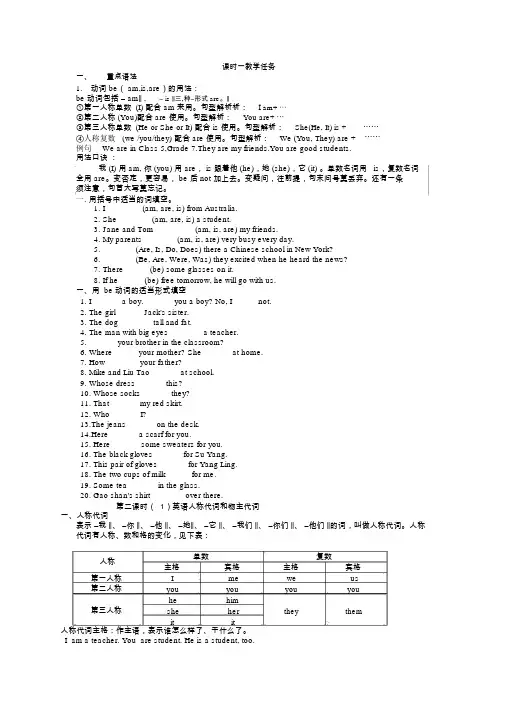
课时一教学任务一、重点语法1. 动词 be( am,is,are)的用法:be 动词包括― am‖ ,― is‖三,种―形式are。
‖①第一人称单数 (I) 配合 am 来用。
句型解析析:I am+ ⋯②第二人称 (You)配合 are 使用。
句型解析:You are+ ⋯③第三人称单数 (He or She or It) 配合 is 使用。
句型解析:She(He, It) is +④人称复数(we /you/they) 配合 are 使用。
句型解析:We (You, They) are +例句We are in Class 5,Grade 7.They are my friends.You are good students.用法口诀:⋯⋯⋯⋯我 (I) 用 am, 你 (you) 用 are, is 跟着他 (he),她 (she),它 (it) 。
单数名词用is,复数名词全用 are。
变否定,更容易, be 后 not 加上去。
变疑问,往前提,句末问号莫丢弃。
还有一条须注意,句首大写莫忘记。
一.用括号中适当的词填空。
1.I ________(am, are, is) from Australia.2.She _______ (am, are, is) a student.3.Jane and Tom _________(am, is, are) my friends.4.My parents _______ (am, is, are) very busy every day.5._______ (Are, Is, Do, Does) there a Chinese school in New York?6._______ (Be, Are, Were, Was) they excited when he heard the news?7.There _____ (be) some glasses on it.8.If he _____ (be) free tomorrow, he will go with us.一、用 be 动词的适当形式填空1.I ______ a boy. ______ you a boy? No, I _____ not.2.The girl______ Jack's sister.3.The dog _______ tall and fat.4.The man with big eyes _______ a teacher.5.______ your brother in the classroom?6.Where _____ your mother? She ______ at home.7.How _______ your father?8.Mike and Liu Tao ______ at school.9.Whose dress ______ this?10.Whose socks ______ they?11.That ______ my red skirt.12.Who ______ I?13.The jeans ______ on the desk.14.Here ______ a scarf for you.15.Here ______ some sweaters for you.16.The black gloves ______ for Su Yang.17.This pair of gloves ______ for Yang Ling.18.The two cups of milk _____ for me.19.Some tea ______ in the glass.20.Gao shan's shirt _______ over there.第二课时( 1)英语人称代词和物主代词一、人称代词表示―我‖、―你‖、―他‖、―她‖、―它‖、―我们‖、―你们‖、―他们‖的词,叫做人称代词。
(完整版)初一英语语法学习知识点详细总结
初一英语语法学习知识点总结一、初一英语语法——词法1、名词A)名词的数我们知道名词可以分为可数名词和不可数名词,而不可数名词它没有复数形式,但可数名词却有单数和复数之分,复数的构成如下:一)在后面加s。
如:fathers, books, Americans, Germans, apples, bananas二)x, sh, ch, s, tch后加es。
如:boxes, glasses, dresses, watches, wishes,三)1)以辅音字母加y结尾的变y为i再加es 如:baby-babies,2)以元音字母加y结尾的直接加s。
如:day-days, boy-boys, toy-toys, key-keys, ways四)以o结尾加s(外来词)。
如:radios, photos, 但如是辅音加o的加es:如: tomatoes 西红柿, potatoes马铃薯五)以f或fe结尾的变f为v再加es(s)。
如:knife-knives, wife-wives, half-halves, shelf-shelves, leaf-leaves, yourself-yourselves六)单复数相同(不变的)有:fish, sheep, deer鹿子, Chinese, Japanese七)一般只有复数,没有单数的有:people,pants, shorts, shoes, glasses, gloves, clothes, socks八)单词形式不变,既可以是单数也可以是复数的有:police警察局,警察, class 班,同学, family家,家庭成员九)合成的复数一般只加主要名词,多数为后一个单词。
如:action movie-action movies, pen pal-pen pals; 但如果是由man或woman所组成的合成词的复数则同时为复数。
如:man doctor-men doctors, woman teacher-women teachers十)有的单复数意思不同。
初中英语知识点全总结
初中英语知识点全总结一、基本语法1. 词类名词、代词、形容词、副词、介词、连词、冠词、动词2. 句子成分主语、谓语、宾语、表语、定语、状语3. 句型肯定句、否定句、疑问句、祈使句4. 时态一般现在时、一般过去时、一般将来时、进行时、完成时、过去完成时、将来完成时5. 语态主动语态、被动语态二、词汇1. 常用英语词汇数字、日期、时间、颜色、家庭成员、学科、职业、食物、动物、植物等2. 常用短语日常用语、问候用语、表达喜怒哀乐的短语、表示时间的短语、表示原因的短语、表示结果的短语、表示条件的短语、表示方法的短语、表示比较的短语、表示目的的短语等3. 常见习惯用语表达感谢、道歉、邀请、怀疑、建议、请求、承诺等4. 同义词辨析动词、名词、形容词、副词等的同义词辨析5. 反义词辨析动词、名词、形容词、副词等的反义词辨析6. 词语拼写常见的易错拼写单词、易混淆单词、词汇记忆技巧7. 词语辨析容易混淆的近义词、疑难词语的理解三、句型转换1. 肯定句转换否定句2. 否定句转换肯定句3. 陈述句转换疑问句4. 一般疑问句转换特殊疑问句5. 直接引语转换为间接引语6. 主动语态转换为被动语态7. 定语从句的转换8. 状语从句的转换四、阅读理解1. 阅读短文阅读理解题型、文章的类型、文章的结构、文章的主题,作者的观点和态度分析,文章细节理解等2. 理解词语和短语根据上下文理解词语和短语,推测词义,理解事实和信息,归纳文章主旨等3. 阅读策略找主题句、段落大意概括、理解作者的意图等4. 阅读技巧速读、精读、细读,快速定位等五、听力1. 日常生活对话日常生活对话、问路、购物、订餐、电话、预约、乘坐交通工具等2. 学校生活对话上课、放学、作业、考试、运动会、话剧表演、校园活动等3. 交际用语问候、介绍自己、询问信息、表达感谢、道歉、请求、承诺、邀请、祝福等4. 语音语调语音语调的基本规律和特点,英语连读、舌尖音、上音,语调变化等六、写作1. 书面表达书信、便条、日记、日程安排、活动安排、口头表达等2. 写信格式信头、信尾、日期、称呼等3. 作文结构作文的开头、扩写、过渡、结尾等4. 句式转换改写句子、段落,使表达更加丰富多样5. 表达方式使用例证、比喻、排比、描写等,使文章更生动七、语法专题1. 介词介词的常见用法和搭配2. 连词并列连词、从属连词的用法和区别3. 形容词和副词形容词和副词的比较级和最高级,以及用法区别4. 名词的单数复数名词单数复数的变化规则5. 疑问词及疑问句特殊疑问词和疑问句的结构6. 定语从句定语从句的连接词和用法7. 状语从句状语从句的连接词和用法八、语言运用1. 情态动词can、could、may、might、must、shall、should、will、would、ought to的用法2. 动词的时态和语态一般现在时、一般过去时、一般将来时、进行时、完成时、过去完成时、将来完成时等动词时态,以及主动语态和被动语态的用法3. 句子的语序陈述句、一般疑问句、特殊疑问句、祈使句的语序规则4. 词语辨析同义词、反义词、单词形式的变换5. 词语的搭配不同词义的搭配,固定搭配的用法6. 语法填空根据语境选择合适的词语或词组来填充空白7. 交际用语日常生活中常用的交际用语的表达九、复习技巧1. 听力技巧听力材料的整体理解、选项干扰性的词、对话文章的表达、上下文对比等2. 阅读技巧细节题、主旨题、归纳题、推理题等题型的解题技巧3. 写作技巧书面表达的开头展开结尾的写作技巧4. 背诵技巧词汇、短语的背诵技巧5. 口语表达表达能力的提升、语音语调的模仿等技巧以上就是初中英语知识点的全面总结,希望对学习英语的同学有所帮助。
(完整版)初一英语语法知识点总结复习(超详细)

课时一教学任务一、重点语法1.动词be(am,is,are)的用法:be动词包括“am”, “is”, “are”三种形式。
①第一人称单数(I)配合am来用。
句型解析析:I am+…例句:I am Snoopy.I am ten years old.I am a student.I am a boy.②第二人称(You)配合are使用。
句型解析:You are+…例句:You are my good friend.You are a good teacher.You are beautiful③第三人称单数(He or She or It)配合is使用。
句型解析:She(He, It) is +……例句:She is a good girl.She is so tall.She is short.④人称复数 (we /you/they)配合are使用。
句型解析:We (You, They) are +……例句 We are in Class 5,Grade 7.They are my friends.You are good students.用法口诀:我(I)用am, 你(you)用are,is跟着他(he),她(she),它(it)。
单数名词用is,复数名词全用are。
变否定,更容易,be后not加上去。
变疑问,往前提,句末问号莫丢弃。
还有一条须注意,句首大写莫忘记。
对应练习:一. 用括号中适当的词填空。
1. I ________(am, are, is) from Australia.2. She _______ (am, are, is) a student.3. Jane and Tom _________(am, is, are) my friends.4. My parents _______ (am, is, are) very busy every day.5. _______ (Are, Is, Do, Does) there a Chinese school in New York?6. _______ (Be, Are, Were, Was) they excited when he heard the news?7. There _____ (be) some glasses on it.8. If he _____ (be) free tomorrow, he will go with us.一、用be 动词的适当形式填空1. I ______ a boy. ______ you a boy? No, I _____ not.2. The girl______ Jack's sister.3. The dog _______ tall and fat.4. The man with big eyes _______ a teacher.5. ______ your brother in the classroom?6. Where _____ your mother? She ______ at home.7. How _______ your father?8. Mike and Liu Tao ______ at school.9. Whose dress ______ this?10. Whose socks ______ they?11. That ______ my red skirt.12. Who ______ I?13.The jeans ______ on the desk.14.Here ______ a scarf for you.15. Here ______ some sweaters for you.16. The black gloves ______ for Su Yang.17. This pair of gloves ______ for Yang Ling.18. The two cups of milk _____ for me.19. Some tea ______ in the glass.20. Gao shan's shirt _______ over there.第二课时(1)英语人称代词和物主代词一、人称代词表示“我”、“你”、“他”、“她”、“它”、“我们”、“你们”、“他们”的词,叫做人称代词。
初一英语语法知识点总结复习(超详细)
We/You/They are students.人称代词宾格作宾语,表示动作行为的对象。
Give it to me. Let’s go (let’s =let us)二、物主代词表示所有关系的代词叫做物主代词,也可叫做代词所有格。
物主代词分形容词性物主代词和名词性物主代词二种,其人称和数的变化见下表。
数人称类别单数复数第一人称第二人称第三人称第一人称第二人称第三人称形容词性物主代词my your his her its our your their名词性物主代词 mine yours his hers its ours yours theirs汉语我的你的他的她的它的我们的你们的他(她、它)们的形容词性物主代词(my/your/his/her/its/our/their)+名词而名词性物主代词则相当于形容词性物主代词+名词,故其后不必加名词。
如: Is this your book?No,,it isn()9. __________ the great photo of your family.A. thank forB. Thanks forC. Thank forD. thanks for ()10. Are those your friends? __________.A. Yes, they’reB. No, they areC. Yes, they areD. Yes, those are 代词练习(二)课时二(2)简单句一陈述句陈述句的否定结构:陈述句的否定式主要用两种结构来表达:(1)句子的谓语动词为be , have 或者谓语动词有助动词、情态动词时,其否定结构为:主语+谓语动词/助动词/情态动词 + not + 其他成分 I am not a teacher. 我不是老师。
We have not (haven`t) any books on animals. 我们没有任何有关动物方面的书。
初一英语语法知识点总结复习超详细
课时一教学任务一、重点语法1.动词be(am,is,are)的用法:be动词包括“am”, “is”, “are”三种形式。
①第一人称单数(I)配合am来用。
句型解析析:I am+…②第二人称(You)配合are使用。
句型解析:You are+…③第三人称单数(He or She or It)配合is使用。
句型解析:She(He, It) is +……④人称复数(we /you/they)配合are使用。
句型解析:We (You, They) are +……例句We are in Class 5,Grade 7.They are my friends.You are good students.用法口诀:我(I)用am, 你(you)用are,is跟着他(he),她(she),它(it)。
单数名词用is,复数名词全用are。
变否定,更容易,be后not加上去。
变疑问,往前提,句末问号莫丢弃。
还有一条须注意,句首大写莫忘记。
1.用括号中适当的词填空。
1. I ________(am, are, is) from Australia.2. She _______ (am, are, is) a student.3. Jane and Tom _________(am, is, are) my friends.4. My parents _______ (am, is, are) very busy every day.5. _______ (Are, Is, Do, Does) there a Chinese school in New York?6. _______ (Be, Are, Were, Was) they excited when he heard the news?7. There _____ (be) some glasses on it.8. If he _____ (be) free tomorrow, he will go with us.2.用be 动词的适当形式填空1. I ______ a boy. ______ you a boy? No, I _____ not.2. The girl______ Jack's sister.3. The dog _______ tall and fat.4. The man with big eyes _______ a teacher.5. ______ your brother in the classroom?6. Where _____ your mother? She ______ at home.7. How _______ your father?8. Mike and Liu Tao ______ at school.9. Whose dress ______ this?10. Whose socks ______ they?11. That ______ my red skirt.12. Who ______ I?13.The jeans ______ on the desk.14.Here ______ a scarf for you.15. Here ______ some sweaters for you.16. The black gloves ______ for Su Yang.17. This pair of gloves ______ for Yang Ling.18. The two cups of milk _____ for me.19. Some tea ______ in the glass.20. Gao shan's shirt _______ over there.第二课时(1)英语人称代词和物主代词一、人称代词表示“我”、“你”、“他”、“她”、“它”、“我们”、“你们”、“他们”的词,叫做人称代词。
初一英语语法及主要知识点归纳总结
初一英语知识点归纳总结分类:英语学习Unit 1 Where’s your pen pal from一.短语:1 .be from = come from 来自于----2.live in 居住在---3.on weekends 在周末4 .write to sb = write a letter to sb 给某人写信;写信给某人5 .in the world 在世界上in China 在中国6.pen pal 笔友14 years old 14岁favorite subject 最喜欢的科目7.the United States 美国the United Kingdom 英国New York 纽约8.speak English 讲英语like and dislike 爱憎9.go to the movies 去看电影play sports 做运动二.重点句式:1 Where’s your pen pal from = Where does your pen pal from/2 Where does he live3 What languages does he speak4 I want a pen pal in China.5 I can speak English and a little French.6 Please write and tell me about yourself.7 Can you write to me soon8 I like going to the movies with my friends and playing sports.三.本单元的国家,人民、语言对应;1 Canada---- Canadian---- English / French2 France------ French------French3 Japan------Japanese----Japanese4 Australia----Australian----- English5 the United States------ American---- English6 the United Kingdom---British----- EnghishU nit 2 Where’s the post office一.Asking ways: 问路1.Where is the nearest …… 最近的……在哪里2.Can you tell me the way to …… 你能告诉我去……的路吗3.How can I get to …… 我怎样到达……呢4.Is there …… near here / in the neighborhood 附近有……吗5.Which is the way to ……哪条是去……的路二.Showing the ways: 指路1. Go straight down / along this street. 沿着这条街一直走;2. Turn left at the second turning. 在第二个路口向左转;3. You will find it on your right. 你会在你右手边发现它;4. It is about one hundred metres from here. 离这里大约一百米远;5. You’d bette r take a bus. 你最好坐公交车去;You’d better+动词原形三.词组1. across from …… 在……的对面across from the bank 在银行的对面2. next to…… 紧靠…… next to the supermarket 紧靠超市3. between……and…… 在……和……之间between the park and the zoo 在公园和动物园之间among 表示位于三者或三者以上之间4. in front of…… 在……前面There is a tree in front of the classroom.课室前面有棵树;in the front of…… 在……内的前部There is a desk in the front of the classroom.课室内的前部有张桌子;5. behind…… 在……后面behind my house 在我家后面6. turn left/ right 向左/右拐on the left/right of…… 在某物的左/右边on the left of our school 在我们学校的左边on one’s left/right 在某人的左/右边on my left 在我左边7. go straight 一直走8. down /along…… 沿着……街道down/along Center Street 沿着中央街9. in the neighborhood=near here 在附近10 welcome to…… 欢迎来到……11. take /have a walk 散步12. the beginning o f…… ……的开始,前端at the beginning of…… 在……的开始,前端in the beginning 起初,一开始13. have fun=have a good time=enjoy oneself 玩得开心,过得愉快我昨天玩得很开心; I had fun yesterday.I had a good time yesterday.I enjoyed myself yesterday.14. have a good trip 旅途愉快15. take a taxi 坐出租车16. 到达:get to +地方get here/ there/ home 到这/那/家arrive in +大地方I arrive in Beijing.arrive at +小地方I arrive at the bank.reach +地方17.go across 从物体表面横过go across the street 横过马路go through 从空间穿过go through the forest 穿过树林18.on + 街道的名称; Eg: on Center Streetat + 具体门牌号+街道的名称Eg: at 6 Center Street三.重难点解析1.enjoy doing sth 享受做某事的乐趣,喜爱做某事I enjoy reading. 我喜爱读书;到目前为止,我们学了两个特殊的动词finish和enjoy,都是要带doing.I finish cleaning the room. 我扫完了这间屋子;2.hope to do sth 希望做某事I hope to pass this exam. 我希望通过这次考试; hope +从句I hope tomorrow will be fine. 我希望明天将会晴朗;从句即是一个小句子,这个小句子又放在大句子中,从属于大句子,所以叫从句;如tomorrow will be fine是一个从句,它又放在I hope 的后面,形成句中有句;3. if 引导一个表示假设的句子;If I have much money, I will go to the moon. 如果我有许多钱,我就会去月球;If you are hungry, you can buy some food in the supermarket.如果你饿了的话,你可以在超市买一些食物;四.本单元的反义词、近义词配对1new—old 2 quiet--- busy 3 dirty--- clean 4 big---- smallUnit 3 Why do you like koala bears一.重点词组eat grass eat leaves be quiet very shy very smart very cuteplay with her friends kind of South Africa other animalsat night in the day every day during the day二. 交际用语1. Why do you like pandas Because they’re very clever.2. Why does he like koalas Because they’re kind of interesting.3. Where are lions from They are from South Africa.4. What other animals do you likeI like dogs, too.WhyBecause they’re friendly and clever.5. Molly likes to play with her friends and eat grass.6. She’s very shy.7. He is from Australia.8.He sleeps during the day, but at night he gets up and eats leaves.9.He usually sleeps and relaxes 20 hours every day.10.Let’s see the pandas first.11.They’re kind of interesting.12.What other animals do you like13.Why do you want to see the lions三. 重点难点释义1、kind of 有点,稍微Koala bears are kind of shy. 考拉有点害羞;kind 还有“种类”的意思如:各种各样的all kinds ofWe have all kinds of beautiful flowers in our school.2、China n. 中国Africa n. 非洲China 和Africa都是专有名词,首字母都应该大写,而且和介词in连用;There are many kinds of tigers in China.There are many kinds of scary animals in Africa.3、friendly adj. 友好的,和蔼可亲的它是名词friend的形容词形式,常常和be动词连用, be friendly;The people in Chengdu are very friendly.4、with prep. 跟,同,和…在一起I usually play chess with my father.注意区别与and的用法,and通常用于连接主语或宾语,连接主语时,如果有I, I通常放在and 之后,如:My father and I usually play chess together.Play with “和…一起玩耍”“玩…”I often play with my pet dog.Don’t play with water5、day和night 是一对反义词,day 表示白天或一天,night表示夜或夜晚;通常说in the day, during the day, at night;Koala bears often sleep during the day and eat leaves at night.6、leaf n. 叶子复数形式为:leaves, 类似的变化还有:wife—wives, wolf—wolves, knife—knives等;7、hour n. 小时;点钟hour前边通常加上冠词an 表示“一个小时”, 即:an hour;There are 24 hours in a day and 60minutes in an hour.8、be from 来自…be from = come fromPandas are from China. = Pandas come form China.9、meat n. 食用的肉,为不可数名词,表示“许多”时,使用much来修饰,即:much meatHe eats much meat every day.10、grass n. 草,为不可数名词,表示“许多”时,使用much来修饰,即:much grass; There is much grass on the playground.四. 语法知识特殊疑问句通常以“what”、“who”、“which”、“when”、“where”、“how”、“how old”、“how many”等开头,对某一具体问题进行提问;特殊疑问句的基本构成有两种情况:1. 疑问句+一般疑问句结构;这是最常见的情况;例如:What’s your grandfather’s telephone number 你爷爷的号码是多少Who is that boy with big eyes 那个大眼睛的男孩是谁Which season do you like best 你最喜欢哪个季节When is he going to play the piano 他什么时候弹钢琴Where does he live 他住在哪儿How are you 你好吗How old are you 你多大了How many brothers and sisters do you have 你有几个兄弟姐妹2. 疑问句+陈述句结构;这时疑问词作主语或修饰主语;例如:Who is on duty today今天谁值日Which man is your teacher哪位男士是你的老师我们学过的What/How about+名词/代词+其他也是特殊疑问句,它是一种省略结构;例如:I like English. What/How about you 我喜欢英语;你呢What about playing basketball 打篮球怎么样Unit 4 I want to be an actor.一.短语:1 want to do sth 想要作某事2 give sb sth = give sth to sb 给某人某物/ 把某物给某人3 help sb do sth 帮助某人作某事Eg: I want to help my mother do some housework at home.4 help sb with sth 帮助某人谋事Eg: I want to help my mother with some housework at home5 in the day 在白天6 at night 在晚上7 talk with/ to sb 和----谈话8 be busy doing sth 忙于做某事Eg: He is busy listening to the teacher.9 in a hospital 在医院l10 work/ study hard 努力工作11 Evening Newspaper 晚报二.重点句式及注意事项:1 询问职业的特殊疑问词是what;有三种主要句式①What + is / are + sb②What + does/ do + sb + do③What + is/ are + 名词所有格/ 形容词性物主代词+ job2 People give me their money or get their money from me.3 Sometimes I work in the day and sometimes at night.4 I like talking to people.5 I work late. I’m very busy when people go out to dinners.6 Where does your sister work7 then we have a job for you as a waiter.8 Do you want to work for a magazine Then come and work for us as a reporter.9 Do you like to work evenings and weekends10 We are an international school for children of 5-12.三.本单元中的名词复数;1 policeman--- policemen2 woman doctor----- women doctors 3thief-----thieves首先主谓宾结构I have an apple.其次定状补I really have a big apple.really做have的状语状语修饰动词动词一般就是谓语动词big做apple的定语定语修饰名词名词一般是主语或宾语最后主系表结构它与主谓宾很相似只不过谓语动词时系动词最常见的是be动词及其变形I am a student;主语通常用于句子开端,主要有:i,you,he,she,it,we,they,但it有时用作形式主语,表特指;谓语,通常放在主语之后,一般是动词,表示“某某人在;;;”宾语,通常放在谓语之后,一般是主语的宾格;有时候是人,有时候是物;定语,状语,通常是从句;定语从句:常有关系代词that\which\who\whoes,关系副词when\where\why.通常选择关系词的步骤是:1、确定先行词2.确定关系词.主系表:主,就是主语;系,特指系动词,就是说当句子中没有谓语时,用系动词来代替;表,修饰系动词用;1、名词A、名词的数我们知道名词可以分为可数名词和不可数名词,而不可数名词它没有复数形式,但可数名词却有单数和复数之分,复数的构成如下:一在后面加s;如:fathers, books, Americans, Germans, apples, bananas二x, sh, ch, s, tch后加es;如:boxes, glasses, dresses, watches, wishes, faxes三1以辅音字母加y结尾的变y为i再加es 如:baby-babies, family-families, duty-duties, comedy-comedies, documentary-documentaries, story-stories2以元音字母加y结尾的直接加s;如:day-days, boy-boys, toy-toys, key-keys, ways四以o结尾加s外来词;如:radios, photos, 但如是辅音加o的加es:如: tomatoes 西红柿, potatoes马铃薯五以f或fe结尾的变f为v再加ess;如:knife-knives, wife-wives, half-halves, shelf-shelves, leaf-leaves, yourself-yourselves六单复数相同不变的有:fish, sheep, deer鹿子, Chinese, Japanese七一般只有复数,没有单数的有:people,pants, shorts, shoes, glasses, gloves, clothes, socks八单词形式不变,既可以是单数也可以是复数的有:police警察局,警察, class班,同学, family家,家庭成员九合成的复数一般只加主要名词,多数为后一个单词;如:action movie-action movies, pen pal-pen pals; 但如果是由man或woman所组成的合成词的复数则同时为复数;如:man doctor-men doctors, woman teacher-women teachers十有的单复数意思不同;如:fish鱼fishes鱼的种类, paper纸papers报纸,卷子,论文, work工作works作品,工厂, glass玻璃glasses玻璃杯,眼镜, orange桔子水oranges橙子, light光线lights灯, people人peoples民族, time时间times 时代, 次数, chicken 鸡肉chickens 小鸡十一单个字母的复数可以有两种形式直接加s或’s;如:Is I’s, Ks K’s;但如是缩略词则只加s;如:IDs, VCDs, SARs十二特殊形式的有:child-children, man-men, woman-women, foot-feet, mouse-mice, policeman-policemen, Englishman-EnglishmenB名词的格当我们要表示某人的什么东西或人时,我们就要使用所有格形式;构成如下:一单数在后面加’s;如:brother’s, Mike’s, teacher’s二复数以s结尾的直接在s后加’,如果不是以s结尾的与单数一样处理;如:Teachers’ Day教师节, classmates’; Children’s Day六一节, Women’s Day三八节三由and并列的名词所有时,如果是共同所有同一人或物时,只加最后一个’s,但分别拥有时却分别按单数形式处理;如:Mike and Ben’s room迈克和本的房间共住一间,Mike’s and Ben’s rooms迈克和本的房间各自的房间2、代词项目人称代词物主代词指示代词反身代词人称主格宾格形容词名词性第一人称单数I me my mine myself复数we us our ours ourselves第二人称单数you you your yours yourself复数you you your yours yourselves第三人称单数she her her hers herselfhe him his his himselfit it its its this that itself复数they them their theirs these those themselves3、动词A 第三人称单数当动词是第三人称单数时,动词应该像名词的单数变动词那样加s,如下:一一般在词后加s;如:comes, spells, waits, talks, sees, dances, trains二在x, sh, ch, s, tch后加es;如:watches, washes, wishes, finishes三1以辅音字母加y结尾的变y为i再加es;如:study-studies, hurry-hurries, try-tries2以元音字母加y结尾的直接加s;如:plays, says, stays, enjoys, buys四以o结尾加es;如:does, goes五特殊的有:are-is, have-hasB 现在分词当我们说某人正在做什么事时,动词要使用分词形式,不能用原形,构成如下:一一般在后加ing;如:spell-spelling, sing-singing, see-seeing, train-training, play-playing, hurry-hurrying, watch-watching, go-going, do-doing二以不发音e的结尾的去掉e再加ing;如:dance-dancing, wake-waking,take-taking, practice-practicing, write-writing, have-having三以重读闭音节结尾且一个元音字母+一个辅音字母注意除开字母组合如show –showing, draw-drawing要双写最后的辅音字母再加ing;如:put-putting,run-running, get-getting, let-letting, begin-beginning四以ie结尾的变ie为y再加ing;如:tie-tying系die-dying死lie-lying 位于4、形容词的级我们在对两个或以上的人或物进行对比时,则要使用比较或最高级形式;构成如下:一一般在词后加er或est如果是以e结尾则直接加r或st;如:greater-greatest, shorter –shortest, taller –tallest, longer –longest, nicer- nicest, larger -largest二以重读闭音节结尾且1个元音字母+1个辅音字母字母组合除外,如few-fewer fewest结尾的双写结尾的辅音再加er /est;如:big-bigger biggest, red-redder reddest, hot-hotter hottest三以辅音字母+y结尾的变y为i加er/est;如:happy-happier happiest,sorry-sorrier sorriest, friendly-friendlier friendliestmore friendly most friendly, busy-busier busiest, easy-easier easiest四特殊情况:两好多坏,一少老远good/well - better best many/much - more most bad/ill – worse worstlittle- less least old- older/elder oldest/eldest far- farther/further farthest/furthest 5、数词基变序,有规则;一、二、三,自己背;五、八、九、十二;其它后接th;y结尾,变为i, eth跟上去; first, second, third; fifth, eighth, ninth, twelfth; seventh, tenth, thirteenth, hundredth; twenty-twentieth, forty-fortieth, ninety-ninetieth二、初一英语语法——句式1.陈述句肯定陈述句a This is a book. be动词b He looks very young. 连系动词c I want a sweat like this. 实义动词d I can bring some things to school. 情态动词e There’s a computer on my desk. There be结构否定陈述句a These aren’t their books. b They don’t look nice.c Kate doesn’t go to No. 4 Middle School.d Kate can’t find her doll.e There isn’t a cat here. =There’s no cat here.2. 祈使句肯定祈使句a Please go and ask the man. b Let’s learn Englishc Come in, please.否定祈使句a Don’t be late. b Don’t hu rry.3. 疑问句1 一般疑问句a Is Jim a student b Can I help you c Does she like saladd Do they watch TVe Is she reading肯定回答: a Yes, he is. b Yes, you can. c Yes, she does. d Yes, they do. e Yes, she is.否定回答: a No, he isn’t. b No, you can’t. c No, she doesn’t. d No, they don’t. e No, she isn’t.2 选择疑问句Is the table big or small 回答It’s big./ It’s small.3 特殊疑问句①问年龄How old is Lucy She is twelve.②问种类What kind of movies do you like I like action movies and comedies.③问身体状况How is your uncle He is well/fine.④问方式How do/can you spell it L-double O-K.How do we contact you My e-mail address is cindyjones163.⑤问原因Why do you want to join the club⑥问时间What’s the time =What time is it It’s a quarter to ten a.m..What time do you us ually get up, Rick At five o’clock.When do you want to go Let’s go at 7:00.⑦问地方Where’s my backpack It’s under the table.⑧问颜色What color are they They are light blue.What’s your favourite color It’s black.⑨问人物Who’s that It’s my sister.Who is the boy in blue My brother.Who isn’t at school Peter and Emma.Who are Lisa and Tim talking to⑩问东西What’s this/that in English It’s a pencil case.What else can you see in the picture I can see some broccoli, strawberries and hamburgers.11问姓名What’s your aunt’s name Her name is Helen./She’s Helen. What’s your first name My first name’s Ben.What’s your family name My family name’s Smith.12 问哪一个Which do you like I like one in the box.13 问字母What letter is it It’s big D/small f.14 问价格How much are these pants They’re 15 dollars.15 问号码What’s your phone number It’s 576-8349.16 问谓语动作What’s he doing He’s watching TV.17 问职业身份 What do you do What’s your father He’s a doctor.句子结构1.S主+ Vi不及物动词谓Time flies.1 S + V + adverbial状语Birds sing beautifully.2 S + Vi+ prep Phrase介词短语He went on holiday.3 S + Vi+ Infinitive 不定式We stopped to have a rest.4 S + Vi+ Participle 分词I'll go swimming.2. S 主+ Vt 及物动词谓+ O宾We like English.1 S + VT + N/PronI like music.I like her.2 S + VT + infinitive不定式I want to help him.常用于这句型的动词有:attempt, dare, decide, desire, expect, hope, intend, learn, need, offer, pretend, promise, propose, purpose, refuse, want, wish等;3 S + VT + Wh-Word + InfinitiveI don't know what to do.常用于这句型的动词有:ask, consider, decide, discover, explain, find out, forget, guess, inquire, know, learn, observe, remember, see, settle, tell, think, understand, wonder等;4 S + VT + GerundI enjoy living here.常用于这句型的动词有:admit, advise, avoid, consider, defend, enjoy, excuse, finish, forbid, mind, miss, practise, risk, suggest, give up, can't help等;5 S + VT + That-clauseI don't think that he is right.常用于这句型的动词有:Admit, believe, command, confess, declare, demand, deny, doubt, expect, explain, feel觉得, hear听说, hope, imagine, intend, know, mean, mind当心, notice, propose, request, report, say, see看出,show, suggest, suppose, think, understand, wish, wonder觉得奇怪;3. S 主+ V谓lv 系动词+ P表We are Chinese.除了be 系动词外,还有一些动词也可以用作系动词,1表感官的动词,feel, smell, taste, sound, look, appear, seem 等;2 表转变变化的动词,become, get, grow, turn, go,等; 3表延续的动词remain, keep, seem, hold, stay, rest等;4表瞬时的动词come, fall, set, cut, occur等5其他动词eat, lie, prove, ring, run, shine, sit, stand, continue, hang等;1 S + Lv + N/Pron名词/代词He is a boy.This is mine.2 S + Lv + Adj形容词She is beautiful.3 S + Lv + Adv 副词Class is over.4 S + Lv + Prep PhraseHe is in good health.5 S + Lv + Participle分词He is excited.The film is interesting.4. S 主+ VT 谓+ In O间接宾+ D O直接宾I give you help.1 S + VT + N/Pron + NI sent him a book.I bought May a book.2 S + VT + N/Pron + To/for-phraseHe sent a book to me.He bought a coat for me.间接宾语前需要加to 的常用动词有:allow, bring, deny, do带来, give, grant, hand, leave, lend, offer, owe, pass, pay, permit, promise, read, refuse, render, restore, sell, send, show, teach, tell wish, write等;间接宾语前需要加for 的常用动词有:bring, buy, cash, choose, fetch, get, leave, make, order, paint, play演奏,save, sing, spare等;5. S 主+ VT谓+ O宾+ O C宾补I make you clear.1 S + VT + N/Pron + NWe named our baby Tom.常用于这句型的动词有:appoint, call, choose, elect, entitle, find, make, name, nominate命名;2 S + VT + N/Pron + AdjHe painted the wall white.常用于这句型的动词有:beat, boil, cut, drive, find, get, hold, keep, leave, like, make, paint, see, set, turn, want, wash, wipe, wish等;3 S + VT + N/Pron + Prep PhraseShe always keeps everything in good order.4 S + VT + N/Pron + InfinitiveI wish you to stay.I made him work常用于这句型的动词有:a不定式带to的词:advice, allow, ask, beg, cause, choose, command, decide, encourage, expect, force, get, hate, invite, know, leave, like, love, order, permit, persuade, prefer, remain, request, teach, tell, want, warn, wish等;b不定式不带to的词:feel, have, hear, know, let, listen to, look at, make, notice, see, watch等;5 S + VT + N/Pron + Participle 分词I heard my name called.I feel something moving.常用于这句型的动词有:catch, feel, find, get, have, hear, imagine, keep, leave, listen to, look at, notice, observe, perceive, see, set, smell, start, watch等;6 S + VT + N/Pron + Wh-word + InfinitiveHe show me how to do it.常用于这句型的动词有:advise, ask, inform, show, teach, tell等;7 S + VT + N/Pron + That-clauseHe told me that the film was great.常用于这句型的动词有:assure, inform, promise, remind, teach, tell, warm等;8 S + VT + N/Pron + Wh-ClauseHe asked me what he should do.常用于这句型的动词有:Advise, ask, inform, show, teach, tell.三、初一英语语法——时态1、一般现在时表示普遍、经常性的或长期性的动作时使用一般现在时,它有:Be 动词:She’s a worker. Is she a worker She isn’t a worker.情态动词:I can play the piano. Can you play the piano I ca n’t play the piano.行为动词:They want to eat some tomatoes. Do they want to eat any tomatoes They don’t want to eat any tomatoes.Gina has a nice watch. Does Gina have a nice watch Gina doesn’t have a watch.2、现在进行时表示动词在此时正在发生或进行就使用进行时态,结构为sb be v-ing sth + 其它.I’m playing baseball. Are you playing baseball I’m not playing baseball. Nancy is writing a letter. Is Nancy writing a letter Nancy isn’t writing a letter.They’re listening to the pop music. Are they listening the pop music They aren’t list ening to the pop music.一.短语:1 .be from = come from 来自于----2.live in 居住在---3.on weekends 在周末4 .write to sb = write a letter to sb 给某人写信;写信给某人5 .in the world 在世界上in China 在中国6.pen pal 笔友14 years old 14岁favorite subject 最喜欢的科目7.the United States 美国the United Kingdom 英国New York 纽约8.speak English 讲英语like and dislike 爱憎9.go to the movies 去看电影play sports 做运动二.重点句式:1 Where’s your pen pal from = Where does your pen pal from/2 Where does he live3 What languages does he speak4 I want a pen pal in China.5 I can speak English and a little French.6 Please write and tell me about yourself.7 Can you write to me soon8 I like going to the movies with my friends and playing sports.三.本单元的国家,人民、语言对应;1 Canada---- Canadian---- English / French2 France------ French------French3 Japan------Japanese----Japanese4 Australia----Australian----- English5 the United States------ American---- English6 the United Kingdom---British----- EnghishUnit 2 Where’s the post office一.Asking ways: 问路1.Where is the nearest …… 最近的……在哪里2.Can you tell me the way to …… 你能告诉我去……的路吗3.How can I get to …… 我怎样到达……呢4.Is there …… near here / in the neighborhood 附近有……吗5.Which is the way to …… 哪条是去……的路二.Showing the ways: 指路1. Go straight down / along this street. 沿着这条街一直走;2. Turn left at the second turning. 在第二个路口向左转;3. You will find it on your right. 你会在你右手边发现它;4. It is about one hundred metres from here. 离这里大约一百米远;5. You’d better take a bus. 你最好坐公交车去;You’d better+动词原形三.词组1. across from …… 在……的对面across from the bank 在银行的对面2. next to…… 紧靠…… next to the supermarket 紧靠超市3. between……and…… 在……和……之间between the park and the zoo 在公园和动物园之间among 表示位于三者或三者以上之间4. in front of…… 在……前面There is a tree in front of the classroom.课室前面有棵树;in the front of…… 在……内的前部There is a desk in the front of the classroom.课室内的前部有张桌子;5. behind…… 在……后面behind my house 在我家后面6. turn left/ right 向左/右拐on the left/right of…… 在某物的左/右边on the left of our school 在我们学校的左边on one’s left/right 在某人的左/右边on my left 在我左边7. go straight 一直走8. down /along…… 沿着……街道down/along Center Street 沿着中央街9. in the neighborhood=near here 在附近10 welcome to…… 欢迎来到……11. take /have a walk 散步12. the beginning of…… ……的开始,前端at the beginning of…… 在……的开始,前端in the beginning 起初,一开始13. have fun=have a good time=enjoy oneself 玩得开心,过得愉快我昨天玩得很开心; I had fun yesterday.I had a good time yesterday.I enjoyed myself yesterday.14. have a good trip 旅途愉快15. take a taxi 坐出租车16. 到达:get to +地方get here/ there/ home 到这/那/家arrive in +大地方I arrive in Beijing.arrive at +小地方I arrive at the bank.reach +地方17.go across 从物体表面横过go across the street 横过马路go through 从空间穿过go through the forest 穿过树林18.on + 街道的名称; Eg: on Center Streetat + 具体门牌号+街道的名称Eg: at 6 Center Street三.重难点解析1.enjoy doing sth 享受做某事的乐趣,喜爱做某事I enjoy reading. 我喜爱读书;到目前为止,我们学了两个特殊的动词finish和enjoy,都是要带doing.I finish cleaning the room. 我扫完了这间屋子;2.hope to do sth 希望做某事I hope to pass this exam. 我希望通过这次考试; hope +从句I hope tomorrow will be fine. 我希望明天将会晴朗;从句即是一个小句子,这个小句子又放在大句子中,从属于大句子,所以叫从句;如tomorrow will be fine是一个从句,它又放在I hope 的后面,形成句中有句;3. if 引导一个表示假设的句子;If I have much money, I will go to the moon. 如果我有许多钱,我就会去月球; If you are hungry, you can buy some food in the supermarket.如果你饿了的话,你可以在超市买一些食物;四.本单元的反义词、近义词配对1new—old 2 quiet--- busy 3 dirty--- clean 4 big---- smallUnit 3 Why do you like koala bears一.重点词组eat grass eat leaves be quiet very shy very smart very cuteplay with her friends kind of South Africa other animalsat night in the day every day during the day二. 交际用语1. Why do you like pan das Because they’re very clever.2. Why does he like koalas Because they’re kind of interesting.3. Where are lions from They are from South Africa.4. What other animals do you likeI like dogs, too.WhyBecause they’re friendly and clever.5. Molly likes to play with her friends and eat grass.6. She’s very shy.7. He is from Australia.8.He sleeps during the day, but at night he gets up and eats leaves. 9.He usually sleeps and relaxes 20 hours every day.10.Let’s see the pandas first.11.They’re kin d of interesting.12.What other animals do you like13.Why do you want to see the lions三. 重点难点释义1、kind of 有点,稍微Koala bears are kind of shy. 考拉有点害羞;kind 还有“种类”的意思如:各种各样的all kinds ofWe have all kinds of beautiful flowers in our school.2、China n. 中国Africa n. 非洲China 和Africa都是专有名词,首字母都应该大写,而且和介词in连用;There are many kinds of tigers in China.There are many kinds of scary animals in Africa.3、friendly adj. 友好的,和蔼可亲的它是名词friend的形容词形式,常常和be动词连用, be friendly;The people in Chengdu are very friendly.4、with prep. 跟,同,和…在一起I usually play chess with my father.注意区别与and的用法,and通常用于连接主语或宾语,连接主语时,如果有I, I通常放在and 之后,如:My father and I usually play chess together.Play with “和…一起玩耍”“玩…”I often play with my pet dog.Don’t play with water5、day和night 是一对反义词,day 表示白天或一天,night表示夜或夜晚;通常说in the day, during the day, at night;Koala bears often sleep during the day and eat leaves at night.6、leaf n. 叶子复数形式为:leaves, 类似的变化还有:wife—wives, wolf—wolves, knife—knives等;7、hour n. 小时;点钟hour前边通常加上冠词an 表示“一个小时”, 即:an hour;There are 24 hours in a day and 60minutes in an hour.8、be from 来自…be from = come fromPandas are from China. = Pandas come form China.9、meat n. 食用的肉,为不可数名词,表示“许多”时,使用much来修饰,即:much meatHe eats much meat every day.10、grass n. 草,为不可数名词,表示“许多”时,使用much来修饰,即:much grass; There is much grass on the playground.四. 语法知识特殊疑问句通常以“what”、“who”、“which”、“when”、“where”、“how”、“how old”、“how many”等开头,对某一具体问题进行提问;特殊疑问句的基本构成有两种情况:1. 疑问句+一般疑问句结构;这是最常见的情况;例如:What’s your grandfather’s telephone number 你爷爷的号码是多少Who is that boy with big eyes 那个大眼睛的男孩是谁Which season do you like best 你最喜欢哪个季节When is he going to play the piano 他什么时候弹钢琴Where does he live 他住在哪儿How are you 你好吗How old are you 你多大了How many brothers and sisters do you have 你有几个兄弟姐妹2. 疑问句+陈述句结构;这时疑问词作主语或修饰主语;例如:Who is on duty today今天谁值日Which man is your teacher哪位男士是你的老师我们学过的What/How about+名词/代词+其他也是特殊疑问句,它是一种省略结构;例如:I like English. What/How about you 我喜欢英语;你呢What about playing basketball 打篮球怎么样Unit 4 I want to be an actor.一.短语:1 want to do sth 想要作某事2 give sb sth = give sth to sb 给某人某物/ 把某物给某人3 help sb do sth 帮助某人作某事Eg: I want to help my mother do some housework at home.4 help sb with sth 帮助某人谋事Eg: I want to help my mother with some housework at home5 in the day 在白天6 at night 在晚上7 talk with/ to sb 和----谈话8 be busy doing sth 忙于做某事Eg: He is busy listening to the teacher.9 in a hospital 在医院l10 work/ study hard 努力工作11 Evening Newspaper 晚报二.重点句式及注意事项:1 询问职业的特殊疑问词是what;有三种主要句式①What + is / are + sb②What + does/ do + sb + do③What + is/ are + 名词所有格/ 形容词性物主代词+ job2 People give me their money or get their money from me.3 Sometimes I work in the day and sometimes at night.4 I like talking to people.5 I work late. I’m very busy when people go out to dinners.6 Where does your sister work7 then we have a job for you as a waiter.8 Do you want to work for a magazine Then come and work for us as a reporter.9 Do you like to work evenings and weekends10 We are an international school for children of 5-12.三.本单元中的名词复数;。
(完整版)初中英语语法大全[知识点总结
英语语法大全初中英语语法学习提纲一、词类、句子成分和构词法:1、词类:英语词类分十种:名词、形容词、代词、数词、冠词、动词、副词、介词、连词、感叹词。
1、名词(n。
):表示人、事物、地点或抽象概念的名称.如:boy, morning, bag, ball, class, orange.2、代词(pron.):主要用来代替名词。
如:who, she, you, it 。
3、形容词(adj。
):表示人或事物的性质或特征.如:good, right, white, orange .4、数词(num。
): 表示数目或事物的顺序。
如:one, two, three, first, second, third, fourth。
5、动词(v。
): 表示动作或状态。
如:am, is,are,have,see 。
6、副词(adv.): 修饰动词、形容词或其他副词,说明时间、地点、程度等。
如:now, very, here, often,quietly, slowly.7、冠词(art。
.):用在名词前,帮助说明名词。
如:a, an, the。
8、介词(prep。
):表示它后面的名词或代词与其他句子成分的关系.如in, on, from, above, behind.9、连词(conj。
):用来连接词、短语或句子。
如and, but, before 。
10、感叹词(interj.。
)表示喜、怒、哀、乐等感情.如:oh, well, hi, hello。
2、句子成分:英语句子成分分为七种:主语、谓语、宾语、定语、状语、表语、宾语补足语。
1、主语是句子所要说的人或事物,回答是“谁”或者“什么”。
通常用名词或代词担任。
如:I’m MissGreen.(我是格林小姐)2、谓语动词说明主语的动作或状态,回答“做(什么)"。
主要由动词担任。
如:Jack cleans the room everyday. (杰克每天打扫房间)3、表语在系动词之后,说明主语的身份或特征,回答是“什么”或者“怎么样”。
初一(七年级)英语重点知识总结(含短语、句型和语法等知识点)
初一(七年级)英语重点知识总结(含短语、句型和语法等知识点)一.重要句型知识汇总1. Let sb. do sth.2. Could sb. do sth.?3. would like sth.4. would like to do sth.5. What about something to eat?6. How do you spell …?7. May I borrow…?二.常用交际用语汇总1. —Thanks very much!—You're welcome.2. Put it/them away.3. What's wrong?4. I think so.I don't think so.5. I want to take some books to the classroom.6. Give me a bottle of orange juice, please. Please give it / them back tomorrow. OK.9. What's your favourite sport?10. Don't worry.11.I’m (not) good at basketball.12. Do you want a go?13. That's right./ That‘s all right./ All right.14. Do you have a dictionary / any dictionaries? Yes, I do. / No, I don’t.15. We / They have some CDs.We / They don’t have any CDs.16. ---What day is it today / tomorrow?---It’s Monday.17. ---May I borrow your colour pens, please? ---Certainly. Here you are.18. ---Where are you from?---From Beijing.19. What's your telephone number in New York?20. ---Do you like hot dogs?---Yes, I do. ( A little. / A lot. / Very much.)---No, I don't. ( I don't like them at all.)21. ---What does your mother like?---She likes dumplings and vegetables very much.22. ---When do you go to school every day?---I go to school at 7:00 every day.23. ---What time does he go to bed in the evening?---He goes to bed at 10:00.三.祈使句祈使句一般表示请求、命令、劝说、号召、警告等。
初一英语语法知识点(词法、句式、时态)
初一英语语法知识点(词法、句式、时态)初一英语语法掌握不熟练,往往会造成一些语法应用上的错误。
因此在学习初一英语语法时,要认真、细心。
下面从(词法、句式、时态)三个方面,总结了初一英语语法,如果要复习英语的同学,可以参考一下。
一、初一英语语法——词法1、名词A)、名词的数我们知道名词可以分为可数名词和不可数名词,而不可数名词它没有复数形式,但可数名词却有单数和复数之分,复数的构成如下:一)在后面加s。
如:fathers, books, Americans, Germans, apples, bananas二)x, sh, ch, s, tch后加es。
如:boxes, glasses, dresses, watches, wishes, faxes三)1)以辅音字母加y结尾的变y为i再加es 如:baby-babies, family-families, duty-duties, comedy-comedies, documentary-documentaries, story-stories2)以元音字母加y结尾的直接加s。
如:day-days, boy-boys, toy-toys, key-keys, ways四)以o结尾加s(外来词)。
如:radios, photos, 但如是辅音加o 的加es:如: tomatoes西红柿, potatoes马铃薯五)以f或fe结尾的变f为v再加es(s)。
如:knife-knives, wife-wives, half-halves, shelf-shelves, leaf-leaves, yourself-yourselves六)单复数相同(不变的)有:fish, sheep, deer鹿子, Chinese, Japanese七)一般只有复数,没有单数的有:people,pants, shorts, shoes, glasses, gloves, clothes, socks八)单词形式不变,既可以是单数也可以是复数的有:police警察局,警察, class班,同学, family家,家庭成员九)合成的复数一般只加主要名词,多数为后一个单词。