
外研版英语(一年级起点)四年级英语短语
仅供参考小学教育资料姓名:__________________班级:__________________仅供参考Module 1一、短语1. read a letter 读一封信2. my friend 我的朋友3 in London. 在伦敦4. a bit 一点,有点5. on Saturday 在周六6. a photo of 一张……的照片7. birthday party 生日聚会8.have got /has got 有9.long black hair 又长又黑的头发10. at Buckingham Palace 在白金汉宫11 write to. 给……回信12. tell about 告诉……关于……13.next year 明年14. new friend 新朋友15.at the Great Wall 在长城16. computer game 电脑游戏二、句子(一)、一般现在时1. Where is my desk? 我的桌子在哪里?2. Where does she live?她在哪里居住?3. How are you? 你好吗?4.Here is a photo of my birthday party.这是一张我生日聚会的照片。
5.Write to me soon.尽快给我回信。
6.Tell me about your friend.告诉我关于你朋友的事。
7.I’ve got a new friend.我有一个新朋友。
8.He’s got short, yellow hair.他有又短又黄的头发。
9.Thank you for your letter.谢谢你的来信。
10. Beijing isn’t cold now.北京现在不冷了。
11.What about you?你呢?你怎么样?12. I like music.我喜欢音乐。
13.I like dancing.我喜欢跳舞。
(二)、现在进行时14. What are you doing?你在做什么?(三)、一般过去时15.It was my birthday on Saturday.我的生日在周六。
16.Where was he?他在哪里?Module 2一、短语1.help my mum帮我的妈妈2. wash my shirt洗我的衬衫3. wash my skirt洗我的短裙4. clean my room打扫我的房间5.finish my homework完成我的家庭作业6.a very good boy一个很好的男孩7.thank you谢谢你8.wash my trousers洗我的裤子st Sunday上周日仅供参考10.cook noodles做面条11.watch TV看电视12.paint a picture画一幅画13. play the flute吹笛子14.play with me 和我玩15.listen to music听音乐16.help his mother帮他的妈妈17.play football踢足球二、句子(一般过去时)1. My trousers were very dirty.我的裤子非常脏。
2.Tom helped him.汤姆帮了他。
Module 3一、短语1. walk to school 走路去学校2 finish my homework .完成我的作业3.get up 起床4.on Mondays 在每个周一5. at seven(7) 在七点6.have English/Chinese/Maths/Science上英语/语文/数学/科学7.at school 在学校8. National Day 国庆节9.watch TV 看电视10.play with her toys 玩她的玩具11.cook fish 做鱼12. on Sundays 在每个周日13.ride my bike 骑我的自行车14. play football 踢足球15. in the park 在公园里16.stay at home 呆在家里17.clean all the rooms 打扫全部的房间18. play the drums 打鼓19.clean the bed 打扫床铺20.read the books 读书21.go swimming 去游泳22.wash shoes 洗鞋子23.play basketball 打篮球24. paint a picture 画一幅画25. help my mom 帮我的妈妈二、句子(一)、一般现在时1.Lingling usually gets up at 7 on Mondays. 每逢周一玲玲七点起床。
2.She usually walks to school. 她通常走路去学校。
3.On Sundays, I usually ride my bike to the park.每逢周日,我通常骑我的自行车去公园。
4.I usually play football in the park. 我通常在公园里踢足球。
5.What a boring day! 多么无聊的一天啊!(二)、一般过去时1.She didn’t get up at 7 yesterday. 昨天她七点没起床。
2.She didn’t walk to school yesterday. 昨天她没有走路去学校。
3.I didn’t ride my bike yesterday. 昨天我没有骑我的自行车。
4.I didn’t play football in the park. 我没有在公园里踢足球。
(三)、过去进行时1.It was raining. 下雨了。
Module 4一、短语1.invent paper发明纸2.invent printing发明印刷术3. print book印书4.print newspaper印刷报纸5. class newspaper班报6.between the chairs在椅子之间7. invent paper发明纸8. look at看一看9beside the house.在房子旁边10.in front of在……的前面11.beside the bicycle在自行车旁边12.between the two cars在两辆车之间13.beside the two girls在两个女孩的旁边14. last Monday.上周一二、句子(一)、一般现在时1. What’s this?这是什么?2. It’s a boat.它是一个小船。
3. It’s a bike.它是一个自行车。
4. You are so clever.你是如此的聪明。
5.Chinese people are very clever.中国人是非常聪明的。
6.We print books and newspapers.我们印书和报纸。
7.It’s beside the house.它在房子的旁边。
8.It’s in front of the cat.它在猫的前面9. Look at the man beside the bicycle.看一看在自行车旁边的这个男人。
10. Where is it?它在哪儿?11. It’s between the chairs.它在椅子之间。
12. Look at the man between the two cars.看一看在两辆车之间的这个男人。
13. Now the pen is between the ruler and the pencil.钢笔在尺子和铅笔之间。
(二)、一般过去时1. Chinese people invented many important things.中国人发明了许多重要的东西。
2. Chinese people invented printing.中国人发明了印刷术。
3. I printed our class newspaper yesterday.昨天我印了我们的班级报纸。
4. Chinese people invented paper.中国人发明了纸。
5.He invented this bicycle.他发明了这辆自行车。
6. He was from the UK.来自英国。
7. He invented these cars.他发明了这些车。
8. He was from the US.他来自美国。
9 Where was Lingling?.玲玲在哪里?10. She was beside the two girls.她在两个女孩之间。
11. The pencil was between the ruler and the pen.铅笔在尺子和钢笔的中间。
12.Who was in front of you last Monday?上周一谁在你的前面?Module 5一、短语1.go to the river去河边2. go to the party去聚会3. go on a school trip参加学校旅行4.go to the Great Wall去长城5 climb to the top.爬到顶端6. lots of = a lot of许多的7. eat candies吃糖果8. see some beautiful plants看见一些美丽的植物9. buy you a present给你买了一个礼物10. a picture of…一幅……的图画:一张……的照片11. the Great Wall长城12go skating.去滑冰13 wear warm clothes.穿着暖和的衣服14. go out出去15.climb up the Great Wall爬上长城16. next to紧挨着17. play basketball打篮球18. go to the sea去海边19. last summer去年夏天二、句子(一)、一般过去时1. Did you go on a school trip yesterday?昨天你们去参加学校旅行了吗?3.We saw lots of mountains.我们看见了许多山。
4. We ate candies.我们吃了糖果。
5. We saw some beautiful plants.我们看见了一些美丽的植物。
6. You had a good time.你们过得很愉快。
7.We bought you a present.我们给你买了一个礼物。
8. I saw a pig yesterday.昨天我看见了一只猪。
外研(一年级起点)四上重点短语
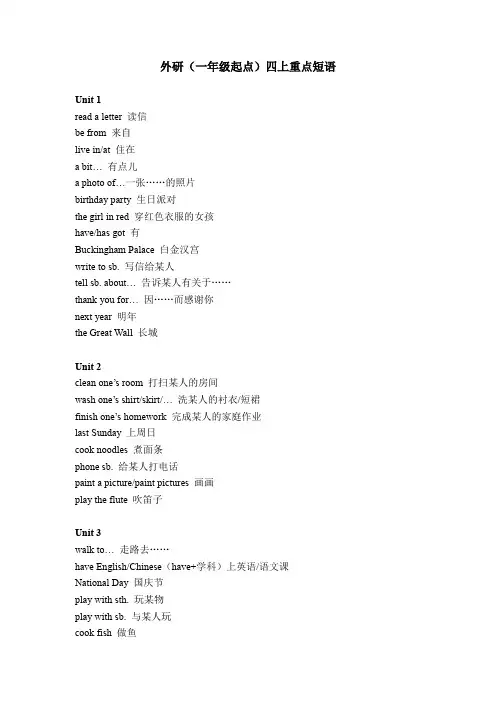
外研(一年级起点)四上重点短语Unit 1read a letter 读信be from 来自live in/at 住在a bit…有点儿a photo of…一张……的照片birthday party 生日派对the girl in red 穿红色衣服的女孩have/has got 有Buckingham Palace 白金汉宫write to sb. 写信给某人tell sb. about…告诉某人有关于……thank you for…因……而感谢你next year 明年the Great Wall 长城Unit 2clean one’s room打扫某人的房间wash one’s shirt/skirt/…洗某人的衬衣/短裙finish one’s homework完成某人的家庭作业last Sunday 上周日cook noodles 煮面条phone sb. 给某人打电话paint a picture/paint pictures 画画play the flute 吹笛子Unit 3walk to…走路去……have English/Chinese(have+学科)上英语/语文课National Day 国庆节play with sth. 玩某物play with sb. 与某人玩cook fish 做鱼ride one’s bike骑自行车ride one’s bike to…骑自行车去……stay at home 待在家Unit 4look at…看……in front of…在……前面between…and…在……和……之间Unit 5go to…去……go on a trip 去旅行go on a school trip 学校旅行it takes sb. +时间+to do sth. 做某事花费某人多少时间climb to the top 爬到顶lots of…(+复数名词或不可数名词)许多的have a good time 玩得开心buy sb. sth.=buy sth. for sb. 给某人买某物a picture of…=a photo of…一张……的照片go skating 去滑冰warm clothes 暖和的衣服at first 首先fall over 摔倒,跌倒a lot 很,非常;许多be able to 能够Unit 6have…for breakfast/lunch/dinner早餐/午餐/晚餐吃……long long ago很久以前with the magic paintbrush 用神笔take…away把……拿走go to sea in the ship 坐船出海come back 回来Unit 7look for 寻找Unit 8go to the zoo 去动物园come to…来到……last week 上周music competition 音乐比赛last Wednesday 上周三gold cup 金杯win a competition 赢得比赛come to see me 来看我take a picture 拍照take a picture of…拍一张……的照look tired 看起来很累go out 出去Unit 9fall off the tree/bike/bed 从树上/自行车上/床上掉下来fall off 掉下来in the tree 在树上on the tree 在树上happen to sb. 某人发生某事go for a bike ride 骑自行车兜风bump one’s head撞到某人的头take sb. to…带某人去……cut one’s finger(s)割到某人的手指hurt one’s knee(s)伤到某人的膝盖Unit 10every morning 每天早上get up early/late 早/晚起go to bed early/late 早/晚睡during the day 在白天come in 进来have got a cold(患)感冒play computer games 玩电脑游戏take the medicine 吃药drink water 喝水a lot of…=lots of…许多的……drink a lot of water 喝许多水do (some)exercise 做(一些)运动want to do... 想做……want to be healthy 想要健康every day 每天play ball games 进行球类运动wash one’s hands洗手go to the toilet 去厕所。
外研社小学英语一起四年级下重点词汇及句子
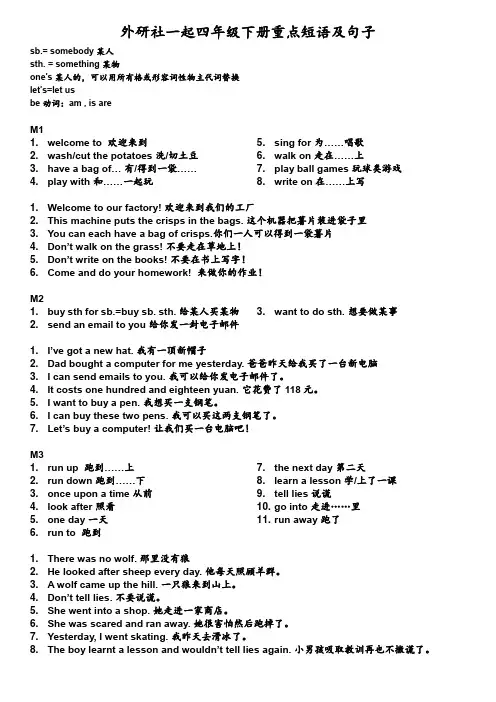
外研社一起四年级下册重点短语及句子sb.= somebody 某人sth. = something 某物one’s 某人的,可以用所有格或形容词性物主代词替换let’s=let usbe 动词:am , is areM11. welcome to 欢迎来到2. wash/cut the potatoes 洗/切土豆3. have a bag of… 有/得到一袋……4. play with 和……一起玩5. sing for 为……唱歌6. walk on 走在……上7. play ball games 玩球类游戏8. write on在……上写1. Welcome to our factory! 欢迎来到我们的工厂2. This machine puts the crisps in the bags. 这个机器把薯片装进袋子里3. You can each have a bag of crisps.你们一人可以得到一袋薯片4. Don’t walk on the grass! 不要走在草地上!5. Don’t write on the books! 不要在书上写字!6. Come and do your homework! 来做你的作业!M21. buy sth for sb.=buy sb. sth. 给某人买某物2. send an email to you 给你发一封电子邮件3. want to do sth. 想要做某事1. I’ve got a new hat. 我有一顶新帽子2. Dad bought a computer for me yesterday. 爸爸昨天给我买了一台新电脑3. I can send emails to you. 我可以给你发电子邮件了。
4. It costs one hundred and eighteen yuan. 它花费了118元。
5. I want to buy a pen. 我想买一支钢笔。
四下外研一起点单词短语
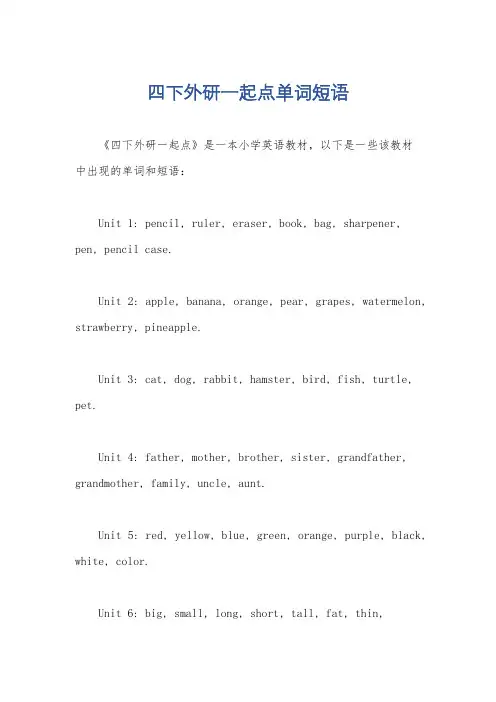
四下外研一起点单词短语《四下外研一起点》是一本小学英语教材,以下是一些该教材中出现的单词和短语:Unit 1: pencil, ruler, eraser, book, bag, sharpener, pen, pencil case.Unit 2: apple, banana, orange, pear, grapes, watermelon, strawberry, pineapple.Unit 3: cat, dog, rabbit, hamster, bird, fish, turtle, pet.Unit 4: father, mother, brother, sister, grandfather, grandmother, family, uncle, aunt.Unit 5: red, yellow, blue, green, orange, purple, black, white, color.Unit 6: big, small, long, short, tall, fat, thin,strong, weak.Unit 7: head, shoulder, arm, hand, finger, leg, foot, body, face.Unit 8: carrot, potato, tomato, cucumber, cabbage, onion, vegetable, fruit.Unit 9: Monday, Tuesday, Wednesday, Thursday, Friday, Saturday, Sunday, week.Unit 10: breakfast, lunch, dinner, bread, egg, milk, rice, noodles, food.除了单词外,这些单元还包括与日常生活和学习相关的短语,例如:What's this?(这是什么?)。
外研(一起)英语默写清单四上
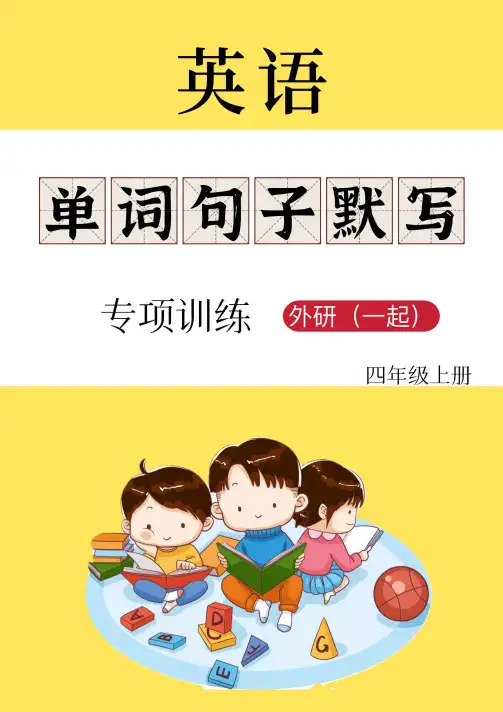
二、短语句子1、读信2、住在伦敦3、在星期六4、电脑游戏5、一张…….的照片6、在白金汉宫7、生日聚会8、在长城9、尽快写信给我。
10、祝你生日快乐!11、我有一本新书。
12、我的生日在周五。
13、他住在哪里?14、他住在伦敦。
15、改正:16、改正:1、亲爱的2、健康3、属于(人或物);关于(人或物)4、不久;很快5、告诉6、爱你的1、女裙2、打扫3、完成4、肮脏的5、绘画6、先生7、电话二、短语句子1、洗我的衬衫2、洗我的裙子3、打扫我的房间4、帮助我的妈妈5、做面条6、洗我的裤子7、完成我的作业8、我打扫了房间。
9、詹妮洗了她的裙子10、我们去了公园。
11、改正:12、改正:13、改正:14、改正:1、没有2、没有3、国庆日4、保持5、什么6、没趣的;令人厌倦的7、一天二、短语句子1、国庆节2、起床3、待在家里4、步行去上学5、完成家庭作业6、骑自行车7、打扫房间8、上英语课9、多么无聊的一天啊!10、她昨天没有踢足球。
11、他们上周没有看电视。
12、改正:13、改正:14、改正:1、发明,创造2、纸3、重要的4、印刷5、印刷的文字;印花布6、对的7、在⋯⋯中间8、自行车9、老鼠10、在旁边11、男人二、短语句子1、中国人发明了纸。
2、美国人发明了飞机.3、玲玲在哪里?4、她在那两个女孩旁边。
5、小河在那里?6、它在这幢大楼后面。
7、没错。
8、发明印刷术9、这个星期10、印刷书和报纸11、改正:12、改正:13、改正:14、改正:二、短语句子1、过得愉快2、起初,开始时3、能够4、爬到顶部5、一张..….的照片6、去滑冰7、在很大程度上8、它很容易!9、我们去过了长城。
10、我穿着暖和的衣服。
1、去2、看3、旅行4、拍照5、五十6、分钟7、顶部;顶8、山9、吃10、(candy的复数)糖果11、植物12、have的过去式13、过得愉快14、买15、(wear的过去式)穿16、旅行17、冰18、首先,最初19、摔倒20、倒下21、受伤22、很多23、聪明能干的24、能够做25、滑冰二、短语句子1、昨天早餐我吃了面条,2、我早餐没有吃鱼。
外研社英语教材(一年级起点版)四年级上册句型总结
外研社英语教材(一年级起点版)4年级上册句型总结1. 动词过去式① 动词过去式不规则变化:go - went (去), see - saw (看见), take - took (花费;采取), eat - ate (吃), have - had (有), buy - bought (买), fall - fell (掉下、摔倒), is / am - was (是), are - were (是), get - got (得到,抓到), do - did (做), say - said (说), s i ng - s a ng (唱歌), make - made (制作), r i de - r o de (骑), w i n - w o n (赢,胜利), wr i te - wr o te (写), dr i nk - dr a nk (喝), wear - wore (穿), speak - spoke (讲话), break - broke (打破), fly - flew (飞), lose - lost (丢失), find - found (发现), c o me - c a me (来), bec o me - bec a me (变成), run - ran (跑), learn - learnt (学习)不规则变化, - 外研社英语4年级上册(一年级起点版)② 动词过去式直接+ed:wash - washed (清洗),finish - finished (完成), clean - cleaned (打扫), help - helped (帮助), cook - cooked (煮), phone - phoned (打电话), watch - watched (观看), paint - painted (绘画), play - played (玩耍), live - lived (居住), invent - invented (发明), stay - stayed (停留), practise - practised (练习), bump - bumped (碰、撞), happen - happened (发生), climb - climbed (爬)动词过去式直接+ed, - 外研社英语4年级上册(一年级起点版)③ 动词过去式变y为i+ed:carr y - carr i ed(拿走,带走)动词过去式变y为i+ed, - 外研社英语4年级上册(一年级起点版)④ 动词过去式不变:cut - cut (切、割), hurt - hurt (使疼痛,使受伤)动词过去式不变, - 外研社英语4年级上册(一年级起点版)(英语动词过去式的变化大部分是有规律的加"ed",或者改写为"ied",也有不规则变化,不规则的我们见一个积累一个就好。
外研版小学英语一年级起点四年级上册知识点总结
外研版小学英语一年级起点四年级上册知识点总结Module1
1.重点单词
behind在.后面left左边
right右边lost迷路的
street街道,大街supermarket超市cinema电影院
train火车hill小山
house房屋station车站
2.牢记小尾巴
live at居住,住在next to紧靠.旁边at the station在车站
3.重点短语
excuse me打扰一下turn left向左转turn right向右转go straight on直着走up the hil上山down the hill下山near the house在房子附近
4.重点句型
(1)—-Excuse me.Where's the..,please?
打扰一下,请问..在哪儿?
(2)——Thank you so much.十分感谢你。
——You are welcome.
Module2
1.重点单词
run跑步these这些children孩子们China中国
2.重点短语
read a book读书take pictures拍照watch TV看电视play with a toy train玩玩具火车fly a kite放风筝ride a bike骑自行车listen to music听音乐talk to my friend和朋友交谈
3.重点句型
(1)He's taking pictures.他正在拍照。
(2)-What are you doing?你在干什么?
-I'm reading a book.我正在读书。
外研版一起点四年级下册期末复习材料-关键短语句子
Module 11. these machines 这些机器2. make crisps 制造薯片3. wash the potatoes 清洗土豆4. cut the potatoes 切土豆5. touch the machines 触摸机器6. wear these glasses 戴上眼镜7. don’t touch 严禁触摸8. put …in …把……放进……9. a very good class 优秀的班集体10. wash your hands 洗手11. a bag of 一袋……12. play ball games 从事球类运动13. walk on the grass 踩踏草坪14. dangerous危急的1. Don’t touch the machines! 别碰机器!2. What does this machine do? 这台机器是干什么的?3. You can each have a bag of crisps. 你们每个人都能得到一包薯片。
4. Don’t feed the fish. 别喂鱼。
5. Don’t write on the books. 别在书上写字。
Module 21. buy a puter 买一台电脑2. last year去年3. helpful 有关心的4. send emails发邮件1. Dad bought a puter for me yesterday. 爸爸昨天给我买了一台电脑。
2. What colour is it? 它是什么颜色?3. It costs one hundred and eighteen yuan. 它价值118元。
4. It’s beautiful and helpful. 它又美丽又有用。
Module 31. once upon a time 从前2. look after 照看,照管3. the next day 其次天4. run to …跑向…5. go into…到…里去6. run away 逃跑7. run up 向上跑8. e up the hill消失在山上1. Once upon a time, there was a boy. He looked after sheep everyday.从前有个小男孩,他每天照看羊(放羊)。
一年级起点英语四年级上册外研版
一年级起点英语四年级上册外研版一、单词部分。
1. 重点单词汇总。
- Module 1.- clever ['klevə(r)]:聪明的。
如:The boy is very clever.(这个男孩非常聪明。
)- naughty ['nɔːti]:淘气的。
My little brother is naughty.(我的小弟弟很淘气。
)- Module 2.- city ['sɪti]:城市。
Beijing is a big city.(北京是一个大城市。
)- ship [ʃɪp]:船。
There is a big ship on the sea.(海上有一艘大船。
)- beautiful ['bjuːtɪfl]:美丽的。
The park is beautiful.(这个公园很美丽。
)- Module 3.- house [haʊs]:房子。
My house is near the school.(我的房子在学校附近。
)- station ['steɪʃn]:车站。
The train station is very busy.(火车站非常繁忙。
)- supermarket ['suːpəmɑːkɪt]:超市。
We can buy many things in the supermarket.(我们可以在超市买很多东西。
)- Module 4.- tomato [tə'mɑːtəʊ]:西红柿。
I like tomatoes.(我喜欢西红柿。
)- potato [pə'teɪtəʊ]:土豆。
Potatoes are very delicious.(土豆非常美味。
)- flower ['flaʊə(r)]:花。
There are many flowers in the garden.(花园里有很多花。
)- Module 5.- help [help]:帮助。
外研版(一年级起点)四年级下M1-M10 重点短语、句子总结
M1知识点A单词:welcome 欢迎potato马铃薯,土豆put,放,安放,放置wait等,等待A 短语:1 welcome to our factory欢迎来我们的工厂2 put the crisps in the bags把薯片放进袋子里put …in…把…放到…里A 句子:Don’t touch the machines,please!请不要触摸机器B :单词:machines机器crisp炸薯片sir先生dangerous危险的each各自,每个短语:have a bag of crisps有一包薯片句式:Don’t+ 动词原形不要做某事。
M1知识点U2A句子:Dou’t feed the fish!不要喂鱼!B短语:1 walk on the grass在草地上走2 write on the books在书上写字句子:1 Don’t walk on the grass!不要在草地上走!2 Dou’t play ball games here!不要玩球类的游戏3 Dou’t talk!不要讲话!4 Don’t write on the books!不要在书上写字Don’t+动词原形不要做某事M2知识点U1单词:email电子邮件短语:send emails to…给….发送电子邮件句子:Is it expensive ? No, it’s cheap, but it’s beautiful. It’s pink.它贵吗?不,它很便宜,但是它很漂亮。
它是粉色的。
单词:cheap便宜的expensive昂贵的send发送,寄短语: buy a computer for me给我买一台电脑句子:1 Is it big?Yes,it is。
它大吗?是的,它很大2 Is it beautiful?Well,it’s not beautiful,but it’s helpful。
它漂亮吗?它不漂亮,但是它很有用。
外研版四年级上册一年级起点
外研版四年级上册一年级起点一、单词部分。
1. Module 1.- clever:聪明的。
如:He is a clever boy.(他是一个聪明的男孩。
)- naughty:淘气的。
The monkey is naughty.(这只猴子很淘气。
)2. Module 2.- city:城市。
I live in a big city.(我住在一个大城市里。
)- ship:船。
There is a big ship on the sea.(海上有一艘大船。
)- beautiful:美丽的。
The park is beautiful.(这个公园很美丽。
)二、课文重点句型。
1. Module 1.- This is my mother. She is very nice.(这是我的妈妈。
她非常和蔼。
)- He's a bit shy.(他有点害羞。
)- These are my friends.(这些是我的朋友们。
)2. Module 2.- What's this? It's a book about London.(这是什么?这是一本关于伦敦的书。
)- London is a big city.(伦敦是一个大城市。
)- It's very famous.(它非常著名。
)三、语法要点。
1. 形容词的用法。
- 形容词可以用来描述人或事物的特征。
在句子中,形容词可以放在名词前面,如a nice day;也可以放在be动词后面,用来描述主语的特征,如He is clever。
2. This和These的用法区别。
- This用于单数,指离说话人较近的单个事物或人,如This is my pen.(这是我的钢笔。
)- These用于复数,指离说话人较近的多个事物或人,如These are my pencils.(这些是我的铅笔。
)。