
(完整版)初中英语八种时态归纳总结表格版
特殊:Wh… + was/ were 的疑问句?
特殊:Wh… +did 的疑问句?
时 为。
at the age of 5, one day,
once upon a time,
tomorrow, by…,
基本结构
一
next day
be going to + 动原
will/shall +do .
般 表示将要发生的 (week, month , year…), 肯定:主语+am/is/are/going to + do;
问句: Will /Shall 主语+ 动词原形 ?
或准备做某事。
答:Yes …be ./ No ,…be not
答句:Yes …will . / No ,…won’t .
时
特殊:Wh…+ Be 主语 going to do 的疑问句?特殊:Wh… +will 的疑问句?
1
The shortest way to do many things is to only one thin
②would +do . 肯定:主语+ would + 动词原形 否定:主语+ would not (wouldn’t) + 动词原形 问句:Would 主语+ 动词原形 ? 答句:Yes …would. / No ,…wouldn’t .
特殊:Wh… +would 的疑问句?
2
The shortest way to do many things is to only one thin
The next day (morning,year…), the following month (week…)
基本结构: 肯定:主语 was /were +doing 否定:主语 was /were not + doing.
问:Was /Were 主语 +doing ? 答:Yes …was/ were ./ No ,…was /were not 特殊:Wh…+ Be 主语 + 疑问句?
以过去某个时间 为标准,在此以 前发生的动作或 行为,或在过去 某动作之前完成 的行为,即“过 去的过去” 立足于过去某一 时刻,从过去看 将来,常用于宾 语从句中
recently, lately, since+ 时间点 for+ 时间段。 =(since + 时间点 ago) in the past few years, before, by the end of last year (term,month…); 过去时态的从句
态; 过
last week
问:Was/Were + 主语 + 其他?
过去习惯性、经 (year, night ,month…), 答:Yes …be ./ No ,…be not .
问句:Did + 主语 + 动原?
答:Yes…did. / No,… didn’t.
去 常性的动作、行 in1989, just now ,
初中英语八种时态归纳
①be 动词: 肯定:主语+ be(am/ is /are )+ 其他 否定:主语+ am/is/are + not + 其他 问:Be (am/ is are )+ 主语 + 其他? 答:Yes …be ./ No ,…be not . 特殊:Wh… + Be 的疑问句?
结构及变化
注意:当与一段时间连用时,动词要改为 延续性动词。 have bought =have been had have borrow = have kept have died = have been dead ………… have been to : have gone to : have been in :
②行为动词: 肯定:主语+ do(does) + 其他 否定:主语 + don't / doesn’t + 动原 问句:Do /Does + 主语 + 动原?
答:Yes…do/does ./ No,… don’tdoesn’t.
特殊:Wh… + do /does 的疑问句?
ago, yesterday,
基本结构: 肯定:主语+ had + done(动词的过去分词) 否定:主语 had not+ done.(动词的过去分词) 问句:主语+ had + done(动词的过去分词)? 答:Yes …had./ No ,…had not . 特殊:Wh…+had 主语 + 疑问句?
基本结构: 肯定:主语+ was/were going to + do; 否:主语+ was/were+ not going to do 问:Be + 主语 +going to do……? 答:Yes …be ./ No ,…be not 特殊:Wh…+ Be 主语 going to do 的疑问句?
基本结构:
肯定:主语+ have/has+ done(动词的过去分词) 否定:主语 have/has+ not+ done. (动词的过去分词) 问句:主语+have/ has + done(动词的过去分词)? 答:Yes …have /has ./ No ,…have/has not . 特殊:Wh…+ have/has 主语 + 疑问句?
The shortest way to do many things is to only one thin
时态
一 般 现 在 时
意义
时间状语
always, usually, often , sometimes, 经常、反复发生 every week 的动作或行为及 (day, year , month…), 现在的某种状况。 Once a week, On Sundays
3
The shortest way to do many things is to only one thin
过去 进行 时
现在 完成 时
过去 完成 时
过去 将来 时
表示过去某段时 间或某一时刻正 在发生或进行的 行为或动作
At this time yesterday ,at that time , 或 when 现在造成的影响 或结果, 或从过去已经开 始,持续到现在 的动作或状态。
long long ago ,
①be 动词:
②行为动词:
一 过去某个时间里 the day
肯定:主语+ (was /were)+ 其他
肯定:主语+ 动词过去式 + 其他
般 发生的动作或状 before yesterday,
否定:主语+ wasn’t/were not + 其他 否定:主语 + did + 动原
肯定:主语+will /shall + 动词原形
将 动作或存在的状 soon, in a few minutes , 否:主语+ am /is /are + not going to do 否定:主语+will not (won’t) + 动词原形
来 态及打算、计划 the day after tomorrow 问:Be + 主语 +going to do……?
现在 进行 时
表示现阶段或说 话时正在进行的 动作及行为。
now, look , listen at this time , these days ,
基本结构: 肯定:主语 am/is/are +doing 否定:主语 am/is/are+ not + doing.
问: am/is/are 主语 +doing ? 答:Yes …be ./ No ,…be not 特殊:Wh…+ Be 主语 + 疑问句?
八种时态归纳总结表格版
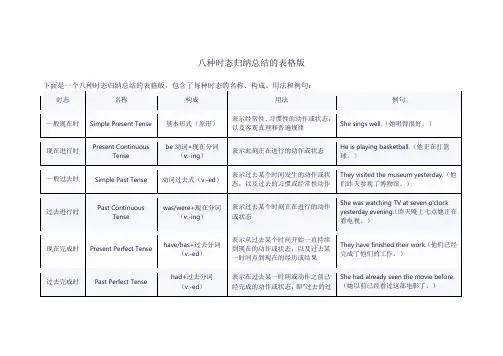
Past Continuous Tense
was/were+现在分词(v.-ing)
表示过去某个时刻正在进行的动作或状态
She was watching TV at seven o'clock yesterday evening.(昨天晚上七点她正在看电视。)
现在完成时
Present Perfect Tense
have/has+过去分词(v.-ed)
表示从过去某个时间开始一直持续到现在的动作或状态,以及过去某一时间点到现在的经历或结果
They have finished their work.(他们已经完成了他们的工作。)
过去完成时
Past Perfect Tense
had+过去分词(v.-ed)
表示在过去某一时间或动作之前已经完成的动作或状态,即“过去的过去”
She had already seen the movie before.(她以前已经看过这部电影了。)
一般将来时
Simple Future Tense
will/shall+动词原形(v.)
表示将来某个时间将要发生的动作或状态,以及Fra bibliotek来的计划或安排
We will go to the park tomorrow.(我们明天要去公园。)
过去将来时
Past Future Tense
would+动词原形(v.)
表示从过去某个时间看将要发生的动作或状态,常用于宾语从句或间接引语中
She said she would come back soon.(她说她很快就会回来。)
be动词+现在分词(v.-ing)
初中英语八种时态归纳表格
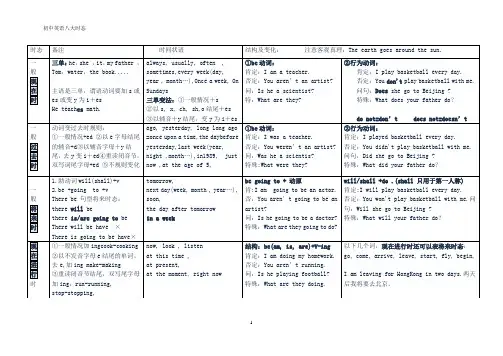
时态 一 般 现 在 时
一 般 过 去 时
备注
时间状语
结构及变化:
注意客观真理:The earth goes around the sun.
三单:he,she ,it,my father , always, usually, often ,
Tom,water,the book..... sometimes,every week(day,
①be 动词: 肯定:I am a teacher. 否定:You aren’t an artist? 问:Is he a scientist? 特:What are they?
①be 动词: 肯定:I was a teacher. 否定:You weren’t an artist? 问:Was he a scientis? 特殊:What were they?
Before he arrived, the train had left.(表过去的过去)
基本结构: 肯定: was/were going to + do
②would +do . 肯定:主语+ would + 动词原形 否定:主语+ would not (wouldn’t) + 动词原形 问句:Would 主语+ 动词原形 ?
般 There be 句型将来时态:
soon,
否:You aren’t going to be an 否定:You won't play basketball with me.问
将 there will be
the day after tomorrow
artist?
句:Will she go to Beijing ?
初中英语8种时态及情态动词的被动语态 总结表格版
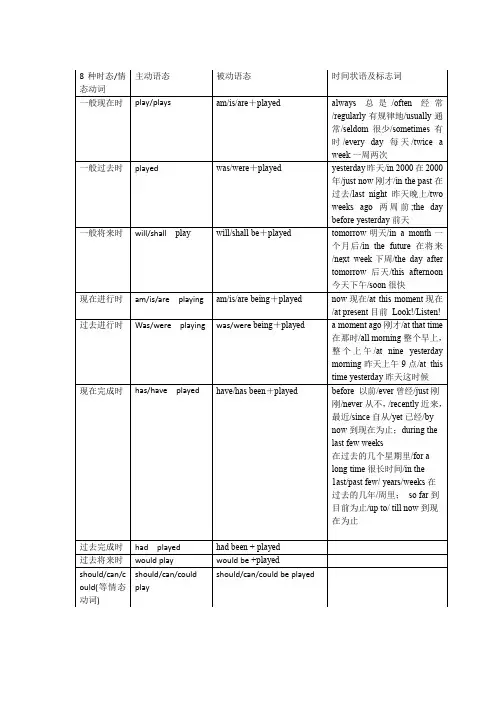
tomorrow明天/in a month一个月后/in the future在将来/next week下周/the day after tomorrow后天/this afternoon今天下午/soon很快
现在进行时
am/is/are playing
am/is/are being+played
一般现在时plຫໍສະໝຸດ y/playsam/is/are+played
always总是/often经常/regularly有规律地/usually通常/seldom很少/sometimes有时/every day每天/twice a week一周两次
一般过去时
played
was/were+played
yesterday昨天/in 2000在2000年/just now刚才/in the past在过去/last night昨天晚上/two weeks ago两周前;the day before yesterday前天
should/can/could(等情态动词)
should/can/could play
should/can/could be played
时态解题步骤
看时间标志词确定时态看主语与动词关系确定语态看人称确定单复数
现在完成时
has/have played
have/has been+played
before以前/ever曾经/just刚刚/never从不,/recently近来,最近/since自从/yet已经/by now到现在为止;during the last few weeks
在过去的几个星期里/for a long time很长时间/in the 1ast/past few/years/weeks在过去的几年/周里;so far到目前为止/up to/ till now到现在为止
初中英语时态总结表格
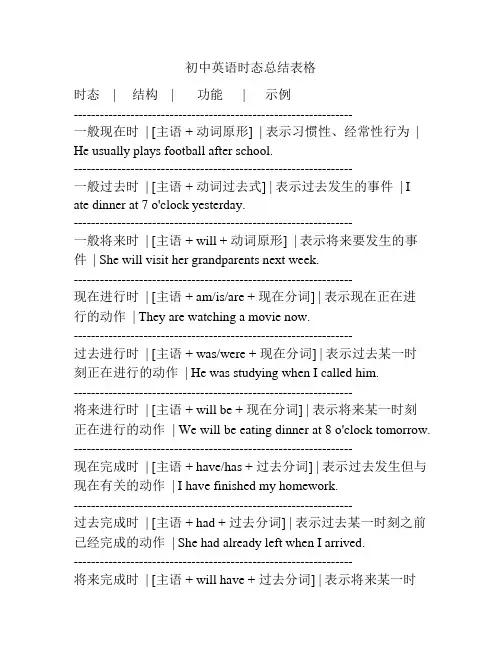
初中英语时态总结表格时态 | 结构 | 功能 | 示例----------------------------------------------------------------一般现在时 | [主语 + 动词原形] | 表示习惯性、经常性行为 | He usually plays football after school.----------------------------------------------------------------一般过去时 | [主语 + 动词过去式] | 表示过去发生的事件 | I ate dinner at 7 o'clock yesterday.----------------------------------------------------------------一般将来时 | [主语 + will + 动词原形] | 表示将来要发生的事件 | She will visit her grandparents next week.----------------------------------------------------------------现在进行时 | [主语 + am/is/are + 现在分词] | 表示现在正在进行的动作 | They are watching a movie now.----------------------------------------------------------------过去进行时 | [主语 + was/were + 现在分词] | 表示过去某一时刻正在进行的动作 | He was studying when I called him.----------------------------------------------------------------将来进行时 | [主语 + will be + 现在分词] | 表示将来某一时刻正在进行的动作 | We will be eating dinner at 8 o'clock tomorrow. ----------------------------------------------------------------现在完成时 | [主语 + have/has + 过去分词] | 表示过去发生但与现在有关的动作 | I have finished my homework.----------------------------------------------------------------过去完成时 | [主语 + had + 过去分词] | 表示过去某一时刻之前已经完成的动作 | She had already left when I arrived.----------------------------------------------------------------将来完成时 | [主语 + will have + 过去分词] | 表示将来某一时刻之前已经完成的动作 | By this time next year, we will have graduated from high school.----------------------------------------------------------------情态动词 | [情态动词 + 动词原形] | 表示能力、意愿、推测等 | She can swim very well.----------------------------------------------------------------。
英语八大时态总结表
英语八大时态总结表英语中一共有八种时态,分别是简单现在时、现在进行时、简单过去时、过去进行时、一般将来时、将来进行时、现在完成时、过去完成时。
下面我们将对每一种时态进行详细介绍。
1、简单现在时简单现在时表示现在正在进行的动作或状态,也可以表示经常性、习惯性的动作或状态。
结构:主语 + 动词原形 / 动词第三人称单数形式(he, she, it)+ 其他例如:1. I eat breakfast every morning. 我每天早上吃早饭。
2. She teaches at a school. 她在一所学校教书。
2、现在进行时现在进行时表示现在正在发生的动作或状态。
结构:主语 + be动词的现在分词(am, is, are)+ 动词-ing + 其他。
例如:1. He is studying for the exam. 他正在为考试而学习。
2. We are watching a movie right now. 我们现在正在看电影。
3、简单过去时简单过去时表示在过去某个时间发生的动作或状态。
结构:主语 + 动词的过去式 / 动词的第二人称单数形式(you)+ 其他。
例如:1. They went to the beach last summer. 他们去年夏天去了海滩。
2. She talked to her friend on the phone yesterday. 她昨天给她的朋友打电话聊天了。
4、过去进行时过去进行时表示过去某个时间正在进行的动作或状态。
结构:主语 + be动词的过去分词(was, were)+ 动词的现在分词(-ing)+ 其他例如:1. They were playing soccer when it started raining. 下雨的时候他们正在踢足球。
2. She was studying when her phone rang. 她在学习的时候接到了电话。
八种时态表格

把was或were放在句首。
主语+was/ were+ not+ doing
5、现在进行时
表示现阶段或说话时正在进行的动作或状态。
now, at this time, these days, etc.
主语+am/ is/ are +doing
把be动词放在句首。
表示在过去某一时间或动作之前已经发生或完成的动作或情况。表示“过去的过去”
by, before等构成的过去时间短语连用或用于when, before, until等引导的从句中。由said, asked, told, thought等引导的宾语从句中,
had+ done
had放于句首。
had+ not+ done
1.be going to +do2.will /shall+do
1.be放在句首。2.will/shall提到句首。
1.be going to+not+ do
2.will /sh某一时刻正在发生或进行的动作或行为。
at this time yesterday或以when引导的谓语动词是一般过去时的时间状语等。
on Mondays, etc.
1.be动词
2.行为动词
主语+be+其他
1.把动词be放于句首。
2.用助动词do提问,如主语为第三人称单数,则用does,同时还原为动词原形。
1.am/is/are+not
2.此时态的谓语动词若为行为动词,则在其前加don’t;若主语为第三人称单数,则用doesn’t,同时还原行为动词。
初中英语八种时态一览表
初中英语八种时态一览表(以do为例)注:1、动词第三人称单数的构成与名词的复数变化一样,遵循同样的规则。
在词尾加-s或-es.2、have , be的第三人称单数形式分别为:has , is。
3、现在分词是在动词后加-ing,遵循加-ing的规则,注意以-ie结尾的单章节单词将ie改为y再加ing。
4、表示状态而不表示动作的动词,如:be, know,see , believe, understand , have(有) ,like , love , remember等不用实行时态。
5、对于规则动词,其过去式和过去分词一样,都是在词末加-ed,遵循加-ed的规则;不规则动词也有一些变化规律,可以归纳为AAA,AAB,ABB,ABC型进行记忆。
6、表示将来时的两种结构用法有所不同,分别可以表示主观打算、事先安排的行为和客观必然发生的事情。
另外,表示将来的概念还许多方法。
例句:1. He often reads magazines after class.2. Tom always wants to go swimming in summer.3. Lucy has a twin sister Lily.4. There is a big tree in front of our classroom.5. People sometimes make friends by doing exercise.6. We have an English class on Mondays.7. The boy is tall.8. Three times three is nine.9. We began to learn English two years ago.10. I was glad to get your letter.11. When Edison was a child, he often asked questions.12. I will be here at ten o’clock tomorrow.13. I am going to see him next Tuesday.14. Shall I open the window?15. I am writing a letter now.16. We are preparing for the exams.17. He is leaving for Beijing next week.18. The rain has stoppe d already.19. I have never seen such a film before.20. I haven’t seen him for three days.21. He has lived here since 1992.22. I have seen this film three times.23. What were you doing at 9:30 yesterday morning?24. I was writing while he was reading.25. He said he would go to Shanghai soon.26. We had learnt over 1200 words by the end of last term.27. He had gone home before I got to his office.28. He said he had returned the book to the library.练习:用所给的动词的适当形式填空。
初中英语八种时态归纳表格
以 过 去 某 个 before, 过
基本结构:
时间为标准,
肯定:主语+ had + done(动词的过去分词)
去
by the end of last
在此以前发
否定:主语 had not+ done.(动词的过去分词)
完
year
生的动作或
问句:主语+ had + done(动词的过去分词)
成
(term,month…);
肯定:主语+ (was /were)+ 其他 肯定:主语+ 动词过去式 + 其他
动作或状态; the day
否定:主语+ wasn’t/were not + 否定:主语 + did + 动原
过去习惯性、 before
其他
经常性的动
般 作、行为。 yesterday, last week
问:Was/Were + 主语 + 其他 问句:Did + 主语 + 动原 答:Yes …be ./ No ,…be not . 答:Yes…did. / No,… didn’t.
或准备做某
形
事。
soon, in a few 否:主语+ am /is /are + not going
将
minutes ,
to do
问句: Will /Shall 主语+ 动词原形
the day after 问:Be + 主语 +going to do…… 答句:Yes …will . / No ,…won’t .
来
tomorrow
初中时态语态总结表格
初中时态语态总结表格初中时态语态总结表格动词形式一般现在时一般过去时一般将来时完成时态进行时态被动语态一般形式 V原形+s/es V-ed will/shall+V原形have/has+V过去分词 am/is/are+V-ing am/is/are+V过去分词例句 She plays basketball. He studied English yesterday. I will go to the beach tomorrow. They have finished their homework. I am watching TV now. The book was written by Mark.时态解释表示现在发生的动作或状态。
表示过去发生的动作或状态。
表示将来发生的动作或状态。
表示过去发生并一直延续到现在的动作或状态。
表示说话时正在进行的动作或状态。
表示动作的承受者。
一般性使用主语+动词主语+动词ed 主语+will/shall+动词主语+have/has+动词ed 主语+am/is/are+动词ing 主语+am/is/are+动词过去分词一般疑问句助动词(do/does)/be动词(is/am/are)+主语+动词助动词(did)/be动词(was/were)+主语+动词助动词(will/shall)/be动词(is/am/are)+主语+动词助动词(have/has)/be动词(is/am/are)+主语+动词ed 助动词(am/is/are)/be动词(is/am/are)+主语+ 动词ing 助动词(am/is/are)/be动词(is/am/are)+主语+动词过去分词特殊疑问句疑问词+助动词(do/does)/be动词(is/am/are)+主语+动词疑问词+助动词(did)/be动词(was/were)+主语+动词疑问词+助动词(will/shall)/be 动词(is/am/are)+主语+动词疑问词+助动词(have/has)/be动词(is/am/are)+主语+动词ed 疑问词+助动词(am/is/are)/be动词(is/am/are)+主语+ 动词ing 疑问词+助动词(am/is/are)/be动词(is/am/are)+主语+动词过去分词否定句主语+助动词(do not/does not)/be动词(is/am/are not)+动词主语+助动词(did not)/be动词(was/were not)+动词主语+助动词(will/shall not)/be动词(is/am/are not)+动词主语+助动词(have/has not)/be 动词(is/am/are not)+动词ed 主语+助动词(am not/is not/are not)/be动词(is/am/are not)+动词ing 主语+助动词(am not/is not/are not)/be动词(is/am/are not)+动词过去分词情态动词主语+情态动词+动词原形主语+情态动词+动词原形主语+will/shall+情态动词+动词原形主语+have/has+情态动词+动词原形主语+am/is/are+情态动词+ 动词ing 主语+am/is/are+情态动词+动词过去分词现在进行时主语+am/is/are+V-ing 主语+was/were+V-ing 主语+will/shall+be+V-ing 主语+have/has+been+V-ing - -过去进行时主语+was/were+V-ing -- - - -将来进行时主语+will/shall+be+V-ing -- - - -完成进行时主语+have/has+been+V-ing 主语+had+been+V-ing - -- -被动语态主语+am/is/are+V过去分词主语+was/were+V过去分词主语+will/shall+be+V过去分词主语+have/has+been+V过去分词主语+am/is/are+being+V过去分词主语+am/is/are+V过去分词。
英语八大时态总结表
英语八大时态总结表时态是英语语法中非常重要的部分,它决定了句子的时间和态度。
掌握英语的八大时态对于正确理解和运用英语语法至关重要。
下面将对英语的八大时态进行详细总结。
一、一般现在时态(Simple Present Tense)一般现在时用于描述经常或一直存在的情况、习惯性的行为或现在的真理。
它的结构是主语+动词原形。
例如:1. The sun rises in the east.(太阳从东方升起。
)2. I usually go to bed early.(我通常早睡。
)3. They live in New York.(他们住在纽约。
)二、一般过去时态(Simple Past Tense)一般过去时用于描述已经发生并结束了的过去事件或状态。
它的结构是主语+动词过去式。
例如:1. She studied abroad last year.(她去年出国留学了。
)2. They visited their grandparents yesterday.(他们昨天拜访了他们的祖父母。
)3. We lived in London for five years.(我们在伦敦住了五年。
)三、一般将来时态(Simple Future Tense)一般将来时用于描述将来会发生的事件或状态。
它的结构是主语+will+动词原形。
例如:1. I will meet my friends tomorrow.(我明天会见我的朋友。
)2. They will travel to Japan next month.(他们下个月会去日本旅行。
)3. She will study hard for her exams.(她将为考试努力学习。
)四、现在进行时态(Present Continuous Tense)现在进行时用于描述正在进行的动作或当前的情况。
它的结构是主语+am/is/are+动词-ing形式。
例如:1. She is watching TV at the moment.(她此刻正在看电视。