
八年级英语下册《Unit 6 Sunshine for all》知识梳理
Reading
1. hope, wish和expect
hope作“希望”解,主要用来表示主观上的愿望并对其实现抱有信心。可接不定式(短语)或that引导的从句,但不可接“宾语+不定式”,即不定式的复合结构。
China.
I hope that you can tell us the truth.
wish作“但愿,希望”解,表示某种未完成或不能完成的愿望,可接不定式(短语),双宾语,“宾语+不定式”的复合结构以及that 从句。wish表示实现愿望的可能性不大或根本不可能时,从句用虚拟语气。
e.g. I wish you to go to Beijing with me next year.
We wish you success/(to be) happy.
I wish (that) I were a millionaire.
expect作“期待,期望”解,侧重于相信或认为有可能实现的愿望。可接名词,不定式(短语),不定式的复合结构。
I expect you to give me a han d.
3. support为动词,意为“支持”,也可作名词,表示“支持,支援”,另一名词形式为supporter , 意为“支持者”。
e.g. Our parents are very tired because they have to support our family.
This event got the support from local businesses.
八年级英语下册《Unit 6 Sunshine for all》知识梳理
编 辑:__________________
时 间:__________________
《Unit 6 Sunshine for all》
1. train为动词,意为“接受训练,培训,训练”,其名词形式为training,意为“训练”。
It’s clever o f you to work out the maths problem.
(2). It is +adj. +for sb. to do sth结构中的形容词仅仅是描述事物或行为,不是对不定式的逻辑主语的品格进行的评价,这类形容词有difficult, easy, hard, important, dangerous, possible等。
e.g. My mother will have an operation soon.
The doctor did an operation on the little boy last Friday.
3. lose one’s life, 意为“失去生命,丧生”,同义词为die.
e.g. The man lost his life in the war.
He expected that he could get there on time.
2. disability为名词,意为“缺陷,障碍”,同根词有:able, disabled, ability.
3. chance为名词,意为“机会”,常见短语为by chance,意为“偶然”,have a chance to do sth意为“有机会做某事”。
6. provide为动词,意为“提供,供给”。常用于短语provide sth for sb, 相当于provide sb with sth,意为“给某人提供某物”。
e.g. It is said that the management will provide food and drinks.
They provided some necessary support for the sufferers.
e.g. Your little dog is so clever. How have you trained it?
2. volunteer为名词,意为“志愿者”。做动词意为“志愿做,义务做”,volunteer to do sth意为“志愿做某事”。
They volunteered to repair the house for the old lady.
e.g. Will you take part in the English evening?
We should take an active part in school activities.
(3) join in 通常指参加某种活动,尤其指和其他人一起参加某项活动。
e.g. I hope you’ll all join in the game.
4. give a helping hand意思是“帮助,伸出援助之手”。
e.g. They all rushed there to give a helping hand.
八年级下册Unit 6词汇过关(词的各类变形,构词,归类等)
1
培训,训练 vin.
20
运动员n.
2
支持 vtn.
Байду номын сангаас21
教练n.
3
e.g. It’s the chance of a lifetime, you shouldn’t miss it.
I met him on the street by chance.
I haven’t had a chance to read my letter.
4. similar作形容词,意为“同样 的,类似的”,后跟介词to表示“与…相像”;跟in表示“在…方面相像”。similar to短语在句中可用作表语或定语,作定语时可后置。
e.g. Doctors believe they have cured him of the disease.
2. op eration为名词,意为“手术”,以元音因素开头,前边使用不定冠词an, 其动词形式为operate, 意为“做手术”,常见短语为do/perform an operation on sb. 意为“给某人做手术”。
有意义的 adj.n.v.
22
黄金,金牌 n.adj.
e.g. He has some trouble learning English well.
Whenever we have trouble with our study, our teachers always help us patiently.
Integrated skills
1. join, take part in和join in
e.g. His views are similar to mine.
We have similar taste in music.
5. give up意为“放弃”,后接名词,代词或动名词。
e.g. We had to give up this plan because of the bad weather.
(1). It is +adj. +of sb. to do sth结构中的形容词描述不定式的逻辑主语的性格、品质,如kind, good, nice, right, wrong, clever, careless, polite, foolish等。
e.g. It’s very kind of you to help me.
She achieved no success.
Grammar
1. It is +adj. +to do sth 的用法
引导词it作形式主语,代替由不定式或不定式复合结构所表示的真正主语。
e.g. It’s necessary to read English every morning.
2. It is +adj. +of/for sb. to do sth 的用法
e.g. It’s very dangerous for children to cross the busy street.
It’s difficult for us to finish the work.
3. have some trouble (in) doing sth意为“在做某事方面有困难、有麻烦”。而表示“在某事方面有困难”时,用短语have some trouble with sth, 此处trouble相当于difficulty.
e.g. Your encouragement made me more confident of my future.
I feel much more confident about myself now.
8. feel like意为“感觉像(是)…”
e.g. They made me feel like one of the family.
e.g. The two events are closely connected.
10. achieve作动词,意为“实现”,其名词形式为achievement,意为“成就,成绩”。achieve一般只用作及物动词,其宾语可以是“实现”的目标,目的等,也可以是“取得”的胜利、成功、名誉、地位等。
e.g. There are many who will work hard together to achieve these goals.
My father decided to give up smoking.
6. be born意为“出生”,be born with意为“生来就有…”。
e.g. He was born with a weak heart.
The kid is born with painting talent.
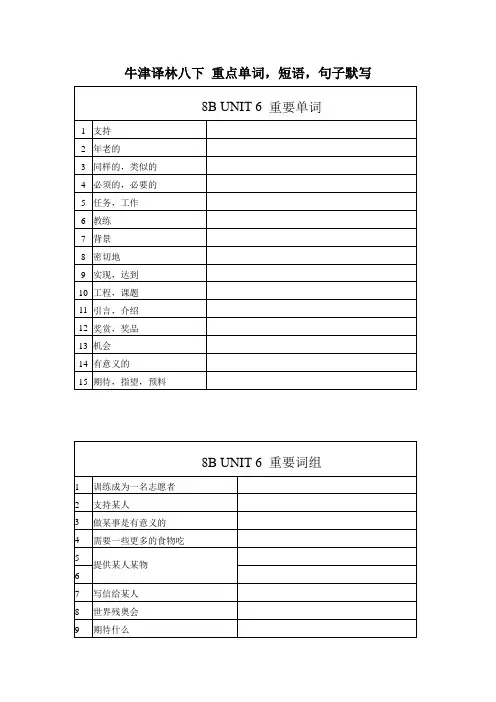
牛津译林版英语八年级下Unit 6 Sunshine for all单词,短语,句子默写(含答案)
1
用这种方式,他们能够帮组当地人改善生活。
In this way, they can help the local people improve their lives.
2
自从上个月起,他就住院了。
He has been ill in hospital since last month.
25
取得第四名
26
感到更加自信
27
因为
28
齐聚一堂
29
来自不同背景
30
感觉像一个大家庭中的一员
31
亲密地工作
32
实现某人的梦想
33
34
35
没有得到报酬
36
赢得第一名
37
举办
38
做某事是有趣的
39
对做某事感兴趣
40
给老人让座
41
捐钱给慈善机构
42
赢得比赛
43
一对一地做某人的工作
44
没有某人的帮助
45
有一些经验
46
一个大学生
a college student
47
中国西南
south-west China
48
一个志愿者项目
a volunteer project
49
在某人的日常生活中
in one's daily lives
50
采取行动保护环境
take action to protect the environment
4
必须的,必要的
necessary
5
任务,工作
task
6
教练
coach
牛津译林版八年级下册英语Unit 6 Sunshine for all单元知识点归类
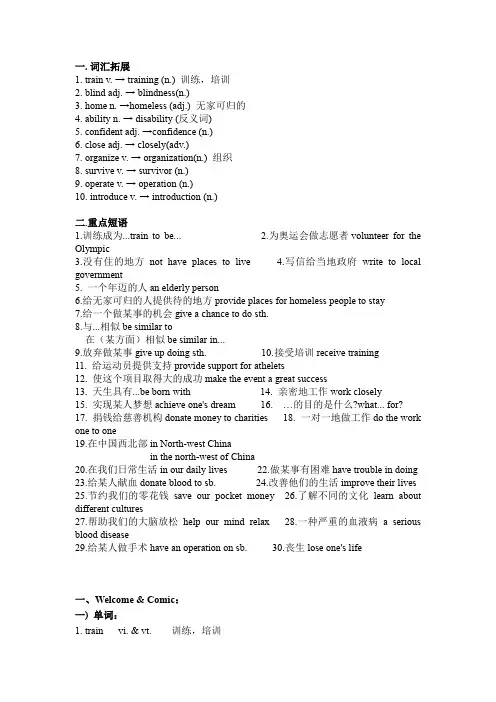
一.词汇拓展1. train v. → training (n.) 训练,培训2. blind adj. → blindness(n.)3. home n. →homeless (adj.) 无家可归的4. ability n. → disability (反义词)5. confident adj. →confidence (n.)6. close adj. → closely(adv.)7. organize v. → organization(n.) 组织8. survive v. → survivor (n.)9. operate v. → operation (n.)10. introduce v. → introduction (n.)二.重点短语1.训练成为...train to be...2.为奥运会做志愿者volunteer for the Olympic3.没有住的地方not have places to live4.写信给当地政府write to local government5. 一个年迈的人an elderly person6.给无家可归的人提供待的地方provide places for homeless people to stay7.给一个做某事的机会give a chance to do sth.8.与...相似be similar to在(某方面)相似be similar in...9.放弃做某事give up doing sth. 10.接受培训receive training11. 给运动员提供支持provide support for athelets12. 使这个项目取得大的成功make the event a great success13. 天生具有...be born with 14. 亲密地工作work closely15. 实现某人梦想achieve one's dream 16. …的目的是什么?what... for? 17. 捐钱给慈善机构donate money to charities 18. 一对一地做工作do the work one to one19.在中国西北部in North-west Chinain the north-west of China20.在我们日常生活in our daily lives 22.做某事有困难have trouble in doing 23.给某人献血donate blood to sb. 24.改善他们的生活improve their lives 25.节约我们的零花钱save our pocket money 26.了解不同的文化learn about different cultures27.帮助我们的大脑放松help our mind relax 28.一种严重的血液病a serious blood disease29.给某人做手术have an operation on sb. 30.丧生lose one's life一、Welcome & Comic:一) 单词:1. train vi. & vt. 训练,培训培训某人train sb. 训练做某事train to do sth.=train for sth.名词:training类似动词变名词的词:turning crossing meaning painting例题:1)---What are you doing now?---I am ___________ (训练) for the next football match.2) He felt very tired after a day’s _____________ (训练).2)汤姆正受训为奥运会志愿者。
牛津译林版英语八年级下册8b unit6 sunshine for all 知识点汇编

8 B Unit6 Sunshine for all1.(1)train n. 火车(2)train v. 训练,培训train to be/as ... 训练成为train to be a volunteer 训练成为一名志愿者train for为…训练They are training for the boat race. 他们正在为划船比赛接受训练。
train sb. 训练某人train to do sth.训练做…train sb.(not)to do sth. 训练某人(不)做某事receive training 接受训练2. support v.&n. 支持;养活support→supporter支持者;拥护者①have a lot of support from sb得到某人的大力支持②Mark has a big family to support.马克养活一大家人。
③with/without one’s support在某人的支持下/没有某人的支持3.It’s meaningful to do sth. 做某事是有意义的②at work 在工作时4. the blind/ deaf/ disabled/ elderly/ homeless/ poor (people)盲人/ 聋哑人/ 残疾人/ 年纪大的人/无家可归的人/穷人an elderly person 一个老年人5. have one’s own place to live有自己的地方住6. write to the local government 给当地政府写信(1) provide sb. with sth. 或provide sth. for sb(2) supply sb. with sth.或supply sth. to sb.provide special places for homeless people = provide homeless people with special places (3) offer侧重表示“愿意给予”,常用于offer sb. sth./offer sth. to sb向某人提供某物offer to do sth 主动提出做某事一份志愿者经历的报告7.(1) ① experience作“(一次)经历”解时,是可数名词;作“经验”解时,是不可数名词.表示做某事的经验,in [of] doingsth。
牛津译林八年级下册Unit6Sunshineforall单元重点解析

牛津译林八年级下册Unit6Sunshineforall单元重点解析牛津英语8B Unit6 Sunshine for all单元重点解析必背短语:1.训练成为一名志愿者train to be a volunteer2.志愿帮助穷人volunteer to help the poor3.支持我support me4.需要帮助的人们people who need help5.一个残疾人 a disabled person6.一个盲人 a blind person7.一位老人,年长者an elderly person8.聋哑人deaf people9.无家可归的人 a homeless person10.给他们提供食物和衣服give them food and clothes11.给当地政府写信write to the local government12. 提供特别居所给无家可归的人provide special places for homeless people= provide homeless people with special places13.一份志愿者经历的报告a report on the experience of a volunteer14.期待他做一名工程师expect him to be an engineer15.为奥运会志愿服务volunteer for the Olympics16.他一生中最神奇的经历之一one of the most amazing experience of his life17.有智障的儿童和成年人children and adults with intellectual disabilities18.与…相似be similar to …19.放弃他们的业余时间干某事give up their spare time to do sth.20.接受训练receive training21.做这些工作, 完成这些任务do the tasks22.一名运动员an athlete23.一名游泳教练 a swimming coach for sb.24.感到更加自信feel more confident25.把人们团结在一起, 聚集一起bring people together26.他对这项赛事的感受his feelings about the event27.获得一等奖/第一名win (the) first prize28.获得第四名finish fourth = come fourth29.使他们梦想成真make their dreams come true30. 帮助他们实现梦想help them realize/achieve their dreams31.给老人让座give seats to the elderly32.帮助盲人过马路help blind people (to) cross the road33.捐钱给慈善机构donate money to charities34.种植更多的树plant more trees35.许多组织机构many organizations36.在山区工作work in a mountain area37.一名大学生 a college student38.一位小学老师 a primary school teacher39.在中国西北in North-west China40.一个志愿者课题 a volunteer project41.一项训练计划 a training plan42.通过写邮件相互联系keep in touch with each other by writing emails43.教他们中文和数学teach them Chinese and maths44.在我们的日常生活中in our daily lives45.节省零花钱save one’s pocket money46.在社区中心做志愿者工作work as volunteers at community centres47.由…组成be made up of …48.用不同的方式in different ways49.我家乡的变化changes in my hometown50.青少年们的课外活动teenagers’ after-school activities51.向人们求助ask for people’s help = ask people for their help52.在二中at No. 2 Middle School53.患了严重的血液病have a serious blood disease54.贫困地区的人们people in poor areas55.失去双亲的儿童(孤儿)children without parents56.地震幸存者们earthquake survivors重点句型解析1.受训成为一名奥运会的志愿者train to be a volunteer for the Olympic Games/ the Olympics考点解析:1).train 可表示“火车”,用作可数名词by traine.g I’ll go there by train. 我会坐火车去那儿。
苏教版八年级英语下册 Unit 6 知识点

【知识建构】We use “ It’s + ____________________________”to express what we think about something. We use “ It’s + ____________________________”to specify who we are talking about.We use “ It’s + ____________________________”to express what we think of someone’s actions.1.Can you make sentences with “It is+形容词+to infinitive.” ?2.Can you make sentences with “It is+形容词+for …+ to infinitive.” ?3.Can you make sentences with “It is+形容词+of …+ to infinitive.”?【典例精讲】1. It’s kind __________you to give me a hand whenever I am in trouble.A. ofB. forC. toD. with本题考查两个句式的比较:It’s +adj. + for sb. to do sth 和It’s + adj. + of sb. to do sth。
重点关注for 和of的区别。
当句式中的adj修饰人的品格,个性时,常选用of;当句式中的adj. 修饰后面的不定式时,选用for。
句意:无论我何时有困难,你都给我帮助,你真好。
kind是修饰人,故选A。
2. It was really helpful___________him to take the cat to the animal centre_______ a rainy night.A. of; onB. of; atC. for; onD. for; at同上,helpful修饰人,排除C、D。
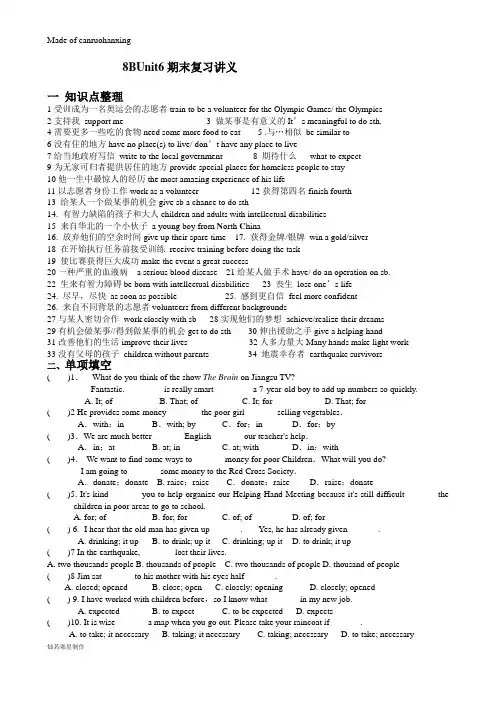
牛津译林版英语八下Unit6Sunshineforall(期末复习讲义)
8BUnit6期末复习讲义一知识点整理1受训成为一名奥运会的志愿者train to be a volunteer for the Olympic Games/ the Olympics2支持我support me 3 做某事是有意义的It’s meaningful to do sth.4需要更多一些吃的食物need some more food to eat 5 .与…相似be similar to6没有住的地方have no place(s) to live/ don’t have any place to live7给当地政府写信write to the local government 8 期待什么what to expect9为无家可归者提供居住的地方provide special places for homeless people to stay10他一生中最惊人的经历the most amazing experience of his life11以志愿者身份工作work as a volunteer 12获得第四名finish fourth13 给某人一个做某事的机会give sb a chance to do sth14. 有智力缺陷的孩子和大人children and adults with intellectual disabilities15 来自华北的一个小伙子a young boy from N orth C hina16. 放弃他们的空余时间give up their spare time 17. 获得金牌/银牌win a gold/silver18 在开始执行任务前接受训练receive training before doing the task19 使比赛获得巨大成功make the event a great success20一种严重的血液病 a serious blood disease 21给某人做手术have/ do an operation on sb.22 生来有智力障碍be born with intellectual disabilities 23 丧生lose one’s life24. 尽早,尽快as soon as possible 25. 感到更自信feel more confident26. 来自不同背景的志愿者volunteers from different backgrounds27与某人密切合作work closely with sb 28实现他们的梦想achieve/realize their dreams29有机会做某事//得到做某事的机会get to do sth 30伸出援助之手give a helping hand31改善他们的生活improve their lives 32人多力量大Many hands make light work33没有父母的孩子children without parents 34 地震幸存者earthquake survivors二、单项填空( )1.---What do you think of the show The Brain on Jiangsu TV?---Fantastic. ________ is really smart ________ a 7-year-old boy to add up numbers so quickly.A. It; ofB. That; ofC. It; forD. That; for( )2 He provides some money _______ the poor girl_______ selling vegetables.A.with;in B.with; by C.for;in D.for;by( )3.We are much better_______ English_______ our teacher's help.A.in;at B. at; in C. at; with D.in;with( )4.-We want to find some ways to_______ money for poor Children.What will you do?-I am going to_______ some money to the Red Cross Society.A.donate;donate B. raise;raise C.donate;raise D.raise;donate( )5. It's kind_______ you to help organize our Helping Hand Meeting because it's still difficult_______ the children in poor areas to go to school.A. for; ofB. for; forC. of; ofD. of; for( ) 6. -I hear that the old man has given up_______. -Yes, he has already given_______.A. drinking; it upB. to drink; up itC. drinking; up itD. to drink; it up( )7 In the earthquake, _______ lost their lives.A. two thousands peopleB. thousands of peopleC. two thousands of peopleD. thousand of people( )8 Jim sat_______ to his mother with his eyes half_______.A. closed; openedB. close; openC. closely; openingD. closely; opened( ) 9. I have worked with children before,so I know what_______ in my new job.A. expectedB. to expectC. to be expectedD. expects( )10. It is wise_______ a map when you go out. Please take your raincoat if_______.A. to take; it necessaryB. taking; it necessaryC. taking; necessaryD. to take; necessary( )11. .I think the party was a big __________and we did it _________.A.success; successfulB.successful; successC.success; successfullyD.successful; successful( )12. Do you feel like_______ to a film or would you like_______ at home?A. to go; stayB. going; stayingC. going; stayD. going; to stay( )13. _______ we have done! We feel great as we can do something to help children in need.A.What a meaningful workB.What a meaningful jobC.How meaningful jobD. How meaningful work( )14. Simon's idea is_______ Sandy's. They don't agree with each other.A. different fromB. similar toC. as good asD. the same as( )15. -I will travel to Shanghai this summer holiday. -_______.A. It's very nice of you.B. Will you?C. Have a good time.D. Good luck.三、首字母填空Have you ever heard of a famous charity called Operation Smile? We h 1 we can help you understand how we are trying to help children all over the world.Operation Smile was started by a d 2 and his wife. In 1982, together with some volunteers, they w 3 to Philippines to help children who had holes in their lips or inside their mouths. It was very difficult for them to e4 and drink. These volunteers worked very hard. But they worried that they could not carry on with the work b5 they hadn’t enough money. Then they decided to s6 a charity so that they could help these needy children. They called it Operation Smile.Operation Smile work in more t 7 twenty developing countries and has cured over 10,000 children who have problems with their mouths. Operation Smile has won m 8 prizes for its work and in 1999 they even started a special event called “The World Journey of Hope”. 5,000 children in 18 countries are cured d 9 the event.So show your kindness to the needy children now. You can s 10 your donation to Operation Smile at local banks.Many thanks from the children who can smile now will come to you.1. 2. 3. 4. 5.6 7. 8. 9. 10.四任务型阅读There are some very good things about open education. This way of teaching allows the students to develop their interests in many subjects. Open education asks students to be responsible(负责的) for their own education. The open classroom may help them to enjoy learning. Some students will be happier in an open education school. They will not have to worry about grades or rules.But many students may not do well in an open classroom. For some students, if there are too few rules, they will do little in school. They will not make good use of open education. Because open education is so different from traditional(传统的) education, these students may have a problem of getting used to making so many choices. It is important for many students to have some rules in the classroom. A few rules will help them. The last point about open education is that some traditional teachers show little interest in it. So it may not get support from those teachers.You now know what open education is. Some of its good points and bad points have been explained. You may have your own opinions about open education. The writer thinks that open education is only a good idea. It may not work very well in a real class or school. The writer believes that most students, but of course not all students, want and need to have some rules. They must study some subjects. Many students are pleased to find the subjects that they have to study interesting. They will not study those subjects if they do not have to.Open EducationMeaning Open education is a way of teaching without many rules. Students are allowed to learn subjects they are 1 in.Good points ●Open education makes students realize they are learning for 2 ,not for others.●In open classrooms, many students don’t need to be 3 aboutgrades or rules.●Some students feel 4 in open classrooms than in traditionalclassrooms.5 points ●Many students may not do as6 in open classrooms as intraditional classrooms.●It’s 7 for students to make many choices so they can’t makegood use of open education.●Some teachers do not 8 such a way of teaching.The writer’s9 about open education ●Open education is just a good idea, but it may not work well in a realclass or school.●Students will not study some subjects if they aren’t 10 to.五词汇1. The two stories happened in different_____ _(背景)of times.2. The government has provided some covers for the___ _(无家可归的).3. Which is the most important cultural_____ _____(大事)of the year?4The Special Olympic World Games make the disabled feel more_____ ___(自信).5. Listening to light music can help our mind____ ______(放松).6.Why not help people in need in our_____ _____(日常的)life?7 Will you_____ _____(支持)those volunteers, Amy?8.-Do you have any trouble_____ _____ out the Maths problem? -Of course not.9.-How long have you_______ ill in hospital? -For about half a month.10. Wilson is going to travel to the________ __(西南方)of Y unnan next month.11. I have no other wish __________(除了) to pass the examination.12. We shouldn't look down on those people with mental_______ ____(缺陷).13. Dr. Wang is doing an important_________ __(手术).14. -The 2-year-old child was the only________ ___ in the accident.-Oh, my god.15 Tom had __________ in winning the competition.(自信)16. The boy ________________(实现) his goal by working hard. How happy he was!17. Special (运动员) can take part in the Special Olympics World Games.18 Did Mary finish ______________(three) in the race?19 Williams hopes to become a friends of_________(he)because they share the same interest.20 The day before yesterday, we had a_________(discuss) about our project.六动词填空1. Can you tell me how often the Olympic Games___ ____ (take) place?2. The boy feels very worried because he__ _____ (not hear) from his parents yet.3. -Who_____ __ (organize) yesterday's charity show? It was great. -Tom did.4. The government is trying to stop the pollution____ ___ (improve) people's lives.5. There____ ___ (be) great changes in our hometown in the past three years.6. Red lanterns are often __________(hang) along the streets before Spring Festival.7.______ _ (not leave) home without saying anything to your parents.8. Mr. Wu has lived in England for a year, so he is used to ___________ (drive) on the left now.9. When the telephone rang, Tom with his friends_____ __ (chat) on the Internet.10. It__ _____ (not rain) this afternoon, is it?11. The girl won’t go to bed till she ______ _______(finish) her homework every night.12.It’s not a good habit to leave the tap _____________ (run).13 Next week a speech _____________________ (give) by an artist in our school.14He spent as much time as he could ____ __________ (read) English.He spent as much time as he could _______________ (improve) his English.15 Our parents expect all of us _______ ______ (work) hard and get good results.七句子翻译1. 他们没有足够的钱来做这样一个手术。
八年级英语下册 Unit 6 Sunshine for all单词讲义 (新版)牛津版
Unit 6 Sunshine for all单词讲义1. train vi.& vt.接受训练,培训,训练 (trainer) train to be a volunteer for…接受训练成为…的志愿者train to d o sth train to be…=train as…train sb to do sthn. 火车take a train to…= go to … by train2. the Olympic Games(= the Olympics)奥林匹克运动会Eg: The Olympic Games take place every four years.奥林匹克运动会每四年举行一次。
3. supp ort vt.支持 support sbn. 支持 give sb some support 给某人一些支持 with one’s support= with the support of sbprovide support for 为…提供支持4. meaningful adj.有意义的反:meaningless(adj.)无意义的be meaningful to sb/ It’s meaningful to do sthmean (v.) meaning (n .) what does it mean?= what’s the meaning of…5. blind adj. 瞎的 blindness (n.) 失明 be blind in the left eye 左眼瞎 the blind 盲人们(复数)Eg: We should help the blind person cross the street.6. deaf adj. 聋的 deafness (n.) 耳聋Eg: Most deaf people cannot speak.大多数聋人不能说话。
7. disabled adj. 残疾的able (adj.) 有能力的 disable (adj.) 没有能力的 ability (n.) 能力disability (n.)缺陷,障碍(可数)8. elderly adj. 年老的 an elder ly person一位老人the elderly=the old=the old people= the aged老人们区别elder、older、elderly: elder brother= older brother 但 elder不可与than连用,只能修饰名词作定语elderly是委婉用语,意为上了年纪的 the elderly泛指老人9. homeless adj. 无家可归的 homelessness (n.) 无家可归名词+后缀less表示否定的形容词 loveless 无爱的 endless 无止境的 colorless 无色的 hopeless 无望的thoughtless不经思考的 useless无用的 voiceless 无声的 helpless无助的10. volunteer vi & vt. 志愿做,义务做 volunteer to do sth=volunteer for sth志愿做某事n.志愿者 a volunteer for the Olympic Games一名奥运会的志愿者11. expect vi & vt.期待,指望;预料 expect sb to do sth 期待某人做某事just as you expected 正如你所期盼的区别hope:主要用来表示主观上的愿望,对其实现抱有信心hope to do / hope that 从句wish:表示某种未实现或不能实现的愿望wish to do/ wish sb to do/ wish that 从句(不可实现的愿望用虚拟语气)expect:侧重于相信或认为有实现可能的愿望 expect sth/ expect to do sth / expect sb to do stheg: I never expected his help. 我从未期望过他的帮忙。
八年级英语下册《Unit 6 Sunshine for all》知识梳理
《Unit 6 Sunshine for all》Welcome to the unit1. train为动词,意为“接受训练,培训,训练”,其名词形式为training,意为“训练”。
e.g. Your little dog is so clever. How have you trained it?The company can train 5000 employees at once.2. volunteer为名词,意为“志愿者”。
做动词意为“志愿做,义务做”,volunteer to do sth意为“志愿做某事”。
e.g. The volunteers for community service are doing a good job.They volunteered to repair the house for the old lady.3. support为动词,意为“支持”,也可作名词,表示“支持,支援”,另一名词形式为supporter , 意为“支持者”。
e.g. Our parents are very tired because they have to support our family.This event got the support from local businesses.I am a supporter of the local football team.4. meaningful为形容词,意为“有意义的”,其动词形式为mean,名词形式为meaning,反义词为meaningless。
常见短语为be meaningful to sb,意为“对某人来说有意义”。
e.g. Many things in my life are meaningful to me.Helping others is very meaningful.5. homeless为形容词,意为“无家可归的”,其名词形式为home。
牛津译林版八年级英语下册Unit6 Sunshine for all知识点
【知识建构】We use “ It’s + ____________________________”to express what we think about something. We use “ It’s + ____________________________”to specify who we are talking about.We use “ It’s + ____________________________”to express what we think of someone’s actions.1.Can you make sentences with “It is+形容词+to infinitive.” ?2.Can you make sentences with “It is+形容词+for …+ to infinitive.” ?3.Can you make sentences with “It is+形容词+of …+ to infinitive.”?【典例精讲】1. It’s kind __________you to give me a hand whenever I am in trouble.A. ofB. forC. toD. with本题考查两个句式的比较:It’s +adj. + for sb. to do sth 和It’s + adj. + of sb. to do sth。
重点关注for 和of的区别。
当句式中的adj修饰人的品格,个性时,常选用of;当句式中的adj. 修饰后面的不定式时,选用for。
句意:无论我何时有困难,你都给我帮助,你真好。
kind是修饰人,故选A。
2. It was really helpful___________him to take the cat to the animal centre_______ a rainy night.A. of; onB. of; atC. for; onD. for; at同上,helpful修饰人,排除C、D。
译林牛津英语 八年级下册 8b unit 6 sunshine for all 知识点重难点归纳
8B Unit6 Sunshine for all(Reading知识点)1. I’m training to be a volunteer for the Olympic Games. 我在训练成为一名奥林匹克运动会的志愿者。
train此处用作动词,意为“培训,接受训练”。
He is training to be a doctor.We should train students to form good habits. 我们应该训练学生养成好的习惯。
【拓展】①train还可用作可数名词,意为“火车”。
I’ll go there by train. 我会坐火车去那儿。
②training是不可数名词,意为“训练”。
You need more training. 你需要更多的训练。
2. Will you support me, Eddie? 你会支持我吗,艾迪??support此处用作及物动词,意为“支持”。
We support you, Lily. 莉莉,我们支持你。
I don’t support his opinion. 我不支持他的看法。
【拓展】①support还可用作不可数名词,意为“支持,拥护”。
He needs our support. 他需要我们的支持。
②supporter 可数名词,意为“支持者,拥护者”。
He has many supporters. 他有很多拥护者。
3. It’s meaningful to do something for the Olympics. 为奥运会做事情是很有意义的。
?meaningful 形容词,意为“有意义的”,其反义词为meaningless,意为“无意义的”,在句中可作表语或定语。
What he did is meaningful. 他所做的很有意义。
He gave me a meaningful look. 他意味深长地看了我一眼。
4. How can I help then? 那么我怎么才能帮助(你)?辨析:can与be able to5. I need some more food to eat at work. 我工作时需要吃更多的食物。