
托福听力TPO21原文 Lecture 2
托福听力TPO21原文Lecture 2下面就让小编来为大家介绍一下托福听力TPO21原文中Lecture 2的文本内容吧,大家要好好把握,这些都是非常有价值的材料,同时,大家也可以登录前程百利论坛进行TPO练习辅导,希望能够给准备托福听力的同学带来帮助。
TPO21 Lecture 2 Computer ScienceProfessor:We’ve been talking about the software development cycle, and today I’d like to move on to the next stage of that cycle-testing, and why finding bugs during testing is actually a great thing. Eh...eh... the quality of the software product often relies heavily on how well it’s been tested. Liz?Student:Um... just a quick thing. Bugs is the word for problems in the program code, right?Professor:Yeah, in code or in a computer itself. There is a bit of a story behind that term. Um... back in the 1940s, when the computer industry was just starting, a group of computer scientists was working late one night, and there was a problem in one of the computers’ circuits1. When they examined it, they found a five-centimeter long moth caught in there. Once they debugged the computer, it worked just fine. And ever since then, all kinds of computer problems have been known as bugs. Anyway, you want to find bugs while the software is still in the development and testing phases. Finding them when the software product has already been put on the market can be quite embarrassing. Generally speaking, every software development project has a group of testers and a group of developers. Jack?Student:And they are different people?Professor:They are generally completely different group of people. My personal opinion is that they have to be different groups of people because developers often have a bias for their own work, and it blinds them to certain problems that might be obvious to somebody else. So it is always good to have a different set of eyes to go in there and make sure that everything is tested properly.Ok, now, here’s the key. Developers and testers have different mentalities. The mentality of the software developer is construtive, creative, they are spending long hours working together to create and build something new.A software tester, on the other hand, their entire goal is to look at this product and find problems with it, to improve it. Now, this difference between the testers and the developers can lead to an environment where there is a bit of friction. And that friction sometimes makes it difficult for the two teams to worktogether.There are two projects that I worked on a couple of years ago. One, which I’ll call Project Split, well, the testin g and development teams did not work well together. And the other, I’ll call Project Unity, during which both teams worked very well together. Now, during Project Split, we had defect meetings where the developers and the testers met together, eh... eh... to discuss various problems and how they should be fixed. And you could sense the conflict just by walking into the room. Literally, the testers and the developers sat on opposite sides on the table. Um... and ... and the developers were very defensive about the feedback.Student:Well, if bugs are being pointed out they wouldn’t be too happy since its their work.Professor:Exactly. Now, ‘cause the two teams weren’t working well together, the fixes were coming very very slowly. And you know, a lot of times when you fix bugs you introduce new bugs, or you discover bugs and other areas that only come to light because something has been changed, so fixing all those new additional bugs was also being delayed. Um... the test process went on much longer than expected and we ended up having to put the product on the market with known bugs in it, which was obviously not ideal.Student:Ok, and what about Project Unity? How was it different?Professor:Um... this was different because two teams worked closely together during the defect meetings, instead of put up walls. Um... we didn’t even talked about, you know, who should fix this, who is at fault2. We all acknowledge what needed to be fixed. So if we had ten bugs, we said, ‘Hey, you know what? Let’s do this on e first ‘cause this would expose another whole bunch of defects that we haven’t even seen yet.’ So we were being proactive3 and effective. And because we were so much more effective with our time, we were actually able to do more than just fix the bugs, we even put in some improvements that we hadn’t planned.教授:之前我们一直在讲软件开发周期,今天我们进入下一阶段的讨论-----软件测试,以及为何在测试过程中找到bug是件好事。
呃,软件产品的质量往往很大程度在取决于它的测试情况。
利兹,有什么问题吗?学生:就一个小小的问题,bug是指编程码存在的问题是吗?教授:是的,编程码或者计算机本身存在的问题都叫bug. 其实这个术语的背后还有一个小故事。
TPO21听力答案的解析
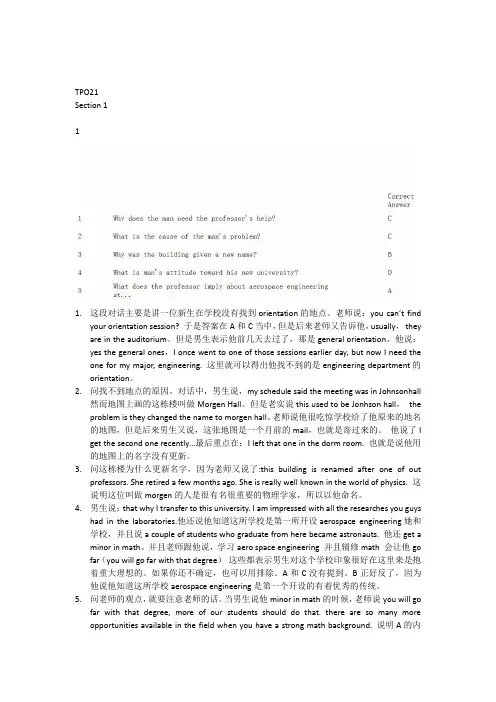
TPO21Section 111.这段对话主要是讲一位新生在学校没有找到orientation的地点。
老师说:you can’t findyour orientation session? 于是答案在A和C当中,但是后来老师又告诉他,usually,they are in the auditorium。
但是男生表示他前几天去过了,那是general orientation。
他说:yes the general ones,I once went to one of those sessions earlier day, but now I need the one for my major, engineering. 这里就可以得出他找不到的是engineering department的orientation。
2.问找不到地点的原因。
对话中,男生说,my schedule said the meeting was in Johnsonhall然而地图上画的这栋楼叫做Morgen Hall。
但是老实说this used to be Jonhson hall,the problem is they changed the name to morgen hall。
老师说他很吃惊学校给了他原来的地名的地图,但是后来男生又说,这张地图是一个月前的mail,也就是寄过来的。
他说了I get the second one recently…最后重点在:I left that one in the dorm room. 也就是说他用的地图上的名字没有更新。
3.问这栋楼为什么更新名字,因为老师又说了:this building is renamed after one of outprofessors. She retired a few months ago. She is really well known in the world of physics. 这说明这位叫做morgen的人是很有名很重要的物理学家,所以以他命名。
TPO21综合写作听力阅读范文独立写作范文托福写作机经
TPO21综合写作听力阅读范文独立写作范文托福写作机经TPO21综合写作:Reading:Genetic modifications, a process used to change an organism's genes and hence its characteristics, is now being used to improve trees. Through genetic modification, it is possible to create trees that produce more fruit, grow faster, or withstand adverse conditions. Planning genetically modified trees on a large scale promises to bring a number of benefits.First, genetically modified trees are designed to be hardier than natural trees; that is, they are more likely to survive than their unmodified counterparts. In Hawaii, for example, a new pest-resistant species of payapa tree has been developed in response to ringshot virus infections that have repeatedly damaged the native papaya-tree population. Planning the genetically modified papayas has largely put an end to the ringshot problem. Moreover, genetically modified trees promise to bring a number of economic benefits to those who grow then. Genetically modified trees tend to grow faster, give greater yields of food, fruit, or other products- and be hardier. This allows tree farmers to get faster and greater returns on their farming investment and save on pesticides as well. [hardy: resistant to cold, 耐寒]Finally, the use of genetically modified trees can prevent overexploitation of wild trees. Because of the growing demand for firewood or building timber, many forests around the world are being cut down faster than they can be replaced. Introducing genetically modified trees designed for fast growth and highyield in given geographic conditions would satisfy the demand for wood in many of those areas and save the endangered native trees, which often include unique or rare species.Lecture:Sure, there are some benefits of planting genetically modified trees, but are these trees really as great as they first sound? When you examine the subject closely, here are some serious problems and costs associated with using genetically modified trees.First, genetically modified trees may be resistant to one particular condition, but that does not necessarily ensure their survival. You see, a typical non-modified tree population is genetically diverse. That means that, for most threatening conditions, for climates, insects and other pests, whatever, there will be at least some individual trees or any given species of trees that are resisted. So even if most of one kind of tree are killed, those few resisted ones will survive and ensure the survival of that species of tree. But genetically modified trees are genetically much more uniformed, so if they are exposed to an environmental challenge they have not been designed for, they will all die. So if the climate changes or a new pest invades the area, the genetically modified trees will likely be completely wiped out.Now as the second point, there are hidden costs associated with growing genetically modified trees. You see, the companies that genetically modified the trees tend to charge farmers much more for each seed than unmodified tree seeds would cost. Also, as you've grown the tree, you cannot collect the seeds and plant a new tree for free. By law, you have to pay the company every time you plant.And finally, genetically modified trees might actually cause even more damage to the local wild trees. You see, genetically modified trees are often grown more aggressively than natural trees do. And genetically modified trees are typically planted among natural trees. As a result, the genetically modified trees out compete the native trees for resources: sunlight, soil, nutrients and water, eventually crowding out the natural trees.Integrated writing sample essay:The professor claims that there are serious problems and costs associated with planting genetically modified trees, challenging the view in the reading passage that planting genetically modified trees on a large scale promises to bring tremendous benefits.First, the passage says that genetic modification is a good way to protect the trees against harsh natural conditions or possible infections because they are designed to be hardier. However, the lecturer claims that genetic modification does not ensure their survival because these trees are genetically more unified. So, if their genes are not designed for a particular condition, such as climate change or invasion of new pests, they might be eradicated altogether.Second, the passage says that genetically modified trees tend to grow faster, give more fruits and therefore provide greater financial returns for the growers. However, the lecturer points out that this is not the whole picture, because the seeds of genetically modified trees are more costly and the law requires farmers to pay for the company for every genetically modified tree that is planted.Finally, the passage says that genetic modification is a good solution for the protection of wild trees from overexploitation.But the professor points out that these trees are genetically more aggressive and typically planted among the natural trees. They might out compete the natural trees for natural resources and eventually edge them out.独立写作:For future career success, is the ability to relate well to other people more important than studying hard at school?1P: 咩个人都渴望获得success,但成功需要付出extraordinary efforts,而且还需要an element of luck和一定的社会关系;因为这是一个强调团队合作和cooperation的时代。
托福TPO21听力原文
TPO 21 听力原文Conversation1NarratorListen to a conversation between a student and a professor.Professor Excuse me, can I help you? You look a little lost.Student Yeah, I am. This is my first day on campus, and I don’t know where anything is.Prof essor Can’t find your orientation session?Student Uh-huh. What a way to begin! Lost going to orientationProfessor Well, my guess is in the auditorium, that’s where they usually are.Student You’re right, the general ones. I went to one of those sess ions ealier today. But now I need the one for my major, engineering. My schedule says the meeting room is in ... Johnson Hall? In the engineering department, which should be right here in front of us, according to the map. But this building is called the Morgan Hall.Professor Well, your map reading skills are fine actually. This used to be Johnson Hall, all right. Trouble is they changed the name to Morgan Hall last spring. So they sent you a map with an old name? I am surprised.Student Well, this was actually mailed out month and month ago. I got a second pack in the mail more recently with another one of these maps in it. I guess they must have the updated name. I left that one in my dorm room.Professor Well, things change fast around here. This building was renamed after one of our professors. She retired a few months ago. She is very well-known in the world of physics. Too bad for Johnson, I guess.Student Who is Johnson anyway?Professor Oh, one of the early professors here. Unfortunately, I thinks his ideas are going out of style. Science kept marching forward.Student I’ll say it does. That’s why I transferred to this university. I was really impressed with all the research equipment you guys have at the laboratories. You arereally on the forefront.Professor Um... so do you know what kind of engineering you want to specialize in?Student Yeah, aerospace engineering.Professor Well, the aerospace engineering department here is excellent! Eh... do you know that this university was the first one in the country to offer a program in aerospace engineering?Student Yeah, I know. And a couple of students who graduated from here became astronauts and orbited the Earth.Professor Right. The department has many prominent alumni. Well, you might end up taking some of your advanced math course with me. I get a lot of students from the engineering department because I teach the required applied mathematics courses.Student Oh, cool. Actually, I want to get a minor in math.Professor Excellent. Hmm... A major in aerospace engineering with a minor in math, you’ll go far with that degree. More of our students should do that. There are so many more opportunities available in the field when you have a strong math background.Student I’m glad to hea r you say that.TPO 21 Lecture 1 Astronomy(Geocentric&Heliocentric theory)Narrator Listen to part of a lecture in a history of science class.Aristarchus-Heliocentric TheoryProfessor Ok, we have been talking about how throughout history, it was often difficult for people to give up ideas which have long been taken for granted as scientific truth, even if those ideas were false. In Astronomy, for example, the distinction between the solar system and the universe wasn’t clear until modern times. The ancient Greeks believed that what we called the solar system was in fact the entire universe, and that the universe was geocentric. Geocentric meansEarth-centered, so the geocentric view holds that the Sun, the planets, and the stars, all revolve around the Earth, which is stationary. Of course, we now know that the planets, including Earth, revolve around the Sun, and that the solar system is only a tiny part of the universe.So, why did the ancient Greeks believe that the Earth was the center of the universe? Well, it made sense to them. Observations of the sky make it appear as if the Sun, the moon, and the stars all revolve around the Earth everyday, while the Earth itself stayed in one place. And this view is also supported by their philosophical and religious beliefs about the origin and structure of the universe. It was presented in the works of well-known Greek philosophers as early as the fourth century B.C.E., and the geocentric theory continue to prevail in Western thought for almost 2,000 years, until the 17th century.Now, what’s especially interesting is that when astronomical observations were made that seemed to be inconsistent with the geocentric view, the ancient Greeks did not really consider alternative theories. It was so intuitive, so sensible that the Earth was the center of the universe that astronomers found ways to explain those seemingly inconsistent phenomena within the geocentric view.For example, Greek astronomers made excellent, very accurate observations of the movements of the planets, but the observations revealed a bit of a problem. The geocentric theory said, that the planets would move around the Earth in one direction. However, astronomers noticed that at times, several planets seem to stop moving in one direction and start moving backward in their orbits around the Earth, and they came up with a theory that these planets themselves moved in smaller circles called epicycles as they travelled around the Earth. Here’s a picture of what they imagined. You see how this epicycle theory could account for the seemingly backward motion of the planet. Of course, today we know that this appearance of backward motion is caused by the fact that Earth, as well as other planets, all move in their own orbits around the Sun, and the relative movements of the planets with respect to each other can get quite complex.However, there were a few astronomers in Greece and other places who didn’t agree with the geocentric view, for example, a Greek astronomer who lived in the third century B.C.E. He proposed the theory that our planetary system might be heliocentric, his name was Aristarchus. Heliocentric means Sun-centered, that the Earth revolves around the Sun. Aristarchus recognized from his calculations that the Sun was much larger than the Earth and other planets. It was probably this discovery that led him to conclude that the universe is heliocentric. I mean, isn’t it more sensible to think that a smaller heavenly body would orbit a larger one, rather than the opposite?However, his proposition was rejected largely based on other scientific beliefs held at the time, which all made sense in a way even if they were incorrect. Let me mention two objections Greeks made to Aristarchus’s theory. First, they believe that everything that moves creates its own wind, so to speak, everyone has this experience when you are running, right? So, they thought that if the Earth itself was moving, there would have to be a constant wind blowing, sweeping them off their feet, and of course there wasn’t. And second, the idea of an Earth that moved didn’t fit in with the ancient Greeks’ understanding of gravity. They thought that gravity was basically a natural tendency of all things to move towards the center of the universe, which was the Earth, or the center of the Earth, so that explains why apples and other falling objects were falling straight down. If the Sun was at the center of the universe, things would fall toward the Sun and away from the Earth, which of course they didn’t. So these were some of the reasons they rejected the heliocentric theory.TPO21 Lecture 2 Computer Science(Software Development)Narrator Listen to part of a lecture in a Computer Science class. The professor is discussing software engineering.Professor We’ve been talking about th e software development cycle, and today I’d like to move on to the next stage of that cycle-testing, and why finding bugs during testing is actually a great thing. Eh...eh... the quality of the software product often relies heavily on how well it’s been te sted. Liz?Student Um... just a quick thing. Bugs is the word for problems in the program code, right?ProfessorYeah, in code or in a computer itself. There is a bit of a story behind that term. Um... back in the 1940s, when the computer industry was just starting, a group of computer scientists was working late one night, and there was a problem in one of the computers’ circuits1. When they examined it, they found a five-centimeter long moth caught in there. Once they debugged the computer, it worked just fine. And ever since then, all kinds of computer problems have been known as bugs.Anyway, you want to find bugs while the software is still in the development and testing phases. Finding them when the software product has already been put on the market can be quite embarrassing. Generally speaking, every software development project has a group of testers and a group of developers. Jack?Student And they are different people?Professor They are generally completely different group of people. My personal opinion is that they have to be different groups of people because developers often have a bias for their own work, and it blinds them to certain problems that might be obvious to somebody else. So it is always good to have a different set of eyes to go in there and make sure that everything is tested properly.Ok, now, here’s the key. Developers and testers have different mentalities. The mentality of the software developer is construtive, creative, they are spending long hours working together to create and build something new. A software tester, on the other hand, their entire goal is to look at this product and find problems with it, to improve it. Now, this difference between the testers and the developers can lead to an environment where there is a bit of friction. And that friction sometimes makes it difficult for the two teams to work together.There are two projects that I worked on a couple of years ago. One, which I’ll call Project Split, well, the testing and development teams did not work well together. And the other, I’ll call Project Unity, during which both teams worked very well together. Now, during Project Split, we had defect meetings where the developers and the testers met together, eh... eh... to discuss various problems and how they should be fixed. And you could sense the conflict just by walking into the room. Literally, the testers and the developers sat on opposite sides on the table. Um... and ... and the developers were very defensive about the feedback.Student Well, if b ugs are being pointed out they wouldn’t be too happy since its their work.Professor Exactly. Now, ‘cause the two teams weren’t working well together, the fixes were coming very very slowly. And you know, a lot of times when you fix bugs you introduce new bugs, or you discover bugs and other areas that only come to light because something has been changed, so fixing all those new additional bugs was also being delayed. Um... the test process went on much longer than expected and we ended up having to put the product on the market with known bugs in it, which was obviously not ideal.Student Ok, and what about Project Unity? How was it different?ProfessorUm... this was different because two teams worked closely together during the defect meetings, inste ad of put up walls. Um... we didn’t even talked about, you know, who should fix this, who is at fault2. We all acknowledge what needed to be fixed. So if we had ten bugs, we said, ‘Hey, you know what? Let’s do this one first ‘cause this would expose anothe r whole bunch of defects that we haven’t even seen yet.’ So we were being proactive3 and effective. And because we were so much more effective with our time, we were actually able to do more than just fix the bugs, we even put in some improvements that we hadn’t planned.TPO21 Conversation 2Narrator Listen to a conversation between a student and her public relations professor.Student Hi, professor Gordin. I really learned a lot from your lecture, the one about analyzing all those different segments of the population. Oh, the official term is audience, right? I never imagine that one company could have over thirty audiences to communicate with.Professor Yeah, a lot of students are taken aback by this, and some public relations consultants don’t figure it out until they’ve worked in the field a while.Student Everyone thinks, public relations, eh, PR is easy, but there’s a lot to it. You really got to know what you are doing.Professor Absolutely. So, Stacy, your email implied that you needed my advice about graduate school?Student No, since my undergraduate degree will be in public relations, I’ve already decided to get a master’s degree in marketing. Sorry, I wasn’t clear. My issue is, I have got two require courses and two electives. I am trying to figure out which elective course is to take. My advisor suggested economics and accounting, but I am not really sure.Professor About?Student Well, I endured accounting and economics in high school and barely stayed awake, they were so ...Profe ssor Ok, Ok. I hear you. Eh... you say you wanted a master’s in marketing, you have got one more semester till graduation. Have you taken any marketing courses yet?Student No, I figured I’ve got the marketing basis already since I have take every PR in communication courses offered here.Professor Well, there’s some overlap between PR and marketing, but there are important differences too. Marketing focuses on selling your product or service, eh, you know, attracting customers through advertising, and also buiding relationships with customers. That’s what a marketing department does. PR is all about, it involves relationships too, that’s why I am saying the two fields overlap. But in PR, you are developing relationships with a wider range of audience.Student Right. Like employees, suppliers, the media. I do understand this in theory, but aren’t you still selling your product, just in a different way?Professor Not necessarily. Ok, do you remember that PR strategy I alluded to the other day? The one o ur university uses, a strategy that doesn’t overlap its marketing strategy?Student You mean how the university invites local residents to attend certain lectures and classes for free?Professor Yeah, this cultivates a sense of good will and helps the university avoid becoming isolated from the larger community. Bringing neighbours into our classrooms is good PR, but it is not marketing since our neighbours aren’t our customers, for the most part.Student That’s why I want to focus on marketing in graduate school. Wouldn’t having expertise in PR and marketing giving me more career options?Professor Yeah, but you’ll also want to enjoy your work. So for you electives, why don’t you take advertising principles and intro to marketing, which I teach. This way, you’ll find out if marketing is something you really want to pursue. Graduate School tuition is expensive, and these courses will give you a good overview of the field before committing yourself.Student I wish my advisor had suggested those courses.Professor Well, I am someone who has worked in both marketing and PR, so I can offer a different perspective than someone who only teaches ...TPO21 Lecture3 Biology(Snake Evolution)Narrator Listen to part of a lecture in a biology class.Professor Probably back in some previous biology course you learned that snakes evolved from lizards, and that the first snakes weren’t venomous and then along came more advanced snakes, the venomous snakes. Ok, venomous snakes are the ones that secrete poisonous substances or venom, like the snakes of the viper family or cobras. Then there is non-venomous snakes like constrictors and pythons. Another family of snakes, the colubrids, don’t really fit neatly into either category though. Colubrids, and you probably learned this too, although they are often classified as venomous snakes, they are actually generally non-venomous. They are classified as venomous snakes because they resemble them, their advanced features more than the othernon-venomous snakes.Now, what if I told you that there is a good chance that most everything I just said is wrong? Well, everything except the part about snakes evolving from lizards. See, the basic theory about snake evolution has been challenged by a recent study that revealed a whole new understanding of evolutionary relationship for reptiles, you know, which reptiles descended from which ancestors. The researchers study the proteins in the venom genes of various species of colubrids. Emm... snake venom is a mixture of proteins, some toxic, poisonous, and some not. By analyzing the DNA, the genetic material of the proteins, the researchers could focus on the toxic genes and use them to trace the evolution of snake venom, and from this, the evolution of snakes.Traditionally, to understanding evolutionary relationships, we looked at various easily observed physical characteristics of animals, their skeleton, the size of their brain, and... and then classify them based on similarities and differences. The problem with this method is that characteristics that appear similar may actually have developed in quite different ways. For example, some venoms are chemical-based, and others are bacteria-based, so they clearly had to have developed along different routes and may not be as closely related as we thought.Now, and not everyone will agree about this. The classification based on DNA seems to be much more reliable. Ok, back to the research. The researchers found that venom evolved before snakes even existed, about a hundred million years before. Now, a couple of venomous lizards were included in this study. And the researchers found some of the same DNA in their venom as in the snakes’ venom. This suggested that the common ancestor of all snakes was actually venomous lizard, which meansth at actually, according to this research, anyway, in terms of the snakes’ ancestry, there is no such thing as a non-venomous snake, not even colubrids. What separates colubrids from other snakes we have been classifying is venomous, is not the lack of venom, but the lack of an effective way to deliver the venom into its prey. In mostvenomous snakes, like vipers and cobras, the venom is used to catch and inmoblize the prey; but in colubrids, venom drips onto the prey only after the prey is in the snake’s mou th. So for colubrids, the venom must serve some other purpose, maybe linked to digesting prey. As the different families of venomous snakes evolved, the teeth moved forward, becoming larger, and the venom becoming stronger, so the evolution of the obvious venomous snakes, like cobras and vipers, is about the evolution of an efficient delivery system, not so much the evolution of the venom itself.So, if there are no truly non-venomous snakes, were the so-called non-venomous snakes, like constrictors and pythons, were they venomous at some point in their evolution? Well, that’s not clear at this point. Constrictors have evolved to kill their prey by crushing, but perhaps they once were venomous, and then at some point their venom-producing apparatus4 wasn’t needed anymore, so it gradually disappeared. There’s one species of snake, the brown tree snake, that uses both constriction and venom, depending on its prey. So, well, it is possible.So, we have these new concepts of snakes’ evolution and a new DNA data base, all these information on the genetic makeup of snake venom. And what we have learned from this has led researchers to believe that venom proteins may have some exciting applications in the field of medical research. You see, venom alters biological functions in the same way certain drugs do, and the big benefit of drugs made from snakes venom would be that they target only certain cells, so maybe that’ll create fewer side effects. Now, it sounds far-fetched5, venom is the basis for human drugs. So far, only one protein has been targeted for study as a potential drug, but who knows, maybe someday.TPO21 Lecture 4 Art History(Alice Neel)Narrator Listen to part of a lecture in an Art History class.ProfessorAll right, so today we are moving on to Alice Neel, N-E-E-L. Um... Alice Neel painted portraits, she was born in Pennsylvania, and she lived from 1900 to 1984. And I guess you might say, she experienced difficulties as an artist. She was in her 70s, before she had her first major solo exhibition. Um, and this is due at least in part to eh... or... because of photography. After photography became regarded as an art form, portrait painting became less prestigious6, less respected as an art form. And, well, art photography kind of took its place, so you can imagine that a portrait artist, would have had a hard time finding acceptance.Eh, but the real reason I want to look at Neel, is that I really find her style ... eh, she had interesting ways of portraying people. She combined some elements ofrea lism. What’s realism, Alison?Student It’s like painting something exactly how it is, so an artist would try to make it as accurate, um... and objective as possible. Painting stuff just how it appears on the surface.Professor Ok, good. So Neel combined realism with, well, actually, with expressionism. And that is? We, we just covered this.Student Um... It’s into emotion, like artists are trying to, well, express themselves through the painting, right?ProfessorYep. The artist is depicting subjective emotions, showing the inner reality as interpreted by the artist rather than the outward form. So the image itself might be distorted or exaggerated in some way. The expression overrides7 objective representation. Ok, so, Alice Neel combined these two styles ... Yes?Student Em... How is that even possible? How can your portray something exactly as it is and at the same time distort it with emotions? I don’t get it.ProfessorAll right, good question. It is actually a good lead-in8 to some of the techniques that Neel used, that she employed to bridge that contradiction. In a minute, I’ll show you some of her portraits, and I’ll want you to notice a few things about them.First, Neel’s use of bold color. All right? You’ll see she uses color to conveyemt ion and feeling, like the subjects’ clothing for instance, it appears brighter than it really is. And the subjects, the people being portrayed, Neel paid special attention to faces. The way she paints the eyes and how the faces are portrayed, these are quite realistic, like the realists’ work. But another thing Neel did was use elongated, sort of stretchy figures.Student But didn’t a lot of expressionist painters do that? So really your are saying that Neel’s techniques were similar to what other artists were doing. What was it that she did, that was like all her own?Professor Ok, well, I think it has to do partly with the way she combined these techniques. So, for example, those realistic faces and eyes, but bright, distorted figures. It is a mix. You’l l see that her portraits do reflect reality, the people that were actually sitting there. Realism was important in the sense that she wanted to show people as they really were, much like a photographer would. But Neel wasn’t satisfied with photo-like realism, she went beyond that. And this is where expressionism comes in.She believed in capturing the whole person, not just what was on the surface, that’s where the expressionists’ distortion is important, in an attempt to reveal the subjects’ character or personality.But Neel’s paintings are distinctive for her time in part because they are portraits. Remember I said that photography and art photography had largely taken the place of portraiture, to the extent that some critics had declared the genre of portraiture to be dead. But Neel felt that painting should reflect reality, a real realist’s stance9 you could say. And to her, individuals, people best reflect the reality of their time, of the age that they lived in, so she painted portraits. And if you look at her work, we are talking in the vicinity of10 three thousand paintings. If your looked at them, it is like this gallery of the whole century, an enomous range of subjects: families, women, children, artists, people in poverty--these paintings really span class, age and gender. It is like she transformed the genre, it is not just formal depictions of presidents and ancestors any more.But keep in mind that she was doing this when abstract art dominated the art scene. Representations of people weren’t fashionable in the art world. And it wasn’t until fairly late in the century that critics recognized the power of what she did.。
托福TPO21综合写作阅读原文+听力原文+满分范文
¡¡¡¡ÎªÁË°ïÖú´ó¼Ò¸ßЧ±¸¿¼Íи££¬Îª´ó¼Ò´øÀ´Íи£TPO21×ÛºÏд×÷ÔĶÁÔ-ÎÄ+ÌýÁ¦Ô-ÎÄ+Âú·Ö·¶ÎÄ£¬Ï£Íû¶Ô´ó¼Ò±¸¿¼ÓÐËù°ïÖú¡£¡¡¡¡Íи£TPO21×ÛºÏд×÷ÔĶÁÔ-ÎÄÎı¾£º¡¡¡¡Genetic modification, a process used to change an organism¡¯s genes and hence its characteristics, is now being used to improve trees through genetic modification. It is possible to create trees that produce more fruit, grow faster, or withstand adverse conditions. Planting genetically modified trees on a large scale promises to bring a number of benefits. First, genetically modified trees are designed to be hardier than nature trees; that is, they are more likely to survive than their unmodified counterparts. In Hawaii, for example, a new pest-resistant species of papaya trees has been developed in response to ring spot virus infections that have repeatedly damaged the native papaya tree population. Planting the genetically modified papayas has largely put an end to the ringspot problem. Moreover, genetically modified trees promise to bring a number of economic benefits to those who grow them. Genetically modified trees tend to grow faster, give greater yields of food, fruit, or other products and be hardier. This allows tree farmer to get faster and greater returns on their farming investment and save on pesticides as well. Finally, the use of genetically modified trees can prevent overexploitation of wild trees. Because of the growing demand for firewood and building timber, many forests around the world are being cut down faster than they can be replaced. Introducing genetically modified trees,designed for fast growth and high yield in given geographic conditions,would satisfy the demand for wood in many of those areas and save the endangered native trees, which often include unique or rare species.¡¡¡¡Íи£TPO21×ÛºÏд×÷ÌýÁ¦Ô-ÎÄÎı¾£º¡¡¡¡Sure, there are some benefits to plant genetically modified trees, but, are these trees as really great as they first sound? When you examine the subject firstly, there are some serious problems and costs associated with genetically modified trees.First, genetically modified trees may be resistant to one particular condition. But that doesn't necessarily ensure their survival. You see, a typical non modified trees' population is genetically diverse. That means that for most threatening conditions, or climate, insects and other pests, whatever, there will be at least some individual trees of any given species of tree that are resistant. So even if most of one kind of trees are killed, those few resistant trees will survive and ensure the survival of that species of tree. But genetically modified trees are genetically much more uniform. So if they're exposed to an environmental challenge they have not been designed for, they all die. So if the climate changes, the genetically modified trees will likely to be completely wiped out.Now as to the second point, they're hidden costs associated with genetically modified trees. You see, the company that genetically modifies the tree can charge tree farmers more for its seeds than un-genetically modified trees would cost. Also, as you've grown the tree, you can't justcollect the seeds and plant the new tree for free. By law, you have to pay the company every time you plant.And finally, genetically modified trees might actually cause even more damage to the local wild trees. You see, genetically modified trees often grow more aggressively than natural trees do. And, genetically modified trees are typically planted among natural trees. As a result, the genetically modified trees outcompete the native trees for resources, sunlight, soil, nutrients, and water, eventually crowding out the natural trees.¡¡¡¡Íи£TPO21×ÛºÏд×÷Âú·Ö·¶ÎÄ1£º¡¡¡¡In the lecture, the professor claims that although they may be some benefit, planting genetic modified trees will bring potential problems and costs. She totally opposes the three statements made in the reading passage. Firstly, the professor indicates that genetic modified trees may resistant, but this cannot guarantee their survival. She points out that in fact the unity of genes within genetic modified plantwill increase their likelihood to wipe out when there is some threatening situation.The professor counters the claim made by the reading passage. Secondly, the professor opposes the reading passage by pointing out there is hidden cost behind modification trees. Though genetic modification trees may provide more products or can save pesticide, their seeds are usually charged at a higher price. In addition, accordingto the law, a farmer has to pay for the seed each time they plant the trees. Thiswill not bring any economic benefit mentioned in the reading passage. Last but not least, the professor opposes the statement that genetic modification trees will prevent overexploit of wild trees. In fact, genetic modification trees tend to grow aggressively and can easily exhaust the resource of normal trees. This will bring disastrous result for the local vegetation.¡¡¡¡Íи£TPO21×ÛºÏд×÷Âú·Ö·¶ÎÄ2£º¡¡¡¡In the reading, the author claim that planting genetically modified trees can bring a number of benefits. However, in the lecture, the professor states that although there might be some benefits, planting genetic modified trees will bring serious problems and costs. Firstly, the professor indicates that genetic modified trees may be resistant to certain conditions as the reading states, but this cannot guarantee their survival. She points out that in fact the uniform genes of these genetically modified trees may lead them to be wiped out when facing unfavorable conditions suchas climate changes, while some of the ordinary trees might be able to survive. Secondly, the professor opposes the reading passage by pointing out there is hidden cost behind modification trees. Though genetic modification trees may have higher yields or need less pesticide, their seeds are usually charged at a higher price.In addition, according to the law, a farmer has to pay for the seed each time they plant the trees. L ast but not least, the professor opposes the statement that genetic modification trees will prevent overexploit of wild trees. In fact, genetic modification trees tend to grow aggressively and can easily exhaust the resource of。
托福听力TPO学习宝典
How
Long time for rivalry to come down
TPO 24lecture 3—Archeology—Mega fauna
Structure
Content
Intro
Agreat variety of beasts
Two difference medium (reflect back)
2.Dolphins
1)Balancingin the head—no good
2)Melon
A.Fat—different purpose—matchthespped
B.Bursa—transferring sound to the melon into sea water
How
Criticism of the theory
1.No shortage of agricultural lands
2.No sudden population increase
TPO 22lecture 2—Astronomy—Faint Young Sun Paradox
Structure
1.Greenhouse gas effect
1)CO2 much higher than today but not enough to dothejob
2)Ammonia destroyed by the ultra-violet
2.Bright Young Sun
1)Mass loss—not enough to warm the earth
Natural movement from children
托福听力TPO21原文 Lecture2
托福听力TPO21原文Lecture2下面就让小编来为大家介绍一下托福听力TPO21原文中Lecture2的文本内容吧,大家要好好把握,这些都是非常有价值的材料,同时,大家也可以登录前程百利论坛进行TPO练习辅导,希望能够给准备托福听力的同学带来帮助。
TPO21Lecture2Computer ScienceProfessor:We’ve been talking about the software development cycle,and today I’d like to move on to the next stage of that cycle-testing,and why finding bugs during testing is actually a great thing.Eh...eh... the quality of the software product often relies heavily on how well it’s been tested.Liz?Student:Um...just a quick thing.Bugs is the word for problems in the program code,right?Professor:Yeah,in code or in a computer itself.There is a bit of a story behind that term.Um...back in the1940s,when the computer industry was just starting,a group of computer scientists was working late one night,and there was a problem in one of the computers’circuits1.When they examined it,they found a five-centimeter long moth caught in there.Once they debugged the computer,it worked just fine.And ever since then,all kinds of computer problems have been known as bugs.Anyway,you want to find bugs while the software is still in the development and testing phases.Finding them when the software product has already been put on the market can be quite embarrassing.Generally speaking,every software development project has a group of testers and a group of developers.Jack?Student:And they are different people?Professor:They are generally completely different group of people.My personal opinion is that they have to be different groups of people because developers often have a bias for their own work,and it blinds them to certain problems that might be obvious to somebody else.So it is always good to have a different set of eyes to go in there and make sure that everything is tested properly.Ok,now,here’s the key. Developers and testers have different mentalities.The mentality of the software developer is construtive, creative,they are spending long hours working together to create and build something new.A software tester,on the other hand,their entire goal is to look at this product and find problems with it,to improve it. Now,this difference between the testers and the developers can lead to an environment where there is a bit of friction.And that friction sometimes makes it difficult for the two teams to work together.There are two projects that I worked on a couple of years ago.One,which I’ll call Project Split,well,the testing and development teams did not work well together.And the other,I’ll call Project Unity,during which bothteams worked very well together.Now,during Project Split,we had defect meetings where the developers and the testers met together,eh...eh...to discuss various problems and how they should be fixed.And you could sense the conflict just by walking into the room.Literally,the testers and the developers sat on opposite sides on the table.Um...and...and the developers were very defensive about the feedback.Student:Well,if bugs are being pointed out they wouldn’t be too happy since its their work.Professor:Exactly.Now,‘cause the two teams weren’t working well together,the fixes were coming very very slowly.And you know,a lot of times when you fix bugs you introduce new bugs,or you discover bugs and other areas that only come to light because something has been changed,so fixing all those new additional bugs was also being delayed.Um...the test process went on much longer than expected and we ended up having to put the product on the market with known bugs in it,which was obviously not ideal.Student:Ok,and what about Project Unity?How was it different?Professor:Um...this was different because two teams worked closely together during the defect meetings,instead of put up walls.Um...we didn’t even talked about,you know,who should fix this,who is at fault2.We all acknowledge what needed to be fixed.So if we had ten bugs,we said,‘Hey,you know what?Let’s do this one first‘cause this would expose another whole bunch of defects that we haven’t even seen yet.’So we were being proactive3and effective.And because we were so much more effective with our time,we were actually able to do more than just fix the bugs,we even put in some improvements that we hadn’t planned.教授:之前我们一直在讲软件开发周期,今天我们进入下一阶段的讨论-----软件测试,以及为何在测试过程中找到bug是件好事。
综合写作tpo21听力原文
综合写作tpo21听力原文Lecture TranscriptAlright, today we're going to be talking about customer satisfaction and loyalty. Customer satisfaction is obviously very important for businesses. It is what drives repeat purchases, positive word-of-mouth, and ultimately, customer loyalty. In fact, numerous studies have shown that there is a strong link between customer satisfaction and loyalty. Satisfied customers will not only continue to buy from a company, but they will also recommend it to others. This is why many businesses use customer satisfaction surveys to gauge how happy their customers are.So, let's look at some of the key factors that drive customer satisfaction. The first and most obvious one is product quality. Customers want to be sure that they are getting a high-quality product that meets their needs. If they are satisfied with the product, they are more likely to be satisfied with the company as a whole. This is why companies put so much effort into ensuring that their products are of the highest quality.Another factor that contributes to customer satisfaction is customer service. Customers want to feel valued and taken care of. They want their inquiries and complaints to be addressed promptly and efficiently. If a company provides excellent customer service, chances are its customers will be satisfied and loyal. On the other hand, if a company has poor customer service, customers are likely to be dissatisfied and may switch to a competitor.The third factor we're going to discuss is price. Now, you might think that price is the most important factor when it comes to customer satisfaction, but that's not necessarily the case. While it is true that customers want value fortheir money, they are often willing to pay a little extra for a better product or service. So, price is important, but it's not everything.Finally, we have convenience. Nowadays, customers have a wide range of choices when it comes to where and how to shop. They want convenience and ease of use. If a company makes it easy for customers to find and purchase their products or services, they are more likely to be satisfied. Convenience includes things like user-friendly websites, convenient store locations, and efficient delivery options.In conclusion, customer satisfaction is crucial for businesses as it leads to repeat purchases, positive word-of-mouth, and customer loyalty. Product quality, customer service, price, and convenience are all important factorsthat contribute to customer satisfaction. Companies that focus on these factors are likely to have satisfied and loyal customers.。
托福TPO1-30听力中Lecture部分的每个Lecture文章主旨大意和中心思想
childhood amnesia,rate of forgetting
中 parenting behaviors of birds
中
different types of residential architectures in the United States
中
the state of Florida,farmers moved south,great citric industry in Florida,the impact of landscapes on temperature
How you can successfully call attention to the service or
product you want to sell
DNA,chromosomes
MBWA--managing by wandering around
难 Opera,the golden age in French literature
Animal communication systems,human language
How whales became ocean dwellers
中 Where american food ingredients originally come from
nutrient cycle,the carbon cycle,the Phosphorus cycle
Lec 4 Art history
Lec 1 Art history
Lec 2 Environmental Science Lec 3 History Lec 4 Biology Lec 1 Astronomy Lec 2 Art history Lec 3 European history Lec 4 Biology
2018年3月24日托福听力真题回忆及解析
2018年3月24日托福听力真题回忆及解析相信大家都很想知道2018年3月24日托福听力考了哪些内容吧,下面小编给大家带来2018年3月24日托福听力真题回忆及解析,希望大家喜欢。
2018年3月24日托福听力真题回忆及解析(精准)Conversation 1话题分类:学校社团(部分论文讨论)场景内容回忆:女生找教授询问关于太阳系以外的星系,并想以此为题目作为演讲的题目,老师表示认同。
接下来学生表示自己希望可以申请创立一个新的社团,并询问了创立社团的相关问题,老师进行了解答,并在学生表示有困惑的时候鼓励学生创立社团对学生帮助很大,并且讨论了高空云层对下方云层会产生影响。
学生说很多因素很困难去探测或者控制,甚至会对一些调查产生影响,教授说这些都是很好的能促进学生们学习的部分。
参考听力:TPO 16 Conversation 1Conversation 2话题分类:论文作业场景内容回忆:女生和Creative Writing 教授的对话。
教授留的作业是让大家写memoir回忆录。
女生说她的人生回忆都是很可怕的事情,能不能写成关于其他人的人物传记。
教授说他让大家写回忆录的目的主要是让大家体验不同的写作风格,并且相信女生能写好。
之后澄清了memoir和autobiography之间的不同,并举例说明。
女生听明白之后,就清楚自己的memoir怎么写了。
参考听力:TPO 34 Conversation 2Lecture 1话题分类:艺术历史(涉及考古)内容回忆:讲座主题主要围绕在1800年左右的平版印刷的话题。
两个艺术家创新lithograph,用于报纸业,反映西部地区生活,也反映理想化的乡村生活。
这个东西,在当时价格平价,但是现在放在展馆里,价值成千上万。
教授说现在的考古学界对pottery一般是用单一的分类方法,但是她认为这样不全面,比如咱们班这两个同学来自不同的城市,看起来没有共同点,但是如果从别的角度会发现他们都爱滑雪,所以她认为分类时应该考虑很多因素,说了4~5个,主要介绍了shape。
托福听力真题
托福考试(TOEFL)/真题题库2015年11月21日托福听力真题Conversation 1 讲一个女生在杂志上看到一个关于iceberg的文章,觉得很有意思,就来问professor,想用这个做project,professor表示赞成鼓励,后来又讲了一个air beam,这个东西的特点和它的名字有关,最后professor询问女生去不去某个活动,女生表示不太想去。
Lecture 1 讲的是玛雅毁灭的原因,有一种说法是干旱。
气候学家说发现了一种G开头是物质(TPO里一个cave 里面提过这种物质)。
在玛雅一个城市附近的lake里,说明气候很干旱。
后来又有研究发现,说是一个城市并不是因为干旱而毁灭的,具体原因忘了。
后来说研究了很多wetland anima,发现大多数都有数量下降。
最后说因为玛雅人砍伐树林过度产生了很严重的后果。
Lecture 2 讲的是很难确定一些物种是不是endangered。
一种生物eel,它在幼虫阶段时在大西洋某个S开头的地方,然后随着洋流到处漂,最后快死的时候又会回到S地产卵,再死去。
很多人觉得eel不应该是endangered,因为它能随着洋流去很多地方,能适应很多环境。
然后又说它是一种C开头的种类,这个种类的生物都是在salt water里出生,生活在fresh water,并且回到salt water产卵。
也有人说,因为不同地方发现的eel数量没法估算整体,所以也没有人知道eel的大概数量。
Conversation 2一个男生在图书馆用电脑遇到些问题,管理员说帮忙查看是不是系统问题,男生说应该不是,只是偶尔会遇到问题,其他都是挺好的,特别是新上的在线图书馆很useful。
然后男生问能否在这儿工作。
管理员说确实在招人,要求是graduate并且熟悉电脑,男生是大三但是电脑很好,整个group还去公司实习过,然后开始说自己团队的东西的优点。
最后管理员说,系统是新安装的,就算有问题也应该很快会修复,并且建议男生就工作问题去咨询另一个人。