
2015年12月英语六级听力原文及答案
2015年12月英语六级听力原文及答案:第一套短文1&2(沪江网校版)
评论:1 划词:关闭划词收藏
Passage 1
Changing technology and markets have stimulated the team approach to management. Inflation, resource scarcity, reduced personnel levels and budget cuts have all underscored the need for better coordination in organizations. Team management provides for this coordination. Team management calls for new skills if personnel potential is to be fully realized. Although a team maybe composed of knowledgeable people, they must learn new ways of relating and working together to solve cross-functional problems.
When teams consist of experienced employees from hierarchical organizations, who had been conditioned to traditional organizational culture, cooperation may not occur naturally. It may need to be created.
Furthermore, the issue is not just how the team can function more effectively, but how it integrates with the overall organization or society it supposedly serves.
A group of individuals is not automatically a team. Therefore, teambuilding may b e necessary in order to improve the group’s performance.
Casey, an expert in this filed, suggests that the cooperation process within teams, must be organized, promoted and managed. He believes that team cooperation results when members go beyond their individual capabilities, beyond what each is used to being and doing. Together, the team may then produce something new, unique, and superior to that of any one member. For this to happen, he suggests that the multicultural managers exhibit understandings of their own and others’ cultural influences and limitations. They should also cultivate such skills as toleration of ambiguity, persistence and patience, as well as assertiveness.
If a team manager exemplifies such qualities, then the team as a whole would be better able to realize their potential and achieve their objectives.
问题+答案:
16. What should team members do to fully realize their potential?
B) Follow closely the fast development of technology.
17. What needs to be considered for effective team management?
B) What type of personnel the team should be composed of.
18. What conclusion can we draw from what Casey says?
D) A team manager should develop a certain set skills.
Passage 2
In early 1994, when Marc Andreessen was just 23 years old, he arrived in Silicon Valley with an idea that would change the world. As a student at the University of Illinois, he and his friends had developed a program called Mosaic, which allowed people to share information on the worldwide web. Before Mosaic, the web had been used mainly by scientists and other technical people, who were happy just to send and receive text. But web Mosaic, Andreessen and his friends, had developed a program, which could send images over the web as well.
Mosaic was an overnight success. It wa s put on the university’s network at the beginning of 1993, and by the end of the year, it had over a million users. Soon after, Andreessen went to seek his fortune in Silicon Valley. Once he got there, he started to have meetings with the man called Jim C lark, who was one of the valley’s most famous entrepreneurs.
In 1994, nobody was making any real money from the Internet, which was still very slow and hard to use. But Andreessen had seen an opportunity that would make him and Clark rich within 2 years. He suggested, they should create a new computer
program that would do the same job as Mosaic, but would be much easier to use. Clark listened carefully to Andreessen, whose ideas and enthusiasm impressed him greatly. Eventually, Clark agreed to invest 3 million dollars of his own money in the project and raised an extra 15 million from venture capitalists who are always keen to listen to Clark’s new ideas.
问题+答案:
19. What do we learn about Mosaic?
A) It is a program allowing people to share information on the Web.
20. What did Andreessen do upon arriving Silicon Valley?
B) He met with an entrepreneur named Jim Clark.
21. Why would venture capitalists willing to join in Clark’s investment?
B) They had confidence in his new ideas.。
12月英语六级听力参考答案
12月英语六级听力参考答案2015年12月英语六级听力参考答案大学英语六级考试(又称CET-6,全称为“College English T est-6”)是由国家统一出题的,统一收费,统一组织考试,用来评定应试人英语能力的全国性的考试,每年各举行两次。
下面是店铺收集整理的2015年12月英语六级听力参考答案,希望大家喜欢。
短对话答案1. B. The dressing makes themixed salad very inviting.2. B. He is opening a newconsulting firm.3. B. The man may find thesupplies in the cabinet.4. D. He has to use amagnifying glass to see clearly.5. C. Redecorating heroffice.6. A. Shortage of containerships.7. A. Acolleague.8. C. Hold the banquet at a differentplace.长对话答案ConversationOne9. D. He often goes backhome late for dinner.10. B. To discuss an urgentproblem.11. C. There is a sharpincrease in India's balance of payment deficit.ConversationTwo12. D. They have unrealisticexpectations about the other half.13. A. He is lucky to beable to do what he loves.14. B. It is allglamour.15. A.Amazed.短文答案Passage One16. B. Follow closely the fast development oftechnology.17. B. What type of personnel the team should becomposed of.18. D. A team manager should develop a certainset skills.Passage Two19. A. It is a program allowing people to shareinformation on the Web.20. B. He met with an entrepreneur named JimClark.21. B. They had confidence in his newideas.Passage Three22. A. Word-of-mouthadvertising.23. D. To build up theirreputation.24. D. By using the servicesof large advertising agencies.25. C. Pre-test alternative ads or commercialsin certain regions.短文听写答案26. eternal27. diminishing28. absolute29. succeed30. on a vast scale31. As regards32. used up33. disposing34. modification35. magnitude【第一版】短对话1.W: Wow, what a variety of salads you’ve got on your menu, could yourecommend something special?M: Well, I think you can try this mixed salad. We make the dressingwith fresh berries.Q: what does the man mean?2.W: I was talking to Mary the other day, and she mentioned that your newconsulting firm is doing really well.M: Yes, business paced up much faster than we anticipated. We now haveover 200 clients.Q: What do we learn about the man from the conversation?3.W: Do you know where we keep flash disks and printing paper?M: They should be in the cabinet if there are any. That’s where we keepall of our office supplies.Q: what does the woman mean?4.W: The printing of this dictionary is so small. I can’t read theexplanations at all.M: Let me get my magnify glass. I know I just can’t do without it.Q: What does the man mean?5.W: I’m considering having my office redecorated, the furniture is oldand the paint is chipping.M: I’ll give you my sister-in-law’s number. She just graduated from aninterior designing academy, and will give a free estimate.Q: What is the woman considering?6.W: We have a full load of goods that needs to be delivered.But wecan’t get a container ship anyway.M: That’s always being a problem in this port. The facilities here arenever able to meet our needs.Q: What are the speakers talking about?7.W: Why didn’t Rod get a pay raise?M: The boss just isn’t convinced that his work attitude warranted it.She said she saw him by the coffee machine more often than at his desk.Q: What are the speakers talking about?8.W: The hotel called, saying that because of the scheduling there, theywon’t be are able to cate r for our banquet.M: I know an Indian restaurant on the high street that offers a specialdiner for groups. The food is excellent, and the room is large enough toaccommodate us.Q: What does the man suggest they do?长对话Conversation 1M: Hello Jane.W: Hello Paul.M: Please coming. I’m just getting ready to go home. Susan is expectingme for dinner. I wanted to be on time for a change.W: Look, I’m terribly sorry to drop in this time on Friday, Paul, butit is rather important.M: That’s OK. What’s the proble m?W: Well, Paul, I won’t keep you long. You see there is a problem withthe exchange rates. The Indian Rupee has taken a fall on the foreign exchangemarket. You see there is being a sharp increase in Indian’s balance of paymentdeficit.M: I see. How seriou s, isn’t it?W: Well, as you know, there have been reports of unrest India, and theprospects for the Rupee look pretty gloomy.M: And that’s going to affect us, as if we didn’t have enough problemson our hands.W: So I thought it would be wise to take out forward exchange cover toprotect our position on the outstanding contract.M: Just a minute. Forward exchange cover, now what does that meanexactly?W: Well, it means that JO notes enters into a commitment to sell IndianRupees at the present rate.M: I see. And how will that benefit us?W: Well, JO notes wouldn’t lose out if Indian Rupee falls further.M: What will it cost, Jane?W: A small percentage, about 1% and that can be built into the price ofthe bike.M: Well, I don’t suppose there is much choice. All right Jane, let’sput it into action.Q9: What do we learn aboutthe man’s daily life?Q10: Why did the woman cometo see the man?Q11: What makes the womanworry about the Indian Rupee?Conversation 2W: Charles, among other things, you regarded as one of the America’sgreat masters of the blues. A musical idiom does essentially about loss,particularly the loss of romantic love. Why does love die?M: People often get into love affairs because they have unrealisticexpectations about somebody. Then when the persondoesn’t turn out to be whothey thought he or she was, they start thinking maybe I can change him or her.That kind of thinking is a mistake. Because when the dust settles, people aregoing to be pretty much what they are. It’s a rare thing for anybody to be ableto change who they really are. And this creates a lot of problems.W: At 62, you continue to spend a large percentage of your lifetouring. What appeals to you about life on the road?M: Music, I don’t especially love life on the road, but I figur e if youare lucky enough to be able to do what you truly love doing, you’ve got theultimate of life.W: What’s the most widely-held misconception about the life of a famousmusician?M: People think it’s all glamour. Actually we have the same troublesthey d o. Playing music doesn’t mean life treats you any better.W: How do you feel about being recognized everywhere you go?M: You think I be used to it by now. But I still find it fascinating.You go to a little town in Japan, where nobody speaks English, yet t hey knowyou on side and know all your music. I’m still amazed by the love peopleexpress for me and by music.Q12: What does the man sayabout most people when they get into love affairs?Q13: What does the man sayabout himself as a singer on the road most of his life?Q14: What do most peoplethink of the life of a famous musician?Q15: How does the man feelwhenever he was recognized by his fans?短文Passage 1Changing technology and markets have stimulated the team approach tomanagement. Inflation, resource scarcity, reduced personnel levels and budgetcuts have all underscore the need for better coordination in organizations.Team management provides for this coordination. Team management calls for newskills if personnel potential is to be fully realized. Although a team may be composed ofknowledgeable people, they must learn new ways of relating and working togetherto solve cross-functional problems. When teams consist to be experiencedemployees from hierarchical organizations, who have been condition totraditional organizational culture. Cooperation may not occur naturally, itmainly to be created. Furthermore, the issue is not just how the team canfunction more effectively, but how it integrates with the overall organization,all society that it supposes it serves.A group of individuals is notautomatically a team. Therefore, team building may be necessary in order toimprove the group’s performance. Casey, an expert in this field, suggests thatthe cooperation process within teams must be organized, promoted and managed.He believes the team corporation results when members go beyond theirindividual capabilities, beyond what each is used to being and doing. T ogether,the team may then produce something new, unique and superior to that of any onemember. For this to happen, he suggests the multi-cultural managers exhibitunderstanding of their own and others’ cultural influences and limitations.They should also cultivate such skills as toleration of ambiguity, persistenceand patience, as well as assertedness. If a team manager exemplifies suchqualities, then the team as a whole would be better able to realizetheirpotential and achieve their objectives.。
2015年12月大学英语六级考试真题(第二套)
2015年12月大学英语六级测试真题(第二套)Part IDirections:Writing (30 minutes)For this part, you are allowed 90 minutes to write a short essay based on the picture below. You should focus on the difficulty in acquiring useful information in spite of advanced information technology. You are required to write at least 150 words but no more than 200 words.Listening Comprehension (30 minutes)Section ADirections: In this section, you will hear two long conversations. At the end of each conversation, you will hear some questions. Both the conversation and the questions will be spoken only once. After you hear a question, you must choose the best answer from the four choices marked A), B), C) and D). Then mark the corresponding letter on Answer Sheet 1 with a single line through the centre. Conversation OneQuestions 1 to 4 are based on the conversation you have just heard.1. A) Touch his heart. C) Remind him of his life.B) Make him cry. D) Make him feel young.2. A) It makes him exciting. C) It catches his attention.B) It isn’t very musical. D) It is hard for him to sing.3. A) He is good at singing operas. C) He can sing any song if he likes it.B) He enjoys complicated music. D) He loves country music in particular.4. A) Go to a bar and drink for horns. C) Go to see a performance in a concert hail.B) Go to an isolated place to sing blues. D) Go to work and wrap himself up in music. Conversation TwoQuestions 5 to 8 are based on the conversation you have just heard.5. A) How he became an announcer. C) How he makes his living.B) How he writes news stories. D) How he does his job.6. A) They write the first version of news stories. C) They polish incoming news stories.B) They gather news stories on the spot. D) They write comments on major news stories.7. A) Reading through the news stories in a given period of time.B) Having little time to read the news before going on the air.C) Having to change the tone of his voice from time to time.D) Getting all the words and phrases pronounced correctly.8. A) It shows where advertisements come in. C) It alerts him to something important.B) It gives a signal for him to slow down. D) It serves as a reminder of sad news.Section BDirections: In this section, you will hear two passages. At the end of each passage, you will hear some questions. Both the passage and the questions will be spoken only once. After you hear a question, you must choose the best answer from the four choices marked A), B),C) and D). Then mark the corresponding letter on Answer Sheet 1 with a single linethrough the centre.Passage OneQuestions 9 to 11 are based on the passage you have just heard.9. A) It gives pleasure to both adults and children. C) It can be found in many parts of the world.B) It is often carried around by small children. D) It was invented by an American Indian.10. A) They were made for earning a living.B) They were delicate geometric figures.C) They were small circus figures made of wire.D) They were collected by a number of museums.11. A) In art.B) In geometry.C) In engineering.D) In circus performance.Passage TwoQuestions 12 to 15 are based on the passage you have just heard.12. A) It is mostly imported from the Middle East.B) It is a sure indicator of its economic activity.C) It has a direct impact on the international oil market.D) It equals more than 30 million barrels of oil each day.13. A) It eventually turns into heat.B) It is used in a variety of forms.C) Its use is chiefly responsible for air pollution.D) Part of it is lost in the process of transmission.14. A) When it is used in rural areas.B) When it is environment-friendly.C) When it operates at near capacity.D) When it operates at regular times.15. A) Traffic jams in cities.B) Inefficient use of energy.C) Fuel shortage.D) Global warming.Section CDirections: In this section. you will hear recordings of lectures or talks followed by some questions. The recordings will be played only once. After you hear a question, you must choose the best answer from the four choices marked A), B), C) and D). Then mark the corresponding letter on Answer Sheet 1 with a single line through the centre.Now listen to the following recording and answer questions 16 to 19.16. A) It is caused by stress from work or study.B) It has a great impact on people’s life.C) It results in some strange diseases nowadays.D) It gives people lots of trouble at work.17. A) Talk about it. C) Ignore it.B) Immerse ourselves in it. D) Shut it down.18. A) To release the negative emotion. C) To feel more comfortable.B) To relax ourselves. D) To have a short break.19. A) Looking down upon it. C) Giving it space and attention.B) Doing something else. D) Getting some amusement.Now listen to the following recording and answer questions 20 to 22.20. A) Stand up for themselves. C) Contribute more to the company.B) Never laugh at their workmates. D) Get close to their bosses.21. A) They are indifferent to their employees.B) They focus on the finished projects.C) They don’t know everybody in the company.D) They hate to see employees show off their work.22. A) People start repeating their achievements.B) People ask for rewards for their achievements.C) People look down upon their colleagues.D) People attract the attention of their bosses on purpose.Now listen to the following recording and answer questions 23 to 25.23. A) A primary school education and some secondary school.B) Basic skills they need to escape from poverty.C) Governments and many donors? support.D) The skills necessary to operate a business.24. A) The skills in numeracy and the ability to read and write.B) A bridge between school and work.C) The completion of the first few years of schooling.D) A process of remembering something by repeating it.25. A) Going to south of the Sahara Desert. C) Receiving training from skilled workers.B) Getting opportunities to learn through TV. D) Organizing system for women.Part III Reading Comprehension (40 minutes)Section ADirections: In this section, there is a passage with ten blanks. You are required to select one word for each blank from a list of choices given in a word bank following the passage. Read the passage through carefully before making your choices. Each choice in the bank isidentified by a letter. Please mark the corresponding letter for each item on Answer Sheet 2 with a single line through the centre. You may not use any of the words in the bank more than once.Questions 26 to 35 are based on the following passage.According to a report from the Harvard School of Public Health, many everyday products, including some bug sprays and cleaning fluids, could lead to an increased risk of brain and behavioral disorders in children. The developing brain, the report says, is particularly 26 to the toxic effects of certain chemicals these products may contain, and the damage they cause can be 27. The official policy, however, is still evolving. Health and environmental 28 have long urged U. S. government agencies to 29 the use of some of the 11 chemicals the report cites and called for more studies on their long-term effects. In 2001, for example, the Environmental Protection Agency 30the type and amount of lead that could be present in paint and soil in homes and child-care 31, after concerns were raised about lead poisoning. The agency is now 32 the toxic effects of some of the chemicals in the latest report. But the threshold for regulation is high. Because children’s brain and behavioral disorders, like hyperactivity and lower grades, can also be linked to social and genetic factors, it’s tough to pin them on exposure to specific chemicals with solid 33 evidence, which is what the EPA requires. Even the Harvard study did not prove a direct 34but noted strong associations between exposure and risk of behavioral issues. Nonetheless, it’s smart to 35 caution. While it may be impossible to prevent kids from drinking tap water that may contain trace amounts of chemicals, keeping kids away from lawns recently sprayed with chemicals and freshly dry-cleaned clothes can’t hurt. .A) advocatesB) compactC) correlationD) exerciseE) facilitiesF) interactionG) investigatingH) overwhelmedI) particlesJ) permanentK) restrictedL) simulatingM) statisticalN) tightenO) vulnerableSection BDirections: In this section, you are going to read a passage with ten statements attached to it. Each statement contains information given in one of the paragraphs. Identify the paragraph from which the information is derived. You may choose a paragraph more than once. Each paragraph is marked with a letter. Answer the questions by marking the corresponding letter on Answer Sheet 2.The Impossibility of Rapid Energy Transitions[A] Politicians are fond of promising rapid energy transitions. Whether it is a transition from imported to domestic oil or from coal-powered electricity production to natural-gas power plants, politicians love to talk big. Unfortunately for them (and often the taxpayers), our energy systems are a bit like an aircraft carrier: they are unbelievably expensive, they are built to last for a very long time, they have a huge amount of inertia (meaning it takes a lot of energy to set them moving), and they have a lot of momentum once they are set in motion. No matter how hard you try, you can’t turn something that large on a dime (10美分的硬币), or even a few thousand dimes.[B] In physics, moving objects have two characteristics relevant to understanding the dynamics of energy systems: inertia and momentum. Inertia is the resistance of objects to efforts to change their state of motion. If you try to push a boulder (大圆石), it pushes you back. Once you have started the boulder rolling, it develops momentum, which is defined by its mass and velocity. Momentum is said to be “conserved,” that is, once you build it up, it has to go somewhere. So a heavy object, like a football player moving at a high speed, has a lot of momentum that is, once he is moving, it is hard to change his state of motion. If you want to change his course, you have only a few choices: you can stop him, transferring (possiblypainfully) some of his kinetic energy(动能) to your own body, or you can approach alongside and slowly apply pressure to gradually alter his course.[C] But there are other kinds of momentum as well. After all, we don’t speak only of objects or people as having momentum; we speak of entire systems having momentum. Whether it’s a sports team or a presidential campaign, everybody relishes having the big momentum, because it makes them harder to stop or change direction.[D] One kind of momentum is technological momentum. When a technology is deployed, its impacts reach far beyond itself. Consider the incandescent (白炽灯的) bulb, an object currently hated by many environmentalists and energy-efficiency advocates. The incandescent light bulb, invented by Thomas Edison, which came to be the symbol of inspiration, has been developed into hundreds, if not thousands, of forms. Today, a visit to a lighting store reveals a stunning array of choices. There are standard-shaped bulbs, flame-shaped bulbs, colored globe-shaped bulbs, and more. It is quite easy, with all that choice, to change a light bulb.[E] But the momentum of incandescent lighting does not stop there. All of those specialized bulbs led to the building of specialized light fixtures, from the desk lamp you study by, to the ugly but beloved hand-painted Chinese lamp you inherited from your grandmother, to the ceiling fixture in your closet, to the light in your oven or refrigerator, and to the light that the dentist points at you. It is easy to change a light bulb, sure, but it is harder to change the bulb and its fixture.[F] And there is more to the story, because not only are the devices that house incandescent bulbs shaped to their underlying characteristics, but rooms and entire buildings have been designed in accordance with how incandescent lighting reflects off walls and windows.[G] As lighting expert Howard Brandston points out, “generally, there are no bad light sources, only bad applications.” There are some very commendable characteristics of the CFL [compact Fluorescent(荧光的) light bulb], yet the selection of any light source remains inseparable from the luminaire (照明设备) that houses it, along with the space in which both are installed, and lighting requirements that need to be satisfied. The lamp, the fixture, and the room, all three must work in concert for the true benefits of end-users. If the CFL should be used for lighting a particular space, or an object within that space, the fixture must bedesigned to work with that lamp, and that fixture with the room. It is a symbiotic (共生的) relationship. A CFL cannot be simply installed in an incandescent fixture and then expected to produce a visual appearance that is more than washed out, foggy, and dim. The whole fixture must be replaced light source and luminaire and this is never an inexpensive proposition.[H] And Brandston knows a thing or two about lighting, being the man who illuminated the Statue of Liberty.[I] Another type of momentum we have to think about when planning for changes hi our energy systems is labor-pool momentum. It is one thing to say that we are going to shift 30 percent of our electricity supply from, say, coal to nuclear power in 20 years. But it is another thing to have a supply of trained talent that could let you carry out this promise. That is because the engineers, designers, regulators, operators, and all of the other skilled people needed for the new energy industry are specialists who have to be trained first (or retrained, if they are the ones being laid off in some related industry), and education, like any other complicated endeavor, takes time. And not only do our prospective new energy workers have to be trained, they have to be trained in the right sequence. One needs the designers, and perhaps the regulators, before the builders and operators, and each group of workers in training has to know there is work waiting beyond graduation. In some cases, colleges and universities might have to change their training programs, adding another layer of difficulty.[J] By far the biggest type of momentum that comes into play when it comes to changing our energy systems is economic momentum. The major components of our energy systems, such as fuel production, refining, electrical generation and distribution, are costly installations that have lengthy life spans. They have to operate for long periods of time before the costs of development have been recovered. When investors put up money to build, say, a nuclear power plant, they expect to earn that money back over the planned life of the plant, which is typically between 40 arid 60 years. Some coal power plants in the United States have operated for more than 70 years! The oldest continuously operated commercial hydro-electric plant in the United States is on New York’s Hudson River, and it went into commercial service in 1898.[K] As Vaclav Smil points out, “All the forecasts, plans, and anticipations cited above have failed so miserably because their authors and promoters thought the transitions theyhoped to implement would proceed unlike all previous energy transitions, and that their progress could be accelerated in an unprecedented manner.”[L] When you hear people speaking of making a rapid transition toward any type of energy, whether it is a switch from coal to nuclear power, or a switch from gasoline-powered cars to electric cars, or even a switch from an incandescent to a fluorescent light, understanding energy system inertia and momentum can help you decide whether their plans are feasible.36. Not only moving objects and people but all systems have momentum.37. Changing the current energy system requires the systematic training of professionals and skilled labor.38. Changing a light bulb is easier than changing the fixture housing it.39. Efforts to accelerate the current energy transitions didn’t succeed as expected.40. To change the light source is costly because you have to change the whole fixture.41. Energy systems, like an aircraft carrier set in motion, have huge momentum.42. The problem with lighting, if it arises, often doesn’t lie in light sources but in their applications.43. The biggest obstacle to energy transition is that the present energy system is too expensive to replace.44. The application of a technology can impact areas beyond itself.45. Physical characteristics of moving objects help explain the dynamics of energy systems.Section CDirections: There are 2 passages in this section. Each passage is followed by some questions or unfinished statements. For each of them there are four choices marked A), B), C) and D). You should decide on the best choice and mark the corresponding letter on Answer Sheet 2 with a single line through the centre.Passage OneQuestions 46 to 50 are based on the following passage.One hundred years ago, “colored” was the typical way of referring to Americans of African descent. Twenty years later, it was purposefully dropped to make way for Negro.? Bythe late 1960s, that term was overtaken by “Black.” And then, at a press conference in Chicago in 1988, Jesse Jackson declared that “African American” was the term to embrace. This one was chosen because it echoed the labels of groups, such as “Italian Americans” and “Irish Americans,” that had already been freed of widespread discrimination.A century’s worth of calculated name changes point to the fact that naming any group is a politically freighted exercise. A 2001 study cataloged all the ways in which the term “Black” carried connotations (涵义) that were more negative than those of “African American”.But if it was known that “Black” people were viewed differently from “African Americans,” researchers, until now, hadn’t identified what that gap in perception was derived from. A recent study, conducted by Emory University抯Erika Hall, found that 揃lack? people are viewed more negatively than “African Americans” because of a perceived difference in socioeconomic status. As a result, “Black” people are thought of as less competent and as having colder personalities.The study’s most striking findings shed light on the racial biases permeating the professional world. Even seemingly harmless details on a resume, it appears, can tap into recruiters’ biases. A job application might mention affiliations with groups such as the “Wisconsin Association of African- American Lawyers” or the “National Black Employees Association,” the names of which apparently have consequences, and are also beyond their members’control.In one of the study’s experiments, subjects were given a brief description of a man from Chicago with the last name Williams. To one group, he was identified as “African-American,” and another was told he was “Black.” With little else to go on, they were asked to estimate Mr. Williams’s salary, professional standing, and educational background.The “African-American” group estimated that he earned about $ 37,000 a year and had a two-year college degree. The “Black” group, on the other hand, put his salary at about $ 29,000, and guessed that he had only “some” college experience. Nearly three-quarters of the first group guessed that Mr. Williams worked at a managerial level, while only 38. 5 percent of the second group thought so.Hall’s findings suggest there’s an argument to be made for electing to use “African American,” though one can’t help but get the sense that it’s a decision that papers over theurgency of continued progress. Perhaps a new phrase is needed, one that can bring everyone one big step closer to realizing Du Bois’s original, idealistic hope: “It’s not the name------it’s the Thing that counts.”46. Why did Jesse Jackson embrace the term “African American” for people of African descent?A) It is free from racial biases.B) It represents social progress.C) It is in the interest of common Americans.D) It follows the standard naming practice.47. What does the author say about the naming of an ethnic group?A) It advances with the times. C) It merits intensive study.B) It is based on racial roots. D) It is politically sensitive.48. What do Erika Hall’s findings indicate?A) Racial biases are widespread in the professional world.B) Many applicants don’t attend to details on their resume.C) Job seekers should all be careful about their affiliations.D) Most recruiters are unable to control their racial biases.49.What does Erika Hall find in her experiment about a man with the last name Williams?A) African Americans fare better than many other ethnic groups.B) Black people’s socioeconomic status in America remains low.C) People’s conception of a person has much to do with the way he or she is labeled.D) One’s professional standing and income are related to their educational background.50. What is Dr. Du Bois’s ideal?A) All Americans enjoy equal rights.B) A person is judged by their worth.C) A new term is created to address African Americans.D) All ethnic groups share the nation’s continued progress.Passage TwoQuestions 51 to 55 are based on the following passage.Across the board, American colleges and universities are not doing a very good job of preparing their students for the workplace or their post-graduation lives. This was made clear by the work of two sociologists, Richard Arum and Josipa Roksa. In 2011 they released a landmark study titled “Academically Adrift,” which documented the lack of intellectual growth experienced by many people enrolled in college. In particular, Arum and Roksa found, college students were not developing the critical thinking, analytic reasoning and other higher-level skills that are necessary to thrive in today’s knowledge-based economy and to lead our nation in a time of complex challenges and dynamic change.Arum and Roksa placed the blame for students? lack of learning on a watered-down college curriculum and lowered undergraduate work standards. Although going to college is supposed to be a full-time job, students spent, on average, only 12 to 14 hours a week studying and many were skating through their semesters without doing a significant amount of reading and writing. Students who take more challenging classes and spend more time studying do learn more. But the priorities of many undergraduates are with extracurricular activities, playing sports, and partying and socializing.Laura Hamilton, the author of a study on parents who pay for college, will argue in a forthcoming book that college administrations are overly concerned with the social and athletic activities of their students. In Paying for the Party, Hamilton describes what she calls the “party pathway”, which eases many students through college, helped along by various clubs that send students into the party scene and a host of easier majors. By sanctioning this watered-down version of college, universities are “catering to the social and educational needs of wealthy students at the expense of others” who won’t enjoy the financial backing or social connections of richer students once they graduate.These students need to build skills and knowledge during college if they are to use their degrees as a stepping-stone to middle-class mobility. But more privileged students must not waste this opportunity either. As recent graduates can testify, the job market isn’t kind to candidates who can’t demonstrate genuine competence, along with a well-cultivated willingness to work hard. Nor is the global economy forgiving of an American workforce with increasingly weak literacy, math and science abilities. College graduates will still fare better than those with only a high school education, of course. But a university degreeunaccompanied by a gain in knowledge or skills is an empty achievement indeed. For students who have been coasting through college, and for American universities that have been demanding less work, offering more attractions and charging higher tuition, the party may soon be over.51. What is Arurn and Roksa’s finding about higher education in America?A) It aims at stimulating the intellectual curiosity of college students.B) It fails to prepare students to face the challenges of modem times.C) It has experienced dramatic changes in recent years.D) It has tried hard to satisfy students? various needs.52. What is responsible for the students? lack of higher-level skills? .A) The diluted college curriculum. C) The absence of rigorous discipline.B) The boring classroom activities. D) The outdated educational approach.53. What does Laura Hamilton say about college administrations?A) They fail to give adequate help to the needy students.B) They tend to offer too many less challenging courses.C) They seem to be out of touch with society.D) They prioritize non-academic activities.54. What can be learned about the socially and financially privileged students?A) They tend to have a sense of superiority over their peers.B) They can afford to choose easier majors in order to enjoy themselves.C) They spend a lot of time building strong connections with businesses.D) They can climb the social ladder even without a degree.55. What does the author suggest in the last paragraph?A) American higher education has lost its global competitiveness.B) People should not expect too much from American higher education.C) The current situation in American higher education may not last long.D) It will take a long time to change the current trend in higher education.Part lv Translation (30 minutes)Directions: For this part, you are allowed 30 minutes to translate a passage from Chinese into English. You should write your answer on Answer Sheet 2.最近,中国政府决定将其工业升级:中国现在涉足建造高速列车、远洋船舶、机器人,甚至飞机。
201512月大学英语六级听力真题MP3下载(含文本)(第一套)答案及解析
2015年12月大学英语六级听力真题MP3下载(含文本)(第一套)Section ADirections: In this section, you will hear 8 short conversations and 2 long conversations. At the end of eachconversation, one or more questions will be asked about what was said. Both the conversation and the questions will be spoken only once. After each question there will be a pause. During the pause, you must read the four choices marked A., B., C. and D ), and decide which is the best answer. Then mark the corresponding letter on Answer Sheet 1 with a single line through the centre.注意:此部分试题请在答题卡1上作答。
1. A. Prepare for his exams.B. Catch up on his work.C. Attend the concert.D. Go on a vacation.2. A. Three crew members were involved in the incident.B. None of the hijackers carried any deadly weapons.C. The plane had been scheduled to fly to Japan.D. None of the passengers were injured or killed.3. A. An article about the election.B. A tedious job to be done.C. An election campaign.D. A fascinating topic.4. A. The restaurant was not up to the speakers' expectations.B. The restaurant places many ads in popular magazines.C. The critic thought highly of the Chinese restaurant.D. Chinatown has got the best restaurants in the city.5. A. He is going to visit his mother in the hospital.B. He is going to take on a new job next week.C. He has many things to deal with right now.D. He behaves in a way nobody understands.6. A. A large number of students refused to vote last night.B. At least twenty students are needed to vote on an issue.C. Major campus issues had to be discussed at the meeting.D. More students have to appear to make their voice heard.7. A. The woman can hardly tell what she likes.B. The speakers like watching TV very much.C. The speakers have nothing to do but watch TV.D. The man seldom watched TV before retirement.8. A. The woman should have registered earlier.B. He will help the woman solve the problem.C ) He finds it hard to agree with what the woman says.D. The woman will be able to attend the classes she wants.Questions 9 to 12 are based on the conversation you have just heard.9. A. Persuade the man to join her company.B. Employ the most up-to-date technology.C. Export bikes to foreign markets.D. Expand their domestic business.10. A. The state subsidizes small and medium enterprises.B. The government has control over bicycle imports.C. They can compete with the best domestic manufacturers.D. They have a cost advantage and can charge higher prices.11. A. Extra costs might eat up their profits abroad.B. More workers will be needed to do packaging.C. They might lose to foreign bike manufacturers.D. It is very difficult to find suitable local agents.12. A. Report to the management.B. Attract foreign investments.C. Conduct a feasibility studyD. Consult financial experts.Questions 13 to 15 are based on the conversation you have just heard.13. A. Coal burnt daily for the comfort of our homes.B. Anything that can be used to produce power.C. Fuel refined from oil extracted from underground.D. Electricity that keeps all kinds of machines running.14. A. Oil will soon be replaced by alternative energy sources.B. Oil reserves in the world will be exhausted in a decade.C. Oil consumption has given rise to many global problems.D. Oil production will begin to decline worldwide by 2025.15. A. Minimize the use of fossil fuels.B. Start developing alternative fuels.C. Find the real cause for global warming.D. Take steps to reduce the greenhouse effect.Section BDirections: In this section, you will hear 3 short passages. At the end of each passage, you will hear some questions. Both the passage and the questions will be spoken only once. After you hear a question, you must choose the best answer from the four choices marked A ), B ), C. and D ). Then mark the corresponding letter on Answer Sheet 71 with a single line through the centre.Passage OneQuestions 16 to 18 are based on the passage you have just heard.16. A. The ability to predict fashion trends.B. A refined taste for artistic works.C. Years of practical experience.D. Strict professional training.17. A. Promoting all kinds of American hand-made specialties.B. Strengthening cooperation with foreign governments.C. Conducting trade in art works with dealers overseas.D. Purchasing handicrafts from all over the world.18. A. She has access to fashionable things.B. She is doing what she enjoys doing.C. She can enjoy life on a modest salary.D. She is free to do whatever she wants.Passage TwoQuestions 19 to 22 are based on the passage you have just heard.19. A. Join in neighborhood patrols.B. Get involved in his community.C. voice his complaints to the city council.D. Make suggestions to the local authorities.20. A. Deterioration in the quality of life.B. Increase of police patrols at night.C. Renovation of the vacant buildings.D. Violation of community regulations.21. A. They may take a long time to solve.B. They need assistance from the city.C. They have to be dealt with one by one.D. They are too big for individual efforts.22. A. He had got some groceries at a big discount.B. He had read a funny poster near his seat.C. He had done a small deed of kindness.D. He had caught the bus just in time.Passage ThreeQuestions 23 to 25 are based on the passage you have just heard.23. A. Childhood and healthy growth.B. Pressure and heart disease.C. Family life and health.D. Stress and depression.24. A. It experienced a series of misfortunes.B. It was in the process of reorganization.C. His mother died of a sudden heart attack.D. His wife left him because of his bad temper.25. A. They would give him a triple bypass surgery.B. They could remove the block in his artery.C. They could do nothing to help him.D. They would try hard to save his life.Section CDirections: In this section, you will hear a passage three times. When thepassage is read for the first time, you should listen carefully for its general idea. When the passage is read for the second time, you are required to fill in the blanks with the exact words you have just heard. Finally, when the passage is read for the third time, you should check what you have written.When most people think of the word "education," they think of a pupil as a sort of animate sausage casing. Into this empty casing, the teachers(26)stuff "education."But genuine education, as Socrates knew more than two thousand years ago, is not (27 )the stuffings of information into a person, but rather eliciting knowledge from him; it is the 28 of what is in the mind."The most important part of education," once wrote William Ernest Hocking, the (29) Harvard philosopher, "is this instruction of a man in what he has inside of him. And, as Edith Hamilton has reminded us, Socrates never said, "I know, learn from me." He said, rather, "Look into your own selvers and find the (30) of truth that God has put into every heart, and that only you can kindle (点燃) to a( 31)." In a dialogue, Socrates takes an ignorant slave boy, without a day of (32), and proves to the amazed observers that the boy really "knows" geometry--because the principles of geometry are already in his mind, waiting to be called out.So many of the discussions and (33) about the content of education are useless and inconclusive because they(34) what should "go into" the student rather than with what should be taken out, and how this can best be done.The college student who once said to me, after a lecture, "I spend so much time studying that I don't have a chance to learn anything," was clearly expressing his ( 35 ) with the sausage-casing view of education.2015年12月大学英语六级听力真题MP3下载(含文本)(第一套)答案Section A 参考答案1. C)【精析】行动计划题。
2015年12月大学英语六级试卷一真题及答案详解

试卷一作文As is graphicallyrevealed in the cartoon, a few employees are holdinga conference in themeeting room equipped with advanced devices. However, the moststriking feature of the drawing is that the man in the center, whoseems like a manager, says that they have lots of informationtechnology, while useful information is badly needed. Simple as theillustration seems, it discloses a serious problem that it israther hard to obtain helpful information in the highly modernizedsociety.A multitude of reasonscan account for the phenomenon. On the one hand, it can bepartially due to the fact that the modern technology has beendeveloping at an incredible speed, which provides a booming amountof information and it is difficult to tell the right from thewrong. On the other hand, it is also because the restriction aboutspreading information on the Internet is far from perfect, makingit difficult to get rid of the problem effectively andfundamentally.From my perspective,it is high time that we transferred our focus from developingtechnology to searching for something helpful. Only in this way canwe acquire what we literally need.听力原文及答案第一版:短对话答案1. B. The dressing makes themixed salad very inviting.2. B. He is opening a newconsulting firm.3. B. The man may find thesupplies in the cabinet.4. D. He has to use amagnifying glass to see clearly.5. C. Redecorating heroffice.6. A. Shortage of containerships.7. A. Acolleague.8. C. Hold the banquet at a differentplace.长对话答案ConversationOne9. D. He often goes backhome late for dinner.10. B. To discuss an urgentproblem.11. C. There is a sharpincrease in India's balance of payment deficit. ConversationTwo12. D. They have unrealisticexpectations about the other half.13. A. He is lucky to beable to do what he loves.14. B. It is allglamour.15. A.Amazed.短文答案Passage One16. B. Follow closely the fast development oftechnology.17. B. What type of personnel the team should becomposed of.18. D. A team manager should develop a certainset skills.Passage Two19. A. It is a program allowing people to shareinformation on the Web.20. B. He met with an entrepreneur named JimClark.21. B. They had confidence in his newideas.Passage Three22. A. Word-of-mouthadvertising.23. D. To build up theirreputation.24. D. By using the servicesof large advertising agencies.25. C. Pre-test alternative ads or commercialsin certain regions.短文听写答案26. eternal27. diminishing28. absolute29. succeed30. on a vast scale31. As regards32. used up33. disposing34. modification35. magnitude短对话1.W: Wow, what a variety of salads you’ve got on your menu, could yourecommend something special?M: Well, I think you can try this mixed salad. We make the dressingwith fresh berries.Q: what does the man mean?2.W: I was talking to Mary the other day, and she mentioned that your newconsulting firm is doing really well.M: Yes, business paced up much faster than we anticipated. We now haveover 200 clients.Q: What do we learn about the man from the conversation?3.W: Do you know where we keep flash disks and printing paper?M: They should be in the cabinet if there are any. That’s where we keepall of our office supplies.Q: what does the woman mean?4.W: The printing of this dictionary is so small. I can’t read theexplanations at all. M: Let me get my magnify glass. I know I just can’t do without it.Q: What does the man mean?5.W: I’m considering having my office redecorated, the furniture is oldand the paint is chipping.M: I’ll give you my sister-in-law’s number. She just graduated from aninterior designing academy, and will give a free estimate.Q: What is the woman considering?6.W: We have a full load of goods that needs to be delivered. But wecan’t get a container ship anyway.M: That’s always being a problem in this port. The facilities here arenever able to meet our needs.Q: What are the speakers talking about?7.W: Why didn’t Rod get a pay raise?M: The boss just isn’t convinced that his work attitude warranted it.She said she saw him by the coffee machine more often than at his desk.Q: What are the speakers talking about?8.W: The hotel called, saying that because of the scheduling there, theywon’t be are able to cater for our banquet.M: I know an Indian restaurant on the high street that offers a specialdiner for groups. The food is excellent, and the room is large enough toaccommodate us. Q: What does the man suggest they do?长对话Conversation 1M: Hello Jane.W: Hello Paul.M: Please coming. I’m just getting ready to go home. Susan is expectingme for dinner. I wanted to be on time for a change.W: Look, I’m terribly sorry to drop in this time on Friday, Paul, butit is rather important.M: That’s OK. What’s the problem?W: Well, Paul, I won’t keep you long. You see there is a problem withthe exchange rates. The Indian Rupee has taken a fall on the foreign exchangemarket. You see there is being a sharp increase in Indian’s balance of paymentdeficit.M: I see. How serious, isn’t it?W: Well, as you know, there have been reports of unrest India, and theprospects for the Rupee look pretty gloomy.M: And that’s going to affect us, as if we didn’t have enough problemson our hands.W: So I thought it would be wise to take out forward exchange cover toprotect our position on the outstanding contract.M: Just a minute. Forward exchange cover, now what does that meanexactly?W: Well, it means that JO notes enters into a commitment to sell IndianRupees at the present rate.M: I see. And how will that benefit us?W: Well, JO notes wouldn’t lose out if Indian Rupee falls further.M: What will it cost, Jane?W: A small percentage, about 1% and that can be built into the price ofthe bike. M: Well, I don’t suppose there is much choice. All right Jane, let’sput it into action. Q9: What do we learn aboutthe man’s daily life?Q10: Why did the woman cometo see the man?Q11: What makes the womanworry about the Indian Rupee?Conversation 2W: Charles, among other things, you regarded as one of the America’sgreat masters of the blues. A musical idiom does essentially about loss,particularly the loss of romantic love. Why does love die?M: People often get into love affairs because they have unrealisticexpectations about somebody. Then when the person doesn’t turn out to be whothey thought he or she was, they start thinking maybe I can change him or her.That kind of thinking is a mistake. Because when the dust settles, people aregoing to be prettymuch what they are. It’s a rare thing for anybody to be ableto change who they really are. And this creates a lot of problems.W: At 62, you continue to spend a large percentage of your lifetouring. What appeals to you about life on the road?M: Music, I don’t especially love life on the road, but I figure if youare lucky enough to be able to do what you truly love doing, you’ve got theultimate of life.W: What’s the most widely-held misconception about the life of a famousmusician? M: People think it’s all glamour. Actually we have the same troublesthey do. Playing music doesn’t mean life treats you any better.W: How do you feel about being recognized everywhere you go?M: You think I be used to it by now. But I still find it fascinating.You go to a little town in Japan, where nobody speaks English, yet they knowyou on side and know all your music. I’m still amazed by the love peopleexpress for me and by music.Q12: What does the man sayabout most people when they get into love affairs?Q13: What does the man sayabout himself as a singer on the road most of his life? Q14: What do most peoplethink of the life of a famous musician?Q15: How does the man feelwhenever he was recognized by his fans?短文Passage 1Changing technology and markets have stimulated the team approach tomanagement. Inflation, resource scarcity, reduced personnel levels andbudgetcuts have all underscore the need for better coordination in organizations.Team management provides for this coordination. Team management calls for newskills if personnel potential is to be fullyrealized.Although a team may be composed ofknowledgeable people, they must learn new ways of relating and working togetherto solve cross-functional problems. When teams consist to be experiencedemployees from hierarchical organizations, who have been condition totraditional organizational culture. Cooperation may not occur naturally, itmainly to be created. Furthermore, the issue is not just how the team canfunction more effectively, but how it integrates with the overall organization,all society that it supposes it serves. A group of individuals is notautomatically a team. Therefore, team building may be necessary in order toimprove the group’s performance. Casey, an expert in this field, suggests thatthe cooperation process within teams must be organized, promoted and managed.He believes the team corporation results when members go beyond theirindividual capabilities, beyond what each is used to being and doing. Together,the team may then produce something new, unique and superior to that of any onemember. For this to happen, he suggests the multi-cultural managers exhibitunderstanding of their own and others’ cultural influences and limitations.They should also cultivate such skills as toleration of ambiguity, persistenceand patience, as well as assertedness. If a team manager exemplifies suchqualities, then the team as a whole would be better able to realize theirpotential and achieve their objectives.Q 16: What should teammembers do to fully realize their potential?Q 17: What needs to beconsidered for effective team management?Q 18: What conclusion can wedraw from what Casey says?Passage 2In early 1994, when MarkAndreessen was just 23 years old, he arrived in Silicon Valley with an ideathat would change the world. As a student at the University of Illinois, he andhis friends had developed a program called Mosaic, which allowed people toshare information on the worldwide web. Before Mosaic, the web had been usedmainly by scientists and other technical people, who were happy just to sendand receive text. But with Mosaic, Andreessen and his friends had developed aprogram, which could send images over the web as well. Mosaic was an overnightsuccess. It was put on the university’s network at the beginning of 1993. Andby the end of the year, it had over a million users. Soon after, Andreessenwent to seek his fortune in Silicon Valley. Once he got there, he started tohave meetings with a man called Jim Clark, who was one of the Valley’s mostfamous entrepreneurs. In 1994, nobody was making any real money from theInternet, which was still very slow and hard to use.But Andreessen had seen an opportunity thatwould make him and Clark rich within two years. He suggested they should createa new computer program that would do the same job as Mosaic but would be mucheasier to use. Clark listened carefully to Andreessen, whose ideas andenthusiasm impressed him greatly. Eventually, Clark agreed to invest threemillion dollars of hisown money in the project, and to raise an extra fifteenmillion from venture capitalists, who were always keen to listen to Clark’s newideas.Q 19 What do we learn about Mosaic?Q 20 What did Andreessen do upon arriving in Silicon Valley?Q 21Why were venture capitalists willing to join in Clark’sinvestment?Passage 3Advertising informs consumers about the existence and benefits ofproducts and services and attempts to persuade them to buy them. The best formof advertising is probably word of mouth advertising which occurs when peopletell their friends about the benefits of products or services that they havepurchased. Yet virtually no providers of goods or services relay on this alone,which using paid advertising instead. Indeed many organizations also use institutionalor prestige advertising which is designed to build up their reputation ratherthan to sell particular products. Although large companies could easily set up theirown advertising departments, write their own advertisements and by media space themselves.They tend to use the services of large advertising agencies. These are likelyto have more resources and more knowledge about all aspects of advertising andadvertising media than single company. It is also easier for a dissatisfycompany to give its account to another agency. And it would be to fire theirown advertising staff. The company generally give the advertising agency andagreed budget. A statement of theobjective of the advertising campaign know asbrief and overall advertising strategy concerning the message to becommunicated to the target customers. The agency creates advertisements anddevelops a media prime, specifying which media will be used and in which proportions.Agencies often produce alternative ads or commercials that pretested innewspapers, television stations etc. in different parts of the country. Beforea final choices was madeprior to anational campaign.Q22 What is probably the bestform of advertising according to the speaker?Q23 What does the speaker sayis the proposes of many organization using prestige advertising ?Q24 How did large companiesgenerally handle their advertising?Q25 What would advertisingagencies often do before a national campaign?听写题Extinction is a difficult concept to grasp. It is an eternal concept. Itis not at all like the killing of individual life forms that can be renewedthrough normal processes of reproduction. Nor is simply diminishing numbers.Nor is it damage that can somehow be remedied or for which some substitute canbe found. Nor is it something that only affects our own generation. Nor is it somethingthat could be remedied by some supernatural power. It is, rather, an absoluteand final act which there is no remedy on earth or in heaven. A species onceextinct, it’s gone forever.However many generations succeed us in comingcenturies, none of them will ever see this species that we extinguish. Not onlyus we bring about extinction of life on a vast scale. We are also making theland and the air and sea so toxic that the very conditions of life are being destroyed.As regard natural resources ,not only are the none renewable resources beingused up in a of frenzy of processing, consuming and disposing but we are alsoruining much of our renewable resources. Such as the very solid self on which terrestriallife depends. The change that is taking place on the earth and in our minds isone of the greatest changes ever to take place in human affairs. Perhaps thegreatest, since we are talking about is not simply another historical change orcultural modification. But it change the geological and biological as well as psychologicalorder of magnitude.选词填空(一)36. B. caters37. M. recommended38. D. debated39. F. ideal40. C. chronically41. G. improvements42. E. deprivation43. L. ready44. H. necessarily45. O. target长篇阅读C 46. Not only moving objects and people but all systems have momentum.I 47. Changing the current energy system requires the systematic training of professionals and skilled labor.E48. Changing a light bulb is easier than changing the fixture housing it.K49. Efforts to accelerate the current energy transitions didn’t succeed as expected.G 50. To change the light source is costly bec ause you have to change the whole fixture.A 51. Energy systems, like an aircraft carrier set in motion, have huge momentum.G 52. The problem with lighting, if it arises, often doesn’t lie in light sources but in their applications.J 53. The biggest obstacle to energy transition is that the present energy system is too expensive to replace.D 54. The application of a technology can impact areas beyond itself.B 55. Physical characteristics of moving objects help explain the dynamics of energy systems.第一套仔细阅读1答案:Passage One56. A) It is free from racial biases.57. D) It is politically sensitive.58. A) Racial biases are widespread in the professional world.59. C) People’s conception of a person has much to do with the way he or she is labeled.60. D) All ethnic groups share the nation’s continued progress.第一套仔细阅读2答案:Passage Two61. B) It fails to prepare students to face the challenges of modern times.62. A) The diluted college curriculum.63. D) They prioritize non-academic activities.64. D) They can climb the social ladder even without a degree.65. C) The current situation in American higher education may not last long.翻译(一)解析者:长沙新东方张巧临最近,中国政府决定将其工业升级。
2015年12月六级考试真题及答案
2015年12月六级答案汇总写作Directions:For this part, you are allowed 30 minutes to write a short essay based on thepicture below. You should focus on theimpact of social networking websites on reading.“I love reading. I read about 3 hoursaday.My favorite book is Facebook.”*Facebookis the name of a social networking website.此文预计会引发巨大争议,有人会认为FB和朋友圈这类东西完全不是正真意义的“阅读”,但是也有认为,这才是当今时代有特色的阅读,其实,能说明白就好,观点没有正误。
Impact的含义:影响。
第一段: 描述漫画内容.强调网络阅读的趋势和现象第二段: 分析网络读书的原因. ( 或阐述不同的人的不同观点)在这一段,既可以把网络阅读的影响力归结为利大于弊,也可以归结为弊大于利,自圆其说即可。
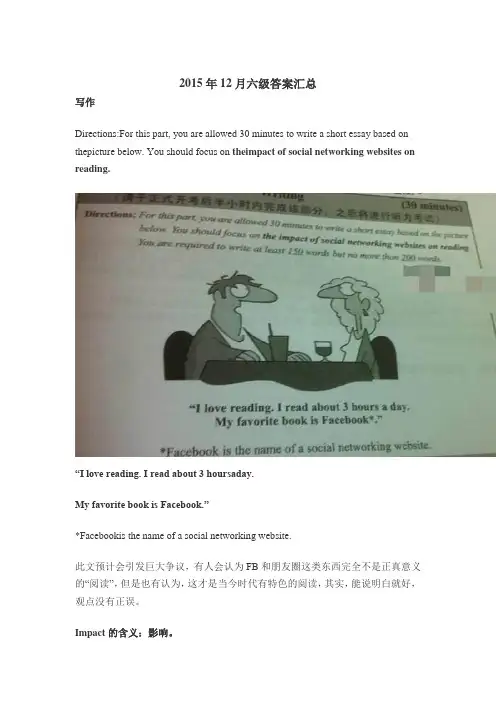
第三段:双面总结,得出结论.Thepicture describes a conversation between two people, one of them said: “I readabout 3 hours a day. My favorite book is Facebook.” The picture intends toinform us that the Internet has exerted an important influence on reading forthe modern citizens.The phenomenon involves many factors, which canbe listed as the follows. To begin with, with the rapid development ofscientific technology, The Internet has become indispensable in our daily life.Undoubtedly, it provides people with many advantages and makes our life morecomfortable and efficient, including the way ofreading. What’s more, it is a moreadvanced way to get information needed by people, and an efficient way to searchfor materials. “I have hardly ever bought any books since 2003. I have beenreading online in recent years.” said professor Wang from Peking University.“With the click of the mouse, any stories or information that I want at anygiven time or place, is there.” she said. This may well explain why so manypeople now prefer to embrace the wonders of the Internet than read print copiesof book or any other reading material.Every coin hastwo sides, reading in social networking websites is no exception. Admittedly,there is false and useless information on the social networking websites, it isadvisable that we read more critically and carefully.六级作文信息技术版参考范文For this part,you are allowed 30 minutes to write a short essay based on the picture be low. You should focus on the difficulty in acquiring useful information in spite of advanced information technology. You are required to write at least 150 words but no more than 200 words.第一段: 描述漫画内容.强调网络信息对我们生活的影响.第二段: 阐述网络信息技术找寻信息的弊端.第三段: 得出结论.The picture describes a conversation among several people, one of them complains: “we havelots of information technology; we just don’t have much useful information.” Itis safe to figure out that our lives are full of information technology, but weare supposed to have the ability to distinguish the useful ones from theuseless ones.The human beings are stepping into theinformation society. The information industry develops very rapidly, so doestheinformation technology. Information technology brought us many benefits, as well as theunexpected side effects. First, when we search for information on the Internet,it comes out that the useful information and useless ones appear together. Italways takes us long time to separate them. What makes things worse is thatsome information on the Internet even misleads the people who cherish the hopeof acquiring the useful knowledge from theInternet. Thus,information technology becomes an impending important issue.Through the above analysis on information technology,I believe that the positive aspects far outweigh its negative ones though thetechnology does bring us some unwanted information. As college students, weshould enhance the awareness of recognizing the useful information when we are surfingthe net.第三版第一段: 描述漫画内容.强调误导信息的存在对我们的影响.第二段: 误导性信息对我们的影响的阐述. (可以结合具体的例子.)第三段: 提出方法解决这一问题It can be clearly seen that the coupleare discussing the information on the Internet, one of them said: “I just feelunfortunate to live in a world with so much misleading information.” Thec onversation of the cartoon picture conveys the message that people attained informationfrom the Internet, some of which might be misleading.Along with the development of societyand technology, an increasing numberof problems are brought to our attention, one ofwhich is that misleading information exists on the Internet. Here is an exampleI got from my friend, which works well in the case. She expected to discover acure from the Internet when her mother got a certain disease. Unfortunately,that so called “cure” from the Wechat moments did not work at all and hermother’s healthy condition got worse. Such misleading information often wastepeople’s time and may result in even severe consequences.In view of the problem, effectivemeasures should be taken. For one thing, it is high time that we realized theimportance of ability to separate the useful information from the misleadingones. Thus, critical thinking is of great importance. For another, thegovernment should issue strict laws and regulations to put the situation undercontrol.六级翻译(贫困版)在帮助国际社会于2030年前消除极端贫困过程中,中国正扮演着越来越重要的角色。
2015年12月大学英语六级考试真题及答案(第二套).doc
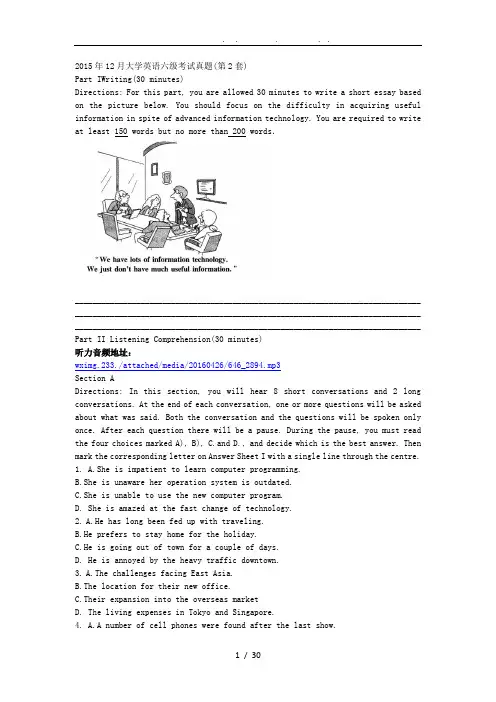
2015年12月大学英语六级考试真题(第2套)Part IWriting(30 minutes)Directions: For this part, you are allowed 30 minutes to write a short essay based on the picture below. You should focus on the difficulty in acquiring useful information in spite of advanced information technology. You are required to write at least 150 words but no more than 200 words._______________________________________________________________________________ _______________________________________________________________________________ _______________________________________________________________________________ Part II Listening Comprehension(30 minutes)听力音频地址:wximg.233./attached/media/20160426/646_2894.mp3Section ADirections: In this section, you will hear 8 short conversations and 2 long conversations. At the end of each conversation, one or more questions will be asked about what was said. Both the conversation and the questions will be spoken only once. After each question there will be a pause. During the pause, you must read the four choices marked A), B), C.and D., and decide which is the best answer. Then mark the corresponding letter on Answer Sheet I with a single line through the centre.1. A.She is impatient to learn computer programming.B.She is unaware her operation system is outdated.C.She is unable to use the new computer program.D. She is amazed at the fast change of technology.2.A.He has long been fed up with traveling.B.He prefers to stay home for the holiday.C.He is going out of town for a couple of days.D. He is annoyed by the heavy traffic downtown.3.A.The challenges facing East Asia.B.The location for their new office.C.Their expansion into the overseas marketD. The living expenses in Tokyo and Singapore.4. A.A number of cell phones were found after the last show.B.The woman forgot where she had left her cell phone.C.The woman was very pleased to find her cell phone.D. Reserved tickets could be picked up at the ticket counter.5.A.The building materials will be delivered soon.B.The project is being held up by bad weather.C.The construction schedule may not be met.D. Qualified carpenters are not easy to find.6.A.She is getting very forgetful these days.B.She does not hold on to bitter feelings.C.She resents the way she is treated.D. She never intends to hurt anyone.7.A.The man wants to rent a small apartment.B.The woman has trouble getting a mortgage.C.The woman is moving to a foreign country.D.The man is trying to sell the woman a house.8. A.They are writing a story for the Morning News.B.They are facing great challenges to get re-elected.C.They are launching a campaign to attract women voters.D.They are conducting a survey among the women in town.Questions 9 to 11 are based on the conversation you have just heard.9.A.Touch his heart.B.Make him cry.C.Remind him of his life.D.Make him feel young.10. A.He is good at singing operas.B.He enjoys complicated music:C.He can sing any song if he likes it.D.He loves country music in particular.11.A.Go to a bar and drink for hours.B.Go to an isolated place to sing blues.C.Go to see a performance in a concert hall.D.Go to work and wrap himself up in music.Questions 12 to 15 are based on the conversation you have just heard.12.A.How he became an announcer.B.How he writes news stories.C.How he makes his living.D.How he does his job.13.A.They write the first version of news stories.B.They gather news stories on the spot.C.They polish incoming news stories.D.They write comments on major news stories.14. A.Reading through the news stories in a given period of time.B.Having little time to read the news before going on the air.C.Having to change the tone of his voice from time to time.D.Getting all the words and phrases pronounced correctly.15.A.It shows where advertisements come in.B.It gives a signal for him to slow down.C.It alerts him to something important.D.It serves as a reminder of sad news.Section BDirections : In this section, you will hear 3 short passages. At the end of each passage, you will hear some questions. Both the passage and the questions will be spoken only once. After you hear a question, you must choose the best answer from the four choices marked A), B),C).and D). Then mark the corresponding letter on Answer Sheet I with a single line through the centre.Passage OneQuestions 16 to 18 are based on the passage you have just heard.16. A.It gives pleasure to both adults and children.B.It is often carried around by small children.C.It can be found in many parts of the world.D.It was invented by an American Indian.17. A.They were made for earning a living.B.They were delicate geometric figures.C.They were small circus figures made of wire.D.They were collected by a number of museums.18.A.In art.B.In geometry.C.In engineering.D.In circus performance.Passage TwoQuestions 19 to 21 are based on the passage you have just heard.19. A.They offer students a wide variety of courses.B.They attract students from all over the world.C.They admit more students than they can handle.D.They have trouble dealing with overseas students.20. A.Everyone will benefit from education sooner or later.B.A good education contributes to the prosperity of a nation.C.A good education is necessary for one to climb the social ladder.D.Everyone has a right to an education appropriate to his potential.21. A.He likes students with high motivation.B.He enjoys teaching intelligent students.C.He tailors his teaching to students' needs.D.He treats all his students in a fair manner.Passage ThreeQuestions 22 to 25 are based on the passage you have just heard.22. A.It is mostly imported from the Middle East.B.It is a sure indicator of its economic activity.C.It has a direct impact on the international oil market.D.It equals more than 30 million barrels of oil each day.23. A.It eventually turns into heat.B.It is used in a variety of forms.C.Its use is chiefly responsible for air pollution.D.Part of it is lost in the process of transmission.24.A.When it is used in rural areas.B.When it is environment-friendly.C.When it operates at near capacity.D.When it operates at regular times.25.A.Traffic jams in cities.B.Inefficient use of energy.C.Fuel shortage.D.Global warming.Section CDirections: In this section, you will hear a passage three times. When the passage is read for the first time, you should listen carefully for its general idea. When the passage is read for the second time, you are required to fill in the blanks with the exact words you have just heard. Finally, when the passage is read for the third time, you should check what you have written.Graphics are used in textbooks as part of the language of the discipline, as in math or economics, or as study aids. Authors use graphic aids to 26 and expand on concepts taken up in the text because graphics are yet another way of portraying relationships and 27 connections.Graphics are used extensively in natural sciences and social sciences. Social scientists work with statistics 28 data, and the best way to present these statistics is often in graphic form. Graphics are included- not merely as a means of making the information easier for the student to grasp, but as an integral part of the way social scientists think. Many textbooks, 29 those in economics, contain appendixes that provide specific information on reading and working with graphic material.Make it a practice to 30 attentively the titles, captions, headings, and other material connected with graphics. These elements 31 and usually explain what you are looking at. When you are examining graphics, the 32 questions to ask are (a.)What is this item about? and (b.)Whatkey idea is the author 33 ?One warning: Unless you integrate your reading of graphics with the text, you may make a wrong assumption. 34 , from a chart indicating that 33 percent of firstborn children in a research sample did not feel close to their fathers, you might assume that some dreadful influence was at work on the firstborn children. However, a careful reading of the text 35 that most of the firstborn children in the sample were from single-parent homes in which the father was absent.Part III Reading Comprehension (40 minutes)Section ADirections: In this section, there is a passage with ten blanks. You are requiredto select one word for each blank from a list of choices given in a word bank following the passage. Read the passage through carefully before making your choices. Each choice in the bank is identified by a letter. Please mark the corresponding letter for each item on AnswerSheet 2 with a single line through the centre. You may not use any of the words in the bank more than once.Questions 36 to 45 are based on the following passage.According to a report from the Harvard School of Public Health, many everyday products, including some bug sprays and cleaning fluids, could lead to an increased risk of brain and behavioral disorders in children. The developing brain, the report says, is particularly 36 to the toxic effects of certain chemicals these products may contain, and the damage they cause can be 37 .The official policy, however, is still evolving. Health and environmental 38 have long urged U.S. government agencies to 39 the use of some of the 11 chemicals the report cites and called for more studies on their long-term effects. In 2001, for example, the Environmental Protection Agency 40 the type and amount of lead that could be present in paint and soil in homes and child-care 41, after concerns were raised about lead poisoning. The agency is now 42 the toxic effects of some of the chemicals in the latest report.But the threshold for regulation is high. Because children's brain and behavioral disorders, like hyperactivity and lower grades, can also be linked to social and genetic factors, it's tough to pin them on exposure to specific chemicals with solid43 evidence, which is what the EPA requires. Even the Harvard study did not provea direct 44 but noted strong associations between exposure and risk of behavioral issues.Nonetheless, it's smart to 45 caution. While it may be impossible to prevent kids from drinking tap water that may contain trace amounts of chemicals, keeping kids away from lawns recently sprayed with chemicals and freshly dry-cleaned clothes can't hurt.A.advocatesB pactC.correlationD.exerciseE. facilitiesF. interactionG. investigatingH. overwhelmedI. particlesJ. permanentK. restrictedL. simulatingM. statisticalN. tightenO. vulnerableSection BDirections : In this section, you are going to read a passage with ten statements attached to it. Eachstatement contains information given in one of the paragraphs. Identify the paragraph from which the information is derived. You may choose a paragraph more than once. Each paragraph is marked with a letter.Answer the questions by marking the corresponding letter on Answer Sheet 2.The Impossibility of Rapid Energy Transitions[ A ] Politicians are fond of promising rapid energy transitions. Whether it is a transition from imported to domestic oil or from coal-powered electricity production to natural-gas power plants, politicians love to talk big. Unfortunately for them (and often the taxpayers), our energy systems are a bit like an aircraft carrier: they are unbelievably expensive, they are built to last for a very long time, they have a huge amount of inertia ( meaning it takes a lot of energy to set them moving ), and they have a lot of momentum once they are set in motion. No matter how hard you try, you can't turn something that large on a dime ( 10美分硬币 ), or even a few thousand dimes.[ B ] In physics, moving objects have two characteristics relevant to understanding the dynamics of energy systems: inertia and momentum. Inertia is the resistance of objects to efforts to change their state of motion. If you try to push a boulder ( 大圆石 ), it pushes you back. Once you have started the boulder rolling, it develops momentum, which is defined by its mass and velocity.Momentum is said to be "conserved," that is, once you build it up, it has to go somewhere. So a heavy object, like a football player moving at a high speed, has a lot of momentum-that is, once he is moving, it is hard to change his state of motion. If you want to change his course, you have only a few choices: you can stop him, transferring ( possibly painfully) some of his kinetic energy (动能) to your own body, or you can approach alongside and slowly apply pressure to gradually alter his course.[ C ] But there are other kinds of momentum as well. After all, we don't speak only of objects or people as having momentum; we speak of entire systems having momentum. Whether it's a sports team or a presidential campaign, everybody relishes having the big momentum, because it makes them harder to stop or change direction. [ D ] One kind of momentum is technological momentum. When a technology is deployed, its impacts reach far beyond itself. Consider the incandescent (白炽灯的) bulb, an object currently hated by many environmentalists and energy-efficiency advocates. The incandescent light bulb, invented by Thomas Edison, which came to be the symbol of inspiration, has been developed into hundreds, if not thousands, of forms. Today, a visit to a lighting store reveals a stunning array of choices. There are standard-shaped bulbs, flame-shaped bulbs, colored globe-shaped bulbs, and more. It is quite easy, with all that choice, to change a light bulb.[ E ] But the momentum of incandescent lighting does not stop there. All of those specialized bulbs ledto the building of specialized light fixtures, from the desk lamp you study by, to the ugly but beloved hand-painted Chinese lamp you inherited from your grandmother, to the ceiling fixture in your closet, to the light in your oven or refrigerator, and to the light that the dentist points at you. It is easyto change a light bulb, sure, but it is harder to change the bulb and its fixture. [ F ] And there is more to the story, because not only are the devices that house incandescent bulbs shaped to their underlying characteristics, but rooms and entire buildings have been designed in accordance with how incandescent lighting reflects off walls and windows.[ G ] As lighting expert Howard Brandston points out, “ Generally, there are no bad light sources, only bad applications. " There are some very commendable characteristics of the CFL [ compact fluorescent (荧光的) light bulb ], yet the selection of any light source remains inseparable from the luminaire (照明装置 ) that houses it, along with the space in which both are installed, and lighting requirements that need to be satisfied. The lamp, the fixture, and the room, all three must work in concert for the true benefits of end-users. If the CFL should be used for lighting a particular space, or an object within that space, the fixture must be designed to work with that lamp, and that fixture with the room. It is a symbiotic (共生的) relationship. A CFL cannot be simply installed in an incandescent fixture and then expected to produce a visual appearance that is more than washed out, foggy, and dim. The whole fixture must be replaced-light source and luminaire-and this is never an inexpensive proposition.[ H ] And Brandston knows a thing or two about lighting, being the man who illuminated the Statue of Liberty.[ I ]Another type of momentum we have to think about when planning for changes in our energy systems is labor-pool momentum. It is one thing to say that we are going to shift 30 percent of our electricity supply from, say, coal to nuclear power in 20 years. But it is another thing to have a supply of trained talent that could let you carry out this promise. That is because the engineers,designers, regulators, operators, and all of the other skilled people needed for the new energy industry are specialists who have to be trained first ( or retrained, if they are the ones being laid off in some related industry), and education, like any other complicated endeavor, takes time.And not only do our prospective new energy workers have to be trained, they have to be trained in the right sequence. One needs the designers, and perhaps the regulators, before the builders and operators, and each group of workers in training has to know there is work waiting beyond graduation. In some cases, colleges and universities might have to change their training programs, adding another layer of difficulty.[ J ] By far the biggest type of momentum that comes into play when it comes to changing our energy systems is economic momentum. The major components of our energy systems, such as fuel production, refining, electrical generation and distribution, are costly installations that have lengthy life spans. They have to operate for long periods of time before the costs of development have been recovered. When investors put up money to build, say, a nuclear power plant, they expect to earn that money back over the planned life of the plant, which is typically between 40and 60 years. Some coal power plants in the United States have operated for more than 70 years! The oldest continuously operated commercial hydro-electric plant in the United States is on New York's Hudson River, and it went into commercial service in 1898.[ K ] As Vaclav Smil points out, "All the forecasts, plans, and anticipations cited above have failed so miserably because their authors and promoters thought the transitions they hoped to implement would proceed unlike all previous energy transitions, and that their progress could be accelerated in an unprecedented manner. "[ L ] When you hear people speaking of making a rapid transition toward any type of energy, whether it is a switch from coal to nuclear power, or a switch from gasoline-powered cars to electric cars, or even a switch.from an incandescent to a fluorescent light, understanding energy system inertia and momentum can help you decide whether their plans are feasible.46. Not only moving objects and people but all systems have momentum.47. Changing the current energy system requires the systematic training of professionals and skilled labor.48. Changing a light bulb is easier than changing the fixture housing it.49. Efforts to accelerate the current energy transitions didn't succeed as expected.50. To change the light source is costly because you have to change the whole fixture.51. Energy systems, like an aircraft carrier set in motion, have huge momentum.52. The problem with lighting, if it arises, often doesn't lie in light sources but in their applications.53. The biggest obstacle to energy transition is that the present energy system is too expensive to replace.54. The application of a technology can impact areas beyond itself.55. Physical characteristics of moving objects help explain the dynamics of energy systems.Section CDirections: There are 2 passages in this section. Each passage is followed by some questions or unfinished statements. For each of them there are four choices marked A), B), C),and D ). You should decide on the best choice and mark the corresponding letter on Answer Sheet 2 with a single line through the centre.Passage OneQuestions 56 to 60 are based on the following passage.One hundred years ago, "Colored" was the typical way of referring to Americans of African descent. Twenty years later, it was purposefully dropped to make way for "Negro. " By the late 1960s,that term was overtaken by "Black. " And then, at a press conference in Chicago in 1988, Jesse Jackson declared that "African American" was the term to embrace. This one was chosen because it echoed the labels of groups, such as "Italian Americans" and "Irish Americans," that had already beenfreed of widespread discrimination.A century's worth of calculated name changes point to the fact that naming any group is a politically freighted exercise. A 2001 study cataloged all the ways in which the term "Black" carried connotations (涵义) that were more negative than those of "African American. "But if it was known that "Black" people were viewed differently from "African Americans,"researchers, until now, hadn't identified what that gap in perceptionwas derived from. A recent study, conducted by Emory University's Erika Hall, found that "Black" people are viewed more negatively.than "African Americans" because of a perceived difference in socioeconomic status. As a result,"Black" people are thought of as less competent and as having colder personalities.The study's most striking findings shed light on the racial biases permeating the professional world.Even seemingly harmless details on a resume, it appears, can tap into recruiters' biases. A job application might mention affiliations with groups such as the "Wisconsin Association of African-American Lawyers" or the "National Black Employees Association," the names of which apparently have consequences, and are also beyond their members' control.In one of the study's experiments, subjects were given a brief description of a man from Chicago with the last name Williams. To one group, he was identified as "African-American," and another was told he was "Black. " With little else to go on, they were asked to estimate Mr. Williams's salary,professional standing, and educational background.The "African-American" group estimated that he earned about $ 37,000 a year and had a two-year college degree. The "Black" group, on the other hand, put his salary at about $ 29,000, and guessed that he had only "some" college experience. Nearly three-quarters of the first group guessed that Mr.Williams worked at a managerial level, while only 38.5 percent of the second group thought so.Hall's findings suggest there's an argument to be made for electing to use "African American,"though one can't help but get the sense that it's a decision that papers over the urgency of continued progress. Perhaps a new phrase is needed, one that can bring everyone one big step closer to realizing Du Bois's original, idealistic hope: "It's not the name-it's the Thing that counts. "56.Why did Jesse Jackson embrace the term "African American" for people of African descent?57. A.It is free from racial biases.B.It represents social progress.C.It is in the interest of common Americans.D.It follows the standard naming practice.57. What does the author say about the naming of an ethnic group ?A.It advances with the times.B.It is based on racial roots.C.It merits intensive study.D.It is politically sensitive.58.What do Erika Hall's findings indicate?A.Racial biases are widespread in the professional world.B.Many applicants don't attend to details on their resumes.C.Job seekers should all be careful- about their affiliations.D.Most recruiters are unable to control their racial biases.59. What does Erika Hall find in her experiment about a man with the last name Williams?A.African Americans fare better than many other ethnic groups.B.Black people's socioeconomic status in America remains low.C.People's conception of a person has much to do with the way he or she is labeled.D.One's professional standing and income are related to their educational background.60. What is Dr. Du Bois's ideal?A.All Americans enjoy equal rights.B.A person is judged by their worth.C.A new term is created to address African Americans.D.All ethnic groups share the nation's continued progress.Passage TwoQuestions 61 to 65 are based on the following passage.Across the board, American colleges and universities are not doing a very good job of preparing their students for the workplace or their post-graduation lives. This was made clear by the work of two sociologists, Richard Arum and Josipa Roksa.In 2011 they released a landmark study titled"Academically Adrift," which documented the lack of intellectual growth experienced by many people enrolled in college. In particular, Arum and Roksa found, college students were not developing the critical thinking, analytic reasoning and other higher-level skills that are necessary to thrive in today's knowledge-based economy and to lead our nation in a time of complex challenges and dynamic change.Arum and Roksa placed the blame for students' lack of learning on a watered-down college curriculum and lowered undergraduate work standards. Although going to college is supposed to be a Full-time job, students spent, on average, only 12 to14 hours a week studying and many were skating through their semesters without doinga significant amount of reading and writing. Students who take more challenging classes and spend more time studying do learn more. But the priorities of many undergraduates are with extracurricular activities, playing sports, and partying and socializing.Laura Hamilton, the author of a study on parents who pay for college, will argue in a forthcoming book that college administrations are overly concerned with the social and athletic activities of their students. In Paying for the Party, Hamilton describes what she calls the “arty pathway," which eases many students through college, helped-along by various clubs that send students into the party scene and a host of easier majors.By sanctioning this watered-down version of college, universities are"catering to the social and educational needs of wealthy students at the expense of others" who won't enjoy the financial backing or social connections of richer students once they graduate.These students need to build skills and knowledge during college if they are to use their degrees as a stepping-stone to middle-class mobility. But more privileged students must not waste this opportunity either. As recent graduates can testify, the job market isn't kind to candidates who can't demonstrate genuine competence, along with a well-cultivated willingness to work hard. Nor is the global economy forgiving of an American workforce with increasingly weak literacy, math and science abilities. College graduates will still fare better than those with only a highschool education, of course. But a university degree unaccompanied by a gain in knowledge or skills is an empty achievement indeed. For students who have been coasting through college, and for American universities that have been demanding less work, offering more attractions and charging higher tuition, the party may soon be over.61. What is Arum and Roksa's finding about higher education in America?A.It aims at stimulating the intellectual curiosity of college students.B.It fails to prepare students to face the challenges of modern times.C.It has experienced dramatic changes in recent years.D.It has tried hard to satisfy students' various needs.62. What is responsible for the students' lack of higher-level skills?A.The diluted college curriculum.B.The boring classroom activities.C.The absence of rigorous discipline.D.The outdated educational approach.63. What does Laura Hamilton say about college administrations?A.They fail to give adequate help to the needy students.B.They tend to offer too many less challenging courses.C.They seem to be out of touch with society.D.They prioritize non-academic activities.64. What can be learned about the socially and financially privileged students?A.They tend to have a sense of superiority over their peers.B.They can afford to choose easier majors in order to enjoy themselves.C.They spend a lot of time building strong connections with businesses.D.They can climb the social ladder even without a degree.65. What does the author suggest in the last paragraph?A.American higher education has lost its global competitiveness.B.People should not expect too much from American higher education.C. The current situation in American higher education may not last long.D.It will take a long time to change the current trend in higher education. Part IVTranslation(30 minutes)Directions: For this part, you .are allowed 30,minutes to translate a passage from Chinese into English. You should write your answer on Answer Sheet 2.最近,中国政府决定将其工业升级。
2015年12月英语六级考试真题及详细答案(第一套).docx
2015年12月大学英语六级考试真题(第1套)Part I Writing(30 minutes)Directions: For this part, you are allowed 30 minutes to write a short essay based on the picturebelow. You should focus on the impact of social networking websites on reading.You arereauired to write at least 150 words but no more than 200 words._______________________________________________________________________________ _______________________________________________________________________________ _______________________________________________________________________________ Part IIListening Comprehension(30 minutes)听力音频地址:/englishlistening/CET6/zhenti/2016-05-28/427638.htmlSection ADirections : In this section, you will hear 8 short conversations and 2 long conversations. At the end of each conversation, one or more questions will be asked about what was said. Both the conversation and the questions will be spoken only once. After each question there will be a pause. During the pause, you must read the four choices marked A., B., C. and. D., and decide which is the best answer. Thenmark the eorresponding letter on Answer Sheet 1 with a single line through the centre.1. A. The restaurant offers some specials each day.B. The restaurant is known for its food varieties.C. The dressing makes the mixed salad very inviting.D. The woman should mix the ingredients thoroughly.2. A. He took over the firm from Mary.C. He failed to foresee major problems.B. He is running a successful business.D. He is opening a new consulting firm.3. A. Someone should be put in charge of office supplies.B. The man can leave the discs in the office cabinet.C. The man may find the supplies in the cabinet.D. The printer in the office has run out of paper.4.A. He has to use a magnifying glass to see clearly.B. The woman can use his glasses to read.C. He has the dictionary the woman wants.D. The dictionary is not of much help to him.5.A. Redecorating her office.B. Majoring in interior design.C. Seeking professional advice.D. Adding some office furniture.6.A. Problems in port management.B. Improvement of port facilities.C. Delayed shipment of goods.D. Shortage of container ships.7.A. Their boss.B. A colleague.C. Their workload.D. A coffee machine.8.A. Call the hotel manager for help.B. Postpone the event until a later date.C. Hold the banquet at a different place.D. Get an expert to correct the error.Questions 9 to 11 are based on the conversation you have just heard.9.A. He shares some of the household duties.B. He often goes back home late for dinner.C. He cooks dinner for the family occasionally.D. He dines out from time to time with friends.10.A. To take him to dinner.B. To talk about a budget plan.C. To discuss an urgent problem.D. To pass on an important message.11. A. Foreign investors are losing confidence in India's economy.B. Many multinational enterprises are withdrawing from India.C. There are wild fluctuations in the international money market.D. There is a sharp increase in India's balance of payment deficit. Questions 12 to 15 are based on the conversation you have just heard.12. A. They have unrealistic expectations about the other half.B. They may not be prepared for a lifelong relationship.C. They form a more realistic picture of life.D. They try to adapt to their changing roles.13. A. He is lucky to have visited many exotic places.B. He is able to forget all the troubles in his life.C. He is able to meet many interesting people.D. He is lucky to be able to do what he loves.14.A. It is stressful.B. It is full of tim.C. It is all glamour.D. It is challenging15. A. Bothered.B. Amazed.C. Puzzled.D. Excited.Section BDirections : In this section, you will hear 3 short passages. At the end of each passage, you will hearsome questions. Both the passage and the questions will be spoken only once. After youhear a question, you must choose the best answer from the four choices marked A., B.,C. and D . Then mark the corresponding letter on Answer Sheet I with a single linethrough the centre.Passage OneQuestions 16 to 18 are based on the passage you have just heard.16. A. Maintain the traditional organizational culture.B. Learn new ways of relating and working together.C. Follow closely the fast development of technology.D. Learn to be respectful in a hierarchical organization.17. A. How the team integrates with what it is supposed to serve.B. How the team is built to keep improving its performance.C. What type of personnel the team should be composed of.D. What qualifications team members should be equipped with.18. A. A team manager must set very clear and high objectives.B. Teams must consist of members from different cultures.C. Team members should be knowledgeable and creative.D. A team manager should develop a certain set of skills.Passage TwoQuestions 19 to 22 are based on the passage you have just heard.19. A. It is a platform for sharing ideas on teaching at the University of Illinois.B. It was mainly used by scientists and technical people to exchange text.C. It started off as a successful program but was unable to last long.D. It is a program allowing people to share information on the Web.20. A. He visited a number of famous computer scientists.B. He met with an entrepreneur named Jim Clark.C. He sold a program developed by his friends.D. He invested in a leading computer business.21.A. They had confidence in his new ideas.B. They trusted his computer expertise.C. They were very keen on new technology.D. They believed in his business connections.Passage ThreeQuestions 22 to 25 are based on the passage you have just heard.22.A. Prestige advertising.B. Institutional advertising.C. Wordofmouth advertising.D. Distributing free trial products.23.A. To sell a particular product.B. To build up their reputation.C. To promote a specific service.D. To attract high-end consumers.24. A. By using the services of large advertising agencies.B. By hiring their own professional advertising staff.C. By buying media space in leading newspapers.D. By creating their own ads and commericais.25.A. Decide on what specific means of communication to employ.B. Conduct a large-scale survey on customer needs.C. Specify the objectives of the campaign in detail.D. Pre-test alternative ads or commercials in certain regions.Section CDirections: In this section, you will hoar a passage three times. When the passage is read for thofirst time, you should listen carefully for its general idea. When tho passage is read for the second time, you are required to fill in tho blanks with the exact words you have justhoard. Finally, when tho passage is read for the third time, you should chock what youhave written.Extinction is difficult concept to grasp. It is an26concept. It's not at all like the killing ofindividual lifeforms that can be renewedthrough normal processes of reproduction. Nor is it simply27numbers. Nor is it damage that can somehow be remedied or for which some substitute can beound. Nor is it something that simply affects our own generation. Nor is it something that could beremedied by some supernatural power. It is rather an28and final act for which there is no remedy on earth or in heaven. A species once extinct is gone forever. However many generations29us incoming centuries, none of them will ever see this species that we extinguish.Not only are we bringing about the extinction of life30, we are also making the land and theair and the sea so toxic that the very conditions of life are being destroyed.31basic naturalresources, not only are the nonrenewable resources being32in a frenzy ( 疯狂) of processing,consuming, and33, but we are also mining much of our renewable resources, such as the verysoil itself on which terrestrial (地球上的) life depends.The change that is taking place on the earth and in our minds is one of the greatest changes ever totake place in human affairs, perhaps the greatest, since what we are talking about is not simply anotherhistorical change or cultural34, but a change of geological and biological as well as psychologicalorder of35Part III Reading Comprehension(40 minutes)Section ADirections: In this section, there is a passage with ten blanks. You are required to select one wordfor each blank from a list of choices given in a word bank following the passage. Read thopassage through carefully before making your choices.Each choice in the bank isidentified by a letter. Please mark tho corresponding letter for each item on AnswerSheet 2 with a single line through tho centre. You may not use any of tho words in the bank more than once.Questions 36 to 45 are based on the following passage. It seems to be a law in thetechnology industry that leading companies eventually lose theirpositions, often quickly and brutally.Mobile phone champion Nokia, one of Europe's biggesttechnology success stories, was no36, losing its market share in just a few years.In 2007, Nokia accounted for more than 40% of mobile phone sales37But consumers' preferences were already38toward touch-screen smartphones. With the introduction of Apple'siPhone in the middle of that year, Nokia's market share39rapidly and revenue plunged. By theend of 2013, Nokia had sold its phone business to Microsoft. What sealed Nokia's fate was a series of decisions made by Stephen Elop in his position as CEO,which he40in October 2010. Each day that Elop spent in charge of Nokia, the company's marketvalue declined by $ 23 million, making him, by the numbers, one of the worst CEOs in history. But Elop was not the only person at41Nokia's board resisted change, making it impossiblefor the company to adapt to rapid shifts in the industry. Most42, Jorma Ollila, who had ledNokia's transition from an industrial company to a technology giant, was too fascinated by thecompany's43success to recognize the change that was needed to sustain its competitiveness. The company also embarked on a44cost-cutting program, which included the elimination of which hadmotivated employees to take risks and make miracles. Good leaders left the company, taking Nokia'ssense of vision and directions with them. Not surprisingly, much of Nokia's most valuable design andprogramming talent left as well.A)assumed I) previousB. bias J) relayedC. desperateK) shiftingD. deteriorationL) shrankE) exceptionM) subtleF) faultN) transmittingG) incidentallyO) worldwideH) notablySection BDirections : In this section, you are going to read a passage with ten statements attached to it. Eachstatement contains information given in one of the paragraphs. Identify the paragraphfrom which the information is derived. You may choose a paragraph more than once.Each paragraph is marked with a letter.Answer the questions by .marking the corresponding letter on Answer Sheet 2. First-Generation College-Goers: Unprepared and Behind Kids who are the first in their families to brave the world of higher education come on campus withlittle academic know—how and are much more likely than their peers to drop out before graduation.[ A] When Nijay Williams entered college last fall as a first—generation student and Jamaican immigrant,he was academically unprepared for the rigors of higher education. Like many first—generationstudents, he enrolled in a medium-sized state university many of his high school peers were alsoattending, received a Pell Grant, and took out some small federal loans to cover other costs.Given the high price of room and board and the closeness of the school to his family, he chose tolive at home and worked between 30 and 40 hours a week while taking afull class schedule.[ B] What Nijay didn't realize about his school—Tennessee State University—was its frighteningly lowgraduation rate: a mere 29 percent for its first-generation students. At the end of his first year,Nijay lost his Pell Grant of over $ 5,000 after narrowly missing the 2.0 GPA cut-off, making itimpossible for him to continue paying for school.[ C ]Nijay represents a large and growing group of Americans: first—generation college students whoenter school unprepared or behind. To make matters worse, these schools are ill-equipped tograduate these students—young adults who face specific challenges and obstacles. They typicallycarry financial burdens that outweigh those of their peers, are more likely to work while attendingschool, and often require significant academic remediation (补习).[ D ] Matt Rubinoff directs I'm First, a nonprofit organization launched last October to reach out to thisspecific population of students. He hopes to distribute this information and help prospectivecollege-goers fmd the best post-secondary fit. And while Rubinoff believes there are a goodnumber of four—year schools that truly care about these students and set aside significant resourcesand programs for them, he says that number isn't high enough.[ E ] "It's not only the selective and elite institutions that provide those opportunities for a small subsetof this population," Rubinoff said, adding that a majority of first-generation undergraduates tendtoward options such as online programs, two—year colleges, and commuter state schools."Unfortunately, there tends to be a lack of information and support to help students think biggerand broader. "[ F] Despite this problem, many students are still drawn to these institutions--and two-year schools inparticular. As a former high school teacher, I saw students choose familiar, cheaper options yearafter year. Instead of skipping out on higher education altogether, they chose community collegesor state schools with low bars for admittance.[ G]"They underestimate themselves when selecting a university,"said Dave Jarrat, a marketingexecutive for Inside Track, a for—profit organization that specializes in coaching low-income studentsand supporting colleges in order to help students thrive. "The reality of it is that a lot of low-incomekids could be going to elite tufiversities on a full ride scholarship and don't even realize it. "[ H] "Many students are coming from a situation where no one around them has the experience ofsuccessfully completing higher education, so they are coming in questioning themselves and theircollege worthiness," Jarrat continued. That helps explain why, as I'm First's Rubinoff indicated,the schools to which these students end up resorting can end up being some of the poorestmatches for them. The University of Tennessee in Knoxville offers one example of this dilemma. Aflagship university in the South, the school graduates just 16 percent of its first—generationstudents, despite its overall graduation rate of 71 percent. Located only a few hours apart, TheUniversity of Tennessee and Tennessee State are worth comparing. Tennessee State's overallgraduation rate is a tiny 39 percent, but at least it has a smallergap between the outcomes forfirst—generat.ion students and those of their peers.[I] Still, the University of Tennessee deserves credit for being transparent. Many large institutionskeep this kind of data secret—or at least make it incredibly difficult to find The University ofNorth Carolina at Chapel Hill, for instance, admits only that the graduation rate for its first—generation pupils is "much lower" than the percentage of all students who graduate within fouryears (81 percent). [J] It is actually quite difficult to fred reliable statistics on the issue for many schools.Highereducation institutions are, under federal law, required to report graduation rates, but thesereports typically only include Pell recipient numbers —not necessarily rates specific to fLrst—generation students. Other initiatives fail to break down the data, too. Imagine how intimidating itcan be for prospecitive students unfamiliar with the complexities of higher education to navigatethis kind of information and then identify which schools are the best fit.[ K] It was this lack of information that prompted the launch of I'm First in 2013, originally as an annof its umbrella organization, the Center For Student Opportunity."If we can help to directstudents to more of these types of campuses and help students to understand them to be realisticand accessible places, have them apply to these schools at greater frequency and ultimately get inand enroll, we are going to raise the success rate," Rubinoff said, citing a variety of colleges ranging from large state institutions to smaller private schools.[ L] Chelsea Jones, who now directs student programming at I'm First, was a first —generation college student at Howard. Like other student new to the intimidating higher—education world, she often struggled on her path to college, "There wasn't really a college—bound cnlture at my high school," she said. "I wanted to go to college but I didn't really know the process. " Jones became involved with a college —access program through Princeton University in high school. Now, she attributes much of her understanding of college to that: "But once I got to campus, it was a completely different ball game that no one really prepared me for. "[ M] She was fortunate, though. Howard, a well—regarded historically black college, had an array of resources for its first—generation students, including matching kids with counselors, comecting first— generation students to one another, and TRIO, a national program that supported 200 students onHoward's campus. Still, Jones represents a small percentage of first-generation students who areable to gain entry into more elite universities, which are often known for robust financial aidpackages and remarkably high graduation rates for first—generation students.(Harvard, for example, boasts a six—year graduation rate for underrepresented minority groups of 98 percent. )[ N]Christian Vazquez, a first—generation Yale graduate, is another exception, his success story settinghim far apart from students such as Nijay. "There is a lot of support at Yale, to an extent, after awhile, there is too much support," he said, half—joking about the countless resources available atthe school. Students are placed in small groups with counselors ( trained seniors on campus) ;they have access to cultural and ethnic affinity (联系) groups, tutoring centers and also have a summer orientation specifically for first—generation students ( the latter beingone of the mostcommon programs for students).[ O]"Our support structure was more like : ' You are going to get through Yale; you are going to dowell,' " he said, hinting at mentors (导师), staff, and professors who all provided significantsupport for students who lacked confidence about "belonging" at such a top institution.46. Many first—generation college—goers have doubts about their abilities to geta college degree.47. First—generation college students tend to have much heavier financial burdens than their peers.48. The graduation rate of first—generation students at Nijay's university was incredibly low.49. Some top institutions like Yale seem to provide first—generation students with more support than they actually need.50. On entering college, Nijay Williams had no idea how challenging college education was.51. Many universities simply refuse to release their exact graduation rates for first-generation students.52. According to a marketing executive, many students from low-income families don't know they could have a chance of going to an elite university.53. Some elite universities attach great importance to building up the first—generation students' serf—confidence.54. I'm First distributes information to help first-generation college-goers find schools that are most suitable for them.55. Elite universities tend to graduate fn'st-generation students at a higher rate. Section CDirections: There are 2 passages in this section. Each passage is followed by some questions or unfinished statements. For each of them there are four choices marked A., B., C. andD . You should decide on the best choice and mark the corresponding letter on AnswerSheet 2 with a single line through the centre.Passage OneQuestions 56 to 60 are based on the following passage.Saying they can no longer ignore the rising prices of health care, some of the most influentialmedical groups in the nation are recommending that doctors weigh the costs, not just the effectivenessof treatments, as they make decisions about patient care.The shift, little noticed outside the medical establishment but already controversial inside it,suggests that doctors are starting to redefine their roles, from being concerned exclusively aboutindividual patients to exerting influence on how healthcare dollars are spent. In practical terms, the new guidelines being developed could result in doctors choosing one drugover another for cost reasons or even deciding that a particular treatment—at the end of life, forexample—is too expensive. In the extreme, some critics have said that making treatment decisionsbased on cost is a form of rationing. Traditionally, guidelines have heavily influenced the practice of medicine, and the latest ones areexpected to makedoctors more conscious of the economic consequences of their decisions, eventhough there's no obligation to follow them. Medical society guidelines are also used by insurancecomoanies to help determine reimbursement (报销) policies. Some doctors see a potential conflict in trying to be both providers of patient care and fmancial Overseers."There should be forces in society who should be concerned about the budget, but they shouldn'tbe functioning simultaneously as doctors," said Dr. Martin Samuels at a Boston hospital. He saiddoctors risked losing the trust of patients if they told patients, "I'm not going to do what I think is bestfor you because I think it's bad for the healthcare budget in Massachusetts. " Doctors can face some grim trade —offs. Studies have shown, for example, that two drugs are aboutequally effective in treating macular degeneration, and eye disease. But one costs $ 50 a dose and theother close to $ 2,000. Medicare could save hundreds of millions of dollars a year if everyone used thecheaper drug, Avastin, instead of the costlier one, Lucentis. But the Food and Drug Administration has not approved Avastin for use in the eye. and using itrather than the alternative, Lucentis, might carry an additional, although slight, safety risk. Shoulddoctors consider Medicare's budget in deciding what to use?"I think ethically (在道德层面上) we are just worried about the patient in front of us and nottrying to save money for the insurance industry or society as a whole," said Dr. Donald Jensen. Still, some analysts say that there's a role for doctors to play in cost analysis because not manyothers are doing so. "In some ways," said Dr. Daniel Sulmasy, "it represents a failure of wider society to take up the issue. "56. What do some most influential medical groups recommend doctors do?A. Reflect on the responsibilities they are supposed to take.B. Pay more attention to the effectiveness of their treatments.C. Take costs into account when making treatment decisions.D. Readjust their practice in view of the cuts in health care.57. What were doctors mainly concerned about in the past?A. Specific medicines to be used.B. Effects of medical treatment.C. Professional advancement.D. Patients' trust.58. What may the new guidelines being developed lead to?A. The redefining of doctors' roles.B. Overuse of less effective medicines.C. Conflicts between doctors and patients.D. The prolonging of patients' suffering.59. What risk do doctors see in their dual role as patient care providers and financial overseers?A. They may be involved in a conflict of interest.B. They may be forced to divide their attention.C. They may have to use less effective drugs.D. They may lose the respect of patients.60. What do some experts say about doctors' involvement in medical cost analysis?A. It may add to doctors' already heavy workloads.B. It will help to save money for society as a whole.C. It results from society's failure to tackle the problem.D. It raises doctors' awareness of their social responsibilities.Passage TwoQuestions 61 to 65 are based on the following passage.Economic inequality is the "defining challenge of our time," President Barack Obama declared in aspeech last month to the Center for American Progress. Inequality is dangerous, he argued, not merelybecause it doesn't look good to have a large gap between the rich and the poor, but because inequalityitself destroys upward mobility, making it harder for the poor to escape from poverty. "Increasedinequality and decreasing mobility pose a fundamental threat to the American Dream," he said. Obama is only the most prominent public figure to declare inequality Public Enemy No. 1 and thegreatest threat to reducing poverty in America. A number of prominent economists have also arguedthat it's harder for the poor to climb the economic ladder today because the rungs (横档 ) in that ladderhave grown farther apart.For all the new attention devoted to the 1 percent, a new damset from the Equality of OpportunityProject at Harvard and Berkeley suggests that, if we care about upward mobility overall, we're vastlyexaggerating the dangers of the rich—poor gap. Inequality itself is not a particularly strong predictor ofeconomic mobility, as sociologist Scott Winship noted in a recent article based on his analysis of this data. So what factors, at the community level, do predict if poor children will move up the economicladder as adtdts? what explains, for instance, why the Salt Lake City metro area is one of the 100largest metropolitan areas most likely to lift the fortunes of the poor and the Atlanta metro area is oneof the least likely?Harvard economist Raj Cherty has pointed to economic and racial segregation, community density,the size of a community's middle class, the quality of schools, commtmity religiosity, and familystructure, which he calls the "single strongest correlate of upward mobility. " Chetty finds thatcommunities like Salt Lake City, with high levels of two-parent families and religiosity, are much morelikely to see poor children get ahead than communities like Atlanta, with high levels of racial andeconomic segregation. Chetty has not yet issued a comprehensive analysis of the relative predictive power of each of thesefactors. Based on my analyses of the data. of the factors that Chetty has highlighted, the followingthree seem to be most predictive of upward mobility in a given community:1. Per-capita (人均) income growth2. Prevalence of single mothers ( where correlation is strong, but negative)3. Per-capita local government spending In other words, communities with high levels of per-capita income growth, high percentages oftwo-parent families, and high local government spending-which may stand for good schools-are themost likely to help poor children relive Horatio Alger's rags-to-riches story.61. How does Obama view economic inequality?A. It is the biggest obstacle to social mobility.B. It is the greatest threat to social stability.。
【英语】2015年12月大学英语六级答案汇总
【关键字】英语Directions:For this part, you are allowed 30 minutesto write a short essay based on thepicture below. You should focuson theimpact of social networking websites onreading.“I love reading. I read about 3 hoursaday.My favorite book is Facebook.”*Facebookis the name of a social networkingwebsite.此文预计会引发巨大争议,有人会认为FB和朋友圈这类东西完全不是正真意义的“阅读”,但是也有认为,这才是当今时代有特色的阅读,其实,能说明白就好,观点没有正误。
Impact的含义:影响。
第一段: 描述漫画内容.强调网络阅读的趋势和现象第二段: 分析网络读书的原因. ( 或阐述不同的人的不同观点)在这一段,既可以把网络阅读的影响力归结为利大于弊,也可以归结为弊大于利,自圆其说即可。
第三段:双面总结,得出结论.Thepicture describes a conversation between two people,one of them said: “I readabout 3 hours a day. My favorite book isFacebook.” The picture intends toinform us that the Internet hasexerted an important influence on reading forthe moderncitizens.The phenomenon involves many factors,which canbe listed as the follows. To begin with, with the rapiddevelopment ofscientific technology, The Internet has becomeindispensable in our daily life.Undoubtedly, it provides peoplewith many advantages and makes our life morecomfortable andefficient, including the way ofreading. What’smore, it is a moreadvanced way toget information needed by people, and an efficient way to searchformaterials. “I have hardly ever bought any books since 2003. I havebeenreading online in recent years.” said professor .“With the click of the mouse, any stories orinformation that I want at anygiven time or place, is there.” shesaid. This may well explain why so manypeople now prefer to embracethe wonders of the Internet than read print copiesof book or anyother reading material.Every coin hastwo sides, reading in social networkingwebsites is no exception. Admittedly,there is false and uselessinformation on the social networking websites, it isadvisable thatwe read more critically and carefully.六级作文信息技术版参照范文有道考神版本答案,转载请注明出处考神团队:@老师王菲@建昆老师For this part,you are allowed 30 minutes to write a short essay based on the picture below. You sho uld focus on the difficulty in acquiring useful information in spite of advanced information technol ogy. You are required to write at least 150 words but no more than 200 words.第一段: 描述漫画内容.强调网络信息对我们生活的影响.第二段: 阐述网络信息技术找寻信息的弊端.第三段: 得出结论.The picture describes a conversation among several people,one of them complains: “we havelots of information technology; wejust don’t have much useful information.” Itis safe to figure outthat our lives are full of information technology, but wearesupposed to have the ability to distinguish the useful ones fromtheuseless ones.The human beings are stepping intotheinformation society. The information industry develops veryrapidly, so does theinformationtechnology. Informationtechnology brought us many benefits, as well as theunexpected sideeffects. First, when we search for information on the Internet,itcomes out that the useful information and useless ones appeartogether. Italways takes us long time to separate them. What makesthings worse is thatsome information on the Internet even misleadsthe people who cherish the hopeof acquiring the useful knowledgefrom the Internet. Thus,information technology becomes an impending importantissue.Through the above analysis on information technology,Ibelieve that the positive aspects far outweigh its negative onesthough thetechnology does bring us some unwanted information. Ascollege students, weshould enhance the awareness of recognizing theuseful information when we are surfingthe net.第三版第一段: 描述漫画内容.强调误导信息的存在对我们的影响.第二段: 误导性信息对我们的影响的阐述. (可以结合具体的例子.)第三段: 提出方法解决这一问题It can be clearly seen that the coupleare discussing theinformation on the Internet, one of them said: “I justfeelunfortunate to live in a world with so much misleadinginformation.” Theconversation of the cartoon picture conveys themessage that people attained informationfrom the Internet, some ofwhich might be misleading.Along with the development of societyand technology, anincreasing number of problems are brought to our attention,one ofwhich is that misleading information exists on the Internet.Here is an exampleI got from my friend, which works well in thecase. She expected to discover acure from the Internet when hermother got a certain disease. Unfortunately,that so called “cure”from the Wechat moments did not work at all and hermother’s he althycondition got worse. Such misleading information oftenwastepeople’s time and may result in even severeconsequences.In view of the problem, effectivemeasures should be taken.For one thing, it is high time that we realized theimportance ofability to separate the useful information from the misleadingones.Thus, critical thinking is of great importance. For another,thegovernment should issue strict laws and regulations to put thesituation undercontrol.六级翻译(贫困版)有道考神版本答案,转载请注明出处,时间仓促,译文仅供参照,欢迎讨论。
英语六级201512-1听力原文+答案
2015年12月英语六级听力试卷(第一套)短对话1.W: Wow, what a variety of salads you’ve got on your menu, could yourecommend something special?M: Well, I think you can try this mixed salad. We make the dressingwith fresh berries.Q: what does the man mean?2.W: I was talking to Mary the other day, and she mentioned that your newconsulting firm is doing really well.M: Yes, business paced up much faster than we anticipated. We now haveover 200 clients.Q: What do we learn about the man from the conversation?3.W: Do you know where we keep flash disks and printing paper?M: They should be in the cabinet if there are any. That’s where we keepall of our office supplies.Q: what does the woman mean?4.W: The printing of this dictionary is so small. I can’t read theexplanations at all.M: Let me get my magnify glass. I know I just can’t do without it.Q: What does the man mean?5.W: I’m considering having my office redecorated, the furniture is oldand the paint is chipping.M: I’ll give yo u my sister-in-law’s number. She just graduated from aninterior designing academy, and will give a free estimate.Q: What is the woman considering?6.W: We have a full load of goods that needs to be delivered. But wecan’t get a container ship anywa y.M: That’s always being a problem in this port. The facilities here arenever able to meet our needs.Q: What are the speakers talking about?7.W: Why didn’t Rod get a pay raise?M: The boss just isn’t convinced that his work attitude warranted it.She said she saw him by the coffee machine more often than at his desk.Q: What are the speakers talking about?8.W: The hotel called, saying that because of the scheduling there, theywon’t be are able to cater for our banquet.M: I know an Indian restaurant on the high street that offers a specialdiner for groups. The food is excellent, and the room is large enough toaccommodate us.Q: What does the man suggest they do?长对话Conversation 1M: Hello Jane.W: Hello Paul.M: Please comin g. I’m just getting ready to go home. Susan is expectingme for dinner. I wanted to be on time for a change.W: Look, I’m terribly sorry to drop in this time on Friday, Paul, butit is rather important.M: That’s OK. What’s the problem?W: Well, Paul, I won’t keep you long. You see there is a problem withthe exchange rates. The Indian Rupee has taken a fall on the foreign exchangemarket. You see there is being a sharp increase in Indian’s balance of paymentdeficit.M: I see. How serious, isn’t it?W: Well, as you know, there have been reports of unrest India, and theprospects for the Rupee look pretty gloomy.M: And that’s going to affect us, as if we didn’t have enough problemson our hands.W: So I thought it would be wise to take out forward exchange cover toprotect our position on the outstanding contract.M: Just a minute. Forward exchange cover, now what does that meanexactly?W: Well, it means that JO notes enters into a commitment to sell IndianRupees at the present rate.M: I see. And how will that benefit us?W: Well, JO notes wouldn’t lose out if Indian Rupee falls further.M: What will it cost, Jane?W: A small percentage, about 1% and that can be built into the price ofthe bike.M: Well, I don’t suppose there is much choic e. All right Jane, let’sput it into action.Q9: What do we learn aboutthe man’s daily life?Q10: Why did the woman cometo see the man?Q11: What makes the womanworry about the Indian Rupee?Conversation 2W: Charles, among other things, you regarded as one of the America’sgreat masters of the blues. A musical idiom does essentially about loss,particularly the loss of romantic love. Why does love die?M: People often get into love affairs because they have unrealisticexpectations about somebody. Then when the person doesn’t turn out to be whothey thought he or she was, they start thinking maybe I can change him or her.That kind of thinking is a mistake. Because when the dust settles, people aregoing to be pretty much what they are. It’s a rare thing for anybody to be ableto change who they really are. And this creates a lot of problems.W: At 62, you continue to spend a large percentage of your lifetouring. What appeals to you about life on the road?M: Music, I don’t especially love life on th e road, but I figure if youare lucky enough to be able to do what you truly love doing, you’ve got theultimate of life.W: What’s the most widely-held misconception about the life of a famousmusician?M: People think it’s all glamour. Actually we have the same troublesthey do. Playing music doesn’t mean life treats you any better.W: How do you feel about being recognized everywhere you go?M: You think I be used to it by now. But I still find it fascinating.You go to a little town in Japan, where nobody speaks English, yet they knowyou on side and know all your music. I’m still amazed by the love peopleexpress for me and by music.Q12: What does the man sayabout most people when they get into love affairs?Q13: What does the man sayabout himself as a singer on the road most of his life?Q14: What do most peoplethink of the life of a famous musician?Q15: How does the man feelwhenever he was recognized by his fans?短文理解Passage 1Changing technology and markets have stimulated the team approach tomanagement. Inflation, resource scarcity, reduced personnel levels and budgetcuts have all underscore the need for better coordination in organizations.Team management provides for this coordination. Team management calls for newskills if personnel potential is to be fully realized. Although a team may be composed ofknowledgeable people, they must learn new ways of relating and working togetherto solve cross-functional problems. When teams consist to be experiencedemployees from hierarchical organizations, who have been condition totraditional organizational culture. Cooperation may not occur naturally, itmainly to be created. Furthermore, the issue is not just how the team canfunction more effectively, but how it integrates with the overall organization,all societythat it supposes it serves. A group of individuals is notautomatically a team. Therefore, team building may be necessary in order toimprove the group’s performance. Casey, an expert in this field, suggests thatthe cooperation process within teams must be organized, promoted and managed.He believes the team corporation results when members go beyond theirindividual capabilities, beyond what each is used to being and doing. Together,the team may then produce something new, unique and superior to that of any onemember. For this to happen, he suggests the multi-cultural managers exhibitunderstanding of their own and others’ cultural influences and limitations.They should also cultivate such skills as toleration of ambiguity, persistenceand patience, as well as assertedness. If a team manager exemplifies suchqualities, then the team as a whole would be better able to realize theirpotential and achieve their objectives.Q 16: What should teammembers do to fully realize their potential?Q 17: What needs to beconsidered for effective team management?Q 18: What conclusion can wedraw from what Casey says?Passage 2In early 1994, when MarkAndreessen was just 23 years old, he arrived in Silicon Valley with an ideathat would change the world. As a student at the University of Illinois, he andhis friends had developed aprogram called Mosaic, which allowed people toshare information on the worldwide web. Before Mosaic, the web had been usedmainly by scientists and other technical people, who were happy just to sendand receive text. But with Mosaic, Andreessen and his friends had developed aprogram, which could send images over the web as well. Mosaic was an overnightsuccess. It was put on the university’s network at the beginning of 1993. Andby the end of the year, it had over a million users. Soon after, Andreessenwent to seek his fortune in Silicon Valley. Once he got there, he started tohave meetings with a man called Jim Clark, who was one of the Valley’s mostfamous entrepreneurs. In 1994, nob ody was making any real money from theInternet, which was still very slow and hard to use. But Andreessen had seen an opportunity thatwould make him and Clark rich within two years. He suggested they should createa new computer program that would do the same job as Mosaic but would be mucheasier to use. Clark listened carefully to Andreessen, whose ideas andenthusiasm impressed him greatly. Eventually, Clark agreed to invest threemillion dollars of his own money in the project, and to raise an extra fifteenmillion from venture capitalists, who were always keen to listen to Clark’s newideas.Q 19 What do we learn about Mosaic?Q 20 What did Andreessen do upon arriving in Silicon Valley?Q 21Why were venture capitalists willing to join inClark’sinvestme nt?Passage 3Advertising informs consumers about the existence and benefits ofproducts and services and attempts to persuade them to buy them. The best formof advertising is probably word of mouth advertising which occurs when peopletell their friends about the benefits of products or services that they havepurchased. Yet virtually no providers of goods or services relay on this alone,which using paid advertising instead. Indeed many organizations also use institutionalor prestige advertising which is designed to build up their reputation ratherthan to sell particular products. Although large companies could easily set up theirown advertising departments, write their own advertisements and by media space themselves.They tend to use the services of large advertising agencies. These are likelyto have more resources and more knowledge about all aspects of advertising andadvertising media than single company. It is also easier for a dissatisfycompany to give its account to another agency. And it would be to fire theirown advertising staff. The company generally give the advertising agency andagreed budget. A statement of the objective of the advertising campaign know asbrief and overall advertising strategy concerning the message to becommunicated to the target customers. The agency creates advertisementsanddevelops a media prime, specifying which media will be used and in which proportions.Agencies often produce alternative ads or commercials that pretested innewspapers, television stations etc. in different parts of the country. Beforea final choices was made prior to anational campaign.Q22 What is probably the bestform of advertising according to the speaker?Q23 What does the speaker sayis the proposes of many organization using prestige advertising ?Q24 How did large companiesgenerally handle their advertising?Q25 What would advertisingagencies often do before a national campaign?听写题Extinction is a difficult concept to grasp. It is an eternal concept. Itis not at all like the killing of individual life forms that can be renewedthrough normal processes of reproduction. Nor is simply diminishing numbers.Nor is it damage that can somehow be remediedor for which some substitute canbe found. Nor is it something that only affects our own generation. Nor is it somethingthat could be remedied by some supernatural power. It is, rather, an absoluteand final act which there is no remedy on earth or in heaven. A species onceextinct, it’s gone forever. However many generations succeed us in comingcenturies,none of them will ever see this species that we extinguish. Not onlyus we bring about extinction of life on a vast scale. We are also making theland and the air and sea so toxic that the very conditions of life are being destroyed.As regard natural resources ,not only are the none renewable resources beingused up in a of frenzy of processing, consuming and disposing but we are alsoruining much of our renewable resources. Such as the very solid self on which terrestriallife depends. The change that is taking place on the earth and in our minds isone of the greatest changes ever to take place in human affairs. Perhaps thegreatest, since we are talking about is not simply another historical change orcultural modification. But it change the geological and biological as well as psychologicalorder of magnitude.2015年12月英语六级听力试卷(第一套)答案短对话答案1. B. The dressing makes themixed salad very inviting.2. B. He is opening a newconsulting firm.3. B. The man may find thesupplies in the cabinet.4. D. He has to use amagnifying glass to see clearly.5. C. Redecorating heroffice.6. A. Shortage of containerships.7. A. Acolleague.8. C. Hold the banquet at a differentplace.长对话答案ConversationOne9. D. He often goes backhome late for dinner.10. B. To discuss an urgentproblem.11. C. There is a sharpincrease in India's balance of payment deficit.ConversationTwo12. D. They have unrealisticexpectations about the other half.13. A. He is lucky to beable to do what he loves.14. B. It is allglamour.15. A.Amazed.短文答案Passage One16. B. Follow closely the fast development oftechnology.17. B. What type of personnel the team should becomposed of.18. D. A team manager should develop a certainset skills.Passage Two19. A. It is a program allowing people to shareinformation on the Web.20. B. He met with an entrepreneur named JimClark.21. B. They had confidence in his newideas.Passage Three22. A. Word-of-mouthadvertising.23. D. To build up theirreputation.24. D. By using the servicesof large advertising agencies.25. C. Pre-test alternative ads or commercialsin certain regions. 短文听写答案26. eternal27. diminishing28. absolute29. succeed30. on a vast scale31. As regards32. used up33. disposing34. modification35. magnitude。
完整word版,201512月大学英语六级听力真题MP3下载(含文本)(第一套)答案及解析
2015年12月大学英语六级听力真题MP3下载(含文本)(第一套)Section ADirections: In this section, you will hear 8 short conversations and 2 long conversations. At the end of eachconversation, one or more questions will be asked about what was said. Both the conversation and the questions will be spoken only once. After each question there will be a pause. During the pause, you must read the four choices marked A., B., C. and D ), and decide which is the best answer. Then mark the corresponding letter on Answer Sheet 1 with a single line through the centre.注意:此部分试题请在答题卡1上作答。
1. A. Prepare for his exams.B. Catch up on his work.C. Attend the concert.D. Go on a vacation.2. A. Three crew members were involved in the incident.B. None of the hijackers carried any deadly weapons.C. The plane had been scheduled to fly to Japan.D. None of the passengers were injured or killed.3. A. An article about the election.B. A tedious job to be done.C. An election campaign.D. A fascinating topic.4. A. The restaurant was not up to the speakers' expectations.B. The restaurant places many ads in popular magazines.C. The critic thought highly of the Chinese restaurant.D. Chinatown has got the best restaurants in the city.5. A. He is going to visit his mother in the hospital.B. He is going to take on a new job next week.C. He has many things to deal with right now.D. He behaves in a way nobody understands.6. A. A large number of students refused to vote last night.B. At least twenty students are needed to vote on an issue.C. Major campus issues had to be discussed at the meeting.D. More students have to appear to make their voice heard.7. A. The woman can hardly tell what she likes.B. The speakers like watching TV very much.C. The speakers have nothing to do but watch TV.D. The man seldom watched TV before retirement.8. A. The woman should have registered earlier.B. He will help the woman solve the problem.C ) He finds it hard to agree with what the woman says.D. The woman will be able to attend the classes she wants.Questions 9 to 12 are based on the conversation you have just heard.9. A. Persuade the man to join her company.B. Employ the most up-to-date technology.C. Export bikes to foreign markets.D. Expand their domestic business.10. A. The state subsidizes small and medium enterprises.B. The government has control over bicycle imports.C. They can compete with the best domestic manufacturers.D. They have a cost advantage and can charge higher prices.11. A. Extra costs might eat up their profits abroad.B. More workers will be needed to do packaging.C. They might lose to foreign bike manufacturers.D. It is very difficult to find suitable local agents.12. A. Report to the management.B. Attract foreign investments.C. Conduct a feasibility studyD. Consult financial experts.Questions 13 to 15 are based on the conversation you have just heard.13. A. Coal burnt daily for the comfort of our homes.B. Anything that can be used to produce power.C. Fuel refined from oil extracted from underground.D. Electricity that keeps all kinds of machines running.14. A. Oil will soon be replaced by alternative energy sources.B. Oil reserves in the world will be exhausted in a decade.C. Oil consumption has given rise to many global problems.D. Oil production will begin to decline worldwide by 2025.15. A. Minimize the use of fossil fuels.B. Start developing alternative fuels.C. Find the real cause for global warming.D. Take steps to reduce the greenhouse effect.Section BDirections: In this section, you will hear 3 short passages. At the end of each passage, you will hear some questions. Both the passage and the questions will be spoken only once. After you hear a question, you must choose the best answer from the four choices marked A ), B ), C. and D ). Then mark the corresponding letter on Answer Sheet 71 with a single line through the centre.Passage OneQuestions 16 to 18 are based on the passage you have just heard.16. A. The ability to predict fashion trends.B. A refined taste for artistic works.C. Years of practical experience.D. Strict professional training.17. A. Promoting all kinds of American hand-made specialties.B. Strengthening cooperation with foreign governments.C. Conducting trade in art works with dealers overseas.D. Purchasing handicrafts from all over the world.18. A. She has access to fashionable things.B. She is doing what she enjoys doing.C. She can enjoy life on a modest salary.D. She is free to do whatever she wants.Passage TwoQuestions 19 to 22 are based on the passage you have just heard.19. A. Join in neighborhood patrols.B. Get involved in his community.C. voice his complaints to the city council.D. Make suggestions to the local authorities.20. A. Deterioration in the quality of life.B. Increase of police patrols at night.C. Renovation of the vacant buildings.D. Violation of community regulations.21. A. They may take a long time to solve.B. They need assistance from the city.C. They have to be dealt with one by one.D. They are too big for individual efforts.22. A. He had got some groceries at a big discount.B. He had read a funny poster near his seat.C. He had done a small deed of kindness.D. He had caught the bus just in time.Passage ThreeQuestions 23 to 25 are based on the passage you have just heard.23. A. Childhood and healthy growth.B. Pressure and heart disease.C. Family life and health.D. Stress and depression.24. A. It experienced a series of misfortunes.B. It was in the process of reorganization.C. His mother died of a sudden heart attack.D. His wife left him because of his bad temper.25. A. They would give him a triple bypass surgery.B. They could remove the block in his artery.C. They could do nothing to help him.D. They would try hard to save his life.Section CDirections: In this section, you will hear a passage three times. When thepassage is read for the first time, you should listen carefully for its general idea. When the passage is read for the second time, you are required to fill in the blanks with the exact words you have just heard. Finally, when the passage is read for the third time, you should check what you have written.When most people think of the word "education," they think of a pupil as a sort of animate sausage casing. Into this empty casing, the teachers(26)stuff "education."But genuine education, as Socrates knew more than two thousand years ago, is not (27 )the stuffings of information into a person, but rather eliciting knowledge from him; it is the 28 of what is in the mind."The most important part of education," once wrote William Ernest Hocking, the (29) Harvard philosopher, "is this instruction of a man in what he has inside of him. And, as Edith Hamilton has reminded us, Socrates never said, "I know, learn from me." He said, rather, "Look into your own selvers and find the (30) of truth that God has put into every heart, and that only you can kindle (点燃) to a( 31)." In a dialogue, Socrates takes an ignorant slave boy, without a day of (32), and proves to the amazed observers that the boy really "knows" geometry--because the principles of geometry are already in his mind, waiting to be called out.So many of the discussions and (33) about the content of education are useless and inconclusive because they(34) what should "go into" the student rather than with what should be taken out, and how this can best be done.The college student who once said to me, after a lecture, "I spend so much time studying that I don't have a chance to learn anything," was clearly expressing his ( 35 ) with the sausage-casing view of education.2015年12月大学英语六级听力真题MP3下载(含文本)(第一套)答案Section A 参考答案1. C)【精析】行动计划题。