
人教版八下英语第三单元知识点
Unit 3 Could you please clean your room?
重要词组及短语
1. could you please do sth.? 你能……吗?/ 请你干……好吗?
2. do the chores 做杂务
3. do the dishes 洗餐具
4. sweep the floor 清扫地板
5. take out the trash 倒垃圾
6. make one's bed 铺床
7. fold one's clothes 叠衣服
8. clean the living room 清扫客厅
9. stay out late 晚归10. come over 过来11. have a test 考试 12. get a ride 搭车 13. use one's computer 使用某人的电脑14. hate sth. / hate to do sth. / hate doing sth. 讨厌某事/做某事 15. do the laundry = do some washing = wash clothes 洗衣服17. wash the car 刷车16. make breakfast / make dinner = do some cooking 做饭18. work on 从事,忙于 work at 学习、致力于、在……上下工夫19. borrow some money 借一些钱 borrow sth. from sb. 向某人借某物(借入) lend sb. sth.= lend sth. to sb. 借给某人某物(借出) 20. invite sb. to do sth. 邀请某人做某事 invite sb to a place 邀请某人去某地 invite you to my party 21. go to the store 去商店 22. agree sb. to do sth. 同意某人做某事 agree with sb. 同意某人的意见 disagree sb. to do sth. 不同意某人做某事 disagree with sb. 不同意某人的意见 23. take care of = look after 照顾、照看、照料 take good care of = look after … well 把……照管得好 26. take sb. for a walk 带某人去散步 27. play with sb.
和某人玩 28. forget to do sth. 忘记去做某事(未做) forget doing sth. 忘记做过某事(做过) have to do sth. 不得不,必须做某事 need to do sth. 需要做某事 hate to do sth. 讨厌做某事 like to do sth. 喜欢做某事 want to do sth. 想做某事 love to do sth. 热爱做某事 forget to do sth. 忘记做某事 start to do sth. 开始做某事 begin to do sth. 开始做某事 ask sb to do sth. 请某人做某事
二.重点句型
1. Could you please clean your room?
Yes, sure. / Sorry, I can't. I have to do my homework first.
2. Could I please use the car?
Sure. / Certainly. / Of course. / No, you can't. I have to go out.
3.Could I use your computer?(我可以用你的电脑么?) Sorry, I’m going to work on it now.(对不起,我将要用它工作)
4.Could you please help out with a few things?
5.Because Mom will be back from shopping any minute.
6.She did not do any housework and neither did I.(我也没做,表示否定,肯定用so)
7.I finally understand that we need to share the housework to have a clean and comfortable home.(最后,我终于明白了我们需要分担家务来保证我们有一个干净而舒适的家)
8.Could I invite my friends to a party?(我能邀请我的朋友们参加聚会么?) No, you can’t have a party .You have a test on Monday.(不,你不能举行聚会。
你星期一要考试)
9.Housework is a waste of their time.(做家务就是浪费时间)
10. They should spend their time on school in order to get good grades and get into a good university.(为了取得好成绩并且进入好的大学,我们应该把时间花费在学业上)
11. provide sth for sb = provide sb with sth,为某人提供某物
12. It is not enough to just get good grades at school.(在学校仅仅取得好成绩是不够的)
13. Children these days depend on their parents too much.(现在的孩子太过于依赖父母)
14. The earlier kids learn to be independence, the better it is for their future.孩子们越早学会独立,对他们的将来越有好处)15.Volunteering here is a dream come true for me.(在这里当志愿者对我来说是梦想成真)
16. We can make plans to visit sick children in the hospital or raise money for homeless people.(我们计划去医院看望生病的孩子或者为无家可归的人筹钱)
17.I’d like to thank you fo r giving money to Animal Helper. (我要感谢你给动物帮手捐款)
18.You helped to m ake it possible fo r me to have Lucky.
(有了你的帮助我才有可能拥有幸运)
19 You see, I’m only able to have a “dog helper”because of your kindness.(你知道,因为你的仁慈我才能拥有一个狗狗帮手)20 Which volunteer job do you want to do?(你想做哪种志愿者工作?)
21.Take/have an interest in....对.....有兴趣
22.What are your interests and hobbies?。
人教版初中英语八年级下册Unit3-课文讲解、知识点及练习
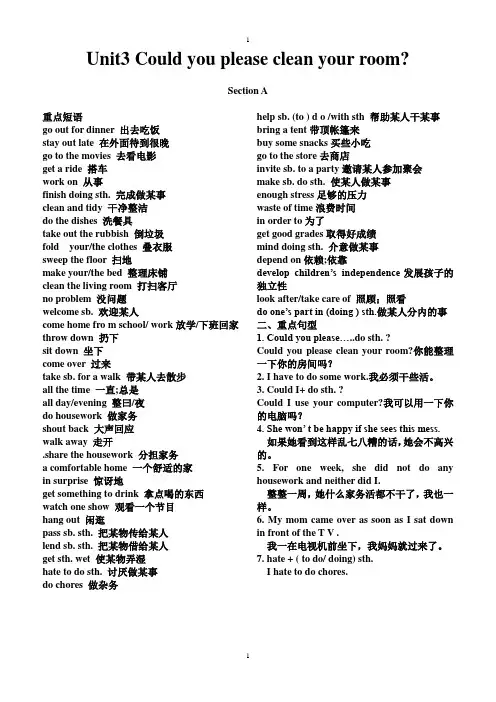
Unit3 Could you please clean your room?Section A重点短语go out for dinner 出去吃饭stay out late 在外面待到很晚go to the movies 去看电影get a ride 搭车work on 从事finish doing sth. 完成做某事clean and tidy 干净整洁do the dishes 洗餐具take out the rubbish 倒垃圾fold your/the clothes 叠衣服sweep the floor 扫地make your/the bed 整理床铺clean the living room 打扫客厅no problem 没问题welcome sb. 欢迎某人come home fro m school/ work放学/下班回家throw down 扔下sit down 坐下come over 过来take sb. for a walk 带某人去散步all the time 一直;总是all day/evening 整曰/夜do housework 做家务shout back 大声回应walk away 走开.share the housework 分担家务a comfortable home 一个舒适的家in surprise 惊讶地get something to drink 拿点喝的东西watch one show 观看一个节目hang out 闲逛pass sb. sth. 把某物传给某人lend sb. sth. 把某物借给某人get sth. wet 使某物弄湿hate to do sth. 讨厌做某事do chores 做杂务help sb. (to ) d o /with sth 帮助某人干某事bring a tent带顶帐篷来buy some snacks买些小吃go to the store去商店invite sb. to a party邀请某人参加聚会make sb. do sth. 使某人做某事enough stress足够的压力waste of time浪费时间in order to为了get good grades取得好成绩mind doing sth. 介意做某事depend on依赖;依靠develop children’s independence发展孩子的独立性look after/take care of 照顾;照看do one’s part in (doing ) sth.做某人分内的事二、重点句型1. Could you please…..do sth. ?Could you please clean your room?你能整理一下你的房间吗?2. I have to do some work.我必须干些活。
新人教版八年级英语(下册)第三单元知识点总结归纳
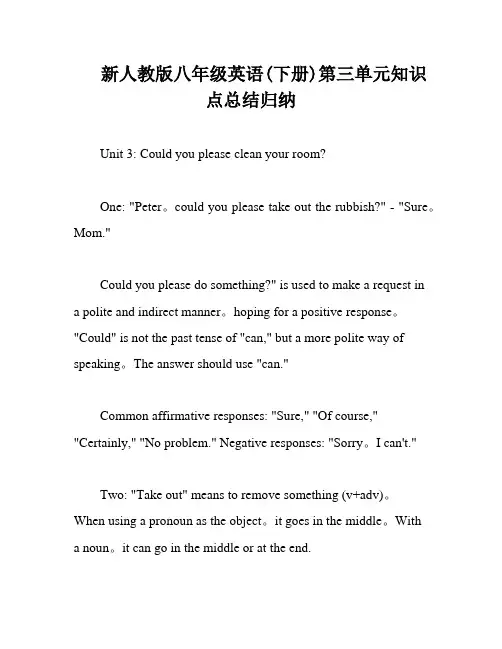
新人教版八年级英语(下册)第三单元知识点总结归纳Unit 3: Could you please clean your room?One: "Peter。
could you please take out the rubbish?" - "Sure。
Mom."Could you please do something?" is used to make a request in a polite and indirect manner。
hoping for a positive response。
"Could" is not the past tense of "can," but a more polite way of speaking。
The answer should use "can."Common affirmative responses: "Sure," "Of course," "Certainly," "No problem." Negative responses: "Sorry。
I can't."Two: "Take out" means to remove something (v+adv)。
When using a pronoun as the object。
it goes in the middle。
Witha noun。
it can go in the middle or at the end.Phrases using "take":Take out" means to bring something out or remove it.Please take out a piece of paper."Please take it out."Take。
人教版八年级下册英语第三单元知识点

人教版八年级下册英语第三单元知识点人教版八年级下册英语第三单元主要包括以下几个知识点:一、词汇1. 介词短语:such as(例如)、lots of(许多)、go on a trip (去旅行)、come up with(想出)、take part in(参加)、lots of fun(许多有趣的事情)等。
2. 形容词:broken(断掉的)、smelly(有气味的)、well-known(著名的)、quite(相当)、valuable(有价值的)等。
二、语法1. 定语从句:用来修饰名词或代词的从句。
关系代词有:that (指物)、which(指物)、who(指人)、whose(表示所属关系)、whom(表示宾语关系)。
常用引导定语从句的词有:that、which、who、whom、whose等。
例句:The storybook that she gave me is very interesting.(她给我的那本故事书非常有趣。
)2. 状语从句:用来修饰句子的从句。
常用引导状语从句的词有:when(表示时间)、where(表示地点)、while(表示时间)、because(表示原因)、if(表示条件)等。
例句:We will go to the zoo if it doesn't rain tomorrow.(如果明天不下雨,我们会去动物园。
)3. 强调句型:强调句型是通过使用强调副词或者借助强调式动词来强调某一部分内容。
例句:It was Alice who won the first prize in the speech contest.(是爱丽丝在演讲比赛中获得了第一名。
)三、阅读技巧1. 根据上下文推测词义:通过上下文的提示来推测生词的词义。
2. 找出关键句:在一篇文章中,找出关键句可以帮助我们更好地理解文章的主旨。
3. 圈点标记:在阅读过程中进行圈点标记,可以帮助我们更好地理解文章,并且方便日后复习。
八下英语人教版第三单元笔记
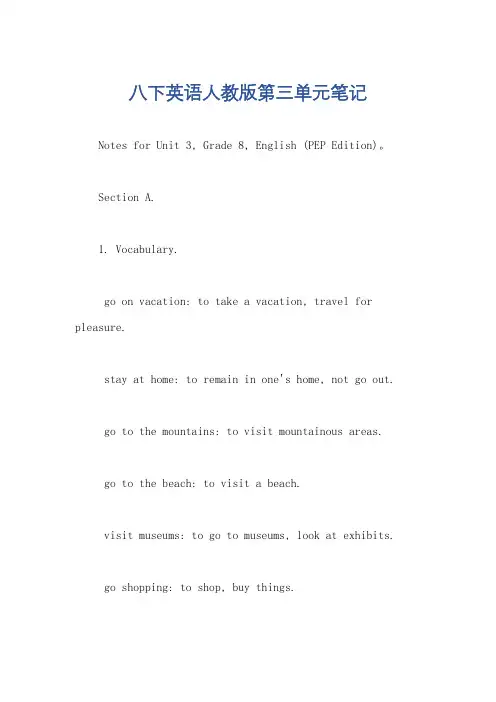
八下英语人教版第三单元笔记Notes for Unit 3, Grade 8, English (PEP Edition)。
Section A.1. Vocabulary.go on vacation: to take a vacation, travel for pleasure.stay at home: to remain in one's home, not go out.go to the mountains: to visit mountainous areas.go to the beach: to visit a beach.visit museums: to go to museums, look at exhibits.go shopping: to shop, buy things.go swimming: to swim, usually in a pool or the sea.go boating: to row a boat, usually on a lake or river. go skating: to skate, usually on ice.go walking: to walk, usually for pleasure or exercise.rent videos: to borrow movies or TV shows to watch at home.sleep a lot: to sleep a lot, usually due to beingtired or lazy.eat out: to eat meals outside the home, such as in a restaurant.something different: something unusual or unique.take photos: to capture images with a camera.buy gifts: to purchase presents for others.go hiking: to walk in the countryside or mountains for pleasure.quite a few: many, a considerable number.taste good: to have a pleasant flavor.have a good time: to enjoy oneself, have fun.feel like: to have a desire or inclination to do something.go to the summer camp: to attend a camp during the summer, usually for fun or to learn new skills.2. Grammar.Present Simple Tense: This unit reviews the present simple tense, which is used to describe habitual or routine actions, or actions that are true at the present moment. Verbs in this tense are conjugated with "-s" or "-es" forthird-person singular subjects (he/she/it). Example: "She always goes to the beach in the summer."Modal Verbs: The unit also introduces modal verbs such as "can," "could," "may," "might," "must," and "should." These verbs express possibility, necessity, obligation, or advice. Example: "You could try renting some videos for the weekend."3. Expressions and Sentences."What did you do last weekend?" Inquiry about someone's activities during the past weekend."I went to the mountains." Response stating where someone went during the weekend."Did you go with anyone?" Inquiry asking if the person went with someone else."No, I didn't. My family went there." Negative response with further explanation."What did you do?" General inquiry about someone's activities."I rented some videos and slept a lot." Response describing what the person did."Did you buy any special gifts?" Inquiry asking if the person purchased any unique gifts."Yes, I bought my mom a book." Positive response with details."How was your vacation?" Inquiry asking about someone's vacation experience."It was great!" Positive response expressing satisfaction.Section B.1. Vocabulary.camp: a temporary shelter or place where people stay for a short period of time, especially for outdoor activities.lake: a large body of fresh water surrounded by land.beach: a shore or margin of the sea or a large lake, usually with sand or gravel.bad weather: unpleasant or uncomfortable weather conditions.quite a bit: a considerable amount.quite a little: a considerable amount (used with uncountable nouns)。
初中英语人教新目标八年级下册Unit 3 SectionA预习指导(知识点+练习题)
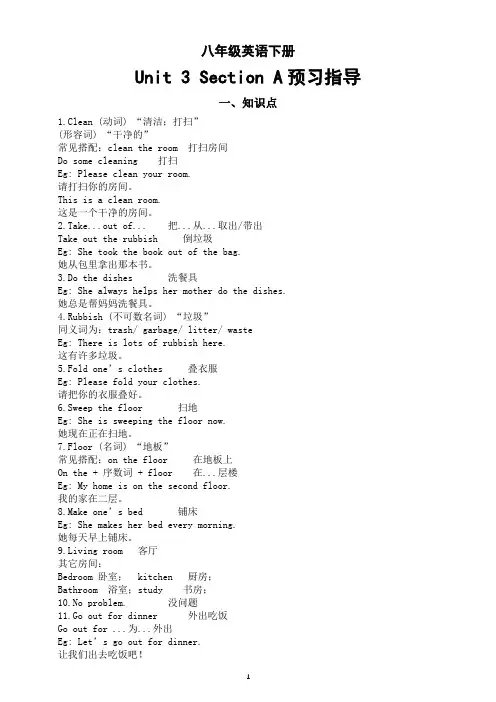
八年级英语下册Unit 3 Section A预习指导一、知识点1.Clean (动词) “清洁;打扫”(形容词) “干净的”常见搭配:clean the room 打扫房间Do some cleaning 打扫Eg: Please clean your room.请打扫你的房间。
This is a clean room.这是一个干净的房间。
2.Take...out of... 把...从...取出/带出Take out the rubbish 倒垃圾Eg: She took the book out of the bag.她从包里拿出那本书。
3.Do the dishes 洗餐具Eg: She always helps her mother do the dishes.她总是帮妈妈洗餐具。
4.Rubbish (不可数名词) “垃圾”同义词为:trash/ garbage/ litter/ wasteEg: There is lots of rubbish here.这有许多垃圾。
5.Fold one’s clothes 叠衣服Eg: Please fold your clothes.请把你的衣服叠好。
6.Sweep the floor 扫地Eg: She is sweeping the floor now.她现在正在扫地。
7.Floor (名词) “地板”常见搭配:on the floor 在地板上On the + 序数词 + floor 在...层楼Eg: My home is on the second floor.我的家在二层。
8.Make one’s bed 铺床Eg: She makes her bed every morning.她每天早上铺床。
9.Living room 客厅其它房间:Bedroom 卧室; kitchen 厨房;Bathroom 浴室;study 书房;10.No problem. 没问题11.Go out for dinner 外出吃饭Go out for ...为...外出Eg: Let’s go out for dinner.让我们出去吃饭吧!12.Go to the movies 去看电影类似词组:see the film 看电影Eg: They went to the movies last night.他们昨晚去看电影了。
人教版八年级下册英语第三单元知识点

人教版八年级下册英语第三单元知识点Unit 3 Could you please clean your room?一、重点短语1.go out for dinner出去吃饭2.stay out late在外面待到很晚3.go to the movies去看电影4.geta ride搭车5.work on从事6.cleanand tidy干净洁7.do the dishes洗餐具8.takeout the rubbish倒垃圾9.fold your/the clothes叠衣服10.sweepthe floor扫地11.make your/the bed整理床铺12.cleanthe living room打扫客厅13.no problem没问题14.welcomesb.欢迎某人e home fro m school/work放学/下班回家16.throw down扔下17.sit down坐下eover过来19.take sb.for a walk带某人去散步20.all the time总是21.all day/evening整日/夜22.dohousework做家务23.shout back大声回应24.walkaway走开25.a comfortable home一个舒适的家26.share the housework分担家务27.get some thing to drink拿点喝的东西28.insurprise惊讶地29.watch one show观看节目30.hangout闲逛31.pass sb.sth.把某物传给某人32.lend sb.sth.把某物借给某人33.get sth.wet使某物弄湿34.hate to do sth.讨厌做某事35.help sb.to do/with sth帮助某人干某事36.do chores做杂务37.bring a tent带顶帐篷来38.buy some snacks买些小吃39.invite sb to a party邀请某人参加聚会40.go to the store去商店41.make sb.do sth使某人做某事42.enough stress足够的压力43.a waste of time浪费时间44.inorder to为了45.get goodgrades取得好成绩46.minddoing sth.介意做某事47.developchildren’s independence发展孩子的独立性48.dependon依赖49.do ones part in(doing)sth.做某人分内的事50.look after/take care of 照顾;51.finish doing sth.完成做某事二、知识点解析1.“Could you please do sth.?”的答语以下两种情况:接受请求时可以用Yes,sure./Sure./Of course./Certainly./No problem./My pleasure./It’s my pleasure./With pleasure.等来回答拒绝请求时可以用Sorry./Sorry,I can’t.等来回答,还可以用Ihave to do sth.来解释其否定句是:“Could youplease not do sth.?”2.有关“家务劳动”有关的短语:takeout the rubbish/trash倒垃圾foldone’s clothes叠衣服sweepthe floor扫地cleanthe room打扫房间makeone’s/the bed铺床dothe dishes/wash the dishes洗餐具3.throw down扔下throwat扔向,掷向throw away扔掉例题:Recycling is good,so don’t__________bottles or newspapers.A.find outB.hand ine upD.throw away4.the minute表示“一…….就……”,相当于as soon as.(引导时间状语从句)e.g.:I’ll tell himthe minute he gets there.5.常见time的短语:all the time一直,总是at times不时,有时in time及时on time按时forthe first time第一次in no time立刻at any time随时bythe time到...的时候atthe same同时have a good/great/wonderful time玩的愉快例题:---Hurry up.It’s almost time for school.---Don’t worry.We are sure to be atschool__________.A.at timesB.on timeC.all the timeD.by the time6.as….as表示“和……一样”,之间要用形容词或副词的原级。
人教版八年级下册英语unit 3 语法+知识点
eg. We were amazed at the news. =We were amazed to hear the news. 我们对这个消息感到非常惊讶.
精品PPT
in a tree与 on a tree
精品PPT
3.when用作并列连词时,主句常用进行时态,从句则用 一般过去时,表示主句动作发生的过程中,另一个意想不 到的动作发生了。
I was walking in the street when someone called me. 我正在街上走时突然有人喊我。
精品PPT
4. when作并列连词,表示“(这时)突然”之意时,第 一个并列分句用过去进行时,when引导的并列分句用一般 过去时。
in(at) the front of 在……的前头,前排(列) (在一个范围内的前面部位) eg. She sat in the front of the bus. 她坐 在公交车的前排
精品PPT
get out of 与get into 是反义词
get into走进,进入 eg. He get out of the car and get into the building
Unit 3
What were you doing when the UFO arrived?
精品PPT
in front of 与in (at) the front of
in front of 在……的前面 (表示“有距离的前 面”,在一个参照物的前面) eg. There is a car in front of the house. 房子前面有一辆车
最新人教版八年级英语下册第三单元知识点汇总
最新人教版八年级英语下册第三单元知识点汇总Unit3 Could you please clean your room?1、take out 取出(v+ adv)【注】: 跟代词做宾语,代词放中间;跟名词做宾语,可放在中间,也可放在后边His teeth hurt badly. The dentist take them out .【短语】take out the trash 倒垃圾take a walk 散步take away 拿走,取走take back 收回take place 发生take off 脱下;起飞Peter ,could you please take out the trash? 彼得,你能把垃圾倒了吗?Could you please do sth ?请你(做)......好吗?用于提出请求,希望得到对方的肯定回答,说话的语气比较客气委婉。
Could 不是can的过去式,是委婉、礼貌的说法。
回答用can.【常用答语】肯定回答:Sure./ Of course./ Certainly./No problem. 否定回答:Sorry , I can’t Could I at least finish watching this show? 至少让我看完这个节目可以吗?1】Could I do a sth? 我可以做......吗?用于表达请求,语气比较委婉。
Could I go out with my classmate this weekend?2】at least 至少,多指数量或程度上的最低限度。
(反) at most 至少,不超过Now all of us exercise at least an hour a day and outside school.3】finish v 结束;完成finish doing sth 做完某事— Can you finish __reading__ these books before 10 o'clock? — Yes, I can.2. Can you do the dishes.?那你可以洗盘子吗?do the dishes 洗碗【结构1】do the +名词:do the dishes/ laundry 洗餐具/衣服【结构2】do the +动词-ing do the cleaning 打扫卫生【结构3】do one’s + 名词do one’s housework/ homework 做家务/家庭作业【结构4】do some +动词-ing do some reading/ shopping 读写书/购物3、Could you take out the rubbish,fold the clothes and do the dishes?你能把垃圾倒了。
人教版八年级下册英语 Unit 3 单元知识点总结(含练习题及答案)
人教版八年级下册英语Unit 3 单元知识点总结Section Augh v. & n. 笑We all laughed loudly when she made a joke. 她说了个笑话,我们都大声笑起来。
We all laughed at his joke. 听了他的笑话我们都笑起来。
He laughs best who laughs last. 谁笑在最后,谁笑得最好。
/不要高兴得太早。
(与at连用)嘲笑Don’t laugh at him. 别嘲笑他。
People have often laughed at stories told by seamen. 人们常常嘲笑海员所讲的故事。
Everyone laughed at his foolish antics. 大家都笑他那种愚蠢的滑稽动作。
N. 笑;笑声We had a good laugh at his joke. 我们被他的笑话逗得哈哈大笑。
2. though conj. 虽然;纵然;即使;尽管= althoughThough it was raining,he went there. 虽然当时正下着雨,他还是到那里去了。
Though he was poor he was happy. 虽然他很穷却很快乐。
注意:不能受汉语的影响,在though引导的从句后使用but。
如:Though he was poor,but he was happy.(误)though adv.. 不过,可是,然而,常用于句末,用逗号隔开。
Jim said that he would come, he didn’t , though.English is difficult to learn. I like it,though.英语难学,不过我喜欢它。
3. quietly轻声地,安静地,平静地quiet轻声的,安静的,平静的The students walked to a quiet place.同学们向一个安静的地方走去。
(完整版)人教版部编版八年级下册英语第三单元复习知识点梳理
(完整版)人教版部编版八年级下册英语第三单元复习知识点梳理
1. 语法知识点
- 一般现在时:表示经常性动作或现在的状态
- 一般过去时:表示过去发生或存在的动作或状态
- 现在进行时:表示现在正在进行的动作
- 过去进行时:表示过去某一时刻正在进行的动作
- 现在完成时:表示过去某一时刻发生的动作对现在产生的影响
- 过去完成时:表示过去某一时刻之前已完成的动作
2. 词汇知识点
- 动词的不定式
- 预先研究一些常见的动词短语
- 研究动词的过去分词形式
- 研究一些常见的形容词和副词
3. 句型知识点
- 肯定句:主语 + 动词 + 其他成分
- 否定句:主语 + 动词 + not + 其他成分
- 一般疑问句:助动词/系动词 + 主语 + 动词 + 其他成分?
- 特殊疑问句:疑问词 + 一般疑问句
4. 对话和情景交际
研究并熟悉课本中的对话和情景交际,理解对话中的语言表达和交流。
5. 阅读理解
通过阅读短文,理解文章大意,研究并掌握一些常见的词汇和表达方式。
6. 写作技巧
- 研究常用句式和表达方式
- 练写一些简短的句子和段落
- 注意语法和拼写错误的纠正
以上是人教版部编版八年级下册英语第三单元的复知识点梳理,希望对你的研究有所帮助。
*注意:此文档梳理的内容来源于人教版部编版八年级下册英
语教材,仅供参考学习使用。
*。