
全国高校网络教育考试委员会办公室统考问答解析
全国高校网络教育考试委员会办公室统考问答2005-5-16一. 关于统考的意义和重要性.1.什么是“统考”?2.为什么要进行统考?3.统考的依据是什么?4.统考要达到什么要求?二. 关于统考组织机构5.统考工作由谁来组织实试?网考委的职责是什么?6.网考办的职责是什么?7.考区办公室的职责是什么?8.全国设立哪些考区?9.统考考务工作由谁负责?三. 关于统考对象10.哪些学生需要参加统考?11.统考可以替代入学考试吗?四. 关于统考课程及考试科目12.统考课程包括哪些?13.高中起点本科学生的统考科目有哪些?14.专科起点本科学生的统考科目有哪些?五. 关于免考条件15.免考的条件包括哪些方面?可以免考哪些课程?16.哪些学生可以免考《大学英语》课程?17.如何理解“入学注册时年龄满40周岁”?18.目前大学英语等级证书考试正在改革,统考中《大学英语》课程的免考条件是否有改变?19.大学英语四、六级证书和计算机等级考试证书等免考条件是否有有效期规定?20.免考资格由谁审核?六. 关于统考内容21.各统考科目的考试范围及要求?22.《计算机应用基础》考试操作系统部分考哪个版本?23.公共外语为非英语的学生,《大学英语》课程考哪一档?七. 关于统考辅导用书24.统考课程是否采用统一教材?25.统考考试内容会超出考试大纲规定的范围吗?26.如何购买考试辅导用书?27.考试辅导用书是谁编写的?由哪里出版?八. 关于统考时间安排28.每年统考时间是怎样安排的?33.考试不通过,下次还能考吗?九. 关于统考报名及考试34.统考试点初期学生采用什么方式报名?35.统考考试收费标准是什么?如何缴费?36.统考报名后,考生是否可以修改报考科目等信息?37.参加统考时考生需携带什么证件?38.统考有效身份证件指哪些?39.统考准考证如何打印和领取?40.统考考试方式如何?十. 关于统考成绩41.统考考试成绩如何记录?42.统考考试成绩有何作用?43.统考成绩记入学籍档案吗?44.统考考籍档案包括哪些内容?45.统考考试合格有证书吗?46.考生如何查询统考成绩?47.统考成绩由谁发布?何时发布?48.《大学英语》听力考试分数占卷面成绩的比例是多少?49.《大学英语(A)》口试分数是多少?口试怎么进行?50.考生是否可以申请复核统考科目成绩?需履行怎样的手续?十一. 关于统考违纪违规处理51.对统考考生违纪违规情况如何处理及处罚?52.如何认定考试违纪?53.如何认定考试作弊?54.统考考试违纪或作弊由谁认定,由谁做出处理决定?55.在统考成绩公布后发现考生有作弊行为,如何处理?一. 关于统考的意义和重要性1.什么是“统考”?答:“统考”是指教育部对现代远程教育试点高校网络教育部分公共基础课实施的全国统一考试,即对我国网络高等学历教育部分公共基础课的全国统一测试,简称“统考”。
2.为什么要进行统考?答:在市场机制和宽进机制下,如何保证网络高等学历教育基本的人才培养质量,是教育部和所有试点高校网络教育学院共同关心的问题,也是社会关注的问题之一。
进行统考是为了促进我国网络高等学历教育健康、有序发展,切实提高网络高等学历教育的教学质量,提高网络高等学历教育的社会声誉而采取的重要措施之一。
3.统考的依据是什么?答:统考的主要依据是教育部和网考委的相关文件:(1)《教育部办公厅关于对现代远程教育试点高校网络教育学生部分公共课实行全国统一考试的通知》(教高厅[2004]2号);(2)《教育部关于开展现代远程教育试点高校网络教育部分公共课全国统一考试试点工作的实施意见》(教高[2004]5号);(3)《试点高校网络教育部分公共基础课统一考试试点工作管理办法(试行)》(网考委[2005]1号);(4)《试点高校网络教育部分公共基础课统一考试考试大纲》(网考委[2005]2号)。
4.统考要达到什么要求?答:统考的要求与成人高等教育本科相应的公共基础课的要求相一致。
根据现代远程教育的特点和应用型人才的培养目标,针对从业人员继续教育的特点,统考重在检验学生掌握基础知识的水平及应用能力。
二. 关于统考组织机构5. 统考工作由谁来组织实试?网考委的职责是什么?答:网考委是“全国高校网络教育考试委员会”的简称,是教育部组织成立的负责对统考工作具体组织落实的专家组织。
在教育部的领导下,网考委对统考工作进行决策、指导、咨询、研究和组织与实施。
网考委的主要职责是负责制定统考的实施意见和管理办法、审定考试大纲、制定考务标准、组织与管理命题和阅卷等工作,并进行有关统考的研究工作等。
6.网考办的职责是什么?答:网考委下设办公室,简称网考办。
网考办作为网考委的日常办事机构,执行网考委的决定,主要负责组织落实统考的有关具体工作。
包括组织制定考试大纲、命制试题、建设题库,考试组织过程的监督,信息发布,财务管理,组织研发与管理考试信息系统,进行有关统考的研究及对考试结果进行统计分析,并及时向网考委和教育部汇报有关统考工作的实施情况。
7.考区办公室的职责是什么?答:考区办公室的主要职责是负责阅卷及相关工作。
包括组织阅卷、登录成绩,考场违纪、作弊的登录,无效、雷同等违纪试卷的认定,以及成绩复核等。
8.全国设立哪些考区?答:网考委在全国设立8个考区,包括北京、沈阳、上海、杭州、武汉、广州、成都和西安等,每个考区设有一个考区办公室。
北京考区办公室分管北京市、天津市、河北省、山东省、山西省、内蒙古自治区等地区;沈阳考区办公室分管黑龙江省、吉林省、辽宁省等地区;上海考区办公室分管上海市;杭州考区办公室分管浙江省、江苏省、安徽省、江西省等地区;武汉考区办公室分管湖北省、湖南省、河南省等地区;广州考区办公室分管广东省、福建省、广西壮族自治区、海南省、港澳台等地区;成都考区办公室分管重庆市、四川省、贵州省、云南省、西藏自治区等地区;西安考区办公室分管陕西省、甘肃省、宁夏回族自治区、青海省、新疆维吾尔自治区等地区。
9.统考考务工作由谁负责?答:统考考务工作在网考委的领导下,主要由“中央广播电视大学现代远程教育校外教学支持服务体系”,即奥鹏远程教育中心承担。
中央广播电视大学对考务工作负有领导和协调责任。
三. 关于统考对象10. 哪些学生需要参加统考?答:教育部批准的现代远程教育试点高校和中央广播电视大学“人才培养模式改革和开放教育试点”项目中自2004年3月1日(含3月1日)以后入学的本科层次网络学历教育的学生(含高中起点本科、专科起点本科)应参加试点高校网络教育部分公共基础课统一考试。
对2004年3月1日以前入学的本科层次网络学历教育的学生只进行抽测, 试点初期不进行统考。
怎么抽测待定。
对高中起点专科和研究生教育层次的学生暂不进行统考。
11.统考可以替代入学考试吗?答:统考是对在读的部分学生进行的考试,即是对经入学考试已录取的学生进行的基础课考试,所以统考不能替代入学考试,入学考试也不能替代统考。
四. 关于统考课程及考试科目12.统考课程包括哪些?答:包括《大学英语》、《计算机应用基础》、《大学语文》和《高等数学》四门课程。
统考科目按不同学历起点和专业类别确定。
13.高中起点本科学生的统考科目有哪些?答:高中起点本科学生的统考科目如下:专业分类请参照教育部公布的专业目录14.专科起点本科学生的统考科目有哪些?答:专科起点本科学生的统考科目如下:专业分类请参照教育部公布的专业目录五. 关于免考条件15.免考的条件包括哪些方面?可以免考哪些课程?答:(1)已具有国民教育系列本科以上学历(含本科)的学生,可免考全部统考科目;(2)除计算机类专业学生外,获得全国计算机等级考试一级、或一级A、或一级B或以上级别证书者可免考“计算机应用基础”;其他计算机等级证书获得者目前不能免考该课程;(3)除英语专业学生外,获得大学英语等级考试(CET)4级或以上级别证书者、全国公共英语等级考试(PETS)三级或以上级别证书者、省级教育行政部门组织的成人教育学位英语考试合格证书者,可免考“大学英语”;(4)在入学注册时年龄满40周岁的非英语专业学生可免考“大学英语”;(5)除英语专业考生外,户籍在少数民族聚居地区的少数民族学生(参见《教育部关于开展现代远程教育试点高校网络教育部分公共基础课全国统一考试试点工作的实施意见》(教高[2004]5号)的附件:免考“大学英语”的少数民族学生的界定)可免考“大学英语”。
16.哪些学生可以免考《大学英语》课程?答:具备以下条件之一者可免考《大学英语》课程:(1)已具有国民教育系列本科以上学历(含本科)的学生;(2)除英语专业学生外,获得大学英语等级考试(CET)4级或以上级别证书者、全国公共英语等级考试(PETS)三级或以上级别证书者、省级教育行政部门组织的成人教育学位英语考试合格证书者;(3)在入学注册时年龄满40周岁的非英语专业学生;(4)除英语专业考生外,经界定的户籍在少数民族聚居地区的少数民族学生(参见《教育部关于开展现代远程教育试点高校网络教育部分公共基础课全国统一考试试点工作的实施意见》(教高[2004]5号)附件:免考“大学英语”的少数民族学生的界定)。
17.如何理解“入学注册时年龄满40周岁”?答:“入学注册时年龄满40周岁”是指按学生本人身份证上的出生日期为计算起点,在所就读的试点高校网络教育学院实际入学注册日期为终点进行计算的年龄。
18.目前大学英语等级证书考试正在改革,统考中《大学英语》课程的免考条件是否有改变?答:目前暂无改变。
我们已经注意到大学英语等级证书考试目前正在改革,网考办将在其正式公布新规定以后,对统考文件中涉及该证书的一些条款进行修订。
19.大学英语四、六级证书和计算机等级考试证书等免考条件是否有有效期规定?答:目前暂无有效期限制。
20.免考资格由谁审核?答:免考资格由所属试点高校网络教育学院负责审核。
本校免考学生名单需公示,并报网考办备案。
六. 关于统考内容21.各统考科目的考试范围及要求?答:各统考科目的考试范围以网考委颁发的《试点高校网络教育部分公共基础课统一考试考试大纲》为依据。
命题将结合现代远程教育和培养目标的特点,体现应用型人才培养要求,既考核学生对基本理论、基本知识和基本技能的掌握,也将考核学生应用知识的能力、分析问题和解决问题的能力。
22.《计算机应用基础》考试操作系统部分考哪个版本?答:Win2000。
23.公共外语为非英语的学生,《大学英语》课程考哪一档?答:公共外语为非英语的学生,《大学英语》课程考“大学英语(c)”。
非英语的外语专业学生,《大学英语》课程考“大学英语(B)”。
七. 关于统考辅导用书24.统考课程是否采用统一教材?答:统考不指定统一教材,但采用统一考试大纲和考试辅导用书。
全国高校网络教育考试委员会办公室电函
全国高校网络教育考试委员会办公室电函
网考电函[2009]20号
关于公布2007-2008年度统考评优
先进单位和个人名单的通知
为了进一步提高统考各环节组织工作的管理实施水平,激发参与统考工作的单位和个人的积极性,经教育部、网考委批准,在认真总结统考各环节工作的基础上,网考办组织开展了对统考各参与单位和相关人员的评优工作,并向各试点高校和相关单位下发了《关于开展试点高校网络教育部分公共基础课统一考试总结评优工作的通知》(网考电函[2008]49号),各单位根据通知要求积极申报了统考评优材料。
网考办根据统考评优申报材料和统考报名组织、考务组织、技术支持、考风考纪、阅卷、考试成绩合格率及违纪作弊率等各项工作实际,组织有关专家评审、召开专门会议研究,评审出2007-2008年度试点高校网络教育统考工作优秀单位和先进个人,并予以公示。
经过公示,最后确定出该年度“统考工作优秀单位82个”、“先进个人422名”。
具体单位和个人名单,详见附件。
特此通知。
附件:
1、2007-2008年度试点高校网络教育统考工作优秀单位名单
2、2007-2008年度试点高校网络教育统考工作先进个人名单
全国高校网络教育考试委员会办公室
2009年5月13日
附件1
2007-2008年度试点高校网络教育
统考工作优秀单位名单
(共82个)
(排名不分先后,以下表第二列“单位或部门”按汉语拼音排列)
附件2
2007-2008年度试点高校网络教育
统考工作先进个人名单。
网络教育开放教育远程教育成人教育英语全国统考试题及标准答案

高校网络教育部分公共基础课全国统一考试大学英语试卷来源:全国高校网络教育考试委员会办公室注意事项一、将你的姓名、考号填写在答题卡的规定栏内,将考号和考试科目在规定的栏内用2B铅笔涂满涂黑。
考试结束后,把试卷和答题卡放在桌上。
试卷和答题卡均不得带出考场。
二、仔细读懂题目的说明,并按题目要求答题。
答案一定要写在答题卡的指定位置上,写在试卷上的答案无效。
三、选择题用2B铅笔将选中项涂满涂黑,主观题用蓝、黑圆珠笔或钢笔答题,使用铅笔答题无效。
第一部分:英语知识运用(共10小题;每小题2分,满分20分)此部分共有10个未完成的对话,针对每个对话中未完成的部分有4个选项,请你从A、B、C、D四个选项中,选出可以填入空白处的最佳选项,并用铅笔将答题卡上的相应字母涂黑。
示例〔A〕〔B〕D〕1. —Good-bye and thank you very much for a wonderful time.—_____. Hope to see you again.A. Thank you for your comingB. Not at allC. It was nothingD. Never mind2. —Could you show me your passport?—_____.A. Yes, I couldB. SureC. I haven’t it with meD. I don’t want to3. —Would you mind if I turned the radio up?—_____.A. Yes, pleaseB. No, go aheadC. No, thank youD. Yes, that’ll be right4. —We are going to London for holiday next week. Would you mind taking care of my garden while we’re away?—Not at all. _____.A. Sorry, I h ave no timeB. I’d rather notC. With pleasureD. No, I wouldn’t5. —Please help yourself to the fish.—_____.A. Thanks, but I don’t like fishB. Sorry, I can’t helpC. Well, fish don’t suit forD. No, I can’t6. —Would you like to have dinner with me this Saturday, Mr. Wang?—_____.A. Oh, no. Let’s notB. I’d rather stay at homeC. I’d love to, but I have a meeting that dayD. Thank you7. —Excuse me, is there a park here?—_____.—Thank you all the same.A. I don’t want to tell youB. Yes, there isC. No, there isn’tD. Sorry, I don’t know8. —Mike, I am going to skate in the mountains tomorrow.—Oh, really? _____.A. Good luckB. Thank youC. Have a good timeD. Congratulations9. —I am sorry for what I have said to you.—_____.A. It’s just too badB. No problemC. Don’t think any more about itD. I’m sure about that10. —I wonder if I could use your dictionary?—Sure. _____.A. Go onB. Here you areC. Go upD. Here are you第二部分:阅读理解(共20小题;每小题2分,满分40分)此部分共有4篇短文,每篇短文后有5个问题,每个问题后有4个选项,请你从A、B、C、D四个选项中,选出可以填入空白处的最佳选项,并用铅笔将答题卡上的相应字母涂黑。
远程教育网络教育常见一些问题

远程教育疑难问题解答1、什么是网教?网络教育是远程教育的现代化表现,远程教育是一种同时异地或异时异地进行教育的形式。
我们认为迄今为止,远程教育经历了三代历程:传统的远程教育、广播电视远程教育和网络教育。
传统的远程教育首指函授、刊授教育。
最早的函授教育起源于1840 年的英国,当时英国速记法发明人伊萨克.皮特曼通过邮寄方式教速记,教育界一般就认为这便是世界函授教育的开端。
广播电视远程教育起步于本世纪60 年代,在近二十多年来得到了巨大的发展。
由多媒体计算机技术和网络通讯技术在教育中充分利用而演绎出来的现代远程教育,一般被称为第三代远程教育,即网络教育。
2、网教国家承认吗?答案是肯定的。
网络教育亦称远程教育,它与成人自考、成人高考、广播电大组成成人教育四大模式。
这四种模式都是教育部批准的,所颁发的学历证书国家承认其有效性,在教育部指定机构进行电子注册,且在官网()上可以查询。
3、网教的名校是哪所截止到目前,国家批准68所高校可以开展远程学历教育,即网络学历教育,国家承认学历,电子注册,教育部指定网站可进行查询,这68所高校名单如下:北京大学、中国人民大学、清华大学、北京交通大学、北京航空航天大学、北京理工大学、北京科技大学、北京邮电大学、中国农业大学、北京中医药大学、北京师范大学、北京外国语大学、北京语言大学、中国传媒大学、对外经济贸易大学、中国科学技术大学、中央音乐学院、南开大学、天津大学、大连理工大学、东北大学、中国医科大学、东北财经大学、吉林大学、东北师范大学、哈尔滨工业大学、东北农业大学、复旦大学、上海交通大学(含医学院)、华东理工大学、东华大学、华东师范大学、上海外国语大学、南京大学、东南大学、江南大学、浙江大学、厦门大学、福建师范大学、山东大学、中国石油大学(华东)、郑州大学、武汉大学、华中科技大学、中国地质大学(武汉)、武汉理工大学、华中师范大学、湖南大学、中南大学4、网教怎么报名,有条件限制吗,什么时间报名?根据教育部相关要求,同学如想报名远程教育需具备以下三个条件:A.报读高中起点专科的学生,须具有高中、职业中学、中等专业学校毕业证书,年满18周岁。
全国高校网络教育考试委员会办公室电函解析
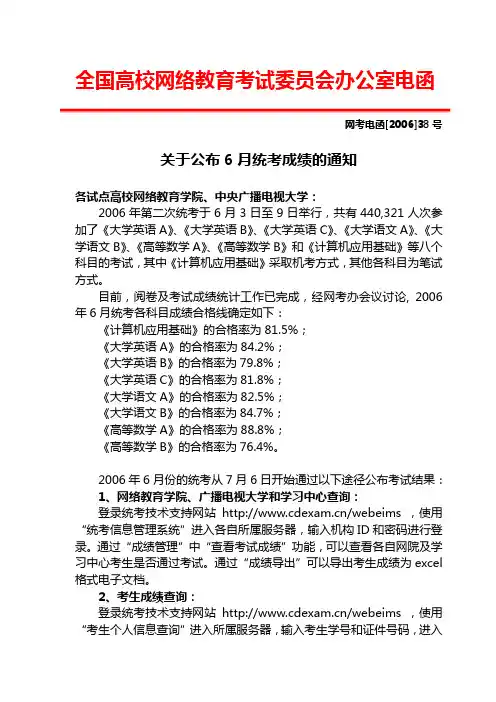
全国高校网络教育考试委员会办公室电函网考电函[2006]38号关于公布6月统考成绩的通知各试点高校网络教育学院、中央广播电视大学:2006年第二次统考于6月3日至9日举行,共有440,321人次参加了《大学英语A》、《大学英语B》、《大学英语C》、《大学语文A》、《大学语文B》、《高等数学A》、《高等数学B》和《计算机应用基础》等八个科目的考试,其中《计算机应用基础》采取机考方式,其他各科目为笔试方式。
目前,阅卷及考试成绩统计工作已完成,经网考办会议讨论, 2006年6月统考各科目成绩合格线确定如下:《计算机应用基础》的合格率为81.5%;《大学英语A》的合格率为84.2%;《大学英语B》的合格率为79.8%;《大学英语C》的合格率为81.8%;《大学语文A》的合格率为82.5%;《大学语文B》的合格率为84.7%;《高等数学A》的合格率为88.8%;《高等数学B》的合格率为76.4%。
2006年6月份的统考从7月6日开始通过以下途径公布考试结果:1、网络教育学院、广播电视大学和学习中心查询:登录统考技术支持网站/webeims ,使用“统考信息管理系统”进入各自所属服务器,输入机构ID和密码进行登录。
通过“成绩管理”中“查看考试成绩”功能,可以查看各自网院及学习中心考生是否通过考试。
通过“成绩导出”可以导出考生成绩为excel格式电子文档。
2、考生成绩查询:登录统考技术支持网站/webeims ,使用“考生个人信息查询”进入所属服务器,输入考生学号和证件号码,进入查看,可以看到成绩是否合格。
3、考生也可通过手机短讯方式查询(1.5元/次),方法如下:考试科目共四科,考生查分需要发送"考试科目字母+考号"到相应的查分号码,如发送A1234567890,各科目字母代码如下:A大学英语B大学语文C高等数学D计算机应用基础中国移动手机用户:发送"科目代码+考号"到3355466,如发送A1234567890到3355466中国联通手机用户:发送"科目代码+考号"到9355466,如发送B1234567890到9355466小灵通网通用户:发送"科目代码+考号"到19355466,如发送C1234567890到19355466小灵通电信用户:发送"科目代码+考号"到9855466,如发送D1234567890到9855466各试点高校考生的考试成绩合格名单书面通知将另发。
2.设函数,则().A.B解读

座位号试点高校网络教育部分公共基础课全国统一考试高等数学(B )试卷来源:全国高校网络教育考试委员会办公室2005年12月一、选择题(满分20分)本大题共5个小题,每小题4分。
在每小题给出的四个选项中,只有一项符合题目要求,把所选项前的字母填在题后的括号内。
1.()1lim12e a xx x →+=,则常数a =( ).A .2-B .12-C .12D .22.设函数()()ln 2f x x =,则()d f x =( ). A .2d x x B .1d x xC .1d 2x xD .2d x x3.函数()2ln 2y x =+单调增加区间为( ).A. ()1,1-B. (),0-∞C.()0,+∞D.(),-∞+∞4.设二元函数3z xy =,则()1,1zx ∂=-∂( ).A .3-B .2-C .2D .35.设函数()f x 在[],a b 上连续, 则()()d d bbaaf x x f t t -⎰⎰( ) .A. 大于零B. 小于零C. 等于零D. 符号不能确定二、填空题(满分28分)本大题共7个小题,每小题4分。
把答案填在题中横线上。
6.23lim31x x x →∞+=- .7.曲线23812y x x x =-+的凹区间为 .8.设函数()2ln f x x =,则()2f '= .9.若sin xx为函数()f x 的一个原函数,则()d f x x =⎰ +C . 10.π20sin d x x =⎰.11.设区域D 为0x a ≤≤,02y a≤≤()0a >,且d d 8Dx y =⎰⎰,则常数a = .12.微分方程d 1d yx x+=的一个解是 . 三、解答题(满分52分)本大题共7个小题。
解答应写出推理、演算步骤。
13.(本题满分7分)求极限()20ln 1lim x x x x →-+.14.(本题满分8分)设函数 ()y y x = 由方程sin πx y y ++=所确定,求 d d y x , π,=0d d x y yx= .15.(本题满分7分)计算定积分()π-π1cos d x x x +⎰.16.(本题满分7分)设二元函数()sinz x y =-,求:(1)z x ∂∂,(2)z y∂∂,(3)d z .17.(本题满分9分)计算二重积分d d Dx x y ⎰⎰,其中D 是由直线y x =,2x =及x 轴围成的区域.18.(本题满分9分)求微分方程ln d ln d y x x x y y =满足e ey x ==的特解.19.(本题满分5分)已知曲线l :21y x x=+,求(1)曲线l 与x 轴的交点()00,A x y ;(2)点A 处曲线l 的切线方程.。
全国高校网络教育公共基础课统一考试解析

主讲人
湖南广播电视大学外国语学院 魏晓鹏
2008年
提 纲
背景
考试大纲分析
考试指南与样题分析
背景
考试目的:加强网络教育规范管理,确保质量, 促进网络教育健康、有序发展 《大学英语(B)》全国统考是现代远程教育试点高 校网络教育实行全国统一考试的部分公共基础课 之一。是一种基础水平检测性考试,考试合格者 应达到与成人高等教育本科相应的大学英语课程 要求的水平。 考试级别:非英语专业学生要求参加大学英语(B)
考试大纲
考试对象与时间
考试目标
考试内容与要求
试卷结构与题型
考试方式与时间
考试对象
2004年3月1日以后入学的以下学生:
现代远程教育试点普通高校的本科层次网络
学历教育的学生
中央广播电视大学“人才培养模式改革与开
放教育试点”项目的本科层次学历教育的学
生
考试对象
统考免考的规定:
获得大学英语等级考试(CET)4级及以上级别证书者 (在2006年1月1日前,已经获得四、六级考试证书的考生仍然 按照原有规定免考“大学英语”;参加改革后的四、六级考试, 成绩达到420分的考生可免考“大学英语”。2006年1月1日后, 大学英语四、六级考试将不再作为统考“大学英语”免考的条 件。) 全国公共英语等级考试(PETS)3级及以上级别证书者 省级教育行政部门组织的成人教育学位英语考试合格证书者 入学注册时年龄满40周岁的非英语专业学生 户籍在少数民族聚居地区的少数民族学生
Must I do…? May I do…? Can I do…?
交际用语之请求及回答
Would/Do you mind doing sth.?
网络教育问答.
网络教育问答1、现代远程教育学历证书国家是否承认?答:自1999年以来,教育部批准68所普通高校学校和中央广播电视大学开展现代远程教育试点工作,允许上述68所试点高校在校内开展网络教学工作的基础上,通过现代通信网络,开展学历教育和非学历教育。
对达到本、专科毕业要求的学生,由学校按照国家有关规定颁发高等教育学历证书,学历证书电子注册后,国家予以承认。
2、开放式教育学历证书国家是否承认?答:中央广播电视大学“人才培养模式改革和开放教育试点”项目是现代远程教育试点工作的一个部分,由其培养的达到本、专科毕业要求的学生,由学校按照国家有关规定颁发高等教育学历证书,学历证书电子注册后,国家予以承认。
3、哪些现代远程教育毕业证书国家承认?答:教育部批准了68所高等学校开展现代远程教育试点,对这68所高校培养的达到本、专科毕业要求的网络教育学生,由学校按照国家有关规定颁发高等教育学历证书,学历证书电子注册后,国家予以承认。
这68所现代远程教育试点高校名单如下:北京 17所北京大学、中国人民大学、清华大学、北京交通大学、北京航空航天大学、北京理工大学、北京科技大学、北京邮电大学、中国农业大学、北京中医药大学、北京师范大学、北京外国语大学、北京语言大学、中国传媒大学、对外经济贸易大学、中国科学技术大学、中央音乐学院上海 8所上海交通大学(含医学院、复旦大学、同济大学、华东理工大学、东华大学、上海外国语大学、华东师范大学东北 8所东北大学、东北师范大学、东北农业大学、吉林大学、哈尔滨工业大学、大连理工大学、中国医科大学、东北财经大学四川 6所四川大学、西南交通大学、电子科技大学、西南科技大学、西南财经大学、四川农业大学湖北 5所华中科技大学、中国地质大学(武汉、武汉理工大学、华中师范大学、武汉大学陕西 4所西安交通大学、西北工业大学、西安电子科技大学、陕西师范大学广东 3所华南理工大学、华南师范大学、中山大学江苏 3所南京大学、东南大学、江南大学福建 2所厦门大学、福建师范大学湖南 2所湖南大学、中南大学山东 2所山东大学、中国石油大学(华东天津 2所天津大学、南开大学重庆 2所重庆大学、西南大学安徽 1所中国科学技术大学甘肃 1所兰州大学河南 1所郑州大学浙江 1所浙江大学4、教育部对现代远程教育有何规定?如何查找这些规定?答:教育部从1999年启动现代远程教育试点工作以来,下发了一系列文件,对现代远程教育试点工作的招生、教学、教学管理、支持服务、资源建设、考试等各方面都做了严格的规范和要求。
统考常见问题-中国现代远程与继续教育网
统考常见问题1、高中起点的本科学生应报考的统考科目有哪些?答:高中起点本科学生的统考科目如下:专业分类请参照教育部公布的专业目录2、专科起点的本科学生应报考的统考科目有哪些?答:专科起点本科学生的统考科目如下:专业分类请参照教育部公布的专业目录3、具备哪些条件可以免考哪些统考科目?答:各类免考条件及其适用的学生范围和免考科目情况如下:注:2006年1月1日后大学英语四、六级考试将不再作为统考“大学英语”免考的条件。
4、怎样办理免考?答:办理免考需要以下手续:⑴学生持免考证明材料原件到所在学习中心申请免考;⑵学习中心对学生的免考证明材料原件进行初审,初审合格填写“免考申请表”;⑶学习中心向网络教育学院及省级电大报送学生的免考证明材料原件的扫描件或复印件和“免考汇总表”;⑷网络教育学院对免考申请材料进行审核并统一汇总报送网考办备案;省级电大对免考申请材料进行审核并报送中央电大,由中央电大统一汇总报送网考办备案。
5、统考时间是怎么样安排的?答:一般每年的统考计划安排3次,分别在4月、9月和12月进行。
每次具体考试时间将提前在中国远程与继续教育网()上公布。
学生可以根据自己的情况,自行选择参加考试的时间和科目。
6、统考信息管理系统里的考生基本信息数据是由谁报送的?答:统考信息管理系统里的考生基本信息是从学信网中获取。
而学信网学生基本信息的最初来源是由各试点高校向“高校网络教育阳光招生服务平台”上报完成。
7、考生和统考信息管理系统里的考生基本信息关联不上怎么办?答:考生如果发现基本信息有误,无法进行基本信息关联,可以与试点高校网络教育学院和省级电大联系,由试点高校网络教育学院和省级电大向网考办提出修改申请。
8、报考时查不到考生信息怎么办?答:考生报考时查不到基本信息,请及时与试点高校网络教育学院和省级电大联系进行查询。
9、第一次参加统考的考生如何注册及登陆统考信息管理系统?答:第一次参加统考的考生可以通过以下方式注册及登陆统考信息管理系统:⑴登陆中国远程与继续教育网(),在统考报名栏目里使用“网院考生入口或电大考生入口”点击进入注册。
__网考英语B_大学英语B
试点高校网络教育部分公共基础课全国统一考试大学英语B试卷来源:全国高校网络教育考试委员会办公室2005年12月注意事项一、将你的考号、姓名填写在答题纸的规定栏内。
考试结束后,把试卷和答题纸放在桌上。
试卷和答题纸均不得带出考场。
二、仔细读懂题目的说明,并按题目要求答题。
答案一定要写在答题纸的指定位置上,写在试卷上的答案无效。
三、用蓝、黑圆珠笔或钢笔答题,使用铅笔答题无效。
四、第一至第四部分的答案在答题纸上相应的字母上划横线。
Part I Listening Comprehension (20 points)Section ADirections:In this section you will hear ten short conversations. At the end of each conversation, aquestion will be asked about what was said. Both the conversation and the question will bespoken twice. After each conversation, there will be a pause. During the pause, youshould read the four choices marked A, B, C and D, and decide on the best answer. Then mark the corresponding letter on the Answer Sheet with a single line through the center.1. A. At home. B. At school.C. In a restaurant.D. In the office.2. A. Spain.B. Greece.C. Switzerland.D. Italy.3. A. 3.B. 6.C. 9.D. 12.4. A. He misses the lecture.B. He shares the woman’s opinion.C. He disagrees with the woman.D. He was not interested in the lecture.5. A. Chocolate cake. B. Ice-cream.C. Nothing.D. Candy.6. A. Her ring.B. Her suitcase.C. Her key.D. Her passport.7. A. Find out the information by himself.B. Wait while she gets the information.C. Call back later.D. Go to the museum directly.8. A. The walk will last for the whole day.B. The weather is not very pleasant.C. She is not interested in walking.D. She would like to come along.9. A. A letter.B. A postcard.C. A complaint.D. A present.10. A. The bus will probably arrive at 8:50.B. The bus has broken down.C. The snowstorm stopped all traffic.D. The bus driver had an accident.Section BDirections:In this section you will hear a conversation. The conversation will bespoken twice. There are five questions about the conversation. For each question there are four choices marked A, B, C and D. Decide on the best answer andthen mark the corresponding letter on the Answer Sheet with a single line through the center.11. When will Mary be leaving for vacation?A. In fourteen days.B. In two week’s time.C. On June 4th.D. On June 14th.12. Why does Mary prefer the beach?A. Because she has never been to the beach.B. Because she hasn’t made any hotel reservations.C. Because it is cooler there in June.D. Because she wants to relax there.13. Where is Mary going to stay while she is on vacation?A. In her own car.B. In a small hotel nearthe beach.C. With her friends.D. In a tent borrowedfrom her friends.14. Where is Bill going to have his vacation?A. At the beach, too.B. At home.C. He has not thought about it yet.D. He is not going tohave it.15. Why does Bill say that Marry is lucky?A. Because Mary is going to have a long vacation.B. Because Mary has chosen a nice place for the vacation.C. Because the weather in the beach area is good for vacation.D. Because Mary can find a place to stay at the beach in June.Section CDirections:In this section you will hear a passage. The passage will be read twice. There are five questions about the passage. For each question there are four choices marked A, B, C and D. Decide on the best answer and then mark the corresponding letter on the Answer Sheet with a single line through the center.16. Which of the following groups of people can join the library?A. All teachers.B. High school students.C. University students.D. Army officers.17. Why can’t the library issue library cards to everyone who applied?A. Because it takes too long to process all the applications.B. Because its resources are limited.C. Because there are not enough staff members.D. Because it is a library for special purposes.18. What would the library do if a reader fails to return the video on time?A. Ask him to apply again.B. Cancel his video card.C. Not approve his application.D. Not allow him to borrow anyitems.19. How many items can be borrowed at one time?A. 1.B. 2.C. 3.D.4.20. For how long can a reader keep a book before he returns it?A. 1 month.B. 2 months.C. 1 week.D. 2weeks.Part II Use of English (10 points)Directions: In this part there are 10 incomplete dialogues. For each dialogue there are four choices marked A, B, C and D. Choose the ONE answer that best completes the dialogue. Then mark the corresponding letter on the Answer Sheet with a single line through the center.21. —I'm afraid I've got a terrible flu.—____________________________.A. Never mindB. Keep away from meC. Better go and see a doctorD. You need be more careful22. —It’s cold in here. Do you mind if I close the door?—____________________________.A. With pleasureB. Yes, pleaseC. Of course notD. Thank you23. —I’m going to America for a holiday next week.—____________________________!A. GoodbyeB. Wish you successC. For sureD. That’s great24.—What a beautiful dress you’re wearing!—____________________________.A. No, thanksB. Thank youC. Yes, it isD. Sorry, it isn’t25.—Would you like a cup of coffee?—____________________________.A. It’s very kind of youB. No, I wouldn’tC. Yes, pleaseD. Here you are26. — Can I help you with your luggage?—____________________________.A. Thank you. I can manage it myselfB. No way. I can do it myselfC. No, I don’t need your helpD. You do your things, please27. — This is the worst film ever produced. Do you think so?—____________________________.A. You’re wrongB. I don’t think so, I’m afraidC. Not at allD. No, that’s not real28.—Can I borrow your camera for a week?—____________________________.A. Sure, here you areB. Yes, you can borrowC. Yes, bring it with youD. It doesn’t matter29. —Sorry, I have kept you waiting.—____________________________.A. That’s all rightB. I don’t car eC. I’m sadD. No, not at all30. —When your classmate can’t follow you, what will he say to you?— He will say, “____________________________”A. Can you say for a second time?B. Pardon?C. I don’t understand anything.D. What you said was nonsense.Part III Reading Comprehension (30 points)Directions: There are three passages in this part. Each passage is followed by five questions. For each question there are four choices marked A, B, C and D. You should decide on the best choice and mark the corresponding letter on the Answer Sheet with a single line through the center.Passage 1Why was Bastille important to the citizens of Paris?The building of the Bastille had been started in 1370 under Charles V. By the seventeenth century ithad stopped to be important for defense. Cardinal Richelieu turned it into a prison. It was not an ordinary prison to punish common crimes. Its huge doors closed only on enemies of the King. The Bastille’s workings were secret. Prisoners were taken to it in closed vehicles. Soldiers on guard duty had to stand with their faces to the wall. No talking was allowed. Worst of all, a prisoner never knew if he would be there a day, a week, a year, or forever. Only the King’s letter could set him free.Over the years the number of arrests by King’s letter had become fewer. By the time of its fall, most of the prisoners were writers who had written against the corruptions (贪污腐败) of the government. Voltaire, the famous French writer, spent a year there in 1717-1718, and another 12 days in 1726.For those who believed in free speech and free thinking, the Bastille stood for everything evil. The day it was captured, only seven prisoners were found inside. Still, the Bastille was hated by the people. It was a symbol of the King’s complete power.31. The Bastille became a prison ___________.A. since the time of Charles VB. since 1370C. in the seventeenth centuryD. since the time of Cardinal Richelieu32. According to the passage, which of the following statements is NOT true?A. Anyone who did something wrong could find himself suddenly in theBastille.B. The Bastille was only for those who were opposed to the King.C. Things done in the Bastille were hardly known to people outside.D. Voltaire was twice put in the Bastille.33. At the time of its fall, the Bastille housed _____________.A. a large number of prisonersB. a lot of writers who had been against the governmentC. some dozens of people who believed in free speech and free thinkingD. only a few prisoners34. Which of the following statements is TRUE according to the passage?A. All prisoners in the Bastille had to stay there for life.B. Over the years the number of prisoners in the Bastille was getting biggerand bigger.C. The King could put people in or let them out of the Bastille as hewanted.D. At the time it was captured, there were so few prisoners in it that itmeant little to the people.35. This passage mainly ________________.A. tells how the prisoners were controlled by the KingB. tells how little was known about the BastilleC. shows the inner workings of the BastilleD. gives a brief history of the BastillePassage 2The resources of the library can be helpful evenwhen we are doing something very informal, such as trying to devise (设计) a better way to measure attitudes toward music or looking for a better way to teach mathematics. The library can be equallyhelpful when we are doing something very formal, such as writing a dissertation (学位论文) or preparing an article for publication in a professional journal. In either case, our goal should be to use the library as a useful tool to help us understand and solve our problem.The following sections of this chapter will describe specificresources available in many libraries. In some cases you may already be aware ofaresource andmay use it frequently andsuccessfully. In other cases you may be completely unfamiliar with aresource. Your goal should be to become aware of what is available andto know how touseeach ofthese resources to help you solve theproblem they are designed to solve.When educators have a piece of informationthat they want to share with their colleagues, they often make this information available inprofessional journals or at professional meetings.It wouldoften be useful to have access to such information, and this chapter will describe the special services that enable us tolocate such information.36. The library resources can be helpful when we ______________.A. want to find a better way to measure attitudes toward musicB. are preparing a paper for a professional journalC. are writing a dissertationD. All of the above37. The familiarity of readers with different resources ____________.A. is more or less the sameB. varies slightlyC. differs greatlyD. should not be different38. The author believes that _______________.A. library resources should be used frequently and completelyB. library resources cannot be made good use of if they are not availableto usC. one is supposed to be aware of the library resources that are usuallynot availableD. one is supposed to have good knowledge and make good use of resources39. When educators wish to share some information with theircolleagues, theyoften __________.A. publish it in a professional journalB. get it from professional meetingsC. get access to it in the libraryD. make use of some library services40. The chapter where this passage is taken ______________.A. mainly deals with the ways of dissertation writingB. presents information on publishing papers in professional journalsC. introduces some library servicesD. describes some professional meetingsPassage 3What will man be like in the future — in 5,000 or even 50,000 years from now? We can only make guesses, of course, but we can be sure that he will be different from what he is today, for man is slowly changing all the time.Let us take an obvious example. Man, even five hundred years ago, was shorter than he is today. Now, on average, men are about three inches taller. Five hundred years is a relatively short period of time, so we may assume that man will continue to grow taller. Again in the modern world we use our brains a great deal. Even so, we still make use of only about 20% of the brain’s capacity (容量). As time goes on, however, we shall have to use our brains more and more, and eventually we shall need larger ones! This is likely to bring about a physical change too: the head, in particular the forehead, will grow larger.Nowadays our eyes are in constant use. In fact, we use them so much that very often they become weaker and we have to wear glasses. But over a very long period of time it is likely that man’s eyes will grow stronger.On the other hand, we tend to make less use of our arms and legs. These, as a result, are likely to grow weaker. At the same time, however, our fingers will grow more sensitive because they are used a great deal in modern life.But what about hair? This will probably disappear from the body altogether in course of time because it does not serve a useful purpose any longer. In the future, then, both sexes are likely to be bald.Perhaps all this gives the impression that future man will not be a very attractive creature to look at! This may well be true. All the same, in spite of all these changes, future man will still have a lot in common with us. He will still be a human being, with thoughts and emotions similar to our own.41. The size of man’s forehead will probably grow bigger because _______.A. he will use his brain more and more as time goes onB. he makes use only 20% of the brain’s capacityC. his brain has grown larger over the past centuriesD. the other 80% of his brain will grow in due time42. What serves as the evidence that man is changing?A. Man has got stronger eyes now than he ever had.B. Man has been growing taller over the past 500 years.C. Man’s hair is getting thinner and thinner.D. Man’s arms and legs have become lighter and weaker.43. What will be true about a human being in the future?A. He will be hairless because hair is no longer useful.B. He will have smaller eyes and will wear better glasses.C. His fingers will grow weaker because he won’t have to make use of them.D. He will think and feel in a different way.44. It is implied that __________________.A. human beings will become more attractive in the futureB. body organs will become poorer if they are not used oftenC. human beings hope for a change in the future lifeD. future life is always predictable45. The passage mainly tells us that _______________.A. man’s life will be different in the futureB. man is growing taller and uglier as time passesC. future man will look quite different from usD. human beings’ organs will function weakerPart IV Vocabulary and Structure (25 points)Section ADirections: In this section there are 15 incomplete sentences. For each sentence there are four choices marked A, B, C and D. Choose the ONE answer that best completes the sentence. Then mark the corresponding letter on the Answer Sheet with a single line through the center.46. He studied hard in his youth, _________ contributed to his great successin later life.A. thatB. itC. whatD. which47. He’s determined to finish the job __________long it takes.A. no matterB. howeverC. whereverD. whatever48. She's the only child in her family, but they didn't really _______ her.A. hurtB. damageC. spoilD. harm49.For a successful business, friendly and _______ staff are essential.A. sufficientB. effectiveC. efficientD. respective50. Strict _____________ measures have been taken during the President'svisit.A. secureB. securityC. safeD. save51. I don’t know why she avoids _______ her opinion on the subject.A. to giveB. to be givenC. givingD. being given52. The police are________ the two missingchildren.A. looking outB. looking afterC. looking forD. looking on53. I do not intend to follow that, because we shall have an opportunity todo so on another ______.A. occasionB. situationC. conditionD. environment54. The difference between an African elephant and an Asian one is that theformer has_________ ears.A. largerB. the largeC. more largerD. the largest55. These two areas are similar _______ they both have a high rainfallduring this season.A. thatB. besidesC. becauseD. except56.We are interested in the weather because it ______ us so directly— whatwe wear, what we do, and even how we feel.A. benefitsB. affectsC. guidesD. effects57. A suitcase with a shirt, trousers and shoes _______ stolen from the car.A. have beenB. hasC. wasD.are58. The furniture in his room is quite different _______ in yours.A. from thoseB. from thatC. from that oneD.from those ones59. The government official explained that there’s no point _______ aboutthe cultural gap in that city.A. to worryB. with them worryingC. in worryingD. worry60. If he _______such a good chance, he would have planned to learn more.A. was givingB. had givenC. had been givenD. was togiveSection BDirections: There are 10 blanks in the following passage. For each blank there are four choices marked A, B, C and D. You should choose the ONE answer that best completes the passage. Then mark the corresponding letter on the Answer Sheet with a single line through the center.What do we mean by a perfect English pronunciation? In one sense there are as many different kinds of English as there are speakers of it. 61 two speakers speak in exactly the same way. We can always hear differences 62 them, and the pronunciation of English shifts a great deal in different geographical 63 . How do we decide what sort of English to use as a model? This is not a question that can be 64 in the same way for all foreign learnersof English.65 you live in a part of the world like India or West Africa, where thereis a long 66 of speaking English for general communication purpose, you should tend to acquire a good 67 of the pronunciation of this area. On the other hand, if you live in a country 68 there is no traditional use of English, you must take as your model some form of native English pronunciation. It does not 69 very much which form you choose. The most effective way is to takeas your model the sort of English you can 70 most often.61. A. NoB. NoneC. NotD.Nor62. A. betweenB. of C. amongD. from63. A. areasB. countriesC. parts D.spaces64. A. givenB. satisfied C. respondedD. answered65. A. BecauseB. IfC. WhenD.Whether66. A. customB. tradition C. useD. habit67. A. varietyB. practiceC. fashionD.method68. A. whereB. thatC. whichD. what69. A. careB. troubleC. affectD.matter70. A. listenB. notice C. hearD. findPart Ⅴ Writing (15 points)Directions: For this apart, you are allowed thirty minutes to writea letter to one of your friends who invited you to his/her birthday party. You should writeat least 80 words, and base your letter on the Chinese outline below:1. 告诉对方你不能接受他/她的邀请;2. 对对方的邀请表示感谢;3. 说明无法接受邀请的原因。
全国高校网络教育部分公共基础课统一考试解析
全国高校网络教育部分公共基础课统一考试2010年9月考试工作安排根据教育部的要求和《现代远程教育试点高校网络教育部分公共基础课全国统一考试2010年考试工作计划》的部署,2010年9月统考考试工作安排如下:一、考试计划安排1、考试和报名时间考试时间:2010年9月11-14日,每门课程考试时间90分钟。
报名缴费时间: 2010年7月9日至7月28日17:002、考试科目考试科目包括《大学英语》(A、B、C)、《大学语文》(A、B)、《高等数学》(A、B)和《计算机应用基础》等4门统考课程。
3、考试对象所有符合统考条件的学生均可自愿报名参加本次考试。
5、考试方式四门课程全部实行网上闭卷机考。
4、考试收费根据“发改价格[2006]279号”文件规定向考生收取考试费。
收费标准:35元/人·科。
二、考试报名安排1、网上报名系统的开通报名网站(网址):2、考生网上报考与缴费考生通过“考生个人信息管理系统”在网上一次性完成报考与缴费。
各试点高校应及早通知学生提前办理相关银行卡(系统支持的银行卡请关注网站说明),并开通网上支付功能。
考生个人无法进行网上报考,可由学习中心帮助在网上完成。
学习中心完成报考后,应及时通知考生登录报名网站查验本人的报考信息;考生发现本人报考信息有误,应及时与所在学习中心联系,由学习中心予以更正。
3、机考约考原则及规定在约考时间内,按先约先考、约满为止的原则报考缴费。
(1)《计算机应用基础》、《大学英语》(A、B、C)、《大学语文》(A、B)和《高等数学》(A、B)四门统考课程全部采用混编考场方式。
具体报考时间如下:(2)个人报考可预约考试地点和考试时间。
为避免网上约考占位时间过长而影响他人约考,每人约考占位时间限定在30分钟内,即从考生个人选择报考轮次开始到报考缴费成功必须在30分钟内完成。
(3)集体报名可预约考试地点,不能预约考试时间。
集体报考后由系统自动分配座位,为避免占位时间过长而影响他人约考,占位时间限定在30分钟内,即从学习中心报考操作开始到缴费成功必须在30分钟内完成。